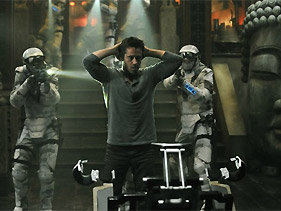
Len Wiseman walks MTV News through the first look at his remake. By Kevin P. Sullivan, with reporting by Kara Warner Colin Farrell in “Total Recall” Photo: Sony Pictures Earlier this week, we saw Colin Farrell realize he may not be the man he thought he was, in the first trailer for “Total Recall.” The first look at the sci-fi remake had a ton of futuristic visuals, badass women and a bleach-blond John Cho, but we wanted a deeper take on what the movie has in store. So MTV News turned to director Len Wiseman for the answers. Wiseman went into the details of the trailer and how it will reflect the finished film, scene-by-scene, and even shared some secrets from the set. The first images from the trailer surprisingly give no sign of the remake’s futuristic setting. Colin Farrell, as Doug Quaid, wakes up next to his wife (Kate Beckinsale) and slowly looks out onto his world. “We actually open up very intimately with Quaid, and then we step out and realize what world he lives in,” Wiseman said. “I wanted to set the stage first for just his relationship and then get a sense of the world and what sort of environment he is in and oppressed by.” Once the plot begins to move forward, Quaid seeks meaning from Rekall, a company than can implant memories. Here, Wiseman saw an opportunity to pay homage to the original film. “Rekall, I wanted to set up some elements that were familiar — a bit of the chair, a bit of what I was excited about when I was a teenager, things that I had kept from that experience,” he said. At the same time, Wiseman wanted to add edgier elements to the familiar setting. “[We] set it up in a much more opium-den, slightly more sketchy version of this whole process,” he said. “I wanted to have a little bit more danger. At its core, it’s screwing with your brain chemistry. That cannot be a widely accepted thing.” The flashiest scene of the trailer comes after the police storm Rekall and attempt to arrest Quaid. In a brutally kinetic single shot, the camera literally flies around the room as Quaid dismantles the police force. Wiseman said he had always wanted to do a scene like that but only just found the opportunity with “Total Recall.” “I needed to have the audience feel what Quaid was feeling. I wanted to set up a moment where you aren’t given a chance to take a breath until it’s over, just like he would.” The setup to capture that shot involved computer-operated cameras moving quickly around the set as Farrell repeatedly performed the fight choreography. “It was a very complicated shoot where Colin had to do the fight 22 times, actually, to get the thing right with all of the cameras,” Wiseman said. “The cameras would move at 35 miles an hour that were on computer systems. It took two days. It was immensely fun, but it is 100 percent practical.” Though the trailer only shows a brief look at it, the fight scene between Beckinsale and Jessica Biel is one Wiseman felt was important to include. “I wanted to give a sense of how strong these female characters are,” he said. “I want it to be the actual payoff of Jessica Biel and Kate Beckinsale going at it; you’re not watching two stunt players that are carrying that name. It’s actually Jessica and Kate just kicking either other’s ass.” The trailer closes with a mind-bending shot of Quaid quickly shuffling through a series of faces in place of his own. Wiseman said he included the scene as a way of communicating the central idea of the movie. “I’ve always been attracted and intrigued by anything that brings into question, ‘Who am I’? It’s such an enticing story to me,” he said. “That line right there is the basis of the movie. That line right there is the core of the movie.” Check out everything we’ve got on “Total Recall.” For breaking news, celebrity columns, humor and more — updated around the clock — visit MTVMoviesBlog.com . Related Videos ‘Total Recall’ Trailer Breakdown
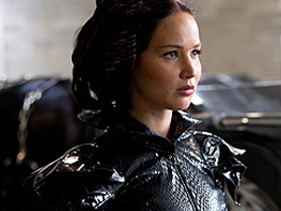
Katniss and company dominated theaters for the second weekend in a row, but box-office experts wonder if they can tackle the mighty ‘Titanic.’ By Kevin P. Sullivan Jennifer Lawrence in “The Hunger Games” Photo: Lionsgate For the second week in a row, “The Hunger Games” laid claim to the box office. This past weekend offered a unique challenge for the reigning champ, however. Two relatively big studio films, “Wrath of the Titans” and “Mirror Mirror,” challenged Katniss Everdeen and the rest of the tributes, but the two competitors could not overcome. “The Hunger Games” collected an estimated $61 million over the weekend, a 60 percent drop from its $152.5 million debut. Despite its enormous opening weekend, “The Hunger Games” managed to maintain the buzz around it heading into the second weekend. Jeff Bock, a box-office analyst with Exhibitor Relations, Inc., said that for how big “The Hunger Games” opened, a steeper drop could have been expected. “Ticket sales dipped 60 percent, but when compared to ‘Harry Potter and the Deathly Hallows, Part 2,’ which dropped 72 percent, that is a great hold,” Bock said. “Especially when you consider how great both films were received. ‘Deathly Hallows, Part 2’ got some of the best reviews of the franchise, and it still had a huge decline in the second weekend.” Part of that lasting success, says Phil Contrino from BoxOffice.com, belongs to the adults, who are interested in seeing the movie but aren’t part of the rabid fanbase. “It’s appealing to adults, and adults don’t feel the need to rush out opening weekend. They’ll take their time discovering it.” Almost as important as what “The Hunger Games” has — like its broad appeal — is what it doesn’t have. “The film has everything: love, mystery, and adventure. One thing it doesn’t have: 3-D,” Bock said. “Proving once again, it is not a necessary distraction for tentpole films.” But can “The Hunger Games” win the weekend competition for a third time in a row? Both Contrino and Box Office Guru’s Gitesh Pandya agree that the fight will be a difficult one. “It’s going to be tough. ‘Titanic’ 3-D and ‘American Reunion’ both look very strong,” Contrino said. Pandya sees James Cameron’s 3-D revamp of “Titanic” as the one that could take down “The Hunger Games.” “This coming weekend, ‘Hunger Games’ will be challenged by the 3-D release of ‘Titanic,’ which can compete with ‘Hunger Games’ for the #1 spot if it can break $30M over the Friday-to-Sunday Easter frame.” How long do you think “The Hunger Games” will stay hot? Leave your comment below! Check out everything we’ve got on “The Hunger Games.” For young Hollywood news, fashion and “Twilight” updates around the clock, visit HollywoodCrush.MTV.com . Related Photos The Hunger Games
We count down our favorite Batman rides, in The Weekly Rising. By Kevin P. Sullivan The Batmobile Photo: AFP/ Getty Images Warner Bros. recently shot a bonus feature from the eventual Blu-ray release of “The Dark Knight Rises” (early, I know!) that featured all five Batmobiles from the movies, starting with Adam West’s Lincoln to Christopher Nolan’s Tumbler. The video makes for a cool stunt, seeing all the vehicles in one place, but it also provides insight into just how different the Batmobiles have been over the years — so much so that it begs the question: Which Batmobile was best? Here is our countdown of the top five Batmobiles from the movies: 5. “Batman and Robin” Joel Schumacher ‘s run as the director of the Batman series brought around the two worst Batmobiles by far. Both cars stand as perfect symbols of everything that was wrong with the director’s take on the Caped Crusader. They are both too over-the-top to actually function as vehicles, in the same way that Schumacher’s Batman simply doesn’t work. But of the two, the painful swirling light of the final Schumacher Batmobile from “Batman and Robin” remains the worst Batmobile of all time. The one-seater looks like an oversized Happy Meal toy, and the convertible design puts the Bat out in the open air where everyone can make fun of him. 4. “Batman Forever” The first Schumacher Batmobile gets a pass simply because it’s not as bad as the one from “Batman and Robin.” The enormous fins remain, but the body doesn’t extend nearly as far out. It also gets the added benefit of a closed cabin, so Batman can hide his shame from behind the privacy of tinted windows. At the very best, the “Batman Forever” Batmobile wins the losers bracket. 3. “Batman: The Movie” The Batmobile that Adam West drove during his stint as Batman on the television series and in the 1966 film is the only one of the Dark Knight’s cars that actually looks like a car. Completed in three weeks, the original Batmobile was made from a modified 1955 Lincoln Futura concept car. West’s Batmobile scores points now for a retro style that can’t be beat and just the right amount of camp. 2. “Batman” and “Batman Returns” Admittedly, this is the ride that inspired the two worst Batmobiles ever, but Tim Burton’s take on the Bat vehicle has a certain charm to it. Burton’s films in the series had a look all their own, but they never quite went over-the-top insane like Schumacher’s, and the same applies to his Batmobile. It had the same long body but had a more refined and battle-ready look to it. As impractical as it probably was, the Burton Batmobile was badass in its own way. 1. “Batman Begins,” “The Dark Knight” and “The Dark Knight Rises” Is there really any other choice? The Tumbler not only fits the realistic take on the series, but it also could eviscerate any and all other Batmobiles. Did I mention that his has a motorcycle hidden inside the front of it? How about the newly added flight feature? It may have been meant originally for building bridges, but all the Tumbler ended up doing was being the toughest ride the streets of Gotham has ever seen. It’s only fitting that the greatest iteration of Batman gets the all-around best version of his car. Which is your favorite Batmobile? Let me know on Twitter via @KPSull! Check out everything we’ve got on “The Dark Knight Rises.” For breaking news and previews of the latest comic book movies — updated around the clock — visit SplashPage.MTV.com . Related Photos ‘Dark Knight Rises’ Trailer: 5 Key Scenes
Film had the seventh-highest second weekend ever, beating out ‘Wrath of the Titans’ and ‘Mirror Mirror.’ By Ryan J. Downey Jennifer Lawrence in “Hunger Games” Photo: Lionsgate
‘The atmosphere I grew up in was 100 percent church,’ singer says in new promo for the film. By Jocelyn Vena Katy Perry Photo: Robyn Beck/ AFP/ Getty Images Since first announcing she’d be starring in her own 3-D concert movie, “Katy Perry: Part of Me,” Katy Perry has kept fans in the loop about the film. In keeping with that routine, she’s just revealed the release date for the summer flick. “My concert documentary is coming out Fourth of July weekend. Go and see it and be a firework!” she told E! News at the Kids’ Choice Awards . The film was directed by Magical Elves Dan Cutforth and Jane Lipsitz, who also served as producers on Justin Bieber’s highly successful “Never Say Never” concert movie. “The atmosphere I grew up in was 100 percent church. I started singing and I never really had another plan,” she said in a TV spot that began airing over the weekend, which is also full of vintage, behind-the-scenes footage of the singer. After kicking it old-school, a montage of her music videos leads up to colorful concert footage of the singer from her California Dreams Tour. “If you have a dream, you have to go on a journey to fulfill that dream,” she says in the clip. The tease closes out with Perry dressed up as her “T.G.I.F.” alter ego, Kathy Beth Terry. “This film, you’re going to see it from my best friend/ buddy perspective, you’re going to see exactly what I mean and feel and think about everything,” Perry recently told MTV News . “Listen, I’ve [worked on] most of this film for a very long time and the word ‘cheap’ was not in the vocabulary,” she said. “But, hello, it’s 3-D. You’re going to get hit with a lot of sh–.” To add to the excitement for the movie, Robert Pattinson and Kristen Stewart were recently spotted shooting something that will appear in the film. “That tour was so life-changing to me. I learned so much, I went through so much along the way,” Perry said. “I’m not necessarily trying to prove anything to anyone, but not only will people really hands-down know me after they see this film, but you’ll see me as the Dorothy wearing the red ruby slipper, and at the end of it all I’m the [Wizard of] Oz as well.” Related Videos MTV First: Katy Perry’s ‘Part Of Me’ Related Artists Katy Perry
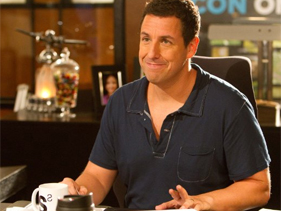
Comedian’s reviled drag comedy won a record 10 Razzies. By Gil Kaufman Adam Sandler in “Jack and Jill” Photo: Sony Pictures Adam Sandler is the worst. That’s not a personal opinion, it’s just a fact based on his across-the-board sweep at the 32nd Annual Golden Raspberry Awards on Sunday night. The comedy star, who is already a Razzies regular, set a new high in lows at the event, when his critically bashed drag comedy, “Jack and Jill” , became the first movie to ever win every single trophy handed out at the annual Oscars spoof honoring the movie industry’s least laudable work. The film, in which Sandler plays a brother and sister pair of twins, was already a record-setter before the night began thanks to an unprecedented 11 nominations. Among the “wins” for Sandler: Worst Picture, Worst Actor (for Sandler’s work in “Jack & Jill” and “Just Go With It”), Worst Actress (as “Jill”), Worst Supporting Actor (for Al Pacino’s cameo as himself), Worst Supporting Actress (for pal David Spade as “Monica”), Worst Screen Ensemble (for the entire cast), Worst Director (Dennis Dugan for “Jack and Jill” and “Just Go With It”), Worst Remake, Rip-off or Sequel (“Jack and Jill” for ripping off Ed Woods’ camp classic “Glen or Glenda”), Worst Screen Couple (Sandler and Katie Holmes, Sandler and Al Pacino or Sandler with himself) and Worst Screenplay. The movie, which was disliked by 97 percent of the critics at the Rotten Tomatoes website, set the Razzies record thanks to the love and adoration of the 657 voting members of the Golden Raspberry Award Foundation. The previous record holder for the most Razzies was 2007’s “I Know Who Killed Me,” for which Lindsay Lohan took home two dis-honors for her role as twins.
Critics agree the Snow White adaptation is ‘not the fairest of them all.’ By Fallon Prinzivalli Lily Collins in “Mirror, Mirror” Photo: Relativity Media Before it even hit the box office, “Mirror Mirror” was viewed with a critical eye as two Snow White adaptations had announced their release dates a month apart. But with the release of the trailers, it was clear that the two movies were very different. The Tarsem Singh film is a quirky comedy from the vantage point of the Evil Queen ( Julia Roberts ) over the traditional Snow White ( Lily Collins ), while “Snow White and the Huntsman” is about the epic battle Snow White ( Kristen Stewart ) must fight for her life. Unfortunately for those involved in the former, as the reviews pour in, it’s obvious the movie is making critics grumpy. The Story ” ‘Mirror Mirror’ begins with an impressively animated recap of Snow White’s predicament: Banished to her castle by a wicked stepmother after her father the king disappears, and being played by such a vacantly pretty ingenue as Lily Collins. Collins conveys a properly Audrey Hepburn princess look and the acting range of a runway model. The damsel’s role is always distressed. The queen has run the kingdom into the ground, funding a lavish lifestyle with escalating taxes. After sneaking out for a tour of the squalor, Snow sides with the other 99 percent. Their relationship is further strained with the arrival of handsome Prince Alcott.” — Steve Persall, Tampa Bay Times The Laughs ” ‘Mirror Mirror’ is unfair to people expecting more than a few good laughs. Scenes proceed lethargically, with pauses after punch lines where Tarsem must hope for audience laughter. Anachronistic gags (as when the Prince tells Snow White that he has to be the hero because ‘it’s been focus-grouped — it works’) break whatever luscious spell the art direction and costumery might create. On their first meeting in the woods, the Prince tells the dwarfs, ‘You’re short, and it’s funny.’ Well, the film is shortish (106 mins.) but it’s also epically unfunny. The producers should have handed the script to an actual clever person like Paul Rudnick (‘In & Out,’ ‘Jeffrey’) and told him to send it back in a week, with solid jokes and a buoyant spirit.” — Richard Corliss, Time Julia Roberts “Roberts has had exactly one high point (‘Duplicity’) since winning her Oscar in 2000, and she acts here as if simply appearing in a floofy dress is high hilarity. Her ‘playfulness’ seems like work and her cartoony maliciousness is dull. (Charlize Theron, who plays the queen in this summer’s more serious ‘Snow White and the Huntsman,’ needn’t fret.)” — Joe Neumaier, New York Daily News The Visuals “Singh, whose eye-popping tribute to the Silent Era, ‘The Fall,’ was several years ahead of ‘The Artist’/’Hugo’ curve, never lets his attention waver from the production design — those beautiful, snowy, birch tree forests; the parapets; cliffs; and opulent palace digs. He lets his stars deliver their lines — some with more flourish and wit than others (among the dwarfs, Jordan Prentice and Danny Woodburn get off the best) — but his eye is mostly on the gilt and the silk, the CG-ed skies, and the eerie, iced-over lake that separates the castle from the town.” — Steven Rea, Philadelphia Inquirer The Final Word “The whole thing lacks tonal cohesion, lurching from Tim Burton-style comic grotesquerie to underpowered action set pieces to a gratuitously self-referential Bollywood production number on the end credits. The impression is that of a director constantly fighting to put his stamp on material that’s foreign to him, and unable to figure out what that stamp should be.” — David Rooney, The Hollywood Reporter “Not the fairest of them all.” — Matt Stevens, E! Online Check out everything we’ve got on “Mirror Mirror.” For breaking news, celebrity columns, humor and more — updated around the clock — visit MTVMoviesBlog.com . Related Videos MTV Rough Cut: ‘Mirror Mirror’
‘American Idol’ alum talks to Entertainment Weekly about working with the late legend on their upcoming movie ‘Sparkle.’ By Kara Warner Whitney Houston Photo: 20th Century Fox/Getty Images Many people will remember exactly where they were and what they were doing when they heard the news of Whitney Houston’s untimely death in February. And while everyone’s experience was memorable in some way, the story of Houston’s “Sparkle” co-star Jordin Sparks hearing the news is especially poignant. The season-six “American Idol” winner was in a L.A. hotel room getting ready to meet Houston at the Beverly Hilton and attend Clive Davis’ annual pre-Grammy bash when her publicist knocked on her door. “She said, ‘Whitney’s gone,’ ” Sparks told Entertainment Weekly. “I said, ‘What do you mean? She’s not going to the party?’ She said, ‘No, she passed.’ It was like a movie when you see somebody and they’re just shocked and can’t move. I literally couldn’t say anything. I couldn’t feel anything. It was a complete shock. I was just holed up in my hotel room for a few days after that. “I didn’t know her for very long, but it was an intense two months: 12 hours every day spending time with somebody,” Sparks recalled. “It was amazing to walk into work and then Whitney is sitting in her chair blasting gospel music and singing. I’m thinking to myself, ‘People would give their right arm to just hear some of this. And it’s happening every day.’ She was really, really great.” “Sparkle” is a remake of the 1976 Irene Cara film about three talented young musicians who struggle with addiction. The new version features the 2007 “American Idol” winner as the titular character Sparkle and Houston, who also served as executive producer after acquiring the rights to the film more than a decade ago, as her mother, Emma. “It was definitely her baby,” Sparks said of Houston’s attachment to the project. “You could see the pride on her face when we wrapped. She was so excited that this was finally happening. Even before she passed I wanted to be able to represent this movie in a way that would honor her and respect her, because she worked so hard on it. With her passing, it’s definitely been a lot more pressure. We’ll see how it goes. I’m sure there will be interviews where it will hit me and I might get emotional, and there’s going to be other interviews where I reminisce about how happy and excited she was. I’m really proud of the film. I can’t wait for people to see it.” “Sparkle” is scheduled to be released by Sony on August 17. Check out everything we’ve got on “Sparkle.” For breaking news, celebrity columns, humor and more — updated around the clock — visit MTVMoviesBlog.com . Related Photos Whitney Houston: A Life In Photos Related Artists Whitney Houston Jordin Sparks
The new trailer for People Like Us (nee Welcome to People ) is here, featuring Chris Pine and Elizabeth Banks as siblings who meet only after their father dies. The inheritance/estrangement/salvation plot (and a vaguely incestuous vibe that the trailer mostly counteracts with a few key shots of Olivia Wilde as Pine’s wife) thickens around the family, with Michelle Pfeiffer dropping in as Pine’s mother, which is just as bizarre as I expected it would be . Overall, though? Screenwriter Alex Kurtzman’s directorial debut looks all right! If nothing else, at least the title is an improvement. [via Moviefone ] People Like Us – Trailer No. 1 Follow S.T. VanAirsdale on Twitter . Follow Movieline on Twitter .
After years of foisting dashed-off 3-D — and its inflated ticket prices — on movie audiences, studios may have found their most reliable ally yet in shoring up box office: IMAX. And not just the punch and potential of the brand’s own 3-D, either, but good old conventional 2-D as well. Call it the IMAX Old Wave. Led by last weekend’s $155 million Hunger Games windfall — $10.6 million of which came from the giant-screen format — more and more evidence suggests that audiences are both showing a preference for IMAX and happily forgoing often-reviled 3-D visuals. Just as important, and perhaps far more telling, blockbuster directors like Christopher Nolan and Brad Bird are making influential use of IMAX technology to augment their creativity. Those results have been roundly embraced by critics and crowds, all while 3-D continues generating negative feedback and diminishing returns. Are the studios finally ready to follow filmmakers around the corner? Maybe, if cinematographer Robert Elswit’s recent experience is any indication. “3-D was never a choice for us, so the matter never really came up,” said Elswit, the Academy Award winner who served as Bird’s director of photography on last year’s IMAX-intensive Mission: Impossible – Ghost Protocol . “As for the IMAX decision, Brad certainly decided to go that route, but he was basically unproven as an action director. Having somebody as influential as Tom Cruise supporting the idea meant it was more likely to happen. Once he was completely in agreement that IMAX would benefit the film as a result the studio never fought it – Tom really influenced them to agree on spending the money, and ultimately it was not such a major expense, budget-wise.” The move underscores both the creative and commercial advantages in turning away from the muddy visuals of the ongoing 3-D “renaissance” in favor of the optimal experience of regular, two-dimensional IMAX viewing. The company itself has recognized this, delivering increasingly fan-friendly franchise titles (many of course, like Harry Potter and the Deathly Hallows – Part 2 and Transformers: Dark of the Moon , still in its proprietary IMAX 3D) while aggressively expanding to nearly 600 screens in 48 countries. Currently the company is well into a project that will add 15 new venues into China. Meanwhile, as Hollywood rebounds from last year’s dismal box office, IMAX has actually outpaced that success. Even before Hunger Games landed the third biggest opening weekend of all time, Hollywood had seen a 20 percent increase in year-to-date grosses over the same time frame in 2011. During this same time IMAX has enjoyed a 45 percent surge over last year’s numbers. Even the bomb John Carter boasted a healthy 17 percent of its meager opening from IMAX theaters. IMAX has such a busy slate this year that despite clearing 270 screens for Hunger Games ‘ debut in North America (and an additional 19 venues in the U.K. and France), it has to edge out the blockbuster after a week to accommodate its commitment to today’s Wrath of the Titans. This is not a fluke. The Canadian juggernaut has cultivated a following among viewers and filmmakers alike for four decades, with the more of the latter gravitating towards the 65mm format in recent years. Nolan, a longtime proponent of the technology, was instrumental in ushering in the IMAX Old Wave with his 2008 megahit The Dark Knight , while Bird and Elswit followed suit in 2011 with Ghost Protocol . “Brad wanted to use IMAX right from the start, and that was mainly due to Chris Nolan’s success in using it for sequences in his Dark Knight film,” Elswit told me. “We decided that we wanted to use IMAX cameras to shoot four or five of the action sequences” — most famous being the thrilling Burj Khalifa scenes , featuring Tom Cruise actually scaling and bounding around the top of the world’s tallest building. “Initially the plan was to construct a massive set replicating the tower and then digitally inserting the ground shot behind what we filmed,” Elswit explained. “Tom, however insisted that he actually go outside the actual location, and that enabled us to take IMAX cameras to the tower and film him scaling the building. That meant we were able to deliver those shots that could cause vertigo when watching in an IMAX theater.” The global reach of IMAX also provided an unforeseen benefit to their location shoot. “As it turns out Dubai has an IMAX theater,” Elswit said. “So we were able to go there and actually view our dailies in IMAX.” Then, in another unique move, Paramount debuted Ghost Protocol exclusively on 300 IMAX screens five days prior to its wide opening. From the shoot to the release strategy, the format conferred an event status that helped nab the film $45 million in IMAX grosses alone and represented the first wave in a nearly $700 million global phenomenon. Asked to elaborate on the specific cost differences of producing 3-D versus standard IMAX, Elswit demurred. But the implication was clear for the filmmakers weighing both formats: On the whole, IMAX wields the bigger bang for one’s buck. “When it comes to altering a print for 3-D in post, that is not so expensive,” he said. “But if you were to properly shoot in either format, I don’t really see a major difference in the cost. In fact, when it comes to shooting an action sequence — because that is the kind of scene where you would be more likely to use IMAX effectively — you would need to use at least three cameras, in order to film it properly and get the images you want. In that case shooting in 3-D becomes more expensive because there is so much more time needed to properly stage your cameras to get the shots properly filmed.” Proponents of 3-D — even those inside IMAX’s front office — face other challenges and red flags regarding the format’s long-term viability. As a side-by-side comparison of established auteurs embracing technology, we can look back to Martin Scorsese’s reported $170 million family film Hugo : While lauded by critics and winning multiple Oscars — including Robert Richardson’s eye-popping 3-D cinematography — the film grossed only $73 million domestically and barely broke even once foreign markets are taken into account. Other telling statistics came with the hit film The Lorax , whose hefty $70 million opening far exceeded expectations. Industry investment analyst Richard Greenfield found that while 3-D screens represented a nearly two-to-one majority of The Lorax ‘s theater count, the grosses expose a nearly even split between 2-D and 3-D. The per-screen average shows that more money was made in conventional screenings, a stunning figure once you factor in the inflated 3-D ticket prices. That breakdown means that while 60 percent of the screenings were displayed in 3-D, 60 percent of the audience watched in 2-D. Greenfield also noted the underperformance of Harry Potter and Deathly Hallows – Part 2 on IMAX 3D — a figure amounting to only 9 percent of its record-breaking $169 million opening gross — further arguing that if viewers had had more 2-D options, the 3-D share would have been even lower. Meanwhile, Hunger Games director Gary Ross — who has proclaimed his “love” for 3-D yet distanced the burgeoning franchise from the format (“I think that if we shoot this movie in 3-D, we become the Capitol,” he told one interviewer . “We start making spectacle out of something that I don’t think is really appropriate here”) — has already dictated that his sequel, Catching Fire , will likewise be projected in the traditional format. And those movies’ promise notwithstanding, IMAX CEO Richard Gelfond isn’t taking his company’s growth — in any dimension — for granted. “For us, one weekend and one film does not make a year,” he cautioned this week . “And that’s one thing you’ve really got to be clear [about] with investors and analysts.” Nevertheless, if artists’ preferences continue to mirror their audiences’ tastes, the combination may yield an inescapable influence on Hollywood’s decision makers. And once sizable, steady profits can be found on the 2-D side of the ledger, studios and IMAX won’t have any choice but to listen as the money does the talking. Brad Slager has written about movies and entertainment for Film Threat, Mediaite, and is a columnist at CHUD.com . His less insightful impressions on entertainment can be found on Twitter .