Tag Archives: movie

‘Kids Are Going to Come See This Film’: A Chat With Bully Director Lee Hirsch

How do you come to the rescue of the millions of children who need someone — anyone — to do what they can’t: get their bullies off their backs? Director Lee Hirsch has sounded a call to action with his new documentary Bully , which exposes bullying from the front lines. Opening today, the film follows several kids and families struggling to stop the taunting and violence. Hirsch captures the frustration and helplessness among not only the victims but also their parents, who have lost trust in our modern school system. There’s Alex, 12, who seems convinced his bullies are his friends; Ja’Meya, 14, locked up after brandishing a gun on the bus where she faced her tormenters; and Kelby, 16, whose whole family retreated into isolation after she came out as a lesbian. Also profiled are the families of a teenager, Tyler, and an 11-year-old, Ty, whose bullying-related suicides devastated their communities and served as a wake-up call. If the film is taken to heart, it should be among the catalysts for changing the “kids will be kids” mentality among some educators and other authority figures. On a micro level, parents who participated in the film are speaking out in their communities and persuading kids to protect one another. Hirsch is working on getting his movie into schools, where it can have more influence. After a whiplash-inducing saga over its MPAA rating, initially an R for strong language, Bully will be released unrated in New York and Los Angeles before expanding to other cities on April 13. Hirsch spoke to Movieline about the movement that has grown out of his project, the newly famous Bully kids, and whether minors will go to the theater to see the film. When were you made aware of the rampant bullying going on in schools these days, and what led to your decision to make a documentary about it? The drive to make the documentary film is that I was bullied as a kid, so it’s very much a piece of my narrative. You know it’s bad, and I had talked about it over the years with people and sort of sensed that it’s a problem greater than my own. I didn’t really understand until we saw the extent to which people were affected by this, to the millionth. It’s funny you ask that because I feel like I dish out these statistics as if I’ve know them forever, but actually there was a process of discovering how big this really was. Then you start doing the math and thinking, if 13 million kids get bullied a year, and you start adding that up from generation to generation, there’s a lot of folks that have this narrative, that have a story, when it comes to bullying. So all those things came together when we started getting into it. Now it’s been three years that I’ve been working on this. It’s interesting you asked me that, I hadn’t thought about that. Did you have any problem getting kids or parents to participate in the film? No, not at all. We shot so many more stories than we were able to include in the final version of the film. We had people reaching out to us. We reached out to a lot of families. It was so different, because we filmed kids like Kelby, where they were outwardly looking for somebody to hear their story and share their outrage, and then Alex, who we very much stumbled upon while being allowed to film inside this school and see how adults and folks were handling certain situations. I wasn’t surprised by the willingness of people, because I remember that feeling of wishing someone would listen to me. I thought it was really brave of Ty’s friend to admit that he’d been a bully at one time. I wondered if you considered putting more kids in the film who shared that side of the story. I had. I think ultimately the narrative of this film is it tells the story of families that are on the victim side, and so you just settle into a world where you’re seeing what they see, as they see it and they deal with it. Ultimately it became less about, “what are the arguments on this side and that side, and what’s this position and that position,” or a full, drawn-out exploration of the psychology of bullying, but rather it became about telling five stories. We didn’t even know how many stories we were going to tell as we shot it. We were just looking to tell stories that allowed you to walk in the shoes of the kids and families who were dealing with this. Now that the Weinstein Company is releasing the film unrated, how do you imagine kids seeing the movie? Do you think they’ll be going to the theater or seeing it in school? We still have school districts reaching out to us every day. We’re in discussions for how to facilitate that. We have a goal of a million kids seeing the film. On their own and with groups. Within their schools and with organizations. Engaging on our website, bullyproject.com , and participating in the movement. We want to have real engagement. That’s the goal now. I think we want to be able to support viewers after they see the film with how they can be involved, how to make a difference. How to do anything from stand up and how to make that meaningful and supportive, to how parents navigate the school system when they’re advocating on behalf of their kids. I think that’s a long-winded answer to say that yes, I really do think that kids are going to come see this film. I think we owe a lot of that to Katy Butler for inspiring hundreds of thousands of teens to sign this petition , and it’s also thanks to so many of the celebrities who have spoken out for the film. It’s exciting. You’re talking to me the day before it opens. I can’t wait to see what happens. Have you seen any positive changes in schools since you started the project? In Alex’s school? In any school, or in any aspect of it, actually. Have you seen anything positive happen as a result of just making the film and building the website? I feel like, how do you measure half a million signatures and people sharing their stories? I think that’s impact. How do you measure the thousands of people that have written on our wall? People are supporting each other and writing to each other and building a community that feels like it’s turning into a movement. I feel that the film has already had impact in ways that I couldn’t have dreamed. I think that already the conversations are rich and deep that people are having about bullying at their schools, about what the climate and culture are like in their community. I think that those conversations are happening, and that’s change, that’s transformation. It’s very exciting. Do you have any plans to do follow-ups with the kids from your film? I don’t have time to do a follow-up film of any kind, but I am in touch with all of the families on a regular basis. Certainly Alex and his family, in particular, and we see them all the time, with Kelby and her family. They come to screenings. They’re doing press. Alex went and argued before the MPAA with Harvey Weinstein. These families are like my second family now. They mean the world to me, and it’s been awesome to get to spend a year with them. Other people are putting cameras in front of them, but it’s not me. I wonder if years down the road we’ll hear from them. I think there would always be an interest in hearing how they’re doing. The families are going to have to make a decision about whether they want this press to continue. For them, boy, this was unexpected, right? I had a sense that maybe we would do some press. It’s been extraordinary for me. I couldn’t have seen this, but for them, it’s been a confusing and extraordinary ride. We just give them as much support as we humanly can. I’ll always be in their lives, and I feel that in my film work I always develop strong bonds with the people that end up in my films, my subjects. It always matters that they see the film and that they’re part of the process and that that relationship stays strong. That comes through in the film. I’m so proud of them — in particular, because I see them so often, Kelby and Alex — because they’ve become advocates. People are writing me and saying, “Can you please send this to Alex? He’s my hero.” It’s incredible. It’s harder for the families that have lost kids. That’s … I … I think about them a lot because they have suffered such an ultimate loss. And they’ve embarked on a new path of advocating for kids and inspiring kids. They’ve been incredible advocates. I’ve seen that a lot with families of kids who have committed suicide that’s been linked to bullying. Can you imagine that sense of injustice that they feel? No. No, you can’t. I can’t either. They’re so engaged, and they’re such powerful advocates. I see many of these families doing such powerful work out in the world. Bully opens today in New York and Los Angeles, with additional cities to come on April 13. Read Stephanie Zacharek’s review here . [Photo: Getty Images]

See the original post here:
‘Kids Are Going to Come See This Film’: A Chat With Bully Director Lee Hirsch
Jason Reitman and The Big Lebowski at LACMA: Seth Rogen’s Dude Abides

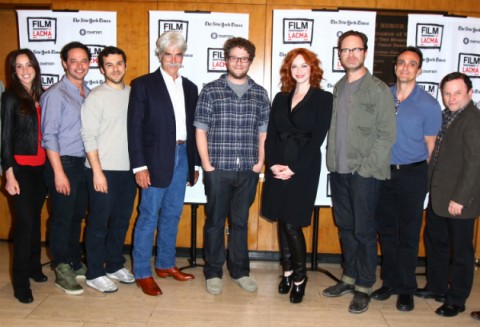
To close out his popular live-reading program at LACMA Thursday night Jason Reitman selected a film that seemed to tie the series and the room together: The Coen brothers’ 1998 noir-comedy opus The Big Lebowski . In the hot seat filling Jeff Bridges’ slippers as The Dude sat Seth Rogen , whose own slacker charm proved oddly suitable, with folks like Hank Azaria (as Donny), Rainn Wilson (as Walter) and Christina Hendricks (as Maude) alongside him re-enacting one of the most quotable films of the past two decades. The cherry on top? Playing the role of The Stranger originated by Sam Elliott and written explicitly for an actor like Sam Elliott, perhaps… was none other than Sam Elliott. Also onboard for the final night of the series’s first run? (According to Reitman, the live-reads will resume again in October – blame the gap on his “day job.”) Jason Alexander as Jeffrey Lebowski; Fred Savage replacing Patton Oswalt at the last minute as the Big Lebowski’s assistant, Brandt; Nick Kroll as Jesus ; and Reitman’s sister, actress Catherine, as Bunny. And of course all the while there was Reitman himself, reading along all the stage directions and fantastically detailed scene descriptions, including both of the film’s trippy dream sequences. (But, strangely enough, not Jackie Treehorn’s mysterious moment of artistic inspiration, scribbled on a notepad, which was conspicuously skipped over.) Elliott’s surprise appearance was the special casting move of the night, a fitting gesture following Reitman’s previous strokes of genius which included tapping original director Rob Reiner to narrate the excellent Princess Bride live-read and re-envisioning Quentin Tarantino’s Reservoir Dogs with an all-black cast. With his first line Elliott drew applause (and subsequently flubbed a few words, saying his eyesight wasn’t what it used to be) but whenever he came back around to deliver another deep, mellifluous nugget of wisdom – the film’s narrator, sitting right there, narrating The Dude’s story right to the audience! — the theater was rapt. Elliott’s vision may have gotten worse over the years, but his sarsaparilla-soaked cowboy flair is as rich and twangy as ever. Besides, this was a “Los Angeleez” story being retold in L.A., right down the street from a Ralphs to boot. How could Reitman not invite the man who so specifically inspired a character that his name was used in the script to describe the role?? In many ways, Elliott had it the easiest; the rest of the cast, through no fault of their own, battled the specter of their onscreen counterparts the whole night – a testament to the indelible performances Bridges, John Goodman, Steve Buscemi, John Turturro, David Huddleston, Ben Gazzara, Julianne Moore and Co. gave in the Coens’ film. Rainn Wilson’s Walter Sobchak was at times uproarious, especially when he, Rogen, and Azaria cross-talked like a well-rehearsed comedy trio. But his Walter was perhaps the most conspicuous example of the film’s performances overshadowing the live-read’s; no matter how well Wilson nailed Walter’s aggro-cluelessness, comparisons to Goodman’s unforgettable work kept creeping into my brain, and it was no contest. Advantage: Goodman. In fairness to Wilson and his cohorts, the live-read can be an extremely limiting setting for an actor. Performance here is primarily aural rather than physical, and one has to establish as best one can, within seconds of spoken dialogue, the kind of character nuance that is otherwise built through months of preparation and rehearsal. Instead of costuming and sets, you’re chair-bound on a stage staring at pages. This can work well with the right script – say, one reliant on dialogue or especially well-suited to alternate forms of storytelling, like, say, a movie about storytelling – but tackling a well-known and beloved film like Lebowski adds the additional challenge of having to compete, in the hearts and minds of your audience, with the cinematic specter of the movie they already know and love. Also suffering from inescapable comparisons to the film: Hendricks’ perfectly good Maude, still much flatter and straighter than Moore’s wonderfully condescending version; Alexander’s Big Lebowski, highly entertaining in his pomposity but naggingly reminiscent of George Costanza; and Rogen’s Dude, effective for the most part in a highly entertaining Rogenesque way but still lacking the subtle variations that made Bridges’ turn so iconic. On the other hand, colorful vocal performances from a few supporting players provided much-needed jolts of creative energy, including voice-over pro Azaria’s multitude of distinct voices (including an off-the-cuff Bush impersonation dropped into the opening supermarket scene as Reitman realized he hadn’t assigned the line to anyone beforehand) and Kroll’s Tony Montana-like Jesus and other assorted delightful side characters. But the biggest discovery of the night, aside from the fact that Reitman’s sister is herself quite talented at accents, was Savage, of all people. The former Wonder Years child thesp-turned-director had done a spunky version of himself months ago at The Princess Bride , but he earned some of the biggest laughs playing Jackie Treehorn’s thug, the third Nihilist, and, most impressively, doing an uncanny Philip Seymour Hoffman impression as Brandt. I’m glad to hear that the live-read series will continue in October, because that gives Reitman time to choose his next selections and cast wisely. One flaw in his group casting Thursday night was the relative similarity in vocal range of many of his actors; variety of tone and register should help differentiate one voice from the next, giving the audience more to paint the imagination with. Viewer familiarity can be both a blessing and a curse; oftentimes during the Lebowski read it felt as if the room was just waiting to hop from one iconic line to the next, laughing along more out of recognition than from the discovery of new and unexpected nuance in the way, say, our hero wakes up to find his rug missing, or struggles to spit out the simplest of platitudes. And while live-read regulars like Kroll (not to mention Mindy Kaling and Oswalt) have absolutely killed, I’d encourage Reitman to think more and further outside the box as he plans his next run. A friend suggested gender-switching as a potential way to keep the energy of these sold-out shows going while daring to push the envelope – why else stage a live-reading, except to explore “what might have been” (i.e. Tom Selleck as Indiana Jones, Christopher Walken as Han Solo) and “what will probably never be?” I’m still convinced that the live-read concept may never turn out as magically as it did with The Princess Bride , a quotable classic built on unforgettable film performances and a fantastic script that nonetheless lent itself well to re-imagination. Following along those lines, with a varied and vocally interesting cast in place, what films should Reitman consider next? Here are my suggestions, off the top of my head: Pulp Fiction , The NeverEnding Story , The Goonies , Annie Hall , Casablanca , Fight Club . But, you know. That’s just, like, my opinion, man. Follow Jen Yamato on Twitter . Follow Movieline on Twitter .

Read the rest here:
Jason Reitman and The Big Lebowski at LACMA: Seth Rogen’s Dude Abides

‘Anchorman 2’: The Legend Of Ron Burgundy’s Return

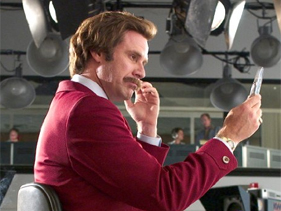
MTV News brings you a timeline of all the obstacles that once stood in the way of the now-greenlit sequel. By Fallon Prinzivalli Will Ferrell in “Anchorman: The Legend of Ron Burgundy” Photo: DreamWorks Pictures Movie fans were overjoyed by Will Ferrell ‘s announcement Wednesday night that “Anchorman 2″ is finally happening . The long journey since the release of the first film left us doubting whether a sequel would ever happen. With our doubts cast aside and our excitement on the rise, we’ve compiled a timeline of all the obstacles the team overcame to arrive at the ultimate destination. August 14, 2008 : Paul Rudd tells us he thinks ” Anchorman ” director Adam McKay and actor Will Ferrell were interested in doing a sequel. “Last I heard they were starting to write [‘Anchorman 2’],” Rudd says. The setting? Possibly the ’80s or the moon . May 27, 2009 : Ferrell tells Aussie radio DJs Jono & Dana that he’ll be meeting with the “Anchorman” creators to “figure out when and how” to get a sequel in the works. August 28, 2009 : In an interview with Empire magazine, “Anchorman” producer Judd Apatow suggests that in “Anchorman 2,” Ron Burgundy, Brick Tamland and Brian Fantana will return as elderly men. “Those anchormen sometimes have their jobs until they’re 75 years old,” Apatow says. September 1, 2009 : Director McKay says that, due to the cast and crew’s busy schedules, the sequel won’t be available for another two years . He adds, “But we are definitely doing it.” Whew. April 6, 2010 : Steve Carell confirms to our very own Josh Horowitz that the “Anchorman” cast “want[s] to do another one,” but there is no script. “I don’t think they’ve [even] decided on a story line yet,” Carell says. April 8, 2010 : On the red carpet for his movie “Date Night,” Carell lies about everything. He says “Anchorman 2” has already been shot in “just two days” while the cast was drunk. When asked if it was any good he says, “It’s fantastic!” Honestly, with the talent in these comedians, we wouldn’t be surprised if it was. April 27, 2010 : Adam McKay reveals that, aside from the actor’s schedules, another holdup in the sequel is payment . Since the cast went on to become even more famous after the first movie, “Everybody’s prices went up.” Graciously, the cast agreed to take a pay cut, which is almost unheard of in Hollywood. April 29, 2010 : McKay dashes all our hopes and dreams in a single tweet : “So bummed. Paramount basically passed on Anchorman 2. Even after we cut our budget down. We tried.” May 3, 2010 : Hope is restored! As it turns out, Paramount is eager to film the sequel. Deadline reports, however, the “Anchorman” team is forced to regroup as they have a budget gap of $30 million to overcome. June 6, 2010 : With financial issues in the way, Paul Rudd jokes that if “Anchorman 2” doesn’t happen, “We’ll look to do ‘Anchorman 3.’ ” July 19, 2010 : Yet again, it seems as if “Anchorman 2” is never going to happen. The saddest part? Neither is the proposed “Anchorman” musical . A few days later, Christina Applegate says she feels let down by the news. May 2, 2011 : All hope is officially lost when Ferrell tells Collider that the sequel “is a brick wall right now” and they’re “playing around with the idea” of a “Step Brothers” sequel instead. And suddenly… March 28, 2012 : Ferrell announces on “Conan” that “Anchorman 2” is officially happening with the original director, Adam McKay, and most of the principal castmembers, including Steve Carell and Paul Rudd. The stars have aligned. It’s finally happening. Cue celebration! Check out everything we’ve got on “Anchorman: The Legend of Ron Burgundy.” For breaking news, celebrity columns, humor and more — updated around the clock — visit MTVMoviesBlog.com .

See the original post here:
‘Anchorman 2’: The Legend Of Ron Burgundy’s Return

Titanic ‘Still Sinks’ In 3-D, James Cameron Confirms

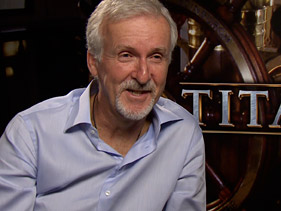
‘Jack still dies,’ director says of the 3-D re-release which he says ‘reinvents’ the 1997 flick. By Kevin P. Sullivan James Cameron Photo: MTV News When “Titanic” hits the big screen again on April 4, the ship will be changing course and heading directly into the audience. Director James Cameron has been one of 3-D’s biggest proponents for years now and has suggested in the past that any film is open for a three-dimensional makeover. It only makes sense, then, that he put his money where his mouth is and converted his own “Titanic.” Cameron spoke with MTV UK about the process and why the real reward of the re-release is the chance to see his blockbuster on the silver screen again after 15 years. The director insisted that the movie remains as it was back in 1997, except for the added dimension. “It ends the same way. The ship still sinks. Jack still dies. Oops, I hope I didn’t spoil it,” he said. As Cameron has said before, he believes that the 3-D element of the re-release plays a supporting role. He simply wants people to see “Titanic” as it was meant to be seen: in a theater. “I think the first thing you should think of, the most important thing, is that you’re going to see it in a movie theater, which is really fundamentally different for anyone who is under a certain age. It hasn’t been in a theater for 15 years, so people know it from video. But they haven’t taken that ride where you commit to the three hours, and you’re going to go on that emotional rollercoaster, and you’re going to come out of the end of the movie in a certain mental, emotional state. It’s very different.” That isn’t the say that the 3-D doesn’t add anything. Cameron sees the conversion as a way to reinterpret the experience. “The 3-D is a kind of way of doing that, a way of reinventing the film, and the 3-D does add something to the experience that was never there before, an immediacy, even an intimacy, which is interesting.” Luckily for Cameron, he had originally shot “Titanic” in a way that was conducive to a 3-D conversion. “Even though I wasn’t shooting it as a 3-D movie 15 years ago, my particular style is to use wider lenses and to wrap the actors in the scenery,” Cameron said. “Because the ship — I don’t like to use the term that it was a character — but the environment was constantly informing what was happening, the elegance, the beauty of the ship, the gilt-edged luxury juxtaposed with steerage third class. All those themes are really manifested in the physicality of the ship. The style of seeing all of that when you convert it to 3-D, it just has this lucidity. You just feel like you’re there.” Are you planning on seeing the 3-D re-release of “Titanic”? Leave your comment below! Check out everything we’ve got on “Titanic.” For breaking news, celebrity columns, humor and more — updated around the clock — visit MTVMoviesBlog.com .

Original post:
Titanic ‘Still Sinks’ In 3-D, James Cameron Confirms

REVIEW: Mirror Mirror Dazzles with Color, Wit and Just the Right Amount of Wickedness

There’s plenty of spectacle in movies these days; it’s delight that’s in short supply, and Tarsem Singh ’s Mirror Mirror offers plenty of it, shimmering like a school of minnows in a reflective pond. The picture is gorgeous to look at: There are fairytale castles topped with minarets of fluted gold, interior marble archways that look as if they might have been carved by Alfonse Mucha, ball gowns that take their inspiration from the rock-star effrontery of peacock feathers. But the story is a delight, too, a modernized — but not too modernized — retelling of the Brothers’ Grimm Snow White peopled with actors who polish the material to a bright glow rather than a high gloss. Mirror Mirror has a great deal of energy and wit and color, so much that it sometimes threatens to go right over the top. Somehow, though, it always stops short of being just too much — it’s never too taken by its own reflection. The picture opens with a beautifully animated prologue that’s a little Brothers Quay, a little Bjork-era Michel Gondry: A king and queen give birth to a daughter, but the queen dies, leaving her grieving spouse to raise the adored child on his own. He remarries, but makes the wrong choice — and you know the rest. Except Mirror Mirror — which was written by Melissa Wallack and Jason Keller — follows its own merry breadcrumb path through the traditional story. With its loose-jointed colloquialisms and gold-tipped touches of romance, the picture is somewhat reminiscent of The Princess Bride , though not nearly as woolly. Lily Collins — who played Sandra Bullock’s daughter in The Blind Side — stars as the impossibly lovely Snow White, who has just reached her 18th birthday after a youth of de facto imprisonment at the hands of her stepmother, Julia Roberts’ wicked Queen. Snow’s father, as that prologue told us, disappeared into the forest soon after his remarriage — he has not been seen since. Now that Snow has blossomed into a real looker, the Queen has more reason than ever to fear her, particularly since her spending habits have caused some financial troubles: She needs to remarry, fast. Conveniently, the criminally handsome Prince Alcott (Armie Hammer) shows up at her castle – he’s just been mugged by merry outfit of seven you-know-whats, who have handily stripped him of most of his clothes. The Queen is dazzled by this dual vision of dollar signs and pecs, not knowing that Snow and Prince Alcott have already met in the forest and, of course, fallen instantly in love. The Queen sends Snow out into the forest with her chief lackey Brighton (a typically winsome Nathan Lane), who has orders to kill the girl. Instead, he urges her to run, which is how she lands in that commune of bandit dwarves. And what dwarves they are! Singh, somehow, manages to make each one reasonably distinct, though their ensemble muttering is also part of their charm. When Snow tries to tell them how wicked her stepmother is, their overlapping chatter indicates that this is old news to them: “She is evil! ” “She’s a bitch!” “Remember that time?” The most charming of the dwarves, Half Pint (played by Mark Povinelli, who also appeared in Water for Elephants ), has a crush on Snow and doesn’t bother to hide it, occasioning much teasing from his cohorts. But even the grumpiest one — his name is Butcher, and he’s played by Martin Klebba — grows to like her, and in one of the movie’s liveliest scenes, he and his pals school her in the art of swordplay, Kill Bill -style, as well as in various other modes of cunning and trickery: They whirl around her like seven little Pai Mei’s. Singh previously directed last year’s surprise crowd-pleaser Immortals , as well as the 2000 Jennifer Lopez vehicle The Cell ; on the basis of those movies, you might not have expected anything this fanciful or this sure-footed, but Singh pulls it off. The able cast he’s assembled sure doesn’t hurt: Hammer makes a stunning, long-legged prince – he’s so absurdly good-looking you almost can’t look at him without laughing. Collins, with those extraordinarily present eyebrows, looks a little like P.J. Harvey and a little like Jennifer Connolly, though she emerges victoriously as her own singular, strong presence. Lane delivers every gag with just the right degree of Borscht Belt ridiculosity. Roberts is the only one who perhaps gets a tad more screen time than she should: When you put Julia Roberts in a really big dress, a little goes a long way. Still, she’s game for anything, and she’s more than willing to cede the spotlight to her younger, and relatively unknown, co-star. Plus, her extravagant pre-party beauty treatment consists of just the kind of ewkiness kids like: A parakeet-poop facial masque, a bee-sting lip plumper, a fish-nibble manicure. (The last, unbelievably, is sort of a real thing .) The color palette of Mirror Mirror is dazzling, a pinwheel of tones that are wonderfully bright and yet always a little “off” — cobalt snuggles up against orange; deep maroons are balanced with just the right amount of gold. (The picture was shot by Brendan Galvin, with production design by Tom Foden.) The costumes, in particular, are so stunning that I’m feeling a hankering to see the movie again, just to get a better handle on their opulent genius. They come to us courtesy of Japanese designer Eiko Ishioka , who died in January at age 73 — I doubt we’ll see finer costuming this year. In one scene, Snow wears a big marigold cloak that falls about her person in lavish folds — I couldn’t tell if it was made of the heaviest duchesse silk or the softest lamb leather, but either way, it’s something to behold. That’s just one measure of the playful inventiveness that has gone into Mirror Mirror . To call the movie an updating of a fairy tale may be a misnomer — don’t all fairy tales take place in the here and now of the imagination? In any event, Mirror Mirror is bold, modern and fun — if not the fairest of all, it is certainly much fairer than most. See a slideshow of Ishioka’s Mirror Mirror costumes here. Follow Stephanie Zacharek on Twitter . Follow Movieline on Twitter .

Continued here:
REVIEW: Mirror Mirror Dazzles with Color, Wit and Just the Right Amount of Wickedness

‘Hunger Games’ Postmortem: Five Lessons For ‘Catching Fire’

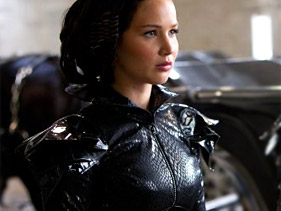
In this week’s Hobnobbing, we take a look at how Gary Ross’ sequel can build upon the success of the first. By Amy Wilkinson Jennifer Lawrence in “The Hunger Games” Photo: Lionsgate To no one’s surprise, the highly anticipated “Hunger Games” opened last week to boffo box-office numbers , all but guaranteeing the second installment in Suzanne Collins’ series, “Catching Fire,” will set theaters ablaze come November 22, 2013. Director Gary Ross, who will also helm the follow-up, has already begun formulating his vision for the 75th annual Hunger Games, telling MTV News, “I have some ideas about how to do ‘Catching Fire’ slightly differently, but I don’t want to share them yet. Not because I’m being evasive, but just because they’re not fully baked. But yes, I think it will look and feel slightly different from the first.” With its jungle-like setting, the next arena will be a much different beast than the forested first, so it’s no wonder Ross is re-jiggering his approach. We can only speculate that some of his sequel planning will include reviewing “The Hunger Games” in great detail — what worked and what didn’t. To that end, we’ve compiled a list of five “Hunger Games” lessons that can and should inform “Catching Fire.” DO keep the arena underwraps This one isn’t so much for Ross as it is for the Gamemakers at Lionsgate, but we have to recognize the studio’s smart decision to use only pre-Games footage in their aggressive marketing campaign for the film. In fact, I’d go so far as to say my favorite parts of the movie were from the arena, largely because they were fresh and unexpected. With the Quarter Quell’s intriguing new venue, Lionsgate would be wise to build anticipation by keeping the tropical death trap shrouded in mystery. DON’T skimp on the CGI If there was a consistent complaint I heard from “Hunger Games” fans following the film’s release, it was that the Girl on Fire scene — in which Katniss and Peeta introduce themselves to the Capitol, riding atop a chariot and flaunting flame-licked jumpsuits representative of their coal-mining home — was … underwhelming. The flame effect just didn’t look real enough. With a slew of new sci-fi aspects introduced in “Catching Fire,” including mutated monkeys, we hope Ross can invest a bit more in the film’s digital technology. DO capitalize on Stanley Tucci Say what you will about Jennifer Lawrence’s gripping, gritty performance as Katniss Everdeen, but if anyone could be categorized as the film’s scene-stealer, it was most certainly Stanley Tucci, whose blue-haired, big-teethed Caesar Flickerman was nothing short of mesmerizing (and a handy exposition device to boot!). Heck, I’d pay to watch a Caesar Flickerman spin-off once all three (four?) “Hunger Games” films debut. “Caesar Flickerman: Not So Blue.” Think about it, Lionsgate. DON’T downplay the dangers of the arena Between her 23 fellow tributes, tracker jackers and muttations, Katniss had plenty to contend with in the arena. But, as my roommate so astutely pointed out to me long after I watched the film and didn’t notice, we never really see Katniss hungry or thirsty. Limiting the violence for a PG-13 rating is an understandable edit, but why dull down the deadliness of the Games otherwise? In “Catching Fire,” we need to see Katniss and her fellow tributes truly struggle, not simply limp along. DO make artful additions (especially if they’re directed by Steven Soderbergh) By shifting the viewpoint of the film from Katniss’ first-person perspective, Ross was able to open up the world of Panem in a way we hadn’t experienced before. The addition of the control room, Seneca Crane’s implied death by berries and, most notably, the District 11 riot only added to the film. What do you think “Catching Fire” can learn from “The Hunger Games”? Sound off in the comments below and tweet me @amymwilk with your thoughts and suggestions for future columns! Check out everything we’ve got on “Hunger Games.” For young Hollywood news, fashion and “Twilight” updates around the clock, visit HollywoodCrush.MTV.com . Related Photos The Hunger Games Inside ‘The Hunger Games’ Capitol

Go here to read the rest:
‘Hunger Games’ Postmortem: Five Lessons For ‘Catching Fire’

‘Titanic’ Theme Song Makes Kate Winslet ‘Feel Like Throwing Up’

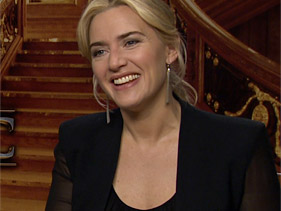
‘Bless you, Celine, but it does rather haunt me,’ the actress admits to MTV News of ‘My Heart Will Go On.’ By Fallon Prinzivalli Kate Winslet Photo: MTV News “Like throwing up.” That’s how Kate Winslet feels when she hears Celine Dion ‘s “My Heart Will Go On,” the once-inescapable theme to “Titanic.” “No, I shouldn’t say that,” Winslet added, thinking through her response before coming to this conclusion: “No, actually, I do feel like throwing up.” Since its release in 1997, the film has stuck with Winslet wherever she goes. It was the movie that helped her sky-rocket to the A-list, after all, and no one is likely to forget Dion’s iconic song from “Titanic,” set to be re-released in 3-D on April 4. “I wish I could say, ‘Oh listen, everybody! It’s the Celine Dion song!’ But I don’t,” Winslet admitted. “I just have to sit there, you know, kind of straight-faced with a massive internal eye roll.” Winslet went on to explain that every time she walks into a bar or a restaurant with a pianist, they never miss an opportunity to start playing the notes. “It’s thrilling for people to surprise me with the Celine Dion song,” she laughed. But they not only play the tune for her, they also encourage the Oscar winner to sing it herself. “I did a talk show recently in Italy and they actually had a live pianist who started gently playing the theme song. I was not even gently, rather severely, urged to go and sing it as though I had in fact sung it myself in the first place. It was like, ‘No! I’m not going to do that.’ They’re like, ‘Oh no, come on it will be funny.’ No, it won’t be funny. At all. And I’m not going to.” Unfortunately for the actress, it’s not just the theme song that haunts her. Whenever she boards a boat, she’s the butt of jokes. “Honestly, I actually now get onto boats and say, ‘No jokes, OK? No jokes. Can we just move on from that? And if you have any jokes, let’s just get them out of the way right now. Thank you. Anyone? Jokes, jokes? OK, moving on.’ And then they still tell jokes,” Winslet said. The most common joke is asking her to head to the front of the boat with them to reenact the iconic scene between hers and Leonardo DiCaprio ‘s characters on the rail. To that she replies, “Oh, yeah! Oh, that one! Oh, don’t worry, it’s my party piece. Sure, come on up, bring your granny.” But Winslet is actually an amazing sport about the jokes. She understands how deeply the film touched its audience. And now that it will be on the big screen again, it can reach a whole new generation — including her children who will see it for the very first time. “What’s negative about it? Really, nothing at all,” she said of the 3-D treatment. “It’s very different and much more present. It’s bigger — if you can believe that — but it is and you really do feel like you’re in it.” Audiences will be able to relive the tragic love story — or experience for the first time — when “Titanic” it hits theaters in 3-D on April 4. Check out everything we’ve got on “Titanic.” For breaking news, celebrity columns, humor and more — updated around the clock — visit MTVMoviesBlog.com . Related Photos ‘Titanic 3D’ Premiere

Visit link:
‘Titanic’ Theme Song Makes Kate Winslet ‘Feel Like Throwing Up’

Rihanna Smacks Down Reporter Over Ill-Timed Ashton Kutcher Question

Rihanna politely put a reporter in her place after being asked a question about her alleged recent dalliance with Ashton Kutcher at a press conference in London this week. In the UK promoting her new film Battleship , Rihanna was asked by a ballsy member of the press if the Two and a Half Men star would be visiting her there. Her response? Far from rude, but even farther from happy: Rihanna Smacks Down Reporter “Wow … how disappointing was that question,” the 24-year-old singer replied, adding pointedly, “I’m happy and I’m single, if that’s what you’re really asking.” Demi Moore is glad she cleared that up. The rest of us are just scratching our heads at how that even came up at a big-time press event for Battleship . Rihanna and Ashton Kutcher allegedly hooked up earlier this month, though there is no proof of this other than a report that she visited his pad late night. There were no photos and TMZ even took down the story, making it even wilder that someone had the nerve to ask a made-for celebrity gossip question.

Visit link:
Rihanna Smacks Down Reporter Over Ill-Timed Ashton Kutcher Question

Jennifer Lawrence Stars in The House at the End of the Street: Trailer

While Lionsgate continues to celebrate the oodles of money flowing in as a result of The Hunger Games , another movie studio is also doing cartwheels: Relativity Media. Why? Because that studio is behind The House at the End of the Street , a September 21 release that stars Katniss Everdeen herself, Jennifer Lawrence. The film is your basic horror flick: Lawrence stars as Ellisa, the daughter of Elisabeth Shue’s Sarah, who moves to a small-town house and starts to discover some chilling secrets about the residence and the area around them. Check out the official, just-released trailer now and look forward to seeing Lawrence again on the big screen: The House at the End of the Street Trailer

Continue reading here:
Jennifer Lawrence Stars in The House at the End of the Street: Trailer

Citizen Ruth: Looking Back at Alexander Payne’s Prescient Abortion Satire

What’s the Film : Citizen Ruth (1996), available on DVD and Hulu Why it’s an Inessential Essential : The premise — one woman’s attempt to have an abortion turns into a national debate and bidding war — was a bold choice out of the gate for writer-director Alexander Payne. Citizen Ruth is his first feature film, and like his subsequent work, it has a biting wit, absurdities from every corner, and deeply flawed characters. Ruth (Laura Dern) is a dim-witted screw-up who is pregnant for the fifth time; her four offspring have been placed elsewhere because of her addiction to inhalants. When she is charged with a felony for huffing “patio sealant,” the judge coerces her to terminate the pregnancy. In jail, she meets anti-abortion crusaders who start a tug-of-war with pro-choice rivals over the unborn child, who becomes widely known as Baby Tanya after a clinic doctor manipulates Ruth into imagining keeping it. Tackling this tricky subject matter, Payne found an unreal story to tell, except that part of it was real. In the DVD commentary, he and co-writer Jim Taylor reveal that the plot was inspired by the true story of a woman who was offered money by anti-abortion and pro-choice camps to honor their respective wishes for her fetus. The parallels to reality don’t stop there. In one of Dern’s best unhinged moments, Ruth screams at two overzealous medical staffers at a clinic, who then pull out all the stops and force her to watch a video of abortion footage. That seems far-fetched, though maybe not in places like Arizona, where a lawmaker recently proposed a bill that would require women to watch an abortion before having one. The state representative, Terri Proud, calls her idea “(The) Reproductive Games.” Truth is catchier than fiction. Why We Recommend It Now : Released in 1996, Citizen Ruth resonates today, of course, because the issue of affordable health care has evolved into a fight over reproductive rights. Although Baby Tanya, were she real/alive, would be old enough to have a Sweet 16 party this year, not much has changed in the public discourse. Payne skewers the radicals on both sides, who are largely motivated by impressing their leaders — Tippi Hedren, for example, as a mother/god figure to the lunatic pro-choice activists. Their behavior is over the top, but their ideologies still echo. Among the points the movie makes so nicely is that extremists tend to lose sight of the real people and issues involved. When Sandra Fluke testified about hormonal birth control, the point she made — that the drug treats medical conditions — was lost once Rush Limbaugh piped in and turned Fluke into an abstraction and a “prostitute.” Ruth is unfit to be a mother, yet a contingent of crazies think she should take a stab at parenthood, aided by 15 grand, because somehow it’ll just all work out. There’s something to be said for laughing so we don’t cry, and Citizen Ruth allows us to do that. The DVD has few extras, but it does feature a revealing commentary track from Payne, Taylor, Dern and production designer Jane Ann Stewart. Explaining that the film doesn’t take sides, Stewart says her team strived to make both camps look a little foolish. Payne gets to the heart of the matter, saying, “Jane, you asked me, ‘Is nothing sacred?’ And it’s true. Everything is sacred, and nothing is sacred. Everyone is open for being examined as a human being.” Other Interesting Trivia : Payne says the film’s limited release was probably the reason he didn’t receive one threatening letter over it, though he was concerned about potential violence at the time from groups like the Army of God. Dern recalls a conversation with the women who ran Planned Parenthood in Texas, who called her to say how much they loved being mocked in the film. Also, let the end credits roll a couple minutes for a hint at Ruth’s fate. PREVIOUS INESSENTIAL ESSENTIALS The Last Temptation of Christ The Sitter

Read this article:
Citizen Ruth: Looking Back at Alexander Payne’s Prescient Abortion Satire