Tag Archives: muslim

REVIEW: What If Women Ran the Middle East? Sanctimonious If Entertaining Where Do We Go Now? Has the Answer

It’s dangerous business to begin a movie with a voice-over monologue introducing “a long tale of women dressed in black.” Run, while there’s still time! Yet it’s a testament to director and actress Nadine Labaki’s gracefulness she pulls off this story as well as she does in Where Do We Go Now? , a fable set in a fictional town, presumably in Lebanon, where Christians and Muslims live together in bumptious accord, if not in complete harmony. Actually, the women – those aforementioned creatures dressed in black – get along famously, gathering regularly at the same café for all manner of gossip and chitchat. It’s the men who can’t hold it together: They’re always on the brink of fisticuffs and worse, each group expecting only the worst from the other. Don’t look now, but somebody filled the church holy water fonts with blood – must be the Muslims! Goats and chickens running amok in the mosque? Got to be those pesky Christians! The women are always suffering because of the men: As the movie opens, they stride toward the local cemetery en masse, their procession orchestrated as if it were a Pina Bausch routine, with somber, stiff leg movements and rhythmic breast-beating. The graves – Christians on one side of the burial ground, Muslims on the other – all bear pictures of the women’s lost men, people who have caused them a great deal of sorrow. The problem, as Labaki and her co-writers Jhad Hojeily and Rodney Al Haddad make clear, is that the men just can’t stop fighting. The village also happens to be located in an area riven by violence – it’s surrounded by land mines, which, in an early scene, kill a hapless goat. (The event is played for laughs, not pathos.) Meanwhile, a tentative romance brews between doe-eyed café proprietress Amale (Labaki, a sultry and winning presence) and local handyman Rabih (Julien Farhat), who’s doing some renovation work in her establishment. She’s Christian, he’s Muslim, and their union will be symbolic if it ever gets off the ground. But again, those men! They just won’t listen. The women eventually hatch a plan to keep peace in the village, but tragedy strikes regardless, making their lot even more challenging and wearying. You can see where Labaki is going with all this: If women ruled the world, there’d be no more war. It’s a darling idea, and Labaki does all she can to keep the proceedings entertaining – the picture is dotted with whimsical comedic touches and even includes a smattering of spontaneous Umbrellas of Cherbourg -style musical numbers. It also features an ensemble cast made up largely of nonprofessional actors, and they can be quite charming to watch. For a picture about centuries-old infighting and suffering, Where Do We Go Now? really is pretty cheerful. But its occasional entertainment value aside, the picture is also blithe to the point of being flimsy. This is Labaki’s second feature: The first was the 2007 Caramel , an engaging and visually lush picture set in a Beirut beauty shop, the perfect setting for a very different sort of story about the complications of women’s lives. Caramel is a delightfully fizzy picture, but oddly enough – or perhaps not – it cuts much deeper than Where Do We Go Now? It’s far less sanctimonious, and it defines some of the very real challenges modern women face in the Middle East: Even though its characters feel they’re free to shape their own futures, there are certain restrictions – put in place by men, of course – that threaten to hold them back. One character in Caramel is engaged to be married and has to find a solution to prevent her fiancé from learning that he isn’t her first. You could argue that her plight is nothing compared with massive wars fought on religious grounds. Then again, it’s a man’s pride she’s trying to protect, and she’ll do what it takes to preserve his illusions. Labaki clearly understands the connection between the larger battles and the small ones – it’s just that her ideas come through more subtly and effectively in the beauty-shop movie than in the war-zone movie. She doesn’t need exploding land mines to get her point across. Follow Stephanie Zacharek on Twitter . Follow Movieline on Twitter .

Follow this link:
REVIEW: What If Women Ran the Middle East? Sanctimonious If Entertaining Where Do We Go Now? Has the Answer

REVIEW: What If Women Ran the Middle East? Sanctimonious If Entertaining Where Do We Go Now? Has the Answer
It’s dangerous business to begin a movie with a voice-over monologue introducing “a long tale of women dressed in black.” Run, while there’s still time! Yet it’s a testament to director and actress Nadine Labaki’s gracefulness she pulls off this story as well as she does in Where Do We Go Now? , a fable set in a fictional town, presumably in Lebanon, where Christians and Muslims live together in bumptious accord, if not in complete harmony. Actually, the women – those aforementioned creatures dressed in black – get along famously, gathering regularly at the same café for all manner of gossip and chitchat. It’s the men who can’t hold it together: They’re always on the brink of fisticuffs and worse, each group expecting only the worst from the other. Don’t look now, but somebody filled the church holy water fonts with blood – must be the Muslims! Goats and chickens running amok in the mosque? Got to be those pesky Christians! The women are always suffering because of the men: As the movie opens, they stride toward the local cemetery en masse, their procession orchestrated as if it were a Pina Bausch routine, with somber, stiff leg movements and rhythmic breast-beating. The graves – Christians on one side of the burial ground, Muslims on the other – all bear pictures of the women’s lost men, people who have caused them a great deal of sorrow. The problem, as Labaki and her co-writers Jhad Hojeily and Rodney Al Haddad make clear, is that the men just can’t stop fighting. The village also happens to be located in an area riven by violence – it’s surrounded by land mines, which, in an early scene, kill a hapless goat. (The event is played for laughs, not pathos.) Meanwhile, a tentative romance brews between doe-eyed café proprietress Amale (Labaki, a sultry and winning presence) and local handyman Rabih (Julien Farhat), who’s doing some renovation work in her establishment. She’s Christian, he’s Muslim, and their union will be symbolic if it ever gets off the ground. But again, those men! They just won’t listen. The women eventually hatch a plan to keep peace in the village, but tragedy strikes regardless, making their lot even more challenging and wearying. You can see where Labaki is going with all this: If women ruled the world, there’d be no more war. It’s a darling idea, and Labaki does all she can to keep the proceedings entertaining – the picture is dotted with whimsical comedic touches and even includes a smattering of spontaneous Umbrellas of Cherbourg -style musical numbers. It also features an ensemble cast made up largely of nonprofessional actors, and they can be quite charming to watch. For a picture about centuries-old infighting and suffering, Where Do We Go Now? really is pretty cheerful. But its occasional entertainment value aside, the picture is also blithe to the point of being flimsy. This is Labaki’s second feature: The first was the 2007 Caramel , an engaging and visually lush picture set in a Beirut beauty shop, the perfect setting for a very different sort of story about the complications of women’s lives. Caramel is a delightfully fizzy picture, but oddly enough – or perhaps not – it cuts much deeper than Where Do We Go Now? It’s far less sanctimonious, and it defines some of the very real challenges modern women face in the Middle East: Even though its characters feel they’re free to shape their own futures, there are certain restrictions – put in place by men, of course – that threaten to hold them back. One character in Caramel is engaged to be married and has to find a solution to prevent her fiancé from learning that he isn’t her first. You could argue that her plight is nothing compared with massive wars fought on religious grounds. Then again, it’s a man’s pride she’s trying to protect, and she’ll do what it takes to preserve his illusions. Labaki clearly understands the connection between the larger battles and the small ones – it’s just that her ideas come through more subtly and effectively in the beauty-shop movie than in the war-zone movie. She doesn’t need exploding land mines to get her point across. Follow Stephanie Zacharek on Twitter . Follow Movieline on Twitter .

See the original post:
REVIEW: What If Women Ran the Middle East? Sanctimonious If Entertaining Where Do We Go Now? Has the Answer
Race Matters: Die-Hard Democrat Town In Ohio Refuses To Vote For Barack Obama Because He’s Black

Some of these folks believe that Barack Obama won the election in 2008 due to “Black Ignorance”…thoughts? Via NY Times: STEUBENVILLE, Ohio — This is the land of die-hard Democrats — mill workers, coal miners and union members. They have voted party line for generations, forming a reliable constituency for just about any Democrat who decides to run for office. But when it comes to President Obama, a small part of this constituency balks. “Certain precincts in this county are not going to vote for Obama,” said John Corrigan, clerk of courts for Jefferson County, who was drinking coffee in a furniture shop downtown one morning last week with a small group of friends, retired judges and civil servants. “I don’t want to say it, but we all know why.” A retired state employee, Jason Foreman, interjected, “I’ll say it: it’s because he’s black.” For nearly three and a half years, a black family has occupied the White House, and much of the time what has been most remarkable about that fact is how unremarkable it has become to the country. While Mr. Obama will always be known to the history books as the country’s first black president, his mixed-race heritage has only rarely surfaced in visible and explicit ways amid the tumult of a deep recession, two wars and shifting political currents. But as Mr. Obama braces for what most signs suggest will be a close re-election battle, race remains a powerful factor among a small minority of voters — especially, research suggests, those in economically distressed regions with high proportions of white working-class residents, like this one. Mr. Obama barely won this county in 2008 — 48.9 percent to John McCain’s 48.7 percent. Four years earlier, John Kerry had an easier time here, winning 52.3 percent to 47.2 percent over George W. Bush. Given Ohio’s critical importance as a swing state that will most likely be won or lost by the narrowest of margins, the fact that Mr. Obama’s race is a deal-breaker for even a small number of otherwise loyal Democrats could have implications for the final results. Obama advisers acknowledged that some areas of the state presented more political challenges than others, but said that the racial sentiment was not a major source of worry. The campaign’s strategy relies in large part on a strong performance in cities and suburban areas to make up for any falloff elsewhere among Democrats in this or other corners of Ohio. Researchers have long struggled to quantify racial bias in electoral politics, in part because of the reliance on surveys, a forum in which respondents rarely admit to prejudice. In 50 interviews in this county over three days last week, 5 people raised race directly as a reason they would not vote for Mr. Obama. In those conversations, voters were not asked specifically about race, but about their views on the candidates generally. Those who raised the issue did so of their own accord. “I’ll just come right out and say it: he was elected because of his race,” said Sara Reese, a bank employee who said she voted for Ralph Nader in 2008, even though she usually votes Democrat. Did her father, a staunch Democrat and retired mill worker, vote for Mr. Obama? “I’d have to say no. I don’t think he could do it,” she said. But the main quarrels Democratic voters here have with Mr. Obama have nothing to do with race. They include his rejection of one proposed route for the Keystone pipeline, a stance they say will harm this area, whose backbone, the Ohio River, is lined with metal mills and coal mines. Stephanie Montgomery, who is black and a graduate of Franciscan University in Steubenville, said her race came up so often in her job search in this area that she developed a technique for recognizing when it was happening. The sign: when warmth on the phone turns cool in person, and “they lose eye contact with you.” “You almost need a corporate environment to get a fair shot,” she said while standing at a job fair in the Steubenville mall. She said that she did not vote for Mr. Obama in 2008 because she preferred Mr. McCain’s more conservative platform, but that Mr. Obama seemed to be a lightning rod for criticism, in part because of his race. “He’s everything they hate,” she said, referring to ultraconservatives. “An affirmative-action baby. Got the Nobel Prize without deserving it.” Many who raised race as a concern cast Mr. Obama as a flawed candidate carried to victory by blacks voting for the first time. Others expressed concerns indirectly, through suspicions about Mr. Obama’s background and questions about his faith.nn“He was like, ‘Here I am, I’m black and I’m proud,’ ” said Lesia Felsoci, a bank employee drinking a beer in an Applebee’s. “To me, he didn’t have a platform. Black people voted him in, that’s why he won. It was black ignorance.” Louis Tripodi, a baker in Steubenville who voted for Mr. Obama, blames talk radio and Republican rhetoric for encouraging such attitudes. “ ‘He’s a Muslim, he’s a socialist, he’s not born in this country,’ ” he said. “It’s got a lot to do with race.” Race has also helped Mr. Obama. It increased voter turnout among blacks in 2008, and some younger voters said it was part of why they voted for him. But now that history has been made, it is less of a pull. Discuss…

View post:
Race Matters: Die-Hard Democrat Town In Ohio Refuses To Vote For Barack Obama Because He’s Black

Jihad Denial and Armenian Genocide Remembrance

http://www.youtube.com/v/ul2hpEOngyo

Continue reading here:

April 24th, 2012 by Andrew Bostom The Center for Security Policy, under security analyst Frank Gaffney’s bold and thoughtful leadership, is launching a 10-part, web-based video course (key findings summarized here), today, April 24, 2012, entitled, “The Muslim Brotherhood in America: The Enemy Within.” Here’s the intro to Frank Gaffney’s series of videos: And here is the link to his Broadcasting platform : YouTube Source : Winds Of Jihad Discovery Date : 28/04/2012 06:22 Number of articles : 2

Jihad Denial and Armenian Genocide Remembrance

Banazir Bhutto Scandalous Pics of the Day

I don’t know shit about Arab politics. I don’t know about Iraq, Iran, Pakistan or Afghanistan…all I know is that that is where oil comes from, where heroin comes from, wheree women who generally know their place come from….who unfortunataly wear bed sheets to cover themeselves up so hard that seeing their hands is the only skin you can have jerk off fantasies about…I mean unless you’re there and you just pull the bitch into an alley or have sex with a goat…..at least that’s what a cab driver once told me and that’s all I really know…. So this BANAZIR BHUTTO is an unknown to me….but after much research I have discovered she was killed in 2007, was the Prime Minister of Pakistan twice and is now in some scandalous pics, 5 year after death, cuz that’s just what happens with the whole internet thing….nothing ever dies… Now sure all she is showing is some leg in some personal pics, but in Muslim countries, this shit is like fisting yourself in front of everyone while using a Sadam Hussien shaped dildo on your fucking ass….It’s a fucking scandal and that’s why I’m posting it…I love scandals…even if I have no idea who is in them or if the people in the pics are actually the people being claimed to be in them….especially when the scandal is so fucking tame….and all these bitches kinda look the fucking same…..That’s racist Story via JONTURK I approve of this message: LIKE US ON FACEBOOK EVEN IF YOU DON’T LIKE US

See original here:
Banazir Bhutto Scandalous Pics of the Day

The Host Teaser: Stephenie Meyer’s Freaky-Eyed Aliens Are Coming For Your Mind, Body, and Soul

It’s brief, but the newly debuted teaser trailer for the sci-fi romance The Host is here to tantalize you with images of freaky-eyed pod people and star Saoirse Ronan ‘s fierce, unearthly qualities. Adapted from author Stephenie Meyer ‘s non- Twilight novel about a human and an alien symbiote who share the same body, The Host is headed to theaters in 2013 under director Andrew Niccol ( In Time ), and while this oughta give Host readers a twinge of anticipation, non-fans are likely scratching their heads wondering what Ronan’s eyeballs and the vaguely Benetton-like reel of faces has to do with anything. Just to fill in the blanks: As Ronan’s voice over says, we’re in a future where the world’s problems have been solved. Yay! The bad news? Everything’s only kosher now because aliens have descended on Earth to invade our bodies, erasing our memories. Except when it comes to Melanie Stryder (Ronan); she refuses to shove over to let her alien “soul,” Wanderer, have full run of the place. And of course, this leads to a love quadrangle as host and alien fall for different boys (Max Irons and Jake Abel). Have a looksie, courtesy of Yahoo: The Host will hit theaters on March 29, 2013. [ Yahoo! ]

See the rest here:
The Host Teaser: Stephenie Meyer’s Freaky-Eyed Aliens Are Coming For Your Mind, Body, and Soul

On The Music, Martial Art — and Muslim Hero — of Silat Actioner The Raid: Redemption

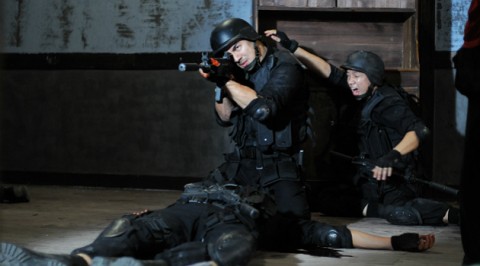
As a member of the Jakarta police force, Rama (Iko Uwais) is one of dozens of SWAT agents about to be trapped within the concrete walls of a tenement building run by a nefarious slumlord, set upon by machete-wielding thugs and forced to fight his way out using knives, broken doorways, and at times, only his bare hands. The fighting style he uses to do so, leaving a trail of broken baddies in his wake, is silat — a lightning-fast, bone-crunching Southeast Asian martial art that gets its best showcase in Gareth Evans’ festival sensation The Raid: Redemption . Welsh-born writer-director Evans didn’t necessarily set out to become the world’s pre-eminent silat action filmmaker, but with his 2009 feature Merantau and now The Raid he’s created a niche for himself while introducing the Western world to the rarely-seen discipline. His fascination with the form began when he was hired to film a documentary about silat, which introduced him to future collaborator, pencak silat practitioner, and Raid star Uwais. “As a kid I had watched kung fu movies and muy thai movies and karate movies, but I’d never seen silat before,” Evans told Movieline last week at SXSW , where The Raid screened ahead of its March 23 release. “When I finally got to see silat it knocked me on my ass, and I wanted my friends back home to be able to see it. I was hungry to be able to have a movie that I could take back to the U.K. — Friday night, a couple of beers, ‘Guys, you’ve got to see silat, it looks so fucking cool!’” The Raid isn’t the first silat action film, but few predecessors found an audience on par with the classic Hong Kong action films or mainstream martial arts hits. “There were films with silat made in the ‘70s and ‘80s in Indonesia but the choreography didn’t hold up in the same way that the choreography in Hong Kong has held up,” Evans explained. “You can’t compare those films to something like Drunken Master because they’re just so different in terms of style. And they added a lot of mysticism and were great as cult movies, but beyond that, not really. So I figured if I wanted to show them silat, I’d better go out and make a film.” With an unrelenting pace and inventive, dynamic fight scenes, The Raid is a near-constant assault on the senses that showcases the physical skills of stars and choreographers Uwais and Yayan Ruhian, not to mention Doni Alamsyah, former judo champ Joe Taslim, and what seems like hundreds of well-trained extras. After the film debuted at the Toronto Film Festival to uproarious acclaim, Sony Pictures Classics picked it up for distribution and two new, unconventional composers were brought onboard to give it a different feel: Linkin Park’s Mike Shinoda and TRON: Legacy orchestrator Joe Trapanese. (Screen Gems is developing an American remake with Evans executive producing; more on that here .) Evans screened the film for Shinoda and Trapanese and gave them carte blanche to create their accompanying electronic score, which they developed after settling on a few parameters – for example, no electric guitars. After watching the film, Shinoda went on tour to Asia and Trapanese headed to New York, both working from memory to create sounds that fit the version of the film and its highlights that they had in their heads. “I was working on my laptop in hotel rooms, in the car, on the plane,” Shinoda said. “I would throw these demos together, these ideas and sketches. Like, in my head I’m thinking, ‘There’s that one scene where the guys are doing this and this and this, and this is the kind of thing I remember it being like.’ Then other times it would be like, what kind of emotion don’t I have yet? What kind of theme is missing? When we came back we started laying all those things against picture and found that a good chunk of the stuff really worked.” Shinoda, who wanted to approach his work on The Raid as a score rather than a collection of songs layered over the film, contrasted writing with Trapanese to the creative process with Linkin Park. “I found it to actually be in many ways easier than writing stuff for a Linkin Park album because we tear our hair out,” he said. “When we’re writing a song for a Linkin Park album it can be very tedious, it takes a long, long time to get from a blank page to the final product, and in this case I’m working with a vision that is already realized. This is awesome — all I have to do is make sure I’m supporting in the best way.”

Read the rest here:
On The Music, Martial Art — and Muslim Hero — of Silat Actioner The Raid: Redemption

Bloomberg Defends NYPD Spying on Muslim Students, Rafting Trips [Video]

http://www.youtube.com/v/4JRJ2PUe52w

See more here:

(Photo: Getty) It was recently revealed that the NYPD secretly monitored college students throughout the Northeast, something that received particularly strong criticism from the president of Yale University, Richard Levin, who wrote “the police surveillance based on religion, nationality, or peacefully expressed political opinions is antithetical to the values of Yale, the academic community, and… Broadcasting platform : YouTube Source : The Politicker Discovery Date : 21/02/2012 19:55 Number of articles : 2

Bloomberg Defends NYPD Spying on Muslim Students, Rafting Trips [Video]

Avril Lavigne and the Perverted Black Paparazzi of the Day

Avril Lavinge is fucking annoying. I see her proactive commercials and they make me want to kill myself…but then again so does waking up in the morning….but the paparazzi are fucking clowns…especially the black dude and I love it… last week we had him moaning over Ashley Tisdale and this week he’s asking Avril if she got Brody Jenner anything sexy for Valentines day…a little “agent provocateur”…and I’m not even sure homie even has a camera…I think he’s the equivalent of a dude who flashes his cock to school girls on the bus….and I’d love to hang out with him….or at least give him his own talk show….all panting and telling girls they are sexy like a fucking rapist all day….

See the original post here:
Avril Lavigne and the Perverted Black Paparazzi of the Day

Mini Anden Nipple for Harper’s Bazaar Turkey of the Day

You don’t know who Mini Anden is and either do I…but I do know what her nipple looks like under some kind of sheer fabric because she’s just that kind of girl…a model from Sweden, even though she is neither blonde or busty, in her 30s who has moved to LA because she wants to pursue acting, but since roles like “supermodel in ocean’s twelve” aren’t cutting it for her and her model husband’s bank accounts, she’s taking on cover shoots for Arab country franchises of fashion magazines, showing more nipple than most American magazines, because Christian run governments are way more uptight than Muslim run governments….cuz Christians are just as fucking crazy….and cuz showing her tits for fashion is kinda her thing…Who cares…here are the pics.

Read the original post:
Mini Anden Nipple for Harper’s Bazaar Turkey of the Day