Tag Archives: Nbc

Jay Leno: ‘Obama Is 49, Which Is Eight Points Higher Than His Approval Rating’

Comedian Jay Leno on Wednesday wished President Obama a Happy Birthday by making fun of him in the opening monologue of NBC’s “Tonight Show.”  “We want to start off by saying Happy Birthday to President Barack Obama,” Leno teased. “He is 49, which is eight points higher than his approval rating.” As “Tonight Show” viewers know, these jokes always come in threes (video follows with transcript): JAY LENO: Welcome to the “Tonight Show,” and we want to start off by saying Happy Birthday to President Barack Obama. He is… [Cheers and applause] LENO: He is 49, which is eight points higher than his approval rating. Wow. [Laughter] LENO: If you would like to get him a a gift, he’s registered at Bed, Bath and Blame it on Bush. That’s the store. [Laughter and applause] LENO: What, did you see the cake they had for him? They had a huge cake. A little different than most birthday parties. What he did was he didn’t blow out the candles, he just taxed them until they finally gave up and went out on their own. Delicious! Absolutely delicious. 

Read the original:
Jay Leno: ‘Obama Is 49, Which Is Eight Points Higher Than His Approval Rating’

Today Show Invites on Rolling Stone Reporter to Complain About Pentagon Ban

NBC’s Today show invited on the reporter, whose Rolling Stone article essentially got General Stanley McChrystal fired, on Thursday’s show to complain that the Pentagon denied him an embed because the war in Afghanistan isn’t going well. After Today co-anchor Meredith Vieira questioned Michael Hastings for his explanation as to why the Pentagon denied him an embed, Hastings concluded “This is a symptom of essentially the war, and how the war is going…The war has hit its all-time low.” This caused Vieira, herself, to cry censorship, as she asked: “Do you think the military is trying to say to reporters,’We will stifle you, if you don’t tell the story the way we want it told?'” MEREDITH VIEIRA: So why do you think, ultimately, you lost this, this right to an embed? I mean, what do you think is going on? Is it the McChrystal article or is there something much bigger than that? MICHAEL HASTINGS: I think it’s, I think it’s much bigger. This is not just about a Rolling Stone reporter being banned from an embed. This is a symptom of essentially the war, and how the war is going. June and July were the deadliest months that we’ve ever seen in the war in Afghanistan. The war has hit its all-time low in approval ratings, so clearly there’s great concern in Washington about how the war is going, and the response to this embed. The response to me on this embed sort of indicates that. I think it’s important to, to just let you know, with this helicopter story, these are stories that I’m very passionate about telling. And it is a great privilege to tell the story of the troops. VIEIRA: But do you think, but do you think the military is trying to say to reporters, “We will stifle you, if you don’t tell the story the way we want it told?” The following Jim Miklaszewski set-up piece and entire interview with Hastings were aired on the August 5 Today show: MEREDITH VIEIRA: And now to the war in Afghanistan. It has been a difficult summer for U.S. troops there. July was the deadliest month yet for Americans. And a new commander took over after a controversial Rolling Stone article led to the end of General Stanley McChrystal’s military career. Well now the Pentagon is refusing to let that reporter, the reporter who wrote it, embed with another unit in Afghanistan. We’re gonna talk about that with Michael Hastings in a moment. But first NBC’s Jim Miklaszewski is at the Pentagon. Mik, good morning to you. [On screen headline: “Pentagon Payback? McChrystal Reporter Not Allowed Back With Troops”] JIM MIKLASZEWSKI: Good morning, Meredith. It’s been a couple of months since the story broke that forced General McChrystal out of the Army, but the fallout over media military relations is far from over. On his last day as a soldier, General Stan McChrystal managed to joke about the article that ended his career, with a word of warning to his fellow soldiers. GEN. STANLEY MCCHRYSTAL: I have stories on all of you, photos on many, and I know a Rolling Stone reporter. MIKLASZEWSKI: That reporter is Michael Hastings. In an interview on Today in June, Hastings explained how he landed that Rolling Stone scoop. MICHAEL HASTINGS: The access I got was almost a throwback to the old days of “fly on the wall” reporting, where, nowadays, access is almost so controlled, it’s always very so controlled. So it was very rare to get this kind of access anyway. MIKLASZEWSKI: But not any more. The U.S. military has revoked Hastings’ recent request to embed with American forces in Afghanistan, after first granting the request last month. Pentagon spokesman Colonel David Lepenn insists it’s not retribution but explains “a key element of an embed is having trust,” and essentially commanders in Afghanistan no longer trust Hastings. But as a freelancer, Hastings has covered the wars in Iraq and Afghanistan for various publications, and Internet news blogs with no apparent complaints. Military officials have, in fact, praised Hastings’ upcoming piece in the Men’s Journal on Army combat helicopters saying “It accurately portrays the Army’s warrior mentality.” So what is going on here? Media watchdogs claim the military is striking back. LUCY DALGLISH, THE REPORTERS COMMITTEE FOR FREEDOM OF THE PRESS: Since they have all of the power, all of it, once he’s published his story they have, if he wants back in, they have all of the power. If they say they don’t trust him to do what they want him to do anymore, they’re just not going to play in the sandbox with him anymore. MIKLASZEWSKI: Meanwhile, the Army Inspector General is still investigating whether if any of McChrystal’s aides who were blindly quoted in that article should face disciplinary action. And as a reporter who’s often been embedded with the military, there is, indeed, a fine line between trust and control. And while the military can control a reporter’s access, there must be no control over the reporter’s content. Meredith? MEREDITH VIEIRA: Mik, thank you very much. Michael Hastings is with us, exclusively. Good morning to you. MICHAEL HASTINGS: Good morning, thanks for having me. VIEIRA: Not at all. Just so people are clear on this, you were offered this embed in June, then the article on General McChrystal comes out at the end of June, between then and now you didn’t hear anything, and then you get this letter this week. Who is it from, and what did it say? HASTINGS: The letter was from a public affairs official in Kabul, named Colonel Wayne Shanks, and it just basically laid out the case that I, noting that I had, had approval and that approval was being revoked because the military was unhappy with, first, the helicopter story, and actually, they, they, they mentioned the helicopter story, and then they mentioned the story that I wrote about General McChrystal for Rolling Stone. VIEIRA: So they specifically pointed out two stories? HASTINGS: Two stories, yes. But the more important part of their case being, what seemed it to be the General McChrystal story. And in fact, what they refer to as the “political fallout” from the General McChrystal story. So nothing to do, really, or there was no specific cases where they mentioned accuracy or anything I got wrong, or, or any, any rules I supposedly broke. VIEIRA: Well when asked about this, a spokesperson for the Defense Department said this, and I’m quoting here, “There is no right to embed. It is a choice made between units and individual reporters. And a key element of an embed is having trust that the individuals are going to abide by the ground rules. The command in Afghanistan decided there wasn’t the trust requisite, and denied your request.” In other words, they didn’t trust you to accurately report. HASTINGS: And that’s what’s very troubling about this. I’ve been doing this for five years. I’ve gone on dozens of embeds with American troops, accompanied them on many combat missions, traveled regularly with senior military officials and I’ve never had an issue. In fact I have many great friends, both Marines and soldiers, who, who I’ve met along the way for this. I think what also should be made clear is that my travels with General McChrystal were not considered an embed at the time. And if the military’s position now is that it was an embed, then the rules for embeds are very clear. Rule number seven says all comments are on the record. All interviews with service personnel are on the record. VIEIRA: Did you take comments off the record- HASTINGS: No. VIEIRA: -in that, in that interview with General McChrystal at all? HASTINGS: No, and, in fact, if you look at the, the people who are sort of making that assertion, and what, and what appears to be their case about why they’re, why they’re saying I can’t do this embed, those assertions are being made by people who, unfortunately, lost their job as a result of the article, and they’re currently under investigation. So they’re not necessarily the most credible sources. VIEIRA: So why do you think, ultimately, you lost this, this right to an embed? I mean, what do you think is going on? Is it the McChrystal article or is there something much bigger than that? HASTINGS: I think it’s, I think it’s much bigger. This is not just about a Rolling Stone reporter being banned from an embed. This is a symptom of essentially the war, and how the war is going. June and July were the deadliest months that we’ve ever seen in the war in Afghanistan. The war has hit its all-time low in approval ratings, so clearly there’s great concern in Washington about how the war is going, and the response to this embed. The response to me on this embed sort of indicates that. I think it’s important to, to just let you know, with this helicopter story, these are stories that I’m very passionate about telling. And it is a great privilege to tell the story of the troops. VIEIRA: But do you think, but do you think the military is trying to say to reporters, “We will stifle you, if you don’t tell the story the way we want it told?” HASTINGS: That appears to be the case. You’d have to ask the military if that’s what they’re doing. But, but I think if we look at just, say, the, the, the story about the Kaiwa pilots — the Kaiwa is a kind of an attack helicopter – you know, sometimes, sometimes reporters will do a story about policy. Sometimes that’s going to be very critical. I think that’s a good thing to be critical about policy, especially if the policy is not going well. And sometimes you do it about the people who are fighting the war, the American men and women over there who are actually implementing the policy, and whose stories deserve to be told. And for that I’ve always said it’s a privilege to, to be able to see that. VIEIRA: Alright, Michael Hastings. Thank you so much for joining us this morning. Appreciate it. HASTINGS: Thanks for having me. Appreciate it.

Original post:
Today Show Invites on Rolling Stone Reporter to Complain About Pentagon Ban

TV Bites: Breaking Bad Takes the Year Off

Also in this morning’s TV Bites: Nigel Lythgoe officially signs on for American Idol … NBC pits Zombies vs. Vampires … Tony Robbins gets the boot… and more ahead.

More here:
TV Bites: Breaking Bad Takes the Year Off

NBC’s Today Show Inaccurately Blames Fox News for Sherrod Firing

On Wednesday’s Today show, Matt Lauer, Ann Curry and Savannah Guthrie left the impression that Fox News’s criticism of Shirley Sherrod was the reason she lost her job at the Agriculture Department, with Lauer, in his interview with Sherrod, charging: “I don’t know who to blame here, Miss Sherrod. I mean the, the, the activist who put forward this garbage in the first place has an agenda. We shouldn’t be surprised by that. The cable news network that, that played this garbage on and on and talked about it, has an agenda. We shouldn’t be surprised by that.” But Lauer and NBC News, itself, revealed they have their own agenda, by failing to report, as the MRC’s Rich Noyes pointed out , that Fox News didn’t mention the Sherrod story until she had already left her job. However, that didn’t stop Curry from claiming, in the 8am half hour news brief, that: “After the video was used to vilify her on Fox television, she lost her job,” and Guthrie advancing the NAACP’s notion, in her piece, that they had been “snookered” by Fox News. The following is a complete transcript of Guthrie’s set-up piece followed by Lauer’s interview with Sherrod as they were aired on the July 21 Today show: MATT LAUER: Now to the turbulence facing the Obama administration over the resignation of an Agriculture Department official. Was she forced to quit her job for comments that were taken completely out of context? We’re gonna talk to Shirley Sherrod in a moment, but first, NBC’s Savannah Guthrie is at the White House with the latest. Savannah, good morning. [On screen headline: “Race In America, Should Obama Appointee Have Been Forced To Resign?”] SAVANNAH GUTHRIE: Good morning to you, Matt. Well these developments are moving really quickly. At first there were condemnations against Shirley Sherrod for alleged racist remarks. But now some of the very first people to rebuke her are now apologizing and over the night the White House directed the agency that fired her to reconsider. This is the video at the center of the controversy. SHIRLEY SHERROD: The first time I was faced with having to help a white farmer save his farm- GUTHRIE: First posted on a conservative Web site, it shows Shirley Sherrod, a Georgia-based official with the U.S. Department of Agriculture, an Obama administration appointee, at an NAACP dinner in March of this year describing her reluctance to help a white farmer who came for aid. SHERROD: I was struggling with the fact that so many black people had lost their farmland, and here I was faced with having to help a white person save their land. So I didn’t give him the full force of what I could do. GUTHRIE: The video became an overnight cable news sensation. BILL O’REILLY: Miss Sherrod must resign immediately. The federal government cannot have skin color deciding any assistance. LAURA INGRAHAM: The question is how many more people like Miss Sherrod exist in the Obama administration? GUTHRIE: The action against Sherrod was quick and decisive. The NAACP condemned her, calling her remarks shameful and intolerable. The USDA asked her to resign. Sherrod says she was driving Monday afternoon when she got the call from an official in Washington. SHERROD: She said, “Well they want you to pull over to the side of the road and submit your resignation.” It was just unbelievable. You know, it was just unbelievable. GUTHRIE: But Sherrod says it was a rush to judgment. The incident she had described at the March NAACP dinner had occurred more than 20 years ago, before she worked for the USDA, and it was a story she told, as an example of overcoming her own prejudices. SHERROD: That’s when it was revealed to me that it’s about poor versus those who have. And in telling that story, how I changed while working with him, I used that to help others to see it’s not about race. GUTHRIE: The farmer who Sherrod is accused of treating unfairly went public Tuesday saying she is no racist and saved his family farm. FARMER: I appreciated everything she done for [us], and we got our farm back. GUTHRIE: Still, in a statement Tuesday, Agriculture Secretary Tom Vilsack stood by his decision to fire Sherrod saying, quote, “We have been working to turn the page on this sordid civil rights record at USDA, and this controversy could make it more difficult to move forward on correcting injustices. But by Tuesday night, the NAACP had reversed course. Officials looked at the full context of her remarks made at the NAACP’s own event, concluded they’d been, quote, “snookered” by Fox News and the conservative activist, who first posted portions of the video. But they acknowledged, they were too quick to condemn. BENJAMIN JEALOUS, NAACP PRESIDENT: We made a mistake here. We have a very good batting average. You know it is near 1,000 but some times we make a mistake and we, and we made one here. GUTHRIE: For Shirley Sherrod, the damage has been done. SHERROD: They called me a racist, of all people. They called me a racist. When you look at my work, when you look at everything I’ve done, you know that I’m not a racist. GUTHRIE: Alright, so initially officials here at the White House said this was solely at the discretion of the Agriculture Secretary, Tom Vilsack. That the President was briefed only afterward, although staff knew something of it, and that he fully stood by the Agriculture Secretary’s decision. However, late last night after the full video was posted on the NAACP Web site, the White House contacted the Agriculture Secretary and encouraged the Agriculture Secretary to take another look. He now says he will, and let me read the statement from Tom Vilsack. He said, quote, “I am, of course, willing and will conduct a thorough review and consider additional facts to ensure to the American people we are providing services in a fair and equitable manner.” But no word yet, Matt, this morning whether or not Shirley Sherrod gets her job back. MATT LAUER: Savannah Guthrie, thank you very much. Shirley Sherrod is with us now from Atlanta. Miss Sherrod, good morning to you. SHIRLEY SHERROD: Good morning. LAUER: What a 24-48 hours you’ve had. I mean let’s go through it here. You were villainized, you were forced to resign, and then when, when even the most elementary level of investigation was put toward your situation, what I like to call the “oopses!” began. The NAACP, which had originally come out against you, apologized saying they made a mistake and now I even understand that the Agriculture Secretary who originally stood by his decision, has said he’s willing to see more information. Can you describe your emotions as we sit here and talk this morning? SHERROD: You know, it’s so hard looking at the last 24 hours. When the department, when, you know, this first came to light I said to them you need to look at the whole thing. That’s not the message I was putting out there. And for them, all day yesterday, to say they were standing by their decision and now, you know, at this late hour to be saying they are now willing to look at the facts, you know, it’s hard to take at this point. LAUER: What’s outrageous about this is this story, that was sent out there as an example of racism on your part was the opposite. It was a story of enlightenment and transformation of overcoming the narrow mindedness that you had been surrounded by as a younger woman and here it was completely misconstrued and misrepresented. SHERROD: Yes, and I couldn’t get people, I couldn’t get the people I was working with, people who should have listened to me, to see that because that was one of the things I kept saying. You need to look at the whole thing. That’s not my message. That’s not me. If you look at my life, if you look at my life’s work, you would know that, that’s not me. [On screen headline: “Race In America, Obama Appointee Forced To Resign Speaks Out”] LAUER: As a state worker in Georgia, you tell this story about how you were dealing with a white farmer who was about to lose his farm and perhaps the temptation was there on your part to continue down the road, you had seen so many travel in the past and maybe not give that farmer, that white person, all the benefit of your help. But you had this, almost an epiphany at that moment- SHERROD: Yes. LAUER: -and said, “Wait a second, the civil rights movement was not about black versus white. It’s about the poor and the powerless and this man deserves as much help as anyone.” I mean did, could anyone who had listened, who would have listened to the entire story have, have thought of you as a racist? SHERROD: I don’t think they would have. I don’t, if, you know, anyone, you know, most people would not have known me but if they had looked at the entire tape, I just don’t see how they could’ve come away with it, thinking I was a racist. LAUER: I don’t who to blame- SHERROD: You know those- LAUER: I don’t know who to blame here, Miss Sherrod. I mean the, the, the activist who put forward this garbage in the first place has an agenda. We shouldn’t be surprised by that. SHERROD: Right. LAUER: The cable news network that, that played this garbage on and on and talked about it, has an agenda. We shouldn’t be surprised by that. I am shocked at the NAACP, I have to admit. That, that- SHERROD: Yes. LAUER: -that they did not investigate further before condemning you. And I’m shocked at the Obama administration for not putting an investigation in place either. Can you give me your thoughts on that? SHERROD: Yes. I was particularly hurt by the NAACP’s reaction to it because if they – you know, I put years, all of my life has been about civil rights work and fairness. And if they had just taken the time to look at it, to see, to look at me, to, to see what I’ve done, I’m certain they would not have come out with that first statement. But I can appreciate the fact that they now have looked at it, they’ve seen, and they come up with a new statement. I can accept the apology. LAUER: And as for the Obama administration, as for the Obama administration, why do you think the Secretary of Agriculture acted so quickly in this situation? SHERROD: You know, that is so hard to, to, to take, especially when I kept saying look at the entire thing. Look at my message and no one would listen. No one would listen. LAUER: The NAACP, Miss Sherrod, now calls this “a teachable moment.”What lessons have you learned? SHERROD: Oh, gosh. You know, the, it’s, it’s the outpouring of support has just been great for me. To, you know, I don’t know that I would have done anything different because this is just me. This is my life. It’s all about fairness. And then to not be treated fairly, you know, in this whole situation is, is, it’s, it’s just something hard to deal with. LAUER: The door seems to be open a little bit to you getting your, your old job back. Do you want to walk through that door? SHERROD: You know, I am just not sure of how I would be treated there now. That’s, that’s, that’s one I just don’t know at this point. LAUER: Shirley Sherrod. Miss Sherrod I thank you for your time this morning. SHERROD: Thank you.

Read the original post:
NBC’s Today Show Inaccurately Blames Fox News for Sherrod Firing

Matt Lauer Turns Into Deficit Hawk, Asks Gingrich About ‘Funny Math’

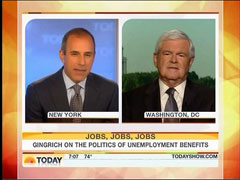
NBC’s Matt Lauer, suddenly turned into a deficit hawk, when he invited on Newt Gingrich on Tuesday’s Today show, to discuss the GOP’s refusal to extend unemployment benefits without paying for them, as he complained to the House Speaker that those same Republicans didn’t offer spending cuts to offset the Bush tax cut and pressed: “Is it funny math?” and “traditionally speaking when you cut taxes, don’t deficits go up as well?” Gingrich initially agreed that the deficit in the “short run” goes up but explained to the Today show anchor that “we proved with Reagan, with the three-year tax cuts in the 1980s” and “again with the Contract With America” that “job creating principles of cutting taxes are far better than the job killing principles of big government and regulation.” The following is the full interview as it was aired on the July 20 Today show: MATT LAUER: Alright, Savannah. Thank you very much. Former Republican Speaker of the House, Newt Gingrich, is a Fox News contributor and the author of the new book To Save America: Stopping Obama’s Secular Socialist Machine. Newt, good to see you. Good morning again. NEWT GINGRICH: Matt, good to see you. LAUER: Let, let me ask you to help me on the math here, alright? What Savannah just talked about, what the President talked about yesterday. You’ve got some Republicans coming out saying, “We’re not in favor extending, of extending these unemployment benefits that carry a price tag of about $33 billion unless there are offsetting cuts in spending.” They are the same Republicans, Newt, who didn’t ask for those offsetting spending cuts when they wanted to make permanent the Bush tax cuts with a price tag of over half a trillion dollars. Is it funny math? GINGRICH: No, I don’t think so. The second biggest concern of the American people after jobs is deficit spending and the fact that this president has been like a teenager with a credit card who has run up – he will have, if he serves eight years, under current plans, he will double the national debt. That is, that is he’ll borrow more than every previous president combined. The average American is beginning to respond with great concern about that amount of debt. LAUER: But traditionally speaking when you cut taxes, don’t deficits go up as well? GINGRICH: Only in the short run. That’s the other difference. I mean we proved with Reagan, with the three-year tax cuts in the 1980s, we proved again with the Contract with America, with the first tax cut in 16 years that, in fact, job creating principles of cutting taxes are far better than job killing principles of big government and regulation. If you look at Rick Perry, the governor of Texas, I think it was in 2007, Texas created more jobs than the other 49 states combined. And the reason was simple. It’s a much lower tax, much lower regulation state in which people found it more convenient and easier to start a business, invest in a company or create a job. [On screen headline: “‘To Save America’ Gingrich’s Formula For Fixing Country”] LAUER: Let’s talk about cutting, cutting the deficit here. You’ve said, you’re thinking more seriously now than ever about running for president. Let’s say I make you president right now. Congratulations. And I give you what a lot of people are predicting – a Republican-controlled House and Senate. That means you’ve got to make some really tough choices in terms of cutting this deficit. What are you willing to say? And name it by name, that you would be willing to cut right now to cut deficits. GINGRICH: First of all, you just may, create a nightmare for virtually every Democrat watching the show, so I apologize to them. But to, but to work out your scenario, in the four years I was Speaker of the House, the average rate of increase was 2.9 percent a year including all the entitlements. That is the lowest rate of increase since Calvin Coolidge in the 1920s. We did it by carefully setting priorities. LAUER: But- GINGRICH: Now, now just let me finish. LAUER: Okay, go ahead. GINGRICH: So, so we doubled, for example, investment in national health research at the National Institutes of Health while we were being very tough on other spending. I would start and I’d go through this budget pretty dramatically and I would eliminate a great deal of federal bureaucracy. I would reform unemployment compensation. I would reform workman’s comp at the state level. I would have a very pro-jobs, very pro-savings, very pro-take-home pay policy. When we reformed welfare, 65 percent of people on welfare either went to work or went to school and we saved billions and billions of dollars. That’s part of how we managed to balance the budget. Remember Matt… LAUER: Would, would you make cuts in Social Security and Medicare? GINGRICH: No, no. LAUER: Would you take those things on? GINGRICH: Well first, well first of all, and we’ve proven at the Center for Health Transformation with a book called Stop Paying the Crooks that there’s between $70 billion and $120 billion a year, that is paid to crooks in Medicare and Medicaid. So sure that, that, by the way, comes out to $700 billion to a trillion, two-hundred billion in savings over the next decade, just by not paying crooks in the federal health system. LAUER: This worst case scenario we just talked about for Democrats, the loss of both the House and the Senate. How likely is it, in your opinion? GINGRICH: About 50/50. It gets worse every month partly because what you just showed was the President with very shallow politics, assuming the American people are dumb enough to follow the latest headline and don’t realize the real problem with unemployment is this is a job killing administration and a job killing Democratic Congress and that’s why those people are unemployed. LAUER: Newt Gingrich. Newt it’s good to see you. Thanks for your time this morning. GINGRICH: Appreciate it. Thanks Matt.

Continue reading here:
Matt Lauer Turns Into Deficit Hawk, Asks Gingrich About ‘Funny Math’

Say Whaaaa? Emmy For Late Night Writing Category Will Not Be Televised

Wake up the Say Whaaaa? Singers! Erstwhile Tonight Show staff writer Deon Cole announced (via Twitter, natch) that the Emmy “powers that be” have determined not to televise this year’s announcement for Best Writing in a Late Night Show — for which, of course, the short-lived Tonight Show with Conan O’B rien is nominated. Emmycaster NBC is not blamed for the decision — yet — but the implications are clear. Leno-centric conspiracy theorists, start your engines… [ Twitter via Videogum ]

Read more:
Say Whaaaa? Emmy For Late Night Writing Category Will Not Be Televised

NYT: WH Defending Health Ins. Penalties As ‘Taxes’ In Court Despite Obama’s Vehement 2009 Denial

The truth comes out. Okay, it was always out there. It’s just that the Barack Obama and the folks in his administration were denying it. The issue in question is whether the individual mandate and penalties for not purchasing health insurance in the statist health care legislation commonly known as ObamaCare should rightly be considered taxes, or if they are something else. In a report dated Friday that appeared in the paper’s print edition at Page A14 on Sunday , Robert Pear at the New York Times noted that in legal proceedings, in response to litigation brought by state attorneys general, the administration is now characterizing the mandate and penalties as taxes. Note the subtle water-down that occurred between the web page’s title bar and the published article’s headline: When Congress required most Americans to obtain health insurance or pay a penalty, Democrats denied that they were creating a new tax. But in court, the Obama administration and its allies now defend the requirement as an exercise of the government’s “power to lay and collect taxes.” And that power, they say, is even more sweeping than the federal power to regulate interstate commerce. Administration officials say the tax argument is a linchpin of their legal case in defense of the health care overhaul and its individual mandate, now being challenged in court by more than 20 states and several private organizations. Under the legislation signed by President Obama in March, most Americans will have to maintain “minimum essential coverage” starting in 2014. Many people will be eligible for federal subsidies to help them pay premiums. In a brief defending the law, the Justice Department says the requirement for people to carry insurance or pay the penalty is “a valid exercise” of Congress’s power to impose taxes. Congress can use its taxing power “even for purposes that would exceed its powers under other provisions” of the Constitution, the department said. For more than a century, it added, the Supreme Court has held that Congress can tax activities that it could not reach by using its power to regulate commerce. While Congress was working on the health care legislation, Mr. Obama refused to accept the argument that a mandate to buy insurance, enforced by financial penalties, was equivalent to a tax. “For us to say that you’ve got to take a responsibility to get health insurance is absolutely not a tax increase,” the president said last September, in a spirited exchange with George Stephanopoulos on the ABC News program “This Week.” When Mr. Stephanopoulos said the penalty appeared to fit the dictionary definition of a tax, Mr. Obama replied, “I absolutely reject that notion.” Now that the legislation has passed, Team Obama has clearly changed its tune. What a surprise (not). As a refresher, what follows is the excerpt from the Obama-Stephanopoulos “spirited exchange” to which Pear referred that I posted last year (at NewsBusters ; at BizzyBlog ). In his annual exercise in legitimate journalism (the one that preceded it was when he moderated an April 2008 Democratic presidential debate and gave then-candidate Obama grief about his relationship with Jeremiah Wright), Stephanopoulos maneuvers an arrogant President into a de facto assertion that Barack Obama’s take on a word’s meaning is more important than the one found in the dictionary: STEPHANOPOULOS: …during the campaign. Under this mandate, the government is forcing people to spend money, fining you if you don’t. How is that not a tax? …. OBAMA: No. That’s not true, George. The — for us to say that you’ve got to take a responsibility to get health insurance is absolutely not a tax increase. What it’s saying is, is that we’re not going to have other people carrying your burdens for you anymore than the fact that right now everybody in America, just about, has to get auto insurance. Nobody considers that a tax increase. People say to themselves, that is a fair way to make sure that if you hit my car, that I’m not covering all the costs. STEPHANOPOULOS: But it may be fair, it may be good public policy… OBAMA: No, but — but, George, you — you can’t just make up that language and decide that that’s called a tax increase. Any… …. STEPHANOPOULOS: I — I don’t think I’m making it up. Merriam Webster’s Dictionary: Tax — “a charge, usually of money, imposed by authority on persons or property for public purposes.” OBAMA: George, the fact that you looked up Merriam’s Dictionary, the definition of tax increase, indicates to me that you’re stretching a little bit right now. Otherwise, you wouldn’t have gone to the dictionary to check on the definition. I mean what… …. STEPHANOPOULOS: I wanted to check for myself. But your critics say it is a tax increase. OBAMA: My critics say everything is a tax increase. My critics say that I’m taking over every sector of the economy. You know that. Look, we can have a legitimate debate about whether or not we’re going to have an individual mandate or not, but… STEPHANOPOULOS: But you reject that it’s a tax increase? OBAMA: I absolutely reject that notion. At time, I reacted by writing: “If you don’t think we have a problem of Orwellian proportions with Barack Obama, I’d suggest you re-read the excerpt. He thinks he’s above the dictionary, that words mean only what he says they mean.” It turns out that I understated the extent of the Orwellian problem. Not only does Team Obama want words only to mean what they say they mean, they want to be able to change the meaning of words at will to suit their purposes. Cross-posted at BizzyBlog.com .

See the original post here:
NYT: WH Defending Health Ins. Penalties As ‘Taxes’ In Court Despite Obama’s Vehement 2009 Denial

Broadcast Networks Ignore Racist Comments At NAACP Meeting

Despite all the attention given to last week’s National Association for the Advancement of Colored People’s resolution against the Tea Party, all three broadcast evening news programs completely ignored Monday’s revelations of racist comments made at one of the civil rights organization’s meetings in March. At 8:18 AM Monday, Big Government reported that on March 27, Shirley Sherrod, the USDA’s Rural Development director for the state of Georgia, delivered a racism-laden address at the NAACP’s 20th Annual Freedom Fund Banquet.  Here’s a taste of what the so-called news divisions at ABC, CBS, and NBC ignored Monday (video follows with partial transcript and commentary): SHIRLEY SHERROD, USDA: The first time I was faced with having to help a white farmer save his farm, he took a long time talking but he was trying to show me he was superior to me. I know what he was doing, but he had come to me for help. What he didn’t know while he was taking all that time trying to show me he was superior to me was, I was trying to decide just how much help I was going to give him. [Laughter] I was struggling with the fact that so many black people had lost their farmland, and here I was faced with having to help a white person save their land. So I didn’t give him the full force of what I could do. I did enough, so that when he, I assumed the Department of Agriculture had sent him to me, either that or the Georgia Department of Agriculture, and he needed to go back and report that I did try to help him. So I took him to a white lawyer that had attended some of training that we had provided because Chapter 12 bankruptcy had just been enacted for the family farm. So I figured if I take him to one of them, that his own kind would take care of him. As most readers are aware, this video has gone viral over the Internet. The Drudge Report posted its first piece concerning this matter at 5:28 PM. Yet, according to closed caption dumps, the three broadcast evening news programs completely ignored the story. This seems particularly hypocritical of ABC and CBS which both did detailed reports on the NAACP resolution against the Tea Party during their respective morning, evening, and Sunday political talk shows last week. For its part, NBC also focused a lot of attention on this matter on Sunday’s “Meet the Press.” I guess these news outlets are only interested in the NAACP when it’s accusing others of racism and NOT when they’re exhibiting it. As a sidebar, CNN also seems nonplussed by this development. Having done scores of reports on the NAACP-Tea Party resolution last week, the only mention of this new controversy Monday was by St. Louis Tea Party head Dana Loesch who brought it up on “Larry King Live.” As such, according to LexisNexis, the supposed most trusted name in news hasn’t fully covered this story yet, although transcripts are still coming in. I can also find no wire service reports either.  Moving forward, as this matter was serious enough for Sherrod to resign late Monday, will it get more attention in the coming days, or will NAACP-loving journalists continue to ignore this story much as they did last year’s ACORN controversy? Stay tuned.

Continue reading here:
Broadcast Networks Ignore Racist Comments At NAACP Meeting

Today Show Job Search Segment Turns Into Ad for Obama Agenda

A segment that was billed as a guide to help some of Today’s unemployed viewers find work, on Wednesday’s show, turned into a platform for the president of the liberal National Urban League to attack those who opposed the President’s plans, as he railed against those in Congress who have been filibustering extension of the unemployment benefits. Today co-anchor Matt Lauer, who hosted the segment, even prompted Morial to address how his organization was going to address the obstruction of the Democratic agenda in Congress, in the upcoming midterm elections, as he asked: “How much do you target candidates who have bad job policies…and support candidates who have good ones?” NBC’s Ann Curry, at the top of the 8:30am half hour of Today’s July 14 show, teased viewers that “Americans, on average, took about 17 weeks to find a job. Well today the number has actually doubled. It’s twice that. So the question is where should you be looking for work? We’ve got some answers this morning.” However when viewers tuned in for those answers they also got a not so veiled anti-Republican diatribe from the National Urban League’s Marc Morial as he chastised those who opposed Democratic measures. MATT LAUER: Marc, let me start with you. I mean 9.5 percent, that’s where the unemployment rate stands right now. It’s been stubborn, it’s not going down nearly fast enough and apparently this job crisis is not an equal opportunity unemployer. It’s striking minorities much harder, isn’t it? MARC MORIAL: African-Americans, the, the rate is more like 16 percent, for Latinos it’s 12 percent. There is no doubt that this recession has been tough for everyone but it’s been especially tough for communities of color. People are hurting. They’re hurting in a very significant fashion and many, many people who’ve worked their entire lives find themselves without work. The new unemployed, it’s a lavender recession. It’s white collar, blue collar, pink collar, it’s across the board, Matt, but especially tough for people of color. LAUER: When you talk about minority communities and you talk to the people in those communities, are you telling them you think the jobs are coming back or are they gone for good? MORIAL: We’re saying that steps have to be taken. And I think our message has been consistent throughout the year that it’s not gonna happen serendipitously. There’s gotta be public policy steps. There’s gotta be a concerted effort. In this nation we can’t tolerate the new normal of a nine percent unemployment rate. That’s not, that’s not acceptable. And right now Congress has been stalling, really the Senate through the use of the filibusters, been stalling an up or down vote on the extension of unemployment benefits, an expansion of the home purchase tax credit, summer jobs. LAUER: Right. MORIAL: These measures, while small, could help many, many people. Lauer then turned to Today’s financial editor Jean Chatzky who, finally, did offer the job seeking advice teased at the top of the half-hour, as she highlighted the best cities to look for new jobs. However Lauer then quickly returned to Morial who finished the segment with a pitch for the National Urban League and its efforts to help elect candidates in the midterms who will help advance the President’s agenda. LAUER: And you know Marc, let me ask you this. I mean we’re coming up to midterm elections here in a couple of months. How political does the National Urban League get with this? How much do you target candidates who have bad job policies, in your opinion, and support candidates who have good ones? MORIAL: I think we’ve got to highlight that there’s been a lot of stalling. The use of the filibuster in the Senate troubles me the most because what it’s done, it’s blocked legislation that would help the economic picture, while on the same time, the very same people who use the filibuster accuse the President and others of not doing enough. So we’ve got to highlight the fact that there’s sort of an inconsistency in that type of message. And jobs, jobs, jobs, are the most important issue we think this fall. LAUER: Marc Morial, Jean Chatzky. Folks thanks very much.

More:
Today Show Job Search Segment Turns Into Ad for Obama Agenda

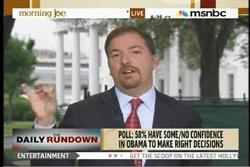
NBC’s Chuck Todd Trumpets Flawed Election Poll, Parrots Democratic Talking Points

NBC Political Director Chuck Todd cherrypicked a recent Washington Post-ABC News poll to dismiss the possibility that Republicans will regain control of Congress in the November election. He did this despite evidence within the same poll that the political landscape in 2010 resembles 1994, when Republicans picked up 54 seats to take control of the House. On the July 13 “Morning Joe,” Todd emphasized the finding that 72 percent of the country has either “just some” or no confidence at all in the ability of congressional Republicans to “make the right decisions for the country’s future.” “This wild card about this election cycle which makes it different from ’06, which makes it different from ’94, is this issue of the public’s view of the Republican Party,” insisted Todd. The poll is misleading for a number of reasons, none of which Todd acknowledged. First, measuring public confidence in President Barack Obama, congressional Democrats, and congressional Republicans, the pollsters grouped respondents who reported “a great deal of confidence” with “a good amount,” and “just some” confidence with “none at all.” This aggregation resulted in a higher percentage of Americans expressing some or no confidence at all in Republicans than in Obama. But grouping “just some” respondents with “none at all” respondents does not make sense because expressing some confidence is much different from expressing “none at all.” If the pollsters had grouped those who reported “a good amount” of confidence with those who reported “just some” confidence, Republicans in Congress would have received 61 percent support, 14 points higher than Obama. Second, Todd’s insinuation that the public preferred congressional Republicans to congressional Democrats in 1994 but not in 2010 contradicts the same poll he cited to advance the argument that Republicans will not maximize their gains in November. As of July 11, 2010, voters prefer congressional Republicans 47 percent and congressional Democrats 46 percent, a negligible difference. By contrast, on August 8, 1994, 49 percent of the public preferred congressional Democrats while only 42 percent of the public preferred congressional Republicans, a seven point edge. In fact, the public preferred congressional Democrats over congressional Democrats in every Washington Post-ABC News poll taken through the November election. MSNBC host Joe Scarborough challenged Todd on the preference issue, asking, “Aren’t these off-year elections really just an opportunity for Americans to vote up or down for the most part on the party in power, the party that’s running Washington?” Todd, seemingly uninterested in demonstrable trends, insisted that the White House and Democrats are capable of turning the election into something other than a referendum on their liberal agenda. An obstinate Todd continued to rain on the GOP’s parade. “Joe, I think it’s the difference between picking up 25 or 30 seats and picking up 40 seats,” he insisted. NBC’s chief political junkie was all too eager to report the results of a poll forecasting sobering prospects for Republicans without scrutinizing the data or researching relevant historical trends. A transcript of the relevant portion of the segment can be found below: MSNBC Morning Joe July 13, 2010 7:24 A.M. E.S.T. JOE SCARBOROUGH: Hey Chuck, let me ask you something. Of course let’s put up the polls really quickly again from the Washington Post and then I’m going to follow it up with some news you say may not as good for Republicans. First of all, let’s look at the polls. Sixty-eight percent of Americans have little confidence in Democrats; Seventy-two percent, Republicans. Of course we talk about 58 percent, Barack Obama. Now let’s go to the four reasons why you say Republicans may not take back the House in the fall. You wrote about this yesterday and it’s very fascinating. You said the favorable ratings the same as the Democrats. And you are exactly right. In fact, in this case it’s even worse for Republicans than Democrats. But I guess the bigger question is – and I want to get Mark’s thoughts on this as well – aren’t these off-year elections really just an opportunity for Americans to vote up or down for the most part on the party in power, the party that’s running Washington? CHUCK TODD, MSNBC political director: Most of the time they are, and for many voters, this will be the case. This wild card about this election cycle which makes it different from ’06, which makes it different from ’94, is this issue of the public’s view of the Republican Party. And the reason you have to sit there and not ignore it is look at what the message the White House is trying to drive. Look at the message that Democratic candidates in congressional races are trying to drive, which is saying, “okay, you may be mad at us, but look at them.” And look, when you already have 70 percent of the public having a negative view, you can sell that story – you have a better chance of selling the story. SCARBOROUGH: Does that work when Democrats – it’s a monopoly though in Washington though. I guess that’s why it’s so much harder to sell. Listen in ’94 the Republicans actually had a plan. We haven’t seen that yet from this group of Republicans. I guess the bigger question, Chuck is, can you beat something with nothing?    TODD: Joe, I think it’s the difference between picking up 25 or 30 seats and picking up 40 seats and 10 seats in the Senate. Do you see what I’m saying? I think the difference between having a good election night and the majority is somehow starting to improve their favorable rating, and starting to go out there and saying, “we have a plan.” And right now they don’t have that and I think that’s what’s keeping them from getting the entire enchilada here. –Alex Fitzsimmons is a News Analysis intern at the Media Research Center. Click here to follow him on Twitter.

Here is the original post:
NBC’s Chuck Todd Trumpets Flawed Election Poll, Parrots Democratic Talking Points