Tag Archives: nirvana

Nirvana’s Rise To Fame, In Their Own Words

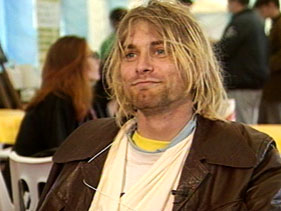
MTV News reveals the Nevermind You Never Knew with a week of 20th-anniversary coverage. By James Montgomery Nirvana’s Kurt Cobain in 1991 Photo: MTV News “What are we about? Oh, we’re just this crazy rock and roll band.” That was wild-haired Nirvana bassist Krist Novoselic’s summation of the band during their first interview with MTV, on September 30, 1991, and he wasn’t just being modest. At the time, their Nevermind album had been in stores for less than a week, the video for “Smells Like Teen Spirit” had just premiered on “120 Minutes” and, really, outside of a few hardy souls in the Pacific Northwest (and various in-the-know journos), no one had really heard of Nirvana, the band that would come to “define an era,” “change the world” or any other hyperbole that would (rightfully) be showered upon them. Back then, they were just another “crazy rock and roll band,” one that was just beginning the voyage from underground to mainstream. Twenty years later, we still marvel at how far they managed to get, and how symbolic that trek truly was. And though they’d released their debut album in 1989, for all intents and purposes, Nirvana’s story really began with Nevermind, which, though it may seem incomprehensible to anyone who lived during the halcyon days of 1991, turns 20 on Saturday. In honor of that anniversary, and the moment where the foundations of rock and popular culture fundamentally shifted, we’re rolling out a week’s worth of coverage — exploring the impact of Nirvana and their wondrous, groundbreaking album, talking to folks who were there the moment everything went global and, of course, mining our tape libraries to unearth rare moments that show Nirvana as they really were: three rather scruffy, decidedly playful guys who often seemed at odds with their own success. Or, as Kurt Cobain put it in a 1993 interview with MTV News: “I wanted to have the adoration of John Lennon but have the anonymity of Ringo Starr. I didn’t want to be a frontman; I just wanted to be back there and still be a rock and roll star at the same time.” To kick things off, we decided to look back at Nirvana’s meteoric rise to fame, as told by the band itself. The above video compiles quotes taken from our vault of Nirvana interviews, starting with that first sit-down and continuing on to the release of their final studio album, 1993’s In Utero. It’s a story that’s been told thousands of times before — as most great tales have been — but never by the members of Nirvana, in their own words. It is appropriately raw, unwashed and revelatory. Just like Nevermind was when it burst forth 20 years ago … and, like all classics, how it still is today. Stick with MTV News all week as we reveal the Nevermind You Never Knew , celebrating the 20th anniversary of Nirvana’s definitive album with classic footage, new interviews and much more. Related Videos Nirvana: The Nevermind You Never Knew Related Photos Kurt Cobain: A Life In Photos Related Artists Nirvana
Follow this link:
Nirvana’s Rise To Fame, In Their Own Words
Skrillex, Foster The People Remember 1991: When Rock Rocked

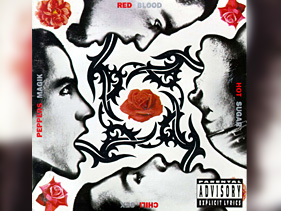
With the 20th anniversary of Nirvana’s Nevermind around the corner, today’s biggest acts recall 1991’s other classic albums. By James Montgomery Red Hot Chili Peppers’ Blood Sugar Sex Magik Photo: Warner Bros. In a few short weeks, Nirvana’s epochal Nevermind album turns 20, a milestone that will be marked with much coverage, celebration and consternation in the media — and understandably so. After all, it was a game-changer in every sense of the term, the kind of album that brought about seismic shifts in music, fashion and culture in general, one that defined a generation and, as such, deserves to be mythologized. And, in the coming weeks, we suspect you’ll see no shortage of stories that do just that. While Nevermind casts an indelibly lengthy shadow, it bears mention that there were no shortage of other magical, massive and equally mythological albums that hit stores in 1991 — from mega-platinum rock blockbusters to best-kept indie secrets, and just about everything in between — classics that, had Nirvana never broken through, would probably be getting the royal treatment right now. In 1991, rock truly rocked, so, in celebration of that fact, we’ve asked some of today’s biggest bands to discuss their favorite albums from that rather amazing year. On Wednesday, we heard from Death Cab for Cutie and Blink-182 ; now, Skrillex and Foster the People share their faves. Don’t worry, we’ll give Nevermind its due — but right now, we’re paying tribute to 1991’s other indispensible albums, in the words of their biggest fans. Metallica, The Black Album The one where “old” Metallica ended and “new” Metallica began — at least according to the die-hards — the band’s fifth studio album (it’s technically self-titled, though, come on, who doesn’t call it The Black Album ?) saw them drifting away from their slash-and-burn thrash-metal past into a new, decidedly fuller phase, one fleshed out with orchestral flourishes and an increased focus on the booming rhythm section of Jason Newstead and Lars Ulrich. Though its recording was plagued by battles with producer Bob Rock, The Black Album features the band’s most iconic songs — “Enter Sandman,” “The Unforgiven,” “Nothing Else Matters,” etc. — and remains their best-selling to date, moving a staggering 22 million copies worldwide. Love it or hate it, you can’t deny its impact, both on the band and the next two decades of hard rock. As Remembered by Skrillex : “Man, The Black Album was me sitting in my room when I was 9 years old, trying to learn all the songs on guitar. That was, for me, rocking out, no reservations, like I was on the stage. And learning the ‘Holier Than Thou’ riff was, like, the biggest achievement, because it’s so hard. Every record on that album is so amazing. … Obviously, ‘Enter Sandman,’ ‘Wherever I May Roam’ … that was the first Metallica song I learned, after ‘Enter Sandman.’ I love The Black Album. It’s perfect; it’s a masterpiece in every way, from front to back, and it’s inspired me, consciously or subconsciously, because I had such a connection to it.” Red Hot Chili Peppers, Blood Sugar Sex Magik One of the most important, celebrated albums of the ’90s alt-rock explosion, Blood Sugar saw the Chili Peppers grow up, get deep and, of course, become hugely famous. While songs like “Give It Away” and “Suck My Kiss” still bobbed and weaved with the band’s visceral energy, it was on tracks like the massive “Under the Bridge” and “Breaking the Girl” where they slowed things down and found their biggest commercial successes. Recorded by producer Rick Rubin in a supposedly haunted mansion in Laurel Canyon, its creation has become the stuff of rock legend, and though the Peppers would subsequently sag beneath its success (guitarist John Frusciante, unable to cope with his sudden fame, quit the band mid-tour) Blood Sugar still stands as perhaps the finest accomplishment of their 28-year career. It would be nearly four years before they released a follow-up, though, given the album’s hugely influential status, you really couldn’t blame them. As Remembered by Mark Pontius, Foster the People : “My favorite record of 1991, and I think the only reason I got this record was my sister had it, and she’s older than me, so it just sort of fell into my lap, is Red Hot Chili Peppers’ Blood Sugar Sex Magik. I think I have to credit that record [for teaching me] a lot of my drumming skills. I loved playing their records, and that one always stuck out to me. It had so much grit, and that was rock and roll at that time of my life.” What is your favorite 1991 rock album? Let us know in the comments below! Related Videos Death Cab, Blink-182, Skrillex Remember Classic Albums From 1991 Related Artists Skrillex Red Hot Chili Peppers Foster the People Metallica Nirvana

Original post:
Skrillex, Foster The People Remember 1991: When Rock Rocked

Watch: Lil Wayne’s VMA Promo Vid, Ross Signs DJ Scream, Fabolous’ Nate Dogg Tribute

http://www.youtube.com/v/oPITAgG2cPA

Read the original post:

Lil Wayne the rockstar shot this quick clip for MTV’s upcoming 2011 VMA awards, which takes place on Aug. 28 at 9:00PM ET. Paying homage to Nirvana and several music legends in this montage. Tune also had something new leak that was produced by Bangladesh. more from Rick Ross and Fabolous after the jump… Rick Ross confirms signing Broadcasting platform : YouTube Source : MissInfo.tv Discovery Date : 02/08/2011 15:34 Number of articles : 2

Watch: Lil Wayne’s VMA Promo Vid, Ross Signs DJ Scream, Fabolous’ Nate Dogg Tribute

Watch: Lil Wayne’s VMA Promo Vid, Ross Signs DJ Scream, Fabolous’ Nate Dogg Tribute

http://www.youtube.com/v/oPITAgG2cPA

Read more here:

Lil Wayne the rockstar shot this quick clip for MTV’s upcoming 2011 VMA awards, which takes place on Aug. 28 at 9:00PM ET. Paying homage to Nirvana and several music legends in this montage. Tune also had something new leak that was produced by Bangladesh. more from Rick Ross and Fabolous after the jump… Rick Ross confirms signing Broadcasting platform : YouTube Source : MissInfo.tv Discovery Date : 02/08/2011 15:34 Number of articles : 2

Watch: Lil Wayne’s VMA Promo Vid, Ross Signs DJ Scream, Fabolous’ Nate Dogg Tribute

Watch: Lil Wayne’s VMA Promo Vid, Ross Signs DJ Scream, Fabolous’ Nate Dogg Tribute

http://www.youtube.com/v/oPITAgG2cPA

See the original post here:

Lil Wayne the rockstar shot this quick clip for MTV’s upcoming 2011 VMA awards, which takes place on Aug. 28 at 9:00PM ET. Paying homage to Nirvana and several music legends in this montage. Tune also had something new leak that was produced by Bangladesh. more from Rick Ross and Fabolous after the jump… Rick Ross confirms signing Broadcasting platform : YouTube Source : MissInfo.tv Discovery Date : 02/08/2011 15:34 Number of articles : 2

Watch: Lil Wayne’s VMA Promo Vid, Ross Signs DJ Scream, Fabolous’ Nate Dogg Tribute

Was Amy Winehouse Crushed By Sudden Fame?

The kind of sudden popularity Winehouse achieved can be disorienting and paralyzing, experts say. By Gil Kaufman Amy Winehouse Photo: Dave Hogan/ Getty Images Some stars seem born to be in the spotlight, thriving in the attention and adulation of their adoring fans and finding a way to navigate the downsides of intense public scrutiny with seeming ease. Others, such as troubled singer Amy Winehouse , appear to have difficulty handling the harsh spotlight and retreat into a destructive cycle of substance abuse and self-harm from which they never return. Winehouse died at age 27 on Saturday. And though her cause of death has not been determined, it would seem with her sadly short career, which saw her rocket from obscurity in 2006 to tragic demise just five years later, she is the latest example of an artist for whom fame was to be too much, too soon. “Anyone who is thrust into that kind of celebrity with that kind of attention needs a solid, well-built foundation and support system that they can wrap around them like a blanket,” said Dr. Charles Sophy, a psychiatrist who has appeared on VH1’s “Celebrity Rehab” and “The Housewives of Beverly Hills” and is the author of a new book on conflict-free communication for mothers and daughters, called “Side by Side.” “If you don’t have those key elements, you’re more likely to implode and hit a wall,” Sophy said. Read what Winehouse producer Salaam Remi had to say about working with the singer. Winehouse, a child of divorce, appeared drawn to destructive personal relationships — including a tumultuous marriage to Blake Fielder-Civil that resulted in a number of public spats and arrests. To the public at least, it seemed she lacked some of the foundation Sophy says is necessary. And though it’s impossible for outside observers to know for sure, Sophy speculated that genetics may have also played a part in Winehouse’s difficulty in dealing with fame, especially if there is a history of addiction or mental health issues in her family. “If those things are not dealt with, then they are huge issues too,” he said. “And if all that hits at once, you need coping skills and if those aren’t there …” Though her legend was based almost entirely on a single album, 2006’s Back to Black, which spawned just two singles that charted in the U.S. — “Rehab” and “You Know I’m No Good” — Winehouse was among the few young women in recent pop history to have attained worldwide critical and commercial success only to either spin out or retreat in the face of the rigors of fame. Some, such as former Fugees star Lauryn Hill, continue to perform sporadically, but have been unable (or unwilling) to release a proper follow-up. Others, like Alanis Morissette, survive their moment and go on to solid careers that never quite reach the same zenith. And some live somewhere in between, such as Courtney Love, who cracked up for years before getting clean and continuing her career at a lower orbit, or Fiona Apple, who seemed uninterested in playing the fame game and retreated into privacy, releasing just three albums over a 15-year career. None of those examples really fit the Winehouse mold, though, according to Jenny Eliscu, a Sirius satellite radio host and Rolling Stone contributing editor who profiled Winehouse for the magazine in 2007, as the singer’s star was about to go supernova. “It would be easy and understandable to think that this is a phenomenon that afflicts female artists, but the parallel that makes the most sense for me is Kurt Cobain,” she said of the troubled Nirvana singer, who committed suicide at age 27, after years of battling with drugs and struggling to deal with the limelight. “He had a band to say, ‘What the f—?’ But when you’re solo, it’s entirely your own operation with no one there to keep you in check,” Eliscu said. “You can languish in your problems. … It’s easy to get in your own cave.” Even if you’re not abusing drugs or alcohol, getting it together to make a follow-up to a huge album is hard. But Eliscu said that if you compound that with the loneliness of being a solo artist, particularly one who probably never expected her authentically pained music to reach such a wide audience, you have a recipe for major trouble. For every Britney Spears and Lindsay Lohan who spin out after achieving early celebrity, there are Justin Timberlakes and Taylor Swifts, who appear able to handle the pressure. Sophy said that could be because they have that support system in place early on to help them deal with the pressure. “Someone who is 27 is not necessarily 27 years old emotionally,” said Sophy. “A 27-year-old can often act like an 18-year-old, because oftentimes addicts stop growing emotionally at the age they started using.” Even if, as father Mitch Winehouse said in a statement released after Amy’s funeral, his daughter had been drug-free for three years, Sophy said it can take a long time for the brain’s chemistry to return to normal long after a patient leaves rehab. Sophy said that any artist who puts themselves in the spotlight is taking a huge risk, regardless of their sobriety. As they look for affirmation that they’re talented enough, once success begins coming in a rush, it can make them doubt their skills more than ever. “When they hit it and it becomes a big thing, then there’s more pressure on them and their self-esteem, which might have been an issue to begin with and that’s a bigger mountain to climb,” Sophy explained. It’s hard for even the most self-assured person to say, “I’m really good at this,” and so, Sophy said, when that doubt creeps in while the world is watching, it sometimes makes it difficult to stay on the straight and narrow without self-medicating or finding some other way to cope with the pressure.

‘Weird Al’ Yankovic: Return Of The King

With his new Alpocalypse album in stores, Bigger Than the Sound pays tribute to the King of the Pop Parody. By James Montgomery Weird Al is his “Perform This Way” video Photo: Sony Music Entertainment I often tell people the first cassette I bought with my own money was the Beastie Boys’ License to Ill. This is, of course, a lie: It was actually ” Weird Al” Yankovic ‘s 1986 album Polka Party!, which featured classics like “Living With a Hernia,” “Addicted to Spuds” and “Toothless People,” a send-up of Mick Jagger’s “Ruthless People” that Wikipedia rather fastidiously describes as “a song that focuses around elderly people who are missing their teeth.” You can probably understand the reason I’ve lied about it for all these years — Weird Al has never exactly been the coolest guy in the world, after all — but since I’m coming clean now, I’d also like to admit that the second and third cassettes I ever bought were Yankovic’s, too: his self-titled 1983 debut (I’d spend hours studying its illustrated cover , mostly because I didn’t have many friends) and the follow-up, In 3-D, which won Al a Grammy for his food-centric take on Michael Jackson’s “Beat It,” a song called, appropriately enough, “Eat It.” Shoot, eventually, I owned all the early Al cassettes: Dare to Be Stupid, Even Worse (I remember recording the video for “Fat” off this very channel), the “UHF” soundtrack. I used to carry them around in one of those little suitcases and listen to them on my Walkman during family vacations (they definitely made the trip to Boca Raton that one year). My parents were probably worried about me. And if they weren’t, well, they probably should have been. Of course, as is the case with most things, I eventually grew out of my Weird Al phase. The last album of his I ever bought was 1992’s Off the Deep End (the one with “Smells Like Nirvana” on it), and truth be told, I haven’t listened to a single thing he’s done since, aside from the occasional single (“Amish Paradise,” “White & Nerdy”) that somehow managed to perforate the pop-culture membrane. Instead, I slowly became obsessed with so-called real music — bands like Nirvana and the Breeders, Tortoise and Pavement, Built to Spill and Modest Mouse. I’ve continued down that path ever since, which is why I’m supposed to be obsessed with the new Bon Iver album (which, thanks to songs like “Beth/Rest,” is sort of like a Weird Al record, really), even though I’m really not. Since we parted ways, Al has released six full-length albums, the most recent of which ( Alpocalypse ) hit stores on Tuesday (June 21). I haven’t heard it, even though I’ve been told most of the songs have been floating around online for months. Chances are, you haven’t either, though perhaps you have heard the Lady Gaga parody and seen the accompanying music video. The latter is not terribly great, mostly because the CGI makes it feel almost un -Al, but still, I suppose that doesn’t really matter much. If Weird Al is anything, he’s critic-proof. But in the days since the Alpocalypse, I’ve found myself thinking back to the days when Yankovic was my favorite artist, and I’ve realized something rather fascinating: Basically everything I know about popular music, I learned from Weird Al. This was mainly because, as an 8-year-old, I didn’t view songs like “The Brady Bunch,” “The King of Suede” or “I Want a New Duck” as parodies of popular hits, mostly because I had never heard the originals. I wasn’t smart enough to pick up the nods to bands like Devo and Oingo Boingo on tracks like “Dare to Be Stupid” and “You Make Me,” because, you know, I was 8. I certainly didn’t get the joke behind “(This Song’s Just) Six Words Long,” because vapidity wasn’t a concept I was familiar with. Shoot, the first time I heard some of the Rolling Stones’ best cuts was when Al covered them on “The Hot Rocks Polka.” In short, almost all of his songs were originals to me. They’re how I learned about stuff like verse-chorus structure and solos and synthesizers. They’re probably why I’d go on to appreciate the slightly skewed work of Beck and Ween (and they’re definitely why I love “Your Party” as much as I do). And if you want to dig even deeper, Yankovic’s parodies are about the earliest example of the so-called “DIY” aesthetic I ever knew; they’re practically punk rock, inasmuch as they represent Al shooting down some of the era’s most Sacred Cows, and doing it on his own terms, repercussions be damned. So, yes, in a lot of ways, I owe everything to “Weird Al” Yankovic. And while I can certainly laud him as the king of the song parody, or point out the fact that he basically laid the groundwork for everything the Lonely Island guys (and 95 percent of the Internet) do these days, I think the most fitting tribute to his greatness is to simply say that without him, I’d probably be working in a bank somewhere. His albums made me love popular music, and I’m pretty sure I’m not the only one who can make that claim. I may not listen to him anymore, but I’ll remain forever loyal. Long live the king. Did Weird Al influence your musical tastes? Let us know in the comments below!

View original post here:
‘Weird Al’ Yankovic: Return Of The King

‘Weird Al’ Yankovic: Return Of The King

With his new Alpocalypse album in stores, Bigger Than the Sound pays tribute to the King of the Pop Parody. By James Montgomery Weird Al is his “Perform This Way” video Photo: Sony Music Entertainment I often tell people the first cassette I bought with my own money was the Beastie Boys’ License to Ill. This is, of course, a lie: It was actually ” Weird Al” Yankovic ‘s 1986 album Polka Party!, which featured classics like “Living With a Hernia,” “Addicted to Spuds” and “Toothless People,” a send-up of Mick Jagger’s “Ruthless People” that Wikipedia rather fastidiously describes as “a song that focuses around elderly people who are missing their teeth.” You can probably understand the reason I’ve lied about it for all these years — Weird Al has never exactly been the coolest guy in the world, after all — but since I’m coming clean now, I’d also like to admit that the second and third cassettes I ever bought were Yankovic’s, too: his self-titled 1983 debut (I’d spend hours studying its illustrated cover , mostly because I didn’t have many friends) and the follow-up, In 3-D, which won Al a Grammy for his food-centric take on Michael Jackson’s “Beat It,” a song called, appropriately enough, “Eat It.” Shoot, eventually, I owned all the early Al cassettes: Dare to Be Stupid, Even Worse (I remember recording the video for “Fat” off this very channel), the “UHF” soundtrack. I used to carry them around in one of those little suitcases and listen to them on my Walkman during family vacations (they definitely made the trip to Boca Raton that one year). My parents were probably worried about me. And if they weren’t, well, they probably should have been. Of course, as is the case with most things, I eventually grew out of my Weird Al phase. The last album of his I ever bought was 1992’s Off the Deep End (the one with “Smells Like Nirvana” on it), and truth be told, I haven’t listened to a single thing he’s done since, aside from the occasional single (“Amish Paradise,” “White & Nerdy”) that somehow managed to perforate the pop-culture membrane. Instead, I slowly became obsessed with so-called real music — bands like Nirvana and the Breeders, Tortoise and Pavement, Built to Spill and Modest Mouse. I’ve continued down that path ever since, which is why I’m supposed to be obsessed with the new Bon Iver album (which, thanks to songs like “Beth/Rest,” is sort of like a Weird Al record, really), even though I’m really not. Since we parted ways, Al has released six full-length albums, the most recent of which ( Alpocalypse ) hit stores on Tuesday (June 21). I haven’t heard it, even though I’ve been told most of the songs have been floating around online for months. Chances are, you haven’t either, though perhaps you have heard the Lady Gaga parody and seen the accompanying music video. The latter is not terribly great, mostly because the CGI makes it feel almost un -Al, but still, I suppose that doesn’t really matter much. If Weird Al is anything, he’s critic-proof. But in the days since the Alpocalypse, I’ve found myself thinking back to the days when Yankovic was my favorite artist, and I’ve realized something rather fascinating: Basically everything I know about popular music, I learned from Weird Al. This was mainly because, as an 8-year-old, I didn’t view songs like “The Brady Bunch,” “The King of Suede” or “I Want a New Duck” as parodies of popular hits, mostly because I had never heard the originals. I wasn’t smart enough to pick up the nods to bands like Devo and Oingo Boingo on tracks like “Dare to Be Stupid” and “You Make Me,” because, you know, I was 8. I certainly didn’t get the joke behind “(This Song’s Just) Six Words Long,” because vapidity wasn’t a concept I was familiar with. Shoot, the first time I heard some of the Rolling Stones’ best cuts was when Al covered them on “The Hot Rocks Polka.” In short, almost all of his songs were originals to me. They’re how I learned about stuff like verse-chorus structure and solos and synthesizers. They’re probably why I’d go on to appreciate the slightly skewed work of Beck and Ween (and they’re definitely why I love “Your Party” as much as I do). And if you want to dig even deeper, Yankovic’s parodies are about the earliest example of the so-called “DIY” aesthetic I ever knew; they’re practically punk rock, inasmuch as they represent Al shooting down some of the era’s most Sacred Cows, and doing it on his own terms, repercussions be damned. So, yes, in a lot of ways, I owe everything to “Weird Al” Yankovic. And while I can certainly laud him as the king of the song parody, or point out the fact that he basically laid the groundwork for everything the Lonely Island guys (and 95 percent of the Internet) do these days, I think the most fitting tribute to his greatness is to simply say that without him, I’d probably be working in a bank somewhere. His albums made me love popular music, and I’m pretty sure I’m not the only one who can make that claim. I may not listen to him anymore, but I’ll remain forever loyal. Long live the king. Did Weird Al influence your musical tastes? Let us know in the comments below!

See the article here:
‘Weird Al’ Yankovic: Return Of The King

Do Foo Fighters Know Robert Pattinson From Robert Plant?

During band’s rehearsal break for Sunday’s Movie Awards, we put Foos to the test. By Ryan J. Downey The Foo Fighters’ Dave Grohl Photo: MTV News UNIVERSAL CITY, California — Hard rock, heavy metal, hardcore and punk have long gone hand-in-hand with evil wizards, magic, vampires and werewolves. And with a collective sub-cultural pedigree that includes stints in the Germs, No Use for a Name, Sunny Day Real Estate, Scream and some band called Nirvana, you’d think the Foo Fighters — set to perform at Sunday’s Movie Awards — would know their “Potter” from their Zeppelin. Certainly they can recognize a “wand” reference and pinpoint its origin? Right? Before we put MTV News’ magically crafted trivia to the band, it seemed safe to assume the Foos would accurately distinguish between the words of Harry Potter, a “Twilight” character and Led Zeppelin. But was their underground nerd cred blown to shreds? Read on — and click the video! — to see how the Foo Fighters fared when we caught up with them on the Universal Studios lot, shortly after they finished rehearsing their Movie Awards performance. Our own Jim Cantiello played dungeon master as Dave Grohl, Nate Mendel, Taylor Hawkins, Chris Shiflett and Pat Smear were given a series of semi-famous lines and asked whether they originated with “Harry Potter,” the “Twilight Saga” or the lyrics of hard-rock pioneers Led Zeppelin. Here’s a sampling of a few of those one-liners:

Death Cab For Cutie’s Guide To Seattle: Coffee And Drum Lessons From Dave Grohl

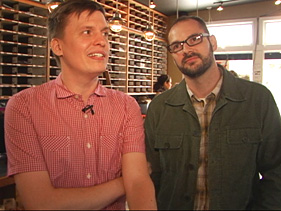
In part two of our ‘Seattle Sonics’ series, the band takes us to their Sip & Ship ‘nerve center’ and American Music shop. By James Montgomery Death Cab for Cutie’s Chris Walla and Jason McGerr Photo: MTV News SEATTLE — Chris Walla is a bit of a multitasker: That much is clear just by his rather prodigious output as a producer, solo musician and full-time member of Death Cab for Cutie . So it should probably come as no surprise that, for MTV News’ second edition of “Seattle Sonics,” Walla decided to take us to one of his favorite spots in Seatown: Sip & Ship, the kind of place that defines multitasking. See, S&S is the sort of place that seemingly only exists in Seattle: A communal, cozy combination shipping depot/coffee bar that also happens to be a gift shop. Oh, and they make a mean grilled cheese, too. Located in the city’s Ballard neighborhood — right down the block from a nefarious FedEx Office outpost — Walla first visited the shop six years ago (after a rather terrible experience at said FedEx), and in the time since, Sip & Ship has become the de facto home office for all things Death Cab. Merch, master tapes of albums, musical instruments and the occasional eBay purchase all pass through S&S. Walla has become close friends with the shop’s owners (one of them, Diana Naramore, even made a cameo in his “Sing Again” video ) and the coffee’s really great, too. “This place has become a communications and shipping and caffeine and calorie hub without which I don’t think Death Cab for Cutie would actually be able to do any business at all. This is one of the Seattle nerve centers of the band,” Walla explained. “We did a whole series of test-pressings for the new record, and we got four or five shipments of them here. We’d pick ’em up and then go home and listen to records.” Drummer Jason McGerr also chimed in: “It’s a far safer bet than my doorstep — which I don’t even step on all that often,” he said, laughing. And while Sip & Ship has been an important cog in the Death Cab machine for six years, there’s another spot nearby that’s been part of their lives for much longer: American Music, a Seattle institution since it first opened its doors in 1973 and the place where local bands (you know, like Nirvana, Soundgarden and Alice in Chains) went to get their gear. It’s not surprising that both Walla — who grew up nearby — and McGerr — who worked there in 1994, when he was 19 years old — chose it as the next place they took our cameras. “I traded all my paychecks for equipment, and I got to know a whole lot of local drummers,” McGerr said from his old post behind the American counter. “And there were times, 10 minutes before close, Dave Grohl would come in and sit down and just start blowing on drums and the front door would shut and we’d sit there and watch him. … There was always a scene happening within the store. If you played music and you got your supplies in Seattle, it was from American Music.” And American was also where you’d find Walla hanging out as a slightly awkward teenager, doing “double drummer stuff” with friend (and former Death Cab drummer) Nathan Good. And he did it mostly out of necessity, because back then, there weren’t many places 15-year-old music obsessives could hang out, due mostly to Seattle’s oppressive Teen Dance Ordinance , which made all-ages shows all but impossible to organize. And, really, to Walla, that’s what makes the place much more than a music store. It’s sort of his home away from home. “I got a lot of stuff here that was cast-off junk, but I still use it,” Walla said. “There are tons of music stores that are just enormous boxes, that are full of guitars and drums and cymbals and whatever, and they might have more stock than a place like American does, but American has the heart and soul of a music store that I want when I walk into a music store.” Death Cab for Cutie: Seattle Sonics continues all week on MTVNews.com. On Thursday, we’ll head to a vaunted (and now defunct) all-ages venue where DCFC learned how to be a band — and still made it home in time for curfew. Related Videos Death Cab For Cutie’s Guide To Seattle Related Artists Death Cab For Cutie

Link:
Death Cab For Cutie’s Guide To Seattle: Coffee And Drum Lessons From Dave Grohl