Tag Archives: nirvana

Nirvana’s ‘Smells Like Teen Spirit’ Video: Behind The MTV Premiere

Onetime ‘120 Minutes’ host Dave Kendall relives that Sunday night the generation-defining clip debuted. By James Montgomery, with reporting by Andréa Duncan-Mao Kurt Cobain Photo: Frank Micelotta/Getty Images On September 29, 1991, Nirvana’s “Smells Like Teen Spirit” video premiered on MTV’s “120 Minutes,” an event that, in the years that followed, would come to signify the beginning of rock’s great renaissance and usher in a cultural shift that would define a generation. Of course, back then, it was just another video on another Sunday night, and no one — not even “120” host Dave Kendall — thought otherwise. “I have to say, quite honestly, as soon as I heard that record and saw that video, I had no idea they were going to be as huge as they were,” he laughed. “I was very, very impressed. I was moved but I really didn’t have any idea it would explode to the extent it did. There’s the truth.” To be fair, no one did. And so, in celebration of the 20th anniversary of the album “Teen Spirit” was meant to promote — Nevermind, of course — MTV News spoke with Kendall about the days before Nirvana became the biggest band in the world and about the alt-rock explosion that followed in their immediate wake. Needless to say, once “Teen Spirit” hit, everything changed and, as host of “120,” he had a front-row seat for all of it. “At that time, most of the music ‘120’ was playing was quite separate from the rest of MTV. Some stuff had crossed over — like, we played Midnight Oil, we played Sinead O’Connor, we played Depeche Mode, the Cure — but a lot of our stuff was really closeted. It was still in this ‘alternative’ genre,” he explained. “So the mood in the building at that point was ‘Some alternative acts might cross over, the others wouldn’t.’ Like, if MTV had known that Nirvana was going to be as huge as they [were], they would’ve world-premiered the video in prime time, not late-night Sunday on ‘120 Minutes.’ But then, I didn’t know either!” And how could he? After all, since creating “120 Minutes” in 1986 (and beginning hosting duties soon after), Kendall had been focused on trying to find bands he loved — “I was a bit stuck in my Anglo-centric, industrial, techno-pop mode,” he laughed — and hadn’t been paying attention to the storm that was brewing in the Pacific Northwest. So when the “Teen Spirit” video appeared at MTV, he’d never even heard of the band that would subsequently change the world. “I hadn’t heard Bleach, I wasn’t that aware of new, American rock … when I first heard the Nevermind record,” he said. “I thought it was going to be another Seattle record, so I was a little suspicious and a little resistant to it because I thought it was going to be a lot of guitars, sort of a ’70s feel. I didn’t think it was going to be something new,” he continued. “And then when I heard it, I knew I’d been wrong. It wasn’t just heavy, it wasn’t just rock, it was real melancholy, real passion, real vulnerability, the way it married intense rage with deep melancholy and sadness. And that really touched me.” Little did Kendall know that within a year the “Smells Like Teen Spirit” video would help bring “120 Minutes” to the mainstream and forever alter the show’s playlist too. It’s little wonder, then, that he’d leave the show the following year, though, with the benefit of 20 years’ worth of hindsight, he can finally appreciate everything that happened following the premiere of that one little video. And, much like the rest of us, Kendall’s still amazed by it all. “It definitely changed the landscape of alternative music at that point. It had become slightly more guitar-heavy over the previous couple of years, partly because of the Seattle grunge influence, but that was the record that ushered in the ‘grunge era’ into the ‘alternative mainstream,’ ” he said. “It brought guitars back into the music, and took the emphasis away from keyboards and synthesizers. It was gutsy and heavy and authentic, and that’s what changed the landscape. Nirvana opened people’s eyes.” Stick with MTV News as we reveal the Nevermind You Never Knew , celebrating the 20th anniversary of Nirvana’s definitive album with classic footage, new interviews and much more. Related Artists Nirvana

See more here:
Nirvana’s ‘Smells Like Teen Spirit’ Video: Behind The MTV Premiere

Nirvana Recall The Other ‘Smells Like Teen Spirit’ Video

Kurt Cobain was disappointed with the first version — so he went in and edited it himself. By Gil Kaufman Kurt Cobain Photo: MTV News It’s one of the most iconic videos in music history, up there with Michael Jackson’s “Thriller,” Madonna’s “Like a Virgin” or Lady Gaga’s “Bad Romance.” But to hear late Nirvana singer Kurt Cobain tell it, he wasn’t that happy with how the final version of “Smells Like Teen Spirit” turned out, which is why he went in at the last minute and tweaked it himself. “Although it worked … I like the video overall, but it wasn’t what I pictured in my mind,” Cobain said in a December 13, 1993, interview with MTV News about the clip that helped launch a rock revolution and turned his band into unwitting grunge poster children. “When I come up with an idea for a video, I want it to be translated exactly how I see it in my mind … and it just wasn’t that way.” Nirvana’s rise to fame, in their own words. Cobain — who was notoriously hands-on with all the imagery associated with the band, including creating the artwork for their album covers — said Nirvana just didn’t take enough time to prep themselves for the shoot. “We didn’t prepare ourselves enough to have as much control as we wanted to,” he explained, perhaps alluding to the fact that the clip was the first one the band filmed after making the huge leap from cash-strapped Seattle indie label Sub Pop to major label Geffen/DGC as a still mostly unknown new act. Cobain described walking in on the first day of shooting of the video — for the first single from what would become their smash breakthrough, 1991’s Nevermind — with director Sam Bayer (Green Day, Justin Timberlake, The Strokes) and realizing that the set did not look as he had imagined or drawn in his storyboarding for the clip. “I told him what I wanted, I drew pictures of it, and I walked in and it wasn’t what I wanted,” Cobain said. “It looked like a Time-Life commercial to me, with that backdrop, it just looked like such a contemporary … you know those kind of commercials where people are sitting there trying to sell aspirin or something? Or an AT&T commercial? That’s what it looked like to me; it looked too contemporary.” Even though he was disappointed with the look of the set, Cobain had high praise for the super-jacked real fans who were trucked in to fill out the bleachers in the studio for the exhausting 12-hour shoot. “Still, the kids made the video,” he said. “Even after Sam had edited it … he edited it and sent it to me and I didn’t like it, and I flew down at the last minute to L.A. and edited it myself. I threw in a few extra things which pretty much saved it.” Reluctant to toot his own horn (while, you know, totally tooting his own horn), Cobain added that there was “a lot of really good” footage that Bayer had shot that wasn’t used. “If a lot of that hadn’t been used, it would have been a really bad video,” he laughed, alluding to the shots of the (over) excited kids trashing the set. “There wasn’t really a lot of that, and most of the stuff that was used looked really contrived. There was no spontaneity in it. So I just threw all the spontaneous parts in.” Stick with MTV News all week as we reveal the Nevermind You Never Knew , celebrating the 20th anniversary of Nirvana’s definitive album with classic footage, new interviews and much more. Related Videos Nirvana: The Nevermind You Never Knew

Read the original:
Nirvana Recall The Other ‘Smells Like Teen Spirit’ Video

R.E.M. And Nirvana: The Kurt Cobain/Michael Stipe Connection

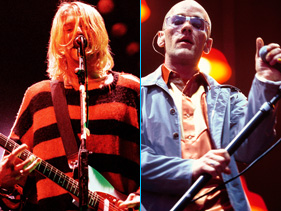
Bands’ intensely private singers had a unique relationship. By Gil Kaufman Kurt Cobain and Michael Stipe Photo: Getty Images Tony Bennett has been making the rounds this week promoting his new Duets II album and talking about how he wanted to save late singing partner Amy Winehouse by telling her to slow down, to take it from someone who’d already been there and had gotten the same advice from his idol, Frank Sinatra. That kind of been-through-the-fire mentoring is a time-honored tradition in the music world, one that came to mind again on Wednesday when long-running alt rock godheads R.E.M. announced they were packing it in after 31 years in the midst of the 20th anniversary celebration of Nirvana ‘s groundbreaking Nevermind album. You see, enigmatic R.E.M. singer Michael Stipe had been through the superstar crucible. The intensely private frontman who spent a good early portion of the band’s career mumbling his cryptic lyrics while hiding behind a scraggly veil of wavy hair knew all about the pressures of fame by the time Nirvana were having their world-exploding “Smells Like Teen Spirit” moment. One thing ends as the dawn of another is celebrated. It’s a rock circle of life that was clearly not planned, but has a very nice, round arc to it. It connects these two bands yet again, providing another reminder that it was because of the hard work of acts like R.E.M. that Nirvana was able to blast out of the Northwest and take on the world. The coincidental chapters also recalled the fact that Stipe had gone from indie darling to worldwide rock star just months before Nevermind hit in late 1991 thanks to the breakout success of “Losing My Religion,” the first single from R.E.M.’s seventh album, Out of Time. In the ensuing years, the two men would carry on a kind of public mutual-admiration society, as Nirvana singer Kurt Cobain went to great lengths to praise R.E.M.’s influence on his own band. And critics couldn’t help but notice how, like R.E.M., Nirvana had managed the tricky tightrope walk of retaining their indie edge while signing to a major label and making polished, pop-influenced music with gritty bite and uncompromising lyrical flavor. Stipe seemed to gladly take on the role of mentor, perhaps seeing in Cobain’s adoration tinges of the same relationship he had with his idol, punk godmother Patti Smith, whose influence Stipe praised publicly at every turn. “I don’t know how that band [R.E.M.] does what they do,” Cobain said in a 1994 Rolling Stone magazine interview. “God, they’re the greatest. They’ve dealt with their success like saints, and they keep delivering great music.” By 1994, Stipe, like many in Nirvana’s inner circle of friends and management, had grown concerned about Cobain’s dangerous drug spiral. In an attempt to try and bring Cobain back from the abyss, Stipe — the godfather of Cobain and wife Courtney Love’s only child, Frances Bean — planned a collaboration with the doomed grunge singer. “I was doing that to try to save his life. The collaboration was me calling up as an excuse to reach out to this guy. He was in a really bad place,” Stipe told Interview magazine earlier this year. “I constructed a project to try to snap Kurt out of a frame of mind. I sent him a plane ticket and a driver, and he tacked the plane ticket to the wall in the bedroom and the driver sat outside the house for 10 hours. Kurt wouldn’t come out and wouldn’t answer the phone.” The superstar hookup never happened and — like Neil Young, Smith and numerous others — Stipe was inspired to write a musical eulogy for Cobain, the moving 1994 song “Let Me In,” from the album Monster. Fittingly, that disc found R.E.M. adopting a grungier, harder-edge, distorted sound that went the opposite direction of their two more sedate, previous mainstream breakthrough efforts. Once again, the celebration of a beginning and a sad ending that can forever link these two legendary acts. Stipe grew gracefully into the role of alt-rock elder statesman, enduring the rigors of stardom with wit and confidence. “A wise man once said–‘the skill in attending a party is knowing when it’s time to leave,’ ” he wrote in a statement announcing the band’s end. “We built something extraordinary together. We did this thing. And now we’re going to walk away from it.” Cobain, on the other hand, was swallowed up by the machine, prematurely putting an end to his story and walking away from the party way too early. Maybe if he’d had that sit-down session with Stipe he might have managed the dream he shared with us in a 1993 interview. “I wanted to have the adoration of John Lennon but have the anonymity of Ringo Starr,” Cobain told MTV News . I didn’t want to be a frontman. I just wanted to be back there and still be a rock and roll star at the same time.” Stick with MTV News all week as we reveal the Nevermind You Never Knew , celebrating the 20th anniversary of Nirvana’s definitive album with classic footage, new interviews and much more. Related Videos Nirvana: The Nevermind You Never Knew Related Artists R.E.M. Nirvana

View post:
R.E.M. And Nirvana: The Kurt Cobain/Michael Stipe Connection

Big Boi, Freeway, Pill Encourage Prayers For Troy Davis

‘It’s just too much doubt,’ Outkast MC tells ‘RapFix Live’ of Georgia death-row inmate’s scheduled execution on Wednesday at 7 p.m. ET. By Rob Markman Freeway Photo: MTV News With the planned execution of Georgia death-row inmate Troy Davis set for Wednesday (September 21), Big Boi and Freeway are asking people to pray. “The best thing to do is you gotta pray,” Big Boi said on Wednesday’s “RapFix Live” via Skype from Atlanta. “Anything is possible; we’re looking for a miracle right now.” In-house “RFL” guest Freeway agreed with the Outkast rapper. “I think Big Boi said it the best: The best thing people can do is pray for him, man. The power of prayer is unbelievable, man.” Davis’ lawyers have been fighting for a last-minute appeal on his behalf, hoping to be granted a clemency ruling that would spare him the death penalty after he was convicted in the 1989 killing of Georgia police officer Mark MacPhail, a crime Davis claims he did not commit. Big Boi has been supporting Davis’ family. And when he Skyped into “RapFix Live” at approximately 4:30 p.m. ET, just hours before the inmate’s scheduled execution, he told host Sway that he was at a rally outside the prison in Jackson, Georgia, where Davis is being held. “It’s a lot of support, a lot of people,” Big said of the rally. “They got over a million petition signatures saying they should commute his sentence or grant him clemency, so it’s an injustice for everybody right here, right now.” Pill, who first helped shed light on Troy Davis’ situation by flashing a “Justice for Troy Davis” poster in the video for his 2009 single “Trap Gon Ham,” also spoke his piece. “I think it’s an injustice,” the Maybach Music rapper told Sway via Skype. “I feel like somebody like Martin Luther King marched for things like this not to happen and it feels like it was pointless.” Atlanta-based Pill went on to compare Davis’ case with the controversial Casey Anthony verdict earlier this year. “He’s an innocent man, how can you kill an innocent man,” Pill questioned, “and you let a woman who you know killed her daughter walk free? That’s messed up.” Big Boi was a bit more measured with his words, pointing out that Davis’ lawyers have argued that new ballistics tests disprove the prosecution’s case and that seven of the nine original eyewitnesses changed all or part of their testimony in later proceedings. For the Outkast rapper, there just isn’t enough evidence. “It’s just too much doubt, all the way around it’s just too much doubt,” he argued. Related Videos Big Boi And Pill Defend Troy Davis Related Artists Freeway Big Boi

See original here:
Big Boi, Freeway, Pill Encourage Prayers For Troy Davis

R.E.M. Breakup: Life’s Rich Pageant

Band was uncompromising and hugely influential during 31-year career. By Gil Kaufman R.E.M.’s Michael Stipe Photo: Getty Images Some bands have a sound, some have a look, others a strange allure you can’t quite explain and, in rare cases, all three. R.E.M. were one of those bands. The long-running alt rock godheads who packed it in after 31 years on Wednesday (September 21) will be remembered for a lot of things by a lot of the people who bought millions of their albums. But I’ll remember them best for the consistent, exquisite confusion they sowed. It’s hard to put your finger on how this strange brew came to define the alternative-rock era of the mid-1980s and early 1990s. Peter Buck’s iconic, chiming, Byrds-inspired guitars — which came to be known simply as his signature “jangle” — bassist Mike Mills’ flawless high harmonies and Nudie-suit style, original drummer Bill Berry’s economic, steady-on drumming and singer Michael Stipe’s cryptic … everything. This was a band that should have had no chance of becoming what they did. They were too odd, too hard to unpack. From day one, contemporaries like U2 had soaring rhetoric and urgent arena-reaching power that seemed destined to conquer the world through a combination of ambition, chutzpah and titanic riffs. But R.E.M.’s alchemy was darker, not as immediately obvious, which is what made all the difference. They literally made no sense. From their 1983 full-length debut, Murmur, through to their final, 15th album, this year’s Collapse Into Now, Stipe’s lyrics were like Zen poetry: knotty, stream-of-consciousness and thought-provoking in a way 99 percent of rock music never is, or was. You couldn’t sing along because half the time it was hard to hear what he was even saying. And when you did find out, the Rubik’s cube just spun again as you tried to decipher what he was all about. R.E.M. made you work for it. It didn’t matter if you were inspired enough to dig into their muses, which ranged from beat poets and mad literary ravers like William S. Burroughs to punk godmother Patti Smith and the Flying Burrito Brothers, or just let their music wash over you. The end result was that you left with more than you came in with. Even when they hit the sweet spot with hits like “Everybody Hurts,” “The One I Love,” “Shiny Happy People” and the multi-VMA-winning “Losing My Religion,” R.E.M. challenged you in other ways, through arty, envelope-pushing videos. I got the chance to interview the band a number of times in the mid- to late ’90s and early 2000s, and I probably worked harder preparing for those chats than for any others I’d done before or since. Because, like in their music, R.E.M. tested you in interviews. They didn’t give pat, pre-planned answers. They fired back honestly and unflinchingly when it felt like the questions were unfair or slanted and always focused on the one thing that mattered most to them: the music. With few exceptions, you didn’t read tabloid reports about the personal lives of the group’s members, their finances or Hollywood exploits. Mostly that was because there weren’t any tales to tell. The stories were all there in the grooves, in songs like “Talk About the Passion” and “World Leader Pretend.” Their inner circle was a trusted group of friends and advisers that changed little over the years, one they treated like family. They were also one of rock’s most politically and socially literate groups ever, supporting everything from PETA to Rock the Vote, environmental causes and human rights. R.E.M. showed the world, and such acolytes as Nirvana and Pavement, that you could stick to your guns and keep making the music you heard in your head even if it wasn’t fashionable — especially if it wasn’t fashionable. Talk about the passion. Share your favorite R.E.M. memories in the comments below. Related Videos MTV News RAW: R.E.M. ‘Accelerate’ Related Artists R.E.M.

Original post:
R.E.M. Breakup: Life’s Rich Pageant

Nirvana On ‘Headbangers Ball’: Behind The Ball Gown

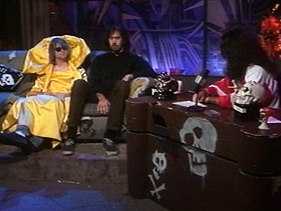
In celebration of Nevermind ‘s 20th anniversary, Riki Rachtman recalls Nirvana’s most notorious MTV appearance. By James Montgomery, with reporting by Matt Elias Kurt Cobain and Krist Novoselic appear on “Headbangers Ball” in 1991 Photo: MTV On October 25, 1991, with their Nevermind album only a month old but already gaining traction and the video for “Smells Like Teen Spirit” beginning to turn the world on its ear, Nirvana appeared on MTV’s flagship metal show “Headbangers Ball” for an interview that would become legendary — mostly for all the wrong reasons. As they made abundantly clear during their stint on the show, Nirvana considered “Headbangers” to be the epicenter of everything they considered evil: the teased-and-tousled, tough-guys-and-tanned-babes world of mainstream metal. As if barely feigning interest wasn’t proof of this point, one only had to look at the canary-yellow ball gown Kurt Cobain threw on for the occasion. It was about as un-metal (and tellingly un- macho ) as you could get. The on-camera interaction between Cobain and bassist Krist Novoselic (drummer Dave Grohl had apparently decided to skip the taping) and “Headbangers” host Riki Rachtman was awkward enough, but you don’t know everything that happened behind-the-scenes. Now, in celebration of Nevermind ‘s 20th anniversary, we sat down with Rachtman to get the story of what happened on that fateful, cringe-inducing day. And, as is the case with most great rock stories, this one starts backstage. Can the album that changed everything change it again? Bigger Than the Sound looks back on Nevermind. “I did that show for five years, and when Nirvana was coming in, here was a band that I could tell was on the verge of making it huge. I was a fan of [them], and I was pretty stoked that I was going to get to meet them, because I had never met Cobain or any of these guys,” Rachtman told MTV News. “Bands would always sit in the green room before they came on the set, you know, have some drinks or whatever, and I walk into the green room thinking, ‘Hey, I’m going to meet Kurt Cobain, you know, we’ll talk a little bit before the show.’ And he is just sprawled out on the floor, passed out. I mean, kick him, not moving.” Of course, things didn’t improve much once the cameras started rolling, as Rachtman repeatedly tried to rescue the interview, despite mounting evidence that this one was heading downhill fast. “So the first time that I ever met Kurt was when all of the sudden they bring him onto the show with his big yellow ball gown. … I’m like, ‘OK, whatever.’ So he sits down, and the whole time he’s just like, ‘Uhhh.’ You could tell that he didn’t want to be there,” Rachtman explained. “People always knew that when I was on the show and there was a band that I was digging and excited to meet, I’m all excited, so I’m up … [but] in that interview, I looked like I was about as slow as he was, because as we started … I wasn’t getting any good answers, I wasn’t finding out anything about them. … It was like pulling teeth. And what started as a day that I was really excited about ended up becoming a day that I was just like, ‘When is this over?’ And you can just see [it].” Of course, Nirvana’s anti-antics only further rankled metal fans, most of whom were already suspicious of the band’s motives and increasing popularity. They saw their “Headbangers” appearance as not only a slap in the face of the respected Rachtman, but of the entire genre. Then again, all that has only added to the episode’s mystique in the years since it first aired. Even if, to this day, Rachtman won’t watch it. “I don’t watch that show, even though it was pretty historic and, hey, I got to interview Nirvana; it was one of the worst interviews I’ve ever done,” he said. “And you can just tell that I didn’t want to be there the whole time, because they didn’t want to be there either.” Despite the “Headbangers” experience, Rachtman remained a Nirvana fan. In fact, almost 20 years later, he’ll still defend them to metal fans who maintain they singlehandedly killed their genre. Nirvana’s rise to fame, in their own words. “People say, ‘Nirvana killed heavy metal,’ and they didn’t. If you had any type of music scene that is so weak that another band can come on playing a different type of music and kill your scene, then your scene wasn’t good enough in the first place,” he laughed. “You come out with this crazy hair and all glam, look like a chick, you know, if you do that, OK, that’s fine, but after awhile, you’re going to need some sort of substance behind it. And what happened was, here’s somebody new that really doesn’t care, that picks up dirty clothes off the floor, wears ’em, has no stage show, goes on camera, does concerts and just plays rock and roll.” Stick with MTV News all week as we reveal the Nevermind You Never Knew , celebrating the 20th anniversary of Nirvana’s definitive album with classic footage, new interviews and much more. Related Videos Nirvana: The Nevermind You Never Knew

Link:
Nirvana On ‘Headbangers Ball’: Behind The Ball Gown

CyHi The Prynce Jacks Rap Classics For Jack Of All Trades

‘It’s just me showing my versatility,’ G.O.O.D. Music soldier tells Mixtape Daily of jumping on timeless beats from Youngbloodz to Outkast. By Rob Markman, with reporting by James Smith Main Pick Artist : CyHi the Prynce Representing : Atlanta Mixtape : Jack of All Trades Real Spit : CyHi the Prynce figured he would end the summer the same way he started: with a free mixtape. In June, the G.O.O.D. Music soldier released Royal Flush 2 to much fanfare and as August rolled to a close, the MC once again got to work with his Jack of All Trades tape. The Atlanta rapper teamed with both DJ Scream and DJ Spinz to gather a bunch of familiar instrumentals that would showcase his rhyme skills. As far as the title of the tape, it’s all pretty simple if you let the Prynce tell it. “It’s just me showing my versatility and that I’m a jack of all trades,” CyHi told Mixtape Daily. “Slow beats, fast beats, mid-tempos, whatever; rugged, pop, I can rap on it all. Gospel, country — whatever you want to give me, I can do. So I think Jack of All Trades shows that I’m a jack of all trades.” On “Farmer,” CyHi goes to the Midwest for inspiration, using Bone Thugs-n-Harmony ‘s 1994 beat for “Thuggish Ruggish Bone” to rap about his affinity for marijuana. “Blacksmith” continues the trend. Over the slow bounce of Tru ‘s “I’m Bout It, Bout It,” Kanye’s prot

‘Pearl Jam Twenty’: The Reviews Are In

Critics accuse director Cameron Crowe over fawning over the band, but fans probably won’t mind. By Eric Ditzian Eddie Vedder in “Pearl Jam Twenty” Photo: Vinyl Films In a neat bit of pop-culture convergence, the 20th-anniversary commemoration of Nirvana’s Nevermind (which MTV News has been feting all week long) is coinciding with another grunge-centric, two-decade celebration: Cameron Crowe’s documentary about the founding and globe-spanning success of Pearl Jam . “When I saw the early … edits of it, I thought it was very interesting and kind of exciting and, like I said, it runs the gamut of all those emotions,” guitarist Mike McCready told us in May. “And it actually put in some sort of musical perspective the past 20 years, like, ‘Oh yeah, we did do that, we did do this’: the Ticketmaster thing, there was Roskilde, there were all these issues, and there were these great highs and interesting beginnings. The story it tells is: Why did it work, and why does it still? It made more sense when I saw the movie.” After debuting at the Toronto International Film Festival earlier this month, “Pearl Jam Twenty” is set for a one-night-only premiere at theaters across the country Tuesday (September 20). The early word from critics is that while the doc gives fans unique access to the band, especially in early footage hauled out from the achieves, it suffers from director Cameron Crowe’s hagiographic treatment of his subject. But that might just be exactly what PJ devotees are looking for. The Comparison “Cameron Crowe’s feature doc … is among his most effective and deeply felt work. … Every rock act possesses a mysterious alchemy that becomes a kind of mythology; as a portrait of one of the biggest bands in the world, ‘Pearl Jam Twenty’ doesn’t so much capture that alchemy as describe it. But it does so with passion, and even the unconverted will find a convincing case for the band’s longevity, popularity and influence.” — Sheri Linden, The Hollywood Reporter The Focus “Crowe, who does a remarkable job of collecting archival footage from the band’s earliest days (and even before that) focuses heavily on [the band’s early days]. He narrates the beginning (before getting almost totally out of the way), setting the stage for the late ’80s and early ’90s, when Seattle was the rock music capital of the world. Soundgarden’s Chris Cornell talks about how there was a wealth of bands, but unlike in New York or Los Angeles, the competition tended to be more friendly than cut throat. Even later, when the twin towers of the Seattle scene — Pearl Jam and Nirvana — seemed ready to face off after Kurt Cobain slagged Pearl Jam’s music for being too mainstream, they resolved their differences before Cobain died.” — Melinda Newman, HitFix The Fandom “The cinematic equivalent of a concert T-shirt, XXL biodocu ‘Pearl Jam Twenty’ gives another awesome souvenir to die-hard fans of the chart-topping Seattle scenesters-turned-cult faves while leaving others to wish there was a thesis in former rock-journo Cameron Crowe’s two-hour puff piece. Finding a pulse only in the band’s late-reel performance of ‘Alive,’ a lusty passage that would’ve begun a pic intent on making a case for the group’s greatness, ‘Twenty’ simply counts the years from 1991 via sludgy backstage and onstage footage whose rarity can’t forgive its inclusion. Crowe’s critic mentor, the late Lester Bangs, would cringe.” — Rob Nelson, Variety The Frontman “Before Vedder was vaguely mystical and a little inscrutable, he was boyish, smiley and uninhibited. Vedder doesn’t come through any clearer after ‘Pearl Jam Twenty,’ but the band’s journey remains a thoroughly entertaining one. Any enterprise like this is inherently self-congratulatory, but the film is best considered from Crowe’s perspective: that of a fan.” — Jake Coyle, The Associated Press The Final Word “[It] suffers from being an all-out fawnapalooza. Crowe, a former Rolling Stone reporter, wastes unprecedented access to one of modern rock’s most private, compelling and enigmatic acts to create little more than a promotional video for Pearl Jam’s non-stop tours. There’s plenty to elicit fist pumps from steadfast fans, largely because of rare archival footage. (A silly slow dance between security guard-turned-rocker Eddie Vedder and Nirvana’s Kurt Cobain is lump-in-the-throat poignant). Yet Crowe glosses over too many of Pearl Jam’s darkest days — a drummer’s mysterious firing, addiction battles, nine fans dying at a show — to keep non-Jammers from getting bored.” — Joseph Rose, The Oregonian For breaking news, celebrity columns, humor and more — updated around the clock — visit MTVMoviesBlog.com . Related Artists Pearl Jam

Follow this link:
‘Pearl Jam Twenty’: The Reviews Are In

Nirvana’s Nevermind 20 Years Later: Forever Changes

Can the album that changed everything change it again? Bigger Than the Sound looks back. By James Montgomery Kurt Cobain Photo: Frank Micelotta/Getty Images Here’s an abbreviated list of everything that’s happened in my life in the 20 years since Nirvana ‘s Nevermind was released : graduated middle school, started wearing thrift-store corduroys, got my learner’s permit, lost my virginity, got my driver’s license, got in several accidents, named All-County keeper in the Central Florida High School Lacrosse League (two times), graduated high school, started smoking clove cigarettes, had an ill-fated long-distance relationship and an even iller-fated run in a community-college film program, moved out to attend “real college,” spent six years doing anything but , slept on a futon in Burbank, attempted to use a 9/11 to reconnect with my ex-girlfriend, experienced shame from that attempt, moved to New York City, had dark times (aside from the Red Sox ’04 and ’07 World Series wins), met a girl, fell in love, got engaged in Reykjavik, got married in Dublin, recently discovered small black hairs growing on my earlobes. Of course, reading back over all that, none of it makes me feel nearly as old as the fact that, on Saturday, Nevermind will officially turn 20. Because as a kid who was alive and kicking during that era when all of a sudden “Smells Like Teen Spirit” was everywhere and Nirvana were the biggest thing in the world (or at least the suburbs), I can tell you that it seemed impossible that this music would ever age; mostly because everything about it seemed so of the moment, so important, so young. That was, in part, due to everything Kurt Cobain was (unwillingly) on his way to becoming: an outsider icon, a generational symbol, maybe even a musical messiah. Like I wrote a few years back, on the 15th anniversary of Cobain’s death , he represented truth and the honor that came with never compromising. He had made it on his terms, and he was going to lift us all up with him. That’s the kind of stuff you believe in when you’re too young to know better. Mostly, it was because Nevermind ripped up the mainstream and instantaneously made everything else out there seem pass

Nirvana Had ‘No Regrets’ About Nevermind

Our Nevermind You Never Knew 20th-anniversary coverage continues with part two of a three-part look back at Nirvana in their own words. By James Montgomery Nirvana’s Kurt Cobain in 1993 Photo: MTV News ” Nevermind was definitely an album we wanted to make. … We have no regrets, other than maybe the production was too slick.” That was Kurt Cobain in December 1993, after the initial impact of Nirvana ‘s sophomore album had subsided, and the band was trying to slip effortlessly into the promotional cycle for its follow-up, In Utero. Of course, it went about as well as you would expect. Such is often the case when a band attempts to move on from the shadow of a monolithic, moment-seizing record: It’s difficult to talk about anything else. When it was released, no one had any idea of what Nevermind would eventually become. In fact, in the Geffen offices, they were hoping it’d sell maybe 250,000 copies, and as such, shortages in record stores were common in the months following its release. But, as you’re probably aware by now, the album far exceeded initial expectations (it’s since sold more than 30 million copies worldwide,) and, in the 20 years since its release, Nevermind has gone on to become an album that not only lends itself to being mythologized, but deserves it as well. And yet, the album didn’t become a household name overnight. It slowly (almost methodically) ascended the charts, finally overtaking Michael Jackson’s Dangerous atop the Billboard albums chart in January 1992. And when it did, it signified not only the changing of the guard, but a new era for music. It was a rare moment: A good band was also the most popular. And 20 years later, we’re still marveling at that fact. But, again, Nevermind lends itself to mythology. And with its 20th anniversary just around the corner, we suspect you’ll be subject to no shortage of it. So rather than add another anecdote (or 10) to the pile, we figured it would be best to tell the story of Nirvana in the words of the people who knew it best: the band itself. We’ve spent the past few weeks mining the MTV News archives to find our definitive Nirvana moments — not just the iconic interviews, but the behind-the-scenes nuggets that show the band as they truly were: funny, irreverent and just a little uncomfortable with their newfound fame (a fact they’d go to great lengths to prove with In Utero ). Earlier Monday (September 19), we published Nirvana’s take on their early years , and now, we’re going to give you their view on everything that happened in the year following the release of Nevermind . Here, now, is a band at the epicenter of a true revolution, trying to make sense of everything that happens while, at the same time, attempting to remain true to the scene that birthed them. That struggle is just one of many reasons why, 20 years after they burst into the world, Nirvana remains one of the most fascinating rock bands of all time. Stick with MTV News all week as we reveal the Nevermind You Never Knew , celebrating the 20th anniversary of Nirvana’s definitive album with classic footage, new interviews and much more. Related Videos Nirvana: The Nevermind You Never Knew Related Artists Nirvana

Read more:
Nirvana Had ‘No Regrets’ About Nevermind