Tag Archives: office

Obama Administration’s Actions in Auto Bailout Added to Unemployment, Audit Says

The Obama administration’s policies in steering the auto bailout drove unemployment up, according to an audit by the Office of Special Inspector General for the Troubled Assets Relief Program (SIGTARP).   “At a time when the country was experiencing the worst economic downturn in generations and the government was asking its taxpayers to support a $787 billion stimulus package designed primarily to preserve jobs, Treasury made a series of decisions that may have substantially contributed to the accelerated shuttering of thousands of small businesses and thereby potentially adding tens of thousands of workers to the already lengthy unemployment rolls – all based on a theory and without sufficient consideration of the decisions’ broader economic impact,” the audit by SIGTARP Neil Barofsky stated.   “It is not at all clear that the greatly accelerated pace of the dealership closings during one of the most severe economic downturns in our Nation’s history was either necessary for the sake of the companies’ economic survival or prudent for the sake of the Nation’s economic recovery,” the audit added. The federal government committed $80.7 billion out of TARP, the $700 billion rescue bill enacted in late 2008, to save General Motors and Chrysler. Chrysler closed 789 dealerships, while GM is set to have closed 1,454 dealerships by October 2010 as a cost cutting measure.   The Treasury Department pushed General Motors and Chrysler to close dealerships at a faster rate than the companies suggested, without taking job losses into consideration, the audit says.   “Although there was a broad consensus that GM and Chrysler generally needed to decrease the number of their dealerships, there was disagreement over how, where and how quickly the cuts should have been made,” the audit says.   “In the fact of the worst unemployment crisis in a generation and during the same period in which government was spending hundreds of billions of dollars on a stimulus package to spur job growth, the Auto Team rejected GM’s original plan (which included gradual dealership terminations), expressly indicated that GM’s pace of terminations was too slow, and then encouraged the companies’ use of bankruptcy to accelerate dealership terminations,” the audit continued.   White House Press Secretary Robert Gibbs said Monday that if the administration had not taken the actions it did, far more jobs would have been lost.   “I think it’s important to look at the decision to put into bankruptcy and restructure both Chrysler and GM. I think it is safe to say without that decision that the president made, it is likely that neither of those two auto companies would exist today,” Gibbs said. “Because of the president’s actions to date, there are tens of thousands of auto jobs, auto manufacturing jobs, auto dealership jobs that exist and auto parts manufacturing jobs. “   The Treasury Department strongly disagreed in a letter to the special inspector general’s office.   “In the absence of government assistance, both GM and Chrysler faced almost certain failure and liquidation, which would have resulted in the loss of hundreds of thousands of jobs across multiple industries,” said the letter from Herbert Allison, assistant Treasury secretary for financial stability.   Meanwhile, GM also weighed in with a statement Monday.   “The events depicted in the SIGTARP’s report have since been overtaken by a new GM and a stronger dealer network to match,” the GM statement said. “More than a year since its bankruptcy, GM is showing substantial progress.   “The company’s business performance is stronger, sales of its four brands are up 32 percent, and it is investing billions of dollars in its plants and bringing several thousands back to work. The new GM is also moving forward to improve dealer relations and has already reinstated several hundred dealers and completed the arbitration hearings for the remaining dealers who filed cases,” the statement added.   The inspector general’s audit also said the closing of plants lacked transparency.   “Just as troubling, there was little or no documentation of the decision-making process to terminate or retain dealerships with similar profiles, making it impossible in many cases for SIGTARP to determine the causes of deviations from the supposedly objective criteria,” the audit says.   The GM statement said the firm was completely cooperative with the inspector general’s office.   “Throughout its review, GM cooperated fully with the SIGTARP to best document the company’s efforts, as well as the criteria and numerous business factors used in GM’s dealer wind-down and appeals process,” the statement said. “The GM which existed at that time did its best to develop and implement an objective dealer consolidation process under extraordinary circumstances.” Crossposted at NB sister site CNS News

Read more:
Obama Administration’s Actions in Auto Bailout Added to Unemployment, Audit Says

TV Bites: Chris Isaak Could Be Your Newest American Idol Judge

Also in this morning’s TV Bites: Brett Ratner’s Chaos gets another life… The Office promotes a cast member… Jon Hamm visits Springfield… and Dexter hires a tattoo artist.

Here is the original post:
TV Bites: Chris Isaak Could Be Your Newest American Idol Judge

Inception Continues Box Office Dominance with $10 Million on Monday

OK, so maybe Inception will gross more than Salt . After taking in perfectly solid $62 million over the weekend, the Christopher Nolan film pulled down a whopping $10 million on Monday. To put that in perspective, box office phenom Toy Story 3 grabbed $15 million on its first Monday. So, great. If it keeps up this pace throughout the week Inception could hit $100 million by Friday. The word of mouth is strong with this one, kids. [ Box Office ]

Go here to see the original:
Inception Continues Box Office Dominance with $10 Million on Monday

Texas mayor kills daughter and then self.

COPPELL, Texas (AP) — The mayor of an upscale Dallas suburb apparently shot her teenage daughter to death before fatally shooting herself, but only after leaving notes at their home warning officers about the scene they would find and outlining how to manage family affairs, police said Wednesday. An envelope taped to the front door of Mayor Jayne Peters' home contained a key to the house and a typed note advising police they would discover something unpleasant inside, Coppell Deputy Police Chief Steve Thomas said. Three other notes contained instructions for handling affairs, such as taking care of the family dogs, but did not provide explanations for the deaths of Peters and her 19-year-old daughter, Corinne. “It appeared to me that there had been some thought,” Thomas said. Police found the bodies Tuesday after the mayor failed to show up at a city council meeting. They said the Dallas County Medical Examiner's Office ruled Wednesday that the case should be officially classified as a homicide-suicide investigation. “Forensic tests (and) procedures performed point to Corinne being the victim in this tragedy, with Mayor Peters subsequently taking her own life,” police said in a statement. “Both of the fatal injuries are a result of a single gun shot wounds.” Thomas said the weapon was a semiautomatic handgun and there were no signs of a struggle. “Everybody in the room is like, 'Did we miss a sign?'” Bob Mahalik, mayor pro tem who is now acting mayor of the city, said of council members' reaction to the deaths. “It's hard to wrap your arms around it.” Mahalik said he had a gut feeling something wasn't right when the mayor didn't turn up for the meeting. “But nowhere in your wildest dreams did you think it would be that far not right,” he said. A small collection of flowers, wreaths and cards decorated the front porch of the Peters' 3,850 square-foot brick home, where the mayor and her daughter lived alone. A printed letter said: “Please know that you are loved no matter what happens. I know that God is with you and giving you comfort. You both are with Don, a wonderful husband and father. A family again.” The mayor's husband, Donald Peters, died of cancer in 2008 at the age of 58. Jayne Peters was a contract software developer who served as mayor of Coppell, a city of about 40,000 located 15 miles northwest of Dallas, for the past year. Her term was to expire in 2012. She had been a council member since 1998. “This is a tremendous loss for the city, the community and the region,” said City Manager Clay Phillips. The elder Peters attended Miami University in Ohio. In her official biography on the city's website, she said “Coppell is a community with a huge heart, and we take care of one another.” “She enjoyed what she was doing as mayor and she was good at what she did,” said Mahalik, who last saw Peters waving and passing out candy at the city's Independence Day parade. “She attended almost everything, every ribbon-cutting, speaking at the schools, the chamber, regional meetings.” Todd Storch, of Coppell, had known Peters for about a year. When his 13-year-old daughter died in a skiing accident in March, Peters was there for him and his family and later took a spot on the foundation he formed in his daughter's name to increase awareness for organ donation. “She was just one of those rocks that was always there. We kind of grieved together,” Storch said. Corinne Peters graduated from Coppell High School this year. A classmate said she was bound for the University of Texas at Austin, and neighbors said the mother and daughter seemed happy. Her Facebook page shows a smiling girl in a white top and details her interests in movies and television comedies. “Corinne was an outstanding student and gifted dancer with a big heart,” said Jessica Doty, a spokeswoman for the Coppell school district. Doty called Jayne Peters a “dedicated school volunteer.” A close friend, Ashley Johnson, said Corinne loved animals and was a phenomenal ballet dancer. There were no signs of serious strain between Corinne and her mother, Johnson said. “Her and her mom fought sometimes, but it was like a normal teenager and mom relationship,” Johnson said. “I never would have thought this would have happened.” Neighbor Diane Ianni said Corinne was excited about enrolling at Texas and frequently donned shirts with the university's logo and colors. She said when she last saw Corinne the teen was upset about having to miss at least two different summer orientation sessions at the Austin campus, the last time because her mom was having problems with her eye and had to go to a doctor's appointment. But she said Corinne recovered and had been back to her happy self. http://hosted.ap.org/dynamic/stories/U/US_MAYOR_DAUGHTER_DEAD?SITE=AP&SECTIO… added by: onemalefla

‘The City’ Season Finale: Whitney Faces A Tough Decision

Olivia makes a splash in Tokyo as season two comes to a close. By Amy Wilkinson Whitney Port in “The City” on Tuesday No-nonsense People’s Revolution founder Kelly Cutrone has been one of Whitney’s strongest allies in the fight to make her fashion line, Whitney Eve, a success. But during Tuesday night’s season finale of “The City,” Whitney had to decide whether she would remain loyal to Kelly or be lured away by a peppy, pink-wearing PR practitioner. Even though Kelly doesn’t actually work for Whitney, the young designer didn’t want to offend or blindside her mentor by accepting help from another agency, so she had a chat with Kelly to discuss her wooer, Alison Brod. “She does mostly beauty, right?” Kelly sniffed. “And she wears pink all the time.” Fashion choices aside, Kelly didn’t think the timing was right for Whitney to hire a full-time PR rep. “I think it’s early for you to do this,” Kelly advised. “You’re still at a place where you’re in very low production numbers. … I want the best for you.” Rather ironically, Kelly had these parting words for Whitney: “Watch out. Every fifth word from PR people should be scrutinized.” Meanwhile, with Olivia on assignment in Tokyo, Louise Roe stepped in to film Web videos of Elle ‘s 25th anniversary photo shoot. And while Keith, the editorial director for Elle.com, liked Louise’s style, he wasn’t quite sure she was the perfect fit to be the new face of Elle.com. “I think Louise is really good, but she is kind of announcing,” he observed. “I think it’s good for this, but we don’t need that treatment for everything. I just wonder, is Olivia more like the Elle girl? Olivia was certainly putting her best foot forward in Japan at the Tibi launch party. She gamely fielded questions at a Q&A session with a poise and eloquence we rarely see in her dealings at Elle (especially with Erin). Yet, Erin and Robbie’s assistant Seth didn’t think anyone back in the States had high hopes for Olivia’s Japan visit. “I mean, Olivia in Japan seems a little bit lost in translation,” Seth joked. “Olivia in America is lost in translation,” Erin replied with a laugh. Whitney decided to meet with Alison Brod in her pink office to discuss the possibility of working together. After scolding Whitney for not wearing one of her own designs to the meeting, Alison said that if she represented Whitney Eve, Whitney would have to swear in blood that she’d do everything she could to support the line. Though Whitney said she’d think about it, Alison began spreading the news that Whitney had dumped People’s Revolution, riling the already perturbed Kelly. “I don’t need to defend my agency against a girl who wears pink,” Kelly chided before kicking Whitney out of her office. Joe had some big news for the Elle staff upon Olivia’s return. Largely due to her spectacular success in Tokyo, Olivia was made the new face of Elle.com (garnering a hard-to-miss eye roll from Erin). But what’s to become of Louise? Don’t worry about her; she’s already got a hosting gig lined up in L.A. But will Erin remain at Elle, knowing she has to work even more closely with Olivia? Still undecided about her PR representation, Whitney asked embattled friend Roxy to meet her for a chit-chat, their first in quite a while. Roxy reminded Whitney that her loyalty was to Kelly, but Whitney didn’t seem entirely convinced. “I’ve been struggling with it,” she said. “I’ve been making a list of pros and cons. I don’t know what to do.” It looks like we’ll have to wait for the next season of “The City” to find out what she decides. What did you think of the season finale of “The City”? Share your reviews in the comments. Related Videos The City (Season 2) | Ep. 12 | ‘Lost In Translation’ Related Photos The City (Season 2): Ep. 12 ‘Lost In Translation’

Read more:
‘The City’ Season Finale: Whitney Faces A Tough Decision

The City Season Finale: Whitney Sells Out Kelly

The second season of The City came to an end last night. Is Whitney Port’s relationship with Kelly Cutrone also over after the events we just saw play out? When Whitney is approached by a PR woman, she quickly gets in over her head and finds herself torn between a new opportunity and her loyal supporter. What will she decide? Here’s THG’s +/- recap … Kelly thinks it might be too early to be doing press because Whitney Port could actually end up with more orders than she can handle. Sage words. Plus 4 . Joe has Louise interview Karolina Kurkova. Keith thinks Louise has more of a TV style and Olivia’s subdued approach is better for Elle.com. Really? Minus 1 . GOLDEN GIRL : Somehow, Olivia Palermo is in Elle’s good books. In Tokyo, the editor-in-chief suggests Olivia should appear on stage with the designers at a party that night so Akiko can ask her about her style. No way that would happen if she weren’t on an MTV reality show, but neat! Plus 6 . Roxy Olin tells Zach she is angry about Whitney. Girl, get over it. Minus 2 . Whitney meets Alison Brod, owner of Alison Brod PR, who says they will do everything they can for Whitney Eve line if she hires them. Thin ice, Whit … Minus 3 . Erin asks Joe who will be the new face of Elle ‘s website. He says he hasn’t decided yet, but he’s hearing some great things about what Olivia is doing in Japan. Erin blatantly lobbies for Louise by mentioning her other job offer. Plus 4 . Kelly calls Whitney into her office. Dun-dun-dunnnnn!! Plus 5 . PORT OF CALL : Will Whitney jump ship from Kelly Cutrone’s tutelage? Alison has been telling people that Whitney fired Kelly and hired her. Whitney quickly apologizes and Kelly says that Alison’s claims are making her look like an ambitious idiot, but Kelly’s right, she got herself into this mess. Minus 4 . At a boardroom meeting, Joe announces that Olivia Palermo will be the new face of the Elle website and says he is sorry for Louise to be leaving. Erin Kaplan is not happy. “Are you OK with that?” asks Olivia with a smile. Plus 8 , b!tch. Roxy later tells Whitney that her loyalty is to Kelly. “If you sign with Alison things will change with you and Kelly,” warns young Ms. Olin. Such integrity! Plus 3 . Seemingly unclear of what to do, Whitney appears deep in thought as Roxy walks away … think this was dramatized at all? Minus 5 , because we assume so. FINALE TOTAL: +9. SEASON TOTAL: +5 .

View original post here:
The City Season Finale: Whitney Sells Out Kelly

John Krasinski & Emily Blunt — Honeymoon’s Over

Filed under: John Krasinski , Emily Blunt , Paparazzi Photo , wedding Two days after tying the knot in Lake Como, Italy , newlyweds John Krasinki and Emily Blunt landed back at LAX on Monday. John must have to really get back to his ” Office .” Read more

See the rest here:
John Krasinski & Emily Blunt — Honeymoon’s Over

Japanese Voters Reject Ruling Party and Doubling ‘VAT Tax’; AP Calls It a ‘Sales Tax,’ Ignores U.S. Implications

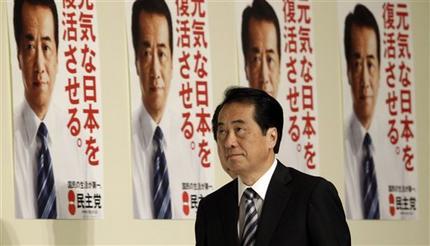
An outraged electorate has just handed Japan’s ruling party its hat in elections for half of the seats in the upper house of that country’s parliament in a direct reversal of election results from a year ago. Opposition parties made major gains. The results constitute a resounding rejection of a massive value-added tax increase proposed by a guy whose immediate predecessor of the same party sounded an awful lot like the U.S. President Barack Obama when he led his party to a historic victory a year ago. But, as will be shown later, you wouldn’t know that from reading the Associated Press’s coverage of Sunday’s returns. But first, a bit of background: The 2010 version of Naoto Kan (pictured at top right in an AP photo) is round two of an attempt by the country’s Democratic Party (no direct relation that I know of, but philosophically they’re nearly clones) to “remake” the island nation. If that sounds depressingly familiar, it should. The parallels of Kan’s same-party predecessor’s victory to Barack Obama’s 2008 electoral win are eerie, as this August 2009 election night report from Eric Talmadge the Associated Press will demonstrate (bolds are mine): Japan opposition wins landslide victory Vote seen as a barometer of frustrations over high unemployment, falling exports Japan’s opposition swept to a historic victory in elections Sunday, crushing the ruling conservative party that has run the country for most of the postwar era and assuming the daunting task of pulling the economy out of its worst slump since World War II. A grim-looking Prime Minister Taro Aso conceded defeat just a couple hours after polls had closed, suggesting he would quit as president of the Liberal Democratic Party, which has ruled Japan for all but 11 months since 1955. “The results are very severe,” Aso said. “There has been a deep dissatisfaction with our party.” Unemployment and deflation – and an aging, shrinking population – have left families fearful of what the future holds. Fed up with the LDP, voters turned overwhelmingly to the opposition Democratic Party of Japan, which ran a populist-leaning platform with plans for cash handouts to families with children and expanding the social safety net. … The Democrats’ plan to give families 26,000 yen, or $275 (U.S.), a month per child through junior high is meant to ease parenting costs and encourage more women to have babies. Japan’s population of 127.6 million peaked in 2006, and is expected to fall below 100 million by the middle of the century. The Democrats are also proposing toll-free highways, free high schools, income support for farmers, monthly allowances for job seekers in training, a higher minimum wage and tax cuts. The estimated bill comes to 16.8 trillion yen ($179 billion) if fully implemented starting in fiscal year 2013 – and critics say that will only further bloat Japan’s already massive public debt. Adjusted for relative population size, the stated $179 billion amount would be the equivalent of about $435 billion in the U.S. That may not seem like much compared to the Obama and the Democrats’ $800 billion-plus “stimulus” of last year, but keep in mind that Japan spent the better part of the 1990s trying to make government stimulus work with little success. Also note that Japan’s Liberal Democratic Party (LDP), as the author of the Lost Decade’s stimulus, has hardly been deserving of the “conservative” label the AP’s Talmadge applied to it. Of course, after Japan’s Democrats came to power, they had to deal with the annoying question of how to close the obvious budget deficits they were building. Their answer, as has all too often been the case with U.S. Democrats, was to raise taxes, despite the tax-cut pledge cited in Talmadge’s AP report. In a Monday, July 12 story , the AP’s Jay Alabaster gave readers many of the details on how that idea was received by voters, but left out a really, really important one: Japan braces for gridlock after ruling party loss Japan’s ruling party faced the prospect of political gridlock Monday after an election setback that could undermine its attempts to reduce a ballooning budget deficit and revive growth in the world’s second-largest economy. Half of the 242 seats in the upper house of parliament were up for grabs Sunday. The ruling Democratic Party of Japan won only 44 seats – far below its stated goal of 54 – while opposition parties made major gains. That leaves the Democrats and their tiny coalition partner with 110 seats, well below their majority of 122 before the vote. The conservative Liberal Democratic Party won 51 seats, bringing its total to 84. … the results are a dramatic contrast to the Democrats’ landslide victory just a year ago, when they seized control of parliament and ended the rival Liberal Democrats nearly unbroken 55-year rule. Losing the majority in the upper house will make it more difficult for the Democrats to move ahead on their agenda, which includes cutting wasteful spending, making government more open and creating a solid social security system for a rapidly aging and shrinking population. … I n office just a month, Kan has warned that Japan’s finances could face a Greece-like meltdown if it doesn’t cut back on soaring debt – twice the country’s GDP – and suggested raising the sales tax as a solution. But voters, already suffering from the economic downturn, rejected that idea. … Kan acknowledged defeat early Monday morning, saying he failed to fully explain his proposal to raise the sales tax from 5 percent to as much as 10 percent in coming years. … Kan, a former finance minister with roots in grass-roots activism, enjoyed support ratings of more than 60 percent when he took office in early June. “Sales tax”? What is this “sales tax”? It turns out that Alabaster was really referring to a de facto value-added tax, as shown here in this description of Japan’s tax structure: Japan Consumption Tax The tax is similar to value added tax and is, in fact, imposed on most sales and services provided in Japan and on imports. A taxpayer may offset the consumption tax paid on expenses against the tax he has to pay on his income. Consumption tax is 5%. Companies whose sales per year are less than 10 million yen are tax exempt. Imagine that. Yes Virginia, the “consumption tax” is effectively a VAT tax, as it is imposed on “consumption” by both individuals and companies. Every time “consumption” occurs, i.e., at every stage of production and distribution, the tax kicks in. The 10 million yen exemption is the U.S. equivalent of about $114,000, meaning that only the very small businesses are exempt. It seems that the AP and Mr. Alabaster didn’t want to give their U.S. audience the impression that voters elsewhere have rejected a steep increase in VAT taxes. Why, accurate and responsible reporting might have made American readers more resistant to allowing this dangerous idea to get started. Apparently, Alabaster and the AP want to see a VAT tax come to pass in the U.S. so badly that they are willing to blatantly misrepresent events overseas in the name of that cause. Beyond the self-evident deception just described, if what has just transpired in Japan’s elections had taken place at the expense of a conservative government trying to cut taxes while a conservative or Republican president occupying the Oval Office was trying to do the same thing, we would never have heard the end of it. As it is, you can virtually take it to the bank that the establishment press will fail to identify the obvious comparison between what Japanese voters have rejected to what the Obama administration both is doing (letting the Bush tax cuts expire, an action I like to refer to as “repealing the tax system that grew the economy for almost six years”), and wants to do more of, including the VAT tax. Raising taxes in a debt-drenched nation during a flat or allegedly recovering economy, in addition to being economically dumb, is an electoral loser. What part of “no” don’t these people understand? Cross-posted at BizzyBlog.com .

Original post:
Japanese Voters Reject Ruling Party and Doubling ‘VAT Tax’; AP Calls It a ‘Sales Tax,’ Ignores U.S. Implications

Roman Polanski Decision Blasted By L.A. District Attorney

‘I am deeply disappointed that the Swiss authorities denied the request to extradite Roman Polanski,’ Steve Cooley says in a statement. By Kelley L. Carter Roman Polanski in 1980 Photo: Central Press/Getty Images Switzerland’s Ministry of Justice announced that it would not extradite director Roman Polanski to the U.S. to face sentencing for child sex charges, but L.A. district attorney Steve Cooley said Monday (July 12) that extradition will be sought if Polanski is arrested someplace else. “I am deeply disappointed that the Swiss authorities denied the request to extradite Roman Polanski,” Cooley said in a statement released to MTV News. “Our office complied fully with all of the factual and legal requirements of the extradition treaty and requests by the U.S. and Swiss Departments of Justice and State. We will discuss with the Department of Justice the extradition of Roman Polanski if he’s arrested in a cooperative jurisdiction.” CNN reported earlier that the 76-year-old director was set free after his arrest last year; the case has been going on for nearly 35 years. At the time, Polanski pleaded guilty in Los Angeles to having unlawful sex with a 13-year-old girl in 1977 and supplying her with champagne and Quaaludes during a photo shoot, but the director fled to Europe before his sentencing. In exchange for his guilty plea, rape and other charges were dropped at the time. Although Polanski pleaded guilty to the one count of unlawful sexual intercourse, the remaining charges are pending since Polanski was never sentenced. “We only formally request when we are notified by a government that the fugitive is in their country,” Cooley said in the statement. “The request was filed immediately by this office after the Swiss notified us of Polanski’s expected arrival at the Zurich film festival in September 2009.” Cooley adds that countries that won’t release Polanski to the U.S. for sentencing are doing a “disservice to justice and other victims as a whole. To justify their finding to deny extradition on an issue that is unique to California law regarding conditional examination of a potentially unavailable witness is a rejection of the competency of the California courts. The Swiss could not have found a smaller hook on which to hang their hat.”

See the article here:
Roman Polanski Decision Blasted By L.A. District Attorney

New Financial Regulations Create Diversity Czars for All Federal Financial Regulators

The financial regulations package recently passed by the House of Representatives would create a new diversity overseer at each of the major federal financial regulatory agencies, including the new ones created by the legislation itself. This new office, called the Office of Minority and Women Inclusion, would take over from any existing diversity or civil rights office already working at the agencies in question. It would also be responsible for making sure that each of the major federal financial regulators is hiring enough minorities and women, and contracting with enough minority-owned and women-owned businesses. However, each individual diversity czar is responsible for defining exactly how many minorities, women, and minority- and women-owned businesses are satisfactory. “[E]ach agency shall establish an Office of Minority and Women Inclusion that shall be responsible for all matters of the agency relating to diversity in management, employment, and business activities,” the legislation says. (The bill passed in the House on June 30; a Senate vote could occur as early as next week.)     In fact, each new diversity chief will be responsible for developing quota-like guidelines proscribing the ethnic and gender makeup of each regulator’s workforce, including upper management.   “Each Director shall develop standards for- (A) equal employment opportunity and the racial, ethnic, and gender diversity of the work-force and senior management of the agency,” it states.   These diversity offices will also be responsible for “assessing the diversity policies and practices of entities regulated by the agency.”   This means that in addition to monitoring every bank in the country, checking every financial institution in America to make sure they are not doing anything systemically risky, and trying to prevent another financial collapse, every federal financial regulator will also be counting the number of minority and female employees at banks and investment firms, big and small.   The proposed law would also mandate that federal financial regulators hire from certain types of minority- or women-only colleges and universities, advertise in minority- and women-focused publications, and partner with inner-city schools and other minority-focused organizations to hire or mentor more minorities and women.   The diversity offices will also be charged with enforcing the newly written diversity guidelines for each private sector company the regulator contracts with, meaning that they will be checking to ensure that each of the agency’s private contractors is following the agency’s diversity guidelines.   “The Director of each Office shall develop and implement standards and procedures to ensure, to the maximum extent possible, the fair inclusion and utilization of minorities, women, and minority-owned and women-owned businesses in all business and activities of the agency at all levels, including in procurement, insurance, and all types of contracts,” the bill states.   This provision is significant because some of the same federal regulators who must establish these diversity offices – Treasury and Federal Reserve – make heavy use of the private sector on a regular basis. They have also relied heavily on the private financial sector in their responses to the financial crisis.   For example, the Fed’s Term Asset-Backed Lending Facility (TALF) program, which backstopped the securitization market during the height of the financial crisis, was actually run with the help of Bank of New York Mellon, an institution regulated by the New York Fed.   The TALF program, along with other Fed lending programs, had to maintain a strict level of secrecy to protect the banks using the program from irrational runs on their businesses. Because the securitization market had essentially collapsed, TALF’s customers had to remain anonymous if the government was to avoid setting an arbitrary – rather than market – price for securitized debt.   Had the markets learned which financial institutions were using Fed lending programs like TALF, they would have known which securities the Fed was taking as collateral for a particular loan amount. With such information in the public domain, the government would have essentially been fixing the price of asset-backed securities, rather than letting supply and demand set the price in the normal way.   The new diversity office at the Fed – and other financial regulators – apparently would be empowered to dig into such sensitive relationships under the guise of diversity enforcement, possibly endangering the programs and hamstringing their effectiveness.   If one of the new diversity czars thinks a financial firm is not being diverse enough, he potentially could recommend that the regulator terminate the contract(s) the regulator has with that firm. Crossposted at NB sister site CNS News

Go here to read the rest:
New Financial Regulations Create Diversity Czars for All Federal Financial Regulators