Tag Archives: person

The Brain Speaks: Scientists Decode Words from Brain Signals

Sept. 7, 2010 — In an early step toward letting severely paralyzed people speak with their thoughts, University of Utah researchers translated brain signals into words using two grids of 16 microelectrodes implanted beneath the skull but atop the brain. “We have been able to decode spoken words using only signals from the brain with a device that has promise for long-term use in paralyzed patients who cannot now speak,” says Bradley Greger, an assistant professor of bioengineering. Because the method needs much more improvement and involves placing electrodes on the brain, he expects it will be a few years before clinical trials on paralyzed people who cannot speak due to so-called “locked-in syndrome.” The Journal of Neural Engineering's September issue is publishing Greger's study showing the feasibility of translating brain signals into computer-spoken words. The University of Utah research team placed grids of tiny microelectrodes over speech centers in the brain of a volunteer with severe epileptic seizures. The man already had a craniotomy – temporary partial skull removal – so doctors could place larger, conventional electrodes to locate the source of his seizures and surgically stop them. Using the experimental microelectrodes, the scientists recorded brain signals as the patient repeatedly read each of 10 words that might be useful to a paralyzed person: yes, no, hot, cold, hungry, thirsty, hello, goodbye, more and less. Later, they tried figuring out which brain signals represented each of the 10 words. When they compared any two brain signals – such as those generated when the man said the words “yes” and “no” – they were able to distinguish brain signals for each word 76 percent to 90 percent of the time. When they examined all 10 brain signal patterns at once, they were able to pick out the correct word any one signal represented only 28 percent to 48 percent of the time – better than chance (which would have been 10 percent) but not good enough for a device to translate a paralyzed person's thoughts into words spoken by a computer. “This is proof of concept,” Greger says, “We've proven these signals can tell you what the person is saying well above chance. But we need to be able to do more words with more accuracy before it is something a patient really might find useful.” People who eventually could benefit from a wireless device that converts thoughts into computer-spoken spoken words include those paralyzed by stroke, Lou Gehrig's disease and trauma, Greger says. People who are now “locked in” often communicate with any movement they can make – blinking an eye or moving a hand slightly – to arduously pick letters or words from a list. University of Utah colleagues who conducted the study with Greger included electrical engineers Spencer Kellis, a doctoral student, and Richard Brown, dean of the College of Engineering; and Paul House, an assistant professor of neurosurgery. Another coauthor was Kai Miller, a neuroscientist at the University of Washington in Seattle. The research was funded by the National Institutes of Health, the Defense Advanced Research Projects Agency, the University of Utah Research Foundation and the National Science Foundation. Nonpenetrating Microelectrodes Read Brain's Speech Signals The study used a new kind of nonpenetrating microelectrode that sits on the brain without poking into it. These electrodes are known as microECoGs because they are a small version of the much larger electrodes used for electrocorticography, or ECoG, developed a half century ago. For patients with severe epileptic seizures uncontrolled by medication, surgeons remove part of the skull and place a silicone mat containing ECoG electrodes over the brain for days to weeks while the cranium is held in place but not reattached. The button-sized ECoG electrodes don't penetrate the brain but detect abnormal electrical activity and allow surgeons to locate and remove a small portion of the brain causing the seizures. Last year, Greger and colleagues published a study showing the much smaller microECoG electrodes could “read” brain signals controlling arm movements. One of the epileptic patients involved in that study also volunteered for the new study. Because the microelectrodes do not penetrate brain matter, they are considered safe to place on speech areas of the brain – something that cannot be done with penetrating electrodes that have been used in experimental devices to help paralyzed people control a computer cursor or an artificial arm. EEG electrodes used on the skull to record brain waves are too big and record too many brain signals to be used easily for decoding speech signals from paralyzed people. Translating Nerve Signals into Words In the new study, the microelectrodes were used to detect weak electrical signals from the brain generated by a few thousand neurons or nerve cells. Each of two grids with 16 microECoGs spaced 1 millimeter (about one-25th of an inch) apart, was placed over one of two speech areas of the brain: First, the facial motor cortex, which controls movements of the mouth, lips, tongue and face – basically the muscles involved in speaking. Second, Wernicke's area, a little understood part of the human brain tied to language comprehension and understanding. The study was conducted during one-hour sessions on four consecutive days. Researchers told the epilepsy patient to repeat one of the 10 words each time they pointed at the patient. Brain signals were recorded via the two grids of microelectrodes. Each of the 10 words was repeated from 31 to 96 times, depending on how tired the patient was. Then the researchers “looked for patterns in the brain signals that correspond to the different words” by analyzing changes in strength of different frequencies within each nerve signal, says Greger. The researchers found that each spoken word produced varying brain signals, and thus the pattern of electrodes that most accurately identified each word varied from word to word. They say that supports the theory that closely spaced microelectrodes can capture signals from single, column-shaped processing units of neurons in the brain. One unexpected finding: When the patient repeated words, the facial motor cortex was most active and Wernicke's area was less active. Yet Wernicke's area “lit up” when the patient was thanked by researchers after repeating words. It shows Wernicke's area is more involved in high-level understanding of language, while the facial motor cortex controls facial muscles that help produce sounds, Greger says. More at link… added by: Almibry

‘Going The Distance’ Stars Share Romantic Gestures Gone Awry

Drew Barrymore recalls an ex’s unsuccessful love letter, while Justin Long’s flower purchase backfires. By Kara Warner Justin Long and Drew Barrymore Photo: Kevin Winter/Getty Images The topic of love and relationships is a loaded one. It’s full of drama, angst, joy — basically a smorgasbord of complex emotions that, no matter how serious and life-changing, can also be rife for comedic interpretation. One such interpretation is Drew Barrymore and Justin Long’s R-rated romp “Going the Distance,” which opens Friday. In the film, the are-they-or-aren’t-they-dating Barrymore and Long play a new couple who try to make a long-distance relationship work. There are expensive plane tickets, romantic gestures, arguments, etc. Speaking to the romantic gestures, because there are a few in the film, we asked Barrymore and Long if they had ever had one backfire. “I once got sent an e-mail that was written in a sarcastic tone, but the person buried the lead and didn’t say he was joking,” Barrymore said of an ex’s attempt at a love letter. “So everything in it was as horrible as you can imagine. That wasn’t funny. That was a really poorly executed romantic gesture. I remember another boyfriend, he bought me a cameo [silhouette pendant], and he said it reminded him of me. And I thought, ‘This old, silhouetted lady reminds you of me? Huh. OK.’ ” Long (who was not the giver of the aforementioned cameo) revealed that his good-intentions-gone-bad gesture involved an unfortunate mix-up of an ex’s preference in flowers. “This was actually a Valentine’s Day thing,” he said. “I went to the florist, and I saw these amazing orchids. There were, like, six orchids. It was tons of money … but I thought, ‘I’m going to do it. These are beautiful, and I’m pretty sure this person loves orchids,’ ” Long recalled. “I brought them home. She was always so appreciative of just the smallest gestures I did, so I was like, ‘Her head’s going to explode.’ ” Unfortunately for Long, his memory was a little skewed. “She was like [ he winces ] ‘I … oh … thank you,’ ” Long re-enacted. “She had this story that was like a really troubling, traumatic experience that had happened to her that involved orchids that she had told me. I knew there was something with orchids, I just didn’t remember that it was an awful association. It was bad. She was molested by a guy named Fred Orchid,” he joked. Have you had any romantic gestures go bad? Share your memories in the comments! Check out everything we’ve got on “Going the Distance.” For breaking news, celebrity columns, humor and more — updated around the clock — visit MTVMoviesBlog.com . Related Videos Drew Barrymore And Justin Long Are ‘Going The Distance’ Related Photos ‘Going The Distance’ Premieres In L.A.

Read more here:
‘Going The Distance’ Stars Share Romantic Gestures Gone Awry

Jack Cafferty’s Latest Rant Against Catholic Church: Ordain Women

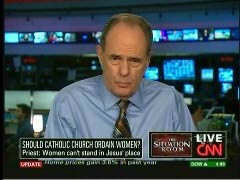
On Tuesday’s Situation Room, CNN’s Jack Cafferty revisited one of his favorite subjects of ire, the Catholic Church, and this time called for the ordination of women. Cafferty highlighted the advertising campaign of a British organization which demands that Pope Benedict XVI allow for such simulations of ordination, and mocked a Catholic priest’s defense of the all-male priesthood. The commentator devoted his 6 pm Eastern hour Cafferty File segment to the issue of women’s ordination: “‘ Pope Benedict: ordain women now ‘- that’s the message that will be plastered on London buses when the pontiff heads to England’s capital in a couple of weeks. A group called Catholic Women’s Ordination is spending $15,000 for 15 buses to carry posters with that message around London for a month.” Cafferty then moved to the opposing viewpoint, and wasted little time before bashing it and one of its defenders: “Father Stephen Wang says women are not barred from the priesthood because of sexism….Wang says that Jesus chose 12 men, and no women, to be his apostles, and he adds that men and women are equal in Christianity, but that gender still matters. Wang compares the role of a priest to an actor, saying no one would be surprised if he wanted a male actor to play King Arthur. He then admits the analogy is weak. That’s the most startling and profound thing he said in the message so far- terrible! ” CNN’s “belief” blog (yes, the network has one) ran an article on Monday which gave further excerpts from Father Wang’s recent column on the priesthood : “Men and women are equal in Christianity, he continues, but ‘ this does not mean that our sexual identity as men and women is interchangeable. Gender is not just an accident .’ He [Father Wang] compared the role of a priest to that of an actor playing King Arthur…’No one would be surprised if I said I wanted a male actor to play the lead,’ he said, admitting the analogy was ‘weak.’ But, he said, ‘ it shouldn’t surprise us if we expect a man to stand in the person of Christ as a priest, to represent Jesus in his humanity – a humanity that is not sexually neutral .'” Cafferty later noted that “in addition to the bus campaign, the women’s group plans to hold a vigil the day before the Pope’s visit, and they plan to demonstrate outside the official London residence of the Archbishop of Canterbury.” That may seem a bit off, as the Archbishop of Canterbury, as he is the honorary chief cleric of Anglicanism, but the commentator didn’t explain that the planned protest will take place when Pope Benedict is meeting with the archbishop. He added that “in 1994, then-pope, John Paul II, declared the Catholic Church has no authority to ordain women , and Cardinal Joseph Ratzinger, who is now pope, agreed with him.” After reading his “Question of the Hour,” the CNN personality remarked to anchor Wolf Blitzer that ” you could probably find people if you tried, Wolf, or even if you didn’t try very hard, who would tell you it’s way past time .” Blitzer replied, ” I know a lot of people agree with you on that, Jack- a lot of people out there .” Just before the top of the 7 pm Eastern hour, Cafferty read some of his viewer replies. Only one defended the Catholic position: CAFFERTY: Joanne in Pennsylvania writes, ‘It’s past time! There is a great need for priests, especially in the United States. We don’t know for sure that Jesus only choose 12 men, since it was men who decided what texts went into the New Testament. I think it is tradition, and not doctrine, that has kept women from becoming priests .’ Guillermo writes, ‘ I completely agree with Father Wang . Similar to babies being born from women only, the role of the priesthood was established for men only. As simple as Father Wang indicates it, the priest represents Jesus- a man.’ ‘Y’ writes, ‘If I were a woman, I’d tell the Catholic Church to take a hike. Why be obsequious to these clowns? The golden days of white male dominance are over .’ Joe in Houston writes, ‘As an ordained minister of the Church of Apathetic Agnostics, I don’t believe there’s any way I could care any less.’ Anthony in New Jersey: ‘ As a disavowed Catholic, I think the Church should just take down its shingle and declare moral bankruptcy. They demonize homosexuals, abuse children, and treat women like second-class citizens. They’re still in the Middle Ages, as our friends, the Islamic radicals. If a religion can’t teach tolerance and acceptance as their main precept, then they ought to just disband, and get out of the way of progress .’ Barker writes, ‘ The Anglican Church is basically the Catholic Church, except you can have women priests and the priests can marry . It seems to have worked fine for the Anglicans and the Episcopalians for the last few centuries, and you don’t see all the scandals with them that you see with the Catholic priests .’ And Dick writes, ‘Oh my goodness, no! The only things that remain the way the Almighty intended are the Catholic Church and the white male-only country clubs in South Carolina .’ Cafferty has long had an axe to grind against the Catholic Church. During a March 19, 2009 commentary, he attacked the pope’s comment against the effectiveness of condoms in reducing the spread of HIV in Africa: ” It’s time- it is past time for the Catholic Church to enter the 21st century, or at least try to drag itself out of the 13th century .” Earlier in 2010, Cafferty devoted five commentaries over the course of 20 days to blasting both Benedict XVI and the Church. Overall, CNN fares no better, with consistently slanted coverage against the Church . For example, during a March 26, 2010 segment , anchor Kyra Phillips endorsed the agenda of three guests who agitate for politically-correct changes inside the Catholic Church, including women’s ordination and the acceptance of homosexual behavior: ” I think all three of you need to head to the Vatican and institute some change .”

Read more:
Jack Cafferty’s Latest Rant Against Catholic Church: Ordain Women

Tupac Biopic Gains Oscar-Winning Screenwriters

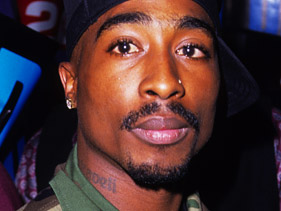
Stephen J. Rivele and Chris Wilkinson have signed on to write script about Death Row superstar’s final years. By Jayson Rodriguez Tupac Shakur Photo: Steve Granitz/ Wireimage Antoine Fuqua’s forthcoming Tupac Shakur biopic will soon have a script: Two Oscar-nominated writers, Stephen J. Rivele and Chris Wilkinson, have been tapped to write the screenplay. The scribes, whose writing credits include “Nixon” and “Ali,” told New York magazine that the film will focus on the late rapper’s final day, with flashbacks of the preceding four years of his life interspersed throughout. Rivele added that the script centers on their perception that Shakur was miscast in the hip-hop world in which he found himself. “It became clear that he was essentially a 19th-century Romantic poet who found himself in the 21st century,” he explained. “He was a really sensitive, very romantic, talented young poet who also could sing, dance, and act. But the realities [of the hip-hop music business] were that he had to create this persona of the gangster.” The film is tentatively slated to begin production later this year, according to the magazine. Fuqua has previously said he hopes to find a newcomer to play Tupac . “I want to go to the streets and find him anywhere he might be in the world,” the director said. In addition to a fresh face, filmmakers intend to offer a new take on the life of the fallen rap star, who was murdered in 1996. Rivele explained that the movie won’t aim to resolve who murdered Shakur, but rather focus on who he was and the person he attempted to be. The movie will push a thesis slanted more toward asking why anyone would have wanted to kill the talented superstar. “He was obviously very angry, and had been subjected to a great deal of violence at home, in the streets and in prison,” Rivele said. “But he was just beginning to shed that anger and look for a purer voice. … He was in the process of changing himself and entering a new phase of his life — essentially a Romantic vision — and had set up a new label and a new production company to create it. He saw the contradiction between the musical persona of ‘Thug Life,’ and his essential nature as a gentle, sensitive person. And that was partly responsible for his murder: He was not a gangster, but the people around him were. They saw he was going to leave, that they were going to lose him, and so I think they decided to kill him.” Who would you cast to play Tupac in a biopic? Share your choices with us in the comments section. For breaking news, celebrity columns, humor and more — updated around the clock — visit MTVMoviesBlog.com . Related Artists Tupac Shakur

Read more here:
Tupac Biopic Gains Oscar-Winning Screenwriters

Flashback: After Katrina, Sensationalistic Media Accounts Earned Press a D-Minus

Five years ago on Sunday, Hurricane Katrina smashed into the Gulf coast, devastating much of the region, and most memorably New Orleans. Yesterday was an occasion to look back at what went wrong in the city, and hope that the same mistakes are not made again. One of the most notorious failures surrounding Katrina was the media’s coverage of the situation in New Orleans. One “well-known [television] anchor,” actor and filmmaker Harry Shearer recalled in an interview with Daily Finance’s Jeff Bercovici, claimed the “the emotional stories are more compelling for our audience.” Hence, the media mostly ignored the larger issues facing the city – survivors still stranded on rooftops, the reasons for the levy’s failures – in favor of more sensationalistic, occasionally outright false stories. Shearer gives the media’s coverage – with the notable exceptions of only a couple outlets – a D-minus. Shearer told Bercovici: The [New York] Times did okay. I think the rest of the press gets a D, and probably a D-minus for their efforts at patting themselves on the back about how well they did speaking truth to power. Anderson Cooper … giving a lecture to [Louisiana senator] Mary Landrieu, like that’s the person you need to lecture. It was grandstanding and showboating in place of telling a story — partly because they left. They left. Water leaves, story over. The [New Orleans] Times-Picayune won two Pulitzers for their work because they couldn’t leave. They lived there. They had to stay. In addition to the Times’s coverage, Shearer also praised the work of Michael Grunwald, who covered Katrina for Time and the Washington Post. But he went on to blast the press’s shallow approach to post-Katrina coverage, claiming that news consumers saw “lots of images of people destitute and unhappy but never [got] to find out why.” W. Joseph Campbell, communications professor at American University and author of “Getting it Wrong: Ten of the Greatest Misreported Stories in American Journalism” (hint: Katrina is one of the 10) agrees with Shearer. In the book, he wrote that post-Katrina media coverage “was in important respects flawed and exaggerated. On crucial details, journalists erred badly, and got it wrong.” They reported snipers firing at medical personnel. They reported that shots were fired at helicopters, halting evacuations from the Convention Center [in New Orleans]. They told of bodies being stacked there like cordwood. They reported roving gangs were preying on tourists and terrorizing the occupants of the Superdome, raping and killing. They said children were victims of sexual assault, that one seven-year-old was raped and her throat was slit. They reported that sharks were plying the flooded streets of New Orleans. Those reports were all wrong, and they contributed mightily to the public (mis)perception of the situation in New Orleans. At his blog, Media Myth Alert , Campbell added no single news organization committed all those errors. And not all those lapses were committed at the same time, although they were largely concentrated during the first days of September 2005. In any case, I write, the erroneous and over-the-top reporting “had the cumulative the effect of painting for America and the rest of the world a scene of surreal violence and terror, something straight out of Mad Max or Lord of the Flies.” Estimates of Katrina’s death toll in New Orleans also were wildly exaggerated. U.S. Senator David Vitter, a Louisiana Republican, said on September 2, 2005, that fatalities in the state could reach 10,000 or more. Vitter described his estimate as “only a guess,” but it was nonetheless taken up by the then-New Orleans mayor, Ray Nagin, and reported widely. In all, the death toll in Louisiana from Katrina was around 1,500. About the inaccurate estimates of fatalities, the Times of London said it had become clear by in mid-September 2005 “that 10,000 people could have died only if more than 90 per cent of them had locked themselves into their homes, chained themselves to heavy furniture and chosen to drown instead of going upstairs as the waters rose.” But the Times rationalized the flawed reporting, suggesting that it was inevitable: When “nature and the 24-hour news industry collide, hyperbole results.” A weak excuse, that. Besides, post-Katrina reporting from New Orleans was more than hyperbolic: It described apocalyptic horrors that the hurricane supposedly unleashed. “D-minus” is none too generous. As usual, the media adopted the role of the nation’s finger-pointers in New Orleans in Katrina’s aftermath, singling out a number of people and institutions they thought deserved blame. Ironically, of all the failings in the days after the hurricane hit, the media’s will inevitably be remembered as among the most grave.

See more here:
Flashback: After Katrina, Sensationalistic Media Accounts Earned Press a D-Minus

British Spy and Top Code Breaker Found Dead in MI6 London Safe House

Gareth Williams, a Welshman from Anglesey was one of Britain's top Code Breakers worked the ” GCHQ listening center” in the West Country. He had been living in an apartment probably owned by MI5 which is nearby. The Pimlico area of London is near to the MI6 HQ and there are many “safe houses” for use. Williams was a single man was discovered in a large sports bag in his bath. A laptop he used is missing. Williams was also a regular visitor to the NSA “Puzzle Palace” another listening and spy center. The CIA are so concerned about his death they are holding their own investigation. Williams was single but porn, bondage mags and women's clothes his size were also found at the “safe house” apartment. MI6 and other spy agencies are refusing to let the police interview any of his fellow workers, stating they are suddenly out of the country. This story has all the hallmarks of a Hollywood Spy Thriller…………… from the Daily Mail The CIA was called in to help investigate the murder of an MI6 spy last night as it emerged he was sent on frequent secret missions to the United States. American intelligence officers are poring over every detail of Gareth Williams's work and personal life to see if the circumstances of his death endangered U.S. national security. The Daily Mail can reveal that the 31-year-old codebreaker flew to the National Security Agency, the Pentagon's listening post and the largest intelligence agency in the world, up to four times a year. He returned from his last trip to America only a few weeks before he was found dead. Questions also remain over why his body lay undiscovered for up to a fortnight at his

Olbermann Distorts Conservative Adage as a ‘Screw the Poor’ Attack

On Friday’s Countdown show, MSNBC host Keith Olbermann either showed his ignorance of conservative ideology, or he made his latest deliberate distortion to attack conservatives as he suggested that a Republican candidate for Oklahoma governor expressed a negative attitude toward the poor, referred to by Olbermann as “screw the poor,” when, in reality, she was making the case that the wealthy are important to the economy because they are the wage payers for many people. As she spoke out against raising taxes, Rep. Mary Fallin alluded to the conservative argument that a tax increase on the wealthy would be bad for their employees. Olbermann quoted her version of the common conservative saying that conveys this point. Fallin: “I don’t know about you, but I’ve never been offered a job by a poor person.” The MSNBC host, apparently not getting the point, concluded that her words were meant as an attack on the poor as being useless to her, and tagged her with the top dishonor of “Worst Person in the World.” Olbermann: At a recent tub thumping for the conservative cause, she insisted government spending needs to be cut and tax breaks be given to the wealthy. And then she added this: “I don’t know about you, but I’ve never been offered a job by a poor person.” She did not add, “So screw’em.” That was merely implied. Below is a transcript of the relevant portion of the Friday, August 27, Countdown show on MSNBC: KEITH OLBERMANN: But our winner, Representative Mary Fallon, who is inexplicably running for governor of Oklahoma. At a recent tub thumping for the conservative cause, she insisted government spending needs to be cut and tax breaks be given to the wealthy. And then she added this: “I don’t know about you, but I’ve never been offered a job by a poor person.” She did not add, “So screw’em.” That was merely implied. But, of course, Miss Fallon is factually mistaken. She’s been elected to public office six times since 1990, and if some poor people didn’t vote for her and offer her her job, then the party she belongs to must necessarily be the rich people’s party. Mary “Screw the Poor” Fallon, Republican candidate for governor of Oklahoma, today’s “Worst Person in the World”!

Read the rest here:
Olbermann Distorts Conservative Adage as a ‘Screw the Poor’ Attack

J.Lo in a Stolen Medicated Lookin’ Titty Grab Pic of the Day

These are some pictures stolen from facebook. I assume the person who took the picture was friends with J.Lo, but then she pissed him off, so he decided to try to embarrass her. Or maybe the real J.Lo is actually cool, laid back, into getting medicated and grabbing her own tit, like a date rape victim, only when you take the pictures of this medicated, tit grabbing bitch, you don’t have to worry about it being evidence that comes to haunt you, but instead as a souvenir cuz she did whatever the fuck she’s doing to herself…. I just know, the fact these exist, make me like her a lot more than the hatred I had for her, like real hate…before seeing this picture.. Pretty fucking amazing…

Visit link:
J.Lo in a Stolen Medicated Lookin’ Titty Grab Pic of the Day

How to Stop the Government From Tracking Your Location (Illegally!)

The 9th Circuit Court of Appeals just decided that it was legal for the police to put a GPS tracking device on your car, sitting in your driveway, on your property. Here's how to protect yourself. To quickly summarize, the supreme court says that police can look through things that anyone in the public could come across, meaning, your driveway is freely accessible to the public, hence, the cops can shove a GPS locator onto your car. Then they can use it track you. Without a warrant. How do you stop this without combing over the underside—or perhaps even inside—of your car and finding the GPS tracker? With technology. Your first bet is probably to find out if someone is tracking you or not. You can turn here for cellphone and bug device detectors. But these aren't 100%, so if you're really paranoid and want to hide your location, you'll want to just go ahead and stop the trackers anyway. The first type is a GPS jammer, which is technically illegal to buy and use in the US, so keep that in mind. These types of GPS jammers plug into the cigarette lighter in your car, and will “prohibit GPS signal” up to 10 meters. Ten meters isn't too far, but it isn't super close either, so cars next to you might get some GPS interference as you drive down the road. This model is $33. There are handheld and higher-powered versions available for slightly more. Our friends at Brando have one too, for $50. If you're worried that someone is tracking your cellphone, there's a signal blocking bag for about $10 that you can shove your device into when not in use. You also have the cellphone-type trackers, which need to be stopped with a different device: a cellphone jammer. There are various portable versions, as well as ones that go into your car. These types of jammers are as illegal as the GPS ones, so again, know what you're getting into. Is it worth it to go to the potential legal troubles of owning and operating a GPS or cellphone jammer if you're not doing anything wrong? That's up to you to decide. But if you are doing something that you want to make sure the government doesn't know about and they're already surveilling you, it might already be too late to get one of these. [The Jammer Store] (not affiliated with the person known as J_Jammer) http://io9.com/5623081/how-to-stop-the-government-from-tracking-your-location added by: pjacobs51

Live Blog: Rock The Bells Los Angeles

Sets by Wu-Tang Clan, A Tribe Called Quest, Rakim and KRS-One also make for an epic tour kickoff. Lauryn Hill Photo: Brendon Thorne /Getty Images

Read more here:
Live Blog: Rock The Bells Los Angeles