Tag Archives: recession

Rep. Weiner’s Anti-Goldline/Beckophobia Crusade Falls Flat

An organization once headed by former Obama administration official Van Jones tried it. Other so-called grassroots organizations have given it a shot. Now Rep. Anthony Weiner, D-N.Y., with the power of Congress in tow, has taken his best shot to shut Glenn Beck down. But so far it isn’t really working. On Sept. 23, Weiner called a representative from Santa Monica, Calif.-based Goldline to testify before the Commerce, Trade and Consumer Protection Subcommittee about what he deemed to be the firm’s unfair business practices. However, it just so happens that Goldline sponsors Beck and other conservative media personalities. With congressional hearings, you’d expect the media to be all over this, right? Not exactly, at least thus far. The most attention Weiner’s charade could muster was a segment at the end of MSNBC’s bomb-thrower show, “Countdown with Keith Olbermann.” Olbermann asked Weiner on his Sept. 23 broadcast if Goldline was in cahoots with “willing partners like Glenn Beck,” since anyone who suggests gold be a part of someone’s portfolio is up to no good. “The scare, lie, rip-off cycle that you outlined in your opening remarks – is it any wonder that Goldline seeks and finds willing partners in people like Glenn Beck?” Olbermann asked. According to a spokesman from Goldline, out of the 30 to 40 television advertisements the company runs on a daily basis, only one runs during Glenn Beck’s Fox News Channel programming. In fact, Goldline runs regular advertising on CNBC, the sister network to Olbermann’s MSNBC. But Weiner faulted Beck and others, including “angry radio hosts” for suggesting gold should be a part of someone’s financial portfolio. “You know this is where the angry radio host works hand-in-glove with these sellers,” Weiner said. “You know, you see Glenn Beck say, be careful, the economy’s a mess. Deficits, debts, you better invest in gold. Now let’s go to a word from our sponsor.” But Goldline offers a product that even media financial experts advise people to have in their portfolio. Take CNBC’s Jim Cramer, who on his May 17 program explained why gold is important, not necessarily as an investment to make money, but as a hedge against inflation – a point Weiner refuses to concede. “First off, gold hedges you against the eve-of-destruction pessimists,” Cramer said. “It’s a safe haven that tends to go up when everything else goes down. Second, as the commercial says, ‘Central banks are printing money like mad.’ That’s a great reason to own gold. Third no, matter what happens in keeping with the pessimistic zeitgeist, people are going to say what central banks around world are doing is inflationary. Doesn’t matter that it’s done to counter deflation – gold’s the antidote to the chatter. Fourth, there’s not a lot of gold being found.” Nonetheless, Weiner took a few more shots at Beck, which has been a pattern for the New York congressman on the gold issue . He argued that Beck was abusing the public’s trust, even though Beck was conveying a perfectly legitimate view and speaking on the behalf of a legitimate sponsor. “It got so bad that even Fox News said to Glenn Beck, you can’t be a paid sponsor for these guys anymore, because it was just — the line was getting blurred,” Weiner continued. “Now, that’s Fox News’ problem. That’s Glenn Beck’s problem. I think he does have some responsibility to his viewers. You know, it’s odd of me to be saying this, but I want to stand up for Glenn Beck’s viewers in this case.” And Weiner maintained that the laws he is proposing, which are motivating his witch-hunt, wouldn’t even be applicable to Fox News or Beck. “But the laws that we’re proposing obviously don’t impact Fox News,” he continued. “And Glenn Beck can say and do whatever he wants. But I would hope he takes a step back and looks at our study and looks at the testimony today, and realize that his viewers are middle class people who are struggling. He should not be aiding and abetting a rip off.” That begs the question – why is Weiner bringing up Beck in the first place?

Read more:
Rep. Weiner’s Anti-Goldline/Beckophobia Crusade Falls Flat

CBS: Americans ‘Angry’ Over Bad Economy, ‘Taking It Out On’ Obama

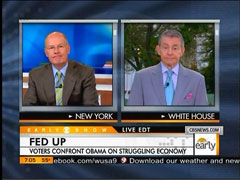
At the top of Tuesday’s CBS Early Show, co-host Harry Smith proclaimed: “Angry Americans. A new report declares the recession officially over. But many of us are not feeling it. Even taking on the President himself.” Later, he seemed to portray the President as a victim: “…a lot of Americans are still suffering its [the recession’s] effects, and are taking it out on President Obama.” In a report that followed, correspondent Bill Plante noted how “numbers may be going in the right direction” but touted “frustrated” Obama supporters speaking out at a Monday CNBC town hall. In between clips of those voters, Plante sympathetically remarked: “On the defensive, the President responded by outlining some of his administration’s accomplishments, but admitted that things aren’t where they need to be.” He concluded the report: “So the reality is that improving statistics aren’t very convincing to voters who are worried about jobs, and that is the reality the President and his party face going into the November elections.” Introducing a brief report on the stock market reaction, co-host Maggie Rodriguez looked for a silver lining: “The average American may be skeptical about an economic recovery, but the reaction on Wall Street to the end of the recession shows that investors are optimistic.” Business and economics correspondent Rebecca Jarvis declared: “…yesterday, stocks responded positively to the news that it is now behind us. The Dow ended higher by 145 points, putting it on track for the best September in 71 years.” Smith later interviewed Obama economic advisor and new head of the Consumer Financial Protection Agency, Elizabeth Warren. He lobbed softballs to her, starting with: “…you’ve spent a good time of your professional career studying the middle class, and quite frankly, worrying about the middle class. As we get this kind of news that we got yesterday that the recession was over, so many people in the middle class are saying, ‘it doesn’t feel like it at my house.’ When do you think it might feel like it at our house?” A headline on screen read: “Anger Over the Economy; Despite Recession’s End, Americans Frustrated.” Smith fretted over Warren not being able to enforce enough new regulations on business: “Can these industries really be regulated? But regulated in a way that – I mean, there will be so much pressure from them for you to do as little as possible. This will be a giant tug-of-war in the days going forward, to see who really does get control.” Warren replied that her job was “to start pushing back,” adding “I intend to do it as hard as I can.” Only at the end of the interview did Smith touch on Warren’s controversial nomination process: “By charging you with creating this agency, is this the best compromise possible? Because a lot of people wanted you to head the agency, and they said, ‘well, you’re not confirmable.'” Smith did not challenge Warren on whether her backdoor appointment broke the administration’s promises of transparency. Here is a full transcript of the September 21 segment: 7:00AM ET TEASE: HARRY SMITH: Angry Americans. A new report declares the recession officially over. But many of us are not feeling it. Even taking on the President himself. UNIDENTIFIED WOMAN: I’m one of your middle-class Americans, and quite frankly, I’m exhausted. I’m exhausted of defending you, defending your administration. SMITH: We’ll talk live with one of President Obama’s closest economic advisers. 7:02AM ET SEGMENT: SMITH: Now to the economy. A new report says the ‘great recession’ is over. According to a nonprofit research group, the recession began in December of 2007, and ended in June of 2009. But a lot of Americans are still suffering its effects, and are taking it out on President Obama. Senior White House correspondent Bill Plante has more. Good morning, Bill. BILL PLANTE: Good morning, Harry. The numbers may be going in the right direction, but if there was any doubt that most of America doesn’t yet feel things improving, listen to what a frustrated voter had to say to President Obama at a CNBC town hall meeting. [ON-SCREEN HEADLINE: Fed Up; Voters Confront Obama On Struggling Economy] UNIDENTIFIED WOMAN: I’m one of your middle-class Americans, and quite frankly, I’m exhausted. I’m exhausted of defending you, defending your administration, defending the mantle of change that I voted for, and deeply disappointed with where we are right now. I have been told that I voted for a man who said he was going to change things in a meaningful way for the middle class. I’m one of those people, and I’m waiting, sir. I’m waiting. I don’t feel it yet. PLANTE: On the defensive, the President responded by outlining some of his administration’s accomplishments, but admitted that things aren’t where they need to be. BARACK OBAMA: As I said before, times are tough for everybody right now. So, I understand your frustration. But what I am saying is, is that we’re moving in the right direction. PLANTE: But the President knows that the only real answer is providing jobs. And that saying the recovery takes time doesn’t play well with voters. UNIDENTIFIED MAN: And what I’m really hoping to hear from you is several concrete steps that you’re going to take, moving forward, that will be able to re-ignite my generation. Re-ignite the youth who are beset by student loans. And I really want to know, is the American dream dead for me? OBAMA: Absolutely not. PLANTE: But that disillusionment is echoed on main street, on both sides of the aisle. UNIDENTIFIED WOMAN B: I’ve been disappointed. Unbelievably disappointed. UNIDENTIFIED REPORTER: Yeah, in what? WOMAN B: From both sides. I feel like nothing changes. And so there’s no point, really. Everything will stay the same. No matter what I do, I could for or against and it’ll stay exactly the same. PLANTE: So the reality is that improving statistics aren’t very convincing to voters who are worried about jobs, and that is the reality the President and his party face going into the November elections. Harry. MAGGIE RODRIGUEZ: I’ll take it here. Bill Plante, thank you very much. SMITH: Alright, Maggie. RODRIGUEZ: Thanks, Harry. The average American may be skeptical about an economic recovery, but the reaction on Wall Street to the end of the recession shows that investors are optimistic. Let’s go to CBS News business and economics correspondent Rebecca Jarvis, she’s at the New York Stock Exchange this morning. Good morning, Rebecca. REBECCA JARVIS: Good morning, Maggie. And we all know how much the ‘great recession’ battered down stocks. Well, yesterday, stocks responded positively to the news that it is now behind us. The Dow ended higher by 145 points, putting it on track for the best September in 71 years. But still, as we all know, the struggles on main street, they do persist, and we’re seeing that in the issues that the ‘great recession’ raised for all of us. It wiped out 7.3 million American jobs. 21% Of our net worth was wiped out between December of 2007, and June of 2009, the official end of the recession. And economists believe it will take significant amounts of time just to regain the pre-recession levels on the employment front. In fact, some economists believe it will take as long as 2013 just to get back to normal employment levels in this country. Another key in all of this is housing prices, and Wall Street will be watching a bunch of data this week on that. Maggie. RODRIGUEZ: Alright, Rebecca Jarvis at the stock exchange. Thank you, Rebecca. Back over to Harry. SMITH: Alright, Maggie. Joining us from Washington with more on how the White House plans to turn the economy around is the new head of the U.S. Consumer Financial Protection Agency, Elizabeth Warren. Good morning. ELIZABETH WARREN: Good morning. SMITH: Let me ask you, before we get to the particulars of your job and the creation of this agency, I just want to ask you a philosophical question. Because you’ve spent a good time of your professional career studying the middle class, and quite frankly, worrying about the middle class. As we get this kind of news that we got yesterday that the recession was over, so many people in the middle class are saying, ‘it doesn’t feel like it at my house.’ When do you think it might feel like it at our house? [ON-SCREEN HEADLINE: Anger Over the Economy; Despite Recession’s End, Americans Frustrated] WARREN: Well, we have to remember that we have a problem in the middle class that didn’t just start in the fall of 2008. We have a problem that’s been under way for 30 years, of squeezing, chipping, hitting on the middle class. Flat wages, rising core expenses, families reached a point where they really couldn’t save, they turned to credit, and the credit industry has drained billions of dollars out of their pockets. So, it’s a – it’s going to take time to rebuild the middle class. I mean that – that really is part of the problem here. We’re starting now with this new credit, Consumer Credit Bureau, and that’s going to be one piece of it. I hope it’s going to patch a big hole in the bottom of the economic boat. But there’s still work to be done in a lot of areas. On wages, on housing, on student loans, on retirement security. It’s not just one thing that went wrong, and it’s not just one thing that’s going to fix it. SMITH: Can these industries really be regulated? But regulated in a way that – I mean, there will be so much pressure from them for you to do as little as possible. This will be a giant tug-of-war in the days going forward, to see who really does get control. WARREN: You know, I’m not a Washington person. I never really wanted a job here. I had this idea for this agency, and thought, that’s it, you know, other people will take care of it. The President asked me to come here, and to start to work immediately. Not to worry about titles, not to go through all that business, but to start to work to set up this agency, to start pushing back. And that’s exactly what I intend to do. And I intend to do it as hard as I can. SMITH: By charging you with creating this agency, is this the best compromise possible? Because a lot of people wanted you to head the agency, and they said, ‘well, you’re not confirmable.’ WARREN: You know, I don’t know the politics. But I don’t see this as a compromise at all. There was one option, and that was to go the confirmation route, and I’m told that would take about a year, during which I couldn’t do any work on the agency. And this is the part that amazes me, I wouldn’t be allowed to talk about it. Or, I could not have that title, and I could get to work right now. And so, I said to the President, I want to go to work right now. I don’t care what you call me. Let me go to work and let me try to help. And when I’m no longer any help, I’ll leave. SMITH: Elizabeth Warren, thank you very much for taking the time to speak with us this morning. WARREN: Thank you. SMITH: Do appreciate it. RODRIGUEZ: So important to point out that the organization that deemed the recession officially over also was very careful to say, it may be over, but the economy is not recovering. That was a ‘by the way’ that’s important, as Americans are realizing. SMITH: A slow recovery. Yeah, right. RODRIGUEZ: A slow recovery and we could still dip into another recession. Which we all hope won’t happen.
Read the original here:
CBS: Americans ‘Angry’ Over Bad Economy, ‘Taking It Out On’ Obama

The View’s Hasselbeck Pummels Valerie Jarrett on Economy; Liberal Co-hosts Repeatedly Change Subject

Interviewing White House senior adviser Valerie Jarrett yesterday, The View’s liberal co-hosts repelled Elisabeth Hasslebeck’s tough questions on President Obama’s failed economic agenda by changing the subject and ignoring their conservative colleague’s criticism. Refuting the claim that the economy is “certainly moving in the right direction” despite dismal unemployment numbers, Hasselbeck asked Jarrett if Obama’s $50 billion infrastructure bill represents an “admittance of failure on the $800 billion stimulus bill that didn’t seem to work.” To sidestep Hasselbeck’s question, Jarrett invoked incredulity, flawed statistics, and historical revisionism: Didn’t seem to work? My goodness, to the three million people who have jobs today – to their families – I’d say it did work. Now it turned out that the economy was in far worse shape than anyone could have predicted, and so we’re not out of the hole yet, but those three million families are certainly better off. The millions of families whose jobs were saved as a result of our investment in the automotive industry, all of the small businesses. “If [the stimulus package] worked so well you wouldn’t need the $50 billion,” retorted Hasselbeck, pressing Jarrett to answer her original question. But instead of waiting for Jarrett to respond, co-host Joy Behar changed the subject to the auto bailout: “I don’t hear enough from the Democrats tooting their own horn on that one.” Delighted to be bailed out of answering a tough question, Jarrett gushed, “Help us tout it, you’re absolutely right. Not just GM, but Chrysler and Ford – all three of them are now having profits for the first time in a decade, they’re all doing well. And that’s a result of the steps [Obama] took.” And before Hasselbeck could repeat her question, co-host Sherri Shepherd changed topics again:  “I want to move it around a little bit and ask about you.” A few minutes later, after Jarrett and her liberal allies exchanged playful banter about family trips to Chuck E. Cheese and her longtime friendship with the Obamas, Hasselbeck made one last attempt to hold the Obama confidant accountable: “I think there’s trouble now that’s to be had or else we wouldn’t need to spend another $50 billion if the plan had worked.” This time, co-hosts Whoopi Goldberg and Barbara Walters jumped to Jarrett’s defense. “We could go on and on,” contended Goldberg. “We could go on and on,” echoed Walters, who proceeded to end the interview. A transcript of the relevant portions of the September 13 “The View” can be found below: ABC The View September 13, 2010 11:38 A.M. E.S.T. JOY BEHAR: He’s criticized a lot for not focusing on jobs. He focused on health insurance. Does he regret that he didn’t do it the other way around? VALERIE JARRETT, White House senior adviser: Well, let me say this: don’t you think it’s important to have a president who can multi-task? BEHAR: Yes. JARRETT: And so he did focus on the economy from day one and if you think about it, Joy, when he took office we were losing over 750,000 jobs every single month, four million jobs in the last six months of the Bush administration. And half of the last eight months we’ve seen private sector growth. Unemployment rate is still too high – you’re right, Elisabeth, it’s not nearly where we would want it to be – we won’t be happy until every single American who wants to work is working. But we are certainly moving in the right direction and it was a terrible condition that he inherited. I mean, think about. ELISABETH HASSELBECK: If I could, on that note, Valerie, because I think it’s important. With the new $50 billion infrastructure bill that the president outlined Friday, correct? JARRETT: Last week, yes. HASSELBECK: Some people are calling that an admittance of failure on the $800 billion stimulus bill that didn’t seem to work. JARRETT: Didn’t seem to work? My goodness, to the three million people who have jobs today – to their families – I’d say it did work. Now it turned out that the economy was in far worse shape than anyone could have predicted, and so we’re not out of the hole yet, but those three million families are certainly better off. The millions of families whose jobs were saved as a result of our investment in the automotive industry. All of the small businesses. HASSELBECK: If it worked so well you wouldn’t need the $50 billion. BEHAR: I don’t hear enough from the Democrats tooting their own horn on that one. JARRETT: Help us tout it, you’re absolutely right. BARBARA WALTERS: The president has talked about it. JARRETT: Not just GM, but Chrysler and Ford – all three of them are now having profits for the first time in a decade, they’re all doing well. And that’s a result of the steps he took. SHERRI SHEPHERD: I want to move it around a little bit and ask about you. You had a really interesting background. You were born in Iran, you lived in Iran for five years, then you lived in London for one year, then you came back. You said while you were out there you had no awareness of race until you came back during the 60s, during the civil rights movement. So when you were back here, what kinds of things did you experience in terms of race? 11:43 A.M. E.S.T. WALTERS: What do you call him? SHEPHERD: When you’re at Chuck E. Cheese? JARRETT: I’ve had my share of Chuck E. Cheese. It’s wonderful when you’ve got a five year old. No but when I’m out of the office and I’m just being his friend I call him Barack, but when I’m in the office I call him Mr. President. BEHAR: You’ve known him a long time and I understand he’s never gotten angry with you – you’ve never seen him get angry. A lot of people would like to see that now. We want to see it. HASSELBECK: We’d just like to see jobs. Not anger, results. JARRETT: Well I think it’s important that we have a president with a solid, steady temper. BEHAR: Absolutely true. JARRETT: Particularly during these difficult times. Don’t you think that’s important? It’s important and, you know, I don’t want a president just being, you know, emotional and sounding off. He has too much responsibility and too much power for that, but I also think last week as we’re going into this election season you’re seeing him make some contrasts between kind of the party that wants to go back to the Bush days that got us into all of this trouble – sorry Elisabeth – that we’re in now. HASSELBECK: I think there’s trouble now that’s to be had or else we wouldn’t need to spend another $50 billion if the plan had worked. WHOOPI GOLDBERG: We could go on and on. WALTERS: We could go on and on. And we’ll ask you to come back with us and we can go on and on. I’m sure the president’s very happy that you’re going to remain in your present position. JARRETT: Thank you very much. Thank you. WALTERS: And we want to thank Valerie Jarrett so much. It’s an honor for us to have you on with us, great pleasure.

More:
The View’s Hasselbeck Pummels Valerie Jarrett on Economy; Liberal Co-hosts Repeatedly Change Subject

Thom Hartmann: Gingrich, Palin, ‘Whole Right-Wing Crazy Train’ Threatens Our Soldiers

On August 31, liberal talk radio host Thom Hartmann complained that the Obama White House needs to “stop taking seriously every feigned outrage of the right” like the Ground Zero mosque. A few minutes later, he unloaded:   [Gingrich is] willing to sell out our country. He’s willing to see Americans die…He’s putting our soldiers at risk. Newt Gingrich, Sarah Palin, the whole right-wing crazy-train bunch of them, Glenn Beck…the right-wing hate machine on…talk radio. They are willing to see…another [terrorist] attack in an American city. In fact, I think, frankly, they would love it ’cause they could blame it on Obama. Why is it that every time conservatives question a radical Muslim imam like the Ground Zero imam, it’s now putting our soldiers at risk?

See the article here:
Thom Hartmann: Gingrich, Palin, ‘Whole Right-Wing Crazy Train’ Threatens Our Soldiers

Obamanomics Open Thread: Poverty on Track for Record Gain in 2009

For general discussion and debate. Possible talking point: Here’s change you can believe in! The number of people in the U.S. who are in poverty is on track for a record increase on President Barack Obama’s watch, with the ranks of working-age poor approaching 1960s levels that led to the national war on poverty. Census figures for 2009 – the recession-ravaged first year of the Democrat’s presidency – are to be released in the coming week, and demographers expect grim findings. The anticipated poverty rate increase – from 13.2 percent to about 15 percent – would be another blow to Democrats struggling to persuade voters to keep them in power. (more stats follow) Should those estimates hold true, some 45 million people in this country, or more than 1 in 7, were poor last year. It would be the highest single-year increase since the government began calculating poverty figures in 1959. The previous high was in 1980 when the rate jumped 1.3 percentage points to 13 percent during the energy crisis. Among the 18-64 working-age population, the demographers expect a rise beyond 12.4 percent, up from 11.7 percent. That would make it the highest since at least 1965, when another Democratic president, Lyndon B. Johnson, launched the war on poverty that expanded the federal government’s role in social welfare programs from education to health care.  To be sure, this is really bad news for Obama and Democrats. However, if the poverty rate ends up being the highest since LBJ started this “war on poverty,” doesn’t it mean we’ve lost, and that expanding “the federal government’s role in social welfare programs from education to health care” has totally failed? Of course, such an obvious conclusion won’t be made by the Left which will certainly use this data to call for even  more socialism, correct?

Read the original post:
Obamanomics Open Thread: Poverty on Track for Record Gain in 2009

Crazy Larry Tongue-Lashes Trumka

Perhaps it was just a publicity stunt for his impending MSNBC show, but Lawrence O’Donnell went Crazy Larry on Morning Joe today. The lefty host of The Last Word unleashed on an unlikely target: AFL-CIO head Richard Trumka.   What ignited Larry’s tirade was Trumka’s professed concern for the contract-negotiations plight of professional football players. O’Donnell was outraged that the union honcho was spending his time on the millionaires of the NFL rather than workers such as miners who merit more concern.  Sample lines: “Exactly how many minutes of your day do you spend worrying about $15-million football players? Is this the biggest waste of your attention that could possibly come your way? Is it embarrassing for you to have to talk about these guys?” Sit back and enjoy Larry going off. Trying to comfort Trumka, Joe Scarborough assured him that he shouldn’t feel singled out: “[O’Donnell] does this to everybody. I introduced him to my mom on the streets of New York.  Fifteen minutes later she was breaking down in tears.” Aside: as a card-carrying member of Local 101 of the Pajamahadeen Bloggers Union, for whom every day is Dress Down Friday, I’m in no position to criticize another media man’s sartorial standards.  But unless Larry is working undercover for a special on street people, you have to wonder about his unkempt, unshaven look today.

See the article here:
Crazy Larry Tongue-Lashes Trumka

Media Seek Silver Linings in Economic Storm Clouds Despite Bad News about Jobs, GDP and Other Sectors

Recently, the economic news has been troubling. The latest jobs report showed another month with net losses, GDP was revised downward to a ” tepid ” 1.6 percent for the second quarter and others sectors like housing have still shown signs of weakness . Obama’s “recovery summer” came to a close with 14.9 million Americans unemployed and many worried about the overall economy. Some politicians are worried about being unemployed come November if the economy continues to crawl. The administration wanted the summer of 2010 to support Obama’s claims that recovery was underway thanks to the stimulus package and numerous bailouts. So Obama and other administration officials announced a tour of infrastructure groundbreakings around the country – projects paid for by the $787 billion “recovery act.” But that costly legislation and other stimulus attempts have failed, even by the Obama administration’s own standards according to nearly 100 economists. US News & World Report found that almost 100 ” prominent ” economists wrote a letter to the president in June 2010 telling Obama the stimulus failed and federal spending must be reined in. Yet the mainstream media have gone out of its way to bolster the stimulus , crediting it with jobs ( saved or created ) in towns across the country. Rarely have journalists taken Obama to task for his grandiose and empty promises about job growth as the result of the stimulus. And as bad news about jobs and other economic indicators has stacked up against the White House, journalists have continued to hunt for silver linings in storm clouds. On Sept. 3, “American Morning” found the ” bright spot ” in August’s loss of 54,000 jobs. Ali Velshi called the report a “glass one-quarter full,” but his two guests that morning were upbeat. Speaking of the 9.6 percent unemployment rate, Shawn Tully of Fortune magazine told viewers “This is actually not such bad news.”   The news media began looking for good economic news early in the Obama presidency, desperate to credit him for turning things around. Newsweek even surprised Obama by declaring the recession over in its Aug. 3, 2009 issue. Broadcast networks also jumped on the bandwagon interviewing economists like Lakshman Achuthan who told CBS the economic indicators “are emphatic that recovery begins this summer [2009].” Although GDP showed gains beginning in the third quarter of 2009, the April 13, 2010 Wall Street Journal reported that the economists who decide when recessions begin and end ” stopped short of calling an end to the downturn that started in December 2007 .” Summer of Recovery that Wasn’t On June 17, 2010, the White House launched its ” Recovery Summer ” tour of groundbreakings at infrastructure projects paid for by the stimulus package. “As part of Recovery Summer, President Obama, Vice President Biden and other administration officials will travel to more than two dozen Recovery Act project sites in the coming weeks, highlighting the surge in project activity and the Recovery Act’s steady climb to 3.5 million jobs by the end of the year,” the White House press release said. CBS followed the president to Ohio the next day and promoted his tour. Katie Couric said, “With the oil spill dominating so much of the news, President Obama wanted to remind everyone today he hasn’t forgotten about unemployment, which remains close to ten percent. So he went to Ohio to mark a milestone.” What milestone? The 10,000 th project paid by stimulus package that the news media sold as a huge job creator. Couric noted that the recession wiped out more than eight million jobs, but stressed that nearly 900,000 jobs were created in November 2009. Couric’s brief report had no criticism of the Obama administration’s handling of the economy. One night later, on June 19, CBS’s Jeff Glor cited an improvement of the unemployment rate in 37 states calling it “one more sign the economy may be improving overall,” as the lead in to a story about four struggling families. On the subject of jobs, the media have grasped for any positive indicators they can find, but have rarely criticized Obama for the lengthy stretch of high unemployment. In 2009, the rate hit a 26-year-high and the United States saw the most jobs lost in a single year since 1940 , yet journalists omitted the failure of the stimulus package and refused to hold Obama accountable for the jobs losses. The media were thrilled when the May jobs report came out reflecting the hiring of 411,000 temporary Census employees, even though those jobs would only last a couple of months. Headlines at CNN.com and other outlets emphasized the “fastest pace” of job creation in 10 years. But now Obama’s “recovery summer” has gone bust . According to James Pethokoukis, Money and Politics columnist for Reuters, it “must have looked like a pretty safe wager for the Obama administration” at the beginning of June. Jobs were added in the spring and the economy was growing, but as Pethokoukis noted “the economy has fallen back to earth.” He cited a number of concerning economic data, including falling private sector job growth, very high unemployment and a growing number of people too discouraged to look for work. ‘Green Shoots,’ Silver Linings and ‘Glimmers of Hope’ It doesn’t seem to matter how bad the economy gets under Obama’s leadership, the mainstream media cling to whatever small piece of good news they can find. That’s exactly how journalists have spun many of the monthly jobs reports – by emphasizing the unemployment rate over the number of jobs lost or vice versa depending on which sounded better. After 54,000 jobs were lost (net) in August and the unemployment rate ticked back up to 9.6 percent, CNN emphasized that 67,000 private-sector jobs that had been created and found two economists to talk up the economy. Just two days later on Sept. 5, CNN’s Ali Velshi said, “There are fresh signs of an economic recovery, but where are the jobs?” At least as far back at April 2009, media outlets were starting to talk about “green shoots” in the economy. Ben Bernanke likely started the trend after telling “60 Minutes” he detected some “green shoots” of economic recovery. Journalists in particular embraced the phrase along with others like silver lining , ” bright spot ,” and ” glimmers of hope .” Newsweek , all three broadcast networks, major newspapers like The New York Times and Washington Post and other outlets have mentioned “green shoots” when discussing the economy since Obama took office. Some have used the good news to bolster the president. Former Clinton administration official George Stephanopoulos was upbeat about an “economic turnaround” on “This Week” Aug. 2, 2009. “The president’s poll numbers may be wilting a bit in the summer heat, but each day this week brought those economic green shoots he’s been counting on,” he said. “Monday, new home sales jumped, the biggest monthly increase in eight years. Tuesday, home prices, their first increase in three years. Wednesday, a surprising step up in manufacturing activity. Thursday, new jobless claims fall to their lowest level since January,” Stephanopoulos said. “And Friday, the clearest sign yet that the recession might be easing. Second-quarter growth falling much more slowly than expected as the stock market capped off its best month since 2002.” Context, however, shows the wishful thinking – or spinning – behind those remarks. The ABC anchor was talking up the economy because growth fell more slowly than it had been – not because the economy was actually growing. On Nov. 24, 2009, Jim Cramer spoke of “areas of encouragement” despite “horrible” unemployment numbers on the “Today” show with Matt Lauer. LAUER: One in 10 Americans out of work in this country right now. Got other people who are underemployed, then there are the whole group of people who are worried about losing their jobs. But you keep hearing economists and experts talk about green shoots.          CRAMER: Right. LAUER: These are – these are areas of encouragement. What do you see as green shoots right now? CRAMER: Auto sales, not bad. October, pretty good. LAUER: Post cash for clunkers? CRAMER: Yeah. November, not bad. We don’t have a lot of cars, excess inventory. There’s not a lot of excess inventory at retailers. Retailers are saying that November’s been pretty good. We also saw a very good number for existing home sales, some stabilization. Those are all three very good signs, Matt. In contrast to the pro-administration media, CNBC’s Rick Santelli has brought perspective to many economic stories including the issue of unemployment On March 29, 2010, Santelli warned that the “traditional media” would overplay the upcoming jobs report that would probably show lower jobless numbers. Santelli explained that the report would mislead because of many temporary census jobs that would be included. “Well, you know I think the market, many want to believe, many want to believe in the green shoots,” Santelli said. “They want to believe that optimism is part of the medicine. You know, I’m not sure if I’m in that camp but I think there’s going to be a couple or three months in a row here, where whether it’s GDP or whether it’s job data, that’s going to have the possibility to look better.” “I think those that understand that this type of job creation isn’t going to last and it isn’t going to ultimately make up the 200,000 we need just to remain neutral, but it will move markets, yes. And I think interest rates on this holiday Friday, should we get a 250,000 or higher number, is going to be wild. And it shouldn’t be, but it will,” Santelli concluded. Like this article? Then sign up for our newsletter, The Balance Sheet .

See the original post here:
Media Seek Silver Linings in Economic Storm Clouds Despite Bad News about Jobs, GDP and Other Sectors

Ed Schultz to Speak at Hastily Arranged DC Rally He Claims Not in Response to Glenn Beck’s Rally

Remember the Seinfeld episode where George Costanza pretended to be an architect? Seinfeld thought it was a bad idea, suggesting Constanza would do better as a fake marine biologist, leading Constanza to complain, “You know I’ve always wanted to pretend that I was an architect.” Ed Schultz, liberal radio host and MSNBC flamethrower, is done pretending to be an architect. Schultz garnered plenty of attention last week with his huff-and-puff claim he could outdraw the estimated 300,000 people who attended Glenn Beck’s Restoring Honor rally in Washington on Aug. 28. What made Schultz’s boast so insipid was his insistence that he not actually organize or take part in a rally to exceed Beck’s draw, if only in spirit. Schultz’s suggestion alone would suffice. No need to actually draft a blueprint or break a sweat. Perhaps the Labor Day weekend knocked some reality into Schultz. According to Brian Maloney at The Radio Equalizer , Schultz has decided to appear at the “One Nation Working Together” rally on the mall in Washington on Oct. 2, exactly one month before the midterms. Here’s Schultz talking about this on his radio show yesterday (audio available at Radio Equalizer) — The march is on, Oct. 2. Will you march with me?  And thousands upon thousands. Oh, we’ll get three hundred grand. We’ll get 300,000, absolutely. We’ll show you conservatives out there when big Eddie starts cranking on something we don’t back down until it gets done. It’s happening on Oct. 2. I appreciate all of you going to our website at wegoted.com, there’s a consortium of groups that are coming together. You see, the Republicans, they want you to quit. They want you to think that there’s a tsunami coming. What tsunami? Ain’t no tsunamis coming! Nothing’s lost until you give up! If you give up, then they have a chance. I don’t buy the polls, I don’t believe it, I believe America is smarter than this, and I think Americans don’t want to go back. … Many of you are out of work. Many of you can’t make it to the rally but a lot of you will. We have been inundated with all kinds of communication from wonderful listeners and viewers and I will be a featured speaker. There will be other speakers and there will be some groups that are going to be obviously helping out with all of this, just like FreedomWorks and the billionaires and the six months of promotion helped out the Beckster. And I want to get something very clear right now. If Beck had not done his rally, this would have happened, OK? This is about the country. This is about making sure that information is where it has to be, with the American people. And now it’s about passion, now it’s about emotion. And by the way, there will be some old and there will be some white people at the Oct. 2 rally on the mall in Washington, D.C. They just won’t be angry. And they won’t be motivated by hate and they won’t be race-baited. Schultz asserts that “if Beck had not done his rally, this would have happened” anyway. Maybe so, and I’ll temporarily set aside my well-deserved skepticism of anything claimed by Schultz. But the whiff of desperation wafting from Schultz’s reversal makes me wonder if Beck hasn’t put the fear of God in him.

Originally posted here:
Ed Schultz to Speak at Hastily Arranged DC Rally He Claims Not in Response to Glenn Beck’s Rally

Bartiromo: GOP-Controlled House ‘Most Important Near-Term Catalyst’ for Economy

As the not-so “recovery summer” draws to an end, many are scratching heads, wondering what it will take for the economy to pull out of this recession. According to Maria Bartiromo, host of CNBC’s “Closing Bell,” it will be political change in Washington, D.C. In an appearance on NBC’s Sept. 7 “Today,” she said the best stimulus would be a Republican-controlled House of Representatives. “This is probably the single most important catalyst for the stock market right now,” Bartiromo said. “I think that the perception of confidence, the perception that perhaps we won’t see tremendous change in terms of higher expenses in 2011 if we were to see the Republicans gain control of the House, it will probably be a positive for the stock market. Bartiromo’s appearance on “Today” was to promote her new book, “The Weekend That Changed Wall Street: An Eyewitness Account.” In her estimation, A GOP takeover would create confidence and induce people spend more money. “That could create a rally and believe it or not, rallies like that make people feel richer,” she continued. “They get a better perception out there and they get people to spend more money. So that’s probably the most important near term catalyst.” It’s estimated that corporations are sitting on at least $1 trillion that if freed up and put back into the economy, it could rescue the country from this recession.

Read more from the original source:
Bartiromo: GOP-Controlled House ‘Most Important Near-Term Catalyst’ for Economy

Robert Reich: Stimulate Economy With 90% Tax On Top Earners

Can you imagine what would happen to the economy if top wage earners were taxed at 70 to 90 percent? Former Clinton Labor Secretary Robert Reich can, and he thinks it’s a great idea. To be sure, many Americans were concerned that giving Democrats control of the executive and legislative branches of our government during an economic crisis could usher back in socialist tendencies first seen in this nation during the Depression. Fears of such a leftward shift sparked a new powerful movement called the Tea Party. With this in mind, Reich’s op-ed “How to End the Great Recession” published in Friday’s New York Times validates these concerns:  The rich spend a much smaller proportion of their incomes than the rest of us. So when they get a disproportionate share of total income, the economy is robbed of the demand it needs to keep growing and creating jobs. What’s more, the rich don’t necessarily invest their earnings and savings in the American economy; they send them anywhere around the globe where they’ll summon the highest returns – sometimes that’s here, but often it’s the Cayman Islands, China or elsewhere. The rich also put their money into assets most likely to attract other big investors (commodities, stocks, dot-coms or real estate), which can become wildly inflated as a result. Meanwhile, as the economy grows, the vast majority in the middle naturally want to live better. Their consequent spending fuels continued growth and creates enough jobs for almost everyone, at least for a time. But because this situation can’t be sustained, at some point – 1929 and 2008 offer ready examples – the bill comes due. And how does Reich see “us” paying that bill? If you said “higher and higher taxes,” give yourself a cigar: THE Great Depression and its aftermath demonstrate that there is only one way back to full recovery: through more widely shared prosperity. In the 1930s, the American economy was completely restructured. New Deal measures – Social Security, a 40-hour work week with time-and-a-half overtime, unemployment insurance, the right to form unions and bargain collectively, the minimum wage – leveled the playing field. In the decades after World War II, legislation like the G.I. Bill, a vast expansion of public higher education and civil rights and voting rights laws further reduced economic inequality. Much of this was paid for with a 70 percent to 90 percent marginal income tax on the highest incomes. And as America’s middle class shared more of the economy’s gains, it was able to buy more of the goods and services the economy could provide. The result: rapid growth and more jobs. 70 to 90 percent! He said it, didn’t he? 70 to 90 percent! But there’s more: What else could be done to raise wages and thereby spur the economy? We might consider, for example, extending the earned income tax credit all the way up through the middle class, and paying for it with a tax on carbon. Or exempting the first $20,000 of income from payroll taxes and paying for it with a payroll tax on incomes over $250,000. Yep. Let’s tax carbon and give the proceeds to lower and middle-income wage earners. There it is, folks. If you doubted the whole global warming scam was specifically designed to redistribute wealth, one of the left’s most-respected economic strategists just admitted it! But there’s still more: In the longer term, Americans must be better prepared to succeed in the global, high-tech economy. Early childhood education should be more widely available, paid for by a small 0.5 percent fee on all financial transactions. Public universities should be free; in return, graduates would then be required to pay back 10 percent of their first 10 years of full-time income. A 0.5 percent fee on all financial transactions! Does that mean if one buy’s stock or a house, the government gets a half of a percent? And another half when you sell? Does that include mutual funds, treasury bills, and money market accounts? And certificates of deposit? See where this could lead? Now just imagine if these socialists also get their way and a new valued added tax is implemented? At that point, any time you want to actually use your money, the government gets a slice kind of like a mafia kingpin or a union leader. And this is supposed to help the economy? But there’s still more: Another step: workers who lose their jobs and have to settle for positions that pay less could qualify for “earnings insurance” that would pay half the salary difference for two years; such a program would probably prove less expensive than extended unemployment benefits. Earnings insurance! Earnings insurance! As I hinted at the onset, this op-ed by Reich is a picture of the future if the Party in power and their media minions get their way.   Be afraid, America! Be very afraid!

See original here:
Robert Reich: Stimulate Economy With 90% Tax On Top Earners






