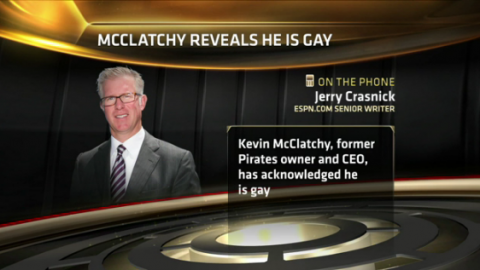
Another day, another sexuality reveal. Today it’s former Pirates owner, Kevin McClatchy… Via ESPN: Kevin McClatchy, the owner and CEO of the Pittsburgh Pirates from 1996 to 2007, has acknowledged he is gay to The New York Times, saying frequent homophobic slurs he heard in baseball circles had convinced him to keep his sexual orientation a secret. McClatchy, an heir to a newspaper chain who sold his shares of the Pirates in 2009 only after ensuring that the club remained in Pittsburgh, said the time had finally come to speak openly about his sexuality. “You’re not going to solve any problem until you start a dialogue,” McClatchy told The Times for an op-ed story published in Sunday’s editions. “And there’s no dialogue right now.” McClatchy will also be the subject of Wednesday’s “Outside The Lines” (3 p.m. ET on ESPN). “I’ve got a birthday coming up where I’m turning old,” McClatchy, who will turn 50 in January, told The Times. “I’ve spent 30 years — or whatever the number is specifically — not talking about my personal life, lying about my personal life.” McClatchy, 49, is not the first major-league executive or former executive to come out as gay. Rick Welts, the president and chief executive officer of the Phoenix Suns, revealed his sexuality last year. “This has been challenging to me,” McClatchy told The Times of his decision to reveal his sexual orientation. “I probably didn’t sleep as well as I could have last night.” McClatchy boasted of baseball’s ending of racial segregation in sports while saying he didn’t think players considered it similar to one of their own coming out as gay.
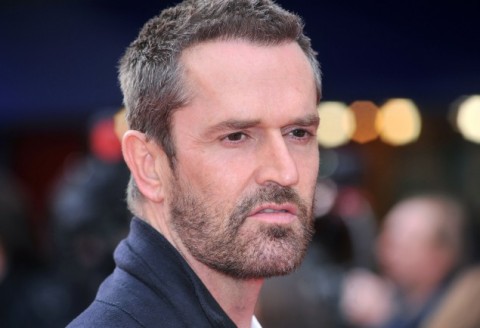
Yay or Nay to gay parenting? British actor Rupert Everett is being criticized after being outspoken about his opposition to the practice of gay folk raising kids… The 53-year-old told the Sunday Times Magazine that his mother Sara had met his boyfriend but “still wishes I had a wife and kids.” “She thinks children need a father and a mother and I agree with her,” he said. “I can’t think of anything worse than being brought up by two gay dads. “Some people might not agree with that. Fine! That’s just my opinion. “I’m not speaking on behalf of the gay community. In fact, I don’t feel like I’m part of any ‘community’. “The only community I belong to is humanity and we’ve got too many children on the planet, so it’s good not to have more.” Campaigners claimed his remarks were reminiscent of those who oppose same-sex marriages. Ben Summerskill, chief executive of the campaign group Stonewall, said: “Rupert should get out a little bit more to see the facts for himself. “There is absolutely no evidence that the kids of gay parents suffer in the way they are being brought up or in how they develop.” Everett also told how his family’s military background, which included his father serving as an Army Major, meant “some things were simply not talked about”. His comments were part of a feature in which his mother was interviewed as well. Mrs Everett, 77, told how she knew her son was gay from when he turned 18, and described her desire for him to have children. “In the past, I have said that I wish Rupert was straight and, I probably still feel that,” she said. “I’d like him to have a pretty wife. “I’d like him to have children. He’s so good with children. He’d make a wonderful father. “But I also think a child needs a mummy and a daddy. I’ve told him that and he takes it very well. He doesn’t get angry with me. He just smiles.” Their comments were likely to cause rancour with gay couples with children such as Sir Elton John and his partner David Furnish, who have a one-year-old son, Zachary. It is not the first time Everett has attracted controversy over interviews. In 2008, he apologized after calling soldiers “wimps” in The Sunday Telegraph. Publicising his film The Victorian Sex Explorer in which he played Sir Richard Burton, he said: “In Burton’s day they were itching to get into the fray. Now it is the opposite. They are always whining about the dangers of being killed. Oh my God, they are such wimps now!” He has also previously spoken of his treatment after making his sexuality public, urging actors not to come out for fear of losing work. In 2009, he said his admission had damaged his career and his work had been limited since the revelation. Sounds like this guy is still living out his childhood issues. We’re gonna take a cue from “My Best Friend’s Wedding” and “say a lil prayer” for his azz! Do you agree with Rupert or is he just on that bullshizz again? Source FameFlynetPics/WENN
Keep The Lights On director Ira Sachs ( Forty Shades of Blue , Delta ) tapped into his own experience in a tumultuous relationship that would eventually morph into the film that screened to accolades at the Sundance and Berlin film festivals earlier this year, winning the New York-based filmmaker a Teddy Award at the Berlinale. Keep The Lights On morphed out of the disintegration of a relationship he had with a man that spanned a number of years in New York around the turn of the century. Career demands, extra-relationship temptations, addictions, obsessions and more play into the rocky road experienced by the young couple. Sachs took inspiration for Keep The Lights On from the likes of Lisa Cholodenko’s The Kids Are All Right , Bill Sherwood’s Parting Glances and Jacques Nolot’s confessional Before I Forget , constructing Keep The Lights On as a gay man in NYC while embracing at times details some may consider unflattering. Danish actor Thure Lindhardt plays documentary filmmaker Erik, while American Zachary Booth plays closeted lawyer Paul, a couple who embrace each other while passionately forming a dramatic relationship rife with sex, drugs, highs, lows and dysfunction. Ahead of Keep The Lights On ‘s theatrical release this weekend, Ira Sachs invited Movieline over to his NYC apartment, which, perhaps not so coincidentally served as a prime location for his film. He talks about embracing depictions of addiction and sexuality, the challenges of making indie film today, how making the film affected him personally and what his former partner, who helped inspire the project, thought of the film. When did you decide that you actually wanted to make this film? I saw a film called Before I Forget by Jacques Nolot at (New York’s) Cinema Village, which was programmed by Ed Arentz — who is now my distributor. And what I saw [was] a film that reflected sort of contemporary life — Parisian life — of a filmmaker who was gay, but also what his life in Paris is that looks like something specific. As a gay person how we live looks very specific today and different than it did 20 years ago. I felt like there was no film that looked like my life, and no film which really reflected the community that I live in which is very mixed. The boundaries between gay and straight, I think, for most of us in our everyday lives, though not in our psyche has dissipated. So I wanted to make a film about sort of what I had seen in the last many years here. But specifically I ended a relationship in 2008 and I had a sense that 10 years before that was an interesting story. I started writing and I put it away for a couple of years, and it was really Mauricio Zacharias, my co-writer who read that material and said, “Well clearly this is a story you have to tell.” And in a way because I was doing something so autobiographical, I think I needed someone else to give me the blessing that it would be relevant. So how much of it is similar and how much of it is a departure to your own life during a certain time period? We began with the journals, and diaries, so we began with the raw materials from my life, but then ultimately we were creating a screenplay, which is constructed around its own laws and orders. And in a way, all my films have begun with things that I feel like I know more than anyone else. They’ve begun in a very intimate place. So you’re creating it similarly to the approach you took in Forty Shades of Blue for instance? Forty Shades was kind of about my dad actually. I grew up in Memphis with this larger than life figure who always had these younger girlfriends. And my relationship to those girlfriends was my entry to the film, and that sort of thing. And then when you start making a movie [like Keep the Lights On ] and you’ve cast a Danish actor to play a character based on yourself, then you’re like off to the races because you’re making a film. So what made you decide to go that route with a Danish actor? Was it that the actor Thure Lindhardt personally that appealed to you? I sent the screenplay to an agent that I have worked with in Hollywood, and I got the response that no one in the agency would be available for this [project]. And I knew even before that I wanted to make this film different. I thought that this film needed to be a truly independent film, so it would be financed that way. It would be made that way. So I heard about Thure who I was told was the bravest actor In Denmark and one of the best, and I knew that he would be. I sent him the script and he was alone in a hotel room in Spain, and he ended up using up all the scenes one could shoot alone, which were a series of masturbation scenes. And I knew that he was both comfortable with the material, but also really amazingly interesting to watch. So I casted him. Is this a little reflection, perhaps, on American actors, that they’re less inclined to do this sort of thing? I have a Danish lead actor. I have a Greek cinematographer. I have a Brazilian co-writer. I have a Brazilian editor. I had a Romanian script supervisor. I surrounded myself with non-American sort of sensibilities. And I think that’s a big part of the film. It’s a film about New York, and it’s a very New York film, but I think it’s told in a way that’s not repressed, and it doesn’t look at sex as some foreign object that has to be viewed only in the dark. Do you agree that that’s sort of the American POV generally, that violence in movies is acceptable, but sex is taboo? I do, I do. I think when this film played in Berlin, it was the most ordinary movie you could see.It was extremely ordinary which is very different than how it played at Sundance. How did it play at Sundance then? The subject matter and the sexuality made people uncomfortable. I think there’s a fear of difference in American cinema. And I was thinking a lot about that when I made this film because there used to be an idea that independent cinema was independent cinema . And that production and the means of production were actually separate from commercial cinema. And that gave you certain rights and opportunities — and I had all those rights and opportunities. I am one of a number of filmmakers who started out making films about gay people who stopped. My whole generation, most of us stopped. We either couldn’t make films, or we had to make other kinds of films. And I think that that’s partially about the individual, but it’s mostly about the culture, and trying to figure out how to sustain a career. I think for me, ultimately, I feel now that in some ways my marginal voice is actually my most powerful. It’s also possibly economically my most fertile, because I’m the guy who can make these films. Is there still a pretty low glass ceiling for gay filmmakers generally in this country? It wasn’t any easier to make a film about a Russian woman living in Memphis ( Forty Shades of Blue ). When you’re trying to make non-broad character-driven stories, and I’m interested in documentary as forum, so I’m actually trying to get the details right, which makes it even more specific in a certain way. Going back to Keep the Lights On and Thure’s character Erik, I got the feeling he was a little bit a love junkie. Yeah, and I would agree. He was someone who didn’t feel complete without obsessing over something. I think, no one’s used that term, but I think it’s a good one. It’s better than a sex addict. I mean, I like love junkie… He is someone who just emotionally needs some attachment. I think that there’s a compulsive need to be connected to another person. And I think the film in a lot of ways is less about addiction and more about obsession. There was something, these two guys, both of them are obsessed with the idea of maintaining their life together. And I think with obsession, sometimes it seems like the most comfortable place to be, because it shuts out everything else because you think, “Well if I can control this situation, then I can control my life.” So was it emotional reliving this to a degree? It wasn’t. No? It wasn’t really. I mean, I think by the time that I made the film I really believe I’d done all the therapeutic work and transformation in a lot of ways. Occasionally it felt like déjà vu. It was like an odd sensation that occasionally I was creating fictional scenes that were replicating things that were close to my own life. But mostly I just really felt like my life was one of the drawers that we can open. And I was always very willing to share as much as I could with the actors. But I never felt like they needed to try to do anything other than what was natural to them as actors and as people living the story. I mean, a lot of what I think I do as a director is try to give everything over to the actor. So I disappear. I mean, but the helms are their helms. The spaces are their spaces. I don’t rehearse with my actors. Then what’s your methodology of instruction? I talk to them individually, but I never talk to them together. So really in a certain way it’s more difficult for the actor because there’s a lot of risk, but actually that risk I think is the element that you could actually name in the performance in this film, and in my films in general. I think there’s something risky about it all. This is the moment. So I think to trying to capture the moment means that you’re really valuing the present, which includes the past, but it is about the present which is about the actors, it’s about flirtation, it’s what happens between them. Did you ever consider not emphasizing the drug use? Maybe there would be some other more acceptable vice like — alcoholism? An everyday addiction… Yeah, an everyday addiction, a “legal” addiction, yeah. You know, I really wanted to be unashamed and unabashed about the truth of my relationship and my behavior, and to not shy away from the details, and to not judge the action. So pot-head, crack addict, different kinds of distractions, different kinds of consequences, but the root of addiction is usually similar in lots of ways. And I feel like the drug use that the film talks about is really prevalent in the gay community at least. It’s something I feel like goes unspoken. So has your former partner seen this film? Yeah, he has seen the film. I showed him the film before Sundance. And he’s been very supportive. I mean, I think it’s not him. It’s a story about our relationship as seen through my eyes. Next: The New York filmmaker gives his personal Top 9 NYC films
She kissed a girl and didn’t like it The fake freaky rapstress was widely speculated to be a a lover of the ladies due to certain lyrics in her earlier tracks, adding to that Nicki later came out to claim she was bi. The rumors began to simmer down once it was discovered that she was dating her close friend and hype man Scaff Beezy. Addressing her sexuality for the first time in years, Nicki says she claimed to be a only pitched part-time for the other team in a bid to attract attention and kickstart her career. “Early in her career Minaj claimed to be bi, but now says she just did that to get attention. “I think girls are hot,” she says. “But I’m not going to lie and say that I date girls,” Rolling Stone reports. If Nicki was truly bi, there’s no doubt she would be accepted in the hip-hop world what with Frank Ocean recently “coming out the closet”. Now we wonder what else Nicki has lied about.. Source
Introducing Movieline’s ARRIVALS series, spotlighting breakthrough performers enjoying a bit of a “moment.” Today meet British actress Carmen Ejogo, whose scene-stealing performance in Sparkle kicks off a big year in film and TV. As much as Sparkle is about well, Sparkle ( Jordin Sparks ), the shy young singer who learns to come into her own in this weekend’s R&B remake (not to mention Whitney Houston in what might have been her comeback), it’s Carmen Ejogo’s scene-stealing Sister — sultry, ambitious, and tragically doomed — who brings the film’s cautionary lessons crashing home. Ejogo’s offscreen story is even more intriguing: the MENSA member and one-time backing singer for Tricky (she does her own vocals in the film) got her start in the 1986 David Bowie musical Absolute Beginners and tried the leading lady route in her first crossover roles ( Metro , What’s the Worst That Could Happen ), before earning notice in Sally Hemings: An American Scandal , HBO’s Boycott , Lackawanna Blues , and last year’s Away We Go . With Alex Cross and ABC’s Zero Hour on the horizon (“It’s kind of like Da Vinci Code meets Mulder and Scully in The X-Files ,” she laughs), Ejogo, who lives in Brooklyn with husband Jeffrey Wright and their children, is poised for a breakthrough year stateside. She rang Movieline en route to the airport, still buzzing about the film’s crowd-pleasing premiere. How did the Sparkle premiere go? Carmen Ejogo: It was fantastic. I’m still sort of trying to absorb the comments that came afterwards about my performance. I’ve been a mom at home mostly for the past ten years, trying to raise a family, and so to come back with a role like this and then to have an evening like last night, where the movie was received really well and my performance is really noted… you know, I’m kind of a little bit dumbfounded at this moment. I have a soft spot for the original Sparkle so I was really interested to see how the film would differentiate itself from the original, and one element that really does set it apart is the performances. CE: I’m most excited when people say that they’ve seen the original and they really responded to our version cause that was my big fear all along. I’d got a lot of questions along the way when people asked what I was doing next and I’d tell them I’m playing Sister in Sparkle . They were like, “What do you mean?” It’s like the untouchable role in so many people’s minds, so I’m most excited when somebody’s seen the original and they’re really into what we’ve done with this new version remake. What’s interesting about Sparkle the story, in both the original and the remake, is that it’s really Sister’s story for so much of the film. Did you find when you were first considering the project and going for it that Sister was a deceptively needy and nuanced character to play? CE: Oh absolutely. I’ve never, ever, if you look at my body of work – I’ve never played a sexy character, ever. You mean a character that explicitly uses her sensuality? CE: Absolutely, exactly. There’s many a career that’s been built on that in this industry and I’ve stayed away from it wholeheartedly, and the only thing that gave me permission in myself to play it in this role was because I understood that the journey. The arc is such that [Sister] is such a naïve personality and that neediness is so much who she is, and that becomes revealed. Where there’s this bravado and controlled sexuality and charisma that’s based on looks and something exterior, you also get an opportunity in this role to really explore and sort of put forth the inner workings of what often makes this kind of girl tick – and it’s usually and very often out of a real deep-seated neediness and insecurity and the need for validation from others. In Sister’s case, it’s from her mother in some kind of strangely complicated way, but it’s also from men, very evidently, throughout the movie. So that sort of complexity is what drew me to this role and I willingly played it, particularly in this sort of cult-celebrity kind of culture that we’re in trying to rope children into. Right, Sister learns that playing into her sexuality for fame is ultimately her downfall. CE: I have a daughter and I’m so conscious of the fact that she is bombarded with images of women who are celebrated purely because of their celebrity and their sexiness, and women who have sort of academic prowess or have great minds are not really looked upon in the same glory, so I really enjoyed the fact that we had [Tika Sumpter’s character] Dolores in the movie, who I saw like comes out as one of the most awesome honest personalities in the movie who wanted to be a doctor. She has no interest in these silly games. Sparkle you respect because she has real talent, and in the end, Sister is really just pathetic. I thought that was an interesting thing to put forth, the idea of the sexiest girl in the movie being the most pathetic. Do you feel that you’ve had to make that similar choice in your life in your work, to navigate the Sister-esque route in your career? CE: Definitely, definitely. If I had been making certain choices earlier in my career that I actively avoided I probably would be a little up to speed with a lot of my contemporaries. A lot of girls I was coming up with have far exceed me in terms of focus within the business, but I’m still happy and proud and can stand by my body of work at this point and I don’t feel like I’ve compromised my values along the way. One of my favorite tidbits about you is that you are a member of MENSA… CE: [Laughs] I don’t know if I can still pass if I took the test! After having kids I’ve definitely lost a few brain cells along the way. A high IQ isn’t something that Hollywood tends to naturally exploit in actors, unfortunately. CE: There was a point when I was very young where I remember talking with my mom about going to drama school and this was maybe when I was 8, 9, 10 years old – and she knew that I was also academically very capable, and she steered me in another direction. I ended up getting a scholarship to a really academically strong girls’ school that had produced people like Kate Beckinsale; she’s actually another actress in the industry who I feel has really had to grapple with certain choices and I think has a similar take on this. She was in the year above me in the school that I went to. It’s interesting the kind of girl that that place has produced, that have recognized the complexity of being a woman in this industry and made choices out of that. There were definitely forks in the path where I could have gone one way or another, but the academics certainly were something that was more encouraged in my house. Whitney Houston is such a tremendous presence onscreen just watching the movie. What it was like to be in those scenes and on set with her? CE: I actually had to get up from the [premiere] screening after she performed her song. I was just in absolute tears, as were many of the people around me, but I had to go and fix my make up because I knew that the lights were coming up in twenty minutes. [Laughs] Her presence on the screen is just utterly mesmerizing, she’s luminescent. On the set, she was always a presence, but there was a humility about that presence, an approachability about her that is not always what you find in stars, and that’s what she embodied. I have to really thank her so much to some degree for the performance that I was able to give within this movie because knowing that the people at the helm, the biggest name in the movie, are willing to be vulnerable and to be honest in their performance and their work, and their willingness to work with the other actors, sort of set the tone and freed me up to so what I had to do. She was also very open about her life, her past, in whatever way she thought would be beneficial to my work because obviously there are very strong parallels at times between my character’s past and Whitney’s past and life. I thought that was very generous and not asked for but was really offered. You really don’t know who you’re going to be showing up to work with on a project, and you just hope that have really creative endeavors at heart, and that’s absolutely where she was coming from. I read that you used to be in a band, is that true? CE: Gosh, yeah! I mean a long time ago, and that was really just a brief moment in time. I went on tour with a recording artist in the UK around the States, actually. I dabbled a little bit in the whole music thing but I’ve always thought about Bernie Taupin, who is Elton John’s lyricist; Elton John is the great melody and song writer but Bernie Taupin is the one who writes all the lyrics. I don’t write lyrics, and I never wanted to be in the music business if I was just going to be a puppet in it. So I made that choice at some point but I have such a passion for music and I love that whole space – I just had to decide at some point to devote myself to acting. That kind of made Sparkle a bit of a dream job. I got to combine the two and play at being a pop star. Which musician were you on tour with? CE: His name is Tricky, he’s a trip-hop artist. In that moment in time he was definitely a force to be reckoned with musically. But one of the reasons I didn’t ever pursue a career – in the music world if you’re black or mixed, you need to be able to belt a song or else you’re not a singer, you know? Coming from the UK, I can think of so many great songs and musical moments that didn’t require a belter of a voice; my favorite singer is Kate Bush and she’s not a belter, or PJ Harvey… I’m definitely more of an alternative girl. So given the fact that I’m on a soundtrack with Whitney Houston and Jordin Sparks and Cee-Lo, for goodness sake, a performance like mine is probably not going to get a lot of attention, and I’m okay with that. [Laughs] But that’s Sister singing those songs. The way I would approach those songs might be a little different – there’s a sassy, there’s a sultry, there’s a husky going on in that voice that’s not necessarily how I’d perform a song. It’s a performance! I was pleasantly surprised to find that R. Kelly was involved in the music of Sparkle . Did you interact with him much? CE: I learned a lot about R. Kelly from Whitney because they go back forever, and I didn’t know that. Whitney would talk about certain people in her life – she’s very reflective, I found, in lots of ways, and would talk about times with Michael Jackson who she really knew when she was a teen, and R. Kelly who she’s known forever. I never actually got to meet him. He remains in the shadows. Your next film is Alex Cross … CE: It is, and it’s a really small but pivotal role in the movie. It’s funny because it’s destined that it happened, because that’s how I got Sparkle – the make-up artist on Alex Cross said, “Do you sing?” And I said yeah, a little bit, and she said, “You really need to know about this movie that’s happening in Detroit, called Sparkle . And that’s when I decided to self-tape that night to go for the role of Sister. As small as the role is in Alex Cross , it’s a funny thing for that to come out after Sparkle . But I’m so thankful for that because really, one came from the other. What was it like to work with Tyler Perry? He has this niche following but this promises to be a real crossover. CE: I totally agree, and that’s what interested me about the project. Rob Cohen, who directed it, had been a fan of Sally Hemings which I did many, many years ago. So I was very excited to work with him for that reason as much as any, but this Tyler aspect was a bit of an unknown because I’ve never seen any of his movies. Of course I knew who he is, and I know the space he inhabits in terms of film, but I recognized that this was going to be a serious role and a departure for him from what he normally does. And he, I have to say, was as dedicated to the work as any actor I’ve ever seen. To the point that I don’t know if I ever actually experienced time with Tyler. I had never met him previously. I think he’s coming to the premiere so I might get a sense of who he really is, but I felt like I was constantly talking to Alex Cross. He was kind of method in his approach, and he was really full on! Audiences will also get to see you on the small screen, in Zero Hour . What can we expect? CE: I literally start as soon as I get back filming [ Zero Hour ] for ABC with Anthony Edwards, this is his return to network television. It’s really a two-hander; what excites me about the potential of this is it deals with subject matter that I think is going to be quite potentially controversial and titillating for the American audience, because it’s all about religion versus science and faith versus non-faith, and these topics that people don’t like to get into too much. It’s kind of like Da Vinci Code meets Mulder and Scully in The X-Files . [Laughs] It’s funny, I know where I’ve been coming from all these years and my background and I realized as I reflect, I’m a horror/sci-fi buff without realizing it. I was a big Stephen King book reader growing up, and I think I’ve made certain choices over the years based on that taste, and this is definitely one of those moments. Sparkle is in theaters now. Follow Jen Yamato on Twitter . Follow Movieline on Twitter .
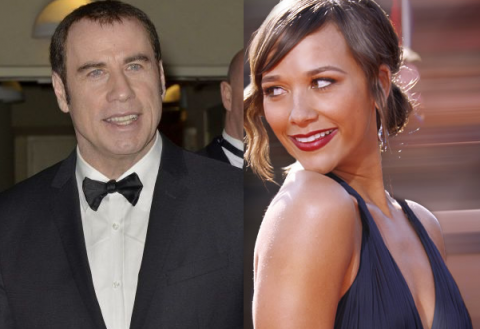
You ain’t fooling nobody Johnny T. Accusations of i mproper booty play and harassment have put John Travolta’s personal life under the microscope and through the wringer in recent months. The star, who has long been dogged by rumors about his sexuality, is facing numerous lawsuits from men, many of them masseurs, who claim he made inappropriate passes, financial offers and other attempts to secure sexual contact with them. Travolta, until recently, has remained silent on the charges, several weeks ago he denied one of the claims but others in Hollyweird, like Joan Rivers and Carrie Fisher, have been more than happy to sound off on the possibility that the “Saturday Night Fever” actor is gay. Now Rashida Jones, star of “The Office” and the upcoming film “Celeste And Jesse Forever,” is joining the choir of voices who want Travolta to come out. In a recent interview Jones, along with friend and “Celeste And Jesse Forever” co-writer Will McCormack, discusses the need for more openly gay actors before addressing Travolta: McCormack: There needs to be, like, a professional athlete that comes out. Jones: And a movie star! It’s time. McCormack: Yeah, like a big one. Jones: A movie star. Like John Travolta? Come out! Come on. How many masseurs have to come forward? Let’s do this. Welp! Might be time for Johhny boy to come out the glitter filled man-hole of a closet after all. Source
This is really an amazing story. Dying Man’s Family Grants Wish Of Leaving Large Tip For Waitress A Kentucky man’s family fulfilled his dying wish when they left a $500 tip to their waitress at a Lexington restaurant a few days after he died, the NBC station WLEX in Lexington. And that wish has turned into something bigger. Before he died July 7, 30-year-old Aaron Collins told his family he wanted to eat pizza and leave the server a large tip, but didn’t have the money, the Lexington Herald-Leader reported. His family raised the money through a website that Collins’ brother Seth started. Days later, they went to have lunch at a pizza parlor and handed the waitress the $500 when they were done, the paper reported. The event was captured on video and is posted on the family’s website. The waitress can be heard saying, “Are you kidding me?” According to the website, more than $10,000 has been donated since Thursday. Collins’ family said they plan on raising more money and giving out big tips weekly to other servers as long as they can. THAT is how you go out in a meaningful way that will always be remembered. If you wish to be apart of this inspiring “Pay It Forward” movement you can make donations HERE Image via YouTube Source Hit the flipside to watch the video for yourself
Ne-Yo Denies Gay Rumors R&B hitmaker Ne-Yo is speaking out on rumors regarding his sexuality. In an interview with Yesi Ortiz of Power 106 earlier this week, the Compound crooner spoke his piece on Frank Ocean’s recent revelation and also addressed long-standing rumors that he himself prefers the peen. “To each his own, if that’s how he rock, that’s how he rock, you know what I mean. It don’t change the fact that his music is incredible. It don’t change the fact that he’s an incredible artist. He chose to put his personal life out there, and that’s him. I don’t fault people for who they are, if that’s really who you are, you know what I mean. If that’s really who you are then by all means do what you do. I’m not gonna judge you behind that. That’s not my place. Ne-Yo had this to say in response to the rumors regarding his own pro-panty preference: Call me ugly or something, let’s think of something else. This whole gay thing has been lingering for a little too long. Say I’m adopted, I’ll take the ninja turtle comments, I’ll take that. Let’s do something else. Source
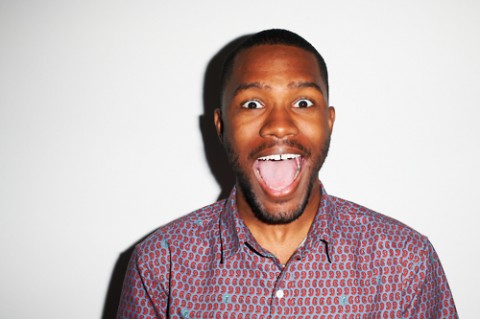
Frank Ocean’s Manager Issues Apology To Target Frank Ocean’s manager did some damage control after recently posting a tweet that had fans in an uproar over Target’s decision not to carry the recently-outed singer’s new album . A manager for R&B singer Frank Ocean, who publicly came out of the closet last week, apologized to retail giant Target after suggesting that they would not be selling his clients CD because of his sexual orientation, according to a report from Billboard magazine. Target revealed that it would not be carrying Ocean’s debut studio album “Channel Orange,” due to the label’s decision to sell it digitally on iTunes ahead of its scheduled release date. But while Ocean’s manager Christian Clancy, announced via his Twitter page that they would not carry the disc due to the iTunes exclusive, he also implied that the decision had something to do with his admission about his sexuality. “Target has refused to carry Frank’s album because of iTunes exclusive,” Clancy initially tweeted.. “Interesting since they also donate to non-equal rights organizations.” But Target later issued a statement to Billboard magazine, denying that Ocean’s sexuality played any role in the matter. “The claims made about Target’s decision to not carry the Frank Ocean album are absolutely false. Target supports inclusivity and diversity in every aspect of our business. Our assortment decisions are based on a number of factors, including guest demand.” Clancy later backtracked on his tweet, saying “I apologize for my comments about Target. They are not carrying Frank’s album because it went digital first. Not for ANY other reason. … My response was simply an emotional knee jerk reaction. … Stop. Breath. Do the best you can. Be honest. Keep it moving.” Interesting turn of events. Do you think Target had ulterior motives for not carrying the album? Source