Tag Archives: social-security

The Power of Bob Marley and Reggae (VIDEO)

Something about reggae music that the children even love. added by: keithponder

Budget Puzzle: You Fix The Budget

Today, you’re in charge of the nation’s finances. Some of your options have more short-term savings and some have more long-term savings. When you have closed the budget gaps for both 2015 and 2030, you are done. Make your own plan, then share it online. ~ Cutting anything from Social Security, Medicare and Medicaid is unfeasible in the real world, so I'd suggest straying from it if you're trying to be realistic. added by: cr00kshanks

Thomas Friedman Bashes Tea Party, Wants Better More ‘Centrist’ Movement

New York Times correspondent Thomas Friedman is clearly unhappy about the Tea Party, so much so that he considers the movement “not that important.” Instead, he envisions another group, “which stretches from centrist Republicans to independents right through to centrist Democrats,” sitting silently out there in America waiting for the right leader to emerge. So wrote Friedman Wednesday in his ” The Tea Kettle Movement “: The Tea Party that has gotten all the attention, the amorphous, self-generated protest against the growth in government and the deficit, is what I’d actually call the “Tea Kettle movement” – because all it’s doing is letting off steam. That is not to say that the energy behind it is not authentic (it clearly is) or that it won’t be electorally impactful (it clearly might be). But affecting elections and affecting America’s future are two different things. Based on all I’ve heard from this movement, it feels to me like it’s all steam and no engine. It has no plan to restore America to greatness. The Tea Kettle movement can’t have a positive impact on the country because it has both misdiagnosed America’s main problem and hasn’t even offered a credible solution for the problem it has identified. How can you take a movement seriously that says it wants to cut government spending by billions of dollars but won’t identify the specific defense programs, Social Security, Medicare or other services it’s ready to cut – let alone explain how this will make us more competitive and grow the economy? Friedman like so many on the left seems ignorant of history, not just the American version but also the world’s. Important political movements on this planet since the dawn of time begin with protest. A small group decides it’s being treated unfairly and begins expressing such sentiments. As it grows, those in power become fearful and either implement changes to assuage the anger developing in their population or are eventually overthrown. If the latter occurs, those doing the conquering don’t initially have a clear platform to enact once they attain power. That comes later. Did our Founding Fathers know what form of government the United States would be when colonists first began protesting the edicts of the King of England? Of course not. That didn’t come until years later. That Friedman and so many media members complaining about the lack of specific ideas in the Tea Party don’t understand this is either the height of stupidity or dishonesty. But Friedman wasn’t done, for he next threw out the same tired line about this movement not being credible because it wasn’t complaining about out of control spending when George W. Bush was president. Once again, this is either ignorant or an intentional misrepresentation, as one of the reasons Democrats did so well at the polls in 2006 was because so many of today’s Tea Party members refused to vote for Republicans that year.  The anger on the Right was first manifested in an election boycott that continued in 2008 when many conservatives couldn’t bring themselves to vote for John McCain. As such, there was plenty of anger being expressed towards establishment Republicans prior to Barack Obama’s inauguration, but it was taking forms that weren’t apparent to liberal media elites like Friedman. That said, having discredited the movement that is currently having more impact on America than the two major parties are, Friedman spoke about another: The issues that upset the Tea Kettle movement – debt and bloated government – are actually symptoms of our real problem, not causes. They are symptoms of a country in a state of incremental decline and losing its competitive edge, because our politics has become just another form of sports entertainment, our Congress a forum for legalized bribery and our main lawmaking institutions divided by toxic partisanship to the point of paralysis. The important Tea Party movement, which stretches from centrist Republicans to independents right through to centrist Democrats, understands this at a gut level and is looking for a leader with three characteristics. Leadership today is about how the U.S. government attracts and educates more of that talent and then enacts the laws, regulations and budgets that empower that talent to take its products and services to scale, sell them around the world – and create good jobs here in the process. Without that, we can’t afford the health care or defense we need. Here’s what Friedman believes “the real Tea Party” wants: To implement it would require us to actually raise some taxes – on, say, gasoline – and cut others – like payroll taxes and corporate taxes. It would require us to overhaul our immigration laws so we can better control our borders, let in more knowledge workers and retain those skilled foreigners going to college here. And it would require us to reduce some services – like Social Security – while expanding others, like education and research for a 21st-century economy. I’m not kidding. Friedman actually thinks that despite the current economic malaise strangling this nation – 9.6 percent unemployment occurring at the same time the government has exploded in size – there is a groundswell of support for raising some taxes and expanding some services. Yes, history has certainly shown homo sapiens willing to die for higher taxes! Methinks Mr. Friedman needs to spend less time in Greenwich Village and Berkeley to test his liberal theory in what know-it-all elites like him call “Flyover Country.” Unfortunately, that will never happen for these folk only care about the opinions of those residing in a handful of places on the coasts. Maybe they’ll broaden their horizons on November 3.

See the rest here:
Thomas Friedman Bashes Tea Party, Wants Better More ‘Centrist’ Movement

NewsBusters Sparks PolitiFact Examination of Bill Clinton Remark

A NewsBusters article about misstatements made by former President Bill Clinton on “Meet the Press” sparked a fact-checking examination by the St. Petersburg Times’ PolitiFact. As reported Sunday, Clinton bragged to host David Gregory that his administration had “paid down the debt for four years, paid down $600 billion on the national debt.” This of course was quite incorrect as the debt didn’t decline one year while Clinton was in the White House and actually increased by $394 billion in the four years in question. PolitiFact staff writer Lou Jacobson contacted a number folks on this issue including me to reach what I consider a “politically correct” conclusion : It depends on what the definition of “national debt” is. There are actually a few ways of tabulating the debt. One is public debt, which includes all debt borrowed by the federal government and held by investors through Treasury notes and other securities. Another is gross federal debt, which includes public debt plus debt held by the government. The most notable forms of debt held by the government are the trust funds for Social Security and Medicare, money which is owed to beneficiaries in the future. The Office of Management and Budget estimates that the public debt will reach $9.3 trillion by the end of fiscal year 2010. Add in the $4.5 trillion in debt held by the government, and you come up with a gross federal debt of $13.8 trillion. Now let’s look at Clinton’s tenure. Using the public debt figures, we see that the debt rose year by year during the first four fiscal years of Clinton’s stewardship, then fell during each of the following four fiscal years, from a 1997 peak to a 2001 trough. So using this measurement, Clinton is correct that “we paid down the debt for four years,” though he did overestimate the amount that was paid down when he said it was $600 billion. The actual amount was $452 billion — which was equal to about 12 percent of the existing public debt in 1997. But what about gross federal debt? On this score, NewsBusters is correct: In each fiscal year from 1993 to 2001, the gross federal debt increased, because the increase in money in government trust funds exceeded the annual decreases in the federal budget deficit. So by one of these measures, Clinton is correct, and by another, he’s wrong. After citing a number of economists on either side of the aisle, PF quoted one of my e-mail messages concerning the subject: “If the public debt during those years was bought with other debt — meaning by the Social Security trust and the Federal Reserve — we didn’t actually pay down any debt, did we? If you take out an equity line of credit on your home to pay off your car loan, your debt didn’t decrease. Furthermore, if you take out an equity line of credit to pay off your car loan and buy a boat, it would be deceitful on your part to say you reduced your debt, right? This is what happened those four years: We did retire some debt held by the public, but we did so by increasing debt held by the government and the (Federal Reserve). That’s not retiring debt. That’s just shifting it from one lender to another.” Despite this seemingly incontravertible logic, PF concluded: We see merit in using both public debt and gross debt, so we are reluctant to declare that Clinton is definitively right or definitively wrong in citing statistics supported by the public debt figure. Clinton’s phrasing — talking about “the debt” and “the national debt” — strikes us as vague enough to refer to either the public debt or the gross federal debt. So we are left with a statement that’s correct using one measurement and incorrect using another measurement. In addition, Clinton overestimated by about 25 percent the dollar amount by which the public debt declined from its peak during his term, though he also correctly characterized the changes in the debt under Republican presidents. So on balance, we rule Clinton’s statement Half True. As readers likely predict, I feel Clinton’s statement should have gotten either a “False” or a “Pants on Fire.” Looking at exclusively public debt would be like a lender only considering your mortgage balance in determining your credit-worthiness while completely ignoring your car loans and your credit cards.  Don’t you wish that were the case? The reality is the Treasury includes moneys owed to Social Security and Medicare in its gross debt figures because they are part of our nation’s total debt. Even the National Debt Clock tabulates gross federal debt and not just what is held by the public. In this instance as it pertains to Clinton’s claim, here are the pertinent facts. Debt held by the public did decline by $452 billion from the end of FY 97 to the end of FY 01. However, the amount held by government accounts – which mostly means Social Security and Medicare trusts – increased by $853 billion. Yet the surpluses in Social Security and Medicare only totalled $534 billion. This means these trust accounts purchased $319 billion more Treasury paper those four years than their actual surplus. That represents most of the $394 billion increase in gross federal debt during this period. Remember, we were told at the time that this debt buyback was as a result of the surpluses. Quite the contrary, what happened was debt held by the public was largely converted into debt owned by the Social Security and Medicare trusts as well as the Federal Reserve.  As our budgets are “unified,” it is therefore ludicrous to only look at public debt when referring to what the nation owes. Let me explain. Since 1969, we calculate what’s called “unified” budgets meaning they include receipts and expenditures associated with Social Security and Medicare. When the Clinton administration was reporting budget surpluses from 1998 on, and the CBO was projecting “surpluses as far as the eye can see,” they were including projected surpluses in Social Security and Medicare. Without these “trust fund” surpluses, we actually showed what’s called “on-budget” deficits in FY 98 and FY 01. In fact, in the four years that we showed unified budget surpluses of a combined $559 billion, fully $534 billion of that came from surpluses in Social Security and Medicare. Our actual “on-budget” surplus those four years was only $25 billion, a far cry from what was advertised and celebrated. With this in mind, if we’re going to report budget figures that include Social Security and Medicare surpluses – and even brag about our performance – we should certainly include what we owe these programs when we talk about national debt. Failing this is allowing political figures to have their cake and eat it too.  Something else to consider is media outlets look at the gross debt and not just what’s held by the public. When the gross debt past the $13 trillion mark earlier this year, these were some of the headlines: ABCNews.com reported on May 26, “National Debt Soars Past $13 Trillion”     Bloomberg.com reported on May 26, “U.S.’s $13 Trillion Debt Poised to Overtake GDP”  CBSNews.com reported on June 2, “National Debt Tops $13 Trillion for First Time” Once again, please recall that Clinton said “national debt.” As such, it appears our friends at PolitiFact were being generous in their ruling, at least in my opinion. That said, Jacobson was tremendously cordial in his e-mail discussion with me, and appears to have done a nice job of soliticiting varied opinions for this piece. Also of note, and in case your assumption was that this group always defends anyone named Clinton, this is not the case. Mr. Clinton has had twelve of his previous comments examined by PF resulting in four “Trues,” three “Half Trues,” one “Barely True,” two “Falses” and two “Pants on Fires.” Maybe this means that the next time the gang at PF is led to examine someone’s statements as a result of something I wrote, I’m going to need to plead my case a little better. To quote the late Ed Hart, we will know in the fullness of time.

Read the original here:
NewsBusters Sparks PolitiFact Examination of Bill Clinton Remark

Paul Krugman – The Angry Rich and Taxes – NYTimes.com

Tax-cut advocates used to pretend that they were mainly concerned about helping typical American families. Even tax breaks for the rich were justified in terms of trickle-down economics, the claim that lower taxes at the top would make the economy stronger for everyone. These days, however, tax-cutters are hardly even trying to make the trickle-down case. Yes, Republicans are pushing the line that raising taxes at the top would hurt small businesses, but their hearts don’t really seem in it. Instead, it has become common to hear vehement denials that people making $400,000 or $500,000 a year are rich. I mean, look at the expenses of people in that income class — the property taxes they have to pay on their expensive houses, the cost of sending their kids to elite private schools, and so on. Why, they can barely make ends meet. And among the undeniably rich, a belligerent sense of entitlement has taken hold: it’s their money, and they have the right to keep it. “Taxes are what we pay for civilized society,” said Oliver Wendell Holmes — but that was a long time ago. The spectacle of high-income Americans, the world’s luckiest people, wallowing in self-pity and self-righteousness would be funny, except for one thing: they may well get their way. Never mind the $700 billion price tag for extending the high-end tax breaks: virtually all Republicans and some Democrats are rushing to the aid of the oppressed affluent. added by: mik661

President Obama To Tea Party: ‘Identify, Specifically, What Would You Do?’

From the Huffington Post: White House advisers on Monday pushed back hard against a New York Times report that the administration is ready to launch a full-frontal assault on the Tea Party movement as the November elections approach. No such plans are being made, insisted senior advisers. And, sure enough, the Times quickly modified its story into something a bit duller. In a town hall meeting broadcast live by CNBC on Monday, however, President Obama seemed to be reading off the initial script. Pressed by an audience member to weigh in on what exactly drives the Tea Party, Obama, in no uncertain terms, accused the movement's members of refusing to talk in specifics. If there is anger over the economic or political landscape, he added, it is being misdirected in his direction. “The problem that I've seen in the debate that's been taking place and in some of these Tea Party events is, I think they're misidentifying sort of who the culprits are here,” said Obama. “As I said before, we had to take some emergency steps last year. But the majority of economists will tell you that the emergency steps we take are not the problem long-term. The problems long-term are the problems that I talked about earlier. We had two tax cuts that weren't paid for, two wars that weren't paid for. We've got a population that's getting older. We're all demanding services, but our taxes have actually substantially gone down.” “So the challenge, I think, for the Tea Party movement is to identify, specifically, what would you do?” he added. “It's not enough just to say get control of spending. I think it's important for you to say, I'm willing to cut veterans' benefits or I'm willing to cut Medicare or Social Security benefits or I'm willing to see these taxes go up. What you can't do, which is what I've been hearing a lot from the other side, is we're going to control government spending, we're going to propose $4 trillion of additional tax cuts, and that magically somehow things are going to work. Now, some of these are very difficult choices.” Obama does seem to operate at his best when facing inherently adversarial questions (recall the positive coverage he received for going to a Republican conference in Baltimore during the height of the health care debate). And while several questioners at the CNBC event were sympathetic to the president, the answers that seemed to resonate best came when the pro-business or anti-government questioners were pressing him. His direct questioning of the Tea Party's motives came just moments before he acknowledged that being “healthfully skeptical about government” is in “our DNA.” added by: BRAVATRAVELS

Ezra Klein – How to fix Social Security in one graph

“The revenue loss over the next 75 years just from extending the tax cuts for people making over $250,000 — the top 2 percent of Americans — would be about as large as the entire Social Security shortfall over this period( http://www.cbpp.org/cms/index.cfm?fa=view&id=3262 ),” write Kathy Ruffing and Paul N. Van de Water at the Center on Budget and Policy Priorities. “Members of Congress cannot simultaneously claim that the tax cuts for people at the top are affordable while the Social Security shortfall constitutes a dire fiscal threat.” We do have fiscal problems in this country: health care, for instance. We have to get growth in that sector down or we'll bankrupt the country. But that's not the case with Social Security. Social Security is just a question of priorities. And the legislators who are saying that we can extend the Bush tax cuts without offsets but that we need massive benefit cuts in Social Security are showing where their priorities lie, not stating a sad economic reality. added by: toyotabedzrock

IS GOVT SEIZING CONTROL?

Look at various aspects of American life and asks a simple question: Who is in control? The individual or the government? Where liberals have already had their way, government is in control. Where liberals are still moving to advance their agenda, their success would mean an increase in government intrusion into the lives of individuals. As they attempt to move the country on a trajectory toward greater government control of our lives, liberals are also pushing the country away from two great constants consistently advocated by the Founding Fathers: the principles of limited government chartered in the Constitution and the natural moral law enshrined in the Declaration of Independence. The greatest fiscal danger the nation faces as a result of the liberal agenda is the coming crisis of the welfare state. According to the Peter G. Peterson Foundation's analysis of Treasury Department figures, the federal government now faces $61.9 trillion in unfunded liabilities. That astounding number is comprised of the federal debt plus the cost of entitlements — such as Medicare and Social Security benefits — promised to people now alive that is not covered by the revenue the current tax structure is expected to yield. This $61.9 trillion in unfunded liabilities, by the way, equals $200,000 for every man, woman and child in the United States — not counting embryos. Where is the government going to find that kind of cash? The Control Freaks know where to look for it: Wherever you put your money. added by: ahiguy

‘Nightly News’ Skips Social Security’s 75th, Highlights Children’s Cartoon

Children must be making the news programming decisions at NBC “Nightly News.” Aug. 14 was the 75 th anniversary of Social Security, the largest government program and most troubled. Social Security is in the red this year – six years ahead of forecasts. The program faces a $41 billion shortfall this year alone. The major anniversary of a program often nicknamed the “third-rail” of politics didn’t even rate a mention on NBC “Nightly News.” Instead, NBC celebrated an “iconic” children’s cartoon: Dora the Explorer. “If you’ve ever said the phrase: ‘Swiper, no swiping.’ then you know the power of the little girl who made that phrase famous.” Kate Snow enthusiastically teased. “Dora the Explorer will forever be a seven-year-old cartoon character, but this weekend marks the tenth anniversary of a ground-breaking show that has been almost inescapable for a generation of kids.” While, Dora the Explorer may be more important to preschoolers and kindergartners it probably doesn’t resonate as deeply with taxpayers as Social Security and its problems. ABC “World News” Saturday also failed to mention Social Security on Aug. 14, while CBS “Evening News” aired a story about the unemployed being “forced” to opt for early retirement (at 62) collecting lower Social Security benefits “permanently.” Like this article? Then sign up for our newsletter, The Balance Sheet .

More here:
‘Nightly News’ Skips Social Security’s 75th, Highlights Children’s Cartoon

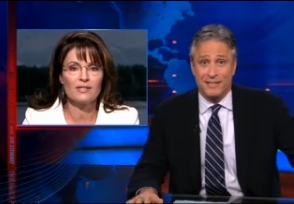
Jon Stewart Vulgarly Attacks GOP Concerns for Rising Taxes and Deficits

Comedian Jon Stewart on Wednesday joined the growing liberal chorus attacking Republicans for their concerns about rising taxes and exploding budget deficits. The only thing different about the “Daily Show” host’s approach was that he needed vulgarity to make his point. Potentially even worse, Stewart in his opening segment Wednesday actually used CNN’s Fareed Zakaria to support his view that letting the Bush tax cuts expire would be a good thing for the nation. Ironically, that was the only thing remotely funny about this sketch (video follows with partial transcript and commentary, extreme vulgarity warning, see BMI’s coverage as well ): The Daily Show With Jon Stewart Mon – Thurs 11p / 10c Deductible Me www.thedailyshow.com Daily Show Full Episodes Political Humor Tea Party “Let’s begin tonight in D.C.,” Stewart said. “It’s our nation’s capital. For the last 18 or so months Barack Obama’s been the President and Democrats have controlled both houses of Congress. Purely by coincidence, that’s the exact same amount of time that Republicans have expressed a newfound concern for our nation’s financial stability.” To set-up this “Republicans are hypocrites skit,” Stewart played clips of Rep. Jeb Hensarling, R-Texas, Sen. Mitch McConnell, R-Ky., Rep. Eric Cantor, R-Va., Rep. John Boehner, R-Ohio and former Republican House Speaker Newt Gingrich warning against the budget deficit. At that point, Stewart said, “The deficit wants to skullf–k your mother. It wants to eat your children after it shows your wife a level of physical passion you’ve never been able to provide.” But here was the real punchline: Stewart played a clip from the August 1 installment of CNN’s “Fareed Zakaria GPS” when the host of that show told his viewers that letting the Bush tax cuts expire would instantly shrink our nation’s deficit by 30 percent. After the clip ended, Stewart said Zakaria was right. That would have elicited uproarious laughter from a well-informed audience, for as NewsBusters reported shortly after Zakaria made this pathetic claim, nothing could be further from the truth. Supporting our view, the Heritage Foundation’s Brian Riedl has research that indicates these tax cuts were just a drop in the bucket of the overall federal budget deficit, and the real culprit is the explosion in spending – not the trotted out liberal misnomer that these tax cuts are responsible. Riedl explains the budget surplus forecasted at the end of the Clinton presidency was set to shift to a $6.1 trillion deficit and that the 2001 and 2003 Bush tax cuts were responsible for a mere 14 percent of this shift. The true culprit: the liberal sacred cow of entitlement spending. “Instead of closing the long-term deficit by splitting the difference between tax hikes and spending cuts, lawmakers should address the source-rising entitlement costs,” Riedl wrote. Indeed. In fact, even if the tax cuts were extended, revenues are projected to rise above the historical average by 2017. Contrary to Zakaria and Stewart’s view, this leaves surging spending responsible for the entire increase in long-term deficits. Business & Media Institute adviser and Cato Institute fellow Daniel Mitchell agrees, and refuted Zakaria’s claim on his Aug. 4 podcast . “Our real problem isn’t that deficits are large,” he said. “It is that the government is far, far too big. That’s what we should focus on, so he’s looking at a symptom rather than the underlying disease and then if we have to look at the issue of federal spending and federal revenue – even under the Obama budget projections – while low now because of the economic downturn – are going to climb to their historical post-World War average. We do not have, in other words, a shortage of revenue in the United States or in Washington, D.C. We have too much government spending.” On top of this, as NewsBusters reported a few hours before Stewart made his foolish comments, a new study published by the liberal Brookings Institution found the savings associated with just letting the Bush tax cuts expire on upper-income wage earners – what President Obama is advocating – to be minimal when compared to the current deficit totals. But facts weren’t getting in the way of Stewart’s populist rant as he next asked a truly absurd question: “How exactly can you be for deficit reduction and extending tax cuts? How do those two diametrically opposed thoughts exist in the same Party platform?” Well, Jon, here’s how: the last time Republicans cut taxes while controlling spending in the mid-1990s, the nation produced budget surpluses for four straight years while adding 12 million jobs to non-farm payrolls. Alas, this is an inconvenient truth Stewart and his ilk have chosen to ignore for over ten years, and Wednesday was no exception as the “Daily Show” host then played a clip of Rep. Mike Pence (R-Ind.) saying the following on “Meet the Press” Sunday: REP. MIKE PENCE (R-INDIANA): They talk about tax cuts the same way they talk about spending increases as though the government owned all of the money. They say, “Are they paid for?” Well, I think, I think deciding on a government spending increase is very different on whether or not we allow the American people to keep more of their hard-earned tax dollars. Makes sense, right? After all, it is OUR money! Obviously not according to Stewart, for he not only seemed totally perplexed by Pence’s logic, he mocked it by asking, “So, you’re saying money the government gets is different than money the government spends?” Well YEAH, Jon! When the government is spending $1.5 trillion MORE than what it takes in, there is a difference! A HUGE difference! Clearly missing this indisputable fact, Stewart said the deficit’s opinion on this matter can be summed up with a clip from the movie “Goodfellas”: ACTOR RAY LIOTTA: Business is bad? F–k you, pay me! Oh, you had a fire? F–k you, pay me! Place got hit by lightning, huh? F–k you, pay me!” In reality, although he clearly didn’t know it, Stewart was making the conservative point about the current administration and Party in power: regardless of how the economy and the American citizens are doing financially, today’s government acts like a Mafioso thug demanding to be paid. Thank you, Jon – we couldn’t have said it any better.
View post:
Jon Stewart Vulgarly Attacks GOP Concerns for Rising Taxes and Deficits