Tag Archives: texas

Washington Post’s Ruth Marcus ‘Despondent’ Over Castle’s Defeat and O’Donnell’s ‘Scary’ Win

Washington Post columnist Ruth Marcus raced to her keyboard on Tuesday night to express her upset with the result of the Republican Senate primary in Delaware. In “ Why Christine O’Donnell’s victory is scary ,” posted at 10:15 PM EDT on the paper’s “ PostPartisan” blog for its opinion writers, she seemed more scared by Mike Castle’s defeat than by Christine O’Donnell’s win. While Democrats may be “delighted” by the prospect of facing O’Donnell, Marcus declared: “I’m despondent.” But not, of course, because it means the Democratic candidate will beat O’Donnell. No, the Post’s deputy national editor from 1999 to 2002 ( bio ) is “despondent” because it ends her dream of “a more robust cadre of moderate Republicans” in the Senate and the “ripple effect” means incumbent Republicans “will be that much more watchful of protecting their right flank,” which will cause them to “be that much less likely to take a political risk in the direction of bipartisanship.” Horrors. Indeed, Marcus feared “a bolstered Jim DeMint caucus, following the disturbingly powerful junior senator from South Carolina : Sharron Angle (Nev.), Rand Paul (Ky.), Ken Buck (Colo.) — plus the two other incumbent-slayers of the primary season, Mike Lee in Utah and in Joe Miller in Alaska. Scary. ” An excerpt from her post: Partisan Democrats are delighted about Christine O’Donnell’s Republican primary victory over Rep. Mike Castle in the race for the open Delaware Senate seat. I’m despondent. From the Democratic point of view, the defeat of the moderate, well-known Castle turns what had looked to be a lost cause into a likely win….So the folks who focus on electing Democrats and keeping a Democratic majority can’t be blamed for breaking out the champagne over O’Donnell’s win. Not me, for two reasons. First, I had thought the silver lining of this election year might be to produce a Senate with a more robust cadre of moderate Republicans. That caucus has pretty much dwindled to the two senators from Maine, with very occasional company from colleagues such as Massachusetts Sen. Scott Brown and departing Ohio Sen. George Voinovich. It’s awfully hard for a caucus of two to break with the party…. There is strength in numbers, and you could imagine a bolstered group of (at least relative) moderates made up of the likes of Castle, Carly Fiorina (Calif.), Mark Kirk (Ill.) or Dino Rossi (Wash.) Now, it’s as plausible to envision a bolstered Jim DeMint caucus, following the disturbingly powerful junior senator from South Carolina: Sharron Angle (Nev.), Rand Paul (Ky.), Ken Buck (Colo.) — plus the two other incumbent-slayers of the primary season, Mike Lee in Utah and in Joe Miller in Alaska. Scary. But not as scary as reason number two: the ripple effect of victories such as O’Donnell’s on other Republican lawmakers. Republican members of Congress look at races such as those in Utah, Alaska and now Delaware and think: There but for the grace of the Tea Party go I. They will be that much more watchful of protecting their right flank against a primary challenge. They will be that much less likely to take a political risk in the direction of bipartisanship….

Read more here:
Washington Post’s Ruth Marcus ‘Despondent’ Over Castle’s Defeat and O’Donnell’s ‘Scary’ Win


Steve Malzberg Destroys Joy Behar: ‘You Represent a Radical Leftist View’

Conservative radio personality Steve Malzberg on Tuesday told Joy Behar exactly what the vast majority of right-thinking Americans would love to say to this “View” co-host if given the opportunity: ” You represent a radical leftist view in this country; it`s a very small minority .” Chatting with Behar on the CNN Headline News program bearing her name, Malzberg told the comedienne turned political commentator a thing or two about the Democrat President she adores, the former Republican President she hates, and why those controlling Congress are to blame for the sagging economy. After only three minutes of having her poorly-founded opinions challenged, Behar quickly dismissed Malzberg to bring on a friendlier guest (video follows with transcript and commentary):  JOY BEHAR, HOST: Well, it`s back-to-school season. You know what that means. Time for some schools in Texas and Colorado to screen President Obama`s speech to children to make sure it`s fit for their ears. Hide your children. I`m about to play a piece. (BEGIN VIDEO CLIP) BARACK OBAMA, PRESIDENT OF THE UNITED STATES: Nobody gets to write your destiny but you. Your future is in your hands. Your life is what you make of it and nothing, absolutely nothing is beyond your reach. So long as you are willing to dream big. So long as you are willing to work hard. So long as you`re willing to stay focused on your education. (END VIDEO CLIP) BEHAR: Good thing they screened that because if you play it backwards it`s actually socialist propaganda. Here with me now are Stephanie Miller, host of “The Stephanie Miller Show”; Steve Malzberg, WOR radio talk show host and columnist for Newsmax.com. Hi Steve, how are you? STEVE MALZBERG, WOR RADIO TALK SHOW HOST: Good, Joy. How are you? BEHAR: Good. What is the paranoia about on the right Steve? Tell me what it`s about. MALZBERG: You can`t ignore what happened last year with the Department of Education put out a directive to schools all over the country on how to handle Barack Obama`s speech last year to kids. BEHAR: What are they afraid of? MALZBERG: First of all, they backed off. They must have been — well, what is who afraid of? What are parents afraid of or what is the Department of Education afraid of? BEHAR: What are they afraid that he is going to say that is going to be so harmful to children? MALZBERG: Well, we know that the school wanted the kids to write letters on how they would help Barack Obama achieve his policies. And the Department of Education must have known they did something wrong because when that was discovered, they backed off and they told teachers not to have kids do that. So you`d have to ask the Department of Education what they did wrong last year that made them change what they did. Look, Barack Obama is the most divisive president we`ve ever seen. BEHAR: Come on. MALZBERG: That`s not just me. You can read Doug Schoen and Pat Caddell, two life-long Democrats who wrote in the “Wall Street Journal” a column called “The Divisive Presidency.” BEHAR: You know, can I just say Steve that — MALZBERG: Sure. BEHAR: I think that the tipping point for divisiveness was when the Supreme Court said that George W. Bush was the president and not the people — of the United States. I think that was the moment when the divide began. Don`t blame it on Barack Obama. MALZBERG: The people of the United States voted. It was the Supreme Court who deciphered the votes. BEHAR: Oh, come on. They never counted all the votes in Florida. There were more hanging chads there — come on. MALZBERG: You represent a radical leftist view in this country; it`s a very small minority. BEHAR: And what do you represent? MALZBERG: I represent the majority of people. BEHAR: Oh, the moral majority? MALZBERG: I didn`t say moral. I said look at the polls. He lost all his independent support because he is a radical, divisive figure. Why do you think all the independents have deserted him? White, educated women have deserted him. BEHAR: What is so divisive about trying to get health care for everybody, about trying to redo the financial situation in this country that he was left with, by President Bush in the previous years — (CROSSTALK) BEHAR: By trying to end the war in Iraq which was an immoral war and a political war that had nothing to do with the truth? What is so divisive about that? Tell me that. MALZBERG: First of all, the Congress has been Democrat since 2006. I don`t know if you know that. But aside from that — BEHAR: I love how the right wing, they blame the Democratic Congress when it suits your side. MALZBERG: Well, you say — well, everybody assumes that the Democrats took over with Obama in `08 and are trying to save us. The unemployment rate when the Democrats took over Congress was 5 percent. It went up to where it is now under a Democratic Congress. That aside — BEHAR: Come on. Cut the guy some slack. You see what he inherited. I really have to go. Thanks, Steve. Let me turn to Stephanie Miller now. Yeah, let’s turn to Stephanie Miller, someone who’s much more likely to agree with Behar. Of course, parents with children watching should be advised to quickly change channels, for after Behar showed a campaign ad mocking House Speaker Nancy Pelosi (D-Calif.), Miller asked, “Is it wrong that I want to pour hot coffee in my genitals just from having been subjected to that?” Now that’s some classy material for a cable news network during prime time. What must CNN have been thinking giving this cretin her own show? On the other hand, that’s a silly question given the recent hiring of Kathleen Parker, Eliot Spitzer, and Piers Morgan, isn’t it? And they wonder why their ratings are plummeting faster than the President’s they helped get elected. Nice job, Steve! Bravo!

Original post:
Steve Malzberg Destroys Joy Behar: ‘You Represent a Radical Leftist View’

Justin Bieber Fans (And Skeptics) Weigh In On VMA Nominee

‘I think I’m too old. I feel kind of creepy,’ one fan says about why she has no symptoms of Bieber Fever. By Kelley L. Carter Justin Bieber rehearses for the VMAs on Friday Photo: John Shearer/ WireImage 16-year-old Justin Bieber is up for Best New Artist at the Video Music Awards on Sunday, and while the reaction from his fans may make it seem as if everyone has Bieber Fever, that’s not necessarily the case.

Read more here:
Justin Bieber Fans (And Skeptics) Weigh In On VMA Nominee

Congressman Ron Paul Hints At 2012 Presidential Campaign

Texas Congressman Ron Paul has hinted that he is strongly considering another Presidential run in 2012. Paul, who previously ran for the Republican nomination in 2008 and under the Libertarian Party in 1988, told an interviewer that “It’s something I think about every single day,”. The Congressman’s comments came during an interview with his former House colleague, Bob Bauman, legal counsel for The Sovereign Society – an independent investment advisory group. Paul said it would “be a tough decision”, but that he believes the American people are ready to embrace a new political direction. The comments have not been picked by by mainstream media sources as of yet. The Congressman has previously downplayed rumors of another Presidential campaign, saying it is unlikely. However, following a string of successes in recent surveys and straw polls, including victory in the Conservative Political Action Conference’s (CPAC) presidential straw poll, it seems Paul is now reconsidering his earlier statements. The full Sovereign Society interview with Ron Paul can be heard here (registration required). Paul’s comments add weight to more recent rumblings that he may once again pick up the presidential campaign mantle in 2012. Earlier this year the Congressman’s wife, Carol, stated “If you would ask him now he would probably say ‘no’, but he did say…things are happening so quickly and fast in our country, if we’re at a crisis period and they need someone…with the knowledge he has…then he would do it.” Jesse Benton, Senior VP of Paul’s advocacy group Campaign for Liberty, has said of the prospective run: “If the decision had to be made today, it would be ‘no’, but he is considering it very strongly and there is a decent likelihood that he will. A lot of it depends on things going on in his personal life and also what’s going on in the country.” At the height of Paul’s 2008 campaign, dubbed the Ron Paul Revolution by supporters, the Congressman smashed the all-time record for political donations on one day, beating John Kerry’s previous effort as he hauled in over $6 million dollars during a 24-hour period that coincided with the 234th anniversary of the Boston Tea Party. Indeed, as we have continuously highlighted, The Tea Party movement, originally Libertarian in origin, grew out of this trend of honouring the anniversary of the Boston Tea Party. An event held in 2006 was repeated in 2007 with the Ron Paul Money bomb, and the movement evolved from there over the following three years. As part of an effort to encourage Ron Paul to run for president in 2012, a Tea Party moneybomb has been set up with the aim of repeating those previous successes. The goal of The Ron Paul Tea Party is to have 100,000 people donate $100 each on December 16, 2010 to kick off Paul’s 2012 presidential bid, should he decide to run. Infowars’ Alex Jones has personally pledged support to the Draft Ron Paul movement, noting that Paul is the only candidate who will inject real issues into an otherwise sterile debate format and that everything he has been warning the American people about for decades is coming into fruition as we approach 2012. Whether neocon and corporate Republicans like it or not, Ron Paul has had and continues to have a far reaching impact upon the direction of the party. Every rare intelligible thing that Sarah Palin has said regarding limited government, fiscal economic policy and the restoration of freedom is taken straight from the Ron Paul handbook. The core difference between Paul and Palin is that the Congressman has built a real grass roots following over the course of several decades. Paul is the real deal, while Palin, Romney, McCain and Gingrich, on the other hand are all neocons at the core, supporting the invasion and occupation of sovereign nations in step with the grossly bloated empire building military industrial complex. Never pandering to the crowds, Paul has consistently hammered home this key difference. Of the current crop of possible 2012 GOP presidential candidates, Ron Paul is once again the only one truly in step with the majority anti-war, anti-big government sentiment in America. The Texas Congressman has also been instrumental in leading a grass roots revolt against the real culprits behind the economic collapse, the Federal Reserve, introducing a bill to audit the private organization which has received widespread support from both Republicans and Democrats but has been fought at every turn by elitists in Washington. If you thought the impact of the Ron Paul Revolution in 2007 and 2008 was damaging to the new world order agenda, then imagine what kind of momentum could be built up over the next few years as we head towards 2012, which globalists have marked down as a key juncture by which they want their global feudalist system firmly in place. It almost seems like fate that the Congressman should lead the mass resistance to the globalist agenda at this crucial time in history, and we implore him to take on that hefty responsibility while guaranteeing that the grass roots will rally behind him with a ferocity never before seen in recent political times. added by: im1mjrpain

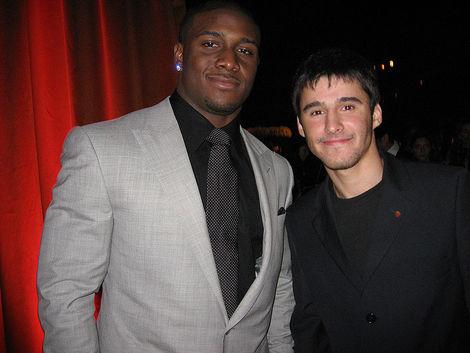
USC Reggie Bush scandal

Reggie Bush, who played for USC, won the 2005 Heisman over Vince Young, of the Texas Longhorns, who received the second most votes. Reggie Bush and O. J. mayo were the subject of an intense investigation into the practices of the USC athletic program. The Heisman Trophy was already removed from its trophy case home on the USC campus and now the trophy will be repossessed altogether. The investigators are expected to rule that Bush accepted improper benefits while at USC, making himself ineligibl

Read more:
USC Reggie Bush scandal

Kat Von D and Jesse James kissing photo

Jesse James was presumably at the airport to fly back to Austin. He and his children moved to Texas so the kids could maintain the close relationship they#39;ve developed with their stepmother, Sandra Bullock) “and manage Austin Speed Shop, his custom car outfit.” Since his move, James has also squired Von D around his new Texas turf. It#39;s back to the real world for Jesse James and Kat Von D. After spending Labor Day weekend joined at the hip, the couple shared a goodbye kiss when Von D dr

Read the original post:
Kat Von D and Jesse James kissing photo

From the Archive: George Washington Fought Revolutionary War ‘For Profit’

With the rise of the Tea Party, their push for constitutional limits on government power and admiration for the wisdom of the Founding Fathers, I thought I’d use this last holiday of the summer as an opportunity to post an item from the MRC’s archive which exposed how a major cable network once tried to discredit George Washington’s moral authority in history, and thus the legitimacy of the Revolutionary War. In an A&E movie, aired in 2000, on George Washington crossing the Delaware, The Crossing, he is persuaded that just like the hired-gun Hessians, his opposition to British taxes means he too is fighting “for profit.” Jeff Daniels, playing George Washington, decries the Hessians: “You want me to weep for those bastards, men who kill for profit?” General Nathanial Greene counters: “Our own cause is, at its heart, a fight against British taxation, is it not? In the end sir, we all kill for profit — the British and the Hessians, and us.” That convinces Washington. “That spin is no surprise,” a 2000 MRC CyberAlert item noted, “when you learn that the screenplay was written by a communist. Really.” Thanks to Karen Topper, who inexplicitly recently abandoned the MRC for another job, but who transcoded the VHS video to an MPEG-2 file for me before her departure. Audio: MP3 clip “A&E’s 224 Year Old Bias,” from the Friday, January 14, 2000 MRC CyberAlert : Ever imagine how the Revolutionary War might have been portrayed each nightg by Dan Rather on the CBS Evening News? Well, a new A&E movie run Monday night and set to repeat Saturday night, offers a troubling projection. Bottom line: Hired Hessian soldiers were no different in what they were fighting for than George Washington and the Continental Army’s soldiers. But that spin is no surprise when you learn that the screenplay was written by a communist. Really. A man who regularly wrote for the Daily Worker and once penned a book titled, Being Red. Before we get to the bias in question, a little history to catch everyone up. Here’s how the A&E Web site describes their two hour movie starring Jeff Daniels as George Washington, which first ran Monday night: The Crossing recalls Washington’s legendary evening attack against the British Army’s German mercenaries, the Hessians, which changed the course of the Revolutionary War. It is December 17, 1776. Suffering from relentless attacks by the British Army and their German mercenaries, the Continental Army is exhausted. Due to death and desertion, General Washington’s troop of ten thousand men has dwindled to a meager two thousand. Word has reached Washington that his demand for more military support has been denied by Congress. He must retreat. The general feels abandoned, cold, alone. Washington realizes that if he retreats the revolutions will be lost and so embarks upon the defining moment of his life. On Christmas Eve, Washington crosses the Delaware River and his troops launch a surprise attack on the Hessians. During the Battle of Trenton, the Germans are routed, the British Army stunned, and new life is given to the revolution. A CyberAlert reader alerted me to an incredible scene which I confirmed actually was shown in the movie. In the battle the Hessian commander, Colonel Rall, is shot. Continental Army General Nathaniel Greene is sent to tell Washington he should see Rall before he dies. As the two sit on horseback beside each other, viewers hear this exchange between actor David Ferry as General Greene and Jeff Daniels as Washington: NATHANIAL GREENE: General Washington, Colonel Rall is dying. General Mercer says you cannot let him die without speaking to him. It’s a courtesy of war. GEORGE WASHINGTON: Courtesy? There are no courtesies of war, Nathaniel. This is not a parlor game where I must pay my respects to that stinking mercenary who killed five hundred of my men in Brooklyn. Slaughtered them when they tried to surrender, skewered them in the backs with bayonets. You want me to weep for those bastards, men who kill for profit? GREENE: Our own cause is, at its heart, a fight against British taxation, is it not? In the end sir, we all kill for profit — the British and the Hessians, and us. Washington nods and is convinced by the argument, saying after a long pause: “Very well, Nathaniel. We must not let them think we’re savages.” That’s right, a rag-tag army fighting for freedom from onerous British taxation is really seeking “profit” on par with those hired to travel the world to fight wars. Who sees American history this way? Check out the bio on A&E’s Web site for the movie’s screenwriter, Howard Fast: In the ’50s, Fast was blacklisted, and in May 1952 The New York Times reported intimidation of librarians across the nation by Legionnaires, Sons and Daughters of the American Revolution, and Minutemen in Texas and California. Fast’s books were purged from school libraries. Citizen Tom Paine, formerly used as a school text, was banned from use in New York City schools. His 1990 memoir Being Red goes more deeply into the issue. You can read Fast’s angry response to the injustices of the McCarthy era in his own Crisis Papers (1951). He also wrote a poetic eulogy, ‘Never to Forget: The Battle of the Warsaw Ghetto,’ as well as pamphlets, journal articles, and columns for the Daily Worker, Masses & Mainstream, and other radical publications.

Excerpt from:
From the Archive: George Washington Fought Revolutionary War ‘For Profit’

Animal Rights Groups Face Off with Federal Laboratory Scientists Over the Fate of Chimps

Almost 200 have had a long break from testing that dates to NASA's early days, but that could end. By Michael Haederle, Los Angeles Times September 3 2010 Ever since the first of their number arrived in New Mexico half a century ago as test subjects in the fledgling U.S. space program, nearly 200 government-owned chimpanzees were routinely injected with viruses and used to test everything from experimental vaccines to insecticides. They have enjoyed a decade-long respite from research at an indoor-outdoor habitat on Holloman Air Force Base near Alamogordo, but now the government wants to move the chimpanzees to a Texas laboratory, where they might face renewed testing. The plan has animal welfare groups and elected officials squaring off against federal scientists at a time when Congress is considering legislation that could shut down federal chimpanzee testing altogether. Chimpanzees are our closest living relatives, sharing between 94% and 98% of our DNA, which is why some scientists see them as ideal research subjects. The similarity extends to their cognitive abilities. Chimps are intelligent and self-aware, even able to plan future actions. “These animals have been put through the wringer and they deserve to be retired,” says Kathleen Conlee, a program manager with the Humane Society of the United States, who has worked in a primate breeding facility and a great ape sanctuary. “The Humane Society doesn't think a laboratory environment can ever meet the psychological needs of a chimpanzee.” Moving the chimpanzees to the Southwest National Primate Research Center in San Antonio is expected to save $2 million a year in upkeep, while making more of a dwindling number of research animals available for crucial medical testing, said Harold Watson, a program director in the National Center for Research Resources at the National Institutes of Health. John L. VandeBerg, director of the San Antonio primate center, says the chimpanzees are needed to test potential vaccines for diseases, such as hepatitis C and hepatitis B, because they are the only species other than humans that can become infected with those viruses. “We only use chimpanzees when it's not possible to do critical experiments with any other species,” VandeBerg said. The primates are well cared for, he said, and only about 100 are used in research at any time. “They are not people, they are animals,” he said. “I believe it's our ethical responsibility to do the research to alleviate the pain, suffering and deaths of millions of human beings.” VandeBerg concedes past abuses in chimpanzee experiments, but he says research now “involves procedures that are no different than those that are used every day in human clinical medicine. It generally involves drawing blood samples from a vein, just as we do with people; we've all had that done.” There are fewer than 1,000 research chimpanzees in the U.S., about half of them under NIH management. Their numbers are slowly declining because of a federal moratorium on breeding and deaths due to old age. The oldest, a female named Flo, turns 53 on Sept. 29. Although the U.S. is virtually the last country in the world to permit invasive testing of chimpanzees, VandeBerg and others have argued for the resumption of a breeding program to permit further biomedical research. Meanwhile, the Great Ape Protection Act, which would phase out invasive research on federally owned chimps and retire them to sanctuaries, has been introduced in Congress with bipartisan support. Announcement of the plan to relocate the chimpanzees when the current third-party management contract at the Holloman facility expires in May 2011 prompted New Mexico Gov. Bill Richardson and Tom Udall, the state's junior U.S. senator, to urge the NIH to reconsider. Richardson paid a visit to NIH headquarters in Bethesda, Md., in August to press the point but made little headway. The Holloman chimpanzee colony traces its origins to the 1950s, when NASA acquired chimps for research during the early days of Project Mercury. By the 1970s they had become part of a breeding program, and the Holloman facility was leased to the late Dr. Frederick Coulston, a controversial toxicology researcher who used them to test insecticides and cosmetics. Later, the chimps were managed by New Mexico State University, but during the early 1990s ownership was transferred to Coulston, who by then had started the nonprofit Coulston Foundation and built a nearby private facility in which the chimpanzees were housed in cramped steel-and-concrete cages with little room for exercise. There were persistent accusations of severe abuse and neglect on Coulston's watch, with nearly 50 chimpanzees and monkeys dying from disease, poor veterinary care and experimentation amid documented violations of the Animal Welfare Act. By the time the Coulston lab went bankrupt in 2002, nearly 300 chimpanzees had been transferred to Save the Chimps, a nonprofit organization that operates a sanctuary in Florida. The remaining 186 chimpanzees have been housed as a reserve population at the Holloman facility, which is now managed by Charles River Laboratories under a 10-year contract that expires next year. About 60 others that were at Holloman have been transferred to other facilities over the past decade. The plan to transfer the Holloman chimpanzees to Texas has riled national animal welfare organizations, including People for the Ethical Treatment of Animals, the New England Anti-Vivisection Society and Animal Protection of New Mexico. An alert from the Humane Society in late July resulted in 25,000 protest letters addressed to Kathleen Sebelius, secretary of Health and Human Services, which oversees NIH, the society's Conlee said. “They're certainly not going to move these chimpanzees without hearing about it from the public,” Conlee said. “We're not against human disease research. We want them to use the money in a better fashion than they do.” Some experts question the scientific premise behind continued use of chimpanzees as an animal model for HIV and hepatitis research. Although it is true that chimpanzees can be infected with viruses like HIV and hepatitis C, they do not develop symptoms. “They're an abject failure,” said Dr. John Pippin, a retired cardiologist who works for the Physicians Committee for Responsible Medicine. “They have contributed nothing to the development of a vaccine for either disease.” He chalks up the continued reliance on animal models to scientific inertia. “It's an enormous industry,” he said. Animal research accounts for between $12 billion and $13 billion annually in federal grant money, and 42% of NIH protocols are for animal research, he said. Pippin contends it is more appropriate to experiment on cell cultures grown from human tissue for vaccine development. In the quest to develop an HIV vaccine, some of the most promising research is in studying the immune response of so-called elite controllers — the small number of HIV-infected people who have never gone on to develop full-blown AIDS, he said. Watson of the National Center for Research Resources acknowledges the strides that have been made in developing new ways to develop and test vaccines, but he insists that the chimpanzees are still needed because their infection process closely mimics that in humans. “The alternatives are something that we're very sensitive to, and our scientists are constantly looking for and finding alternatives for certain things,” Watson said. “But as it stands right now, there's not really an alternative to chimpanzees for evaluating the vaccine.” added by: EthicalVegan

‘Machete’: The Reviews Are In!

Most critics give high marks to Robert Rodriguez’s mix of exaggerated violence and political satire. By Eric Ditzian Danny Trejo in “Machete” Photo: 20th Century Fox “Machete” is everything “The Expendables” could have been but isn’t: vicious, witty, funny, ridiculous, engrossing. The sight of Sly Stallone cavorting with Dolph Lundgren and Jet Li in “Expendables” wears off pretty quickly, and what you’re left with is dull dialogue, explosions-by-numbers action sequences and characters that you never get to know enough to actually care about. “Machete,” by contrast, springs from the same creative well as “Expendables” — wacky and hyper-violent and fanboy-friendly — but there the similarities end. As nutty as “Machete” is, it’s actually smart, with snappy dialogue, clever kills and a story line crackling with social commentary about the heated immigration debate in North America. Why, then, did “Expendables” open to $34.8 million in ticket sales, while “Machete” won’t even cross the $20 million mark over this Labor Day weekend? Credit Stallone and his ’80s action pals. All we can say is that “Machete” delivers one of the most purely fun movie experiences of the summer. And most of the critics agree. Here’s what they’re saying about the film, which should hold the #1 box-office spot after the weekend. The Story “Three years after his wife and daughter were murdered by the druglord Torrez (Steven Seagal), the deadly Mexican Federale known as Machete (Danny Trejo) is working as a day laborer when he’s hired to assassinate the racist Texas Senator McLaughlin (Robert De Niro) in a plot to take down the network of illegal immigrants by the mysterious Sh

Richest lawmakers grew wealthier as economy faltered

The rest of the country is still struggling with high unemployment amid a sluggish-at-best economic recovery — but the wealthiest members of Congress are in high cotton. Indeed, the top 50 wealthiest lawmakers saw their combined net worths increase last year, according to the Hill's annual analysis of financial disclosure documents. Combined, the 50 lawmakers were worth $1.4 billion in 2009 — an $85.1 million increase over their 2008 total — the Hill reports. The members' total combined assets depreciated by nearly $36 million last year — but Congress' well-to-do set also reduced their debts by a combined $120 million. The list of 50 lawmakers spans both parties (27 Democrats and 23 Republicans) and both chambers of Congress (30 House members, 20 senators), the Hill reports. Democratic Sen. John Kerry of Massachusetts topped the list for the second year in a row; Republican Rep. Michael McCaul of Texas made his debut in the top 10. Here are profiles for the 10 most flush Hill power-and-money brokers: 1. Sen. John Kerry (D-Mass.): $188.6 million. Kerry's worth, which grew by $20 million in 2009, stems from his wife's assets. Teresa Heinz Kerry, of the Heinz ketchup family, inherited hundreds of millions upon the death of her previous husband, Sen. John Heinz. 2. Rep. Darrell Issa (R-Calif.): $160.1 million. Issa actually saw his minimum net worth drop by $4 million, partly due to the poor performance of a single investment fund. Issa's fortune stems from investments he and his wife made in the electronics market. Their company eventually became the largest producer of car anti-theft devices in the country. They sold the business in 2000. 3. Rep. Jane Harman (D-Calif.): $152.3 million. Harman is married to audio-equipment mogul Sidney Harman; stock holdings from his company, Harman International Industries, helped Harman's net worth grow by $40 million last year. Sidney Harman is in the process of purchasing Newsweek; the magazine's massive debts will presumably drag down Harman's 2010 disclosure numbers a bit. 4. Sen. Jay Rockefeller (D-WVa.): $83.7 million. No surprise here: The Rockefeller family name has for generations been a byword for fabulous riches. (Rockefeller's great-grandfather John Rockefeller was an oil magnate; inflation-adjusted figures still peg the founder of the Rockefeller fortune as the wealthiest man in history.) But the senator's uptick in personal wealth last year came mainly from his wife's investments. 5. Rep. Michael McCaul (R-Texas): $73.8 million. McCaul saw his net worth double last year, mostly owing to stocks held by his wife. McCaul's father-in-law founded the radio empire Clear Channel Communications. 6. Sen. Mark Warner (D-Va.): $70.2 million. Warner made millions through investments in the cell phone industry, including the Nextel company. 7. Rep. Jared Polis (D-Colo.): $56.5 million. Before his 2008 election to Congress, Polis made a fortune in online enterprises, transforming his family's greeting card company into BlueMountain.com and founding ProFlowers.com. 8. Rep. Vern Buchanan (R-Fla.): $53.5 million. Buchanan grew wealthy as the owner of multiple auto dealerships in Florida. 9. Sen. Frank Lautenberg (D-N.J.): $49.7 million. Lautenberg co-founded a payroll services company in the 1950s that became one of the industry's global leaders. 10. Sen. Dianne Feinstein (D-Calif.): $46.1 million. Most of the California lawmaker's wealth comes from real-estate holdings and investments made by her husband. You can review the full list here… http://thehill.com/homenews/senate/116491-the-hills-50-wealthiest-list-slideshow added by: KSirys