Tag Archives: The Pacific

The Vanishing Of The Bees

Honeybees have been mysteriously disappearing across the planet, literally vanishing from their hives. Known as Colony Collapse Disorder, this phenomenon has brought beekeepers to crisis in an industry responsible for producing apples, broccoli, watermelon, onions, cherries and a hundred other fruits and vegetables. Commercial honeybee operations pollinate crops that make up one out of every three bites of food on our tables. Vanishing of the Bees follows commercial beekeepers David Hackenberg and Dave Mendes as they strive to keep their bees healthy and fulfill pollination contracts across the U.S. The film explores the struggles they face as the two friends plead their case on Capital Hill and travel across the Pacific Ocean in the quest to protect their honeybees. Filming across the US, in Europe, Australia and Asia, this documentary examines the alarming disappearance of honeybees and the greater meaning it holds about the relationship between mankind and mother earth. As scientists puzzle over the cause, organic beekeepers indicate alternative reasons for this tragic loss. Conflicting options abound and after years of research, a definitive answer has not been found to this harrowing mystery. added by: JanforGore

Texas Will Refuse To Implement Federal Permitting Rule On Greehnouse Gas Emissions

Texas coal mine locations. Image credit: Energy Report – Coal; Window On State Governmen t, via TX Railroad Commission. USEPA is proposing that, by this coming January, permit applications for especially energy intensive operations cover greenhouse gases. That would include facility modifications as well as new plants and periodic updates of permits. In response, “the chairman of the Texas Commission on Environmental Quality, or TCEQ, told the EPA in a letter last month that Texas would openly defy the regulations and refuse to ens… Read the full story on TreeHugger

Read more:
Texas Will Refuse To Implement Federal Permitting Rule On Greehnouse Gas Emissions

Follow ‘The Great Marlin Race’ Across the Equator

Credit: Kate Spencer, Randy Kochevar via GreatMarlinRace.org The Pacific blue marlin is one of the largest billfish to swim the open ocean. Just how far can they swim, and where exactly are they going? Scientists are tracking the movements of 10 marlin as part of this year’s Great Marlin Race, and showing the results on the Internet. Last year, three marlins swam across the equator, from Hawaii to the Marquesas Islands , a distance of more than 1,8… Read the full story on TreeHugger

Continued here:
Follow ‘The Great Marlin Race’ Across the Equator

NBC Reporter Warns Global Warming Now Endangering the Walrus

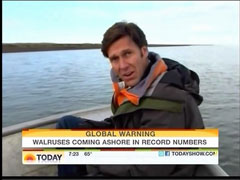
It seems like every few years there’s a new mascot for Team Global Warming. First it was the polar bear, then the Arctic fox and now it’s the walrus’s turn. On Monday’s Today show, Lee Cowan traveled to Point Lay, Alaska to report on how shrinking ice sheets are leaving walruses stranded, in between their feedings, adding: “Much like the polar bear, they can’t swim forever.” In fact it didn’t take long for Cowan to bring up the dreaded specter of global warming as he aired a soundbite of a local tribal president worrying: “I always thought the Arctic would be cold, but scientists tell us that there’s global warming going on.” Cowan even used another local resident to suggest that if something wasn’t done soon, that in 10 years “we won’t have any” animals. The following is a full transcript of the segment as it was aired on the September 20 Today show: ANN CURRY: Now to an extraordinary wildlife event taking place in northwest Alaska. Tens of thousands of Pacific walrus have crowded onto a beach near a remote village. And biologists think it is because the sea ice melted early, leaving the animals no other place to rest. NBC’s Lee Cowan is in Point Lay, Alaska with more on this story. Lee, good morning. [On screen headline: “Global Warning, Walruses Coming Ashore In Record Numbers”] LEE COWAN: Good morning, Ann. We’re about 300 miles above the Arctic Circle this morning and this is where the walrus has gathered, some 20,000 of them, at one point, over the course of the summer. And Ann, scientists are saying that this is a gathering that is so large and so unusual that scientists are now worried about the walruses’ safety. It’s the end of summer along the north slope of Alaska and in the tiny Inupiaq village of Point Lay, they wait for the ice to return. The tundra is usually already frozen by now, with snow on the ground and slush ice forming along the Chuckhi Sea. But instead, children are playing in the lagoon, barefoot, innocently oblivious to what it all may mean. LEO FERRARA, TRIBAL PRESIDENT: I always thought the Arctic would be cold but scientists tell us that there’s global warming going on. COWAN: Do you believe them? FERRARA: Yeah I believe them. COWAN: Leo Ferrara, the tribal president here, doesn’t mind that the bone-chilling 80-below winter temperatures are taking their time getting here, but he’s worried about the villages most recent resident, who need the ice to survive. COWAN LOOKING THROUGH BINOCULARS: Oh you can see them in the water. FERRARA: There you go. COWAN: The Pacific walrus, who normally rest on ice sheets floating out in the sea, have instead hauled out by the thousands at Point Lay to nap, unable to find refuge even on a small piece of sea ice. The scientists say most of it, has melted early. MARK SERREZE, NATIONAL SNOW ICE DATA CENTER: What this is telling us is that there is continuing pattern of sea ice loss in the Arctic. We may be looking at summers with no sea ice at all, or little to speak of in 20 or perhaps 30 years. COWAN: In fact a new report this month shows it’s the third lowest Arctic sea level in over 30 years. Walruses need that ice to rest on in between feeding, much like the polar bear, they can’t swim forever. ANTHONY FISCHBACH, U.S. GEOLOGICAL SURVEY: We suspect this is going to cost walruses more to make a living, when they have to commute from a coastal resting spot out to the foraging grounds, than it would cost them simply to roll of the ice and feed directly beneath them. COWAN: But that’s not the only worry. With upwards of 20,000 crammed so tightly together, easily startled mothers can often stampede, crushing newborn calves as they hurtle toward the water to safety. BILL TRACEY, POINT LAY FIRE CHIEF: Anything can spook them from a polar bear, a brown bear, a dog, a man, a boat going by, an airplane going over. COWAN: Bill Tracey is Point Lay’s fire chief. Last year he says, not far away, more than 100 walruses trampled each other to death. So until the ice comes back, strict limits are now in place. This is about as close as we can legally get to the walruses without disturbing them. From this point forward, the only people allowed in are researchers. There’s even a no fly zone over the beach, something residents here are happy to see. SOPHIE HENRY: What we have now, we have to protect what’s there, because maybe in the next 10 years we won’t have any. COWAN: A way after life for this village, a way life for the walrus, both trying to adapt to an Arctic changing faster than many expected. HENRY: The whales, the walrus, the Belugas, you know they, they live with the ice. And if it, if that all is gone, does that mean all the animals are gone too? CURRY: NBC’s Lee Cowan.
See the rest here:
NBC Reporter Warns Global Warming Now Endangering the Walrus

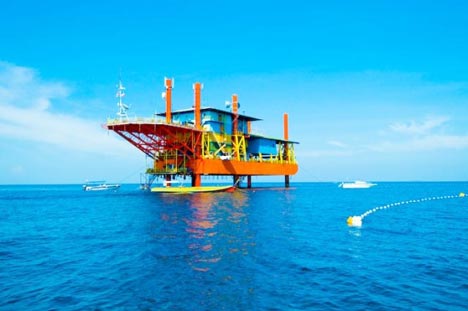
Old Oil Rig Turned Into Scuba Divers’ Dream Hotel

The oil-rig-turned-hotel. Photo via Seaventures Dive Resort . This time, it’s for real: The type of project proposed by Morris Architects for the (pre-BP spill) Gulf of Mexico has actually been carried out in a remote part of the Pacific Ocean, where an old oil-drilling rig has been turned into a hotel catering to snorkelers and scuba divers…. Read the full story on TreeHugger

Continue reading here:
Old Oil Rig Turned Into Scuba Divers’ Dream Hotel

On the ninth anniversary of 9/11, have we truly begun to heal?

In the nine years after 9/11, has our country really had a chance to heal? This year, the 9/11 anniversary has been at the center of a number of controversies, from threatened Quran burnings in Florida to debate over an Islamic community center set to be built in lower Manhattan to American Muslims toning down Eid Al-Fitr celebrations (Eid is the major holiday commemorating the end of Ramadan; this year, it falls on September 10th.) for fear they will be seen as supporting the attacks. Although these have been the stories dominating the media, they are not the only ones. At the same time, there will be memorials held across the country, including an annual Buddhist interfaith ceremony in New York. In light of both the controversies and rememberances in the media, do you think that America has truly begun to heal from the events of 9/11? If not, what do you think we need to do to begin to close the wounds? added by: sgwhites

Anti-War Protesters Face Up To 10 Years In Prison

A federal grand jury in Tacoma, Washington has indicted five anti-war protesters –most of them senior citizens– on charges of conspiracy, trespass and destruction of government property for entering a secure area at the Kitsap-Bangor Naval Base complex last November. The charges carry penalties of up to 10 years in federal prison. The five are accused of using bolt cutters last November to breach three chain-link fences surrounding the base, which is home to part of the Pacific nuclear submarine fleet. added by: The_Global_Report

How California Can Save 1 Million Acre-Feet of Water On The Cheap

Photo via PhillipC The Pacific Institute has released a new report titled “California’s Next Million Acre-Feet: Saving Water, Energy and Money that outlines the steps the state can take to come up with its next one million acre-feet of water. All of it would be relatively easy and a whole lot cheaper than trying to drum up even more fresh water out of a dried-out state — even cheaper than surface storage projects. The steps all involve existing technology and a l… Read the full story on TreeHugger

Continue reading here:
How California Can Save 1 Million Acre-Feet of Water On The Cheap

Scientist Watches Glacier Melt Beneath His Feet

Lonnie Thompson, a professor of earth sciences at Ohio State University, led a team of scientists drilling for ice cores atop the Puncak Jaya glacier in Papua, Indonesia. Here, their base camp sits below a massif bearing one of the upper ice fields. text size A A A September 4, 2010 Earlier this summer, a group of scientists spent two weeks in Indonesia atop a glacier called Puncak Jaya, one of the few remaining tropical glaciers in the world. They were taking samples of ice cores to study the impacts of climate change on the glacier. Lonnie Thompson, a professor of earth sciences at Ohio State University, led the team and what he witnessed shocked him: The glacier was literally melting under their feet. Thompson tells NPR's Guy Raz he has conducted 57 expeditions around the world, but this trip was unusual. It was the first one where he experienced rain on the glacier every day. “Rain is probably the most effective way to … cause the ice to melt,” Thompson says. “So this was the first time you could see the surface actually lowering around you.” While Thompson and his team were there drilling cores, he says, they witnessed the glacier drop 12 inches in just two weeks. “If that's representative of the annual ice loss on these glaciers,” he says, “you're looking at losing over seven meters of ice in a year. Unfortunately, that glacier's going to disappear in as little as five years if that rate continues.” Puncak Jaya is one of the few tropical glaciers remaining in the world, and it's especially vulnerable to climate change. This makes it especially important to researchers. “Well, it's located about 4 degrees south of the equator. It's the only glacier on western side of the Pacific warm pool, the warmest waters on earth,” Thompson says. “For looking at the history of El Nino, it's a wonderful location.” Losing the glacier wouldn't have much environmental impact for the local people, Thompson says, but it would have a deep spiritual impact. “For the tribes that live in that area, the glaciers are the head of the skull of the god and the mountains are the arms and the legs,” he says. “If they lose the glaciers then they’re going to lose part of their soul.” The Canary In The Coal Mine Just because the melting of the glacier won't have a devastating impact on Indonesia doesn't mean it should be ignored, Thompson says. Rather, it's like the canary in the coal mine — an indicator of changes in the planet's warming trends. And one that should be seen with boots on. “When we look at what's happening to the ice on the planet, we use satellites. The problem with the satellite or aerial photography is you don't see the vertical thinning that's taking place,” Thompson says. “Consequently there'll come a year in the future that there'll appear to be a glacier but it will disappear the next year because of the thinning from the top down. And to me, that's very sobering.” added by: JanforGore

New Zealand’s 7.1 Earthquake Has Ripped a New Fault in the Earth

New Zealand quake rips new fault in earth Officials assess at least $1.4 billion in damage, lift curfew Image: Earthquake damage in Christchurch, New Zealand Google; Jonas Bergler Before-and-after images of damaged buildings on Victoria Street in Christchurch, New Zealand. WELLINGTON, New Zealand — The powerful 7.1-magnitude earthquake that smashed buildings, cracked roads and twisted rail lines around the New Zealand city of Christchurch on Saturday also ripped a new 11-foot wide fault line in the earth's surface, officials said Sunday. At least 500 buildings, including 90 downtown properties, have been designated as destroyed in the quake that struck at 4:35 a.m. (12:35 p.m. ET Friday) near the South Island city of 400,000 people. But most other buildings sustained only minor damage. Only two serious injuries were reported from the quake as chimneys and walls of older buildings were reduced to rubble and crumbled to the ground. The prime minister said it was a miracle no one was killed. Power was cut across the region, roads were blocked by debris, and gas and water supplies were disrupted, Christchurch Mayor Bob Parker said. He warned continuing aftershocks could cause masonry to fall from damaged buildings, as could gale force winds due to buffet the region Sunday. New fault rips earth Canterbury University geology professor Mark Quigley said what “looks to us that it could be a new fault” had ripped across the earth and pushed some surface areas up about three feet (a meter). The quake was caused by the ongoing collision between the Pacific and Australian tectonic plates, he said. “One side of the earth has lurched to the right … up to 11 feet (3.5 meters) and in some places been thrust up,” Quigley told National Radio. “The long linear fracture on the earth's surface does things like break apart houses, break apart roads. We went and saw two houses that were completely snapped in half by the earthquake,” he said. Roger Bates, whose dairy farm at Darfield was close to the quake's epicenter, said the new fault line had ripped up the surface across his land. “The whole dairy farm is like the sea now, with real (soil) waves right across the dairy farm. We don't have physical holes (but) where the fault goes through it's been raised a meter or meter and a half (3 to 5 feet),” he told National Radio. “Trouble is, I've lost two meters (6 feet) of land off my boundary,” he added. Strict building codes Experts said the low number of injuries in the powerful quake reflects the country's strict building codes. David Alexander / AP People inspect a crack in the South Brighton Bridge approach in Christchurch, New Zealand, Saturday, after a powerful quake struck the region and ripped a new fault in the earth. “New Zealand has very good building codes … (that) mean the buildings are strong compared with, say, Haiti,” which suffered widespread damage in a magnitude-7.0 quake this year, earth sciences professor Martha Savage told The Associated Press. “It's about the same size (quake) as Haiti, but the damage is so much less. Though chimneys and some older facades came down, the structures are well built,” said Savage, a professor at the School of Geography, Environment and Earth Sciences at Victoria University in the capital, Wellington. “Thank God for earthquake strengthening 10 years ago,” Anglican Dean of Christchurch, Rev. Peter Beck, told TV One News on Sunday. Euan Smith, professor of Geophysics at Victoria University, said the fact that there “were no fatalities … it's quite remarkable.” added by: EthicalVegan