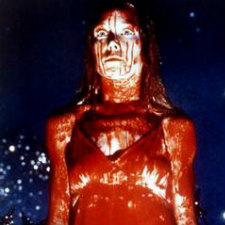
The off-Broadway musical adaptation of Stephen King’s Carrie may have outlasted its 1988 stage predecessor by four times the stage run, but it died nonetheless last weekend — two weeks early! The NYT has the post-mortem: “Several theater producers contacted recently said that Carrie , no matter how well acted and sung, presented far more than the usual share of difficulties, the most insurmountable being that nearly every character is dead at the end….Several reviewers complained about certain songs and a one-note blandness in the high school scenes, but the sharpest criticism was that Carrie had been de-camped to the point of dullness.” Chloe Moretz , you’re our last hope! [ NYT via Movie City News ]
Where does Martin Scorsese stand on the enduring cultural clash between vampires and zombies? Where else? “I happen to like vampires more than zombies. A vampire, quite honestly, you could have a conversation with. He has a sexuality. I mean the undead thing… Zombies, what are you going to do with them? Just keep chopping them up, shooting at them, shooting at them. It’s a whole other thing that apparently means a great deal to our culture and our society. There are many, many books written about it and many movies. I saw one in London when I was doing Hugo. I saw one late at night one weekend. It was called Colin, by a young filmmaker [Marc Price]. He shot it, I think, digitally by himself, edited it himself. It was savage. It had an energy that took the zombie idea to another level. Really interesting filmmaking. Disturbing.” Also: He gets Raging Bull II just about as much as you and I do. [ GQ via /film ]
Have you ever imagined how much better Inside the Actors Studio might be if it consisted entirely of awkward silences? (Culminating in a lightning-round through the Proust questionnaire, natch.) Me too! And thanks to the wonders of YouTube, now we know: A lot better . Let James Lipton and his special guest Johnny Depp enlighten you: May the Dark Shadows press tour be this rewarding. [ You’re a Nation Films via Videogum ]
This week’s Guy Pearce -starring, Luc Besson -produced Lockout might look like a run of the mill action pic — that vague title doesn’t help things — but, as the film’s opening scenes show, it’s got a blustery ’80s-style hero at its core and a punny sense of humor to move things along. Get a taste for the brawny bravado and hijinks to come in the film’s first five minutes, viewable after the jump. The thing about the first five minutes of Lockout is that you’re either with it or not, and this is indeed your cup of tea, Lockout might be the most surprisingly fun action movie of 2012 you never saw coming. Pearce stars as Snow, a government agent wrongfully convicted after a mission gone wrong who is tapped to lead a one-man job into a high-security space prison to save the President’s daughter (Maggie Grace) from the psycho inmates who’ve taken over the place. It’s Pearce’s show, and though he told Movieline recently that he hadn’t had Snake Plisskin in mind during the shoot, there are more than a few strands of Escape from New York and its antihero in Lockout ‘s DNA. (Stay tuned for Movieline’s full chat with Pearce this week.) Much of this was featured in the first European trailer : The opening scene highlights both Pearce’s tough-guy appeal and his character’s penchant for baiting just about everyone with surly jokes, but the sequence is also notable for the tongue-in-cheek flair of co-directors Irish writer-directors James Mather and Stephen St. Leger. It’s a neat trick and a ballsy one to kick off a movie with, and that’s even before the flashback, bathroom fight scene, bed sheet gun flip, space helicopter assault, rooftop fall, and night market shootout. All in the first five minutes . Lockout is based on an original idea by co-writer Besson (of course) and hits theaters this Friday. [via MovieWeb ]
An eagle-eyed reader of Warner Bros.’ exhibitors site passes along word today that The Dark Knight Rises has earned — wait for it — a PG-13 from the MPAA ratings board for “intense sequences of violence and action, some sensuality, and language.” Sensuality! I knew Batman and Bane were going to get close, but not that close. [ Nolanfans via Collider ]
It took a little while to get out, but this young man’s lightning-round riff on all 75 Best Supporting Actress Oscar-winners is the textbook definition of better late than never. Guess who: “I’m only in this movie for four minutes and you gave me an Oscar!” And his Cloris Leachman is pretty dead-on, actually. [via The Lost Boy ]
Kate Winslet broke a PR commandment earlier this week while promoting the release of Titanic 3D : She dismissed the movie’s Oscar-winning theme song, claiming that Celine Dion’s overplayed ballad “My Heart Will Go On” makes her ” feel like throwing up .” Citing the inescapability of fans serenading her with the massive hit wherever she goes, Winslet’s sentiments are understandable. Frankly, I heard that song enough times 15 years ago to never hear it again, no matter how riveting and powerful Dion’s vocals are. To say that song never once gave you chills is probably a lie. But be that as it may, the song hasn’t given anyone chills since post-Oscars April 1998, when we’d all had just about enough of it. All we have left for it now is just a reflexive groan of antipathy. When it comes to much maligned movie theme songs inducing cringing during the end credits, we’re generally more than familiar with such usual suspects as Bette Midler and Bryan Adams. As such, consider this alternative list of nine musical offenders whose disastrous contributions to soundtracks deserve “a massive internal eye roll” from Kate Winslet — or anyone else with discerning musical taste. 9. “Too Close to Paradise” by Sylvester Stallone, Paradise Alley Sylvester Stallone set out in 1978 to become a quadruple threat: After his success with Rocky in 1976, Stallone wrote, directed, and starred in the period film Paradise Alley about blue-collar brothers who turn to professional wrestling to make something of themselves in New York. Stallone also sang the theme song, “Too Close to Paradise,” and thus accomplished his goal — in that this little Neil Diamond-like ditty was a threatening assault upon the ears. Most nauseating : All of it. 8. “Batdance” by Prince, Batman In 2004, Simon Pegg and Nick Frost approved Prince’s Batman soundtrack for use as a weapon against zombies, because what other use can you get out of it? Although “Partyman” is a true musical highlight, Prince’s most offensive contribution to the album is the “Batdance” track, which blends house music with a funked-up version of the 1966 Batman theme. Ultimately a mash-up of several existing pieces of music written for the soundtrack, the “song” is 90 percent movie dialogue samples — including Jack Nicholson exclaiming that “this town needs an enema” and Kim Basinger repeating her character’s name, “Vicky Vale.” Inexplicably, this messy hodgepodge of music styles and Joker one-liners made it to number one in the U.S in 1989. Most nauseating lyric : The repeated 1966-style chant of “Bat-maaaan” throughout. 7. “The Morning After” by Maureen McGovern, The Poseidon Adventure On first listen, this Oscar-winning theme strikes tedious, AMPAS-approved notes of inspiration and hope that match the film’s messages of perseverance and communal survival aboard a foundering cruise liner. On second listen, McGovern’s schmaltzy folk vocals help distinguish the song as a true product of its time, with possible subtextual reflections on the Vietnam War and the political upheaval of the times. On third listen, the repetitive lyrics set your mind adrift and thinking about the morning-after pill. On fourth listen, you suspect Amnesty International opposes this song for its usefulness as a form of torture. Most nauseating lyric : “It’s not too late, we should be giving / Only with love can we climb” 6. “Brothers” by Patrick Swayze and Larry Gatlin, Next of Kin Patrick Swayze always got a lot of flak for having the time of his life with Jennifer Grey and suggesting “she’s like the wind” in the power ballad of the same name on the Dirty Dancing soundtrack. But that’s hardly a misdemeanor compared to Swayze’s collaboration with Larry Gatlin on the 1989 country-styled song “Brothers” featured in Next of Kin . Liam Neeson, one of Swayze’s kin in the film, was into punching things early in his career just as much as he is today, but it’s a shame he didn’t knock some sense into Swayze to avoid such a syrupy theme as “Brothers.” Most nauseating lyric : “No one will ever keep us from standing / Shoulder to shoulder against all others” 5. “Will You Be There” by Michael Jackson, Free Willy It’s a dreadful fact that I was born in 1988, and was thus eventually introduced to the King of Pop late through the bombastic, toothless theme song to Free Willy . Early memories of the “Will You Be There” music video on MTV amount to flashes of Jackson’s outstretched arms with his white shirt billowing grandly behind him in the breeze onstage. Gaudy stuff. Jackson preaches a positive message about cooperation and compassion, and needs a full choir to do so, but the song is undone by a lyrical hollowness that doesn’t come close to matching the emotional oomph of the song’s instrumentals. Most nauseating lyric : “Hold me / Like the river Jordan” 4. “The Neverending Story” by Limahl and Beth Anderson with Kajagoogoo, The Neverending Story This classic movie theme, positively dripping with 1980s guitar, electro-pop and androgynous vocals from Kajagoogoo lead Limahl, is equal parts whimsy and monotony. More reminiscent of an obnoxious children’s television theme song than a sweeping soundtrack single, “The Neverending Story” is a form of parental torture. Most nauseating lyric : “And there upon the rainbow is the answer / To a neverending story” 3. “Can’t Fight the Moonlight” by LeAnn Rimes, Coyote Ugly You know when you’re drunk and you hear a song — or maybe you’re just young and impressionable — and you hear a song, and you think, “Yeah, that’s catchy, I like that”? And then years later when you’re sober and/or older and you have better taste in music, you hear that same song again, and suddenly you’re embarrassed you ever liked it? Well, that’s what I call “coyote ugly”: In 2000, LeAnn Rimes needed a poppier single to cross over from gospel and country into the mainstream, so she recorded this movie single penned by the reliably mainstream Diane Warren (writer of the odious Armageddon theme “I Don’t Want to Miss a Thing,” and multiple other pop hits). Most surprisingly, “Can’t Fight the Moonlight” has never been repackaged for a werewolf movie. Most nauseating lyric : “Deep in the dark / You’ll surrender your heart.” (This is code for sex, kids.) 2. “Die Another Day” by Madonna, Die Another Day There is writing a good song, and writing a good James Bond song, and Madonna failed at both tasks with this unmemorable electronic club remix masquerading as a Bond theme. Maybe Madonna thought she was making an innovative creative statement by bucking the system and writing a flat tune without any tangible thematic relation to the film it’s based on, but we all know Madonna hasn’t been associated with innovation in quite a while. Madonna’s disjointed auto-tuned vocals with bondage-y undertones and lack of storytelling in the chorus and verse writing make for a lifeless theme too restricted to a musical style of the time. Most nauseating lyric : The words “another day” repeated 27 times in absence of an actual melody hook. 1. “Not A Girl, Not Yet A Woman” by Britney Spears, Crossroads Since Spears’s long-forgotten and misguided 2002 starring vehicle Crossroads , the singer has recovered from a notorious nervous breakdown, hospitalization and baldness to reign as queen of the dance remixes. But long before she started auto-tuning the hell out of her vocal cords, Spears was a confused 21-year-old struggling with the same existential question every female asks: At what point do we stop being a girl and become a woman? For Spears, we’re thinking somewhere closer to 2009. Most nauseating lyric : “All I need is time / A moment that is mine / While I’m in between” Most truthful lyric : “But now I know / Life doesn’t always go my way, yeah…” Michelle Welch is a freelance writer who has also contributed at The A.V. Club and PopMatters . She tweets her pop culture ramblings as @stayfrostymw .
Besides William Forsythe , that is: “Director Martin Guigui is currently scouting for: YOUNG JAKE LAMOTTA . To play 14-20 years old, and already a tough bare knuckles fighter. He takes his father’s frequent beatings without a sound and makes money fighting much bigger opponents in back alley fights set up by his drunken, abusive father. Please submit over 18 to play younger OR emancipated. GUISSEPE [ sic ] LAMOTTA . Portrays 40s-70s, Jake’s father, a tough-looking Italian man, he’s a mean drunk who handcuffs and beats his son. He sets up the back alley fights with Jake and much older, stronger opponents. Later he refuses to help the grown-up Jake when he asks for money. Late in life, a frail old man, he reconciles with Jake just before his death. STAR NAME ONLY.” Good luck, Mickey Rourke! [ Moviehole via The Playlist ]
The Triplets development saga just gets better, thanks to Arnold Schwarzenegger: “I can see a poster… A billboard with us three. ‘They found another one!’ ‘ Triplets !’ ‘Only their mother can tell them apart!’ I would do that in two seconds, because that’s real entertainment. You come out with that movie for Christmas, like December 5th or something like that, and you’re home free.” [ Coming Soon ]
Mirror Mirror is about as postmodern as a postmodern version of a fairytale gets these days – “It’s been focus-grouped!,” the prince protests, as the princess defies tradition and sets out to save him. So why is it so very white? It’s especially jarring when Indian director Tarsem Singh ends the movie with a Bollywood-inspired dance number – it’s a Technicolor celebration of cultural diversity by a cast that doesn’t seem to have any, save a dwarf or two who barely stand out from their pack. A fairytale about a heroine named “Snow White” is always going to require imagination, or daring, in casting for diversity, but I was surprised at how little Singh and his studio bothered trying to push the envelope. Not that they’re alone – most of Mirror Mirror ’s competitors in the current fairytale fad , from last year’s Beastly to this spring’s dueling Snow White and the Huntsman , have shown very little imagination about race. (Brownie points to Catherine Hardwicke, who let Shiloh Fernandez win the affections of her Red Riding Hood last year.) In the interests of avoiding further whitewashing – and maybe seeing some updated fables with real edge – here are four ways Hollywood should rethink diversity in all these postmodern fairytales. 1. Paying lip-service to feminism is no longer enough. I love seeing movies with strong roles for women and heroines who actually get to do things. And yes, it’s great that Lily Collins’s Snow White learns to defend herself and beats Armie Hammer at flirty swordplay, and that Chris Hemsworth is going to teach Kristen Stewart how to fight the evil queen in her version of Snow White . All of this would be way more impressive if Drew Barrymore hadn’t done the same thing fourteen years ago in Ever After . If you want to be edgy, Hollywood, let’s move beyond grudging admissions that women can stick up for themselves and find something new to say about race or sexuality or all of those other Gender Studies words the Brothers Grimm didn’t have to deal with. I liked some of Mirror Mirror ’s lopsided efforts to give its dwarves separate characters – one has a crush on our heroine while another wants to help her pick out a fabulous wardrobe – but maybe the next round of big-budget Snow White movies could even explicitly acknowledge why seven unrelated men might live together in a rustic lodge and get freaked out by the appearance of a girl. 2. Stop appropriating culture without showing the people who made it. (Otherwise known as: Every rant I have stored up about Chinese tokenism in Joss Whedon’s Firefly .) The color in Mirror Mirror is amazing, but it’s not even skin-deep. For much of the movie, the brilliant costumes and set designs hide the fact that there are very few nonwhite people wearing Eiko Ishioka ’s crimson peacock dresses and gumdrop courtier costumes and black accordion stilts – which makes the final scene stand out all the more. The Bollywood homage is a fun break from tradition on one level, but it’s also deeply weird considering how little evidence there is that any non-WASPs actually inhabit this magic kingdom. Which is a missed opportunity: Like Snow White and the Huntsman , like Red Riding Hood , like next year’s Hansel and Gretel: Witch Hunters ( yes, really ), we are talking about stories that can be set anywhere, any time – including somewhere completely imaginary. It’s not like directors and studios have much room to hide behind the excuse of casting for “historical accuracy.” Which brings me to… 3. Think outside the casting box. I saw Mirror Mirror a few days after racists came out of the woodwork for The Hunger Games , which dared to cast black actors to play characters who were originally described as “dark-skinned.” As Anna Holmes pointed out at The New Yorker , that ugly reaction highlighted how many movie viewers expect characters to be white until explicitly proven otherwise – and Hollywood reinforces those expectations all too often, even when casting fantasies about imaginary lands where, you would think, anything goes. But no, it’s still sticking to the sidekick sidelines. The dwarves provided Mirror Mirror with pretty much its only diversity; at the very least, the movie could have included more people of color among the speaking courtiers and villagers and downtrodden castle servants. Snow White and the Huntsman , from its latest trailer , is going even more pasty-Eurocentric with its crowds of faux Crusaders. That’s not even considering the television variations; despite its modern setting and larger cast and serialized format, ABC’s Once Upon a Time has made room so far for only one regular non-white character. (NBC’s rival Grimm is doing a little bit better.) Just think what could happen if Hollywood got really radical and reconsidered how it casts its fairytale leads. In fact… 4. Dare to rethink who’s the “fairest of them all.” It could be problematic and somewhat predictable to cast a person of color as the main villain in a fairytale, especially if all of the heroes are white. (Though I think Michelle Yeoh or Angela Bassett could mop the floor with Julia Roberts.) Future fairytale filmmakers could also consider looking for a prince who’s slightly less Caucasian than Armie Hammer – he’s charming and nice to look at, but I suspect there are plenty of attractive young actors out there capable of handling a role where the heavy lifting entails imitating a puppy. But the most interesting possibility, and the one I’d most like to see the next big-budget, postmodern Hollywood fairytale attempt, would be to cast a young woman of color as Snow White or Belle or Red or any other virginal, virtuous, smart and beautiful heroine, especially if she’s a character whose beauty has traditionally been defined by the paleness of her skin. These stories have been told for centuries, and by now they’re desperately in need of some real reinvention. Challenging their most outdated assumptions about who and what is beautiful would be the easiest – and most interesting – way for Hollywood to make its next round of adaptations far more worthwhile. Maria Aspan is a writer living in New York whose work has appeared in The New York Times, Reuters and American Banker. She Tweets and Tumbls .