
Tag Archives: uganda

Bombs Kill At Least 64 In Synchronized Attacks In Uganda Capital During World Cup Finals | Updates | Photos

Bombers Kill at Least 50 (Including Foreigners) in Attacks in Uganda Capital By JOSH KRON Published: July 11, 2010 KAMPALA, Uganda — At least three bombs exploded Sunday in a synchronized attack on large gatherings of World Cup soccer fans watching the televised final on outdoor screens in this normally peaceful capital, turning a boisterous night of cheering into scenes of death and panic. The police and witnesses said more than 50 people were killed including some foreigners, among them at least one American. Marc Hofer/Associated Press Photo: A man attended to an injured woman after a bomb went off in a restaurant in Kampala’s Kabalagala district on Sunday. People carried an injured man at the Mulago Hospital in Kampala on Sunday. The bombs struck at 10:30 p.m. local time in the middle of the match between Spain and the Netherlands under way in South Africa, hitting a popular Ethiopian garden restaurant and a large rugby field in a different Kampala neighborhood where hundreds of people had massed to watch the game. Ugandan police officials said they suspected that the Shabab, a militant Islamic group in nearby Somalia, might have been behind the bombings. If so, it would be that group’s first attack outside Somalia. But the police said it was premature to draw conclusions. “We can’t rule anything out,” said Kale Kayihura, Uganda’s police inspector general, at the scene of one of the attacks. “This was obviously terrorism, from the way it was targeted at World Cup watchers in public places.” Joan Lockard, a spokeswoman at the American Embassy in Kampala, confirmed that at least one American was killed. She did not identify the victim. Local journalists at a major hospital said an unidentified number of American citizens were among the wounded. The Shabab group, one of the more fearsome militias vying for power in Somalia, bans music, dancing and sports, has links to Al Qaeda and has repeatedly threatened targets in Uganda as well as in Burundi because both countries contribute to the African Union peacekeeping mission in Somalia, a lawless nation in the Horn of Africa. The police said other suspects were former rebels in the neighboring Democratic Republic of the Congo with connections to Uganda. The Ugandan capital is relatively safe and relaxed compared with other big cities in Africa, and such bombings are extremely rare. But the city turned tense and fearful early on Monday, as military vehicles and ambulances screeched through the streets and Kampala’s bars and discos emptied. At the Ethiopian restaurant that was attacked, an outdoor cafe with lawn tables known as the Ethiopian Village, soldiers and onlookers watched side by side as rescue crews extracted the dead and the wounded from the wreckage. The police said the bomb appeared to have been placed under a dining table where a group of foreigners, including some Americans, had been sitting. At least 15 people were killed in that blast, police officials witnesses said. “It was so loud,” said a woman named Mami, one of the owners of the restaurant, which had become popular with soccer fans because it showed the games on an outdoor screen. “I am so confused. My God. My God. My God.” At the rugby field where fans had gone to watch the final game on a large screen, police and witnesses said they counted at least 44 bodies. Lines of chairs had been blown apart. One middle-aged woman sat dead, her head hung back, blood dripping. “We were just watching football when the two bombs went off,” said Brian Bomakech, a Ugandan fan at the field. “So many people were hurt, so many people have died.” In Mogadishu, the Somalian capital, Sheik Yusuf Sheik Issa, a Shabab commander, was quoted by The Associated Press early Monday as saying he was happy with the attacks in Uganda. The sheik refused to confirm or deny any responsibility by the Shabab. “Uganda is one of our enemies,” The A.P. quoted him as saying. “Whatever makes them cry, makes us happy. May Allah’s anger be upon those who are against us.” The bombings came two days after another Shabab commander, Sheik Muktar Robow, called during Friday Prayer in Somalia for militants to attack sites in Uganda and Burundi. In Washington, a White House spokesman, Tommy Vietor, said late Sunday that the United States was prepared to provide assistance to Uganda. “The president is deeply saddened by the loss of life resulting from these deplorable and cowardly attacks, and sends his condolences to the people of Uganda and the loved ones of those who have been killed or injured,” he said. http://graphics8.nytimes.com/images/2010/07/12/world/12uganda1/12uganda1-hpMediu… added by: EthicalVegan
Bombs Kill At Least 60 In Attacks In Uganda Capital During Today’s World Cup Finals | Updates

Bombers Kill at Least 50 (Including Foreigners) in Attacks in Uganda Capital By JOSH KRON Published: July 11, 2010 KAMPALA, Uganda — At least three bombs exploded Sunday in a synchronized attack on large gatherings of World Cup soccer fans watching the televised final on outdoor screens in this normally peaceful capital, turning a boisterous night of cheering into scenes of death and panic. The police and witnesses said more than 50 people were killed including some foreigners, among them at least one American. Marc Hofer/Associated Press Photo: A man attended to an injured woman after a bomb went off in a restaurant in Kampala’s Kabalagala district on Sunday. People carried an injured man at the Mulago Hospital in Kampala on Sunday. The bombs struck at 10:30 p.m. local time in the middle of the match between Spain and the Netherlands under way in South Africa, hitting a popular Ethiopian garden restaurant and a large rugby field in a different Kampala neighborhood where hundreds of people had massed to watch the game. Ugandan police officials said they suspected that the Shabab, a militant Islamic group in nearby Somalia, might have been behind the bombings. If so, it would be that group’s first attack outside Somalia. But the police said it was premature to draw conclusions. “We can’t rule anything out,” said Kale Kayihura, Uganda’s police inspector general, at the scene of one of the attacks. “This was obviously terrorism, from the way it was targeted at World Cup watchers in public places.” Joan Lockard, a spokeswoman at the American Embassy in Kampala, confirmed that at least one American was killed. She did not identify the victim. Local journalists at a major hospital said an unidentified number of American citizens were among the wounded. The Shabab group, one of the more fearsome militias vying for power in Somalia, bans music, dancing and sports, has links to Al Qaeda and has repeatedly threatened targets in Uganda as well as in Burundi because both countries contribute to the African Union peacekeeping mission in Somalia, a lawless nation in the Horn of Africa. The police said other suspects were former rebels in the neighboring Democratic Republic of the Congo with connections to Uganda. The Ugandan capital is relatively safe and relaxed compared with other big cities in Africa, and such bombings are extremely rare. But the city turned tense and fearful early on Monday, as military vehicles and ambulances screeched through the streets and Kampala’s bars and discos emptied. At the Ethiopian restaurant that was attacked, an outdoor cafe with lawn tables known as the Ethiopian Village, soldiers and onlookers watched side by side as rescue crews extracted the dead and the wounded from the wreckage. The police said the bomb appeared to have been placed under a dining table where a group of foreigners, including some Americans, had been sitting. At least 15 people were killed in that blast, police officials witnesses said. “It was so loud,” said a woman named Mami, one of the owners of the restaurant, which had become popular with soccer fans because it showed the games on an outdoor screen. “I am so confused. My God. My God. My God.” At the rugby field where fans had gone to watch the final game on a large screen, police and witnesses said they counted at least 44 bodies. Lines of chairs had been blown apart. One middle-aged woman sat dead, her head hung back, blood dripping. “We were just watching football when the two bombs went off,” said Brian Bomakech, a Ugandan fan at the field. “So many people were hurt, so many people have died.” In Mogadishu, the Somalian capital, Sheik Yusuf Sheik Issa, a Shabab commander, was quoted by The Associated Press early Monday as saying he was happy with the attacks in Uganda. The sheik refused to confirm or deny any responsibility by the Shabab. “Uganda is one of our enemies,” The A.P. quoted him as saying. “Whatever makes them cry, makes us happy. May Allah’s anger be upon those who are against us.” The bombings came two days after another Shabab commander, Sheik Muktar Robow, called during Friday Prayer in Somalia for militants to attack sites in Uganda and Burundi. In Washington, a White House spokesman, Tommy Vietor, said late Sunday that the United States was prepared to provide assistance to Uganda. “The president is deeply saddened by the loss of life resulting from these deplorable and cowardly attacks, and sends his condolences to the people of Uganda and the loved ones of those who have been killed or injured,” he said. http://graphics8.nytimes.com/images/2010/07/12/world/12uganda1/12uganda1-hpMediu… added by: EthicalVegan

BREAKING NEWS:Bombs Strike World Cup Watchers In Uganda, Kill 64

KAMPALA, Uganda — In simultaneous bombings bearing the hallmarks of international terrorists, two explosions ripped through crowds watching the World Cup final in two places in Uganda's capital late Sunday, killing 64 people, police said. One American was killed and several were wounded. The deadliest attack occurred at a rugby club as people watched the game between Spain and the Netherlands on a large-screen TV outdoors. The second blast took place at an Ethiopian restaurant, where at least three Americans were wounded. One American was killed in the blasts, said Joann Lockard, a spokeswoman for the U.S. Embassy in Kampala. Kampala's police chief said he believed Somalia's most feared militant group, al-Shabab, could be responsible for the attack. Al-Shabab is known to have links with al-Qaida, and it counts militant veterans from the Iraq, Afghanistan and Pakistan conflicts among its ranks. A head and legs were found at the rugby club, suggesting a suicide bomber may have been to blame, an AP reporter at the scene said. At least three Americans – part of a church group from Pennsylvania – were wounded at the Ethiopian restaurant. One was Kris Sledge, 18, of Selinsgrove, Pennsylvania. “I remember blacking out, hearing people screaming and running,” Sledge said from the hospital. His right leg was wrapped and he had burns on his face. “I love the place here but I'm wondering why this happened and who did this … At this point we're just glad to be alive.” At the scenes of the two blasts, blood and pieces of flesh littered the floor among overturned chairs. Police Chief Kale Kaihura originally said at least 30 people had been killed, though the toll could be higher. Later, a senior police official at the scene said that 64 people had been killed – 49 from the rugby club and 15 at the Ethiopian restaurant. The official said he could not be identified. Kaihura said he suspected al-Shabab, that country's most hardline militant group. Its fighters, including two recruited from the Somali communities in the United States, have carried out multiple suicide bombings in Somalia. If Kaihura's suspicions that al-Shabab was responsible for the Uganda bombings prove true, it would be the first time the group has carried out attacks outside of Somalia. added by: keithponder

Bombers Kill At Least 50 In Attacks In Uganda Capital During Today’s World Cup Finals

Bombers Kill at Least 50 (Including Foreigners) in Attacks in Uganda Capital By JOSH KRON Published: July 11, 2010 KAMPALA, Uganda — At least three bombs exploded Sunday in a synchronized attack on large gatherings of World Cup soccer fans watching the televised final on outdoor screens in this normally peaceful capital, turning a boisterous night of cheering into scenes of death and panic. The police and witnesses said more than 50 people were killed including some foreigners, among them at least one American. Marc Hofer/Associated Press Photo: A man attended to an injured woman after a bomb went off in a restaurant in Kampala’s Kabalagala district on Sunday. People carried an injured man at the Mulago Hospital in Kampala on Sunday. The bombs struck at 10:30 p.m. local time in the middle of the match between Spain and the Netherlands under way in South Africa, hitting a popular Ethiopian garden restaurant and a large rugby field in a different Kampala neighborhood where hundreds of people had massed to watch the game. Ugandan police officials said they suspected that the Shabab, a militant Islamic group in nearby Somalia, might have been behind the bombings. If so, it would be that group’s first attack outside Somalia. But the police said it was premature to draw conclusions. “We can’t rule anything out,” said Kale Kayihura, Uganda’s police inspector general, at the scene of one of the attacks. “This was obviously terrorism, from the way it was targeted at World Cup watchers in public places.” Joan Lockard, a spokeswoman at the American Embassy in Kampala, confirmed that at least one American was killed. She did not identify the victim. Local journalists at a major hospital said an unidentified number of American citizens were among the wounded. The Shabab group, one of the more fearsome militias vying for power in Somalia, bans music, dancing and sports, has links to Al Qaeda and has repeatedly threatened targets in Uganda as well as in Burundi because both countries contribute to the African Union peacekeeping mission in Somalia, a lawless nation in the Horn of Africa. The police said other suspects were former rebels in the neighboring Democratic Republic of the Congo with connections to Uganda. The Ugandan capital is relatively safe and relaxed compared with other big cities in Africa, and such bombings are extremely rare. But the city turned tense and fearful early on Monday, as military vehicles and ambulances screeched through the streets and Kampala’s bars and discos emptied. At the Ethiopian restaurant that was attacked, an outdoor cafe with lawn tables known as the Ethiopian Village, soldiers and onlookers watched side by side as rescue crews extracted the dead and the wounded from the wreckage. The police said the bomb appeared to have been placed under a dining table where a group of foreigners, including some Americans, had been sitting. At least 15 people were killed in that blast, police officials witnesses said. “It was so loud,” said a woman named Mami, one of the owners of the restaurant, which had become popular with soccer fans because it showed the games on an outdoor screen. “I am so confused. My God. My God. My God.” At the rugby field where fans had gone to watch the final game on a large screen, police and witnesses said they counted at least 44 bodies. Lines of chairs had been blown apart. One middle-aged woman sat dead, her head hung back, blood dripping. “We were just watching football when the two bombs went off,” said Brian Bomakech, a Ugandan fan at the field. “So many people were hurt, so many people have died.” In Mogadishu, the Somalian capital, Sheik Yusuf Sheik Issa, a Shabab commander, was quoted by The Associated Press early Monday as saying he was happy with the attacks in Uganda. The sheik refused to confirm or deny any responsibility by the Shabab. “Uganda is one of our enemies,” The A.P. quoted him as saying. “Whatever makes them cry, makes us happy. May Allah’s anger be upon those who are against us.” The bombings came two days after another Shabab commander, Sheik Muktar Robow, called during Friday Prayer in Somalia for militants to attack sites in Uganda and Burundi. In Washington, a White House spokesman, Tommy Vietor, said late Sunday that the United States was prepared to provide assistance to Uganda. “The president is deeply saddened by the loss of life resulting from these deplorable and cowardly attacks, and sends his condolences to the people of Uganda and the loved ones of those who have been killed or injured,” he said. http://graphics8.nytimes.com/images/2010/07/12/world/12uganda1/12uganda1-hpMediu… added by: EthicalVegan

Biodegradeable Vegan Condoms

FDA Certified Biodegradable Vegan Condoms? Here is a story you do not excpet to read too often, but is at the same time great news. As long as they can protect then that is all that maters.These FDA Certified 100% Biodegradable Vegan condoms are made by Sir Richard and I like their slogan as well: “Doing good never felt better.” Here is the full story: Mathew Gerson and Mark Kreloff, noting that a mere 10% of the global demand for free condoms is met on an annual basis, decided that they would focus on offering an ethically produced product made from 100% biodegradable, Fair Trade certified latex that would bestow every person with the basic human right to enjoy safe sex. The result of their efforts has been dubbed Sir Richard's, an FDA certified prophylactic which will make vegans leap for joy due to its lack of milk protein-based casein which is traditionally used to process latex. Intent on empowering consumers with a responsible contraceptive that arms them with personal safety, Sir Richard's condoms take things to the next level since each purchase is backed with the donation of a comparable condom to health-focused organizations located in Uganda, Haiti and Thailand committed to thwarting the spread of STDs. Unlike the US version – which is packaged in a striking plaid wrap that is designed to appeal to the college, female and gay populations – the international versions will be culturally rebranded so that local recipients will feel more comfortable using them. Despite having to adhere to FDA regulations regarding individual Mylar wrappers (which are not recyclable), the company will place multiple condoms in a recyclable cardboard box which could, in the future, be embedded with wildflower seeds if things go according to plan. Ultimately, they hope that by offering their slick looking, eco-sensitive product in somewhat hipster-friendly forums such as American Apparel and Anthropologie, they will slowly but surely pave the way for more widespread acceptance and a far better level of consumer comfort. added by: greywrld

Has Uganda’s Anti-Gay Bill Influenced Others in Africa?

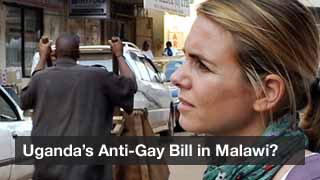
This week has brought more troubling news from Africa about anti-gay efforts: A Malawi gay couple is now facing 14 years in prison for holding a symbolic wedding ceremony. I recently returned from Uganda, where a bill was introduced that would make homosexuality a crime punishable by life in prison or, in some cases, death. While reporting on this story, I spoke with many of the politicians and religious leaders responsible for the anti-gay campaign in the country. And most, if not all of them told me how they believed that Uganda would set an example for other nations. “We think that God may be using this country of Uganda to provide leadership in the area of moral issues where the world needs it most,” said Ugandan Member of Parliament David Bahati, who authored the bill. Bahati and other backers of the legislation told me how they have already received several calls from politicians all across Africa who have been inspired by Uganda’s proposed anti-gay legislation. Homosexuality is already illegal in 38 African countries—just as it already is in Uganda—but that hasn’t stopped backers of the bill from trying to make it even more so, and the penalties even harsher. Vanguard's “Missionaries of Hate” premieres on Current TV Wednesday, May 26 at 10/9c. Watch a trailer for the episode after the jump. added by: MarianaVanZeller

Has Uganda’s Anti-Gay Bill Influenced Malawi?

Mariana Van Zeller wonders if rhetoric espoused in Uganda has influenced other parts of Africa. “Missionaries of Hate” premieres Wed, May 26 at 10/9c.

Originally posted here:
Has Uganda’s Anti-Gay Bill Influenced Malawi?

Mathematicians Solve 140-Year-Old Boltzmann Equation

Two University of Pennsylvania mathematicians have found solutions to a 140-year-old, 7-dimensional equation that were not known to exist for more than a century despite its widespread use in modeling the behavior of gases. added by: danteglam

Four endangered mountain gorillas die in Rwanda

Four highly endangered mountain gorillas have been found dead in Rwanda's Volcanoes National Park, likely because of extreme cold in their mountain habitat, experts said Thursday. Some of the group were found still alive but dying earlier this week by trackers from the Karisoke Research Centre in the mountains of north-west Rwanda. “While the cause of death has yet to be determined, the gorillas are thought to have died because of the extreme cold and rainy conditions,” the World Wildlife Fund said in a statement. “The gorillas? current range is high on Mount Karisimbi, and at high altitude it will be even colder,” WWF said. The wildlife group said there were no signs of foul play but that the dead gorillas, one female and three infants, have been sent for autopsy to determine the cause of death. The four were part of a research group called Pablo. “Unless the post mortem results show something contagious, it may be just a natural event … likely to be down to the cold weather,” said Ian Redmond, a gorilla expert who is chief consultant with the UN's Great Ape Survival Partnership. “As in human populations, an extreme cold spell can be the cause of death for weak or ill individuals who might have otherwise recovered,” Redmond told AFP. Karisoke research centre was founded in 1967 by Dian Fossey, the US primatologist who brought mountain gorillas to the attention of the public and who was brutally murdered in the Virunga National Park in 1985. “The sudden death of the four is not only a great shock but also a big loss for Rwanda and for the whole conservation team,” said Rica Rwigamba, a tourism and conservation official at the Rwanda Development Board. The Virunga volcanoes on the borders of Rwanda, Uganda and the Democratic Republic of Congo are home to about half of the world's 700 mountain gorillas (Gorilla beringei beringei). The other half live in Uganda's Bwindi Impenetrable Forest. Gorilla tracking is a major draw for tourists in Rwanda, with visitors paying 500 dollars for a permit to spend an hour with the primates in their bamboo forest habitat. http://www.google.com/hostednews/afp/article/ALeqM5gb2hOzVW2TGZ2etDI4r_ZxLlfhIA added by: julesrs007

Missionaries of Hate

Mariana van Zeller visits Uganda to trace the influence of American evangelicals on a proposed law that could make being gay punishable by death.

Read the original post:
Missionaries of Hate






