Tag Archives: venezuela

Cox Reporter Rips Right-Wing Luminaries for ‘Rumor’ About Offshore Drilling Plans in Cuba, Burns Herself

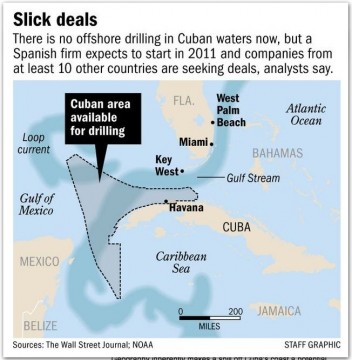
Rush has spent a considerable portion of today’s broadcast ripping into this article by Christine Stapleton of Cox Newspapers, and rightly so, for the first three of the four opening paragraphs that follow: Despite the warnings of Dick Cheney, George Will, Rush Limbaugh and Fox News, the Russians are not drilling for oil off Cuba. Neither are the Chinese. In fact, no one — not even Cuba — is drilling for oil off Cuba. The pesky and persistent rumor, bubbling back up with the Deepwater Horizon disaster, is still nothing more than a pesky and persistent rumor — aired in 2008 by former Vice President Cheney (who got the misinformation from conservative columnist Will), repeated on Fox News and recently revived by conservative radio commentator Limbaugh, who told his listeners 10 days after the spill: “The Russians are drilling in a deal with the Cubans in the Gulf. The Vietnamese and Angola are drilling for oil in the Gulf in deals with the Cubans.” However, as oil from BP’s exploded well continues surging from the Gulf floor and washing onto Panhandle beaches, the rumor is poised to become fact. Repsol, a Spanish company, expects to begin drilling off Cuba in 2011, according to published reports and oil-industry analysts. Companies from at least 10 other countries, including Russia and China, are negotiating or already have signed lease deals to drill off Cuba. It’s as if Cheney, Limbaugh, and Will have been making things up out of thin air all along, nothing at all has happened until now, and they’re all of sudden just getting lucky. Horse manure. Stapleton’s comeback would more than likely be, “I’m right, because no one is drilling right at this very moment.” Well, ma’am, if you’re going to get that technical, I will too. This Wall Street Journal story notes that Repsol did some drilling in 2004, and then stopped after results were disappointing. So the Spanish company isn’t about to “begin” drilling, it’s going to “resume” doing so. And while we’re at it, Ms. Stapleton, a person doesn’t issue “warnings” about what is happening, they do so about what’s coming. So when you try to claim that the conservative trio was claiming that substantial drilling was already occurring two years ago, anyone reading and listening in context knew that they meant that the Russians, Chinese, Vietnamese, and Angolans — and for that matter, Petrobas , the Brazilian-owned oil company in which George Soros has hundreds of millions of dollars invested (how did she miss that?) — are attempting to work out and in several cases have worked out arrangements with the Cuban government that would or will lead to drilling operations. The linked article also notes that: Cuba’s portion of the Gulf of Mexico (Click image at top right to enlarge — Ed.) has been divided into 59 blocks, of which 17 have been contracted out to companies including Spanish oil giant Repsol and its partners, Malaysia’s Petronas, Brazil’s Petrobras, Venezuela’s PDVSA and PetroVietnam. Shazam! They already have contracts (for what that’s worth in dealing with Fidel Castro’s communist workers’ paradise). Rush also pointed to this Associated Press item from July 2006 carried at the Washington Post. From here on out, say a growing chorus of experts, America will pay a price for maintaining its 45-year trade ban with the communist nation — a strategic and economic price that will have negative repercussions for the United States in the decades to come. What has changed the equation? Oil. To be more specific, recent, sizable discoveries of it in the North Cuba Basin — deep-water fields that have already drawn the interest of companies from China, India, Norway, Spain, Canada, Venezuela and Brazil. This, in turn, has reheated debate in the U.S. Congress and the Cuban-American community on an old question: Has the time finally come to shelve the embargo — given America’s need for more sources of crude at a time of rising gas prices, soaring global demand and the outbreak of war in the Middle East? Thus, there has been interest in Cuba’s oil for four years. This, along with the contractual arrangements cited above, makes the existence of plans to drill in Cuba far more than the “pesky and persistent rumor” Ms. Stapleton cited. Ms. Stapleton should have put a hold on the bashing and stuck to reporting the relevant facts. Instead she chose to insult informed readers’ intelligence by taking cheap and ineffective shots at people who have been proven right time and time again — including this time. Your loss, ma’am. Graphic found at the Palm Beach Post . Cross-posted at BizzyBlog.com .

The rest is here:
Cox Reporter Rips Right-Wing Luminaries for ‘Rumor’ About Offshore Drilling Plans in Cuba, Burns Herself

Bozell Column: Oliver’s Ugly America

Oliver Stone shocked many when his movie “World Trade Center” was released in 2006. It was a masterpiece, a meditation on two firemen trapped in a darkened tomb of broken concrete, twisted metal and shattered glass. They had rushed headlong into the collapsing skyscrapers, only to be buried alive. So many of their colleagues died, but in the end these heroes were located by searchers and rescued. Stone maintained it wasn’t a political movie, and for the most part, it wasn’t. It was a personal story. But this movie was also a gift to our country, a reminder not to forget this dark day’s victims and its heroes. It was only political in that it was patriotic. It reminded us all across our country of how our fellow Americans in Washington, New York and Pennsylvania were mercilessly murdered. It came closest to politics (or patriotism) when the firemen were found by a man who vowed to join the War on Terror. Sadly, that was but a brief hiccup in Stone’s career, a befuddling, out-of-character career move. In most of his movies, Oliver Stone is clearly not a fan of America, both her leaders and her policies. Think “Born on the Fourth of July,” “Platoon,” “JFK,” “Nixon” and “W.” Now he is promoting a new documentary called “South of the Border,” which debuted June 25. Its philosophy is illustrated by the poster: The American eagle’s talon is pierced by a large thorn coming out of a blood-red South America. It’s no overstatement to say Stone deeply adores the trend of Yanqui-bashing leftists coming to power, from Hugo Chavez in Venezuela to Evo Morales in Bolivia to Lula da Silva in Brazil. In a recent interview on ABC’s “Good Morning America,” Stone vouched for Chavez, endorsing him as “absolutely” a “good person.” When asked about Chavez’s censorship of opposition press, he claimed there was none. “There’s no pattern of censorship in this country. I’ve been there,” proclaimed this geopolitical expert. “So, you can see it. You can go down to South America, spend three days, and you’ll see the most vibrant opposition in the world.” Stone somehow missed the Venezuelan penal code from 2005, which states: “Anyone who offends with his words or in writing or in any other way disrespects the President of the Republic or whomever is fulfilling his duties will be punished with prison of 6 to 30 months if the offense is serious and half of that if it is light.” Oh, and that sanction applies to those who “disrespect” the president or his flunkies in private, too. At the unveiling of “South of the Border” at the Venice Film Festival last September, Time’s Richard Corliss reported that Stone and Chavez appeared in matching dark jackets, white shirts and red ties. When the festival announcer introduced Stone and not Chavez, Stone grabbed the strongman’s hand and raised it overhead like they were presidential running mates. The crowd screamed in support, Stone holding hands with a man who famously suggested our last president was Satan. It’s not merely that Stone is infatuated with Chavez. He doesn’t seem to consider, in his flowery “most vibrant opposition in the world” exclamation, that his last make-believe movie on clueless George W. Bush (and his bullying father George H.W. Bush) could not have been made in Venezuela if the subject were that country’s president. Stone would be in prison. This kind of performance reminds me of how Stone scorned the evil dominance of America right after 9/11. On Oct. 6, 2001, he participated in a panel discussion where he proclaimed that six companies have control of the world. (These all-powerful conglomerates were actually entertainment companies: AOL Time Warner; Disney; Fox’s parent, News Corporation; Sony; Viacom; and Vivendi Universal.) Stone said the six represented “the new world order … And I think the revolt of Sept. 11 was about ‘F—- you. F—- your order.’” He also wondered, “Does anybody make a connection between the 2000 (presidential) election and the events of Sept. 11?” The United States has provided great latitude to filmmakers mocking our presidents — even imagining the assassination of our last president — and somehow still, America, with all its freedoms offered to Hollywood, is mocked as an evil empire. It is absolutely surreal that Stone would ever make a movie like “World Trade Center,” which made heart-warming heroes out of Americans. Stone isn’t just a critic of America, but of Americans, yet there’s a certain paradox here. On the one hand, we want to dominate, exploit and enslave the world. On the other, we’re powerless, rudderless puppets to those who roll over us and dominate. Stone somehow remains blind to the sweet land of liberty that allows him to stab that eagle in the foot with all of his might.

Go here to read the rest:
Bozell Column: Oliver’s Ugly America

Oliver Stone Lauds Hugo Chavez, Criticizes Action Against Iran on ABC’s GMA

Liberal director Oliver Stone revealed his anti-American bent on Monday’s Good Morning America, praising the rise of mainly left-wing leaders across South America and even went so far to support Brazilian President Lula da Silva for “trying to strike to deal with Iran,” wildly predicting ” it’s going to be like North Vietnam again ” if the U.S. pursued sanctions against the country. Anchor George Stephanopoulos interviewed the Oscar-winning director 44 minutes into the 8 am Eastern hour. Stephanopoulos referenced how Stone has “tackled war, Wall Street, and the Kennedy assassination” and is now “taking on South America. He says our neighbors to the south haven’t gotten a fair shake from the American media, and, armed with a camera, he’s set out on a road trip to try to change that.” Before asking about Chavez, Stephanopoulos played a clip from Stone’s documentary “South of the Border,” which included a sound bite from CNN’s John Roberts that gave the impression that the anchor was condemning the Venezuelan leader: “He’s more dangerous than Bin Laden, and the effects of Chavez, his war against America, could eclipse those of 9/11.” Actually, Roberts, in the January 15, 2009 segment from his American Morning program, actually was reading a quote from a book by his guest, Doug Schoen: “Right off the bat, in the very front of the book, you quote Otto Reich, who was the former ambassador to Venezuela back in the 1980s, as saying that he’s more dangerous than bin Laden and the effects of Chavez, his war against America could eclipse those of 9/11.” Earlier, the ABC anchor asked, “Why take this on?” The director characterized the left-wing trend in leaders in South America as a “march towards reform” and praised these favorite leaders on the continent without naming them: STONE: They have democratically-elected leaders who look like the people who elected them. They have a priest in Paraguay. They have a woman in Argentina. They have an Indian leader- the first Indian- in Bolivia. They have an economist in Ecuador and they have a soldier who’s poor- comes from a poor family- who was elected three times in Venezuela- that’s Hugo Chavez. These are good people. When you look in their eyes, you see it, and you see it on film. That’s why you have to do a  film because on paper, it sometimes it didn’t come across, you know? The leader of Paraguay, Fernando Lugo, is actually a former Catholic bishop who admitted that he fathered a child with a woman in her 20s when he was still a bishop. Lugo led a mainly left-wing coalition into office when he was elected in 2008. Argentina’s president, Cristina Fernandez de Kirchner, nationalized $30 billion in private pension funds late in 2008. Bolivian President Evo Morales and Ecuador’s executive, Rafael Correa , are both avowed socialists. The ABC anchor later pressed the director on his endorsement of his Venezuelan “soldier:” STEPHANOPOULOS (live): Do you believe Hugo Chavez is a good person? STONE: Yes, I do- absolutely . STEPHANOPOULOS: But even the United Nations has said that Hugo Chavez has not been a paragon of free speech- his crackdown on the media in his own country. STONE: I have not seen that report. I know that- you know, there’s no pattern of censorship in this country . I’ve been there. So, you can see it. You can go down to South America, spend three days, and you’ll see the most vibrant opposition in the world . STEPHANOPOULOS: One of the reasons the United States has put a lot of pressure on Chavez is over oil, you believe, and there was particular opposition from the Bush administration. How do you think the relationship may change, now that President Obama is in office? STONE: Well, I hope it changes because America seems to want to control every oil-producing nation in the world, whether it’s Iraq or Iran or Venezuela. Since Stone named Iran, Stephanopoulos mentioned how “the president of Brazil [is] trying to strike a deal with Iran, counter to what the Obama administration is looking for.” The director replied that this move as a ” good thing .” When the anchor asked why, Stone made his “North Vietnam” comparison: STONE: Because- well, the march to sanctions in Iran. We want sanctions. We want- it seems to me, once they start intercepting their ships, we’re going to be in a- it’s going to be like North Vietnam again. We’re going to get into a position where we’re going to get closer to war. There’s no reason for to us go to war in Iran, any more than there was a reason to go in Iraq – STEPHANOPOULOS: Even if they want to build a nuclear weapon? STONE: Hmm? STEPHANOPOULOS: Even if they want to build a nuclear weapon? STONE: I think that has to be discussed. So the Oscar winner not only acted as a left-wing apologist but also vouched for inaction against a nation who has nuclear ambitions and has made threats against its neighbors. Stephanopoulos and Stone concluded by briefly discussing how the director was also releasing a sequel to his acclaimed 1987 movie, “Wall Street.” After thanking his guest, the ABC anchor noted that “‘South of the Border’ is open in New York now” as a title graphic for the movie flashed on screen. But, in a parallel to Stone’s edit of Roberts, the graphic that ABC used for the movie was actually cropped from its movie poster which emulated left-wing propaganda art . Eagle’s talons represented United States’s power in South America on the poster, which were mounted on top of South America which was appropriately painted red.

See more here:
Oliver Stone Lauds Hugo Chavez, Criticizes Action Against Iran on ABC’s GMA

CNN’s Acosta and Costello Parrot Obama Talking Points on Offshore Drilling Moratorium

CNN’s Carol Costello and Jim Acosta revealed their disdain for a federal judge’s decision to overturn the Obama administration’s 6-month moratorium on offshore drilling when the expert they interviewed on the June 25 “American Morning” made a convincing case against the moratorium. Tom Bower, an author who has written extensively on the oil industry, tried to explain the devastating economic impact the moratorium would inflict on an already beleaguered industry, but Costello and Acosta were blinded by ideology: “But isn’t safety more important than money?” queried Costello. “Because, I mean, these oil companies make massive amounts of money each day.” Bower, author of “Oil, Money, Politics and Power in the 21st Century,” drew the ire of Costello and Acosta for calling the Gulf oil spill an “aberration” and noting the oil industry’s “phenomenal” overall safety record.      “But that’s what they say, it is just an aberration, but the BP disaster happened,” argued Costello. “Nobody thought that could happen either. So, it’s just not logical, is it, that argument?” “What do you mean they’re doing a very good job on the whole down there?” demanded Acosta. “I don’t know what that means. In what sense? You know, I mean, this entire body of water is at risk right now. It has been poisoned. And I’m just curious, what do you mean by doing a good job?” Taking aim at Republicans and moderate Democrats like Sen. Mary Landrieu (La.) who continue to support offshore drilling, Acosta asked Bower: “I’m just curious, you know, is there a little bit of a having your cake and eat it too, when it comes to some of these Gulf Coast politicians saying we want the jobs and the protection from any environmental impact at the same time?” Loaded questions designed to advance the White House’s narrative reflect Acosta’s underlying liberal tendencies. Costello also parroted the Obama administration’s narrative: Well, let’s talk about this moratorium because, and I’m just going to play devil’s advocate here. Let’s say — I mean, what’s wrong with these oil companies to stop drilling in the deepwater, these 33 wells, for four more months? Because that’s all we’re talking about when you take the moratorium in its entirety. What’s wrong with that? Bower’s response, unlike Costello’s sputtering rant, was succinct and nonpartisan: Well, the cost. We see each oil platform, each rig costs at least half a million dollars a day, and often more, and they just can’t afford that sort of equipment lying idle and the contractors will find other places around the world who want the rigs, and they’ll just take them there, so there’s just no choice. After dismissing the expert, Acosta, turning to Costello to offer his informed opinion, lamented that “it just doesn’t feel right, you know, to say that as a whole, the industry’s just doing a great job down there.” The transcript of the segment can be found below: CNN American Morning 6/25/10 6:41 a.m. CAROL COSTELLO, co-host: The Obama administration loses another effort to put a moratorium on drilling in the Gulf. But does lifting that ban serve our nation’s best interests? You know, Bonnie is talking about this storm coming in. JIM ACOSTA, co-host: Yeah.                      COSTELLO: Wouldn’t it be a good idea if they continue to stop drilling on those 33 rigs — you know that are affected by this? ACOSTA: It’s another potential complication for this whole thing. COSTELLO: Yes. We’re going to get really into that with author Tom Bower, who has written a lot on BP and the oil industry. It’s 41 minutes past the hour. ACOSTA: Welcome back to the “Most News in the Morning.” You know, a showdown looms this morning over offshore drilling. A federal judge denied the administration’s request to postpone an order that would end a six-month moratorium. COSTELLO: That means if anyone wants to start up the deep water drills, they certainly can, but the White House says it will introduce a new ban in a few days. We wanted to know what a moratorium really means for safety though. Is it really necessary? Joining us from London this morning: Tom Bower, who is the author of “Oil, Money, Politics and Power in the 21st Century.” Good morning, sir. TOM BOWER, author of “Oil, Money, Politics and Power in the 21st Century”: Good morning. COSTELLO: Well, let’s talk about this moratorium because, and I’m just going to play devil’s advocate here. Let’s say — I mean, what’s wrong with these oil companies to stop drilling in the deepwater, these 33 wells, for four more months? Because that’s all we’re talking about when you take the moratorium in its entirety. What’s wrong with that? BOWER: Well, the cost. We see each oil platform, each rig costs at least half a million dollars a day, and often more, and they just can’t afford that sort of equipment lying idle and the contractors will find other places around the world who want the rigs, and they’ll just take them there, so there’s just no choice. COSTELLO: But isn’t safety more important than money? Because, I mean, these oil companies make massive amounts of money each day. BOWER: Well of course, safety is critical. As we’ve now seen, the catastrophe follows if these are not safe. But on the whole, all the oil corporations are working safely. This is just an aberration. COSTELLO: But that’s what they say, it is just an aberration, but the BP disaster happened. Nobody thought that could happen either. So, it’s just not logical, is it, that argument? BOWER: We don’t stop driving on the road because of a car crash. People carry on driving and people walk up staircases and fall down them, but we still walk up stairs. So in the end — ACOSTA: Totally different when you’re talking about an entire body of water as important as the Gulf of Mexico. I mean, the question that I have is we’ve heard the governor of Louisiana, and I’m sure you watch him closely as well, Bobby Jindal, you know, talk about why this moratorium should be lifted for the sake of jobs and so forth. But at the same time, the governor is saying we need to built berms, we need to do all these other things to protect our coastline, and I’m just curious, you know, is there a little bit of a having your cake and eat it, too, when it comes to some of these Gulf Coast politicians saying we want the jobs and the protection from any environmental impact at the same time? BOWER: Look, I’m not an apologist for the oil industry, but I must tell you that on the whole, their record is very good. And America needs the oil, it needs the gas, and the product in the Gulf has been superb, and they’re doing very good job down there on the whole. So, you know, just like we don’t stop fly when a plane crashes, you just got to improve the regulation — ACOSTA: What do you mean they’re doing a very good job on the whole down there? I don’t know what that means. In what sense? You know, I mean, this entire body of water is at risk right now. It has been poisoned. And I’m just curious, what do you mean by doing a good job? Because the other day, there were CEOs from the entire oil industry testifying on Capitol Hill saying that if they were to also engage in deepwater oil drilling, they essentially have the same plan of action in place if there is a major catastrophe, which is, well, we just have to, you know, see if we can plug the hole. BOWER: Look, again, I can only say I’m not an apologist for the industry, but they are extracting amazing amounts of oil from the most difficult conditions. You got to ask why they’re in the Gulf and not getting it from Mexico, Venezuela or Russia. That’s one of the great issues. ACOSTA: Are you saying that we basically put ourselves in this position? I mean, is that your point? BOWER: I think the countries have gotten the oil to put America in that position. But on the whole, they have done a very good job in the Gulf and the executives who testified on the Hill like (INAUDIBLE) have not had these sort of catastrophes that BP is just having. So, I got to repeat on the whole, they’ve done an amazing job to find oil and gas there, and they are bringing it out safely. The point is that the administration discovered that the regulators, the MMS have done a very poor job so the government has got some of the blame here. They’ve let the oil corporations get away with murder for too long. They’ve now learned a lesson. They’ll clearly have much better regulations down in the Gulf and elsewhere as well, because, believe me, they’re going to have to start digging for oil and drilling for oil off other coastlines around the U.S. again in the near future because America needs the oil. COSTELLO: Funny you mentioned that because BP is doing that, you know, off the shores of Alaska and it’s doing this maneuver where they’re drilling it’s three miles offshore, they drilling down very deeply, and then they’re going to make a horizontal line, something that’s never been done before. So, BP, itself, is being allowed to go ahead with this process when we know that BP doesn’t have it together when it comes to extreme disasters and how to fix things. BOWER: You’re absolutely right. The horizontal drilling is really quite well established now. There’s nothing new on that. That is a very effective way of getting huge amounts of oil out which previously would have got lost. But I think BP has learned a lesson. I don’t think they’re going to make that sort of error again. They’re going to be more careful than ever. They can’t afford another catastrophe nor can any other oil corporation. I mean, you just got to set the seed that of course oil is a very risky business as I show in the book. What they’ve done down in the Gulf is quite phenomenal. This is a catastrophe which never should have happened. Everyone is learning lessons. They’re going to do their best to prevent it from happening again, but the government has got as much responsibility now as the oil corporations to make sure that the regulations are there and enforced. COSTELLO: Tom Bower, many thanks to you this morning. We appreciate it. BOWER: Pleasure. ACOSTA: I’m not sure I agree that they’re doing a bang-up job down there, but that’s just my take on it. COSTELLO: You mean BP or the oil industry as a whole? Because I think he was separating them out. ACOSTA: I think he was trying to separate it, but it just doesn’t feel right, you know, to say that as a whole, the industry’s just doing a great job down there. COSTELLO: It’s sort of like you have to trust them that catastrophes similar to what’s happening with BP doesn’t happen again. And the oil companies are saying, “well, we have a great safety record.” But BP said that, too. ACOSTA: Yes. We can’t go on like this. We’ll move on. –Alex Fitzsimmons is a News Analysis intern at the Media Research Center. Click here to follow you on Twitter.

Read more:
CNN’s Acosta and Costello Parrot Obama Talking Points on Offshore Drilling Moratorium

Rabid Adam Lambert Fans Line Up 24 Hours Before New York Show

For Lambert, ‘I’d sleep on the sidewalk again,’ one fan says. By Jim Cantiello Adam Lambert Photo: Frank Micelotta/ Getty Images NEW YORK — Scorching temperatures and puzzled looks from passersby could not keep Adam Lambert fans from lining up outside New York’s Nokia Theatre a full 24 hours in advance of his Glam Nation Tour stop. For Eileen Monahan, spending the night sleeping on a “disgusting” Times Square sidewalk in front of the venue was the only way to guarantee she had the best spot inside the general-admission concert. “I want to be up front,” insisted Monahan, before admitting, “[For Adam], I’d sleep here again.” While Monahan only trekked from the Bronx, many traveled thousands of miles to see their favorite artist rock New York City. Fans from Denmark, Venezuela, England, Japan and Singapore mingled with Georgia peaches, Connecticut natives and Californians, making Adam’s Glam Nation a truly international affair. Even Peru had a message for Adam, via superfan Lilli Becker. “Peru represent! We love you, baby! I have a llama for you,” exclaimed Becker, just in case Adam ever wants a ride over the Andes. Perhaps the most exotic fans on the Lambert line were the dudes. Brooklyn native Chris Leavitt fessed up that his lady was the one to convert him into a Glamily member initially, but now he’s excited to “glam out” with the best of them. (His homemade jeans — complete with hand-drawn dragon and space rocks — certainly spoke volumes.) Elsewhere, 17-year old Brooklyn boy Billy Tropea was stoked to make Adam Lambert’s Glam Nation his first concert experience ever. “His hair is friggin’ awesome. I really want his hair,” he said. “I’m very jealous.” Some of Adam’s more seasoned followers insist they haven’t been this gung-ho about a musician since the days of Beatlemania. “I was still stalking Paul McCartney for awhile. I was on his website all the time, but now … sorry, Paul. Adam’s taken your place,” said Claudia Cohill. Armed with bags of snacks, bottles of water, and enough homemade signs to keep office supply stores in business through 2020, fans passed the time by taking bathroom breaks at a nearby McDonalds and dishing about their favorite glamtastic performances (his sultry six-minute acoustic take on “Whole Lotta Love,” which he debuted on tour, seems to be #1 for most). As the mass of Lambert lovers stretched around the block toward West 45th street, fans promised each other there would be no shoving once the doors opened at 7 p.m. “We made friends with people [in line]. We like being fair. No cutting,” promised 20-year-old Melanie Pellegrino. But if any latecomers try to sneak their way up front, the early birds are ready to throw some ‘bows. “I’m willing to cut a bitch!” one joked. Lambert’s tour moves on to Connecticut and New Jersey after his sold-out shows in New York. Related Artists Adam Lambert

The rest is here:
Rabid Adam Lambert Fans Line Up 24 Hours Before New York Show

Official FIFA World Cup 2010 theme song

Wavin’ Flag by K’naan to be FIFA World Cup 2010 theme song. Somalian-born, Canadian-based hip-hop artist K’Naan has spoken about the “unity and celebration” that will connect with his song “Wavin’ Flag,” after it was chosen as the official anthem of Coca-Cola’s 2010 FIFA World Cup program. K’Naan has specially recorded a version of the song for the tournament, hosted by South Africa. The remix of “Wavin’ Flag” is part of Coca-Cola’s global integrated marketing campaign “inspired by the joyous dance celebrations familiar to Africa.” The track will be used as the music element throughout the entire campaign, including as the soundtrack for all television commercials, during the trophy tour. Official video South Africa 2010. K’naan & David Bisbal – Wavin’ Flag

http://www.youtube.com/v/oUCUYtbaRrc?f=videos&app=youtube_gdata

Go here to see the original:
Official FIFA World Cup 2010 theme song

Iran Makes Nuclear Deal and Agrees to Send Uranium to Turkey

Iran agrees to send uranium to Turkey, report says By the CNN Wire Staff May 17, 2010 2:04 a.m. EDT (CNN) — Iran has agreed to ship its low-enriched uranium to Turkey, state media said Monday. Western nations had been asking Iran to send the low-level uranium out of the country to be enriched elsewhere, but the country had resisted until now. On Sunday, Turkish Prime Minister Recep Tayyip Erdogan announced he was heading to Iran to join nuclear talks in Tehran involving Brazilian President Luiz Inacio Lula da Silva and Iranian President Mahmoud Ahmadinejad. The meeting in Tehran sought to reach a breakthrough in the showdown over Iran's nuclear program, according to Erdogan. The last-minute trip followed a “signal” from the talks, which are intended to resolve the dispute over Iran's nuclear energy program, Erdogan told reporters before departing. Erdogan indicated the signal involved Iran's agreement to swap its low-enriched uranium for nuclear fuel, CNN Turk reported. Erdogan said he hoped an agreement in Tehran would stop the U.N. Security Council from its negotiations on tougher sanctions on Iran. “The Security Council was contemplating a step in the direction of sanctions as of yesterday,” Erdogan said. “As a part of our talks, this has been postponed. Now with this step we are going to take, I hope that we will have the opportunity to overcome these problems.” Iran's official Islamic Republic News Agency made no mention of the nuclear issue in reporting earlier that Lula was sitting down with Ahmadinejad. But French President Nicolas Sarkozy and President Dmitry Medvedev of Russia both have said they back Lula's efforts to resolve the long-running, high-stakes stalemate. “This could be the last chance before the U.N. Security Council makes the already known decisions,” Medvedev said, referring to the U.N. decision on imposing sanctions against Iran. Sarkozy said earlier that he had spoken with Lula by phone to assure him that Paris supports his efforts to resolve the impasse. The United States and many other countries believe that Iran intends to develop nuclear weapons. Iran says its nuclear program is for peaceful purposes. On Saturday, Turkish Foreign Minister Ahmet Davutoglu left for Tehran to join the Iran-Brazil talks. Erdogan said Sunday the anticipated signal from Iran was received and he was changing his schedule to travel to Tehran, postponing a planned visit to Azerbaijan. Erdogan's statement indicated an agreement in which Iran would send most of its low-enriched uranium to be turned into fuel rods suitable for Turkey's nuclear power reactor that makes medical isotopes. “After our high-level meeting in Tehran, I believe we will have the opportunity to start the process regarding the swap,” Erdogan said. “We said that we will go to Tehran if the swap takes place in Turkey, and we received news that the text includes a reference to this. That's why we are going. Otherwise we wouldn't have gone.” Turkey and Brazil have been working on a joint offer based on the nuclear swap deal offered previously to Tehran. Both countries are temporary members of the U.N. Security Council and have been working toward a diplomatic solution that does not involve sanctions. Lula is in Iran ahead of the Group of 15 developing nations meeting in Tehran. The group actually has 17 members — Algeria, Argentina, Brazil, Chile, Egypt, India, Indonesia, Iran, Jamaica, Kenya, Malaysia, Mexico, Nigeria, Senegal, Sri Lanka, Venezuela and Zimbabwe. Lula also met separately with Iranian Supreme Leader Ali Khamenei on his trip, according to Iranian media reports. State-run Press TV reported Khameini emphasized to Lula the need for relations between independent states such as Brazil and Iran in order to reduce the influence of superpowers such as the United States. “The only way to change the oppressive relations in the world today is through the formation of closer ties between independent states,” Khameini said, according to Press TV. “Superpowers have defined vertical relations in the world which places a superpower at the top. These relations must be changed and their change is possible.” PHOTO CAPTION: Iranian President Mahmoud Ahmadinejad and Brazilian counterpart Luiz Inacio Lula da Silva review an honor guard in Tehran. added by: EthicalVegan

Venezuela Celebrates 200th Anniversary With Caracas Parade

Venezuela celebrates its bicentennial and festivals have been taking place in the Venezuela capital, Caracas. A Caracas parade included the military and several groups from all over Venezuelan society. Allies of Venezuelan leader Hugo Chavez namely President Raul Castro from Cuba and President Evo Morales from Bolivia are also present to attend the celebrations. A parade gathering from every sector of society has marched past the socialist leader together with the Venezuela’s Olympic Athletes, Afro-Caribbean descendants and indigenous groups. The military with F-16 fighter jets has also been in attendance and screaming overhead. Red T-shirts, red baseball caps and Venezuelan flags are all over the place. Venezuela Celebrates 200th Anniversary With Caracas Parade is a post from: Daily World Buzz Continue reading

The Dirty Thunderstorm

The dirty thunderstorm is hot trend right now in different blogs. So, what does dirty thunderstorm means? According to an online encyclopedia, dirty thunderstorm is a weather occurrence which occur when lighting is produced in a volcanic plume. Dirty thunderstorm is also know as volcanic lightning . Reports said that mount Eyjafjallajokull in Iceland continued eruptions caused some dirty thunderstorms which were captured by cameras. It is indeed a stunning view but in reality, a scary, terrifying view of erupting volcano. And if you want to see dirty thunderstorm pictures or volcano pictures , you can search for it or go directly to MSNBC. More information about mount Eyjafjallajokull soon here on Daily World Buzz. The Dirty Thunderstorm is a post from: Daily World Buzz Continue reading

Police Report: Ex-Boxing Champion Valero Killed Self

According to authority, former boxing champion Edwin Valero has committed suicide in his jail cell just hours after he was arrested in Venezuela in connection with his wife’s killing. Police said that the former lightweight champion used his own clothes to hang himself in his cell early Monday. He had tied his clothes to a cell bar as reported by Venezuelan Federal Police Chief Wilmer Flores. Wilmer added that another inmate alerted authorities in the police lockup in north-central Carabobo state. Valero still showed signs of life, but they were unable to save him. Edwin Valero at the age of 28-year was detained Sunday on suspicion of killing his wife, Jennifer Viera, the gravest in a string of problems that had threatened to derail his career. Read More Police Report: Ex-Boxing Champion Valero Killed Self is a post from: Daily World Buzz Continue reading