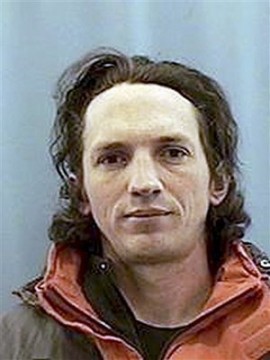
A confessed serial killer was found dead in Anchorage, Alaska this weekend. Israel Keyes is believed to have killed at least eight people over 10 years. Keyes, 34, apparently committed suicide Sunday at the Anchorage Correctional Complex. Israel Keyes was being held at that facility after being charged with “kidnapping resulting in death” of 18-year-old Samantha Koenig earlier this year. Until his death, officials involved in the case had been tight-lipped on the details of Koenig’s death and the possibility Keyes was involved in other crimes. During Sunday’s press conference Anchorage Police Chief Mark Mew said Keyes, who did not know Koenig, confessed to kidnapping the teen from her job. She was taken from a Common Grounds Espresso stand at gunpoint on February 1, 2012. Keyes said he took her to her truck, took her ATM card and killed her that night, using a chainsaw to cut a hole in the ice at Matanuska Lake and disposing of the body. Mew said Keyes then left the state, where he began using the ATM card. It was through those transactions Anchorage Police and the FBI were able to track his movements, but they didn’t know the suspect’s name until his arrest. Keyes was eventually pulled over in Lufkin, Texas on March 13. Police said Koenig’s ATM card and pieces of her cell phone were found in the vehicle. Investigators didn’t say when they were able to get the confession of Koenig’s murder, but on March 30 teams were searching Keyes’ Turnagain home. They were seen taking away a shed. Investigators wouldn’t say what, if anything, was inside. The confession also led them to Koenig’s body. It was pulled from the lake in early April. Out of respect for the Koenig family, who just received the news of Keyes’ suicide Sunday morning, Mew would not say how Koenig died or if she was sexually assaulted. Investigators believe Koenig is Keyes’ only victim here in Alaska, but Keyes also confessed to the June 2011 murders of Lorraine and William Currier in Vermont. In addition to Koenig and the Curriers, during dozens of hours of interviews Keyes also said he was responsible for four murders in Washington State and one in New York. Investigators said he did not provide them with any names of his victims. The FBI is working with law enforcement agencies around the country to try and identify them.
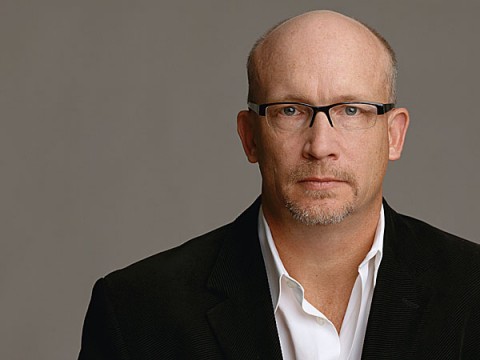
Sundays are a good time for soul-searching — which makes it a good time to check in with filmmaker Alex Gibney , whose chilling documentary about sexual abuse in the Catholic church, Mea Maxima Culpa: Silence in the House of God , is a must-see for anyone interested in the subject as well as the larger issue of what happens when religion becomes big business. Gibney’s documentary, which is in its second week of theatrical release and will run on HBO in February, begins with the headlines-making case of Father Lawrence Murphy, who, in a letter to the Vatican in 1998, admitted to abusing some 200 boys since the 1950s at the St. John’s School for the Deaf in St. Francis, Wisconsin. Although the Vatican had been aware of Murphy’s actions since 1963, he was never defrocked and, in fact, was allowed to remain at the school until 1974 (when he was transferred). Mea Maxima Culpa , which translates to “My Most Grievous Fault,” takes Gibney all the way to the Vatican, and in this interview, the filmmaker talks about the surprisingly integral roles that the late Pope John Paul II and his successor Pope Benedict XVI (then Cardinal Joseph Ratzinger) played in this tragic tale as well as his doubts that the church will ever openly confront this issue in a way that will bring some measure of peace to its many victims. Movieline: After seeing Mea Maxima Culpa , I thought that it shares a theme with Client 9: The Rise and Fall of Eliot Spitzer . On one level, this is about a giant corporation quashing someone those who dare to challenge its ethics. Gibney: That’s right. It’s an abuse of power of sorts. The Vatican is a corporation. It’s religion that’s become a corporation and therein lays the rub. The Vatican has become too seduced by its own power and money. Vatican City is its own state. What struck me about Mea Maxima Culpa is the arrogance that the church has shown towards those who have suffered sexual abuse at the hands of Catholic priests. For somebody like Pope Benedict, I don’t think it’s an arrogance born of malice. I think that the hierarchy intuits itself as a kind of holy order, which is innately better than everyone else and, therefore, can’t fathom the idea of punishing one of its own. It’s like ratting on a family member. If you find out a brother has committed a crime, you don’t go running to the police. But once you’ve started to believe your own hype, even if it’s illogical hype, it can take you to some dark places. And then you’re in the position of maintaining the illusion that you have done nothing wrong, which entails silencing anyone who says otherwise. I think many of these people are true believers — even somebody as sick as Father Murphy: In those therapist’s notes he talks about why he did what he did with those children. He said, “Well, I was taking their sins upon myself.” Doesn’t he also say that he was “fixing” rampant homosexuality at the St. John’s School for the Deaf by having sex with the students there? Right. “I was fixing it.” I think rationalizations like that are made because people like Murphy believe in their essential holiness. It’s not necessarily Machiavellian where they’re sitting there thinking, “Okay, here’s the strategy. We shall employ X, Y, or Z.” Although recently, I do think there’s some of that as well. Tell me what’s going on with Cardinal Dolan , for example, and his maneuvers with the cemetery fund in Milwaukee. I wasn’t aware of that until I saw your film. Wasn’t that wild? After the deaf victims spend years trying to hold Murphy to account, imagine the vicious irony of the idea that when they petition the church for redress, the church moves its money into the cemetery account so it can continue to protect the grave of Father Murphy over and above the victims. There’s also remarkable home-video footage you use in which a group of the deaf men confront Murphy, and his caretaker, who knows sign language, is telling one of the men that he should drop this because he’s a Catholic above all. It’s Murphy’s helper. She had been a helper at the school and, yes, she’s signing furiously saying you are Catholic, you are Catholic. As if to say, you know, the church is more important. You can cut this guy some slack because we don’t want the enemies of the church to have access to any of this information. Put your religion ahead of your petty grievances — the fact that you and so many other children have been abused. Petty. Right. There’s a technical aspect of the film that I wanted to ask you about: Your interviews with the deaf men, who are using sign language to communicate, have an almost 3D quality. Yeah, we did something. We used a variable shutter — it’s what Spielberg used in Saving Private Ryan — so that there’s a kind of flutter to the hands that makes them resonate more. It does. I really felt the emotion and the pain behind their gestures. We actually shot those interviews with three, sometimes four cameras because we wanted to have one camera that took a complete record of their signing, which included their facial gestures and their hands. We wanted another camera that was more impressionistic in terms of being able to move in from the face to the hands, and so forth. We wanted a side angle, of course, and sometimes we would use a fourth camera just to get more details because we really wanted to bring that world to life for the hearing audience. There’s something so rich about their language that it’s very powerful to capture, particularly because their deafness was so much at the heart of this story. They were the voices that could not be heard. Yet, they made themselves heard by dint of their determination. You also use recreations in Mea Maxima Culpa to depict aspects of the Father Murphy story. What led to your decision to take that route? Frankly I was a little nervous about it. We shot some pretty extensive recreations on this one. I hate that word — recreation — but it just seemed that there’s something so poignant about the way Murphy entered that dorm room. I wanted to capture that hallucinatory quality, because the aspect of the story that most people found so haunting is that these children couldn’t hear him coming. That’s how vulnerable they were. Like the fox in the henhouse, he had them available to him at any time. You quote a letter from one of Murphy’s victims in which he says that he used to lay in bed shaking at night. Yeah, because you never knew when he was going to come in and touch you or one of your friends. In the film, you indicate that while Pope John Paul II was on his deathbed, the future Pope Benedict XVI, Cardinal Ratzinger, who oversaw all of the sex abuse cases at the Vatican, sent his chief prosecutor to New York and Mexico City to gather evidence about alleged sexual abuses by Marcial Maciel Degollado , who ran the Legion of Christ and raised a lot of money for the Vatican. As John Paul is dying, Cardinal Ratzinger, who is the head of the Congregation for the Doctrine of the Faith, which oversees all of the sexual abuse cases, sends his chief prosecutor to New York and Mexico City to take testimony so they can build a case against Maciel. Ratzinger was legitimately furious at Maciel, but Maciel had very powerful protectors, notably John Paul and Cardinal Angelo Sodano. Ratzinger becomes Pope but Maciel was never tried under canonical law. It shows that — Even the Pope is not all powerful. That was a revelation to me. That is in essence the banality of evil. Pope Benedict has to play these political games instead of assuming the mantle of God and rendering punishment to somebody. He doesn’t. We don’t know if some kind of deal was cut by Sodano, or if Benedict was simply doing an Obama-like thing and saying we’re going to go forward, not backwards.
Sundays are a good time for soul-searching — which makes it a good time to check in with filmmaker Alex Gibney , whose chilling documentary about sexual abuse in the Catholic church, Mea Maxima Culpa: Silence in the House of God , is a must-see for anyone interested in the subject as well as the larger issue of what happens when religion becomes big business. Gibney’s documentary, which is in its second week of theatrical release and will run on HBO in February, begins with the headlines-making case of Father Lawrence Murphy, who, in a letter to the Vatican in 1998, admitted to abusing some 200 boys since the 1950s at the St. John’s School for the Deaf in St. Francis, Wisconsin. Although the Vatican had been aware of Murphy’s actions since 1963, he was never defrocked and, in fact, was allowed to remain at the school until 1974 (when he was transferred). Mea Maxima Culpa , which translates to “My Most Grievous Fault,” takes Gibney all the way to the Vatican, and in this interview, the filmmaker talks about the surprisingly integral roles that the late Pope John Paul II and his successor Pope Benedict XVI (then Cardinal Joseph Ratzinger) played in this tragic tale as well as his doubts that the church will ever openly confront this issue in a way that will bring some measure of peace to its many victims. Movieline: After seeing Mea Maxima Culpa , I thought that it shares a theme with Client 9: The Rise and Fall of Eliot Spitzer . On one level, this is about a giant corporation quashing someone those who dare to challenge its ethics. Gibney: That’s right. It’s an abuse of power of sorts. The Vatican is a corporation. It’s religion that’s become a corporation and therein lays the rub. The Vatican has become too seduced by its own power and money. Vatican City is its own state. What struck me about Mea Maxima Culpa is the arrogance that the church has shown towards those who have suffered sexual abuse at the hands of Catholic priests. For somebody like Pope Benedict, I don’t think it’s an arrogance born of malice. I think that the hierarchy intuits itself as a kind of holy order, which is innately better than everyone else and, therefore, can’t fathom the idea of punishing one of its own. It’s like ratting on a family member. If you find out a brother has committed a crime, you don’t go running to the police. But once you’ve started to believe your own hype, even if it’s illogical hype, it can take you to some dark places. And then you’re in the position of maintaining the illusion that you have done nothing wrong, which entails silencing anyone who says otherwise. I think many of these people are true believers — even somebody as sick as Father Murphy: In those therapist’s notes he talks about why he did what he did with those children. He said, “Well, I was taking their sins upon myself.” Doesn’t he also say that he was “fixing” rampant homosexuality at the St. John’s School for the Deaf by having sex with the students there? Right. “I was fixing it.” I think rationalizations like that are made because people like Murphy believe in their essential holiness. It’s not necessarily Machiavellian where they’re sitting there thinking, “Okay, here’s the strategy. We shall employ X, Y, or Z.” Although recently, I do think there’s some of that as well. Tell me what’s going on with Cardinal Dolan , for example, and his maneuvers with the cemetery fund in Milwaukee. I wasn’t aware of that until I saw your film. Wasn’t that wild? After the deaf victims spend years trying to hold Murphy to account, imagine the vicious irony of the idea that when they petition the church for redress, the church moves its money into the cemetery account so it can continue to protect the grave of Father Murphy over and above the victims. There’s also remarkable home-video footage you use in which a group of the deaf men confront Murphy, and his caretaker, who knows sign language, is telling one of the men that he should drop this because he’s a Catholic above all. It’s Murphy’s helper. She had been a helper at the school and, yes, she’s signing furiously saying you are Catholic, you are Catholic. As if to say, you know, the church is more important. You can cut this guy some slack because we don’t want the enemies of the church to have access to any of this information. Put your religion ahead of your petty grievances — the fact that you and so many other children have been abused. Petty. Right. There’s a technical aspect of the film that I wanted to ask you about: Your interviews with the deaf men, who are using sign language to communicate, have an almost 3D quality. Yeah, we did something. We used a variable shutter — it’s what Spielberg used in Saving Private Ryan — so that there’s a kind of flutter to the hands that makes them resonate more. It does. I really felt the emotion and the pain behind their gestures. We actually shot those interviews with three, sometimes four cameras because we wanted to have one camera that took a complete record of their signing, which included their facial gestures and their hands. We wanted another camera that was more impressionistic in terms of being able to move in from the face to the hands, and so forth. We wanted a side angle, of course, and sometimes we would use a fourth camera just to get more details because we really wanted to bring that world to life for the hearing audience. There’s something so rich about their language that it’s very powerful to capture, particularly because their deafness was so much at the heart of this story. They were the voices that could not be heard. Yet, they made themselves heard by dint of their determination. You also use recreations in Mea Maxima Culpa to depict aspects of the Father Murphy story. What led to your decision to take that route? Frankly I was a little nervous about it. We shot some pretty extensive recreations on this one. I hate that word — recreation — but it just seemed that there’s something so poignant about the way Murphy entered that dorm room. I wanted to capture that hallucinatory quality, because the aspect of the story that most people found so haunting is that these children couldn’t hear him coming. That’s how vulnerable they were. Like the fox in the henhouse, he had them available to him at any time. You quote a letter from one of Murphy’s victims in which he says that he used to lay in bed shaking at night. Yeah, because you never knew when he was going to come in and touch you or one of your friends. In the film, you indicate that while Pope John Paul II was on his deathbed, the future Pope Benedict XVI, Cardinal Ratzinger, who oversaw all of the sex abuse cases at the Vatican, sent his chief prosecutor to New York and Mexico City to gather evidence about alleged sexual abuses by Marcial Maciel Degollado , who ran the Legion of Christ and raised a lot of money for the Vatican. As John Paul is dying, Cardinal Ratzinger, who is the head of the Congregation for the Doctrine of the Faith, which oversees all of the sexual abuse cases, sends his chief prosecutor to New York and Mexico City to take testimony so they can build a case against Maciel. Ratzinger was legitimately furious at Maciel, but Maciel had very powerful protectors, notably John Paul and Cardinal Angelo Sodano. Ratzinger becomes Pope but Maciel was never tried under canonical law. It shows that — Even the Pope is not all powerful. That was a revelation to me. That is in essence the banality of evil. Pope Benedict has to play these political games instead of assuming the mantle of God and rendering punishment to somebody. He doesn’t. We don’t know if some kind of deal was cut by Sodano, or if Benedict was simply doing an Obama-like thing and saying we’re going to go forward, not backwards.
Dammit, and he’s still alive??? Aurora Dark Knight Shooter James Holmes Tries To Commit Suicide In Jail According to TMZ reports : James Holmes — the shooter in the Aurora movie theater massacre — was hospitalized after several “half-hearted” suicide attempts … this according to law enforcement. According to cops, Holmes ran headfirst into a jail cell wall on Tuesday … and while he sustained injuries … they were not life-threatening. Holmes also reportedly stood on the bed in his cell and fell backwards … in an apparent attempt to crack his skull open. He failed. Holmes — who killed 12 people and injured 58 more during his July 20 shooting rampage — has since been released from the hospital. Awwww, jail life is pretty tough huh azzhole? Google where your major arteries are so you’ll be better prepared next time. We’re sure the victims’ families back in Colorado won’t miss him if he’s successful one day. Image via AP
Teenage ‘Craigslist Killer’ Sentenced To Life In Prison The 17-year-old accomplis who aided another 53-year old mad in a Craigslist scheme where they lured and murdered several victims into their lives using phony job ads has been sentenced to life in prison without the possibility of parole. via CBS News A teenager was sentenced to life in prison with no chance for parole Friday for his role in a deadly plot to lure men desperate for work with phony Craigslist job offers. Judge Lynne Callahan sentenced 17-year-old Brogan Rafferty, who had been convicted on Oct. 30 of aggravated murder and attempted murder in the deaths of three men and wounding of a fourth. The jury rejected the defense claim that Rafferty feared for himself and his family if he didn’t cooperate with his co-defendant, Richard Beasley of Akron. The 53-year-old Beasley, described as the teen’s spiritual mentor, has pleaded not guilty and faces a Jan. 7 trial. Prosecutors say the victims, all down in their luck and with few family ties that might highlight their disappearance, were lured with phony offers of farmhand jobs on Craigslist last year. Even though we agree that this teenager deserves to be held accountable for his own actions, that grown a** man should be ashamed of himself for influencing this 17-year-old boy to throw his life away like that. SMH. Image via Shutterstock
Fans of Jared Leto’s band Thirty Seconds to Mars like to refer to themselves as family, but ‘apostles’ might be a better term. Thanks to their fervent support, Artifact , the Leto-directed (under the pseudonym Bartholomew Cubbins) film about the band’s lengthy legal battle with its record label EMI, is making some noise on the indie circuit. In September, Artifact won the Toronto International Film Festival’s People’s Choice Documentary Award in September, and earlier this month it was nominated for an IFP Gotham Audience Award even though the film didn’t premiere in the U.S. until Thursday night at the DOC NYC festival in New York City. The Echelon — the name that Leto has bestowed upon his band’s fan base — were out in force there, too, braving frigid temperatures and a Nor’Easter-snarled New York to gather by the dozens at the School of Visual Arts in Chelsea for the screening and a glimpse of their idol. A spokeswoman for DOC NYC says that more than 500 people attended the two screenings of the documentary that were held on Thursday. Instead of the screaming hordes you might battle at a Justin Bieber appearance, however, the mostly female and surprisingly middle-aged crowd that gathered at the 6 p.m. screening of Artifact was well behaved and fairly quiet when it came to their reverence. (Somehow, they’d even organized a canned-food drive with local charity City Harvest to help the victims of Hurricane Sandy.) Photographer Jolene McMeans had traveled from Eugene, Ore. to see the film. “I barely made it last night,” she told Movieline. Johana Ruano, who sat next to her and carried a bouquet of flowers, said that she had made it in from Miami despite having her first flight canceled Wednesday night due to the storm. DOC NYC Artistic Director Thom Powers told the crowd that Leto’s initial flight to New York had been canceled, too, but he had also found a way to the city and the Echelon gave him an enthusiastic welcome as he walked to the front of the theater dressed in black and wearing a hipster trapper’s hat. “I know half the people in this room,” he said, after which a male voice in the crowd shouted, “I love you.” “I love you, too!” Leto replied. The Thirty Seconds to Mars frontman was in the process of explaining that Artifact was a “really personal” film and a “labor of love” when he was interrupted by a mewling sound from the audience. “Is that a cat?” he asked. (Actually, it was a young child that one of the audience members had brought with her.) The actor and musical artist returned to describing Artifact : “It’s a film about a battle. It’s a film about an album. It’s a film about our lives,” Leto said. Artifact is also a film in need of an editor, but it does shine a sobering light on the vagaries of the major-label music business, which, the film’s participants point out, for instance, continues to charge bands de-rigeur breakage fees for records that are digitally downloaded. And that’s just one of the minor details. Although the band decided to stay with EMI after the lawsuit was dropped and the band was given a more favorable contract, the film claims that, despite selling millions of albums, Thirty Seconds to Mars has not made any money on the sale of those recordings. And what did the Echelon think? Though Leto did not return at the end of the screening, they stood to give the movie an extended standing ovation. On my way out of the theater, I asked Johana and Jolene why they were so loyal to Leto and Thirty Seconds to Mars. “He involves you. He answers your tweets,” said McMeans. “He makes us part of the band as well,” said Ruano. Follow Frank DiGiacomo on Twitter. Follow Movieline on Twitter.
About a month ago, Lady Gaga admitted: she’s gained a little weight. It’s an issue that has tormented the singer for her entire life. In response, Gaga has started a “Body Revolution” on her Little Monsters website, asking fans to embrace their curves and inner beauty. Speaking to Stylist UK about the movement, she referenced another artist and compared the reception Adele has received versus the one that’s recently plagued Gaga. “Adele is bigger than me,” Gaga said . “How come nobody says anything about it? She’s so wonderful and I think her confidence is something I have to match. She has set the bar very high for a lot of woman. I need to be a confident woman and just say politically active things when I can that are helpful to young people.” And while it might help to shelve those lasagna recipes , Gaga says the true key to self-confidence comes from within – and without. “We should all make an effort to be nice to one another all the time,” Gaga says of women around the world.
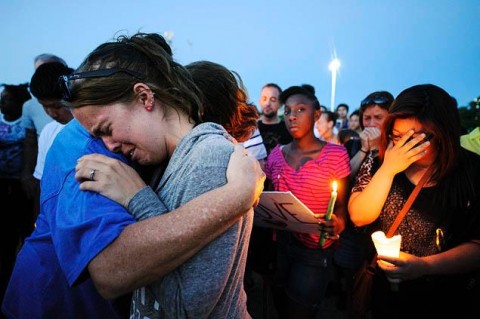
Many of music’s biggest names, most of whom have connections to the regions most affected by Hurricane Sandy this week, came together last night to raise funds for the victims of this disaster. The NBC-hosted telethon was emceed by Matt Lauer and featured emotional performances from East Coast natives Christina Aguilera, Bruce Springsteen, Billy Joel, Mary J Blige, Steven Tyler and Jon Bon Jovi, among others. To make a donation, visit RedCross.org, call (800) RED-CROSS or text the word REDCROSS to 90999 to make a $10 contribution – and enjoy many of the performances from the event below, starting with Mr. New Jersey himself, Bruce Springsteen: Bruce Springsteen – “Land of Hope and Dreams” (NBC Telethon) Bon Jovi, “Who Says You Can’t Go Home” and “Living on a Prayer” mash-up: Jon Bon Jovi Telethon Performance Jimmy Fallon leads version of “Under the Boardwalk.” Jimmy Fallon, Steven Tyler, Billy Joel and Bruce Springsteen – Under the Boardwalk Aerosmith performs “Dream On.” Aerosmith – “Dream On” (Hurricane Sandy Telethon) Sting goes with “Message in a Bottle.” Sting – “Message in a Bottle” Mary J. Blige sends a message with “The Living Proof.” Mary J. Blige – “The Living Proof”
The Dark Knight Rises…and raises mula! Families Of Batman Theater Shooting Victims’ Will Split $5 Million According to TMZ reports : The families of the 12 people killed in the Aurora shooting massacre — along with several people who suffered permanent injuries in the attack — will split the majority of the $5 million in donations raised to assist the victims of the attack. A mediator tasked with dividing the funds has announced the above-mentioned people will split 70% of the funds — roughly $200k each. The mediator says the rest of the cash will go to people who suffered physical injuries — the more severe the injury, the more money they will receive. Aside from the 12 people killed, 58 people were wounded in the July 20 shooting in Aurora, CO. The mediator says … due to limited funds, none of the money will go toward people who did not require overnight hospitalization … and the cash will NOT be used to aid theater-goers who were physically unharmed, but claim they suffer from mental trauma. As for the shooter James Holmes, he’s still in custody facing murder charges. This money will certainly not make up for lost family members and friends, but at least it will help the folks that need it to help pay hospital bills and costs associated with the tragedy.
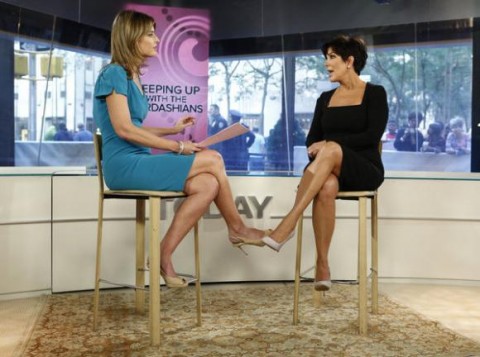
Turns out, the Ann Curry firing debacle was NOT the lowest point to which The Today Show could sink. At 8:46 a.m. today – the time at which the first place hit the World Trade Center 11 years ago – New York City and Washington, D.C. held a moment of silence in memory of 9/11. All the cable networks, Good Morning America and CBS This Morning all provided coverage of the tribute. The Today Show aired an interview with Kris Jenner. In NBC’s defense, Jenner touched on her decision to air footage of herself getting breast implants reduced, telling Savanna Guthrie of the filmed procedure and why she’s a role model: It’s necessary to “change them after 10 years… it was so important, health-wise, to remind women to check your expiration date because it’s a health risk.” Jenner also spoke on the relationship between Kanye West and Kim Kardashian , labeling the rapper as a a “really a great guy” and adding: “I think they are well suited for each other and I think they are really, really happy and anybody who has kids knows that when your kids are happy, you are happy.” So it’s not like Today chose to run meaningless, ratings-grabbing fluff in lieu of honoring the victims of our nation’s most horrific tragedy. WATCH THE INTERVIEW BELOW. Kris Jenner Today Show Interview