Current “It-Girl” Greta Gerwig, Joel Kinnaman and Zoe Lister Jones were among the cast who turned up for the New York premiere Tuesday night of director Daryl Wein’s Lola Versus , hosted by the Cinema Society. A bumper crop of other actors and socialites also joined in on the fun at the screening in Manhattan’s Chelsea neighborhood, including Zachary Quinto, Noah Baumbach, Olivia Munn, Parker Posey, Russell Simmons, Eve Plumb, Jesse Peretz, Gaby Hoffman, Ed Droste (lead singer of Grizzly Bear) for the screening and after-party at the Boom Boom Room atop the Standard Hotel in the Meatpacking District. In the film, Gerwig plays Lola who is suddenly dumped by her fiance only weeks before their wedding. Her life slowly tailspins as she seeks out close friends for solace and sexual mishaps as she faces turning 30 and being suddenly single. “Zoe [Lister Jones] and I were both single and interested in stories that were honest about break-ups and not just glorified versions of them,” Wein told ML at the Standard Tuesday night. He co-wrote the film along with Lister Jones who co-stars in the film with Gerwig. “Greta is great for the part because she is not an overly-polished lead. She’s vulnerable, likable but still at times unlikable,” he added. Wein said the idea for Lola Versus came to him and Lister-Jones though in the interim other films that deal with being single have cropped up. “There are stories with a feminist [bent] that have come up since then, and we’re all for it. We want more realistic depictions of break-ups and being single to be out there.” Not quite so single in real-life, Gerwig danced with her current beau Noah Baumbach at the party, which was co-hosted Brooks Brothers and Grey Goose along with Cinema Society and its founder Andrew Saffir. Of course there were signature vodka cocktails and the champagne and spectacular Manhattan views kept the soiree going well passed midnight. Fox Searchlight will open Lola Versus in limited release beginning this Friday. [ Photo Credit: Nick Hunt/Patrick McMullan Co. ]
Acclaimed, Pulitzer-honored science fiction/fantasy author Ray Bradbury has died at the age of 91 in Los Angeles, following one of the most fruitful creative writing careers of the 20th century. The man behind such genre classics as Fahrenheit 451 , The Martian Chronicles , Something Wicked This Way Comes leaves behind a stunning legacy spanning works adapted for television, film, and the stage. It’s difficult to quantify the impact that Bradbury had on the worlds of science fiction, literature, and the numerous film and television adaptations that sprang from his seven decades of writing, not to mention the generations of sci-fi and fantasy lovers weaned on his tales. The man had an asteroid and a moon crater named in his honor, for goodness sake, had dozens of his stories adapted for stage, film, and television, and never went to college. For a child growing up with Bradbury’s stories, the world was filled much more with wonder. For an adult, his tales prompted deeper introspection. It Came From Outer Space : Icarus Montgolfier Wright : Something Wicked This Way Comes : Bradbury on his Fahrenheit 451 : Folks will have their own cherished Bradbury moments, but I’ll leave you with one of my favorite of his real life stories. Writing in 2001, Bradbury shared the childhood incident that inspired him to become a writer in the first place: A chance meeting with a carnival magician named Mr. Electrico in 1932 following the death of Bradbury’s uncle. Mr. Electrico was a fantastic creator of marvels. He sat in his electric chair every night and was electrocuted in front of all the people, young and old, of Waukegan, Illinois. When the electricity surged through his body he raised a sword and knighted all the kids sitting in the front row below his platform. I had been to see Mr. Electrico the night before. When he reached me, he pointed his sword at my head and touched my brow. The electricity rushed down the sword, inside my skull, made my hair stand up and sparks fly out of my ears. He then shouted at me, “Live forever!” I thought that was a wonderful idea, but how did you do it? The next day, being driven home by my father, fresh from the funeral, I looked down at those carnival tents and thought to myself, “The answer is there. He said ‘Live forever,’ and I must go find out how to do that.” I told my father to stop the car. He didn’t want to, but I insisted. He stopped the car and let me out, furious with me for not returning home to partake in the wake being held for my uncle. With the car gone, and my father in a rage, I ran down the hill. What was I doing? I was running away from death, running toward life. When I reached the carnival grounds, by God, sitting there, almost as if he were waiting for me, was Mr. Electrico. I grew, suddenly, very shy. I couldn’t possibly ask, How do you live forever? But luckily I had a magic trick in my pocket. I pulled it out, held it toward Mr. Electrico and asked him if he’d show me how to do the trick. He showed me how and then looked into my face and said, “Would you like to see some of those peculiar people in that tent over there?” I said, “Yes.” He took me over to the sideshow tent and hit it with his cane and shouted, “Clean up your language!” at whoever was inside. Then, he pulled up the tent flap and took me in to meet the Illustrated Man, the Fat Lady, the Skeleton Man, the acrobats, and all the strange people in the sideshows. He then walked me down by the shore and we sat on a sand dune. He talked about his small philosophies and let me talk about my large ones. At a certain point he finally leaned forward and said, “You know, we’ve met before.” I replied, “No, sir, I’ve never met you before.” He said, “Yes, you were my best friend in the great war in France in 1918 and you were wounded and died in my arms at the battle of the Ardennes Forrest. But now, here today, I see his soul shining out of your eyes. Here you are, with a new face, a new name, but the soul shining from your face is the soul of my dear dead friend. Welcome back to the world.” Why did he say that? I don’t know. Was there something in my eagerness, my passion for life, my being ready for some sort of new activity? I don’t know the answer to that. All I know is that he said, “Live forever” and gave me a future and in doing so, gave me a past many years before, when his friend died in France. Leaving the carnival grounds that day I stood by the carousel and watched the horses go round and round to the music of “Beautiful Ohio.” Standing there, the tears poured down my face, for I felt that something strange and wonderful had happened to me because of my encounter with Mr. Electrico. I went home and the next day traveled to Arizona with my folks. When we arrived there a few days later I began to write, full-time. I have written every single day of my life since that day 69 years ago. I have long since lost track of Mr. Electrico, but I wish that he existed somewhere in the world so that I could run to him, embrace him, and thank him for changing my life and helping me become a writer. Live forever, indeed! Read the full entry here and leave your own Bradbury celebrations below.
People with a strong sartorial sense know the difference between what’s elegant and what’s merely elaborate. It’s not the same in the movie world, where big and overcomplicated is so often mistaken for better, when really it’s only…big and overcomplicated. Ridley Scott ’s Prometheus , designed as a sort-of prequel to the director’s 1979 terror-in-space aria Alien , is elaborate all right. But it’s imaginative only in a stiff, expensive way. Scott vests the movie with an admirable degree of integrity – it doesn’t feel like a cheap grab for our moviegoing dollars – but it doesn’t inspire anything so vital as wonder or fear, either. Prometheus has been one of the most anticipated pictures of the summer, but its lackluster payoff is summed up perfectly by one of its chief characters, a scientist who travels a long way from Earth in the hope of meeting the allegedly superior beings who created us humans: “This place isn’t what we thought it was.” [ Some spoilers follow. ] That character, Elizabeth Shaw ( Noomi Rapace ), is an archeologist who, in one of the movie’s early scenes, circa 2089, stands hand-in-hand with her partner and beau Charlie Holloway (the exquisitely, painfully dull Logan Marshall-Green ) as the two gaze in wonder upon an Earth cave drawing they’ve just discovered. The pictogram shows a couple of unearthly creatures standing tall and pointing at something-or-other. Are they gods who created us, or just random visitors? Shaw thinks they may be the former, and she’s eager for a meet-and-greet. “I think they want us to come and find them,” she says, voicing one of those really bad ideas that make the world of science fiction go ’round. Before long the two have joined a crew of 15 others, all headed to an undisclosed destination in space where they will freely and joyfully act upon yet more bad ideas, including packing a severed alien head into a space baggie and reaching out to touch a slimy tadpole-penis-head thing. But let’s not get ahead of ourselves. The others aboard the all-too-appropriately named Prometheus include a tall, icy businesswoman named Vickers ( Charlize Theron ), a representative of the corporate behemoth that’s funding the trip; the ship’s captain, Janek (played by the appealing, casual Idris Elba); David ( Michael Fassbender ), an android a la Ian Holm’s character in Alien , who has learned a healthy handful of ancient languages as a way of possibly communicating with whatever godlike forebears the crew may encounter; and a random Asian guy who wanders around idly in the background of a few shots until, inexplicably — mini-spoiler alert — he becomes one of the story’s heroes. (This disposable Asian is played by Benedict Wong, who also appeared in Duncan Jones’ 2011 Moon .) There are a bunch of others – including some dumb geologists/biologists (Rafe Spall and Sean Harris) and a doctory-scientist type (Kate Dickie) – but the cast of Prometheus suggests that 17 crew members on a movie space ship is about 10 too many. (The Nostromo , after all, carried 7, and Scott and writer Dan O’Bannon made it easy to distinguish one from another.) But Prometheus , both ship and movie, is overloaded in every way: Scott and screenwriters Jon Spaihts and Damon Lindelof have packed the picture full of noble themes, most of them having to do with the way our yearning to understand the unknown jostles uncomfortably against our desire to explain everything through science. “I just want answers, babe,” the logic-mongering Holloway tells the dreamier Shaw, though this is before – and here, take note of another mini-spoiler alert – a wriggly wormlike thing starts poking out of his eyeball. What do Shaw and the others discover on the mysterious planet to which they’ve trekked? They make their way into a cave where the air is actually breathable – they lift off their bubble helmets and take in deep gulps of the stuff, which seems inadvisable, but what the heck? Deep in the cave’s recesses they find a magnificent hallway replete with majestic murals and a large sculpture surrounded by a formation of conga drums covered with sweaty spores. Prometheus features a host of effects designed to make you say, “What the heck?” and yet none of it stirs real curiosity, awe or dread. The crew also encounters, of course, some variations on the magnificent spoodly pinky-gray creatures designed by H.R. Giger for the earlier Alien pictures. Perhaps these thingies are supposed to be bigger, more impressive and more realistic, whatever that might mean. Yet there’s a business-as-usual quality about them, and they herald their presence openly rather than lurk menacingly in the shadows, as if announcing cheerfully, “You expected to see us, and here we are!” That’s not to say there aren’t some lovely effects in Prometheus , including a sequence in which a group of hologram ghosts appear as shimmery dots and dashes of light – they rush toward and through our intrepid explorers, on their way to, or away from, something. But we never find out who they are or what they’re running toward or from. In fact, there are dozens of loose ends in Prometheus , hanging like so many squirmy, dangly tails. Fassbender’s android commits a significant, malicious act for reasons that are never made clear: We know he has no soul, and thus probably no conscience, but his actions seem like the result of some deeply human traits — Scott never bothers to explain. The geography of the ship is carelessly delineated: Creatures show up in one passageway or another – it’s never clear what room or area they’re coming from. One of these slimy, willfully malevolent wrigglers emerges at a significant climactic moment, and it’s unclear whether it’s a random critter or a larger version of a baby we’ve seen earlier – the lapse represents a missed opportunity, a possible means of fleshing out some of the movie’s ideas about the relationship between gods and the creatures they create (or destroy). Scott is trying to make sure Prometheus is about something, and his ideals may have distracted him from the more prosaic task of just getting on with the storytelling. When Brian De Palma presented, with Mission to Mars , a much more passionate, and more narratively sound, version of this sort of interplanetary spiritual idealism, it was treated as a “bad” science fiction movie. Prometheus , on the other hand, is tasteful even in the midst of all its squirm-inducing gross-outs, and that’s a liability: It’s impossible to have tasteful passion. The actors mostly seem lost here: Rapace comes off as a doll-like naïf, pretty but wholly lacking in charisma or even science-fueled ardor. Guy Pearce appears in heavy age makeup which, if you ask me, is a total waste of a perfectly good Guy Pearce. Theron and Fassbender have much more presence: Theron, at least, gets to suit up and fire a flamethrower – the vision of her big bubble-helmeted head perched upon a body that seems to consist mainly of two lily-stem legs is something to behold. And Scott gives Fassbender the quietest, most poetic sequence in the movie: Early in the picture, the robot David wanders the ship while the rest of the crew are still deep in their hypersleep dreams. He busies himself with assorted tasks, and then sits down before a massive wraparound screen, where he watches Lawrence of Arabia with rapturous admiration. David finds a physical, if not spiritual, twin in O’Toole’s T.E. Lawrence, a model for the man he’d like to be, if only he were a man at all. But Scott doesn’t, or can’t, sustain the eerie, resonant beauty of that sequence. Prometheus isn’t a piece of junk. It feels as if Scott has tried very hard to please us, his audience, in an honest if costly way. He surely knows how high the stakes are: With Alien , Scott gave us one of the great science-fiction films of all time, a picture that was at once glorious and austere; when I looked at it recently, I was struck by how wonderfully slow-moving it was, and yet every minute is taut. But Prometheus is a world apart, a far more unwieldy picture that tries hard to defy this new, noisier age of movies and doesn’t have the agility or the suppleness to do so. You can practically hear Prometheus groaning under the weight of its ambitions; it’s a far cry from the sound Scott was going for, the music of the celestial spheres. Follow Stephanie Zacharek on Twitter . Follow Movieline on Twitter .
Also in Monday morning’s brief roundup, the American Black Film Festival will celebrate Think Like a Man , Moonrise Kingdom and Best Exotic Marigold Hotel reign in the specialty box office, while The Avengers passes a new milestone. And the team behind 21 Jump Street take on resuscitating a floundering project. American Black Film Festival to Fete Think Like a Man Think Like a Man opened to $33.6 million on just over 2,000 screens and became Screen Gems’ highest opener ever targeting African-American audiences. On Friday, June 22, the 16th Annual American Black Festival in Miami Beach, FL, ABFF will celebrate the success of the hit film in an event that will include the film’s producer Will Packer, his business partner Rob Hardy, the film’s director, Tim Story as well as select cast members. Around the ‘net… Specialty Box Office: Moonrise Kingdom and Marigold Hotel Shine as Newcomers Fizzle Among specialty releases, holdovers held the spotlight the first weekend of June. Memorial Day weekend’s record-breaking opener Moonrise Kingdom retained its crown atop the box office in the specialty arena, averaging just over $53K per theater in 16 locations, Deadline reports . Carousel of Hope to Throw George Clooney Bash The group which fights childhood diabetes will host an October gala featuring George Clooney. The biennial fundraiser is the “glitziest, most elaborate event on Hollywood’s charity calendar.” The 26th Carousel of Hope ball, set for Oct. 20 at the Beverly Hilton, Variety reports . The Avengers No. 3 Film of All Time Disney said its latest superhero blockbuster is now the third largest grossing film domestically, surpassing The Dark Knight ‘s $533M. The Avengers passed $538.1M domestically and over $793M internationally making its total over $1.3 billion, Deadline reports . Michael Mann to Lead Venice Jury The director/producer will serve as the leader of the main jury at the 69th Venice Film Festival taking place August 29 – September 8. Also a TV producer ( Miami Vice he directed Manhunter, Heat and Collateral, among others, Variety reports . 21 Jump Street Directors in Negotiations for Carter Beats the Devil Phil Lord and Chris Miller are trying to get Carter Beats the Devil off the ground. Based on the historical mystery novel revolving around magician Charles Carter and written by Glen David Gold, the project has been on Hollywood’s hit list since it was published back in 2001, but it has nevertheless floundered despite heavy-hitters efforts, THR reports .
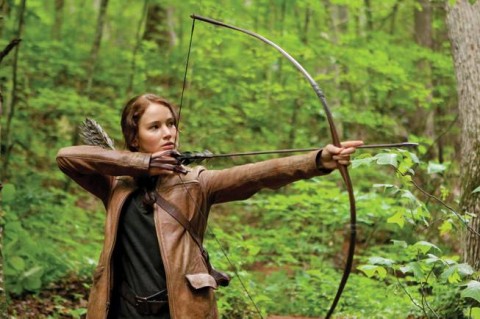
Movies reigned where once music videos played… MTV hosted its annual Movie Awards in L.A. over the weekend from the Gibson Amphitheatre, morphing the venue into a futuristic drive-in of sorts. Russell Brand MC’d the show, which featured four “Golden Popcorn” wins for The Hunger Games , an on-stage performance by Johnny Depp and a roasting for Trailblazer award-winner Emma Stone. Aerosmith front man Steven Tyler and guitarist Joe Perry introduced Dark Shadows star Johnny Depp who received the Generation Award during the show. He then went rock n’ roll, taking a guitar and playing with The Black Keys for a version of the band’s “Gold on the Ceiling.” Later, Christopher Nolan introduced a sneak peek of The Dark Knight Rises along with cast members Christian Bale, Joseph Gordon-Levitt and Gary Oldman. But the night belonged to The Hunger Games , which won four prizes including Best Female and Best Male. The pic also picked up Best Fight and “Best On-screen Transformation.” Bridesmaids , meanwhile won two nods. Emma Watson accepted the Best Cast prize as well as the first-ever socially voted Best Hero Golden Popcorn for Harry Potter and the Deathly Hallows: Part 2 . First-time Movie Awards winner Shailene Woodley was chosen by a group of film directors as this year’s Best Breakthrough Performance winner for The Descendants and Kristen Stewart and Robert Pattinson took home a fourth-straight win in the Best Kiss category for The Twilight Saga: Breaking Dawn – Part 1 . Emma Stone was honored with the inaugural MTV Trailblazer Award. The presentation turned into a joke-filled roast featuring Octavia Spencer, Jim Carrey, Mila Kunis, Anna Faris, Steve Carell and Jason Sudeikis. Not to be outdone, Charlie Sheen took to the stage to fete the greatest party films of all time (naturally), naming Project X as the “next in line to become an Instant Cult Classic.” Closing out the night, The Twilight Saga: Breaking Dawn – Part 1 took the final award of the evening, winning Movie of the Year. Winners of the “2012 MTV Movie Awards” are as follows (*denotes new category/**voted on by an “Academy of Directors”): MOVIE OF THE YEAR (voting stays live throughout the 2012 Movie Awards ceremony) The Twilight Saga: Breaking Dawn – Part 1 Director: Bill Condon, Producers: Karen Rosenfelt, Wyck Godfrey, Stephenie Meyer (Summit Entertainment) BEST FEMALE PERFORMANCE Jennifer Lawrence – The Hunger Games (Lionsgate) BEST MALE PERFORMANCE Josh Hutcherson – The Hunger Games (Lionsgate) BREAKTHROUGH PERFORMANCE** Shailene Woodley – The Descendants (Fox Searchlight) BEST COMEDIC PERFORMANCE Melissa McCarthy – Bridesmaids (Universal Pictures) BEST CAST* Harry Potter and the Deathly Hallows: Part 2 (Warner Bros. Pictures) – Daniel Radcliffe, Emma Watson, Rupert Grint, Tom Felton BEST ON-SCREEN TRANSFORMATION* Elizabeth Banks – The Hunger Games (Lionsgate) BEST FIGHT Jennifer Lawrence & Josh Hutcherson vs. Alexander Ludwig – The Hunger Games (Lionsgate) BEST KISS Robert Pattinson & Kristen Stewart – The Twilight Saga: Breaking Dawn – Part 1 (Summit Entertainment) BEST GUT-WRENCHING PERFORMANCE* Bridesmaids (Universal Pictures) – Kristen Wiig, Maya Rudolph, Rose Byrne, Melissa McCarthy, Wendi McLendon-Covey and Ellie Kemper, “Food poisoning turns the girls’ dress fitting into a disaster” BEST ON-SCREEN DIRTBAG* Jennifer Aniston – Horrible Bosses (Warner Bros. Pictures) BEST MUSIC* “ Party Rock Anthem ,” LMFAO – 21 Jump Street (Sony Pictures) “House dance party”
In 1996, it arrived. Within a few days, it struck box office gold. And on July 3, 2013, it comes back…in 3-D! 20th Century Fox has announced plans to re-release Roland Emmerich ‘s original destructo-blockbuster Independence Day next year in an extra dimension, because America apparently can’t get enough of seeing Will Smith battle aliens . ( Bad Boys in 3-D? Now that I’d pay to see.) Plan your 2013 ’90s sci-fi flashback movie nights accordingly. [ Collider ]
I’d be lying if I said I truly understood the music video for The Black Keys’ “Gold on the Ceiling,” or that it didn’t just give me shades of the stomach-turning willies I’ve been getting from the words “face” and “eating” all week. So please, someone, watch the bizarre VHS-stylings of the latest Harmony Korine joint — an aesthetic cousin to his recent Trash Humpers , with a visual nod to the wheelchair banditry of Umshini Wam — and share in my amused discomfort. Because, yeah. Baby Twinz are my new nightmare. If I see anyone dressed like this on Halloween, I might instinctively punch them in the throat before fleeing in the other direction. You’ve been warned. [via The Playlist ]
This just in from Disney HQ: After bashing records across the globe, The Avengers will go from puny Earthbound box office domination to the final frontier, screening for six lucky multinational cosmonauts currently in orbit: “Marvel Studios announced today that they arranged with NASA to transfer their record-breaking blockbuster film Marvel’s The Avengers to NASA’s Mission Control in Houston, which will uplink the film to the International Space Station (ISS), currently orbiting 220 miles above Earth. The film will then be screened for the space station crew’s exclusive enjoyment.” (Take that, Pentagon !) Keep an eye out for Loki up there fellas, eh? [Press release]
Filmmaker Chris Eyre made his name with his 1998 debut Smoke Signals , a delicate indie adapted from a short story by Sherman Alexie about two young men living on the Coeur D’Alene Indian Reservation who go an a road trip to retrieve the belongings of one’s recently deceased estranged father. It was a small, wistful thing that offered a look at characters and a community that don’t get a lot of time on screen. Hide Away, Eyre’s newest work — since Smoke Signals he’s made four features that have mostly headed to TV — is in the same emotional vein as that first film, but heads away from the rez for a setting that’s more figurative and characters that are more generic (by choice, though it’s also a problem). It’s a slender story of mourning that manages some lovely bits of mood while also being dreary and a little preposterous in its spareness. Josh Lucas does a heroic amount to ground Hide Away in real feeling in the lead role, an unnamed man who is in mourning for reasons we slowly start to understand, one related to the wife and kids we see him with in gauzy flashbacks. “Are you divorced?” people ask him. “No, I’m not,” he responds numbly. He’s told by the man from whom he buys a boat at the start of a film that a lot of divorced guys apparently do what he’s doing. He doesn’t know anything about boats — what he’s looking for is an escape, a refuge — which is why he ends up with a sailboat in barely functioning condition, the Hesperus, named for the evening star. Arriving in a black suit like he either fled straight from a business meeting or a funeral, the would-be mariner pokes around the decrepit vessel on which he plans to live, and starts learning his way around. Hide Away , which was written by Peter Vanderwall, was shot and is set in a real place — on Grand Traverse Bay in Michigan — but the film strips away most identifying details, leaving the dock on which the man’s ship is moored to seem like an outpost at the end of the world. The cinematography, by Elliot Davis, makes the place look fancifully lovely, with its still, reflective water and open skies, its winter storms and cloud banks. There’s a town nearby — the man heads in sometimes to buy groceries or booze — but he doesn’t really interact with it, having chosen solitude. A few people come and go around the dock, including a guy (Jon Tenney) who actually is divorced and using his recent boat-ownership to get women, but otherwise the man’s alone. Lucas is saddled with a lot of scenes in which he’s by himself on screen, and for the most part does an admirable job of conveying someone who’s so haunted by grief that he needed to leave the world behind without actually talking about what he went through. His moments of grief — staring out, sleepless, at night; drinking himself into a stupor at Christmas while lit-up boats past by — feel rough and believable, especially in the way he courts death by acting carelessly while never actually wanting to do the deed himself. Lucas turns the man’s repair of the ship into a series of bits of physical comedy — running out of the shower after it breaks, trying to raise the sail, setting off smoke alarms when starting a fire in the stove. He makes the repetition of work into something believably soothing, makes it seem like a process through which you could genuinely start to heal. But all the interactions the man has with the few visitors he encounters and friends he makes are leadenly infused with meaning. There’s the beautiful waitress (Ayelet Zurer) at the restaurant by the dock who seems to have taken up residence there exclusively to offer comfort sex and a more maternal caring to the broken wanders who end up nearby. There’s the older man (James Cromwell) who offers words of wisdom with regard to his own sorrow — it’s “not a recipe I recommend a young man follow.” There’s the former work colleague (Taylor Nichols) who drops by to insist the man come back to his software company, offering to set him up to telecommute. And there’s the pretty check-out girl (Casey LaBow) who inexplicably comes to him for shelter after her boyfriend beats her. The entire world seems there only to patiently nurture the man back to mental health — as if he’s in some kind of extremely elaborate sanatorium in which patients are led to think that this whole recovery-by-way-of-fixing-a-sailboat thing was their idea from the start. Hide Away has more clunky moments than it does elegantly minimalist ones, the worst of which is the glimpse of what actually happened to the man’s family. It’s over-the-top and unnecessary, given that we’d already gotten the idea about why the guy feels such guilt and grief. In shaping a film so deliberately around things left out, it would have been better to give the audience the benefit of the doubt and leave a little more mystery to the nameless man and his pain. Follow Alison Willmore on Twitter . Follow Movieline on Twitter .
If you could distill essence de chat into a few well-chosen pen strokes, you’d end up with something like Jean-Loup Felicioli and Alain Gagnol’s superb animated adventure A Cat in Paris , a picture whose modest demeanor only underscores how expressive and imaginative it is. This isn’t the kind of big-budget animation we get from the major studios: It’s richness of another sort, a feat of hand-drawn animation that relies on spare but succinct character design and a dazzling sense of perspective — rather than a volley of cultural in-jokes — to tell its story. The picture sparkles, but in the nighttime way — its charms have a noirish gleam. Most of the picture does, in fact, take place at night, beginning and ending with the nocturnal Parisian perambulations of a wily striped cat named Dino. Dino “belongs” to a little girl named Zoe. He pledges his devotion by bringing her little gifts from his nighttime hunting jaunts. Actually, he keeps bringing her the same gift: One dangly, limp dead lizard after another, but Zoe is delighted by them and saves them all in a little box, much to the annoyance of her new nanny. What almost no one knows is that Dino doesn’t go out at night just for fun, or simply out of a feline sense of duty. He’s also a cat burglar, assisting a sneaky but noble local jewel thief, Nico, on his midnight rounds. The plot becomes more complicated — to the extent that it’s complicated at all — by the fact that Zoe’s mother, Jeanne, is a detective with the Paris police. She’s consumed with concern for Zoe, who hasn’t spoken since her father was killed by a square-shouldered, square-headed thug named Victor Costa. She’s also riven with grief, and she’s determined to avenge her husband’s death by catching Costa, who, it turns out, has a new scheme: He plans to steal a precious, valuable and huge antiquity, the Colossus of Nairobi, a hulking totem that’s being brought to the city for an exhibit. Meanwhile, though, Jeanne has peskier problems: Jewels keep disappearing from various households in the city, thanks to Nico and an accomplice with four silent, velvet paws. A Cat in Paris is being released in the states in two versions, an English-language one (in which Marcia Gay Harden, Anjelica Huston and Matthew Modine provide some of the key voices) and a subtitled French one (which features, in the role of the nanny, the voice of actress Bernadette Lafont, who, for those who keep track of such things, played Marie in The Mother and the Whore ). If you’re bringing children and are lucky enough to have bilingual ones, I recommend the French version, since it is simply more French; to hear the English language pouring forth from these characters’ mouths feels just a little wrong. But the visuals of A Cat in Paris resonate in any language, and it doesn’t hurt that the picture features a stunning, stealthy Bernard Hermann-style orchestral score by Serge Bessett. (The music in A Cat in Paris is finer and more resonant than that of any live-action picture I’ve seen this year.) This is Felicioli and Gagnol’s first full-length feature — it was a 2012 Academy Award nominee — and it clocks in at a very trim but visually rich 70 minutes. The filmmakers’ drawings are both meticulous and highly stylized: They render the rooftops of Paris (what is it about city rooftops in general, and Paris rooftops in particular?) as a dusky, velvety patchwork, an invitation to adventure — they take great delight in the city’s highs and lows, in the contrast between tall and short. Their palette features an array of oranges, from muted citrus tones to deep sienna, and lots of deep, nighttime turquoise. And they dot the picture with small but inventive visual touches: When a character dons night goggles, the figures around him are rendered as stark white lines on a flat black surface. And the gargoyles of Notre Dame feature in the climactic chase sequence, a bit of travelogue whimsy that’s nonetheless dramatically gripping, perhaps even a little dizzying for those who are hinky about heights — it doesn’t matter that you can’t really fall off a cartoon building. And then there’s Dino, an utterly bewitching arrangement of orange and chocolate triangles (with a pink one for a nose). Dino isn’t a cute cartoon cat — there’s an element of mystery and devilishness about him, suggesting that Felicioli and Gagnol understand true feline spirit. They also understand feline loyalty, which is a contradiction in terms only to those who don’t understand (to the extent that understanding is possible) these elusive, magnetic creatures. Dino comforts the distressed Zoe by visiting her in bed, sliding under her arms as if he could pretend she’d never notice. And in a way, she doesn’t notice — somehow, suddenly, Dino is simply there , a presence who changes, only ever so slightly, the nature of the room around him. That’s the quiet province of cats everywhere — not just those who are lucky enough to live in the animated city of Paris. Follow Stephanie Zacharek on Twitter . Follow Movieline on Twitter .