Tag Archives: cambridge

Scientists Capture Antimatter Atoms in Particle Breakthrough!

Scientists capture antimatter atoms in particle breakthrough By Thair Shaikh, CNN November 18, 2010 12:21 p.m. EST STORY HIGHLIGHTS * Antihydrogen atoms were trapped in a magnetic field * Matter and antimatter annihilate each other on contact * “It's taken us five years to get here,” says Professor Jeffrey Hangst * CERN's next ambition is to create a beam of antimatter (CNN) — Scientists have captured antimatter atoms for the first time, a breakthrough that could eventually help us to understand the nature and origins of the universe. Researchers at CERN, the Geneva-based particle physics laboratory, have managed to confine single antihydrogen atoms in a magnetic trap. This will allow them to conduct a more detailed study of antihydrogen, which will in turn allow scientists to compare matter and antimatter. Understanding antimatter is one of the biggest challenges facing science — most theoretical physicists and cosmologists believe that at the Big Bang, when the universe was created, matter and antimatter were produced in equal amounts. However, as our world is made up of matter, antimatter seems to have disappeared. Understanding antimatter could shed light on why almost everything in the known universe consists of matter. Antimatter has been very difficult to handle because matter and antimatter don't get on, destroying each other instantly on contact in a violent flash of energy. It's taken us five years to get here, this is a big milestone –Professor Jeffrey Hangst In a precursor to today's experiment, in 2002 scientists at CERN produced antihydrogen atoms in large quantities, but they had an incredibly short lifespan — just several milliseconds — because the antihydrogen came into contact with the walls of their containers and the two annihilated each other. In this latest experiment the lifespan of the antihydrogen atoms was extended by using magnetic fields to trap them and thus prevent them from coming into contact with matter. The researchers created 38 antihydrogen atoms and held on to them for about a tenth of a second, which is long enough to study them says Professor Jeffrey Hangst, one of the team of CERN scientists who worked on the program. Hangst and his colleagues produced a magnet field which was strongest near the walls of the trap, falling to a minimum at the center, causing the atoms to collect there in a vacuum. “We could have held them for much longer… I am just full of joy and relief, it's taken us five years to get here, this is a big milestone,” Hangst told CNN. To trap just 38 atoms, they had to run the experiment 335 times, says Nature which published the report findings. Hangst added: “This was ten thousand times more difficult than creating untrapped antihydrogen atoms. “This will help us understand the structure of space and time. For reasons that no one yet understands, nature ruled out antimatter… this inspires us to work that much harder to see if antimatter holds some secret.” Malcolm Longair, professor of natural philosophy at Cambridge University, told CNN that CERN's results were a considerable achievement. “At the Big Bang we believe the temperatures were very very high and we understand in theory why antimatter disappeared but there is no physical theory to back it up.” Antimatter was first predicted in 1931 by the British physicist Paul Dirac, who theorized that antimatter is ordinary matter in reverse. CERN's next ambition is to create a beam of antimatter which they hope will allow them to unpeel more of the mysteries surrounding it. added by: EthicalVegan
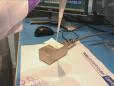

Nanowire Sensing — Nokia Research Center, Cambridge

Jani Kivioja of Nokia Research Center, Cambridge, explains nanowire sensing technology. By engadget Tags : Jani , Kivioja , cambridge , center , nanotechnology , nanowire , nokia , research , sensing

More:
Nanowire Sensing — Nokia Research Center, Cambridge

Ayi Jihu picture

Ayi Jihu is known as the Chinese Madonna for the raunchy RB numbers that have made her such a hit in her homeland. The dishy diva gave up her £4-an-hour job in the family restaurant The Ugly Duckling in order to chase her dream of a career as a singer. A 25-year-old waitress from Cambridge has become a singing sensation in China, selling 100m records to make her one of the world#39;s biggest-selling artists. The strategy clearly worked for the girl who was born in a rural village in Sichuan

View post:
Ayi Jihu picture

Leaked CIA doc: "Use Plight of Afghan Women to Win Public Support for War"

Between the Bomb and the Burqa Her voice was thick with passion as she argued for ending violence against fellow Afghan women, but the men didn't listen. Instead they hurled insults at her; they called her a prostitute and a traitor to her religion. The stubborn men's insults were abusive and frustrating, but it had been worse for other women in her position. They were threatened and hunted down. Some of them were killed. Like many recent reports in the media, this story conjures up images of a brave Afghan villager struggling against the tyrannical rule of a Taliban court or insurgent militia, but that's not case: the woman in this story is an unnamed member of the Afghan Parliament supported by the United States. The verbal abuse is recounted by another female Afghan official in a recent Human Rights Watch (HRW) report. The men who called her a prostitute were her colleagues and fellow legislators, the supposed enemies of the religious fanatics fighting for control of Afghanistan. Such accounts shed doubts on the narrative of female liberation following the initial toppling of the Taliban, as the reinvigorated debate over the occupation has renewed the media's interest in the abuses suffered by Afghan women at the hands of America's enemies. Human rights advocates may be pleased, but media critics say the plight of Afghan woman is being used to rally support for the war, and as a recent military leak reveals, the government secretly considered such a media strategy as recently as this spring. Time magazine became the poster child for this trend last week with a cover story featuring the disfigured face of a young Afghan girl named Aisha with the ominous headline: “What Happens if We Leave Afghanistan.” “They are the people that did this to me,” Aisha told the Time reporter as she touched her damaged face, disfigured as part of Taliban punishment for running away from her abusive in-laws. “How can we reconcile with them?” Aisha's heartbreaking plea reveals the harsh reality of living in a war-torn and ultra-religious society. She puts a face on the Afghan dilemma, but critics contend that the Time article on Aisha oversimplifies a complicated issue. “Feminists have long argued that invoking the condition of women to justify occupation is a cynical ploy and the Time cover already stands accused of it,” wrote Priyamvada Gopal, an English professor at Cambridge University, in The Guardian UK. “Misogynist violence is unacceptable, but we must also be concerned by the continued insistence that the complexities of war, occupation and reality itself can be reduced to bedtime stories.” A careful editorial by Time editor Rick Stengel insists that the magazine is not “either in support of the US war effort or in opposition to it,” but its intention is also an attempt to counterbalance the recent WikiLeaks release of more than 90,000 documents detailing the military actions in Afghanistan. According to Stengel, the leaked documents cannot provide “emotional truth and insight into the way life is lived in that difficult land,” but a different WikiLeaks release does provide some insight on using Afghan women to promote war. The Red Cell CIA Leak An internal Central Intelligence Agency (CIA) document released by WikiLeaks in March reveals a secret plan to use the plight of Afghan women and refugees in developing media strategies to “leverage French (and other European) guilt” during an especially bloody summer of military escalation. The confidential document was prepared by the Red Cell, a secretive group that consults the US intelligence community. In response to the news that Dutch forces would soon withdraw from Afghanistan, the Red Cell outlined a plan to use Afghan women and refugees in developing media strategies to ensure that more NATO allies would not succumb to public pressure and follow suit. The memo claimed that a “not our problem” sentiment toward the Afghan conflict allowed European leaders to ignore voter's vast disapproval of the occupation, but “forecasts of a bloody summer” could provoke a public backlash. The forecast was correct: June and July were the deadliest months for NATO and US forces to date. The record number of body bags coupled with the firing of former US Gen. Stanley McChrystal and the bloody revelations provided by the massive WikiLeaks release has pushed international support for the war to a new low. Bloomberg reported last week that, in the wake of the WikiLeaks release, approximately 70 percent of Germans want their troops to leave “as soon as possible.” Germany has the third largest military presence in Afghanistan. READ MORE AT LINK: http://www.truth-out.org/between-bomb-and-burqa62110 added by: pinkpanther

Cambridge UK To Build Europe’s First Eco-Mosque

Image: Marks Barfield The historic city of Cambridge, UK will soon be home to Europe’s first real eco-mosque. Designed by Marks Barfield, the same design firm known for the London Eye and the Kew Gardens Treetop Walkway , the £13 million project will be built on a 0.4 hectare brownfield that was purchased two years ago, just for the purpose of building a new structure that hopes to inspire other mosques to abide by the long-standing

Follow this link:
Cambridge UK To Build Europe’s First Eco-Mosque

Urban Foraging with David Craft

Urban forager, David Craft, walks all over Boston and Cambridge, but his “footprint” is small. Craft forages about 50% of his entire diet. In this piece, Craft talks about the Hawthorne Apples he found on a walk through Jamaica Plain, MA with Local In Season co-founder, Jon Ross-Wiley. Learn more about David Craft at http://www.localinseason.com added by: Local_In_Season

Rabbi That Filmed Helen Thomas’s Anti-Semitism Gets 25,000 Hate Emails

It’s not just members of the media standing up to support disgraced journalist Helen Thomas after her unscheduled retirement caused by anti-Semitic remarks she made  on camera last week. The rabbi that caught her disgusting comments on videotape and put them on the Internet has received 25,000 hate-email messages – and counting. Hours after MSNBC’s Keith Olbermann actually called Rabbi David Nesenoff one of his “Worst Persons in the World,” CBS-TV in New York reported the vicious electronic attacks streaming into the rabbi’s inbox like a “ticker tape” (video follows with partial transcript, h/t HotAirPundit ): ROB MORRISON, CBS2 NEW YORK: Four days ago Long Island Rabbi David Nesenoff launched his new website with these now-infamous comments from legendary journalist Helen Thomas. MORRISON: The veteran newswoman apologized and then retired. Since then, Rabbi Nesenoff says the hate mail has been pouring in.  RABBI DAVID NESENOFF: As we’re talking here, right now, the emails on my email are like a ticker tape. It’s been this way for a week. It’s going, going, going.  MORRISON: 25,000 and counting — messages like:  “The Jews need to go home just like the filthy illegals that plague America, same (expletive).”  “I know your type you gentile hating Jew boy. Come and face me turd. I’ll smash u under my boot.”  “Hitler was right. Time for you to go back in the oven.”  Most of the senders not even bothering to hide their email addresses.  NESENOFF: These are people that feel very mainstream about anti-Semitism and hate. They feel so proud of it. There is an arrogance about it. There is no shame. There certainly isn’t, nor is there any shame from media members likely missing what the real story is here: rampant anti-Semitism in America and how it goes largely over-looked by our press. In this instance, so-called journalists in their zeal to support Thomas are even defending it. By contrast, any incident of possible racism towards minorities will get great attention by the affirmative action supporting press. Take for example the CNN.com report Wednesday that blamed white people for President Obama’s pathetic response to the Gulf Coast oil spill. Since Obama threw his name into the ring as a presidential candidate back in February 2007, his adoring press have tried to bring race into the discussion whenever possible.  Consider how quickly the Cambridge police department was labeled racist during last July’s Henry Louis Gates Jr. episode. Media then conveniently called it a “teachable moment” about race relations in this country. So why isn’t the nation’s longest living member of the White House press corps making disgustingly anti-Semitic remarks to a rabbi a “teachable moment?” Far from it, as NewsBusters publisher Brent Bozell noted Tuesday, “[T]he only soundbites came from sympathetic media colleagues, wishing her well.” So what did Americans learn from THIS moment? If you’re a journalist that makes an anti-Semitic remark, your colleagues will support you. Isn’t that a nice lesson as anti-Semitic acts of violence around the world continue to rise? Or hadn’t you heard that such attacks more than doubled last year? Oh. That’s right. You couldn’t have known that, for our media chose NOT to report it .  Wasn’t that convenient?  Add it all up, and just as our press exploit real or imagined racism to advance their agenda ESPECIALLY if it can help an elected official they support, anti-Semitic acts are not only regularly ignored but also excused if need be. Why this is still the case 65 years after the few surviving Jews were liberated from Nazi death camps after World War II is truly astounding. 

Originally posted here:
Rabbi That Filmed Helen Thomas’s Anti-Semitism Gets 25,000 Hate Emails

Mexico-demanding that our congress pass amnesty for Mexican illegal aliens, McClintock told Calderon to Butt Out of American affairs.

Mexican President Felipe Calderon insulted America by demanding that our congress pass amnesty for Mexican illegal aliens on May 19, 2010. Congressman Tom McClintock told Calderon to Butt Out of American affairs. http://www.youtube.com/watch?v=-JDo36xPYgE added by: ejasun

Why Atheism Will Replace Religion

by Nigel Barber, Ph.D. Why atheism grows faster than religion Published on May 18, 2010 Atheists are heavily concentrated in economically developed countries, particularly the social democracies of Europe. In underdeveloped countries, there are virtually no atheists. Atheism is thus a peculiarly modern phenomenon. Why do modern conditions produce atheism? First, as to the distribution of atheism in the world, a clear pattern can be discerned. In sub-Saharan Africa there is almost no atheism (Zuckerman, 2007). Belief in God declines in more developed countries and is concentrated in Europe in countries such as Sweden (64% nonbelievers), Denmark (48%), France (44%) and Germany (42%). In contrast, the incidence of atheism in most sub-Saharan countries is below 1%. The question of why economically developed countries turn to atheism has been batted around by anthropologists for about eighty years. Anthropologist James Fraser proposed that scientific prediction and control of nature supplants religion as a means of controlling uncertainty in our lives. This hunch is supported by data showing that the more educated countries have higher levels of non belief and there are strong correlations between atheism and intelligence (see my earlier post on this). Atheists are more likely to be college-educated people who live in cities and they are highly concentrated in the social democracies of Europe. Atheism thus blossoms amid affluence where most people feel economically secure. But why? It seems that people turn to religion as a salve for the difficulties and uncertainties of their lives. In social democracies, there is less fear and uncertainty about the future because social welfare programs provide a safety net and better health care means that fewer people can expect to die young. People who are less vulnerable to the hostile forces of nature feel more in control of their lives and less in need of religion. In addition to being the opium of the people (as Karl Marx contemptuously phrased it), religion may also promote fertility, particularly by promoting marriage, according to copious data reviewed by Sanderson (2008). Large families are preferred in agricultural countries as a source of free labor. In developed “atheist” countries, women have exceptionally small families and do not need religion helping them to raise large families. Even the psychological functions of religion face stiff competition today. In modern societies, when people experience psychological difficulties they turn to their doctor, psychologist, or psychiatrist. They want a scientific fix and prefer the real psychotropic medicines dished out by physicians to the metaphorical opiates offered by religion. Moreover, sport psychologists find that sports spectatorship provides much the same kind of social, and spiritual, benefits as people obtain from church membership. In a previous post, I made the case that sports is replacing religion. Precisely the same argument can be made for other forms of entertainment with which spectators become deeply involved. Indeed, religion is striking back by trying to compete in popular media, such as televangelism and Christian rock and by hosting live secular entertainment in church. The reasons that churches lose ground in developed countries can be summarized in market terms. First, with better science, and with government safety nets, and smaller families, there is less fear and uncertainty in people's daily lives and hence less of a market for religion. At the same time many alternative products are being offered, such as psychotropic medicines and electronic entertainment that have fewer strings attached and that do not require slavish conformity to unscientific beliefs. References Sanderson, S. K. (2008). Adaptation, evolution, and religion. Religion, 38, 141-156. Zuckerman, P. (2007). Atheism: Contemporary numbers and patterns. In M. Martin (ed.), The Cambridge companion to atheism. Cambridge: Cambridge University Press. This book is not held by any U.S. Library. http://www.psychologytoday.com/blog/the-human-beast/201005/why-atheism-will-repl… added by: putdownmypants

13 Subtly Different Ways to Tie a Tie (Videos)

Filed under: Videos , Fashion , Lists , How To The necktie as we know it today (the four-in-hand) was one of countless innovations born out of the Industrial Revolution. Since then, four primary knots have emerged: the four-in hand, the Pratt, the Half-Windsor and the Windsor. However, according to research at Cambridge’s Cavendish Laboratory, up to eighty-five knots are possible. Granted, you wouldn’t want to wear most of them, but there are a few, like the Victoria, that you might find quite fetching. Full Windsor Half Windsor Four-in-Hand Victoria Pratt St. Andrew Prince Albert Nicky Oriental Cross Cavendish Plattsburgh Bow Tie Share Continue reading