Tag Archives: chinese

‘The Karate Kid’: Crane Shot, By Kurt Loder

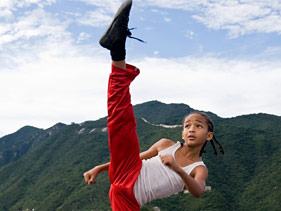
Jackie Chan sets up a star turn for the surprising, young Jaden Smith. Jaden Smith in “The Karate Kid” Photo: Columbia Pictures Is there a generation of 12-year-old girls out there yearning for a 12-year-old action-hunk to obsess about? If so, their prayers have been answered. In “The Karate Kid,” Jaden Smith, in only his third film, emerges as a charismatic star with what would seem, to this non-12-year-old girl, to be a precocious romantic appeal. The movie is a sort-of remake of the 1984 “Karate Kid,” which turned 23-year-old Ralph Macchio into a generational touchstone back in the day. Here, the bones of the original story remain, but they’ve been freely reassembled. In the first film, Macchio’s fish-out-of-water character had been forced to relocate from New Jersey to California — a puny challenge in this global age. Now, Smith’s character, Dre Parker, has to relocate all the way to China with his widowed mother (Taraji P. Henson), who’s been transferred there by the company for which she works. (A vague plot element, but really, who cares?) So Dre arrives in Beijing, friendless and alienated, and enrolls in some sort of international school. He hates his life. But then he meets a cute girl, a violin prodigy named Meiying (angel-faced Wenwen Han), whose disapproving father will soon complicate their budding relationship. Then, unfortunately, he meets a less-charming group of local hooligans led by an older kid named Cheng (Zhenwei Wang), who immediately start pushing him around. Dre tries to retaliate with some meager karate moves he learned off television back in the States, but the hooligans just sneer. Karate is a trifling Japanese discipline; the native Chinese martial art is kung fu (or, more precisely, I suppose, wushu). As we see, the movie’s title is entirely vestigial. One day, during a beatdown by Cheng and his friends, Dre is rescued by the maintenance man in the apartment building he now calls home. This is Mr. Han, and he’s played, in a bit of perfect casting, by the great Jackie Chan. Chan is such a warm and appealing presence that his entry into the story gives it a new emotional glow. Unbeknown to anyone, Mr. Han is actually a kung-fu master who has withdrawn from the world following a personal tragedy about which we only later learn. Informed that Cheng and company are members of a kung-fu team called the Fighting Dragons, he takes Dre to their training school to try to smooth things over. There, however, they also encounter the Dragons’ instructor, the snarling Master Li (Rongguang Yu), whose exhortations to his students (“No Mercy! Our enemies deserve pain!”) suggest that he hasn’t entirely internalized the spiritual component of his chosen art. At the point where Mr. Han volunteers Dre for an upcoming kung-fu tournament in which he’ll face off against the various Dragons, we begin a long wait for that showdown to actually happen. The movie runs nearly two-and-a-half hours, and you can tick off whole sequences that might have been cut, mainly welcome-to-Beijing travelogue footage of the city’s streets and parks and exotic markets (fried scorpions!). There are some lovely scenes at a sort of kung-fu temple high up in the mountains, and a visually arresting (if implausible) training session with Mr. Han and Dre high atop the Great Wall. This material takes up a lot of time, though. Presumably, having gone to considerable trouble to stage these and other interludes (including a rarely allowed visit to Beijing’s Forbidden City), director Harald Zwart was reluctant to compress them. Still, the movie flows. And the classical simplicity of the story leads us along smoothly to the high-flying tournament confrontation that concludes the picture. (Although the famous “crane kick” of the 1984 film, which belatedly crops up at this juncture, comes out of nowhere and for no particular reason.) Chan himself, who’s now 56 years old, doesn’t whip out any of the astonishing acrobatics for which he’s become famous over the last 40-odd years; but any slack in that department is skillfully taken up by Jaden Smith, who underwent what must have been intense training to develop whiplash martial skills of his own. As an actor, with his thoughtful composure and subtle humor, he strongly resembles his father, Will Smith, who co-produced the movie with his son’s mom, Jada Pinkett Smith. Happily, what they have wrought is not an exercise in rich-and-famous nepotism — it’s a showcase for a worthy heir. The kung-fu kid delivers. Check out everything we’ve got on “The Karate Kid” For breaking news, celebrity columns, humor and more — updated around the clock — visit MTVMoviesBlog.com . Related Photos ‘Karate Kid’ Premieres In Los Angeles
Go here to read the rest:
‘The Karate Kid’: Crane Shot, By Kurt Loder

China: 4-Ton Transformeresque Sculpture of General

In the U.S., we often complete the run-up to graduation by writing 25 pages of extremely dry thesis that is typically read and appraised by a single person before being relegated to the library stacks forever. Bi Heng, a student at the Central Academy of Fine Arts in China, decided that instead he would create a 4-ton, $43,000 Transformer-inspired sculpture honoring legendary Chinese general Guan Yu. The sculpture was assembled from components of an old Jiefang brand vehicle, a 25-year-old military service truck employed by the People’s Liberation Army. Robo Guan Yu stands about 32 feet tall and wields a dynastic-era weapon that makes for a nice juxtaposition with the post-Revolutionary scrap he’s assembled from. As for the real Guan Yu, he was a respected general at the end of the Eastern Han Dynasty and a key player in the civil war that ended it. Though his military exploits and valor have been pumped up to mythical standards over the years, he was apparently legitimately revered for his prowess at kungfu. Though Robo Guan Yu is unfortunately static, check out the accompanying promo video below to see the general’s latest moves. added by: diode

42 milestones in cannabis

People around the world have been smoking marijuana for thousands of years while also using the hemp plant for everything from fabric and rope to ethanol fuel. Unfortunately, somewhere along the way, a man with a bit of power and enough determination decided pot was wicked, evil and narcotic. He moved mountains to make it illegal worldwide. In the U.S., the struggle continues to this day to overcome the lies and misconceptions about marijuana that the government spent billions to spread. Between 1937 and 1947, the government spent $220 million on the war against drugs. Between 1948 and 1963, the cost of this “war” on marijuana alone escalated to $1.5 billion. From 1964 to 1969 the government spent $9 billion on the war against marijuana, a price tag that continues to rise. First Fabric Known to Man The hemp plant, also called cannabis or marijuana, has been used around the world for thousands of years. Sometime around 7000 – 8000 BCE, the first fabric is believed to have been woven from dried hemp weed. Cannabis Seeds Used as Food Around 6000 BCE hemp seeds were used as food in China. By 2727 BCE, the Chinese documented the use of cannabis as a medication to treat a variety of health problems. They later grew the plant on a large scale for food and fiber. Cannabis is Cultivated and Left as an Offering In 1500 BCE Scythians started to cultivate cannabis for weaving cloth. By 700 – 300 BCE the status of the plant had been elevated among Scythian tribes and cannabis seeds were left as offering in royal tombs. “Sacred Grass” Named One of Five Sacred Plants in India Cannabis is called “Sacred Grass” in the Hindu sacred text Arthava-Veda and named one of the five sacred plants of India. It was used as an offering to Shiva and also as a medication in India from 1200 – 800 BCE. (more at link) added by: Darevalo

Chinese Hiding 3 Million Babies a Year

As many as three million Chinese babies are hidden by their parents every year in order to get around the country’s one-child policy, a researcher has discovered. “I am the biggest offender against the one-child policy in China!” laughed Fu Yang, a wiry and energetic 47-year-old man, as he fidgeted and poured tea. “I had seven daughters in just ten years.” Mr Fu and his rather more reserved wife are among the millions of Chinese parents who risk threats, fines and even imprisonment in order to defy the country's one-child policy. The couple, who now live a prosperous life in a small village outside the southern city of Xiamen, have had to flee across three provinces and hide their children with friends in the past. “There were some difficult times,” Mr Fu conceded. “We were chased around and we had to live like beggars. But I never thought about doing otherwise. I'm aware that many people do not want their daughters, but we have a decent respect for life. In China, we think that when you have a child it is like dropping a piece of your own body from you, and we never considered the other options,” he said. Since 1978, China’s government has limited each couple to one child in a bid to stem the growth of the world's largest population. To police the law, neighbourhood committees keep a close eye out for any pregnancies, and Family Planning officials have the power to force women to have abortions and sterilisations, as well as to monitor their contraception. The policy does not apply to everyone. In the countryside, parents are allowed to try for a second child if their first is a girl. Couples who are both single children themselves are also allowed to have two children. A growing number of rich Chinese also pay fines in order to have a second child. But for parents who do not comply with the law, the penalties can be harsh. Workers in state-owned companies can lose their jobs. Others face huge fines, the possible demolition of their homes, or even a prison term. more at link… Oh, you eugenicists hate Mr. Fu and his “decent respect for life.” You wish their mobile execution vans could round kill those 3 million and harvest their organs for sale on the black market. The government mandated it in '78, so I guess NARCing on your pregnant neighbors is the right thing to do. These are the people who own our debt. added by: rodstradamus

Jacelyn Tay profile

Profile for Jacelyn Tay (郑秀珍) Born June 12, 1975 (age 34) Singapore Years active 1995-present Jacelyn Tay (simplified Chinese: 郑秀珍; pinyin: Zhèng Xiùzhēn) was born on June 12, 1975 in Singapore. She was a prefect in primary school and later became a rugby player. In 1995, while in her freshman year at the National University of Singapore Arts Faculty, she entered the 4th bi-annual Star Search Competition organised by MediaCorp (Chinese: 新传媒; pinyin: Xīn Chuánméi). She won the female category

Follow this link:
Jacelyn Tay profile

watch cinderella’s sister ep 14

Original post:
watch cinderella’s sister ep 14

watch cinderella’s sister ep 15

See the article here:
watch cinderella’s sister ep 15

watch cinderella’s sister ep 16

View post:
watch cinderella’s sister ep 16

watch cinderella’s sister ep 18

See the article here:
watch cinderella’s sister ep 18

Sun Ho Profile(Singapore singer)

Profile for Sun Ho Name:Ho Yeow Sun Chinese name 何耀珊 Pinyin Hé Yàoshān (Mandarin) Birth name Yeow-Sun Ho (何耀珊) Born June 2, 1972 Singapore Other name(s) Sun Ho, He Yao Sun, Sun Occupation Singer Genre(s) Pop Music, Mandarin Pop Label(s) Warner Music Official Website www.heyaosun.com, www.mynameissun.com Ho Yeow Sun, better known as Sun Ho, is a Singaporean pop music singer. She studied at Anglican High School and Victoria Junior College. Ho is one of the co-founders of City Harvest Chu

Read the rest here:
Sun Ho Profile(Singapore singer)