Tag Archives: country

Vanity Fair On Sarah Palin: She Has A Terrible Temper, Is A Bad Tipper

Two years after entering the nation’s klieg lights Sarah Palin is the subject of a detailed and sometimes scathing profile in next month’s Vanity Fair. The portrait that emerges is one of a willful, often-paranoid, sometimes vengeful woman with a terrible temper and a knack for folksy soundbites, who knows her strengths, saw her moment in the spotlight and has grabbed onto it with both hands. Or as Vanity Fair’s Michael Joseph Gross puts it “anywhere you peel back the skin of Sarah Palin’s life, a sad and moldering strangeness lies beneath.” What is perhaps most amazing about the profile is that it took this long for it to come about. For a woman who has been the subject of spectacular amounts press attention very few details about her personal life, or any life behind the public face and Facebook page, have come to light. Ironically, if Palin wasn’t so secretive none of the things revealed in this profile would be terribly interesting; for the most part it’s pretty basic stuff. But the newness of it subsequently makes it hard not to wonder if this marks some sort of turning point for Palin and the press. Certainly her public persona appeared to take a hit following her puzzling support of Dr. Laura’s N-word debacle (her Facebook and Twitter have been notably tame since), and Sunday’s NYT op-ed calling for the Dems to come up with their own Palin appears to have hit a nerve. Not that Palin is going anywhere, not by a long shot, but one gets the sense her time of skating through all the attention with nary a nod to the public outside a handful of controlled mediums be coming to a close. In the meantime here’s a short selection of passages from the VF profile including some solid speculation about the woman who may be the voice of Palin’s Facebook page. Read the full piece here. Update: Ben Smith thinks you should take this piece with a grain of salt: “[M]y takeaway from the magazine piece is more that you can really write anything about Palin.” A takeaway that arguably adds to the conclusion Palin’s press avoidance is beginning to work against her. Palin and the press: “Her on-the-record statements about herself amount to a litany of untruths and half-truths.” She keeps tight control of her pronouncements, speaking only in settings of her own choosing, with audiences of her own selection, and with reporters kept at bay. (Despite many requests, neither Palin nor her current staff would comment for this article.) She injects herself into the news almost every day, but on a strictly one-way basis, through a steady stream of messages on Twitter and Facebook. The press plays along. Palin is the only politician whose tweets are regularly reported as news by TV networks. The woman behind Sarah Palin’s Facebook page Palin’s most unconventional hire is a novice media consultant, Rebecca Mansour, a 36-year-old Los Angeles resident who has been identified in news stories as a screenwriter. Mansour has said that she volunteered for Obama early in the 2008 campaign and then became disillusioned. Not long after the election…[Mansour] co-founded the most popular pro-Palin blog, Conservatives4Palin, known informally as C4P. By mid-August, her byline, long the most prominent one on C4P, had vanished from the site.But her voice, or at least a voice that sounds much like hers, was about to turn up in another venue…After Mansour’s voice disappeared on C4P, however, Palin’s voice on Facebook and Twitter started sounding increasingly provocative and irascible…This summer, in her capacity as a SarahPAC staffer, Mansour insisted to a reporter that “anything that goes out under [Palin’s] name is hers.” Palin’s virtual voice does sometimes have the ring of authenticity. But often it sounds less like Palin herself than someone else’s fantasy version of Palin at her most vitriolic. On one occasion Palin’s virtual voice contradicted remarks she made in a TV interview two days later. Andrew Sullivan Alert Palin delivers basically the same speech she gave 18 hours earlier to the Tea Party group in Independence. You could pretty much replace the word “constitution,” from yesterday’s remarks, with “Bible,” and be good to go. Then Palin departs from the script and speaks as if from the heart, describing her fear and confusion upon discovering that Trig would be born with Down syndrome. “I had never really been around a baby with special needs,” she tells her listeners. For what it’s worth, this statement is untrue. Depicting the same moment of discovery in her own book, Palin writes that she immediately thought of a special-needs child she knew very well: her autistic nephew. Such falsehoods never damage Palin’s credibility with her admirers, because information and ideology are incidental to this relationship. For someone who loves the common folk, Palin is apparently a bad tipper Palin does not always treat those ordinary people well, however—it depends on who is watching…The only time I heard of Palin giving a generous tip was in St. Joseph, Michigan, after the owner of Kilwin’s chocolate shop, on State Street, sent a CARE package to Palin’s suite, and Palin walked to the store to say thank you. She also wanted to buy more boxes of candy to take home. When the owner would not accept her money, Palin, encircled by the crowd that had jammed the store to get a glimpse of her, pressed a hundred-dollar bill into the woman’s hand, saying, “This is for the staff.” That Ben Franklin was the talk of State Street the whole rest of the day. And has a Terrible Temper The intensity of Palin’s temper was first described to me in such extreme terms that I couldn’t help but wonder if it might be exaggerated, until I heard corroborating tales of outbursts dating back to her days as mayor of Wasilla and before. One friend of the Palins’ remembers an argument between Sarah and Todd: “They took all the canned goods out of the pantry, then proceeded to throw them at each other. By the time they got done, the stainless-steel fridge looked like it had got shot up with a shotgun. Todd said, ‘I don’t know why I even waste my time trying to get nice things for you if you’re just going to ruin them.’ ” This friend adds, “As soon as she enters her property and the door closes, even the insects in that house cringe. added by: TimALoftis
Uranium Mining in The Black Hills – A path of destruction from which there is no return

“Uranium Mining in the Black Hills” Director / Editor, Christopher Crosby Producers, Karla LaRive, Susan Watt and the Institute of Range and American Mustang Interviews by Dayton O. Hyde, Susan Watt, Michael Bucher, Barbara Peltier & Tom Ballanco Original Music by Windwalker, Michael Bucher Governments and the uranium industry say the mining and milling of uranium provides high-paying and much-needed jobs in some of the most remote areas of the country, with manageable environmental risks. But it's an industry that has long attracted its share of controversy. This is a major concern for the Black Hills Wild Horse Sanctuary in western South Dakota, and other residents including environmental and conservation groups. The Sierra Club of South Dakota warns that water pollution will be a major concern if the mining company Powertech is given a permit to mine for uranium. Shirley Frederick, with the Sierra Club’s Black Hills Group, says there’s a high likelihood that aquifers will become polluted if an injection-well recovery system is used to mine the ore. “It’s a huge potential for contamination of groundwater.” Powertech Inc USA has submitted its uranium mining application to the Nuclear Regulatory Commission and it can be viewed at the NRC website. The NRC has announced a time period for interested individuals to voice their concerns regarding the uranium mine’s impacts to the environment. This proposed uranium mine will be the first time folks can be heard under the new GEIS. The Institute of Range and American Mustang (IRAM) founded by Dayton O. Hyde in 1988 is a 501

CBS’s Smith Excuses Obama For Not Crediting Bush With Iraq Troop Surge

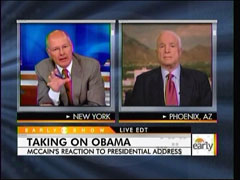
On Wednesday’s CBS Early Show, co-host Harry Smith served as an apologist for President Obama, who failed to credit President George W. Bush with the Iraq troop surge in an Oval Office address Tuesday night: “…while he [Obama] did not acknowledge…President Bush’s support for the surge….he at least gave it tacit agreement – approval. And he has certainly approved a surge in Afghanistan.” Smith made the defense during an interview with Arizona Senator John McCain, who took the President to task for opposing the 2007 troop surge: “…it was President Bush who made the decision – over the vociferous option of the President of the United States, then Senator Obama – to do the surge. And if we had done what President Obama wanted, we would have failed in Iraq because he even voted against the funding for it.” After Smith claimed that Obama “had a year and a half to rescind” his opposition to the surge and eventually gave “tacit agreement” to it, McCain replied: “…if we had done what he wanted to do, we would have left and we would have lost and had a horrendous setback to America’s national security.” Smith moved on to Afghanistan, still skeptical of the success of the Iraq surge strategy: “If, in fact, the surge was successful in Iraq , is that – is there a lesson from that to be applied to Afghanistan now that we’ve – there are more than 320 kids have been killed in Afghanistan this year. Are the lessons of Iraq applicable to Afghanistan?” Prior to Smith’s interview with McCain, fill-in co-host Erica Hill interviewed Vice President Joe Biden. She wondered about Obama changing focus to the economy during the prime time address: “This was, though, supposed to be a speech about ending combat operations in Iraq, about the men and women currently fighting, those who have fought. Was this really the appropriate place and time to make that transition?” On Iraq, Hill questioned the stability of the security situation: “There has been increased violence, we’re hearing more and more about the sectarian divisions. Is there any concern on the part of the administration that there could be the creation of a vacuum of sorts at this point?” Hill failed to question the Vice President about his and President Obama’s opposition to the troop surge. Hill wrapped up the interview with Biden by lobbing a softball about the economy: “…you noted the fact that Democrats and Republicans should be cooperating, should be working together on the economy. As the administration does move forward, this is, of course, a major concern for the American people. What do you have in terms of planning, looking out now, to help stimulate the economy today?” Here is a full transcript of Smith’s September 1 interview with McCain: 7:10AM ET SEGMENT: HARRY SMITH: And joining us now from Phoenix is Senator John McCain. Senator, good morning. JOHN MCCAIN: Good morning. SMITH: What did you think of the speech last night? [ON-SCREEN HEADLINE: Taking On Obama; McCain’s Reaction to Presidential Address] MCCAIN: Well, I was – I was pleased that the President gave such well-deserved praise to the men and women who have served and those who have sacrificed. It certainly was not generous of him when he mentioned former President George Bush as one who also appreciates the military, but the fact is, that it was President Bush who made the decision – over the vociferous option of the President of the United States, then Senator Obama – to do the surge. And if we had done what President Obama wanted, we would have failed in Iraq because he even voted against the funding for it. But the thing that disturbed me the most about it is this continued repetition that we are leaving at a date certain. You don’t win conflicts when you tell the enemy you’re leaving. Our friends are accommodating, our enemies are encouraged. A Taliban captive says ‘you’ve got the watches, we’ve got the time.’ It should be conditions-based. And when those conditions are met, then we can do exactly what we’re now doing in Iraq. SMITH: You’re referring to Afghanistan now. MCCAIN: Afghanistan, yes. I’m sorry. SMITH: One of the things – but one of the things he did say in the speech last night, the pace of reductions in Afghanistan will be determined by conditions on the ground. MCCAIN: If he had stopped there, we’d be in great shape. And then he had to repeat what was purely a political decision, no military person recommended it, that we were going to go ahead and continue – or begin our, quote, ‘withdrawal,’ the middle of next year. Look, that accounts for the behavior, to some degree, of Karzai, the –  many of the things that are happening in the region, because they believe that we are leaving. Look, Harry, I was even – I talked to a police chief outside Kandahar who said, ‘yeah, we think you’re leaving and the Taliban are telling us  they’re going to cut off our heads when you do.’ All he had to do was say it’s conditions-based. SMITH: The – I think part of the subtext of the message last night was, while he did not acknowledge the President’s – prior president, President Bush’s support for the surge, I think that- MCCAIN: Or his opposition – or his vociferous opposition and his opposition throughout- SMITH: Well he also had a year and a half to rescind it. So, he at least gave it tacit agreement –  approval and he has certainly approved a surge in Afghanistan. My question is, if – is, are there- MCCAIN: Harry, if he had had his way and he won the nomination of his party opposing Hillary Clinton, who had voted for it, that was the whole basis of his campaign. And if we had done what he wanted to do, we would have left and we would have lost and had a horrendous setback to America’s national security. SMITH: Let me ask this question, then. If, in fact, the surge was successful in Iraq, is that – is there a lesson from that to be applied to Afghanistan now that we’ve – there are more than 320 kids have been killed in Afghanistan this year. Are the lessons of Iraq applicable to Afghanistan? MCCAIN: The fundamentals are. The same general who made it succeed the last time in Iraq is in charge in Afghanistan. I think he’s the finest general that I’ve had the opportunity – ever had the opportunity of being in the company of. He believes that we can succeed. But I can tell you, the commandant of the Marine Corps said recently that the announcement of beginning a withdrawal, it gives sustenance to the Taliban. I mean, you cannot win conflicts when you say that you are leaving. And again, no military person – no military person with any military background would recommend what the President did. It was a political decision. He made it to please his political base. And he should change it. And it’s wrong to put young Americans in harm’s way when you’re telling your enemies and your friends alike in the region that you’re going to be leaving. SMITH: Alright. Senator John McCain, thank you very much for your time this morning. Do appreciate it. MCCAIN: Thank you. Thank you. SMITH: Alright, good to see you. Here is a full transcript of Hill’s interview with Biden: 7:06AM SEGMENT ERICA HILL: And joining us now from Baghdad is Vice President Joe Biden. Mr. Vice President, good morning. JOE BIDEN: Good morning, Erica. HILL: The President last night, of course, said this was time to turn the page and then took that opportunity to say, and I’m quoting here, ‘our most urgent task is to restore our economy.’ This was, though, supposed to be a speech about ending combat operations in Iraq, about the men and women currently fighting, those who have fought. Was this really the appropriate place and time to make that transition? BIDEN: Yes. It was at the end of his speech. He did speak exactly about turning the page here as well. He didn’t use that phrase. He talked about ‘change the mission.’ I’m about to go to a ceremony literally in the next hour where that is taking place. And he did speak at length about the bravery and the sacrifice made by the men and women of this country. But the truth of the matter is, at the end of the day, our ability to maintain our national security is, in fact, dependent  upon the economy. And it’s time to focus on that as well. Lastly, Erica, what he was really talking about was, just as we turn the page and are cooperating as Democrats and Republicans on the issue of Iraq, we should be doing the same thing on the economy, cooperating. HILL: When it comes to Iraq, you are there – you are there right now on the ground, of course. As people look at the Iraq that we’re seeing today, the government still in flux six months after an election. There has been increased violence, we’re hearing more and more about the sectarian divisions. Is there any concern on the part of the administration that there could be the creation of a vacuum of sorts at this point? BIDEN: Well, there’s always the possibility, long term, if this goes on, creating a vacuum. But the truth of the matter is, violence is the lowest level it’s been since we arrived in 2003. Number one. Number two, the fact of the matter is, that I have been speaking with every one of the major leaders. I’ve met with every one of the groups that are – that won portions of the vote in the election. And I’m absolutely convinced that they are nearing the ability of forming a government that will be a government representing the outcome of the election, which was very much divided. There’s 325-plus members of their parliament, the largest party got 91 votes. So, it takes a while to put together this coalition. But I believe they’re close to doing that. HILL: I do want to bring you back to the economy for one second because, as you said after that first question, you noted the fact that Democrats and Republicans should be cooperating, should be working together on the economy. As the administration does move forward, this is, of course, a major concern for the American people. What do you have in terms of planning, looking out now, to help stimulate the economy today? BIDEN: Well, a continuation of what we’re doing now, which is to stimulate the economy by continuing to focus on infrastructure by giving taxes and more tax breaks to small businesses. They’re the job creators, they’re the incubators of job creation. They need the help. And by continuing the middle class tax cut so that middle class people have disposable income in order to meet their needs and, in turn, that stimulates the economy. And I hope the Republicans, when we get back, will, in fact, lift their hold on us being able to vote on a tax cut for small businesses that is tied up in the Senate. So, I just hope we begin to focus more on job creation than on – as the leader of the Republican Party, Mr. Sessions, in charge of the election – re-election of the Congress – said that what we have to do is return to exactly what we were doing before. That’s not much of an alternative. HILL: Vice President Joe Biden, thanks for joining us this morning. BIDEN: Thank you very much, Erica. Pleasure to be with you.

See more here:
CBS’s Smith Excuses Obama For Not Crediting Bush With Iraq Troop Surge

Today in Machete: Lindsay Lohan No-Shows, Racist Poster Remix

It’s the Wednesday before Labor Day, which means we’re all in this long late-summer slog together. Bless Fox’s heart, they’ve given us a fairly decent means of whiling away at least a little of that time — first by setting the megaviolent spectacle Machete for release this Friday, and then by supplementing it with random Lindsay Lohan gossip and vaguely racist posters for film bloggers to play with.

See the rest here:
Today in Machete: Lindsay Lohan No-Shows, Racist Poster Remix

NBC Developing ‘Harry Potter For Adults’

While Kelsey Grammer prays that NBC may be interested in Frasier: The Next Generation , the network is busy developing a much larger-scale project with the help of Battlestar Galactica creator Ronald D. Moore. The still-untitled drama is being described as “an adult Harry Potter set in a world ruled not by science but by magic,” and let’s just hope that no one asks Conan O’B rien for advice on what it should be called . [ Deadline ]

Read more:
NBC Developing ‘Harry Potter For Adults’

Vanessa Paradis on What Makes a Good Romance and Why She Hasn’t Starred Opposite Her Husband, Johnny Depp

Here’s one notable difference between France’s film industry and America’s: Vanessa Paradis is among the country’s most famous actresses (not to mention a well-known singer and the wife of Johnny Depp), and yet she had never really made a romantic comedy until Heartbreaker , opening in the States on September 10. In it, Paradis plays a cool and collected woman about to be married who meets a romantic rogue (Romain Duris) hired by her father to seduce her and break up the wedding. She told Movieline how she lobbied to make the script more romantic, how she manages to balance all her separate careers, and why she didn’t end up in the Pirates of the Caribbean role that sounded tailor-made for her.

Read more:
Vanessa Paradis on What Makes a Good Romance and Why She Hasn’t Starred Opposite Her Husband, Johnny Depp

Even in the Year 1076 Muslims Couldn’t Get Along with Their Neighbors

The First Crusade played a very important part in Medieval England. The First Crusade was an attempt to re-capture Jerusalem. After the capture of Jerusalem by the Muslims in 1076, any Christian who wanted to pay a pilgrimage to the city faced a very hard time. Muslim soldiers made life very difficult for the Christians and trying to get to Jerusalem was filled with danger for a Christian. This greatly angered all Christians. One Christian – called Alexius I of Constantinople – feared that his country might also fall to the Muslims as it was very close to the territory captured by the Muslims. Constantinople is in modern day Turkey. Alexius called on the pope – Urban II – to give him help. In 1095, Urban spoke to a great crown at Clermont in France. He called for a war against the Muslims so that Jerusalem was regained for the Christian faith. In his speech he said: “Christians, hasten to help your brothers in the East, for they are being attacked. Arm for the rescue of Jerusalem under your captain Christ. Wear his cross as your badge. If you are killed your sins will be pardoned.” Those who volunteered to go to fight the Muslims cut out red crosses and sewed them on their tunics. The French word “croix” means cross and the word changed to “croisades” or crusades. The fight against the Muslims became a Holy War. Many people did volunteer to fight on the First Crusade. There were true Christians who wanted to reclaim Jerusalem for their belief and get the Muslims out of the city. There were those who knew they had committed sin and that by going on the Crusade they might be forgiven by God. They had also been told by the pope that if they were killed, they would automatically go to heaven as they were fighting for God. There were those who thought that they might get rich by taking the wealth that they thought existed in Jerusalem. Any crusader could claim to be going on a pilgrimage for God – pilgrims did not have to pay tax and they were protected by the Church. http://www.historylearningsite.co.uk/cru2.htm added by: congoboy

White Fright – Glenn Beck’s rally was large, vague, moist, and undirected—the Waterworld of white self-pity

One crucial element of the American subconscious is about to become salient and explicit and highly volatile. It is the realization that white America is within thinkable distance of a moment when it will no longer be the majority. This awareness already exists in places like New York and Texas and California, and there have even been projections of the time(s) at which it will occur and when different nonwhite populations will collectively outnumber the former white majority. But it also exerts a strong subliminal effect in states like Alaska that have an overwhelming white preponderance. Until recently, the tendency has been to think of this rather than to speak of it—or to speak of it very delicately, lest the hard-won ideal of diversity be imperiled. But nobody with any feeling for the zeitgeist can avoid noticing the symptoms of white unease and the additionally uneasy forms that its expression is beginning to take. For example, so strong is the moral stature of the Rev. Dr Martin Luther King Jr. and the civil rights movement that even the white right prefers to pretend to emulate it. (This smarmy tactic long predates Glenn Beck, by the way: I remember Ralph Reed trying it when he ran the Christian Coalition more than 10 years ago and announced that he wanted to remodel the organization along the lines of the Southern Christian Leadership Conference.) Thus, it is really quite rare to hear slurs against President Barack Obama that are based purely on the color of his skin. Even Beck himself has tried to back away from the smears of that kind that he has spread in the past. But it is increasingly common to hear allegations that Obama is either foreign-born or a Muslim. And these insinuations are perfectly emblematic of the two main fears of the old majority: that it will be submerged by an influx from beyond the borders and that it will be challenged in its traditional ways and faiths by an alien and largely Third World religion. Advertisement This summer, then, has been the perfect register of the new anxiety, beginning with the fracas over Arizona's immigration law, gaining in intensity with the proposal by some Republicans to amend the 14th Amendment so as to de-naturalize “anchor babies,” cresting with the continuing row over the so-called “Ground Zero” mosque, and culminating, at least symbolically, with a quasi-educated Mormon broadcaster calling for a Christian religious revival from the steps of the Lincoln Memorial. At the last “Tea Party” rally I attended, earlier this year at the Washington Monument, some in the crowd made at least an attempt to look fierce and minatory. I stood behind signs that read: “We left our guns at home—this time” and “We invoke the First Amendment today—the Second Amendment tomorrow.” But Beck's event was tepid by comparison: a call to sink to the knees rather than rise from them. It was clever of him not to overbill it as a “Million”-type march (though Rep. Michele Bachmann was tempted to claim that magic figure). The numbers were impressive enough on their own, but the overall effect was large, vague, moist, and undirected: the Waterworld of white self-pity. The Washington Post quoted Linda Adams, a Beck supporter from Colorado, who said, “We want our country to get back to its original roots,” adding that “her ancestors were on the Mayflower and fought in the American Revolution.” She was also upset that some schools no longer require students to recite the Pledge of Allegiance. Well, the U.S. population is simply not going to be replenished by Puritan pilgrims from England, and the original Pledge of Allegiance was fine with most people as a statement of national unity, until its “original intent” was compromised by a late insertion of the words “under God” in the McCarthyite 1950s. But one still sees what she means and can feel sympathy with the pulse of nostalgia. added by: TimALoftis

Open Thread: Democrats Moving Away from Nancy Pelosi

Today’s starter topic : Does this represent a policy shift or just a campaign tactic? Some of the Democratic Party’s most endangered lawmakers are taking steps to distance themselves from Speaker Nancy Pelosi in an attempt to inoculate themselves from charges that they are beholden to the unpopular House leader and supportive of the ambitious national Democratic agenda. Three vulnerable Democrats from conservative-oriented districts are already running TV ads spotlighting their defiance of Pelosi. One freshman incumbent recently joked about the possibility of Pelosi not being able to take up the gavel next year because she might pass away. Another member from a tough district suggested he might run for speaker himself. The roster of Democrats currently playing six degrees of separation from Pelosi spans the map, from the Northeast to the South and across the Midwest to South Dakota. Pelosi aides and allies said they understand that embattled members sometimes need to distance themselves from the speaker and note that she doesn’t take it personally, although they caution that how it is done is just as important as why it’s done.

David Brooks Discusses Iraq War’s Success Without Mentioning Bush

New York Times columnist David Brooks wrote an article Tuesday largely about the success America has had rebuilding Iraq without ever mentioning the name of former President George W. Bush. To be sure, ” Nation Building Works ” also addressed some of the failures: the absence of “social trust,” the lack of doctors and engineers, as well as rampant corruption to name a few. But in a column published the very day President Obama is to address the nation about Iraq, it seems particularly odd that the man at the helm when America invaded – and who against public sentiment as well as the will of the current White House resident orchestrated a surge of military forces in 2007 largely responsible for the success of this mission – is conspicuously absent: “Iraq has made substantial progress since 2003,” the International Monetary Fund reports. Inflation is reasonably stable. A budget surplus is expected by 2012. Unemployment, though still 15 percent, is down from stratospheric levels. Oil production is back around prewar levels, and there are some who say Iraq may be able to rival Saudi production. That’s probably unrealistic, but Iraq will have a healthy oil economy, for better and for worse. In the most recent Gallup poll, 69 percent of Iraqis rated their personal finances positively, up from 36 percent in March 2007. Baghdad residents say the markets are vibrant again, with new electronics, clothing and even liquor stores. About half the U.S. money has been spent building up Iraqi security forces, and here, too, the trends are positive. Violence is down 90 percent from pre-surge days. There are now more than 400,000 Iraqi police officers and 200,000 Iraqi soldiers, with operational performance improving gradually. According to an ABC News/BBC poll last year, nearly three-quarters of Iraqis had a positive view of the army and the police, including, for the first time, a majority of Sunnis. Sounds pretty darned good, right? Yet Bush’s name is not even mentioned nor is the fact that Obama as Senator voted against the surge and campaigned against the wisdom of it on his road to the White House. As such, who got the de facto credit for the current condition in Iraq as far as this piece was concerned? When President Obama speaks to the country on Iraq, he’ll be able to point to a large national project that has contributed to measurable, positive results. If he is honest, Obama will have to balance pride with caution. He’ll have to acknowledge that the gains the U.S. is enabling may vanish if the U.S. military withdraws entirely next year. He’ll have to acknowledge that bottom-up social change requires time and patience. He’ll have to heed the advice of serious Iraq hands like Crocker, Michael O’Hanlon of Brookings and Stephen Biddle of the Council on Foreign Relations, and shelve plans to withdraw completely. Yes, but nowhere did Brooks advise this President to congratulate or at least acknowledge the former one for going against Obama’s senatorial wishes by orchestrating a surge that made any of the success possible. I’m sure this was just an oversight on Brooks’s part.

Read this article:
David Brooks Discusses Iraq War’s Success Without Mentioning Bush