Bossip: How do you feel about the emergence of white rappers? HDH: I think it’s great! Hip Hop is a culture and a sound, not a color. Music is versatile and relatable to diverse types of people. I was one of the 1st talented “White Rappers” or “White Female Rappers” on World Star and other spots on the internet and it feels great to open the door for others. A few years ago, my 1st song I released on the net went viral and was talked about on a bunch of blogs and sites! I feel like I was and am a Pioneer for White Rappers! I wish I would’ve had better management at that time! Bossip: How does you feel about Iggy? HDH: Is that the one signed to TI? I only heard a couple songs by her, but she sounds good and is talented based on the songs I heard. She looks nice too….I wish her the best! I hope she kills the game! Maybe we will collab in the future. Bossip: Who robbed You? Memphitz? How much did they rob you for? HDH:Ha ha ha! Nahhhhhh! I never met Memph yet….This was a manager I hired from Houston. This snakes name is Marcus Goree aka “”Money Marc” and he embezzled $150,000+ by forging documents and skimming by inflating prices and other unethical practices. He was working for me for about 1.5 years and he was embezzling most of the money in the budget each month and using it on his own artist and to floss and pay his bills which lead to my projects not appearing to be top quality BUT I took him to court and WON and the judge awarded me $2.1 Million in April! It feels good to win over evil and I felt vindicated! That situation taught me a lot and I now have a better team and a clearer vision of where I want to go. My Time Is Now! Bossip: Are your kids mixed? HDHL No my children are White Bossip: What do you feel about black folks who think white women are “stealing” their black men? HDH: My serious answer is “I think that it’s sad that they look at the world from such a racist point of view or feel like they are threatened or inferior or something. Everyone and every color has their own beauty, I don’t think anyone is inferior or superior, just different. I prefer Black men lol they sexy!” My joking answer “Everyone takes what they like from other cultures,” a lot of Black women like to sport Korean Women Hair, why can’t White women have some sexy black arm candy?” Bossip: Are you still with your baby daddy? HDH: No! Bossip: Where you raised around all black people? HDH: Yes and no. I mostly went to schools that were mixed mostly with Black, Latino, and Asian. Mostly Black, and then the others and maybe like 10 White people. But there were no black people in my family. Bossip: How do your parents feel about you in this culture? HDH: They didn’t! That’s why I left home while in High School to pursue my own dreams, goals and ambitions. Most don’t know this but aside from all of the drama I had to go through because my parents didn’t believe in my dream, I still managed to be the Valedictorian of my High School. Bossip: What makes your flow different? HDH: I’m versatile and like to try different and unusual sounds in the instrumentals Bossip: What’s up with an adult tape? You do know that would blow you all the way up, right? HDH: LMAO! ROFL! I haven’t had to take my clothes off yet to get millions of views so why resort to it now? Why use what’s between my legs for money when my brain is so much more powerful! Bossip: How do you feel about the nicki vs kim beef? HDH: I think they were using Greene’s 48 Laws of Power. Nicki used Kims stature by mimicking her and attacking her, tapping into Kim’s power and fanbase. Then Kim fed into it and started attacking her back, which then made Kim look like she felt threatened. When Nicki got HOT and started getting accolades it was in Kim’s best interest to try and keep her name in Nicki’s mouth to keep her buzz up! Classic!
The Dream Named Vice President Of A&R At Def Jam Looks like singer/producer The Dream has found yet another source of income to make it rain all over his 9,876 children and 2 babymamas. He was recently named the Vice President of A&R at Def Jam records. via Billboard Biz According to a statement issued on Oct. 8, The-Dream “will have a comprehensive, broad reaching A&R portfolio.” His responsibilities at the division of Universal Music Group will include overseeing the progress of current and new artist projects, signing new talent to the label and working in a production capacity with artists on the Def Jam roster. Currently, the-Dream is working with Rihanna on her upcoming Def Jam album and with Pusha T on his solo debut for G.O.OD. Music. The label will also devote additional resources to its executive VP’s Radio Killa label imprint. He had this to say about his new gig: “Music means more than just a download, it’s life to the culture and also the people who listen. This is a new exciting yet critical time for music — ‘You Meet Change with Change!’ He must be making somebody happy over at Def Jam even if his babymamas can’t quite say the same.
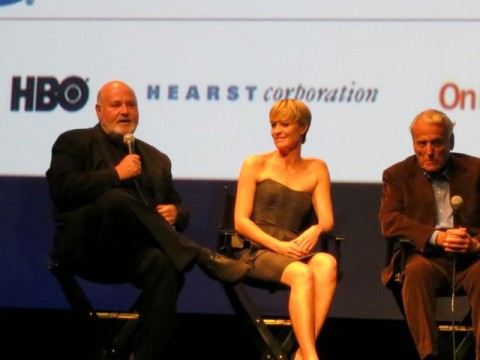
Tuesday night, the New York Film Festival hosted something that is likely a rarified event in the usually hallowed theater venues at Lincoln Center – a boisterous and rowdy crowd. But the event probably landed itself to the culture shift. The occasion was the 25th anniversary of The Princess Bride and a good chunk of the living cast showed up, including Robin Wright , Cary Elwes, Mandy Patinkin, Chris Sarandon, Wallace Shawn and Billy Crystal in addition to director Rob Reiner as well as author William Goldman. Random shouts of “meathead” could be heard from the audience – all loving of course – when Reiner was introduced on stage as first coming to prominence as Michael Stivic in 1970s television show All in the Family . The Princess Bride was also likened to The Wizard of Oz (1939) – something Reiner fully embraced. Reiner recalled that when Princess Bride first went into release, a trailer had not been made a week before its roll out, nor had a one-sheet been created to describe the film. “Like ‘The Wizard of Oz’ at the time, the studios weren’t sure how to market this kind of a film,” said Reiner. “And similar to [that movie] it didn’t do [very well] when it first came out.” Released in September, 1987, the film had a strong showing in nine theaters in its initial run, but its overall theatrical run (nearly $31 million) apparently disappointed, but it has lived on as a cult favorite and the audience at Lincoln Center talked back to the screen in something akin to watching The Little Shop of Horrors (which incidentally also played at NYFF last weekend). Reiner’s father met William Goldman in 1968 while working on a book about Broadway that year. Reiner’s father had coincidentally just created a play running in New York. While still in his 20s, his dad gave him the novel The Princess Bride to read and, as might be expected, fell in love with it. “I was monster fan of everything [Goldman] had written,” he said. “My dad gave me the book and I couldn’t believe how incredible this book was. What a high degree of difficulty to do an adventure, romance, satire and make it all work. I thought it was the most incredible thing I’d read in my whole life.” Years later, after getting his lauded This is Spinal Tap and Stand by Me under his belt, Reiner thought about The Princess Bride . “So, many years go by and I had made some movies and I thought naively, ‘well they make movies out of books and my favorite book is The Princess Bride .’ So as a totally naive person, I thought I’ll see if someone has tried to do this. I found out the Truffaut had tried.” Eventually, he decided to go for it and ask the two-time Oscar winning writer if he could take on The Princess Bride . “I went to meet with him at his place in [New York] and he opened the door and said, ‘ The Princess Bride is my favorite thing I’ve ever written in my life – I want it on my tombstone. What are you going to do with it?'” Goldman did give his blessing that night. Newcomer at the time Robin Wright was cast the title character (aka Buttercup) opposite Cary Elwes, the man of her dreams (who she does some of that kissing with). The fairy tale aspect of the story came as a bit of a surprise for Wright who had not read the book by the time she departed for the set in England, but was taken aback by the fantasy element that rides through the story. When I read the script, I noticed all the stage direction which had things like lightning, sand, thunder, giant rodents and fire. I thought, ‘Oh we’re just going to do the dialog, I didn’t believe all that other stuff,” Wright said at Lincoln Center. “I went to England and had never read the book, thinking all that stage direction B.S. was just that. And then I had to put on my accent and there were attacking eels and all this stuff. It was just insane.”
What??…her daughter was hungry?! The single-mom Professor was in a bind and brought her baby girl to work…but none of her students expected her to break her tiddays out of her top during their lecture. Adrienne Pine was in a jam. The assistant anthropology professor at American University was about to begin teaching “Sex, Gender & Culture,” but her baby daughter woke up in the morning with a fever. The single mother worried that she had no good child-care options. So Pine brought her sick baby to class. The baby, in a blue onesie, crawled on the floor of the lecture hall during part of the 75-minute class two weeks ago, according to the professor’s account. The mother extracted a paper clip from the girl’s mouth at one point and shooed her away from an electrical outlet. A teaching assistant held the baby and rocked her at times, volunteering to help even though Pine stressed that she didn’t have to. When the baby grew restless, Pine breast-fed her while continuing her lecture in front of 40 students. Now Pine finds herself at the center of a debate over whether she did the right thing that day and what the ground rules are for working parents who face such child-care dilemmas.“Every working parent can empathize with facing the choice of an important day at work when a child gets sick,” officials added in a second statement Tuesday afternoon. “Both demand your focus and attention. There is no easy or ideal alternative.”Some students interviewed Tuesday said breast-feeding doesn’t belong in the classroom. University officials, however, said professors should avail themselves of other options rather than expose students to potential illness. “For the sake of the child and the public health of the campus community, when faced with the challenge of caring for a sick child in the case where backup childcare is not available, a faculty member should take earned leave and arrange for someone else to cover the class, not bring a sick child into the classroom,” university spokeswoman Camille Lepre said in an e-mail. We’re all for Women’s rights over here but what do you think about the choice she made? Source Images via shutterstock/facebook
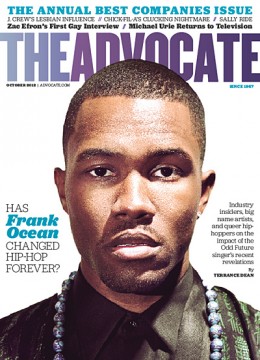
Frankly, Frank Ocean even has the gay community talking. While much of the hoopla behind Frank Ocean’s coming out has died down for the hip-hop community, many who are less aware of who he is as an artist have now turned their attention to the significance of his “Thank You” letter that was published shortly before his album debuted this Summer, and it’s meaning for the LGBT community. The subject garnered a long and insightful feature entitled “The Meaning Of Frank Ocean,” which was scribed by one of our contributing writers, Terrance Dean , in the latest issue of The Advocate magazine. (It’s kind of a big deal to have a black man on the cover of The Advocate too). It’s really long but definitely discussion worthy, so we’ve excerpted key portions below: “It was sheer joy because he was the first national well-known artist to come out and announce his sexuality,” says Lloyd Thurston “Gyant” Dinwiddie, referring to Ocean as the first black artist to come out to a hip-hop audience. “Frank Ocean is cemented in music history forever. Anyone who has walked in the LGBT shoes knows that story. His message related to people, and for him it was a weight lifted off his shoulder.” July 4, 2012, marked a declaration of freedom for 24-year-old R&B soul singer Ocean. It was his coming-out party, and we’d all been invited to the virtual parade. His image, that of a serious-looking, handsome young man with a strong jaw line, a short beard, and a short fade haircut, was circulating along with his letter. Those who hadn’t previously heard of Ocean quickly learned that his announcement was significant, and especially significant to watchers of hip-hop. But it wasn’t a shock to everyone. “I was like, What’s the big deal? It’s not like we all don’t know homosexuality exists and has its place in hip-hop,” says Reggie Osse, entertainment attorney, author, former TV executive, and host of The Combat Jack Show. Osse has represented artists including Damon Dash, Missy Elliott, Timbaland, Puffy, and DMX. He was instrumental in helping Jay-Z secure his first recording deal. “I was really happy that Frank Ocean took his life and career into his own hands and made his proclamation,” says Osse. “It’s the first announcement of someone making a statement willingly. But let’s not act like this doesn’t exist.” Before long music celebrities including Russell Simmons, Solange Knowles, 50 Cent, Jay-Z, and Beyoncé began tweeting and posting messages of support for Ocean. Even Odd Future member Tyler the Creator, who’s well-known for his use of the word “fa**ot,” tweeted how proud he was of his brother and friend. It seemed as if the hip-hop industry, which has notoriously been a closed boys’ club that shuns and ostracizes gay, lesbian, bisexual, and transgender people, had experienced a change of heart. Hadn’t Jay-Z, a towering figure in hip-hop, just recently announced his support of marriage equality, following a message of support by President Obama? Jay-Z had seemingly just given Ocean a pass and ushered him into the boys’ club. And not from afar: Ocean had written and performed on Jay-Z and Kanye West’s hip-hop album Watch the Throne. “I’m surprised that a lot of young gay people flocked to him, like he was doing something big,” says gay rapper Deadlee. “My first reaction was like he didn’t do anything. It didn’t seem to me like it was that big of a deal. But then I did research and discovered he was a part of Odd Future, and Tyler the Creator, who is always saying ‘fa**ot this’ and ‘fa**ot that.’ I was like, Whoa! This dude [Ocean] never checked him. Maybe they knew the whole time, and they were taking the word back and not tripping on it.” Reggie Osse, describing homophobia in hip-hop, says, “I had a conversation with rapper Lil B last year. We were talking about the changing values thematically and what these new rappers are doing. However, the old-guard rappers are like Republicans and want things to stay the same. Whereas hip-hop is changing, and many who are born in this culture are taking it to another place. There are some old-school cats who want to keep rap conservative. Some of my friends who are in hip-hop are very adamant that there is no place for gays. They begin quoting the Bible, and they are coming from an antiquated way of thinking.” “I believe in…one’s right to be free,” says legendary rapper MC Lyte. “When we as a community, be it African American, the entertainment industry, or just the block, allow someone’s sexual, political, or religious preference to cloud our ability to see their true spirit, we lose. We lose the opportunity to fully embrace another one of God’s children. Truthfully, no matter how much an individual would love to point out the differences between themselves and another, we are all one.” Ocean may have received support by some influential hip-hop figures. But the list of artists who were not willing to discuss him for this article is revealing. B.o.B., Lupe Fiasco, Trey Songz, Jaheim, and Wiz Khalifa declined to discuss the subject. The representatives for Queen Latifah, Missy Elliott, and Nicki Minaj said their clients were busy and unavailable for comment. “I’m an advocate for those in my family and those who I am close to, and I am an advocate for the homosexual community,” says rapper Murs who recently released a shocking music video for his single “Animal Style.” Both the single and video feature a young man as he struggles with his sexual orientation, and portray the conflict he feels as he begins to date another man. Murs plays his boyfriend. In the video, the two men share a kiss. He explains that he spoke with his wife prior to making the video, and she fully supported him and the concept. Murs faced significant opposition in making the song. “I wanted to do this song for five years, and for five years producers did not want to touch the song,” he says. “They didn’t want to be associated with the subject matter. However, those same producers are now calling me and supporting me and saying they are proud of me.” Murs says he did the video and song to let his gay friends, associates, and fellow rappers know that he was aware of their being closeted and that he still cared for them. “I wanted to give them their moment and let them know that the door is open and I am going to take a stance for them,” Murs says. “And I think with artists like Jay-Z, Frank Ocean, and myself, homophobia in hip-hop will disappear. “Teenagers are killing themselves,” he continues. “We have to stop this because people are losing their lives and getting beat to death. It makes me extremely sad. I can’t watch children die.” Ocean has largely refused to do interviews on this subject, and even in his interview in the British newspaper The Guardian, he doesn’t address the issue of labels. “A lot of people were giving Frank Ocean props and saying that he was letting everyone come into his world, as opposed to coming out,” Deadlee says. “In his letter he never used the word ‘gay,’ and this guy is getting more props for not even using the word or even identifying in his letter. I’m gay and I’m not afraid to use the word. I hope that Frank Ocean comes to the point of not being afraid to use the ‘gay’ word.” Though he doesn’t give his sexual orientation a label in the letter, Ocean does describe relationships with women. “Frank Ocean never said he was gay or bisexual, he just said he was in love with a man,” says Ebony Utley, an assistant professor in communication studies at California State University, Long Beach. “It was others who needed to identify and label him instead of him, and allowing him to do it for himself. Let’s let the man define himself… Besides, he was wise not to say anything beyond his letter, and that’s what he needed to sell his record.” Though the declarations of support for Ocean by 50 Cent and Jay-Z were a milestone in hip-hop, Utley notes, “Frank Ocean is an R&B singer. Let’s be clear, hip-hop hasn’t had its first openly gay artist. No rapper has come out. Honestly, we don’t know what the support will be for an openly gay rapper because one has not come out.” Singer-rapper-songwriter Meshell Ndegeocello wasn’t ashamed to speak about her bisexuality. She was one of the first artists to be signed to Madonna’s record label, Maverick Records, in 1992. Her latest album, Pour une Ame Souveraine: A Dedication to Nina Simone, is due out October 9. On Ndegeocello’s controversial single “Leviticus: Fa**ot,” she spoke candidly about a young man discovering his homosexuality and the rejection from his family. Though a few brave artists have come out, rising above homophobia will require significant effort from the R&B and hip-hop communities, both gay and straight. Ndegeocello acknowledges the difficulty: “I think it’s harder for men,” she says. “Men need a movement. It’s harder to be black, gay, and male. It makes me have the utmost respect for black gay men in an industry of hypermasculinity.” For several years hip-hop has been described as being at a tipping point with regard to homophobia, yet the toppling of a pervasive attitude has yet to be achieved. Frank Ocean hasn’t yet said what it means to be Frank Ocean, but with each significant coming-out, the haters have less standing to insist that LGBTs have no place in hip-hop. What do you think? Did Frank Ocean open the door to gay hip-hop artists being accepted if they come out of the closet, or will it be years before a gay rapper can be open and successful? Please discuss! You can read the fully article HERE
Keep The Lights On director Ira Sachs ( Forty Shades of Blue , Delta ) tapped into his own experience in a tumultuous relationship that would eventually morph into the film that screened to accolades at the Sundance and Berlin film festivals earlier this year, winning the New York-based filmmaker a Teddy Award at the Berlinale. Keep The Lights On morphed out of the disintegration of a relationship he had with a man that spanned a number of years in New York around the turn of the century. Career demands, extra-relationship temptations, addictions, obsessions and more play into the rocky road experienced by the young couple. Sachs took inspiration for Keep The Lights On from the likes of Lisa Cholodenko’s The Kids Are All Right , Bill Sherwood’s Parting Glances and Jacques Nolot’s confessional Before I Forget , constructing Keep The Lights On as a gay man in NYC while embracing at times details some may consider unflattering. Danish actor Thure Lindhardt plays documentary filmmaker Erik, while American Zachary Booth plays closeted lawyer Paul, a couple who embrace each other while passionately forming a dramatic relationship rife with sex, drugs, highs, lows and dysfunction. Ahead of Keep The Lights On ‘s theatrical release this weekend, Ira Sachs invited Movieline over to his NYC apartment, which, perhaps not so coincidentally served as a prime location for his film. He talks about embracing depictions of addiction and sexuality, the challenges of making indie film today, how making the film affected him personally and what his former partner, who helped inspire the project, thought of the film. When did you decide that you actually wanted to make this film? I saw a film called Before I Forget by Jacques Nolot at (New York’s) Cinema Village, which was programmed by Ed Arentz — who is now my distributor. And what I saw [was] a film that reflected sort of contemporary life — Parisian life — of a filmmaker who was gay, but also what his life in Paris is that looks like something specific. As a gay person how we live looks very specific today and different than it did 20 years ago. I felt like there was no film that looked like my life, and no film which really reflected the community that I live in which is very mixed. The boundaries between gay and straight, I think, for most of us in our everyday lives, though not in our psyche has dissipated. So I wanted to make a film about sort of what I had seen in the last many years here. But specifically I ended a relationship in 2008 and I had a sense that 10 years before that was an interesting story. I started writing and I put it away for a couple of years, and it was really Mauricio Zacharias, my co-writer who read that material and said, “Well clearly this is a story you have to tell.” And in a way because I was doing something so autobiographical, I think I needed someone else to give me the blessing that it would be relevant. So how much of it is similar and how much of it is a departure to your own life during a certain time period? We began with the journals, and diaries, so we began with the raw materials from my life, but then ultimately we were creating a screenplay, which is constructed around its own laws and orders. And in a way, all my films have begun with things that I feel like I know more than anyone else. They’ve begun in a very intimate place. So you’re creating it similarly to the approach you took in Forty Shades of Blue for instance? Forty Shades was kind of about my dad actually. I grew up in Memphis with this larger than life figure who always had these younger girlfriends. And my relationship to those girlfriends was my entry to the film, and that sort of thing. And then when you start making a movie [like Keep the Lights On ] and you’ve cast a Danish actor to play a character based on yourself, then you’re like off to the races because you’re making a film. So what made you decide to go that route with a Danish actor? Was it that the actor Thure Lindhardt personally that appealed to you? I sent the screenplay to an agent that I have worked with in Hollywood, and I got the response that no one in the agency would be available for this [project]. And I knew even before that I wanted to make this film different. I thought that this film needed to be a truly independent film, so it would be financed that way. It would be made that way. So I heard about Thure who I was told was the bravest actor In Denmark and one of the best, and I knew that he would be. I sent him the script and he was alone in a hotel room in Spain, and he ended up using up all the scenes one could shoot alone, which were a series of masturbation scenes. And I knew that he was both comfortable with the material, but also really amazingly interesting to watch. So I casted him. Is this a little reflection, perhaps, on American actors, that they’re less inclined to do this sort of thing? I have a Danish lead actor. I have a Greek cinematographer. I have a Brazilian co-writer. I have a Brazilian editor. I had a Romanian script supervisor. I surrounded myself with non-American sort of sensibilities. And I think that’s a big part of the film. It’s a film about New York, and it’s a very New York film, but I think it’s told in a way that’s not repressed, and it doesn’t look at sex as some foreign object that has to be viewed only in the dark. Do you agree that that’s sort of the American POV generally, that violence in movies is acceptable, but sex is taboo? I do, I do. I think when this film played in Berlin, it was the most ordinary movie you could see.It was extremely ordinary which is very different than how it played at Sundance. How did it play at Sundance then? The subject matter and the sexuality made people uncomfortable. I think there’s a fear of difference in American cinema. And I was thinking a lot about that when I made this film because there used to be an idea that independent cinema was independent cinema . And that production and the means of production were actually separate from commercial cinema. And that gave you certain rights and opportunities — and I had all those rights and opportunities. I am one of a number of filmmakers who started out making films about gay people who stopped. My whole generation, most of us stopped. We either couldn’t make films, or we had to make other kinds of films. And I think that that’s partially about the individual, but it’s mostly about the culture, and trying to figure out how to sustain a career. I think for me, ultimately, I feel now that in some ways my marginal voice is actually my most powerful. It’s also possibly economically my most fertile, because I’m the guy who can make these films. Is there still a pretty low glass ceiling for gay filmmakers generally in this country? It wasn’t any easier to make a film about a Russian woman living in Memphis ( Forty Shades of Blue ). When you’re trying to make non-broad character-driven stories, and I’m interested in documentary as forum, so I’m actually trying to get the details right, which makes it even more specific in a certain way. Going back to Keep the Lights On and Thure’s character Erik, I got the feeling he was a little bit a love junkie. Yeah, and I would agree. He was someone who didn’t feel complete without obsessing over something. I think, no one’s used that term, but I think it’s a good one. It’s better than a sex addict. I mean, I like love junkie… He is someone who just emotionally needs some attachment. I think that there’s a compulsive need to be connected to another person. And I think the film in a lot of ways is less about addiction and more about obsession. There was something, these two guys, both of them are obsessed with the idea of maintaining their life together. And I think with obsession, sometimes it seems like the most comfortable place to be, because it shuts out everything else because you think, “Well if I can control this situation, then I can control my life.” So was it emotional reliving this to a degree? It wasn’t. No? It wasn’t really. I mean, I think by the time that I made the film I really believe I’d done all the therapeutic work and transformation in a lot of ways. Occasionally it felt like déjà vu. It was like an odd sensation that occasionally I was creating fictional scenes that were replicating things that were close to my own life. But mostly I just really felt like my life was one of the drawers that we can open. And I was always very willing to share as much as I could with the actors. But I never felt like they needed to try to do anything other than what was natural to them as actors and as people living the story. I mean, a lot of what I think I do as a director is try to give everything over to the actor. So I disappear. I mean, but the helms are their helms. The spaces are their spaces. I don’t rehearse with my actors. Then what’s your methodology of instruction? I talk to them individually, but I never talk to them together. So really in a certain way it’s more difficult for the actor because there’s a lot of risk, but actually that risk I think is the element that you could actually name in the performance in this film, and in my films in general. I think there’s something risky about it all. This is the moment. So I think to trying to capture the moment means that you’re really valuing the present, which includes the past, but it is about the present which is about the actors, it’s about flirtation, it’s what happens between them. Did you ever consider not emphasizing the drug use? Maybe there would be some other more acceptable vice like — alcoholism? An everyday addiction… Yeah, an everyday addiction, a “legal” addiction, yeah. You know, I really wanted to be unashamed and unabashed about the truth of my relationship and my behavior, and to not shy away from the details, and to not judge the action. So pot-head, crack addict, different kinds of distractions, different kinds of consequences, but the root of addiction is usually similar in lots of ways. And I feel like the drug use that the film talks about is really prevalent in the gay community at least. It’s something I feel like goes unspoken. So has your former partner seen this film? Yeah, he has seen the film. I showed him the film before Sundance. And he’s been very supportive. I mean, I think it’s not him. It’s a story about our relationship as seen through my eyes. Next: The New York filmmaker gives his personal Top 9 NYC films
Garcelle opens up about relationships, her dirty dog ex-hubby and if she’ll ever go back to black men again . We’re big fans of Garcelle Beauvais , not just for her onscreen work, but also for the way she reamed her dirty dog hubby in an email to his colleagues. After her divorce from the trifilin’ ex , the Haitian hottie sat down to talk about her love-life now and getting back to her roots when it comes to men… Some people are wondering…would Garcelle date a Haitian man? Um. [Tremendous laughter] I am open to dating a good man, so whatever forms he comes in, then great. I would have to date a Haitian man who’s more Americanized. A traditional Haitian man would probably not go for the way my life is…in terms of what I do. I’m only speaking of that in terms of my sisters’ husbands. I’m open to all nationalities. It would actually be fun to date somebody Haitian. We can speak in Creole. He’d understand my background and culture. Yeah, I’m totally open. You never had a Haitian boyfriend or anything like that? I did, I did; I did. Back in the days when I was younger, I did. You said you had a Haitian boyfriend before. Was it something about them that turned you off to marriage? No, no. I never dated—I was so young then. It wasn’t about getting married. We were just dating. I haven’t yet met a Haitian man who’s asked asked me out. [Laughter] God, I hope this doesn’t come out wrong. Has the fact that you’ve dated two men who were outside your culture and “race”, made you more open to dating a black man? I’ve always been open to dating black men. Oliver’s dad is black. I’m not opposed to it. It’s that the right people have to approach me. I love who loves me; I love who comes to me. I’m accessible to everybody. I’m receptive to everybody. I can’t just go out and look for only one type of man. Life is tough enough. I love who loves me; who approaches me. Garcelle Beauvais is beautiful, single and ready to mingle. We’re glad to hear Garcelle is back in a good space. Guess that “Something New” ain’t always what it’s cracked up to be. Source
Wonder what Cam’ron and Jim Jones think about this… Chicago Mayor Rahm Emanuel Pleads For People In Chicago To Cooperate With Police Chicago has a SERIOUS problem, and it’s going to take the help of the community to solve it. After another violent weekend in his city, Chicago Mayor Rahm Emanuel has a message for anyone involved in the shootings that left nine people killed and 37 injured: Stop the culture of silence. “I’d like to remind everybody that it also requires a community to step up,” Emanuel said Monday at an unrelated press conference. “You’re not a snitch, you have a role in community policing.” The “s” word is a particularly powerful one in Chicago. Last year a Chicago mother was arrested after she allegedly drove her son and an accomplice to shoot a person they believed was a snitch. The year before, a dying 17-year-old took the name of his killer to the grave. “I know,” Robert Tate reportedly said when asked if he knew who shot him in the chest, “but I ain’t telling you.” Last week, eight people were struck in a drive-by shooting at 79th Street and South Essex Avenue, and community activist Andrew Holmes said some of them reportedly weren’t cooperating with police. “The persons have been struck by gunfire, they need to step up and speak up for us,” Holmes told NBCChicago.com. “Nine times out of 10, they knew who was firing the shot at them.” Ninjas will support the dumbest, most ignorant, “trends” but won’t do something that could help save the neighborhoods that they claim they represent. If you have information that would lead to the arrest of a known killer, do your part. Point blank, period. Image via WENN Source
Wonder what Cam’ron and Jim Jones think about this… Chicago Mayor Rahm Emanuel Pleads For People In Chicago To Cooperate With Police Chicago has a SERIOUS problem, and it’s going to take the help of the community to solve it. After another violent weekend in his city, Chicago Mayor Rahm Emanuel has a message for anyone involved in the shootings that left nine people killed and 37 injured: Stop the culture of silence. “I’d like to remind everybody that it also requires a community to step up,” Emanuel said Monday at an unrelated press conference. “You’re not a snitch, you have a role in community policing.” The “s” word is a particularly powerful one in Chicago. Last year a Chicago mother was arrested after she allegedly drove her son and an accomplice to shoot a person they believed was a snitch. The year before, a dying 17-year-old took the name of his killer to the grave. “I know,” Robert Tate reportedly said when asked if he knew who shot him in the chest, “but I ain’t telling you.” Last week, eight people were struck in a drive-by shooting at 79th Street and South Essex Avenue, and community activist Andrew Holmes said some of them reportedly weren’t cooperating with police. “The persons have been struck by gunfire, they need to step up and speak up for us,” Holmes told NBCChicago.com. “Nine times out of 10, they knew who was firing the shot at them.” Ninjas will support the dumbest, most ignorant, “trends” but won’t do something that could help save the neighborhoods that they claim they represent. If you have information that would lead to the arrest of a known killer, do your part. Point blank, period. Image via WENN Source
Leave it to Lars von Trier to find a connection between Nazi architect Albert Speer and Rat Pack singer Sammy Davis Jr. The controversy-courting Danish filmmaker has invited the public to reintrepret one or more of six great works of art for a community film project that will be unveiled at the Copenhagen Art Festival. The project is being called Gesamt , which translates to “coming together” or “a joint piece of work,” said director Jenle Hallund, who has the nerve-wracking challenge of creating a cohesive film from fragments of the submissions under some very tight time constraints. The deadline for submissions is Sept. 6, and the finished film is slated to debuty Oct.12, 2012 at Kunsthal Charlottenborg in Copenhagen. Hallund, who was a script supervisor on Von Trier’s Melancholia as well as the co-director Limboland (2010) told us Gesamt has the potential to “be a testimony to the health and the soul of civilization. It should show how ordinary people appreciate and interpret big art,” she says. Make that big art that stirs the soul of Von Trier. Participants must base their submissions one or more of six different works of art, and Hallund said that the chosen few “are all pieces of art that [Von Trier] likes.” According to the announcement of the project — which was modestly titled “Lars Von Trier Challenges The People” — by the Danish Agency for Culture, prospective entrants must use as their muse(s): James Joyce’s Ulysses , “which once was banned in the United States because it was seen as obscene and lewd”; August Strindberg’s play The Father , “which still stands as a striking example of a dysfunctional family”; Paul Gaugin’s painting Where Do We Come From? What Are We? Where Are We Going? French composer César Franck’s improvisations; or the music of the late Sammy Davis Jr., “who stepped himself into the hearts of people through song.” Also included among is the Zeppelin Field grandstand in Nuremberg, Germany that Hitler’s main architect Albert Speer created. The choice is sure to generate debate given comments Von Trier made during a press conference at the 2011 Cannes Film Festival, when he said: “I understand Hitler, but I think he did some wrong things, yes, absolutely. … He’s not what you would call a good guy, but I understand much about him, and I sympathize with him a little bit. But come on, I’m not for the Second World War, and I’m not against Jews.” When I asked Hallund if Von Trier, who likes to stir the pot, was referencing the Cannes controversy by including Speer, she replied: “I can’t speak on his behalf, but if you look at some of Speers’ art, it is phenomenal, and I would say that it is possible to appreciate his art independent of the ideology” to which it was attached during the reign of Hitler. “All art can be used toward elitism and propaganda,” Hallund continued, adding, “a lot of religious art has been used for that. Some people will say that the Bible and the Koran are works of art, but they have also been used toward mass murder and genocide and repression on the planet.” “We can’t just close our eyes and say we can never talk about Albert Speers or Nazism,” Hallund concluded. “We make ourselves more prone to repeat the past by ignoring it. Gesamt producer Nadia Claudi told me that six submissions have already been received. One arrived from Germany, she said, and the rest are from Denmark. All but one of the submissions are filmed, and Speers right now is leading the subject matter by a thin margin: Two submissions are based on his work at Zeppelin Field; one deals with Joyce, and another, with Gaugin. She said that one entry takes on all six subjects, while the content of another submission is a bit inconclusive. The deadline for entries is Sept. 6. Everything you need to know about submitting your work can be found at this link. “I just hope that people will be very free in their interpretations of this and show us what they have in their hearts,” Hallund said. “And I would love to hear from Americans.” You heard the lady. Follow Frank DiGiacomo on Twitter. Follow Movieline on Twitter.