Tag Archives: democratic

Scientists Are Warning the Serengeti National Park (World’s Last Great Wildlife Sanctuary) Is On the Road to Ruin

Scientists: Serengeti on road to ruin http://www.cnn.com/2010/WORLD/africa/09/21/serengeti.migration.threat.road/index… Photo: Conservationists say a proposed new road through the Serengeti National Park will disrupt migratory patterns of wildebeests Serengeti on road to ruin, scientists warn By Matthew Knight for CNN September 21, 2010 11:07 a.m. EDT London, England (CNN) — Plans to build a highway through Tanzania's Serengeti National Park will destroy one of the world's last great wildlife sanctuaries, a group of conservation experts has warned. Writing in the journal Nature, 27 scientists have called for a re-think on a proposed 50 kilometer (31 mile) road which they say will cause “environmental disaster.” Under plans approved by the Tanzanian government earlier this year, the trade route would bisect a northern part of the park, forming part of the 170 kilometer-long Arusha-Musoma highway slated to run from the Tanzanian coast to Lake Victoria, Uganda, Rwanda, Burundi and the Democratic Republic of Congo. Construction is expected to begin in 2012. In “Road will ruin Serengeti,” lead author Andrew Dobson, professor at the department of ecology and evolutionary biology at Princeton University, says laying a track across the park would disrupt the annual migratory patterns of tens of thousands of zebras and gazelles, and 1.3 million wildebeest. Using computer simulations the scientists estimate that if the wildebeests' access to the Mara river in Kenya is blocked their numbers “will fall to less than 300,000.” The ecosystem could flip into being a source of atmospheric CO2 –Scientists writing in 'Nature' “This would lead to more grass fires, which would further diminish the quality of grazing by volatizing minerals, and the ecosystem could flip into being a source of atmospheric CO2,” the scientists said. In addition to simulations, the scientists also cite the experience of other park ecosystems where large mammal migration has been hindered by roads and fences. In Canada's Banff National Park in Canada, “habitat fragmentation” has led to the “collapse of at least six of the last 24 terrestrial migratory species left in the world.” In Africa, the ecosystems of Etosha National Park in Namibia and Kgalagadi Transfrontier Park in Botswana have collapsed to “a less diverse and less productive state,” the scientists said. Scientists say a different route running south of the Serengeti should be considered to preserve the 1.2 million hectare UNESCO World Heritage Site. This alternative route could utilize an existing network of gravel roads and would only be 50 kilometers longer than the proposed northern route, the scientists said. While they acknowledge that Tanzania needs improved infrastructure to facilitate economic development, they argue that the road would damage wildlife tourism — “a cornerstone” of the country's economy which was worth an estimated $824 million in 2005. The Nature article adds weight to the growing pressure on the Tanzanian government to reconsider its position regarding the road. Last month, the Wildlife Conservation Society and the Zoological Society of London voiced their concerns and campaigns against the highway are gaining support on social networking sites Facebook (“Stop the Serengeti Highway”) and Twitter (“SaveSerengeti”). Earlier this year, Tanzania's President Jakaya Kikwete tried to placate opponents of the project by announcing that the section of new road running through the Serengeti would not be tarmacked. “I am also a conservation ally and I assure you I'm not going to allow something that will ruin the ecosystem to be built,” President Kikwete said in an address to the nation in July. added by: EthicalVegan
Did Lady Gaga Have Any Impact On ‘Don’t Ask, Don’t Tell’ Vote?

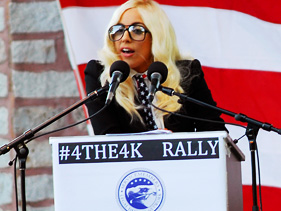
In spite of DADT vote stalling in Senate, supporters of repeal say Gaga’s tireless advocacy has garnered issue global recognition. By Gil Kaufman Lady Gaga speaks in in Portland, Maine on Monday Photo: Cliff Kucine/ Getty Images There are many different ways for celebrities to leverage their notoriety to help a cause. They can play a concert, write a check, make a PSA or, as in the case of actor Sean Penn, live in a meager tent in an earthquake-ravaged country for six months and run their own relief organization. But few stars have given as much in as short a time as Lady Gaga has to the cause of repealing the U.S. military’s “don’t ask, don’t tell” policy. “The reality is that on Saturday night we were looking at what we could do on Monday, knowing that even if we sent out an alert to our base of 80,000 supporters, we’d be talking to the same people,” said Trevor Thomas, spokesperson for the Servicemembers Legal Defense Network, a national organization dedicated to ending DADT. “We wanted to expand our reach and reach more people nationally and, more than anything, the two swing senators [in Maine] who could give us a chance.” The SLDN quickly hatched a plan to organize a rally in Maine on Monday in an attempt to get swing-vote Republican Senators Olympia Snowe and Susan Collins to possibly change their votes on the repeal. That’s where Lady Gaga came in. The pop icon had walked the white carpet at the VMAs with four SLDN members, shouted them out from the stage, turned her website over to the issue and posted public video pleas about the issue. When word came of this last-minute appeal, once again, she stepped up. According to Thomas, the singer finished a show in Raleigh, North Carolina, on Sunday night, hopped on a bus and took a 15-hour ride to Maine, personally writing her address on the way. “The dedication from her was amazing,” he said. “She wrote the speech, did the research and talked to people, and it did exactly what we need to do — highlight the issue to young people and others who might not have heard about this cause. But most importantly, we did it in this key area we needed it in.” The Gaga speech garnered massive local and national coverage for the issue, with stories in the Denver Post, USA Today and The New York Times, among others. “You can work for months to place one story in the Times’ print section, and even if politics prevail and we lose the vote, more people know about the DADT repeal than did yesterday,” Thomas said. And while Gaga’s mighty push to lock in the necessary votes didn’t save the day when the crucial Senate vote took place on Tuesday (September 21), Thomas said her help undoubtedly had a huge impact and put a global spotlight on the policy. From the night Gaga first spoke out on the repeal at the 2010 VMAs and redirected traffic from her official website to the SLDN site until 8 a.m. on Tuesday morning, Thomas said, 314,446 people clicked to the “take action” tab, which sent them to a site listing the phone numbers where U.S. senators could be reached about the vote. While it’s unknown how many of those clicks turned into actual phone calls, Thomas said he was “100 percent sure” that the site would not have gotten nearly that many visits without Gaga’s efforts. The total number of visitors was nearly four times the amount of supporters SLDN had gathered pre-Gaga, but Thomas pointed out an even more impressive number. During that same two-week period, the pages on the SLDN website with background information on DADT got 520,298 page views. In contrast, during the first two weeks of the month, the site had 13,000 visitors and 30,000 page views. “There are many people who are high-profile who speak out in a positive manner on LGBT issues,” Thomas said. “But the difference here is she asked, ‘What can I do?’ at a time when it was critically important for the passage of our bill. Not only did she say that, but she asked how and when to do it. When you look at the past couple of weeks, you see not just strategic tweets but the video address that hit days before the critical vote and which was driving many calls to the Senate switchboard. I don’t know of many entertainers who at the critical moment for a bill would stop their website and direct it to a ‘take action’ page for a relatively small group trying to push an issue crucially important to servicemembers and those who support them.” Before Tuesday’s vote, Jim Manley, a spokesman for Senate Majority Leader Harry Reid — the Nevada senator exchanged DADT-related tweets last week with Gaga — said the Democratic boss welcomed Mother Monster’s advocacy. “We appreciate the support of Lady Gaga and her supporters,” Manley said. “Sometimes that can have an impact, especially when you are as apparently committed as she is to the cause.” Even with all of Gaga’s work, CNN reported that both Collins and Snowe said Gaga’s appearance at Monday’s rally in Maine had no effect on their crucial votes; the final 56-43 tally helped ensure that the Senate would not open a DADT repeal discussion during its current session. Collins, in fact, supported the repeal, but told the network she felt she had to stay in line with her colleagues and vote against debate for procedural reasons. What do you think about Gaga’s efforts in the fight to repeal “don’t ask, don’t tell”? Share your thoughts in the comments! Related Videos Lady Gaga Rallies Against ‘Don’t Ask, Don’t Tell’ Related Artists Lady Gaga

Read more from the original source:
Did Lady Gaga Have Any Impact On ‘Don’t Ask, Don’t Tell’ Vote?

Rick Sanchez: Fox News ‘Essentially the Voice of the Republican Party’

On Tuesday’s Rick’s List, CNN’s Rick Sanchez again bashed Fox News and the conservative media, two of his favorite subjects of ire. Sanchez stated that President Obama was being “dogged” and blamed ” conservative talk radio hosts … lambasting this man 24/7 …. [and] Fox News, which is essentially the voice of the Republican Party, whose job it is to make this man look bad no matter what he does ” . The CNN anchor brought on political correspondent Jessica Yellin at the bottom of the 3 pm Eastern hour to discuss the President’s town hall meeting on Monday. After playing a clip of Velma Hart, an Obama supporter who bluntly told the chief executive that she was “exhausted of defending” him, Sanchez asked Yellin for her take on whether “others out there are thinking in many of the ways that she [Hart] expressed herself.” The liberal correspondent spouted the current administration talking point that “clearly, President Obama inherited this terrible economy and we’re still working our way out of it,” but continued that “the White House, at some point, has to be looking back and questioning their strategy both within Washington and their larger communication strategy outside, and how they’re messaging to the broader public. And it would seem that they’ve made crucial missteps on both fronts, and they have to take some blame for that.” Later, Yellin looked to the last Democratic president as a possible example for the current administration: YELLIN: [Y]ou’ve got to ask, is he messaging correctly? And, you know, with Bill Clinton out on the scene so much lately, it’s a reminder of how effective he is at hitting emotional chords, using anecdotes to help you relate to where he’s coming from, and help you understand his approach to policy. Whereas, President Obama tends to focus on these little examples or- you know, brass tacks sort of technician-type details of what he’s done, instead of giving you this overarching emotional frame. So you don’t end up connecting to it, and that’s one of the ways he seems to be misfiring on this message. Sanchez responded to this with his attack on his regular foes: SANCHEZ: All right- good stuff. It’s an interesting conversation, and I bet you it’s the kind of stuff that people are talking about. And then, of course, there’s the fact that- you know, he is dogged. There’s no question. You’d have to be a fool to not look at the landscape and see conservative talk radio hosts- YELLIN: Of course- SANCHEZ: Literally lambasting this man 24/7. And then, there’s Fox News, which is essentially the voice of the Republican Party, whose job it is to make this man look bad no matter what he does. So, you know, it’s a difficult thing that- YELLIN: Well, this is the time for political jujitsu. SANCHEZ: What’s that? YELLIN: It’s the time for political jujitsu. SANCHEZ: Yes (laughs)- YELLIN: You know, use it against them, right? So, effect- if he could do that- right. SANCHEZ: It all depends on how well he’s able to fight that. And, you know what? He’s got to do it, if he wants to survive in this, certainly up until November. Good conversation, Jessica. Exactly a year ago, on September 21, 2009, the anchor hinted that Fox News wasn’t a “real news organization,” and questioned his competitor’s legitimacy on August 2 of this year. On August 18 , Sanchez labeled Fox News ” way, way, way to the right ,” while putting his own network in the ” middle .” Earlier this summer, the CNN personality, along with guest Roland Martin, targeted Glenn Beck and Rush Limbaugh .

Link:
Rick Sanchez: Fox News ‘Essentially the Voice of the Republican Party’

Disgraced Governor-Turned CNN Host Spitzer Credits Liberals for Health Insurance Across State Lines Initiative

A governor forced to resign for patronizing call girls will probably have a hard time landing a job making pronouncements on politics, right? But there, on CNN, is former New York Gov. Eliot Spitzer.  Spitzer will co-host a show with pseudo-conservative Kathleen Parker called “Parker Spitzer,” which is set to debut on Oct. 4. But in the meantime, Spitzer has been making regular appearances on CNN programming to offer the liberal perspective on issues. On CNN’s Sept. 20 “Anderson Cooper 360,” that’s what he did, carrying water for the Democratic Party – even though his argument was factually leaky. In the wake of the GOP’s nomination of Christine O’Donnell as the Delaware candidate for U.S. Senate, Spitzer took on conservative talker and blogger Dana Loesch over what issues the Tea Party movement was really interested in taking a stand on – fiscal or social. Loesch argued that the movement isn’t just about opposing this Congress’ policy endeavors, but is also offering solutions, as was the case with ObamaCare. The Tea Party supporters may differ on some issues, leading to some vague positions, but, “I think that means for the amounts of issues, perhaps, when you get into social issues,” Loesch said. “But, for things like health care, the movement has been incredibly clear. Some of the things that they have put out are – let’s be able to buy insurance across state lines. Let’s – have health insurance companies compete. We’ve taken on everything from health care, to education, to foreign policy, and not just general.” And according to Loesch, the Democrats have offered a series of platitudes on these policy issues, which she claims they could have offered some more specifics. “I mean, we have isolated specific issues within the realm of each of these topics and we have gone at it,” Loesch continued. “When you talk about people being general, where we have seen people be general is from the Congress currently in Washington, D.C. We’ve seen broad generalizations on a number of different policies. We would actually like to see congressional Democrats be a little bit more – just be a little bit more precise with things.” Spitzer was in agreement over a policy point, but he wanted to credit the Democratic Party, which controls both chambers of Congress and the White House with an idea that it hasn’t been noted for championing, and that it was unable to implement. “Well, you know, because I’m always looking for points of agreement, I agree with you about the ability to purchase across state lines, competition across state lines,” Spitzer said. “Those have been perspectives taken primarily by the liberal wing of the Democratic Party and opposed by the Republican Party. So, if you want to ask, why…” However, it was the Republican Party that fought for the ability for consumers to purchase insurance across state lines. This had long been a policy point offered by the GOP, even at the height of the ObamaCare debate, as shown in a Feb. 25 post on the GOP House Conference blog . Spitzer’s erroneous assertion led to this back-and-forth with Loesch: LOESCH: That came out in the Patients’ Choice Act. SPITZER: … why that – why that has not been permitted… LOESCH: No. SPITZER: What do you mean? You can’t say no. Facts are facts. The reality is … LOESCH: Patients’ Choice Act – the fact is the Republicans came out with a Patients’ Choice Act. I have to correct you on that point. SPITZER: Talking over somebody isn’t going to change the facts. The reality is… LOESCH: Well, I had to point out the facts. SPITZER: … the opposition to interstate competition has come from the Republican Party. And that remains to be the case. A 2009 study showed that health insurance premiums would be reduced by 61 percent for Massachusetts residents if they were allowed to purchase insurance in North Carolina,  which, as the GOP conference blog pointed out, is something that could have easily been put into the Democrat’s health care reform legislation. And as Loesch explained, it was House Minority Whip Eric Cantor, R-Va., who was at the forefront of this push – not the “liberal wing of the Democratic Party,” as Spitzer claimed. “No. That is – that’s – that’s an error. That’s a factual error – Patients’ Choice Act. It came out. Eric Cantor, a number of congressional Republicans came out,” Loesch said. “And that was one of the main talking points, the patients’ bill of rights.”

Visit link:
Disgraced Governor-Turned CNN Host Spitzer Credits Liberals for Health Insurance Across State Lines Initiative

UNICEF: 100,000 Pakistan children face starvation

Suhani Bunglani fans flies away from her two baby girls as one sleeps motionless while the other stares without blinking at the roof of their tent, her empty belly bulging beneath a green flowered shirt. Their newborn sister already died on the ground inside this steamy shelter at just 4 days old, after the family's escape from violent floods that drowned a huge swath of Pakistan. Now the girls, ages 1 and 2, are slowly starving, with shriveled arms and legs as fragile as twigs. More than 100,000 children left homeless by Pakistan's floods are in danger of dying because they simply do not have enough to eat, according to UNICEF. Children already weak from living on too little food in poor rural areas before the floods are fighting to stay alive, as diarrhea, respiratory diseases and malaria attack their emaciated bodies. Doctors roaming the 100-degree camp that reeks of urine and animal manure have warned Bunglani three times to take her children to the hospital, or they will die. The mother says she knows they need help, but she cannot leave the tent without her husband's consent. She must stay until he returns, even if it means risking her daughters' lives. “I am waiting for my husband,” she says, still fanning flies from the sweating babies. “He is coming.” The floodwaters that swamped a section of Pakistan larger than Florida continue to inundate new areas, forcing even more people to flee. At least 18 million have already been affected, and nearly half of them are homeless. Many have been herded into crude, crowded camps or left to fend for themselves along roads. But doctors warn the real catastrophe is moving much slower than the murky water. About 105,000 kids younger than 5 at risk of dying from severe acute malnutrition over the next six months, the United Nations Children's Fund estimates. “You're seeing children who were probably very close to the brink of being malnourished and the emergency has just pushed them over the edge,” says Erin Boyd, a UNICEF emergency nutritionist working in southern Pakistan. “There's just not the capacity to treat this level of severe acute malnutrition.” cont. added by: JanforGore

Libertarian candidate Dr Mike Beitler offers to bring own mic/podium to U.S. Senate debate

After participating in the first two U.S. Senate candidate debates, Libertarian Mike Beitler is being snubbed by the N.C. Association of Broadcasters for the debates they are sponsoring in October 11 and 23. The Beitler campaign first learned about the debates in late August from media reports. A campaign spokesman said that the association did not respond to repeated telephone calls and e-mail messages regarding the debate. “We can only assume that the rumors are correct and that the NCAB is cash strapped and simply does not have the equipment necessary to host another candidate,” said Michael Shanklin, campaign manager. “Mike Beitler is willing to bring his own mic to this event. If necessary we will build our own podium as well.” Association president Tim Morrisey told the Associated Press that Beitler hadn’t been invited because surveys fail to show him with at least 10 percent support. According to sources, the debate criteria is based on only one poll, conducted by Elon University, which does not restrict itself to registered or likely voters. The sources said that Beitler might be included if he polls over 10 percent in a poll due out next week. Libertarian state chair Barbara Howe called the debate rules arbitrary and unfair, especially since most polls do not include the Libertarian candidate as one of their choices. “Often polling doesn’t even include the Libertarian candidate, so it’s impossible for a Libertarian candidate to poll any numbers at all,” she said. “It’s a disservice to the voters of North Carolina not to include all the ballot-qualified candidates.” It is unclear exactly which Elon poll the NCAB is using as a criteria for debate inclusion. Morrisey did not respond to a request for information. The most recent poll of U.S. Senate candidates on the university’s website was published March 22. Beitler was included, but his name was incorrect. The question asked respondents to rate all the candidates in the Democratic and Republican primary on a scale of one to ten. “The broadcasters association is not interested in informing the public,” Howe said. “It’s about protecting the interests of broadcasters.” Beitler will participate in a televised debate October 13 sponsored by the N.C. League of Women Voters. “We believe we’re being treated unfairly, but we are not surprised. Burr and Marshall are both worried about how many votes we are taking from them,” Beitler said. He said that if the association’s educational foundation, which is sponsoring the event, has tax-exempt status, they should lose it. “They are not educational, they are clearly political,” he said. In 2004, Howe filed a complaint with the FCC against WRAL-TV for failing to include her in a gubernatorial debate. The FCC has never issued a ruling. The 2008 Libertarian gubernatorial candidate Dr. Mike Munger was included in only one of the three televised debates in that campaign, which was also sponsored by the League of Women Voters. Both the Burr and Marshall campaigns have said they believe it’s unfair not to include Beitler in all the debates, but neither campaign is taking any action to support including the Libertarian candidate. http://www.examiner.com/libertarian-in-raleigh/libertarian-candidate-offers-to-b… added by: shanklinmike

SEIU Activist: Local Networks ‘Willing Partners’ in Campaign Against Wis. GOP Gubernatorial Candidate

Are the three news networks actively working to defeat the Republican candidate for Governor in Wisconsin? According to the far-left Service Employees International Union, yes, they most certainly are. SEIU spokesman John-david Morgan – also, incidentally, a former journalist – told a staffer  ( audio embedded below the fold ) for GOP gubernatorial candidate Scott Walker that local media affiliates for all three major networks were “willing partners” in the union’s efforts to defeat Walker. The staffer gave a fake name and recorded the conversation without Morgan’s knowledge. “They’ve really been willing partners in it,” Morgan told the staffer. “They come in with the TV cameras, and [channels] 58, 12 come, and 6 doesn’t always. But, yeah, they’ve been really helpful. They think it’s fun.” Channels 58 and 12 are Milwaukee’s CBS and ABC affiliates, respectively. “It’s not perfect,” Morgan added, but “they get our message across.” Indeed, Morgan apparently felt that some items from these outlets reinforced the SEIU’s anti-Walker campaign. Among the issues the union planned on hammering Walker for, according to Morgan, was a disaster at O’Donnell Park in Milwaukee, where a parking garage collapsed over the summer, killing a 15-year-old boy. Morgan apparently approved of the local CBS station’s coverage of the fallout over the accident. He posted a story from the outlet on his Facebook page, as seen in the screenshot below:   Morgan also mentioned channel 4, the local NBC station, for its coverage of inspections of state facilities, which the SEIU hopes to use as the basis of an attack campaign against Walker. According to a transcript of the exchange, Morgan described the union’s tactics – and the media’s role in it – thusly: Yeah, you know, like, when we did the people’s building inspection, we went around to a bunch of buildings where we know stuff is falling apart. Scott Walker has neglected these buildings, and he keeps putting repairs off because he, you know, won’t fix anything. So, you know, they poked fun at us a little bit for having like a phony report card. It’s like whatever, but then they said, “But the group does have a point – a piece fell off the courthouse in May.” And sure enough, a search through channel 4’s website reveals a story from August 19 on the SEIU’s fake “report card” on the state of public facilities. The piece regurgitates a number of claims from union, and one attack from a county supervisor who joined the SEIU in its sham “inspections.” “I think that people should beware of the dishonest budgeting of Scott Walker,” said Democratic county supervisor Chris Larson, whose party affiliation is not mentioned in the piece. I contacted Morgan via Facebook and asked him to elaborate on his “willing partners” comment. At first, he said that he was only expressing his appreciation for “all the hard work that broadcast journalists did covering our events.” When I asked about the disconnect between that claim and the numerous comments he made in his recorded coversation suggesting more than a simple third-party-observation role on the part of the news media, Morgan refused to comment any further. He instead referred me to the transcript of the exchange, in which he said “my meaning is best reflected.” None of the three networks’ local affiliates returned requests for comment by deadline. The Wisconsin Democratic Party, Walker’s oppoenent’s campaign, and SEIU Local 1 also did not respond to such requests. But the Wisconsin Republican Party – to whom the Walker campaign directed a press inquiry – was happy to offer its views on media coverage of the race in a phone conversation. I asked whether the party thinks the media is in fact aiding the SEIU campaign against Walker. Wisconsin GOP spokesman Andrew Welhouse told me: I think that the only voice that you really need to hear is the SEIU’s. I think that the fact that the said something so blatantly – I mean, it’s their words, not ours. They’re the ones that are saying “these guys are in the tank for us.” I can’t imagine that he would say something like that if he didn’t have anything to back it up – a feeling that they were all going with. Asked whether media bias has been a significant problem in the campaign, Welhouse stated: What people see on TV and what people read in the newspaper goes a long way in determining how they perceive their elected officials as representing them, and it goes a long way in how they perceive new people coming on the scene. People know there’s a difference between paid advertising and what they read in the news and what they see in the media, and if there’s an ongoing perception that the media is biased or stilted one way or the other, that’s a big problem. And for the other side to so blatantly say, “we’ve got these guys in our camp,” that’s not only a problem for one party saying one thing and the other party saying another thing and there being a campaign between two different sides, but that’s a real problem for people who see the news media as an unbiased source of information. Though none of the media outlets in question returned requests for comment, it seems safe to assume that they would deny any official collaboration with the SEIU. But the fact that the media in question were so eager to cover events in a manner friendly to a group as far to the left as the SEIU implies a convergence either of political ideology, if not political objectives. Even if the media are not actively working with Democratic shock troops, they apparently share a sense of what is news – in this case, events damaging to the Republican gubernatorial candidate. The bottom line is Morgan’s admission raises serious ethical concerns beyond political bias. The news media can have a dramatic impact on elections, since they proclaim themselves wholly objective and non-partisan. This revelation may belie that claim – at least in Milwaukee.

Continued here:
SEIU Activist: Local Networks ‘Willing Partners’ in Campaign Against Wis. GOP Gubernatorial Candidate

Golden Retriever Puppies eat boy ALIVE

Will nothing stop these cute and dangerous puppies from eating people or causing death from cuteness overload. added by: Mcellie

Republican Senator Richard Burr….The Big Government Corporatist!

Although this article excludes a ballot candidate, Libertarian Dr Mike Beitler. Who recently polled 10% and is making HUGE splashes in North Carolina: http://www.publicpolicypolling.com/pdf/PPP_Release_NC_706.pdf I still think it does a great job pointing out the corporatism that is inherent in our political system. What is worse, is most people don't realize how voting for their red and blue teams actually perpetuates and is a continuation of this corporate socialism process. BY ROB CHRISTENSEN AND DAVID RAYNOR – Staff writers Former New York Mayor Rudy Giuliani was the star attraction at Shelly's Backroom, a scotch and cigar bar in downtown Washington, but the beneficiary was Republican Sen. Richard Burr. The reception last year attracted representatives from a cross section of corporate America: Fidelity Investments, TIAA-CREF, Ameriprise Financial, Hospital Corp. of America, Bayer, Murphy Oil and the American Chemistry Council. Each plunked down up to $2,500 for Burr's re-election kitty, campaign finance records show. Such events, repeated dozens of times since he took office in the Senate in 2005, demonstrate his clout both in business and in Washington, helping him amass a $9.1 million campaign war chest. Quantcast Burr heads into the fall campaign with a commanding financial advantage over his Democratic challenger, Secretary of State Elaine Marshall, having raised nine times as much as she. Even more striking, Burr had $6.2 million on hand compared to $163,195 for Marshall as of June 30, the last time the candidates were required to disclose campaign finances. Burr's campaign has been bankrolled largely by the business community. His donor list reads like a Dow Jones ticker. No member of Congress during this election cycle has received more money than Burr from individuals and political action committees affiliated with pharmaceutical companies, tobacco companies, business associations, foreign import automobile dealers, dentists and steel producers, according to the nonpartisan Center for Responsive Politics, which tracks congressional fundraising. Burr has received the second-highest amount of political donations of any member of Congress from the insurance industry, according to the center, and he's among the leading recipients of money from commercial banks, agribusiness and electric utilities. 'A level of trust' Burr said it was only natural for North Carolina's major industries to support him because he understands their issues. “There is a level of trust,” he said in a recent interview. Burr, who was a Winston-Salem sales executive for a wholesaler before entering politics, pointed out that his donations reflect North Carolina's workplace. “We are a state that is one of the largest manufacturers of pharmaceutical products and also a state of steel manufacturers,” he said, adding that political action committee donations “are a reflection of employee contributions on behalf of their company and their industry.” But Marshall has sought to portray Burr as a Washington insider and a tool of special interests during his 10 years in the House and nearly six years in the Senate. “He … has been there for 16 years,” Marshall said in an interview. “He has taken their contributions. He is beholden to them. He bailed out the Wall Street banks. He turned his back on hardworking North Carolinians.” Some of the most influential K Street lobbying firms hosted D.C. fundraisers for Burr's re-election campaign, according to invitations obtained by the Sunlight Foundation, a Washington nonprofit group that seeks to increase transparency in government. McBee Strategic Group and the BGR Group, both high-powered lobbying firms, even held fundraisers at their downtown Washington offices. Akin Gump Strauss Hauer & Feld held a reception at a D.C. steakhouse, and the Podesta Group hosted a breakfast at the Capitol Hill Club. Burr has been a key ally of business since his election to the U.S. House in 1994. That continued with his election to the Senate 10 years later. In his 2004 Senate race, he held at least 80 Washington fundraisers. This weekend, Burr was scheduled to hold a golf fundraiser at Pine Needles Lodge and Golf Course at Southern Pines at a cost of $1,500 for individuals and $2,500 for a PAC. Marshall, who has been secretary of state since 1996, has long had a reputation as an indifferent fundraiser, and her Senate campaign has done nothing to change that view. North Carolina trial lawyers, who contributed $73,000, are the only major identifiable group of Marshall donors, Federal Election Commission records say. But outside groups have helped her indirectly. Labor, environmental and liberal groups such as MoveOn.org, though not contributing to Marshall's campaign, have financed hundreds of thousands of dollars of anti-Burr TV commercials this summer. His total not unusual Although Burr's $9.1 million haul dwarfs Marshall's donations, the total is not extraordinary. Fifteen Senate candidates raised more than Burr in this election, led by Sen. John McCain with $26.7 million. In the 2008 Senate campaign in North Carolina, Republican Sen. Elizabeth Dole raised $17.4 million, compared with $8.9 million for her Democratic challenger, Kay Hagan. Burr's fundraising patterns are typical of most senators', said Dave Levinthal, a spokesman for the Center for Responsive Politics. “He is acting like a senator,” Levinthal said. “The system is set up so that the big money is in a few power centers. If you want to tap the big money, you go to D.C. or New York.” What's notable about Burr's fundraising, Levinthal said, is that 72 percent of his contributions came from North Carolina – a healthy slice of home-state gifts for a senator. He also noted that Burr's largest contributors tended to be major North Carolina employers such as Reynolds American, the Winston-Salem cigarette manufacturer, plus the Raleigh law firm Womble Carlyle and Charlotte-based Duke Energy. Burr has gone beyond the $9.1 million for his re-election campaign. He also pulled in $1.1 million for the Richard Burr Victory 2010 Committee to help the Republican Party get out the vote this fall. And he raised $379,496 for his Next Century Fund, which went to other congressional candidates. In April last year, the U.S. Chamber of Commerce raised about $43,000 for Burr from companies such as Wal-Mart Stores, Time-Warner, Duke Energy and Progress Energy. The chamber gave him a 100 percent rating in 2008 and an 87 percent rating in 2009. He votes for business “Sen. Burr has been a reliable vote for the business community on issues that create jobs,” said J.P. Fielder, a chamber spokesman. Burr voted with the chamber in opposing the Democrats' health care plan and opposing the Lily Ledbetter Pay Act to extend the period when discrimination claims can be made. He also voted against giving bankruptcy judges more authority to modify existing home mortgages, voting with the industry. Burr Health Professionals $428,229 Lawyers/law firms $411,799 Pharmaceuticals/ health products $398,733 Insurance $308,160 Lobbyists $297,843 Leadership PACs $279,818 Electric Utilities $269,425 Securities and investments $240,050 Real estate $229,700 Commercial Banks $212,682 Marshall Lawyers/law firms $166,555 Democratic/liberal groups $52,260 Women's issue groups $25,550 Educators $17,207 Tobacco $15,650 Health professionals $15,460 Real estate $15,050 Securities and investments $10,100 Industrial unions $10,000 Leadership PACs $10,000 Dr Mike Beitler ZERO DOLLARS IN SPECIAL INTEREST LOBBYIST FUNDS/Political Action Committees! Source: Center for Responsive Politics http://www.newsobserver.com/2010/09/19/690312/business-bolsters-burr-and-vice.ht… added by: shanklinmike

Democrats Worried Jon Stewart Rally Will Hurt Them On Election Day

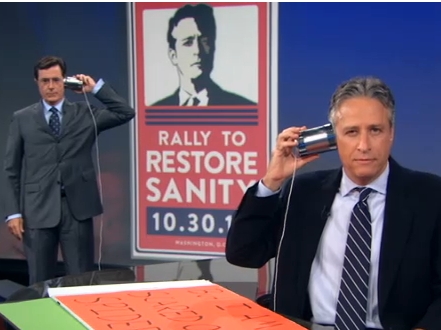
Although the media took last week’s announcement of comedian Jon Stewart’s “Rally to Restore Sanity” like it was manna falling from heaven, some Democrats are concerned it could hurt them in the upcoming midterm elections. Scheduling such an event on the Saturday before Election Day, when field operatives should be diligently working on Get Out The Vote efforts in their districts, could be tremendously counterproductive. On the other hand, as Politico’s Ben Smith noted Monday, there’s already a big Democrat rally planned in October: Stewart hasn’t mentioned that labor groups and other institutional Democratic organizations are already planning a big Washington rally to counter Beck: The One America rally on October 2, which has been struggling to get the kind of attention Beck does. “Midterm elections are about turnout and as has widely been reported, there is an intensity gap in this election, with the Republican base more motivated than the Democrats’. Some of that gap can be closed with an aggressive ground campaign — we can make up 2-3% in a given race by talking to people at their doors and on their phones,” emails veteran labor Democratic consultant Steve Rosenthal. “I love Jon Stewart — rarely miss the show, but to the extent that some people who will attend his rally would otherwise be involved in GOTV efforts this is not helpful.” Nation editor Chris Hayes e-mailed Smith: First: It’s hard to imagine lots of democratic [sic] politicians showing up to a left equivalent of Glenn Beck’s rally (and I wonder how many will be at the *actual* progressive march on October 2nd), but more than that is [sic] puts our current ideological predicament in stark terms. On the right, a large, well-funded, organized, ideologically zealous movement dedicated to a genuinely reactionary vision of America. On the other side? A very gifted satirist calling for everyone to just chill. If I landed here from Mars and took this in and was asked to bet on who’s going to have more political success, it would be a no-brainer. Something else lost in the discussion is that this event is scheduled for the day before Halloween.  Makes you wonder what kind of anti-GOP costumes will be on display and how that will go counter to the “million moderates march” motif. Think about all the George W. Bush, Sarah Palin, Rush Limbaugh, Glenn Beck, and Sean Hannity dolls likely to be burned in effigy in our nation’s capital as organizers futilely ask, “Can’t we all just get along?” Doesn’t present a picture of sanity , does it? Of course, with two liberal Clintonistas involved in putting this event together, they’ll likely have folks patrolling the crowd to control such imagery. Nobody’s better at falsely presenting a “moderate” persona than a former member of that administration.

See the original post here:
Democrats Worried Jon Stewart Rally Will Hurt Them On Election Day