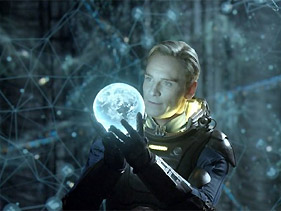
If you’re gearing up to see Ridley Scott’s sci-fi flick for the first time, make sure you’re well-versed in its extraterrestrial lingo. By Kevin P. Sullivan Michael Fassbender in “Prometheus” Photo: If you’re headed out to theaters this weekend to see Ridley Scott ‘s ” Prometheus ,” there are two likely explanations: You’ve been hounded by your friends who have already seen it with theories and a need for discussion or you’re one of those friends and need to see it again. Either way, “Prometheus” is a dense movie filled with symbolism, call-backs to the original “Alien,” and mysteries with elliptical answers, so it might be best to go into the theater with a bit of a primer for what’s about to happen. Whether you’re new to “Prometheus” or you’re very familiar with the work of Weyland Industries, here are some things to consider before heading into the theater. There are no major spoilers here, but if you want to go into “Prometheus” completely fresh, you should probably stop reading. Prometheus : The titan who molded man from clay and gave them fire, which he stole from the gods. As punishment, an eagle repeatedly ate his liver, which regenerated daily. Weyland Industries : The corporation that funds the mission in “Prometheus,” creators of the David 8 android, and antecedent to the Weyland-Yutani Corporation from the “Alien” films. Peter Weyland : Founder of Weyland Industries, played by Guy Pearce. David 8 : An android programmed to assist human life and understand human emotions. He is played by Michael Fassbender in “Prometheus.” Xenomorph : This classic creature from “Alien” bleeds a corrosive acid. It is “a survivor… unclouded by conscience, remorse, or delusions of morality.” The perfect organism. Space Jockey : An enormous, dead humanoid found at the beginning of “Alien” with his chest burst open, surrounded by xenomorph eggs. Facehugger : A developmental stage of the classic “Alien” xenomorph. This creature attaches itself to a host’s face and deposits an embryo in his or her stomach. Chestburster : The phase after facehugger. Once an embryo fully develops, it will exit its host through the abdomen. “Lawrence of Arabia” : The 1962 David Lean film starring Peter O’Toole as T.E. Lawrence. This film appears in “Prometheus” and is the origin of such quotes as “Big things have small beginnings,” “There is nothing in the desert and no man needs nothing,” and “The trick, William Potter, is not minding that it hurts.” LV223 : An Earth-like moon where scientists travel to in “Prometheus” after finding star maps on several prehistoric drawings. LV426 : An inhospitable planetoid where the crew of the Nostromo encounter the Space Jockey and the xenomorph eggs. Check out everything we’ve got on “Prometheus.” For breaking news, celebrity columns, humor and more — updated around the clock — visit MTVMoviesBlog.com .
Bachelorette director Leslye Headland and Radius co-head Tom Quinn. Bachelorette was dubbed the “indie Bridesmaids ” at Sundance. OK, maybe there are some similarities. There are females and there’s a pending wedding and the proverbial “shit hits the fan,” but that’s about it. Based on a play of the same name by Leslye Headland who directed the screen version, the story is quite frankly not going to be a hit with everyone. But for the segment of the population that gets a thrill off of bad ass humor, Bachelorette offers up a load of laughs. John Waters appeared to enjoy himself at the screening of the film, which opened up the Provincetown International Film Festival this week, so that is a stamp of some sort of approval, right? “It was incredible to see it with that audience. There’s something about the [crowd] here that has the exact correct taste for this movie,” Leslye Headland said to ML with a big smile and laughs at the festival. “To have an audience that’s on the same page from the opening jokes right on through the final scenes was great. They accepted these characters. It wasn’t just affirmation with their laughter, but there was good will toward them too.” Starring a rabble rousing Kirsten Dunst, Isla Fisher and Lizzy Caplan, the trio hit New York to help their friend Becky (Rebel Wilson) prepare for her wedding. But these women are anything but prissy debutantes. Booze, drugs, blow jobs, foul mouths – it’s all there and it keeps coming for more. Becky is the only one who seems to have cleaned up her act, and the bad ass trio get into more trouble when they accidentally tear the wedding dress the night before the ceremony. “Kirsten, Isla and Lizzy never thought they should tone down their characters,” offered Headland. “They even improved stuff where where even I didn’t know if we could use some of the things they did. When you watch it, you can see that they’re having fun. I think they were excited to play women they had never met before.” Headland made the Black List for her script back in 2008, but had to go the independent route when studios shied away from the material Bachelorette had played off-Broadway and she was encouraged by a friend to make the screen version her way. “The idea was that could I make a romantic comedy that I would want to see. It’s not overly dire, but it’s dramatic and they’re acting like people. They’re making mistakes and they’re learning from them…” she said. “I wanted to make a film about women that treated them like people and not paper dolls that act all in the way we wish we acted.” The Weinstein Company’s new label Radius picked up the film after it debuted at Sundance. The film has since been re-edited and its pace is absolute killer. The earlier version was more melancholy and the moments of hilarity were buffered with some slow parts. But the version that is presumably the final one that will be released in theaters in early fall had the audience in stitches here in Provincetown. Still there are dissenters and Headland said she expects there to be people who won’t like it. “I’d be more worried if there was [indifferent] reaction to it,” she said. The women in this film are dealing with their inner-demons and resolution does not come in the course of one day as it might in other movies. Noted Headland: “People don’t change in one night, but one night can change people.”
With the world premiere of Woody Allen’s latest under its belt, the Los Angeles Film Festival is now ready to get truly underway with its lineup of premieres, parties, panels and more celebrity guests. Movieline is doing its part to get audiences in the mood, giving sneaks on many of the titles appearing in the festival’s Narrative and Documentary competitions with comments from the real stars at the ten day event – the filmmakers. Yesterday , ML published its first round of filmmaker interviews and trailers screening in the tests competition and several more are featured today. Call Me Kuchu , directed by Katherine Fairfax Wright, Malika Zouhali-Worrall [Documentary Competition] Synopsis: To be openly gay in Uganda is to risk imprisonment and death. The stirring and heartbreaking Call Me Kuchu exposes the horrors of a homophobic government — its hatred fueled by right wing American evangelicals — that terrorizes the LGBT community. Yet brave men and women like David Kato, the country’s first openly gay activist, have fought back at great risk. This intimate and impassioned documentary takes us inside this life and death struggle for human rights. Whether you are familiar with Katos’s story or hearing it for the first time, you will find this a shattering and inspiring testament. [Courtesy of Los Angeles Film Festival] Responses by Katherine Fairfax Wright and Malika Zouhali-Worrall: Wright and Zouhali-Worrall’s take on the film: In Uganda, a proposed Anti-Homosexuality Bill threatens to make homosexuality punishable by death. David Kato – Uganda’s first openly gay man – and his fellow activists work against the clock to defeat the legislation while combatting vicious persecution in their daily lives. But no one is prepared for the brutal murder that shakes their movement to its core and sends shock waves around the world. And why audiences should check out Call Me Kuchu at the LA Film Festival: Call Me Kuchu is an intimate portrait of a courageous man determined to bring an end to the discriminatory status quo in his country. In depicting the last year in his life, the film introduces the viewer to the David Kato we knew, and David Kato as he saw himself, before he was so suddenly and tragically murdered. The film also sheds light on the stark parallels between the situation for LGBT communities in both Uganda and the United States, illustrating not only the role of American evangelicals in the now notorious Ugandan Anti-Homosexuality Bill, but also what can transpire in a democracy when fundamental human rights are left up to a popular vote. Realizing how the story came together… During our initial shoot, David mostly played the role of fixer, advising us on whom to contact and diligently introducing us to a multitude of his friends and colleagues in the LGBT, or “kuchu” community. It wasn’t until we got home from that first shoot, and began to really comb through the footage and story-lines, that we realized that the man known as the “grandfather of the kuchus” was indeed one of the most outspoken and inspired activists in East Africa, and hugely charismatic to boot. It soon became clear that he was the protagonist of Call Me Kuchu . …and comments on the trailer: Over recent years, the vast majority of the international news coverage about the LGBT community in Uganda has been based on a narrative of victimization. During our first shoot, we learned that this was only half the story–so we decided to make a film that goes further: a nuanced narrative that shows David and Kampala’s kuchus boldly working to change their fate, and that of other kuchus across Africa. — Sun Kissed , directed by Adi Lavy and Maya Stark [Documentary Competition] Synopsis: With remarkable strength of spirit, a husband and wife examine their lives as they search for answers as to why their children and others in their small Navajo reservation have been stricken with XP, an extremely rare pediatric disorder that turns sunlight into a deadly foe. Crafting a sensitive, intricate film that organically expands beyond the tragedy of one family to encompass the story of an entire community, directors Maya Stark and Adi Lavy unearth familial taboos, a disturbing history of forced migration and a cultural belief system of cosmic karma in this powerful documentary. [Courtesy of Los Angeles Film Festival] Responses by Adi Lavy and Maya Stark: And they give their take on Sun Kissed : Sun Kissed is a film about a life-changing journey of rediscovery. When a Navajo couple learns that their children have a disorder that makes exposure to sunlight fatal, they find out that their reservation is a hotbed for this rare genetic disease and they go on a journey to find out why. On that journey, they confront cultural taboos, tribal history and their own unconventional choices to learn the shocking truth: The consequences of the Navajos’ “Long Walk” — their forced relocation by the U.S. military in 1864 — are far from over. Ultimately their children’s rare genetic disorders sets them off on a journey that makes them redefine who they are as modern day Navajos. Why audiences should check out Sun Kissed at the LA Film Festival: There is nothing else like Sun Kissed at LAFF, because it is a story that has never been told before with rare access to the Navajo community that is otherwise very suspicious of outsiders. It combines verite scenes with a level of intimacy that only few docs have reached, and unravels like a classical mystery with one unsolved question – why are all these Navajo kids born with this mysterious genetic disorder. We believe that the film’s message is very important when the world is becoming less tolerant to minorities and to the “others.” Even though Sun Kissed is an all American story, this film serve as a cautionary tale of what happens when we try to colonize and assimilate another group of people. Few of us ever realize that 150 years later, people are still dealing with the effects of what we have done. In that sense, Dorey and Yolanda’s intimate tale embodies the larger story of their tribe. We hope that this important and compelling story will be as impactful for audiences as it has been for us. Some tales from making the film… After two years of filming the movie, when Dorey and Yolanda had finally met other XP families on the Reservation and discovered there might be a connection to the Long Walk, we found ourselves confronted by forces that didn’t want us to make this film. The taboo surrounding any discussion of the Long Walk was so great, that we were stonewalled by members of the community and almost gave up on the project. As outsiders to the Navajo community we wanted to be respectful of their culture. We realized that it wasn’t our place to move forward with the story and decided to pack up and go home, until Dorey and Yolanda asked us not to give up on their story. They realized how deeply they had internalized the Western narrative about the Long Walk, and wanted to finally understand what had happened there from their point of view. It was then that we realized how important this story is, and we found the strength and justification to push forward with Dorey and Yolanda as they went up against the silence and taboos. The very process of making the movie showed what they were up against in their quest for answers. As we continued shooting, several members of the Navajo community came forward and championed the cause, believing that these controversial issues should be talked about and dealt with. That’s what’s beginning to happen on the Reservation today. Some thoughts on the trailer: We tried to find the delicate balance between telling enough of the story of Sun Kissed and intriguing audiences but not revealing too much of Dorey and Yolanda’s journey. Because Sun Kissed is a journey of discovery, we did not want to create one big spoiler but we wanted to give enough information so that audiences will understand that there is more to this film than children with a rare genetic disorder. What the trailer tips off is that it’s a story that starts with a search for the origin of a single gene and quickly unravels to explore the larger narrative of a nation impacted – culturally, religiously and physically – by historical events. — Breakfast With Curtis , directed by Laura Colella [Narrative Competition] Synopsis: Over the course of a balmy east coast summer, an introverted, bespectacled teenager is brought into the strange and delightful world of his bohemian neighbors. What unfolds, against the backdrop of lush flowerbeds and overgrown vegetable patches, is a mirthful story of unlikely and rekindled friendships. But for all of its wine-soaked, pot-infused dreaminess, Breakfast is firmly rooted in reality. The rambling purple house where the action happens is writer/director/co-star Laura Colella’s, and her captivating cast is composed of her very own housemates and neighbors.Despite the homespun approach and unfettered narrative, Colella’s smartly written, tightly directed tale has a distinct vision and clear intention, one joyously devoted to the pleasure principle. [Courtesy of Los Angeles Film Festival] Responses by Laura Colella: Colella gives her take on the film: A troubled 14 year-old’s life is shifted in a new direction by his neighbor, a bookseller who has delusions of grandeur fueled by red wine. It’s about the experience of having a seminal summer that rocks your world, and also about letting go of old grudges. And why people should check Breakfast with Curtis out at the LA Film Festival: It’s very fun and unique. Many early viewers have said they want to keep spending time with the people in the movie, and come hang out where we filmed it (at my house)! Also, anyone who comes to our world premiere on 6/17 is invited to the after-party! Some quick anecdotes from the set: I made this film with my neighbors, who are all great actors (and characters). We would shoot for only a few hours a day, and the budget was so low that I didn’t provide any craft services, and people would just go home if they needed a drink or snack. — Birth Story: Ina May Gaskin and The Farm Midwives , directed by Sara Lamm and Mary Wigmore [Documentary Competition] Synopsis: In the early 1970s, Ina May Gaskin and the courageous Midwives of the Farm commune inspired the modern midwifery movement. Today, their efforts continue at the Farm Clinic and across the country, working against an ever-growing hospital culture of intervention and C-section births. Revealing the Midwives’ stories with intelligence and wit, directors Sara Lamm and Mary Wigmore weave extensive archival footage, enlightening interviews and contemporary stories into a beguiling document of past and present. Through Ina May and the Midwives, Lamm and Wigmore portray childbirth in empowering and thrilling ways we’ve never seen before. The result is not just an illuminating documentary, but a joyful rallying call to see humanity through a new lens. [Courtesy of Los Angeles Film Festival] Responses by Sara Lamm and Mary Wigmore: The directors give their take on Birth Story : Birth Story is about an incredible group of women who taught themselves how to deliver babies on a hippie commune in the 1970s. It’s sweet, funny, educational, and it honors women’s leadership and women’s bodies in a time when both are under political attack in our country. Plus, the film features original music by Fleet Foxes front man, Robin Pecknold. …And why audiences should check it out at the LA Film Festival: This film is about community, and about how much we can accomplish when we work together, so we expect the experience of seeing it in the shared space of a theater will be very special. Also, this movie may show the only breech birth in the history of cinema. (Note to film historians: is that true?) Watching that scene in the company of two hundred people will be something to remember forever. Tales from the shoot: Besides our own birth experiences, before making this film we had never seen a baby being born. And so, after a week of waiting around in Nashville for one of our subjects to go into labor, we were impressed with how much dedication it takes for midwives, doulas, and doctors to be on call all the time. And, just at the point where we thought we couldn’t take the suspense any longer, dear Heather went into labor. Once we were at her house, and the Christmas tree was on, and her mother was making cookies, we just couldn’t believe how beautiful and simple it all was. Then, when she pushed her baby out, we were blown away–she was calm and beautiful in labor (just like Ina May says women should be). What also struck us was the camaraderie between Ina May, the newest Farm Midwife Stacie Smith-Hunt, and Heather’s mother, who was a labor and delivery nurse for many years. A lightbulb went off for us–ah, its hard being on call, but wow birth is not only sacred, but when everything goes well, its also a lot of FUN. Afterwards, even though it was 2 in the morning, we had so much energy that we went to a bar and drank two beers. Some thoughts on the clip: In this clip, Ina May and the other Farm Midwives talk about the writing of their famous 1976 book, Spiritual Midwifery–it’s a collection of birth stories and an educational manual that’s had a huge impact on women all over the world. For nearly forty years now, women have passed it along to their newly pregnant friends who in turn give it to their newly pregnant friends. (In fact, friends passed the book on to us when we were each pregnant, and that’s how we became interested in making this movie.) We think the book has had such a long life because it’s one of the only things out there that encourages a reader to think of birth as a beautiful, positive, empowering experience. Read more of Movieline’s coverage of the LA Film Festival here.
Director Adam Shankman explains how ’80s icons like Sebastian Bach and Debbie Gibson ended up in the movie musical. By Amy Wilkinson Julianne Hough and Diego Boneta in “Rock of Ages” Photo: The ’80s are alive and well in director Adam Shankman’s movie musical ” Rock of Ages ,” which shimmied into theaters Friday (June 15). Based on the hit Broadway production of the same name, the flick follows would-be musician Drew Boley (Diego Boneta) as he falls for new-in-town Sherrie Christian (Julianne Hough) and lands his big break opening for rock legend Stacee Jaxx (Tom Cruise) at the famed Bourbon Room. The soundtrack is stuffed with the era’s biggest hits like “Every Rose Has Its Thorn,” “Don’t Stop Believin’ ” and “I Want to Know What Love Is,” but the toe-tapping tunes aren’t the only throwbacks to the decade of decadence. Pay close attention and you’ll spot a number of ’80s music mavens. A major plotline in the film centers around conservative advocate Patricia Whitmore’s (Catherine Zeta-Jones) attempt to shutter the Bourbon Room and reclaim the Sunset Strip for more wholesome pursuits. The struggle reaches its climax in a rocking protest outside the club with Patricia and company facing off against club employee Lonny (Russell Brand) while singing a mash-up of “We Built This City” and “We’re Not Gonna Take It.” It’s here among the assembled masses that you’ll recognize a few familiar faces, like Skid Row’s Sebastian Bach and Debbie Gibson. But how did the cameos come to be? “I had said if anyone from the period wants to participate, there is a scene I’m happy to accommodate, ’cause it just felt right. … So the studio just kind of put out the word, and that’s what happened,” Shankman said. “I would get the phone call the day before going, ‘This is who’s coming tomorrow,’ and I’m like, ‘Seriously?!’ ” Having a bevy of rock stars on a single set might sound like a nightmare of warring egos and AquaNet, but in fact, Shankman said the stars sang for their supper, staging an impromptu concert. “The greatest part of having those guys — [REO Speedwagon’s] Kevin Cronin, [Extreme’s] Nuno Bettencourt and Sebastian — all of them, our lunch that night was at 3:30 in the morning, and during lunch for the whole crew, they did a whole concert, and they sang all the songs.” Now that’s a scene we want to see on the DVD bonus reel! Check out everything we’ve got on “Rock of Ages.” For breaking news, celebrity columns, humor and more — updated around the clock — visit MTVMoviesBlog.com . Related Videos MTV Rough Cut: ‘Rock Of Ages’
Maroon 5 frontman and ‘Voice’ judge set to star alongside Keira Knightley in the film, executive-produced by Judd Apatow. By Kara Warner Adam Levine Photo: Adam Levine is proving to be quite the multi-tasker. In addition to an already busy schedule that includes juggling Maroon 5 frontman duties and judging “The Voice,” Levine is reportedly set to make his big-screen debut in the music-themed, possibly romantic drama “Can a Song Save Your Life?” According to Deadline , Levine will star alongside Keira Knightley, Mark Ruffalo and Hailee Steinfeld. The film reportedly revolves around an aspiring singer (Knightley) who moves to New York with her boyfriend and fellow aspiring musician (Levine) so they can both pursue their music careers. Levine’s character breaks up with Knightley soon after their arrival to pursue a solo recording contract, leaving Knightley on her own to be discovered by a “down-on-his-luck” record producer (Ruffalo) while singing at a local bar. The film will be directed by John Carney (“Once”) and executive-produced by Judd Apatow. The role will be Levine’s first in film, in addition to having already picked up a recurring role on FX’s soapy and creepy noir “American Horror Story.” Levine will play one-half of a couple known as “the Lovers,” but that’s about all we know. “It is the truth,” Levine confirmed to E! News recently about the “Horror” gig. “I mean, it’s pretty much happening. I think it’s happening. I don’t know how much I can divulge, because [series co-creator] Ryan [Murphy] is very under wraps. It’s going to be fun. And I told [Murphy] I really didn’t know what I was doing, but he didn’t seem to really care,” Levine continued. “So I’m just going to go and try to [do] acting. I think I’m going to be kind of playing myself, so hopefully it will be easy.” No word yet on a production start date for “Can a Song Save Your Life?” or the second season of “Horror Story.” Levine is currently on tour with Maroon 5 and will return to his judging duties on “The Voice” this fall. For breaking news, celebrity columns, humor and more — updated around the clock — visit MTVMoviesBlog.com . Related Artists Adam Levine
A word of warning: if you’re already feeling kind of grumpy, this is really going to piss you off. So the topless scene that Jennifer Aniston had removed from Wanderlust (2011) wasn’t completely left on the cutting room floor. It does appear on a Blu-ray special feature, the ” bizarro cut ” of the film, which producer-writers David Wain and Ken Marino describe as ” alternate lines, jokes, deleted scenes, outtakes… stuff that was too silly, too absurd ” (or too nude, as the case may be) to make it into the final film. But even if you hold your nose and get the Blu-ray, you’re still not going to get to see JenAn’s jugs. As the scene begins, we get full frontal from a pair of hippie extras (above), but when the big moment finally arrives and Jen steps forward to reveal her topless glory, a big black head pops up and covers her boobs as an off-screen voice yells, “Down in front!” By the time the “head” moves out of the way, the boobs are gone. Ha ha, guys. Very funny. See stills of the crime against boob-manity that is Wanderlust (2011) after the jump!
A word of warning: if you’re already feeling kind of grumpy, this is really going to piss you off. So the topless scene that Jennifer Aniston had removed from Wanderlust (2011) wasn’t completely left on the cutting room floor. It does appear on a Blu-ray special feature, the ” bizarro cut ” of the film, which producer-writers David Wain and Ken Marino describe as ” alternate lines, jokes, deleted scenes, outtakes… stuff that was too silly, too absurd ” (or too nude, as the case may be) to make it into the final film. But even if you hold your nose and get the Blu-ray, you’re still not going to get to see JenAn’s jugs. As the scene begins, we get full frontal from a pair of hippie extras (above), but when the big moment finally arrives and Jen steps forward to reveal her topless glory, a big black head pops up and covers her boobs as an off-screen voice yells, “Down in front!” By the time the “head” moves out of the way, the boobs are gone. Ha ha, guys. Very funny. See stills of the crime against boob-manity that is Wanderlust (2011) after the jump!
To say that That’s My Boy is a step up from the recent output of Adam Sandler and his company Happy Madison Productions really is to suggest only that the film isn’t likely to be screened as some sort of new Guantanamo interrogation technique. Jack and Jill , Zookeeper , Bucky Larson: Born to Be a Star — these movies aren’t merely bad, they’re sandpaper-on-skin excruciating, unfunny to the point of inspiring hostility toward whoever’s chosen to make them. Sandler, once upon a time, was king of a winning kind of anarchic, gleeful stupidity — Billy Madison holds up so well (seriously, it does) because it feels like it’s just every idiotic gag that he and his buddies could come up with while crowded around a table littered with bongs and beer cans, crammed into an hour and a half. These late features have an undercurrent of misanthropy — their silliness isn’t inclusive, its confrontational and unpleasant, as if it was a chore to have to be bothered to actually make the movie in order to get everyone paid. That’s My Boy , which was directed by Sean Anders (of Sex Drive ) from a script by Happy Endings creator David Caspe, isn’t nearly as problematically hateful (with the exception of the introduction, which I’ll get to later). It’s a celebration of vintage ’80s dirtbaggery, a beer-guzzling, bird-flipping rebuke to contemporary calorie-counting, omega male meekness that finds Sandler back in only somewhat worse-for-wear form as an agent of chaos. He plays Donny Berger, an aging Massachusetts party boy (the phrase “wicked” gets a workout) whose onetime fame/infamy has faded along with his income until he finds himself facing three years in jail for failing to pay his taxes unless he can come up with $43,000 by next week. Donny’s only got a few bucks to his name and no prospects to speak of except for his long estranged son, played by Andy Samberg — and while he’s reluctant (and skeptical) about going to the kid for money, he cuts a deal with trashy talk-show host Randall Morgan (Dan Patrick) to squeeze one last bit of cash out of his past celebrity by agreeing to stage a family reunion with the boy and his mom. Donny’s child has grown into a neurotic, successful hedge fund manager who now goes by Todd — he’s rejected the name (Han Solo) given to him by his young dad, as well as the man’s negligent parenting techniques and lifestyle. Todd is set to marry Jamie (Leighton Meester) out on Cape Cod, where they’re all staying in the luxurious summer home of Todd’s boss Steve (Tony Orlando). Thanks to a wedding announcement in the paper, Donny knows where to find them, and turns up with an overnight (garbage) bag, forcing Todd to hurriedly declare Donny his long-lost best friend, as he told everyone his parents both died in an explosion when he was young. Straight man isn’t a good use for Samberg’s comedic gifts — he seems too at ease with himself to play what’s essentially a role for Michael Cera (whom he does eerily channel in some of his early scenes). Todd is awkward and uptight — he carries an extra pair of underwear around with him as a kind of security blanket — and likes to show off his ability to multiply large numbers in his head (he always precedes his answers with a robot-style “bleep bleep bloop”), but Samberg still comes across as the guy most likely to have a joint to share at the back of a party rather than as a fawning nerd. That’s My Boy is Sandler’s show, anyway, and his Donny somehow charms everyone with his constant beer-drinking, dick jokes and insistence on bringing back the Budweiser commercial catchphrase “Whassup?” Donny loves strip clubs (his favorite also serves breakfast) and his old pal Vanilla Ice (who is to this movie what Al Pacino was to Jack and Jill , albeit with less range). And he slowly worms his way back into his son’s heart and just a little bit into ours, culminating with a bachelor party montage that’s the film’s high point and its biggest celebration of trashed troublemaking. That’s My Boy is Sandler’s raunchiest movie — its approach to sex is enthusiastic and juvenile and the opposite of the squeamishness of Bucky Larson . Three-ways are had with grandmothers, wedding dresses are defiled, sticky post-masturbatory tissues are flung everywhere and a late twist takes the film into what has to be new territory for a gross-out comedy. While maybe half of the jokes actually land, there’s a cheery expansiveness to these antics — everyone’s better when being a sloppy but genuine mess than when being a controlling phony. In other words, this is a film that finds poorly chosen, impulsive back tattoos endlessly hilarious. Which brings us back to the intro, and the reason Donny is famous for the first place — a sequence that may kill the movie for some before it even gets going. That’s My Boy starts in 1984, when Donny’s a junior high student played by Justin Weaver who ends up getting seduced by his teacher Miss McGarricle (Eva Amurri Martino). She takes his virginity and carries on an affair with him until they’re discovered by the entire school at an assembly — at which point the kids and faculty members applaud young Donny for his prowess in “living the ultimate teenage boy’s fantasy.” It’s this Mary Kay Letourneau-style scandal that makes Donny into a celebrity and a hero for men everywhere because he managed not just to sleep with his teacher but to knock her up before she heads to jail. This isn’t a scenario completely resistent to comedy — 30 Rock included a similar storyline (using the same famous actress the film does for its present-day version of the seductress — if you’re unfamiliar, the reveal’s worth leaving her name unmentioned), and it was funny and oddly sweet. But here, both the focus on the world’s celebration of this act of statutory rape and the actual portrayal of an adult woman coming on to a 12-year-old boy in the name of laughs is spectacularly uncomfortable and troubling. That’s My Boy insists that Donny was not a victim, that what happened was every boy’s dream, but the film makes the (unintended?) case that he was permanently warped by the incident, left stunted and half-formed. No matter how much good-hearted licentiousness follows in the rest of the movie, the opening sequence brings a unshakable sourness to the whole affair. Follow Alison Willmore on Twitter . Follow Movieline on Twitter .
To say that That’s My Boy is a step up from the recent output of Adam Sandler and his company Happy Madison Productions really is to suggest only that the film isn’t likely to be screened as some sort of new Guantanamo interrogation technique. Jack and Jill , Zookeeper , Bucky Larson: Born to Be a Star — these movies aren’t merely bad, they’re sandpaper-on-skin excruciating, unfunny to the point of inspiring hostility toward whoever’s chosen to make them. Sandler, once upon a time, was king of a winning kind of anarchic, gleeful stupidity — Billy Madison holds up so well (seriously, it does) because it feels like it’s just every idiotic gag that he and his buddies could come up with while crowded around a table littered with bongs and beer cans, crammed into an hour and a half. These late features have an undercurrent of misanthropy — their silliness isn’t inclusive, its confrontational and unpleasant, as if it was a chore to have to be bothered to actually make the movie in order to get everyone paid. That’s My Boy , which was directed by Sean Anders (of Sex Drive ) from a script by Happy Endings creator David Caspe, isn’t nearly as problematically hateful (with the exception of the introduction, which I’ll get to later). It’s a celebration of vintage ’80s dirtbaggery, a beer-guzzling, bird-flipping rebuke to contemporary calorie-counting, omega male meekness that finds Sandler back in only somewhat worse-for-wear form as an agent of chaos. He plays Donny Berger, an aging Massachusetts party boy (the phrase “wicked” gets a workout) whose onetime fame/infamy has faded along with his income until he finds himself facing three years in jail for failing to pay his taxes unless he can come up with $43,000 by next week. Donny’s only got a few bucks to his name and no prospects to speak of except for his long estranged son, played by Andy Samberg — and while he’s reluctant (and skeptical) about going to the kid for money, he cuts a deal with trashy talk-show host Randall Morgan (Dan Patrick) to squeeze one last bit of cash out of his past celebrity by agreeing to stage a family reunion with the boy and his mom. Donny’s child has grown into a neurotic, successful hedge fund manager who now goes by Todd — he’s rejected the name (Han Solo) given to him by his young dad, as well as the man’s negligent parenting techniques and lifestyle. Todd is set to marry Jamie (Leighton Meester) out on Cape Cod, where they’re all staying in the luxurious summer home of Todd’s boss Steve (Tony Orlando). Thanks to a wedding announcement in the paper, Donny knows where to find them, and turns up with an overnight (garbage) bag, forcing Todd to hurriedly declare Donny his long-lost best friend, as he told everyone his parents both died in an explosion when he was young. Straight man isn’t a good use for Samberg’s comedic gifts — he seems too at ease with himself to play what’s essentially a role for Michael Cera (whom he does eerily channel in some of his early scenes). Todd is awkward and uptight — he carries an extra pair of underwear around with him as a kind of security blanket — and likes to show off his ability to multiply large numbers in his head (he always precedes his answers with a robot-style “bleep bleep bloop”), but Samberg still comes across as the guy most likely to have a joint to share at the back of a party rather than as a fawning nerd. That’s My Boy is Sandler’s show, anyway, and his Donny somehow charms everyone with his constant beer-drinking, dick jokes and insistence on bringing back the Budweiser commercial catchphrase “Whassup?” Donny loves strip clubs (his favorite also serves breakfast) and his old pal Vanilla Ice (who is to this movie what Al Pacino was to Jack and Jill , albeit with less range). And he slowly worms his way back into his son’s heart and just a little bit into ours, culminating with a bachelor party montage that’s the film’s high point and its biggest celebration of trashed troublemaking. That’s My Boy is Sandler’s raunchiest movie — its approach to sex is enthusiastic and juvenile and the opposite of the squeamishness of Bucky Larson . Three-ways are had with grandmothers, wedding dresses are defiled, sticky post-masturbatory tissues are flung everywhere and a late twist takes the film into what has to be new territory for a gross-out comedy. While maybe half of the jokes actually land, there’s a cheery expansiveness to these antics — everyone’s better when being a sloppy but genuine mess than when being a controlling phony. In other words, this is a film that finds poorly chosen, impulsive back tattoos endlessly hilarious. Which brings us back to the intro, and the reason Donny is famous for the first place — a sequence that may kill the movie for some before it even gets going. That’s My Boy starts in 1984, when Donny’s a junior high student played by Justin Weaver who ends up getting seduced by his teacher Miss McGarricle (Eva Amurri Martino). She takes his virginity and carries on an affair with him until they’re discovered by the entire school at an assembly — at which point the kids and faculty members applaud young Donny for his prowess in “living the ultimate teenage boy’s fantasy.” It’s this Mary Kay Letourneau-style scandal that makes Donny into a celebrity and a hero for men everywhere because he managed not just to sleep with his teacher but to knock her up before she heads to jail. This isn’t a scenario completely resistent to comedy — 30 Rock included a similar storyline (using the same famous actress the film does for its present-day version of the seductress — if you’re unfamiliar, the reveal’s worth leaving her name unmentioned), and it was funny and oddly sweet. But here, both the focus on the world’s celebration of this act of statutory rape and the actual portrayal of an adult woman coming on to a 12-year-old boy in the name of laughs is spectacularly uncomfortable and troubling. That’s My Boy insists that Donny was not a victim, that what happened was every boy’s dream, but the film makes the (unintended?) case that he was permanently warped by the incident, left stunted and half-formed. No matter how much good-hearted licentiousness follows in the rest of the movie, the opening sequence brings a unshakable sourness to the whole affair. Follow Alison Willmore on Twitter . Follow Movieline on Twitter .
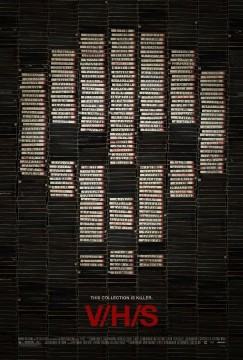
The horror anthology V/H/S was one of the freshest genre discoveries to come out of Sundance ’12 , and this fall it finally arrives in theaters and on VOD. Revel in the found-footage conceit — done particularly well here, spanning short segments by the likes of Adam Wingard, Ti West , Joe Swanberg , and more filmmakers to keep on your radar — with a look at the official poster, itself a clever, cryptic spin on the old hand-marked VHS tapes some folks still have lurking in dusty closets and basements. Of course, most vintage mystery tapes don’t house footage of untold horrors like the ones “documented” in V/H/S — I hope. Over the course of six segments (tied together by a set-up about a gang of punks tasked with breaking into a house) surprises abound, which I’ll leave for you to discover. Head to Movies.com for the poster premiere, where you can view a high-res version of the poster and pore over the meaning of each VHS label in the design… which reveals far more dated tapes than what is shown in the film. What does that mean? HOW MANY HORRORS HAVE WE YET TO DISCOVER?? V/H/S will be released On-Demand via Magnolia on August 31 in theaters on October 5. [via Movies.com ]