Tag Archives: financial

Wall Street Reform Passes–Big Banks Celebrate

(Reuters) – The Congress on Thursday approved the broadest overhaul of financial rules since the Great Depression and sent it to President Barack Obama to sign into law. By a vote of 60 to 39, the Senate passed a sweeping measure that tightens regulations across the financial industry in an effort to avoid a repeat of the 2007-2009 financial crisis. President Barack Obama will likely sign the bill into law next week, the White House said. The legislation, opposed by the banking industry, leaves few corners of the financial industry untouched. It establishes new consumer protections, gives regulators greater power to dismantle troubled firms, and limits a range of risky trading activities in a way that would curb bank profits. The Senate vote caps more than a year of legislative effort after Obama proposed reforms in June 2009. The House of Representatives approved it last month. Although Obama originally had pushed for bipartisan support for an overhaul of financial regulation, only three Republican senators voted in favor of the bill, along with 55 Democrats and two Independents. With Republicans poised for big gains in the November congressional elections, Democrats are eager to show voters that they have tamed an industry that dragged the economy into its deepest recession in 70 years. “I regret I can't give you your job back, restore that foreclosed home, put retirement monies back in your account,” said Democratic Senator Christopher Dodd, one of the bill's chief authors. “What I can do is to see to it that we never, ever again go through what this nation has been through.” Along with the health-care overhaul, Democrats can now point out that they have passed two far-reaching reform efforts that will likely shape American society for generations. It is not clear whether that will impress voters. The public's understanding of the regulatory revamp is very low, according to an Ipsos online poll released on Thursday. Of those polled, 38 percent had never heard of the reform, while 33 percent had heard of it but knew nothing about the legislation. Other polls show the public divided about its merits. The bill has also won Democrats few friends on Wall Street as wealthy donors have started to steer more campaign contributions to Republicans. Financial markets showed little reaction on Thursday. Investors said passage was already priced into banks' share prices. Bank stocks have followed the overall market lower since April, weighed down by poor U.S. economic data and the belief that more regulation could crimp profits down the road. JPMorgan Chase & Co said the bill would not compromise its business model but might hurt profitability. “We'll have some effect on revenues and margins and volumes,” its chief executive, Jamie Dimon, said on a conference call. As the largest U.S. derivatives dealer, JPMorgan could have the most to lose from the bill, which aims to curb lucrative trading in risky over-the-counter derivatives and force banks to end trading for their own profits. FEW CORNERS OF INDUSTRY UNTOUCHED Under the 2,300-page bill, mortgage brokers, student lenders and other financial firms will have to answer to a new consumer-protection authority, though auto dealers will escape scrutiny. Regulators, who scrambled to contain the damage from failing firms like Lehman Brothers in the last crisis, will have new authority to dismantle troubled firms if they threaten the broader economy. A council of regulators will monitor big-picture risks to the financial system and many large banks will have to set aside more capital to help them ride out times of crisis. Large private-equity and hedge funds will face more scrutiny from federal regulators, and credit-rating agencies could potentially see their entire business model upended. Much of the $615 trillion over-the-counter derivatives market will be routed through more accountable and transparent channels, and banks will have to spin off the riskiest of their swaps clearing desk operations. http://www.reuters.com/article/idUSTRE66E0MD20100715 added by: ScottyT

Clinton advisor: Only a terror attack can save Obama

A former senior advisor to President Bill Clinton says that the only thing which can rescue Barack Obama’s increasingly tenuous grip on power as his approval figures continue to plunge is a terror attack on the scale of Oklahoma City or 9/11, another startling reminder that such events only ever serve to benefit those in authority. Buried in a Financial Times article about Obama’s “growing credibility crisis” and fears on behalf of Democrats that they could lose not only the White House but also the Senate to Republicans, Robert Shapiro makes it clear that Obama is relying on an October surprise in the form of a terror attack to rescue his presidency. “The bottom line here is that Americans don’t believe in President Obama’s leadership,” said Shapiro, adding, “He has to find some way between now and November of demonstrating that he is a leader who can command confidence and, short of a 9/11 event or an Oklahoma City bombing, I can’t think of how he could do that.” added by: maasanova

Exclusive: John Legend’s ‘Inspiring Week In Africa,’ In His Own Words

Singer followed FIFA World Cup concert performance with visit to Tanzanian village where his Show Me Campaign is helping to fight poverty. By John Legend Farmers in Mbola tell John how they’ve been able to triple their crop yields using improved seeds, fertilizer and new techniques Photo: MTV News I had an exciting and inspiring week in Africa and I wanted to share the great news with you. The first part of my trip was in South Africa, where I performed at the exhilarating FIFA World Cup kickoff concert and watched my first-ever live soccer match — complete with vuvuzelas — and even visited a lion park. Many thanks to the South Africans for hosting such a thrilling event and giving me such a warm welcome! But before returning home from Africa, I made my way north to a little village called Mbola. Mbola is located in the Uyui district in midwestern Tanzania. Like many parts of Africa, it’s a beautiful place, but life is difficult there. Thirty-one percent of sub-Saharan Africa’s population is chronically undernourished and 63 percent of the people lack access to basic sanitation facilities. Still, the people there are warm, hardworking and optimistic about building a better life for their families and generations to come. The Show Me Campaign is trying to help them do just that. We raise funds to support our friends at the nonprofit organization Millennium Promise, helping them to provide clean water, better access to health care, education, higher-yielding food- and cash crops and Internet connectivity. For those of you who have supported the campaign — thank you from the bottom of my heart. Every time I visit Mbola, I leave feeling hopeful because of the progress they continue to make. Here’s an overview of how far we’ve come: Expanding Educational Opportunities for Children We firmly believe that every child deserves a quality education and we’re working hard to make sure every child in Mbola receives that opportunity. Since we were last there, a secondary school has been built in the area which previously had none. Before the new school was built, students who wanted a secondary education had to travel many miles into Tabora, the nearest town. The unfortunate result was that many youngsters in Mbola did not attend secondary school. Now with the new school in Mbola, a major barrier that prevented young villagers from pursuing a secondary education has been removed. We’ve ensured that we have 90 percent-plus attendance rates in our primary schools by funding new school construction, including classrooms and homes for teachers, and providing free school lunches. This school feeding program is actively maintained by the local community and relies on farmers to give a percentage of their food crops to the school. This encourages farmers to invest in their community and become stakeholders in the long-term development of the community. And we’ve recently equipped the schools with new computers; neither teachers nor students had previously had access. It’s exciting to see them use these incredible teaching and learning tools. Empowering Farmers Through Business Education, Credit and Financial Literacy In Mbola, we’ve always focused on helping farmers become significantly more productive by encouraging best practices in agricultural techniques and providing fertilizer and other tools to increase productivity. Recently, we’ve started the village’s first community bank to extend credit to farmers, helping them manage their small-business and personal financing needs more efficiently. This will make all of the reforms more sustainable, as the villagers will be more empowered and enjoy increased control over their own destinies. Imagine where your life would be if you — and everyone in your family — had never had access to a loan, or savings or checking account. This is what people in Mbola struggled with before. Expanding Health Facilities and Access to Health Care Until recently, there was only one health facility near Mbola, and it was four miles away. When walking is your main form of transportation, four miles is a long way, especially if you are ill. During this visit, I was able to see the dramatically improved and expanded health facilities in the community. New clinics and health centers have been erected to ensure that villagers have accessible health care close to home. We have dramatically reduced malaria through the distribution of medicated bed nets to every family. And if someone happens to get malaria, it is no longer a death sentence since the health centers are now equipped and able to quickly treat and cure malaria with low-cost drugs. Additional promising improvements include access to anti-retroviral drugs for patients infected with HIV and medical advancements to prevent transmission of the virus from mother to child. In addition, Ericsson has donated 3G mobile technology to improve communication between the community and the health centers. The results of this technology are amazing. In a region where distance hinders development, having instant mobile communication can be a lifesaver. Community health workers can not only phone in for emergency services but also use them to help diagnose, record and prescribe treatment. This technology, along with the manpower of trained health workers, is changing the face of health care delivery throughout rural areas like Mbola. Access to Water Many villages in rural Africa have either very little or no access to clean water, and Mbola wasn’t any different a few years ago. Building septic infrastructure is a big part of what we’ve done in the village and I was happy to be able to participate in the groundbreaking ceremony for another water tank. This tank will expand access to clean drinking water for residents by distributing clean water throughout the village via underground pipes. All in all, it was a great trip. I’m still a little jet-lagged from the many hours of travel, but I’m energized by the progress that has been made. Thank you, again, to those of you who have supported our efforts in Mbola. I hope you will continue to support the Show Me Campaign and encourage your friends and family to help us break the cycle of poverty. We can make a difference if we all work together. Asante! Thank you! John For more information on how you can help John’s Show Me Campaign, log on and follow the organization on Twitter , become a fan on Facebook or visit the Show Me Campaign website. Related Photos John Legend’s ‘Inspiring Week In Africa’ Related Artists John Legend

See the rest here:
Exclusive: John Legend’s ‘Inspiring Week In Africa,’ In His Own Words

‘Inception’ Stars Trash Evil, Stupid Cheney, Palin, Preach Hypocritical Environmentalism

One of the big stories in filmdom today is about all the concerns surrounding the marketing of Christopher Nolan’s new film “Inception,” which cost a reported $160 million to produce and hits theatres next Friday, July 16th. According to Reuters, awareness isn’t as high as the studio would like, especially in Middle America. Well, here’s one way to entice Middle America into your film, insult them by having your three main stars hit the promotional circuit and savage Dick Cheney and Sarah Palin as stupid and evil (video below the jump). QUIZ: What makes you most want to see “Inception” now? 1. Ellen Page’s insufferably cruel sanctimony? 2. Joseph Gordon-Levitt’s pathetic, butt-boy me-toosim? 3. Leonardo DiCaprio’s wild hypocrisy? Actually, “wild hypocrisy” is an understatement…. The same Leo you see in that video belly-aching with so much touching concern over Mother Earth, just happens to be the very same elitist whose PRIVATE jet-setting helped cause the chaos that cost hundreds of World Cup fans — who had spent upwards of $1300 for tickets — the ability to attend the game. Found buried yesterday in the sometimes useful L.A. Times: The congestion on the ground, caused in part by earlier bad weather on Wednesday and in part by the arrival of large numbers of private aircraft, led to what one British Airways pilot described as “absolute chaos.” According to a report in Britain’s Financial Times, “Some of the fans had spent upward of $1,300 for semifinals tickets but were stuck in Johannesburg while private jets carrying Spain’s King Juan Carlos , South African President Jacob Zuma , actor Leonardo DiCaprio and socialite Paris Hilton landed.” Keep in mind that Leo isn’t just any hypocritical Hollywood environmentalist, he is the hypocritical Hollywood environmentalist. If you recall his film “The 11th Hour”: Had Leo simply practiced what he preached and flown commerical, maybe things would’ve been a little  less chaotic and a few more of those folks wouldn’t have wasted their hard-earned money. But they’re just the great unwashed and Leo is the The Great Movie Star Who Commands From Above, so… whatever. Leo may want to get in the head of BP’s CEO, but I’d like to get in Leo’s head and understand why someone who believes the planet is in peril would commit an act of genocide against the entire human race by flying around in private jets. My vote, however, goes to Ellen Page, who just went from the lovable and spunky Juno to a shorter, joyless, less-likable version of Rachel Maddow. How sheltered of a self-involved little bubble does one have to live in to think speaking the term “holistic intelligence” out loud doesn’t automatically qualify you for the All-Time Top Five Moments Of Hollywood Assholery. Page actually considers herself a feminist and yet here she is trashing the compassion and questioning the intelligence of a self-made Governor raising a special-needs child as her oldest son serves in Iraq. What’s young Page’s claim to intelligence and compassion fame. Oh, that’s right, she’s a celebrity. Man, I wish I’d never seen this video. I love Christopher Nolan and have been dying to see “Inception.” But goodwill matters and this Terrible Trio of Tactlessness just dropped the needle on that meter way below the half-way point.

Read the original here:
‘Inception’ Stars Trash Evil, Stupid Cheney, Palin, Preach Hypocritical Environmentalism

Dr Riki Ott on dispersants & what BP is hiding

“We know from Exxon Valdez that giving people hardhats instead of respirators is a very bad idea” – Riki Ott See Also: BP using dispersants to hide size of spill, and their financial liability http://current.com/news/92526824_use-of-dispersants-questioned-allegations-that-… What Mainstream Media is Not Telling You about the Gulf Oil Cleanup (NaturalNews) What surface oil dispersant for oil spills is so toxic and ineffective it has been banned in England for a decade? The one that British Petroleum (BP) is using now in the Gulf of Mexico. It's loaded with 2-butoxyethanol, which kills marine and wetland wild life while causing serious lung problems to humans! It is more toxic than the oil it purports to clean, and it simply sends the newly formed toxic globules of dispersant and oil further into the depths where it forms underwater plumes. It's like pouring paint thinner on spilled paint and letting it drip out onto the lawn and garden, except the underwater plumes of thinned oil and toxic dispersant spread onto the shore lines, wetlands and coral reefs and into the Atlantic via the Gulf Stream and beyond. Yet there are many less toxic, even 100% green, oil spill solutions available that are more effective. EPA and BP It was initially reported that the EPA (Environmental Protection Agency) had given BP 72 hours to change the current oil dispersant chemicals to something less toxic and more effective. After a sharp reply from BP, the EPA seems to have back pedaled claiming they only want BP to use less of it. It appears somebody with clout stepped in for BP! BP is involved with a few other large international corporations. Among them is the company that makes the toxic oil dispersant banned in England containing 2-butoxyethanol, which kills what is supposedly being protected! Richard Charter, advisor for Defenders of Wildlife, says this about the chemical dispersant being used in the Gulf: “It's a chemical that the oil industry makes to sell to itself, basically.” So in addition to siphoning some of the oil pouring from the ocean floor into tankers, oil that can be separated from the water and sold later, BP execs are enjoying financially incestuous gains. (source below) Ignored Solutions… (cont http://www.naturalnews.com/029127_Gulf_Coast_cleanup.html ) ~~~ EPA just released it's first set of findings on Corexit, here is one response: “Mobile Baykeeper Executive Director Casi Callaway said Thursday she is “disappointed” with the EPA’s methods. She pointed out, “They did the minimal testing of a limited substance. They didn’t do the test of oil and dispersants mixed with water, and they only tested shrimp and small fish. They didn’t do any field testing. They only tested in a lab.” Callaway said dispersants should not be used in the first place because oil is suspended in the water column, which not only endangers marine creatures, but also makes defense systems such as floating booms ineffective. The products do seem to bolster BP’s public image, however, according to Callaway. “The purpose is to hide it. They think if (the oil) is out of sight, people will forget about it and the problem will go away,” she said. The Alabama Department of Environmental Management (ADEM) is somewhat complicit by making its testing data difficult to obtain, she added. http://networkedblogs.com/5sBK9 ~~~ “Corexit a know poison” The BP disaster is far worse than we are being allowed to know via mainstream news: The toxic dispersant Corexit is gasifying getting into the atmosphere to return as rain, thus and affecting people, crops, far inland. Corexit is manufactured by a company making huge profits for many admin and other bigwigs, including Warren Buffet, Al Gore, & George Soros – a listing which makes me automatically suspect that this piece may be NeoCon finger-pointing – a side-effect which would unfortunately detract from the main news here regarding the degree of disaster that’s coming. Could it be there’s actually a $$$ reason for NOT stopping the leak? It would explain why neither Sen. Cantwell or Sen. Murray called me back after I left messages with their office staffers that I had a pretty good idea for dealing with the spill – I’ve heard nada despite 3 calls to each. Anyway, the following article with extensive details and links will bring you up to speed on a major disaster and perhaps the most hideous crimes. http://ow.ly/26Tih http://www.youtube.com/watch?v=iS66fomgWFI&feature=youtu.be added by: samantha420

MSNBC’s Ratigan: American’s Don’t ‘Give A Damn’ About Iraq and Afghan Wars; Calls for Draft

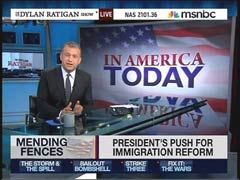
On Thursday’s The Dylan Ratigan Show, MSNBC host Dylan Ratigan went after the wars in Iraq and Afghanistan, and complained about the lack opposition to the conflicts: “Why isn’t there an alarm that we’ve been perpetrating this war?… there aren’t enough people in this country that honestly give a damn. No one really cares.” His solution to the supposed apathy? A draft. Ratigan began his rant by describing the financial and human toll of the wars. He particularly highlighted “the innocent civilians that our bombs are killing. As many as 105,000 dead in Iraq, the number in Afghanistan approaching 13,000, that we have killed.” He argued: “We might even be creating more terrorists….being there may be doing more harm than good.” On his May 13 program , Ratigan condemned the U.S. military for “dropping predator bombs on civilians willy-nilly.” Describing the limited number of Americans who have loved ones on the front lines, Ratigan proclaimed: “…it’s a way for the politicians to isolate on the poorest and the most isolated group of soldiers they can get and protect themselves from our society, were they to understand how violent and oppressive the actions we are taking against our own people are in perpetrating these wars.” Ratigan then proposed: “…we have to raise the stakes on this to decide whether we get out or keep going. And the only way I can see to do that is to return the draft.” He further declared: “Maybe if the sons and daughters of more Americans families, like those of our politicians, were either being killed in combat or facing the stresses of endless repeat deployment, our policymakers would start questioning why we’re still there…” After a discussing the topic with a panel of military experts, Ratigan admitted: “I’ll be the first to tell you, I’m the most ignorant at the table when it comes to the strategic analysis of this topic.” Even so, he concluded: “…the solution is still fairly simple….Either you’re on the side that is with this and is for it and is in there supporting it, or you are there making a strong case not to be there….that means that you, if you’re willing to go, are willing to send yourself and your family members into combat. And on the flip side, in my view, are not willing to do that and as such wouldn’t want to send a fellow citizen.” An on-screen graphic read: “Get Out or Get In! End the Wars or Bring Back the Draft.” Here is transcript of the July 1 segment: 4:30PM DYLAN RATIGAN: Well, day four in our ‘Fix It Week’ garage. And today we tackle a true matter of life and death in this country, the wars in Iraq and Afghanistan. One of them, already America’s longest war. The other, unfortunately, not far behind, long and costly. $731 billion spent so far in Iraq. $280 billion in our efforts in Afghanistan with no clear end in sight at the end of the deadliest month in the history of the war. The cost in American lives 4,396 soldiers dead in Iraq. 1,125 killed in Afghanistan. And then there are the innocent civilians that our bombs are killing. As many as 105,000 dead in Iraq, the number in Afghanistan approaching 13,000, that we have killed. There are two main problems with what we’re doing overseas, as I see it, and why we’re not doing it well. The first, we have no political will to shift from a strategy that has been repeating itself for years with no apparent end in sight. And two, there may not even be an honest understanding of our enemy and what a modern day insurgent war strategy is, let alone, how to actually fight an effective counterinsurgency. We all know about the heroin, the bribery, the rampant political corruption. But what about our overall strategy? And what we’re doing? We might even be creating more terrorists. Our leaders may not even understand the insurgency that they are fighting against. Think about how difficult it would be to launch a so-called counterinsurgency strategy if you haven’t been able to be truly honest about how a modern day insurgency works. Very few people, unrelated, using the internet and communications to disrupt society. Bottom line, us being there may be doing more harm than good. So why isn’t that conversation taking place in our Congress and in our homes? Why isn’t there an alarm that we’ve been perpetrating this war? Well, quite simply, like the cheap price of oil, there aren’t enough people in this country that honestly give a damn. No one really cares. They may say they care. But the politicians know, there’s no – the phone’s not ringing. No one really is expressing themselves. In fact, the number of active duty troops in Iraq and Afghanistan is at the lowest level since World War II. Which means the percentage of us that are exposed to the realties of war in this country, that we’ve been fighting for a decade, is the smallest it has ever been. Why is that? Well, more than a third of our soldiers have been sent back to the front lines multiple times. Some of the same soldiers sent back five and six times to the same war. Why is that? Well, it’s a way for the politicians to isolate on the poorest and the most isolated group of soldiers they can get and protect themselves from our society, were they to understand how violent and oppressive the actions we are taking against our own people are in perpetrating these wars. It means that the fewest number of Americans are truly feeling the brunt of our wars. Meanwhile, those who are feeling it, feel it harder than any troops in American history. I think we have to raise the stakes on this to decide whether we get out or keep going. And the only way I can see to do that is to return the draft. Maybe if the sons and daughters of more Americans families, like those of our politicians, were either being killed in combat or facing the stresses of endless repeat deployment, our policymakers would start questioning why we’re still there and come up with a different way to deal with insurgent warfare in the 21st century. [PANEL DISCUSSION WITH MILITARY EXPERTS] RATIGAN: I’ll be the first to tell you, I’m the most ignorant at the table when it comes to the strategic analysis of this topic. It’s why I asked these gentlemen to join me and benefit from it. But politically, for me, the solution is still fairly simple. I don’t see how, after all these years and all this time, we can continue these types of strategies without an either ‘get out’ or ‘get in’ strategy. Either you’re on the side that is with this and is for it and is in there supporting it, or you are there making a strong case not to be there. [ON-SCREEN GRAPHIC: The Fix Solution: Get Out or Get In! End the Wars or Bring Back the Draft] And explaining, not emotionally, but from a policy standpoint, why that is. And that means that you, if you’re willing to go, are willing to send yourself and your family members into combat. And on the flip side, in my view, are not willing to do that and as such wouldn’t want to send a fellow citizen. Either way, you have to let your politicians know how you feel. We, the people are critical to this process. Dylan.MSNBC.com has contact information for each and every member of Congress. Remember, you can get mad – or you don’t get mad, I should say, if you don’t get involved. This is a classic example.

The rest is here:
MSNBC’s Ratigan: American’s Don’t ‘Give A Damn’ About Iraq and Afghan Wars; Calls for Draft

Dylan Ratigan Condemns ‘Arizona’s Anti-immigration Law,’ Calls for Mob Rule to Overhaul System

You have to hand it to Dylan Ratigan. The MSNBC bloviator melded immigration reform, the military industrial complex, and congressional gridlock into a scatter-brained diatribe at the top of his eponymous program on Thursday. In the wake of President Barack Obama’s speech on immigration reform earlier in the day, Ratigan railed against “Arizona’s latest anti-immigration law” and praised Obama for “doing a good job, and a better job that almost any politician I’ve seen in a long time, in drawing our nation’s attention to the major broken systems in this country.” The former CNBC anchor who fancies himself a financial guru also babbled about a “War on Drugs that feeds money into the military complex but does nothing to defeat drug use or, for that matter, protect the border.” Then, interviewing Rep. Xavier Becerra (D-Calif.), Ratigan excoriated a Senate full of “weasels” that perpetuates an “utterly frozen process that allows the special interests to destroy our country and freeze our government.” Not surprisingly, Becerra, a strident supporter of comprehensive immigration reform, concurred with the unhinged talk show host: “Dylan, I don’t know if I could have said it better.” While claiming to criticize both sides of the aisle, Ratigan continued to cheerlead for the Democratic president, asking Becerra, “How do we – how do I in the media, how do you in the Congress – help this president try to lead us?” Without missing a beat, Becerra suggested dismantling one of America’s most treasured safeguards against tyranny – the Senate’s super-majority threshold for closing debate – and replacing it with what the Founding Fathers derided as “mob rule.” “Dylan all we have to do is get the public to tell the Senate to let us go back to majority rule,” proposed Becerra. Ratigan proved it is possible to misrepresent a popular state law, posit outlandish conspiracy theories about the military, and undermine the foundation of republican government over the course of a five minute rant. The transcript of the relevant portions of the program can be found below: DYLAN RATIGAN: A problem, of course, made more pressing by the controversy over Arizona’s latest anti-immigration law. The government expected to file a lawsuit, in fact, against that law in the coming days. First the president drew our attention to health care. All of our attention, whether we like it or not, remains on our financial system, corrupt and destroying our country as it is. And now immigration. While short on true fixes, at least Obama is doing a good job, and a better job that almost any politician I’ve seen in a long time, in drawing our nation’s attention to the major broken systems in this country. So when and if will we actually see reform? Will our lawmakers actually step up and do better on this effort when it comes to immigration, or will we just get another example of nothing more than “reform in name only” that perpetuates the most profitable aspects of illegal immigration, in this case cheap labor, and of course a War on Drugs that feeds money into the military complex but does nothing to defeat drug use or, for that matter, protect the border. Joining us now, California Congressman Xavier Becerra, an outspoken advocate for immigration reform. He’s also Chair of the House Democratic Caucus, excuse me. You have to be pleased with the president at least drawing everybody’s attention to this, and approaching honesty by acknowledging the mess, not only in immigration in this country, but in Washington and its total denial and inability to lead us to a solution. Do you agree with him? Rep. XAVIER BECERRA (D-Calif.): Dylan I do agree with him, and it takes courage to say those things to the American public because right now the public is so very frustrated. RATIGAN: How do we – how do I in the media, how do you in the Congress – help this president try to lead us? How do we come together in a way that resolves this in a way that is closer to fair than not? BECERRA: We shouldn’t let anyone kick the can down the road, as the president said. Everyone should be held accountable. In Congress, we need to see not just Democrats, we’re ready to go to work on this, but Republicans as well. And we know they’re out there. They were there three years ago. We know that there are some votes in the Senate that would want to do something but right now we need to see some courage on the Republican side in the Senate. Unfortunately right now, the Senate has become the graveyard for good ideas because Republicans are holding hostage any vote that doesn’t get to 60 in a house of 100. So you have to have the super-majority vote, and it makes it very difficult, if not impossible to get good ideas into law. RATIGAN: Should we throw out all the senators in November and start over? BECERRA: Well there’s some very good senators who are trying to do some things here, so no no. RATIGAN: How do we tell the difference, how to we figure out who the weasels are? Don’t tell me it’s the Democrats and the Republicans because I’ve been doing this long enough to know there are just as many weasely Democrats as there are Republicans. The trick is trying to tell which is which within the party. BECERRA: Dylan all we have to do is get the public to tell the Senate to let us go back to majority rule. In November, we’re going to operate on majority rule. Whatever individual wins more votes than the other, that person becomes the next congressman or the next senator. But in the Senate, you can have a majority and still not pass a bill to the president’s desk. So majority rule and we get a lot done. RATIGAN: So you would argue that the very same corrupt system that is bankrupting California, the need for a super-majority to do anything, and obviously nobody gets it, so special interests just continue to torch that state. And now the Senate has a duplication of that same utterly frozen process that allows the special interests to destroy our country and freeze our government. Is that basically what we’re dealing with here? BECERRA: Dylan, I don’t know if I could have said it better. Take a look at the Wall Street reform bill. The Senate is making it almost impossible for us to get there. There are more than 58 votes for a bill and we still can’t get it to the president’s desk. Hopefully soon the senators allow this bill to go the president and stop holding it hostage. –Alex Fitzsimmons is a News Analysis intern at the Media Research Center. Click here to follow him on Twitter.

More here:
Dylan Ratigan Condemns ‘Arizona’s Anti-immigration Law,’ Calls for Mob Rule to Overhaul System

Media Defend Obama’s Call for More Spending, Despite G-20 ‘Rift’

In the wake of a European debt crisis, the recent G-20 meeting in Toronto revealed the intention of many European nations to begin dramatically tightening their fiscal belts. The world leaders agreed to cut deficits in half by 2013 and “start to stabilize their debt-to-output ratios by 2016,” according to Bloomberg Businessweek. That goal conflicted with President Barack Obama’s wishes. During the economic summit, he ” urged continued spending to support growth .” Overall, the news media have been supportive of the Obama’s spending requests, a trend some continued in reports about the summit. An “American Morning” segment painted a flattering picture of Obama at the G-20 summit by ignoring the “rift” between Obama’s push for more stimulus and Europe’s desire to slash budgets. Christine Romans made it sound as if everyone came to an agreement. John Roberts introduced Romans segment saying, “The G-20 summit final communiqué was issued yesterday with a big nod toward both deficit reduction and continuing stimulus and you’ve got to wonder how do you have both.” Romans replied that the group was “saying that they can do both. In the very near term keep the stimulus going, but longer term they have to look to cutting deficits.” In contrast, CBS “Evening News” declared that Obama “for the most part did not succeed” at convincing European leaders to agree to more spending. ABC “World News Sunday” reported that Obama had “lost an argument,” but sided with his calls for greater spending by warning that “some economists say that (budget cutting) could plunge the world into a second recession.” While other economists “say” that stimulus is not the answer, “World News” didn’t include any of those voices and had only one economist on that night to support additional spending. Liberal New York Times columnist and Nobel Prize winner Paul Krugman went even further than “World News” in an attempt to scare up support for more spending. Krugman’s June 28 column warned that the economy is in the beginning stages of a ” third depression ,” and austerity would push us into one. His claims were promoted by the fill-in host of “The Ed Show” on MSNBC and his guest, left-wing economist Dean Baker, on June 28. Few people in the news media have challenged such calls for government spending, but some people on the financial network CNBC have supplied other views. CNBC’s Larry Kudlow and Steve Forbes debunked Krugman’s claim on June 28. Kudlow said, “But Steve, the so-called spending cuts or tax increases or deficit reduction hasn’t happened yet. In the last two years, we’ve had gargantuan spending and ultra-easy money, which is what Professor Krugman has been advocating the whole time. And he still thinks we’re in a depression. So I need to ask you, maybe his policies are what threaten the depression.” Forbes agreed and replied, “It’s like the old physicians who continue to bleed the patient and wonder why the patient isn’t getting better and then bleeds the patient even more.” Forbes argued that the U.S. needs spending cuts, tax cuts (or at least maintaining tax rates) and the stabilization of the dollar. CNBC’s Rick Santelli had a much different recipe for economic recovery than Krugman, shouting on June 28, “I want the government to stop spending! Stop spending, stop spending, stop spending, stop spending! That’s what we want, stop spending!” After a heated debate with CNBC’s Steve Liesman, Santelli declared: “Our deficit is too big and we need to knuckle under and we need to live too prudently, prudently.” Obama Wants to Spend Now, Pay Later Obama urged countries at the G-20 summit to continue spending, but CBS “Morning News” reported June 28 that “even before the summit, President Obama says he intended to slash deficit spending in half by 2012.” That would be an enormous challenge since the federal deficit is projected to reach $1.6 trillion this year, according to Reuters. ” I’m serious about it ,” Obama said at a G-20 news conference. Reuters reported that Obama’s special deficit commission will make recommendations Dec. 1, after the 2010 congressional elections. “I’m doing it because I said I was going to do it,” Obama said. “People should learn that lesson about me, because next year, when I start presenting some very difficult choices to the country, I hope some of these folks who are hollering about deficits and debt step up, because I’m calling their bluff.” Ryan Ellis, tax policy director for Americans for Tax Reform, pointed out the timing of Obama’s “difficult choices.” Ellis told the Business & Media Institute, “Why isn’t he proposing these ‘very difficult choices’ now, before the election? Is he afraid that his tax increases (which are all he could be talking about) would be unpopular?” Another tax expert, Andrew Moylan of the National Taxpayers Union, told BMI “‘Difficult choices’ is thinly veiled code for massive tax hikes that would be necessary to pay for Washington’s unconscionable spending spree.” Moylan said he thought “we’re likely to see proposals to eliminate at least some of the 2001 and 2003 tax cuts (in all likelihood, raising the top rate back to 39.6 percent, reinstating a death tax of something like 45 percent, and eliminating the lower capital gains and dividends tax rate of 15 percent).” And that’s “on top of the myriad other tax hike proposals,” Democrats have suggested like an energy tax and financial transaction tax, Moylan said. What sort of impact would those tax hikes have on an economic recovery? Moylan told BMI no tax hikes improve economic growth so “we can say with confidence that those tax hikes would make the recovery slower than it might otherwise be.” Media Embraced Obama’s Spendy Ways, Blamed Deficit on Bush Obama has spent like no other since he became president. In 2010, he submitted the largest federal budget ever at a whopping $3.8 trillion. To put this in perspective: Obama is proposing a budget $700 billion larger than big spender Pres. George W. Bush’s last budget. It’s twice the size of Pres. Bill Clinton’s last budget of $1.9 trillion, who was credited with generating a budget surplus. Despite that “staggering” budget, at the time broadcast networks managed to paint Obama as a fiscal conservative and deficit slasher. The news media, with few exceptions, promoted Congress and Obama’s spending spree by favorably reporting the $ 787 billion stimulus , the auto bailout , the Cash for Clunkers program and rarely asking how it would all be paid for down the road. Now that government stimulus is unpopular with Americans, the networks barely reported Obama’s request for $50 billion to bail out state and local governments. Sen. Bob Casey, D-Pa., is also asking for $165 billion to bail out labor union pensions. Journalists have used multiple tactics to shift blame away from Obama’s spendthrift ways. In some cases, reports have simply ignored massive deficits. Others have agreed that Obama needed to spend in order to fix the economy, despite the deficits that would be incurred. Still others have repeated the White House’s own claim that the previous administration is to blame for the huge debt. On Oct. 8, 2009, CBS “Evening News” ignored the fact that the federal deficit had risen to $1.4 trillion , three times what it was one year earlier. But on Oct. 7, 2008, under President George W. Bush, Katie Couric made sure to mention the “record federal deficit” had tripled from the prior year. In 2010, after Obama submitted the largest federal budget in history, with a projected deficit of $1.6 trillion, the networks showed their support. NBC’s Savannah Guthrie portrayed all the excess spending as a way to get the economy back on track saying: “He’s asking for $100 billion to spur job growth – things like tax cuts for small business, tax breaks to increase wages – and he’s doing this knowing that it will drive up the deficit, certainly even more in the short term. But all economists agree the real way to get a chunk out of the deficit is to increase hiring.” Guthrie was highlighting only a tiny fraction of the overall budget and failed to criticize the administration for not finding ways to cut more waste. Taking a slightly different tack to express support, CBS’s Bill Plante agreed with the president’s spending priorities on Feb. 1, 2010, saying Obama “needs’ to spend right now. “He needs to spend more money in the short-term to create jobs, but he desperately needs to spend a lot less over the long-term,” Plante said on “The Early Show.” Stories also followed Obama’s lead in blaming his predecessor for the huge deficit. Many reporters pointed their fingers at the Bush administration, including ABC’s David Muir. His Feb. 1 “World News” report nearly copied Obama’s budget announcement right down to the blame on “previous administrations.” Muir pinned the record deficits on President Bush’s tax cuts and war spending when he answered the question: “How did we get here?” His timeline of the expanding federal deficit began with an image of Bush signing a bill and the words “Tax relief for America.” This has long been the claim of the national news media. While Bush was certainly responsible for helping balloon the federal deficit, ATR’s Ellis told the Business & Media Institute the tax cuts weren’t the problem, overspending was. Like Muir, CNN’s Fareed Zakaria demonstrated his economic ignorance by claiming that the Bush tax cuts were “the single largest part of the black hole that is the federal budget deficit.” But the facts don’t bear out Zakaria’s claim. According to Ellis, tax revenues were higher than the average when Bush took office, but fell before the tax cuts because of the dot-com bust and the 2001 recession. “Federal tax revenues are much more dependent on the economy than they are on tax policy. Tax revenues ROSE as a percent of the economy in the years after the BTC (Bush Tax Cuts) became law. They only fell again when the economy imploded,” Ellis explained.

Here is the original post:
Media Defend Obama’s Call for More Spending, Despite G-20 ‘Rift’

Pope Calls for “World Political Authority”

[Note: this is a story from last year, im just posting it for personal reference] Pope Benedict XVI called for a “true world political authority” to manage the economy in his new encyclical on social justice. The encyclical, entitled “Charity in Truth,” was released by the Vatican on Tuesday and signed by the pope a day earlier. Benedict’s encyclical specifically called for “regulation of the financial sector,” and a “worldwide redistribution of energy resources.” Benedict added that “the State’s role seems destined to grow” if his political prescription is followed. “There is urgent need of a true world political authority,” Benedict wrote in the 30,000-word encyclical, calling for “reform of the United Nations Organization, and likewise of economic institutions and international finance, so that the concept of the family of nations can acquire real teeth.” Benedict described what a powerful world government with teeth would look like: “Such an authority would need to be universally recognized and to be vested with the effective power to ensure security for all.” He added: “Obviously it would have to have the authority to ensure compliance with its decisions from all parties” — that is, nations. At best, Benedict is proposing a global federation that would improve upon the U.S. Constitution’s checks and balances. “Such an authority would need to be regulated by law, to observe consistently the principles of subsidiarity,” Benedict says. http://en.wikipedia.org/wiki/File:Pope,_13_march_2007.jpg http://www.thenewamerican.com/index.php/culture/education/1375 added by: ibrake4rappers13

Scientology compares itself to the Salvation Army in Senate inquiry

The Church of Scientology has compared itself to The Salvation Army, while defending its benefit to the community in a Senate inquiry. The organisation was scrutinised by an inquiry into legislation proposed by independent senator Nick Xenophon, which would require religious groups to prove what public benefit they provide, before getting tax breaks. Its representative, Virginia Stewart, told the committee its members lent a hand in times of disaster and promoted drug-free messages. “The church believes the proposed bill is inherently flawed and puts at risk the financial future of charities and religions in Australia,” she said. But a Church of Scientology officer from New Zealand, Mike Ferris, told the inquiry that a public interest test in his country had done no harm. Scientology has charitable status in New Zealand, where the Charity Commission of New Zealand was established in 2005. It demands charities clear a public benefit test, and makes them hand over financial statements, which are available publicly online. Mr Ferris said he believed the commission had been fair to the Church of Scientology. “I think the New Zealand Charities Commission has treated us fairly,” he said. “I think it's a fair process.” The inquiry also heard from ex-Scientologists who went public with their shocking experiences earlier this year, when Senator Xenophon twice failed in efforts to have an inquiry into abuse allegations. Among them was James Anderson, who claims he and his wife spent up to $1.2 million on Scientology materials, and Janette Vonthehoff, who says she was coerced into having abortions, and worked long hours for the organisation under duress. Both argued the organisation should not get tax-free status, because it was completely self-serving, and provided no benefit to taxpayers. Mr Ferris compared the glare on Scientology to that previously directed at The Salvation Army. “They weren't welcome here in Australia, they weren't welcome in New Zealand in the early 19th century because of their view against alcohol,” he said. “They were beaten up and they were persecuted, so where do you go?” Mr Ferris was asked why the records on the website of his country's charity commission showed the organisation went from an income of $2.6 million in 2007, to $374,000 in 2008. “I think that drop in income, was actually, from memory, was the exchange rate drop, absolutely,” he said, but later admitted he wasn't certain. The Church of Scientology also committed to handing over its books to the committee for further scrutiny. http://hiscrivener.files.wordpress.com/2009/06/tom-cruise-and-scientology.jpg http://digg.com/politics/Scientology_compares_itself_to_the_Salvation_Army added by: iamfree