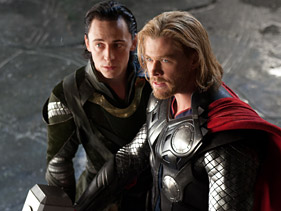
At Tribeca Film Festival, actor tells MTV News, ‘I’d like to see him yield, essentially, to his darkest instincts.’ By Kevin P. Sullivan Tom Hiddleston and Chris Hemsworth in “Thor” Photo: Zade Rosenthal/Paramount Few actors take on the task of playing a super-villain quite like Tom Hiddleston . The British actor approaches his mischievous character, Loki the Norse god, with the utmost seriousness, going as far as writing an op-ed piece defending superhero movies in the Guardian . Hiddleston has been confirmed to reprise his role as Loki in ” Thor 2 ” for a while now. The sequel, due out next year, is said to explore the other cosmic realms outside of Asgard and Earth, but Hiddleston is much more interested in a more-personal exploration of his troubled character. At the closing-night festivities for the Tribeca Film Festival, the actor once again proved his passion for his character, telling MTV News, “I’d like to take [Loki] to his absolute rock bottom. I’d like to see him yield, essentially, to his darkest instincts. Then, having hit rock bottom, maybe come back up.” Loki’s origins, something that has always interested Hiddleston, cast the god as a more ambivalent one. In “Thor 2,” the actor hopes to perhaps find some redemption for Loki and maybe even join the forces of good. “I think the fascination for me about playing Loki is that, in the history of the mythology and the comic books and the Scandinavian myths, is he’s constantly dancing on this fault line of the dark side and redemption,” he explained. “I don’t know when, but it will be so fun to see him see the light again and be recruited to the good side.” Check out everything we’ve got on “Thor 2.” For breaking news and previews of the latest comic book movies — updated around the clock — visit SplashPage.MTV.com . What would you like to see happen to Loki? Share your thoughts in the comments below! Related Videos ‘The Avengers’ Take On Tribeca Film Festival
Boyz up against longtime rivals Jodeci in round one; voting open now! By John Mitchell, with reporting by Jocelyn Vena Boyz II Men Photo: Jeff Fusco/ Getty Images Our Battle of the Boy Bands got off to a roaring start Monday as fans of new groups like the Wanted and One Direction and legacy acts like ‘NSYNC and New Kids on the Block hit our bracket hard to push their favorites on to the next round. One group that is in it to win it is Boyz II Men , who told MTV News they were among the “progenitors” of the entire boy-band genre. “We were kind of like the progenitors, the torch holders of a lot of the artists, of a lot of the boy bands that came about,” Nathan Morris told us. Highest Chart Achievement In the mid-’90s, Boyz II Men ruled the charts. That’s not hyperbole, either — three of the top-10 longest-running #1 singles in the history of the Billboard chart belong to the band. Their top song, though, is actually a duet, and with 16 weeks spent atop the chart, it’s also the biggest single ever: “One Sweet Day” with Mariah Carey. Boyz II Men are one of just four artists or groups to have held the #1 spot for at least 50 weeks cumulatively. On the all-time list, they fall at #4, behind only (ahem!) Elvis Presley, the Beatles and Carey. (With 47 weeks, Usher falls just short at #5.) Clearly, the band has quite a few chart achievements under its belt. Standout Video The Boyz made a series of great videos for their hits “End of the Road,” “I’ll Make Love to You” and “Water Runs Dry,” but for its cameos alone, “On Bended Knee” rises above. In the clip, each band member breaks up with and eventually reconciles with a girlfriend, played by four famous actresses: Victoria Rowell, Ren
This just in from the Avengers press conference in Beverly Hills, where Robert Downey Jr. may or may not be messing with the assembled press a la Tony Stark: “We are shooting one more scene [for The Avengers ]… tonight. Not kidding.” Aaand with that mysterious cliffhanger, Downey and his fellow superheroes exited the stage. What does it mean? UPDATE : Joss Whedon reacts: “He’s Robert, of course he’s kidding.” Well, it was fun while it lasted. And Downey did promise that nothing after his first answer would be sincere. Stay tuned for Movieline’s full report from the Avengers junket!
I’m not going to belabor this: A batch of new media from Prometheus has emerged, including what some mad genius has repurposed as arguably the most revolting — if weirdly entrancing — animated GIF in the history of animated GIFs. No blood or other bodily fluids/waste are involved, but if you are squeamish at all about eyes, do not keep reading . Via Badass Digest and some outer circle of hell, here goes: Worm, meet eye! Follow S.T. VanAirsdale on Twitter . Follow Movieline on Twitter .
It’s been called the greatest rock musical ever made, the movie that launched Prince into the mainstream consciousness: 1984’s Purple Rain . The semi-autobiographical story of a Minneapolis musician known as The Kid and his struggles with success, love, and an abusive father — told as much through Prince’s tortured swagger as through iconic chart-topping songs like “When Doves Cry” and the titular “Purple Rain” — struck a chord with audiences and earned Prince an Oscar for Best Score to boot. But, as recounted in an exclusive excerpt from John Kenneth Muir’s book Purple Rain: Music on Film , the film was headed for the rocks until neophyte director Albert Magnoli dared to tell Prince the truth about the film’s initial script: “Well, I think it sucked.” Muir chronicles the history and lasting impact of Purple Rain in his new tome, on shelves today, from Prince’s early quest to find the right film vehicle for himself to his collaboration with director Magnoli in making drastic changes to screenwriter William Blinn’s original script (then called Dreams ) — a script that, Magnoli and producer Robert Cavallo say had been passed over by countless directors. Also included: What happened when Prince subsequently put himself in the director’s chair for Under the Cherry Moon (1986) and Graffiti Bridge (1990), Tipper Gore’s infamous shock over the lyrics to “Darling Nikki,” and considered analysis of the themes and symbolism that make Purple Rain resonate. In Movieline’s exclusive excerpt, Magnoli recounts his first, insightful encounter with Prince and how he pitched the shy artist on the story that would become Purple Rain . The film’s lore has long held that Purple Rain ‘s story originated from Prince himself — but according to Magnoli, it was destined to be a much different film before he stepped in. Reprinted with permission of the publisher, Limelight Editions, an imprint of Hal Leonard . ======= Meeting His Majesty, Prince The next task at hand was to introduce Magnoli to Prince , and simultaneously, for Magnoli to further familiarize himself with the artist, his background, and his works. Magnoli knew and had liked the 1982 Prince hit singles “1999” and “Little Red Corvette.” He held a powerful image of the artist as “a loner” and “iconoclastic,” but more research was still necessary to get an authentic feel for the man and the performer. So, while he finished an editing job on a Wednesday and Thursday and prepared for a flight to Minneapolis on Friday to meet his movie’s star, Magnoli wanted to learn everything he could about the musician. “I didn’t know his early career,” Magnoli acknowledged. “‘Send to the editing room every video and any foot¬age you have on Prince, so I can see the visuals,’” Magnoli remembers saying to Cavallo on the phone. “So he sent me all of this video of Prince in concert in Minneapolis, and it was during his bikini-wearing, high-heel wearing, long coat days. This was prior to the 1999 album, where I think he had his self-titled album Prince . . . I think that’s what it was called. He was wearing a jacket on the cover [of the album] with a bikini bottom, with his chest sticking out, looking very androgynous. “So now I’m watching all this video that supports this androgyny, and I’m thinking, Wow . . . okay. . . . I realized trying to bring Prince to the public—and I always knew I wanted to cross over from an urban base to a wider one—was going to be difficult,” Magnoli explains. “So I’m watching all this imagery, but I do see the vulnerability under all that crap, and I think, Okay, I need to focus on that,” he notes. “That’s where this is coming from anyway.” An encounter on the way to the airport didn’t exactly quell Magnoli’s concern that the visuals surrounding Prince might have difficulty playing in Peoria. He asked his African American cab driver on the way to LAX if he knew of the performer/songwriter Prince. The man did know of him, so Magnoli next pressed the gentleman on what he thought about him. The man replied that Prince was gay, and furthermore, couldn’t imagine that Prince was not gay. “Don’t forget,” admonishes Magnoli, “we’re back in 1983 now. Nowadays it’s not even an issue. We’ve come a long way, baby. But now I’m thinking, All right . . . more . . . stuff. But when I later met him, I realized, no, this is not even an issue. This is just the noise. This is just the chatter. I never factored it in, ever — ever — from that point on. The frills didn’t bother me. The purple coats didn’t bother me. This was all the stuff, all the chatter, that anybody who didn’t know the soul would just latch on to. And they were going to do that anyway. As long as I could stay focused on the heart and soul, I knew I would be fine.” Albert Magnoli, from the archive of John K. Muir When Magnoli arrived in Minneapolis late in the evening, he met Steve Fargnoli, who promptly informed him that his new story was off and the Blinn story was back on. Fargnoli — whom Magnoli sometimes jokingly referred to as “the second part of a three-part series,” approached him with grave seriousness. “The first words out of his mouth are: ‘Understand this: I don’t give a damn about the story you told Bob [Cavallo]. We’re doing the story that’s already written.’ And I said, ‘Uh huh.’” Then Magnoli was taken to actually meet with Prince. In a hotel lobby, Magnoli first met Chick, Prince’s legendary, Nordic bodyguard, whom Magnoli described as a very “tall, Viking-looking person,” and then went off to a corner to observe the dynamics of the situation. “To my right were the elevator doors,” Magnoli explains. “To my left, across the lobby, was the front door of the building, where Steve [Fargnoli] and Chick were positioned. Then the doors opened at the crack of midnight sharp and out walks Prince by himself. “Because he didn’t know who I was, he didn’t see me. He saw Chick and Steve at the end of the hall and walked to them, which allowed me to do a right-to-left pan with Prince, unencumbered by him knowing I was looking at him. As a result, I ended up filling [in] the whole story based on him walking across the lobby. Because what I saw was extreme vulnerability, in spite of all the bluster and the costume and the music. This was a vulnerable young man. I saw all the heart and soul. I saw all the emotional stuff. I saw the tragedy of his upbringing. I just saw stuff and felt stuff that filled in the three-act story.” Together, Prince, Magnoli, Cavallo, Fargnoli, and Chick went to a working dinner. “I was looking at Prince and I could tell he didn’t like being looked at,” Magnoli says. “He’s very shy. Everybody ordered food, and as soon as the waitress left, Prince looked at me and said, ‘Okay, how did you like my script?’ “I realized a few things there. One, he said, ‘my script,’ which meant that he had personally invested himself in whatever it was that William Blinn had written. And two, that he hadn’t been told anything that I felt about it.” “The words that came out of my mouth were the following: ‘Well, I think it sucked.’” Magnoli pauses for dramatic effect. “At that moment, Steve dropped his head, Chick leaned closer to me, and Prince looked startled. Then I could see him thinking and what he was thinking was: ‘I wasn’t told this before this meeting was to take place. Why wasn’t I told?’ Then he looked toward Steve, because obviously Steve had told him nothing. That look to Steve took about three seconds, but it was telling to me, because now I saw how the operation worked. He had been kept in the dark about this.” “So then Prince looked back to me and said, ‘Why does it suck?’ And I said, ‘You know what, it’s not important why, but here’s what we can do about it. Let me tell you the story.’ So now, with even more passion, because I have more information now that I’m looking at this kid, I told this story. “There was five seconds of silence. Then he looked at Steve and said, ‘Why don’t you take Chick and go home.’ Then he looked at me and said, ‘Why don’t you come with me?’ ‘I’m just going to take Al for a ride.’” Not knowing exactly what was going to happen, Magnoli remembers feeling a little uncertain. Had he offended Prince? Had he made him angry? “We got in his car; he got behind the wheel, I got into the passenger’s seat, and he took off fast,” Magnoli notes. “The next thing I knew, we were driving in pitch-black darkness, [with] not a light in sight. I had no idea where we were. It looked like we were driving in a black tube. A day later I realized we were in horizon-to-horizon farmland, but there were no lights. So I was thinking, He didn’t like the story . . . and now I’m dead. I can die right now. and no one will know. . . .” This nighttime ride was not the beginning of a murder plot, however, but the start of a very fruitful working relationship for Magnoli and Prince. Even though the story Magnoli had recounted involved the lead character (Prince himself, hereafter called “The Kid”) being at odds with his parents, his bandmates, and even his girlfriend, Prince never once flinched from a warts-and-all, three-dimensional presentation. “The thing about Prince is that he wasn’t concerned about his image,” Magnoli reveals. “He was concerned about whether the film would communicate. Would the music communicate? “I said to him, ‘If you’re willing to let me have your father in the movie give you a kick in the face on a certain page and get thrown across the room — if you’re willing to take that hit — we can make a great movie.’ “And he said, ‘I’m willing to take that hit.’ So that was it, metaphorically, realistically, and literally. Because he does get smacked by his old man in the movie. “And then I jokingly said to him, ‘There isn’t a person on the planet who wouldn’t want to hit a rock star in the face,’” Magnoli continues. “And he laughed and said he understood that. We both understood that the image of these people as entitled and selfish was a target. We understood that. “We never discussed warts and all. It just became part of the script and it was totally embraced,” Magnoli explains. When interviewed some time later, Prince reflected on the seemingly biographical aspects of the Magnoli script. “We used parts of my past and present to make the story pop more, but it was a story,” he emphasized. Purple Rain: Music on Film is available in stores today. Follow Movieline on Twitter .
NOAA just released confirmation that the first quarter of 2012 was the warmest on record . The fact that we rely on ‘seasonal adjustments’ in macro data that are so critical in our seeming belief in the recovery of the US economy (and its extrapolation into how many iPads will be bought next month) when the temperature is 20% hotter than average is simply incredible. U.S. records warmest March; more… Broadcasting platform : YouTube Source : zero hedge Discovery Date : 09/04/2012 15:16 Number of articles : 2
Unemployed for obvious reasons….like the fact that she has no talent, that she’s s nobody…that her only redeeeming quality is a set of fake tits…that anyone with a rich dad or a saving’s account and a hatred for their tits can compete with her on…not quite a skillset….I mean with a resume that consists of being on one of the worst shows to ever hit MTV, in fact one of the worst shows in the history TV, where she was a secondary character in what was to be the pre-cursor to garbage like Jersey Shore….you know….the shit that paved the way for shit like Jersey Shore to actually exist….clearly giving her a lot time to eat…cuz those thighs aren’t looking 20 anymore….they’re saddle bags the come with a slow metabolism and broken fucking dreams…..but she does still have that rich dad and fake tits….thinks will work out ok for her….there’s always sex tapes, stripping, going back to her naked for the camera whore roots….but lets just hope she scales down the eating and hits the treadmill before that happens….cuz she’s gone downhill…as most girls do…..but she’s half naked in her bikini and I’m not complaining….or maybe I am….I don’t know….I don’t even know what day it is… TO SEE THE REST OF THE PICS: FOLLOW THIS LINK
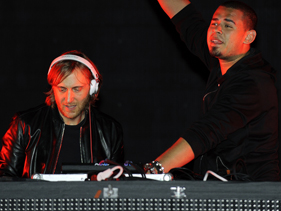
Afrojack, Steve Aoki, Lil Jon, Benny Benassi join Guetta onstage on Miami fest’s final day. By Akshay Bhansali David Guetta and Afrojack at Ultra Music Fest Photo: Getty Images MIAMI — Trance and electro house music reigned supreme at the final day of Ultra Music Festival, closing out the annual three-day dance music mega-fest that saw more than 200,000 people walk through the gates at Miami’s Bayfront Park. Sunday, Carl Cox handed over the Cocoon’s “mega-structure” stage to Dutch trance-music icon Armin van Buuren , who continued his globe-spanning celebration of the 550th episode of his “A State of Trance” radio show, streaming epic, dazzling sets of some of his larger-than-life trance-music friends. Gareth Emery, ATB, Ferry Corsten, Tritonal, and Sander van Doorn were but some of the big stars who had fans packing Cocoon right up to the stage’s back gates. Earlier in the day, 2012 MTV Woodies closing act Steve Aoki set the Ultra Main Stage ablaze with his driving electro-metal house show, and a few of his recent Wonderland album collaborators helped him celebrate the occasion. Lil Jon launched the set into overdrive early, joining Aoki for “Turbulence” and more, and singers Polina, and Alyssa Palmer all hit the stage to perform alongside Aoki. Before ending his set with an inflatable boat ride across a sea of tens of thousands of fans, as he traditionally does, Aoki caked two lucky fans in the front row of the audience — with dexterity, we’d like to add, right in the face from more than seemingly 15 feet away. Sunday night marked the UMF return of dance-music king , certainly the biggest crossover brand in EDM. While one might assume that after a throttling set by Knife Party followed by excellent performances by Kaskade and Fedde Le Grand, fans might have been a bit fatigued by then. If they were, they didn’t show it. “Can I hear my party people?” Guetta asked as he took the stage. The audience roared back as he launched into Alesso’s remix of Guetta’s “Titanium.” Notably, after the French superstar began a mix of little broski Afrojack’s “Can’t Stop Me Now,” Afrojack, Lil Jon, Aoki and Italian DJ/producer (and Madonna MDNA collaborator) Benny Benassi all joined their friend onstage, causing pandemonium. They posed for a group photo for the history books, and the set continued, only with the volume lower. “Every time I play a track at Ultra, it brings me luck!” Guetta told the audience. “And I’m going to start a new electronic label, and this is the first track on the label. “It’s with Nicky Romero , and it’s called ‘Metropolis,’ ” Guetta continued, before pumping the volume back up and letting the audience take in the electro-house banger that both he and Romero have been previewing in their sets recently. Throughout his set, Guetta maintained a bouncing tide of tens of thousands of screaming fans with his typical ease. There were a couple of new stadium house tracks in addition to known crowd-pleasers like Swedish House Mafia’s “Greyhound,” with the addition of Example’s “Changed the Way You Kissed Me” vocal, and Avicii’s “Le7els,” with Gotye’s “Somebody That I Used to Know” vocal. Before ending his set with a remix of “Turn Me On,” his single with Nicki Minaj , and finally “Without You,” his Usher hit, Guetta turned down the volume again and asked folks to take out their cell phones. As a sea of small lit-up screens formed around the UMF Main Stage, he made a remark that would underscore just how big the Ultra Music Festival and electronic dance music are in 2012. “Wow! Thousands and thousands and thousands of people partying together feeling like one,” Guetta remarked. “Do you realize what’s going on in America? How our music is taking over? “I never imagined that one day this would happen,” he added. “But this is only the beginning, right?” Share your Miami Music Week exploits with us in the comments section! Miami Music Week is a wrap, but stick with MTV News as we continue to roll out the latest EDM news and behind-the scenes interviews with your favorite dance music stars! Related Artists David Guetta
The YouTube hits just keep coming today, with one rare Disney-defying treat giving way to another: Take a break and hear eccentric Detachment and American History X filmmaker Tony Kaye’s candid lament for John Carter and passionate appeal for a huge budget of his own. What’s not to love? “For $250 million, I could make…” Kaye expounds, eyes beaming and hands raised. “People’s minds would explode. I’m good as gold. Fucking trust me. Fucking trust me! You don’t give an animation director $250 million.” Stick around for a wealth of storytelling about Kaye’s near-miss at Disney 40 years ago and subsequent Hollywood misadventures. And maybe let’s start a Kickstarter campaign or something? [via Movie City News ]
In this week’s ‘Hunger’-focused episode of ‘Talk Nerdy,’ we compare the soon-to-be-released film to Suzanne Collins’ novel. By Josh Wigler Jennifer Lawrence in “The Hunger Games” Photo: Lionsgate “The Hunger Games” are upon us at last. In the land of Panem, this would not be news worth celebrating. In our day and age of modern movie-going, however, the arrival of Gary Ross’ cinematic take on Suzanne Collins’ dystopian novel is anything but bad. Indeed, “The Hunger Games” is more than “not bad” — it’s great. It might even be exceptional. In fact, I’m ready to call it: Respectfully, I strongly feel the “Hunger Games” movie is better than the “Hunger Games” book. Before you kill me, hear me out, and I’ll try to walk you through my reasons.