Tag Archives: judiciary

5 Issues For Sens. Harris and Booker To Raise On The Senate Judiciary Committee

Go here to see the original:

D emocratic Senators Kamala Harris of California and New Jersey’s Cory Booker were appointed to the Senate Judiciary Committee on Tuesday, the The Hill reported. As the first African-American member of the committee since the 1990s, there are a few pressing issues for them to address. SEE ALSO: Illinois Lawsuit Underscores 5 Ways Trump Is Reversing Obama-Era Justice System Reforms Booker vowed to serve as a “check and balance” on President Donald Trump and Attorney General Jeff Sessions . “The Trump administration has repeatedly demonstrated its hostility to the ideals of civil rights and equal justice for all,” he added. Senate Judiciary Committee — Out: Franken, In: Booker, Harris https://t.co/Dz5uCtnaVG — Axios (@axios) January 9, 2018 Among its several tasks, the Judiciary Committee provides oversight of the Department of Justice and the agencies that report to the department, including the Federal Bureau of Investigation. The members also consider the president’s judicial nominees. Harris is now the second African-American woman to sit on the committee after former Sen. Carol Moseley Braun , a Democrat from Illinois. Booker is the first Black man to serve on the powerful panel. Here are a few issues that Booker and Harris could give voice to on the committee: 1. Oppose Thomas Farr’s judicial nomination Trump nominated Thomas Farr for a lifetime seat on the U.S. District Court for the Eastern District of North Carolina. His nomination has drawn widespread criticism . He has a long history of defending laws that weaken voting rights for African Americans and was part of a scheme by North Carolina’s former GOP Sen. Jesse Helms to intimidate Black voters. Looking forward to hearing Thomas Farr’s answers when @SenKamalaHarris & @CoryBooker hold him accountable for suppressing voters. #StopFarr pic.twitter.com/f9wDbCB1y5 — Let America Vote (@letamericavote) January 9, 2018   2. Restore federal oversight of police reform Under President  Barack Obama , the Department of Justice investigated police departments and used its leverage to reach agreements to reform departments that had patterns of racially biased policing. Sessions has directed his department in a  memo  to review those agreements to ensure they align with Trump’s law-and-order policy. Ferguson is undermining Jeff Sessions' argument against DOJ-led police reform https://t.co/2ZRlnzcF8N pic.twitter.com/ZKkDSykEIE — HuffPost BlackVoices (@blackvoices) October 30, 2017   3. End excessive court fines on poor people Sessions revoked 25 Justice Department guidance documents on a range of federal laws. One of them was from President Obama’s DOJ that called on courts to stop trapping poor people in cycles of fines, debt and jail. https://t.co/HPLCStepfC attorney Jeff sessions his rescinded a obama-era law that prevented cities from going after blacks and other poor people over excessive court fines. — The Observation Man (@William53604792) December 26, 2017   4. Block voter suppression efforts Republican controlled states continue to employ a myriad of schemes to suppress voter turnout among racial minorities, poor people and other groups that tend to support Democrats. Those efforts include cutbacks on early voting, ID requirements and banning ex-felon from casting a ballot. On Tuesday, new concerns were raised after a federal judge lifted a decades-old ban on the Republican National Committee from engaging in voter intimidation. In 1981 RNC used off-duty police officers with badges & weapons to monitor polls in black & Latino areas of NJ. Court order blocking these voter suppression efforts just expired. This is very bad news for voting rights https://t.co/LGYJv7sj9Y — Ari Berman (@AriBerman) January 9, 2018   5. Oppose efforts to renew the War on Drugs Sessions has signaled a return to the racially biased “war on drugs” policy that led to mass incarceration that will include stepping up drug and gun prosecutions, as well as enforcing mandatory minimum sentences. He revoked Obama-era policies on marijuana Thursday that is widely viewed as a major step in that direction. The war on drugs didn’t stop drug usage; it just ruined a lot of lives. Jeff Sessions is reviving it because he believes in using the criminal justice system as an instrument of racial and economic control of poor people and brown people. https://t.co/XRd8OldE2N — Rep. Keith Ellison (@keithellison) January 4, 2018 SOURCE:  The Hill SEE ALSO: Ben Carson Kicks Out 66-Year-Old Chicago Resident Of ‘Closed’ Meeting For Asking About Fair Housing CNN’s Angela Rye Rips Into Rick Santorum For ‘Talking Down’ To Her [ione_media_gallery src=”https://newsone.com” id=”3358541″ overlay=”true”]

5 Issues For Sens. Harris and Booker To Raise On The Senate Judiciary Committee

UK Enterprise Branch Offers Low Rates, Free Pick-Up, Oral Relief

There’s something to be said for making sure no one is able to hack into your computer, no matter if you are a high powered attorney or even just the ad copy guy at a newspaper in Wales. Pembrokeshire Enterprise Ad Snafu Unfortunately the Pembrokeshire Herald knows this all too well… now. They sent out their paper, well 20,000 copies of their paper, with a rather lewd edit to an Enterprise Rental Car advertisement. Instead of the usual “we’ll pick you up”, the ad expounded with “Free pick-up from your home, office, repair shop, and c–cksucking.” How’s that for service?  Of course the newspaper immediately set out apologizing to their readers and have gone so far as to contact the police in the matter. Good luck Pembrokeshire Herald, I saw the episode of  The Simple Life when Paris Hilton and Nicole Ritchie changed the Sonic sign to “1/2 price anal salty wiener bugers” and I’m pretty sure they didn’t even get fired.

Continued here:
UK Enterprise Branch Offers Low Rates, Free Pick-Up, Oral Relief

Student Left in DEA Cell For Days Wins $4M Settlement From U.S.

A college student reached a $4.1 million settlement with the U.S. government after being abandoned in a DEA cell with no food, water or windows for days. Daniel Chong, DEA Reach Settlement Daniel Chong drank his own urine, hallucinated that agents were trying to poison him with gas through vents, and tried to carve a farewell message in his arm. It remained unclear how the situation occurred, and no one has been disciplined, said Eugene Iredale, an attorney for Chong. The DOJ is investigating. “It sounded like it was an accident … a really, really bad, horrible accident,” Chong said, putting it mildly to say the last, after a harrowing ordeal: Chong was taken into custody during a drug raid and placed in the cell in 2012 by a San Diego police officer authorized to perform DEA work on a task force. The officer told Chong he wouldn’t be charged, saying, “Hang tight, we’ll come get you in a minute,” Iredale said … and the door did not open for 4 1/2 days . Why? No one will say publicly, more than a year after the fact. A Justice Department spokeswoman confirmed the settlement was reached for $4.1 million but declined to answer other questions, as did the DEA. Now an economics student at the University of California-San Diego, Chong said he planned to buy his parents a house with the money he receives. Chong was a 23-year-old engineering student when he was at a friend’s house where the DEA found 18,000 ecstasy pills, other drugs and weapons. Chong was there to smoke marijuana, his attorneys said. He and eight other people were taken into custody, but authorities ultimately decided against pursing charges against him after questioning. Chong began to hallucinate on day three in the cell, he recalls. He eventually urinated on a metal bench so he could have something to drink. He also stacked a blanket, his pants and shoes on a bench and tried to reach an overhead sprinkler, futilely swatting at it in an attempt to set it off. Chong said he accepted the possibility of death, biting into his glasses to break them and using a shard of glass to carve “Sorry Mom” onto his arm. Eventually, after screaming and nearly passing out, 5-6 people found him covered in his feces in the cell at the DEA’s San Diego headquarters. Chong was hospitalized for five days, having suffered from dehydration, kidney failure, cramps and a perforated esophagus. He lost 15 pounds. The DEA issued a rare public apology, though it is still unclear what happened. U.S. Sen. Charles Grassley (R-IA), a ranking member of the Judiciary Committee, on Tuesday renewed his call for the DEA to explain the incident.

See the article here:
Student Left in DEA Cell For Days Wins $4M Settlement From U.S.

Australia gets Androidland, we get green with envy

http://www.youtube.com/v/KGwFphUxJ2k

Here is the original post:

It’s been hard to be a down under Android fan lately, what with Apple’s relentless hounding of Samsung design patents bouncing up and down the judiciary ladder. But there’s at least one perk: wireless carrier Telstra has created the first Android-themed retail store, Androidland in Melbourne. Naturally various Android phones and tablets are on display, Broadcasting platform : YouTube Source : Android Community Discovery Date : 02/12/2011 05:05 Number of articles : 2

Australia gets Androidland, we get green with envy

George Stephanopoulos: Should Threat of Koran Burning Make Us Rethink First Amendment?

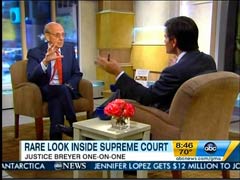
ABC’s George Stephanopoulos on Tuesday wondered if a Florida pastor’s threat to burn a Koran could “change” and “challenge” the meaning of the First Amendment. [MP3 audio here .] Talking to Supreme Court Justice Stephen Breyer, the Good Morning America host speculated, “When you think about the internet and when you think about the possibility that, you know, a pastor in Florida with a flock of 30, can threaten to burn the Koran and that leads to riots and killings in Afghanistan, does that pose a challenge to the First Amendment, to how you interpret it?” Stephanopoulos followed-up, ” Does [the threat of the Koran burning] change the nature of what we can allow and protect?” The ABC host didn’t explain expand on how the First Amendment “changes” in light of an unpopular action such as a Koran burning. Stephanopoulos, a former top aide to Bill Clinton, fawned over Breyer, a judge selected for the Supreme Court by the same Democratic President. The justice was appearing on the show to promote his new book on democracy. Stephanopoulos gushed, “I love the title of this new book, Making Our Democracy Work. And that’s not only the title of the book, but it’s also your mission. And you believe for that to happen, people have to understand our institutions and be engaged with them.” A transcript of the segment, which aired at 8:41am EDT, follows: GEORGE STEPHANOPOULOS: The national and international debate over that Florida pastor who threatened to burn the Koran hit a boiling point last week. And for now, the issue is being batted around the court of public opinion. But it could end up in a court of law. Perhaps, even, the Supreme Court. That’s one of the topics I discussed with Supreme Court Justice Stephen Breyer, when he stopped by to discuss his new book, Making our Democracy Work. I love the title of this new book, Making Our Democracy Work. And that’s not only the title of the book, but it’s also your mission. And you believe for that to happen, people have to understand our institutions and be engaged with them. SUPREME COURT JUSTICE STEPHEN BREYER: Yes. STEPHANOPOULOS: How do they do it? BREYER: Well, the first step is to know what it is that we do, know how your legislature works, how your governor works, how your mayors work, how your courts work. STEPHANOPOULOS: You also in this book plumb, I guess what you call something of a mystery, because it didn’t have to turn out that way, that we built up in our tradition, the norm that when the Supreme Court decides something, the public tends to follow. BREYER: There’s a history in this country, of bad events and marvelous events. And over time, it’s led to a general acceptance of the court, of having the last word on most constitutional issues, even when they are wrong. STEPHANOPOULOS: That was really tested that idea, when you were sitting on Bush V. Gore, the 2000 election, you wrote at the time, you were against it. BREYER: Yes, I was. STEPHANOPOULOS: You said it was a self-inflicted wound that hurt the court. BREYER: Yes. STEPHANOPOULOS: But, you also point out, and you’re write about this in your book, that one of the most remarkable things about this divisive case that decided, in many ways, a presidential election, was that the people accepted that. BREYER: I heard Senator Reid say that. STEPHANOPOULOS: The Democratic leader in the Senate. BREYER: Yes. He said one of the most remarkable about that case is one of the things least remarked. Nobody remarks it because it’s so natural. Here is a case that’s very unpopular, that in my opinion, as a dissenter, was wrong . And yet, the public did not start shooting each other. STEPHANOPOULOS: How do you explain that? BREYER: I explain that. That’s a really good question. You have to learn about history in the United States. We had a Civil War. We’ve had 80 years of legal segregation. We’ve had many ups and downs. But over time, the public has come to accept the need to have an institution that will protect minority rights. STEPHANOPOULOS: One of the tangible symbols that expresses this idea that the institutions have to work together, is the idea that every year, you all, members of the court, go to the President’s State of the Union address. It became a remarkable moment, when President Obama criticized the Citizens United case, where you were actually on the same side as President Obama. You were in the minority. But, he criticized the case. And Justice Alito got visibly upset. It provoked this reaction from chief Justice Roberts. I want to show you this. SUPREME COURT JUSTICE JOHN ROBERTS: The image of having the members of one branch of government, standing up, literally surrounding the Supreme Court, cheering and hollering, while the court, according to the requirements of protocol, has to sit there expressionless, I find troubling. STEPHANOPOULOS: Did you find it troubling? BREYER: I’ve been there for a while. [Laughs] As you have in your job, people say all kinds of things about someone in public life. Sometimes they agree. Sometimes they disagree. My job is not to say things that criticize me or others on our court. My job is to do it as best I can. STEPHANOPOULOS: But, he’s walked away from that saying, perhaps he won’t go in the future. Justice O’Connor when I talked to her about it in the future says she would rethink her attendance. Does it make you rethink your tradition of going? BREYER: No, no. STEPHANOPOULOS: Why not? BREYER: Because I think the reason that I want to go, and I think that the reason we should be there, is because, particularly today, where for better or for worse, people get lots of their information visually. It shows in that room, this is your federal government. The President is there. The cabinet is there. The, the Congress is there. The Joint Chiefs are there. And I’d like some of the judges to be there, too, because the judges have a role in this government. STEPHANOPOULOS: Even if you’re the only one there. BREYER: Even if I’m the only one, I’ll be the only one. But, I’ll do that because I believe very, very strongly in this. STEPHANOPOULOS: You know, when we spoke several years ago, you talked about how the process of globalization was changing our understanding of the law. When you think about the internet and when you think about the possibility that, you know, a pastor in Florida with a flock of 30, can threaten to burn the Koran and that leads to riots and killings in Afghanistan, does that pose a challenge to the First Amendment, to how you interpret it? Does it change the nature of what we can allow and protect? BREYER: Well, in a sense, yes. In a sense, no. People can express their views in debate. No matter how awful those views are. In debate. A conversation. People exchanging ideas. That’s the model. So that, in fact, we are better informed when we cast that ballot. Those core values remain. How they apply can- STEPHANOPOULOS: The conversation is now global. BREYER: Indeed. And you can say, with the internet, you can say this. Holmes said, it doesn’t mean you can shout fire in a crowded theater. Well, what is it? Why? Well people will be trampled to death. What is the crowded theater today? What is- STEPHANOPOULOS: That’s exactly my question. BREYER: Yes. Well, perhaps that will be answered by- if it’s answered, by our court. It will be answered over time, in a series of cases, which force people to think carefully. That’s the virtue of cases. STEPHANOPOULOS: When we last spoke, when you wrote your last book, you had been on the court for about ten years. Yet, you were still the junior justice. BREYER: I was. STEPHANOPOULOS: That’s no longer true. You now have Justice Sotomayor. Soon, Justice Kagan is going to be joining you as well. You talked about how before your first session of court, you were nervous. I was just wondering if you have advice for Justice Kagan as she prepares for that. BREYER: She will be nervous. But, don’t worry about it. There’s no way not to be nervous. For quite a while, the cases- now, they will be final. There’s no one to appeal to. And there is an instinct of everyone to be a little uncertain. To be a little unsure about whether my views, in my case, will I be able to answer these decently? Will I make some terrible mistake? I surely hope not. And that lasts for a while. It takes a while to adjust. STEPHANOPOULOS: Justice Breyer, thanks very much.

View original post here:
George Stephanopoulos: Should Threat of Koran Burning Make Us Rethink First Amendment?

Brian Williams Relitigates Bush v Gore, Pushes Breyer to Elaborate on Irreparable Harm

Giving Supreme Court Justice Stephen Breyer an unusual evening newscast platform to plug a book, on Monday’s NBC Nightly News anchor Brian Williams brought viewers back to the Left’s ten-year-old grudge, cuing up Breyer to agree: “Do you think Bush v Gore hurt the credibility of the modern court?” Breyer replied with a simple “yes” and Williams suggested: “Irreparably?” “No,” Breyer said in rejecting Williams’ overwrought premise, so Williams pressed: “For how long?” Williams introduced the September 13 segment by marveling: We can’t remember a sitting justice on the U.S. Supreme Court ever stopping by our studios here, but it happened today. We spent some time with Justice Stephen Breyer, appointed by President Clinton and residing on the liberal side of the court. Justice Breyer is out with a new book today. It’s about how the court works, including mistakes the court has made over the years. I started out by asking Justice Breyer, given his love of the Supreme Court, if he’s concerned that just one percent of those Americans polled, in a recent survey, knew his name? That book: Making Our Democracy Work: A Judge’s View . The second topic raised by Williams: WILLIAMS: Do you think Bush v Gore hurt the credibility of the modern court? BREYER: Yes. WILLIAMS: Irreparably? BREYER: No. WILLIAMS: For how long? BREYER: I don’t know. That’s up to historians. I thought that the decision — I was in dissent. I obviously thought the majority was wrong. But I’ve heard Harry Reid, I heard him say this, and I agree with it completely, he said the most remarkable thing about that case, Bush versus Gore, is something hardly anyone remarks. And that remarkable thing is even though more than half the public strongly disagreed with it, thought it was really wrong, they followed it. And the alternative, using guns, having revolutions in the street, is a worse alternative. WILLIAMS: To a new area, academic social elitism on the court. What would be your view of bringing in — Presidents appointing justices who went to a couple of state law schools?

Continued here:
Brian Williams Relitigates Bush v Gore, Pushes Breyer to Elaborate on Irreparable Harm

CNN’s Toobin: Judge’s Ruling a ‘Major Setback For Stem Cell Research’

On Monday’s Situation Room, CNN’s Jeffrey Toobin used dire language to describe a federal judge’s decision which struck down federal funding for embryonic stem cell research: “The bottom line is this is a major setback for stem cell research and for the Obama administration ….it will certainly cut way back on federal funding.” Anchor Suzanne Malveaux labeled it a ” potential wedge issue .” Malveaux led the 5 pm Eastern hour with the “breaking news” about Judge Royce Lamberth’s decision, who issued a preliminary injunction against federal funding for the life-destroying research. The anchor brought in Toobin and asked, “What does this mean today?” Toobin immediately gave his “major setback” assessment and described the grounds on which Judge Lamberth gave in his 15-page opinion. The CNN senior legal analyst, like many in the media, omitted that embryonic stem cell research isn’t the only field when it comes to stem cell research. The federal government has actually spent much more on adult stem cell research. According to a July 18, 2008 report by PBS , the NIH “spent $200 million funding non-embryonic stem cell research, and only $38 million on embryonic stem cells.” Less than a month ago, on August 2, the Associated Press actually highlighted the successes of adult stem cell research. Toobin used similarly dire language later in the report: “To be sure, the Obama administration will appeal this ruling to the D.C. Circuit, and it may well be overturned. This case has already been to the appeals court once. But if it stands up, it will certainly cut way back on federal funding for stem cell research .” But he also refreshingly noted that ” this is yet another battleground, broadly defined, of the abortion struggle in America, because, ultimately, that’s what stem cell research and the fight over embryos has really come down to .” Malveaux concluded the report with her “wedge issue” label of the controversial research. The full transcript of Suzanne Malveaux and Jeffrey Toobin’s segment from Monday’s Situation Room: MALVEAUX: Federal funding for embryonic stem cell research is now on hold- a U.S. District Court judge here in Washington issuing a preliminary injunction a short while ago. In the ruling, the judge says the research involves the destruction of human embryos, against the will of Congress. Now, this comes over a year after President Obama signed an executive order repealing Bush-era limits on federal tax dollars to study embryonic stem cells. Many Americans see that research as key to finding cures for spinal cord injuries, cancer, Parkinson’s- other diseases. I want to bring in our senior legal analyst Jeffrey Toobin, who is on the phone, to help us explain what this means.  Now, Jeffrey, in covering President Bush for all of those years, one of the things he was dead-set against was allowing for these federal dollars to be used for embryonic stem cell research. What he proposed was a compromise, saying- look, no more new funding- just allow the funding for 21 existing lines. President Obama reversed that, and now, we have the courts involved in this. What does this mean today? TOOBIN: Well, the bottom line is this is a major setback for stem cell research and for the Obama administration, because what the judge said was, that in 1996, while President Clinton was in office, Congress passed a law that said there could not be any use of federal money for research where embryos are destroyed. Both President Bush and President Obama worked within the framework because the president, unilaterally, can’t overturn a law. By expanding the opportunities for federal funding of research, as President Obama did shortly after he was elected, Judge Royce Lamberth, the judge in Washington, today said he- President Obama- violated that 1996 law. He tried to basically say that that law didn’t count any more, and the president can’t unilaterally overturn an act of Congress, and that’s why the judge suspended the Obama rule today. MALVEAUX: So, Jeff, what does this mean, in terms of projects that have already been funded? Do they continue, or do they stop, or does this mean that there’s just not additional funding for new projects? How does this work today? TOOBIN: Well, as usual, those questions will mean more work for lawyers, because Judge Lamberth’s 15-page opinion does not really deal with all the details of how this will play out in the real world. To be sure, the Obama administration will appeal this ruling to the D.C. Circuit, and it may well be overturned. This case has already been to the appeals court once. But if it stands up, it will certainly cut way back on federal funding for stem cell research, and it is not clear, from Judge Lamberth’s order, what happens to those projects that are under way as we speak. MALVEAUX: And Jeff, just real quick here, what is the next step in the legal process? Where does this go? TOOBIN: Well, the Obama administration, I assume, will go D.C. Circuit Court of Appeals and ask for a stay of this ruling while it’s appealed, but the anti-abortion/pro-life forces who were behind this lawsuit, among others, will certainly oppose that, and this is yet another battleground, broadly defined, of the abortion struggle in America, because, ultimately, that’s what stem cell research and the fight over embryos has really come down to. MALVEAUX: Okay, Jeffrey Toobin, thank you so much. Again, another potential wedge issue that may weigh-in in the midterm elections- this decision coming down today, just earlier this afternoon. 

Read the original post:
CNN’s Toobin: Judge’s Ruling a ‘Major Setback For Stem Cell Research’

Rosie O’Donnell Admits She Got Married in S.F. Merely As Act of ‘Defiance’ Against Bush

Rosie O’Donnell was in the news this week when she signed to do another TV talk show on the forthcoming Oprah cable network. But she’s still serving up leftist political goodies on her satellite radio show. Brian Maloney at Radio Equalizer found her declaring her “wedding” ceremony in San Francisco to former girlfriend Kelli Carpenter was a political protest stunt: George Bush, in the middle of a war, had an all-station news conference to announce how horrible it was for the safety of America that gay people were getting married in San Francisco, which pissed me off enough to get on a plane and go get married. Okay, first of all, on February 24, 2004 , President Bush didn’t call “an all-station news conference.” He made a rather routine statement (not a press conference) in the Roosevelt Room of the White House. And he didn’t say it was “horribly for the safety of America” that gays would marry. He did say the people had voted to endorse the traditional definition of marriage, and some activist judges in Massachusetts and city officials in San Francisco were overturning the will of the people of California. But to Rosie, everything she hears is exaggerated into hate, even as Bush called for civility and calm. She was making it sound like the Nazis were rounding people up: It was like an act of… defiance … If you’re gonna count up everybody who you think is not of value and round ’em all up and slap a pink triangle on ’em… I just felt like I wanted to be counted amongst the people who [some] were saying were unworthy and not allowed to have the same rights as everyone else. …If you’re a straight person and [same-sex marriage] offends you, call me and tell me why, [but] don’t say because marriage is traditionally between a man and woman, because, frankly, that’s such an old and tired line. Now, for a dose of reality, here’s how Bush began his statement : Eight years ago, Congress passed, and President Clinton signed, the Defense of Marriage Act, which defined marriage for purposes of federal law as the legal union between one man and one woman as husband and wife. The act passed the House of Representatives by a vote of 342-67 and the Senate by a vote of 85-14. Those congressional votes, and the passage of similar defense of marriage laws in 38 states, express an overwhelming consensus in our country for protecting the institution of marriage. In recent months, however, some activist judges and local officials have made an aggressive attempt to redefine marriage. In Massachusetts, four judges on the highest court have indicated they will order the issuance of marriage licenses to applicants of the same gender in May of this year. In San Francisco, city officials have issued thousands of marriage licenses to people of the same gender, contrary to the California Family Code. That code, which clearly defines marriage as the union of a man and a woman, was approved overwhelmingly by the voters of California. And here’s how he ended: The union of a man and woman is the most enduring human institution, honored and encouraged in all cultures and by every religious faith. Ages of experience have taught humanity that the commitment of a husband and wife to love and to serve one another promotes the welfare of children and the stability of society. Marriage cannot be severed from its cultural, religious and natural roots without weakening the good influence of society. Government, by recognizing and protecting marriage, serves the interests of all. Today, I call upon the Congress to promptly pass and to send to the states for ratification an amendment to our Constitution defining and protecting marriage as a union of a man and woman as husband and wife. The amendment should fully protect marriage, while leaving the state legislatures free to make their own choices in defining legal arrangements other than marriage. America’s a free society which limits the role of government in the lives of our citizens. This commitment of freedom, however, does not require the redefinition of one of our most basic social institutions. Our government should respect every person and protect the institution of marriage. There is no contradiction between these responsibilities. We should also conduct this difficult debate in a matter worthy of our country, without bitterness or anger. In all that lies ahead, let us match strong convictions with kindness and good will and decency. Thank you very much. Kindness and good will and decency — not to mention accuracy — aren’t qualities Rosie O’Donnell demonstrates once she starts talking about conservatives on the radio.

See the rest here:
Rosie O’Donnell Admits She Got Married in S.F. Merely As Act of ‘Defiance’ Against Bush

CBS Legal Correspondent: Senate Democrats Can Blame Themselves for Kagan Confirmation Difficulties

There have been a lot of complaints from the left over the opposition Supreme Court Justice nominee Elena Kagan has faced from Senate Republicans in her battle to win confirmation. But Kagan proponents should have seen this day coming when Democrats in the Senate did the same things to try to slow the confirmations of Justices John Roberts and Samuel Alito. On CBS’s July 4 “Face the Nation,” CBS legal correspondent Jan Crawford explained why. Previously throughout these types of confirmation processes, the Senate would approve a President’s nominee, assuming the candidate was qualified. But President Barack Obama, Vice President Joe Biden and Senate Judiciary Chairman Sen. Patrick Leahy, D-Vt. all set a new precedence when George W. Bush was president. “Historically, [Kagan] would have been confirmed like Justice Ginsburg was, 96-3, or Justice Breyer, 87-9, but things changed. I mean, things changed 10 years ago, when Democrats started filibustering President Bush’s qualified nominees,” Crawford said. “I had a talk about all this — I guess, what, five or six years ago with Mitch McConnell. You know, he said memories are long in the U.S. Senate. People remember what the Democrats — including President Obama, Vice President Biden, Judiciary Committee Chairman Patrick Leahy — did. ” According to Crawford, this will ultimately change the public’s perception of the Supreme Court. “They not only voted against Sam Alito, who is just as qualified as Elena Kagan in really every way, had liberal support. They voted to block his nomination. So in some ways, what goes around comes around. She’s going to get confirmed, but there’s also a little bit of payback here, and she’s not going to get 96 votes like Justice Ginsburg. And the – – the — the problem with that is that it damages — ultimately, the loser, it’s not Elena Kagan. She’s going to get confirmed. It’s the courts. I mean, it makes the Supreme Court look in the people’s mind politicized. When you have these bipartisan votes on qualified nominees, the danger is the court itself looks political. And I think that’s a real problem long term.” And Crawford said she thinks this partisan gridlock needs to stop, regardless who is to blame. “But, you know, I mean, listen, I mean, in some ways, it’s like, you know, my 9-year-old will say, ‘You know, she started it,’ referring to my 6-year-old,” Crawford said. “At some point, somebody has got to be a grown- up and say, ‘Listen, I don’t care who started it. We’re going to stop it, and let’s realize what the stakes are here.'”

Here is the original post:
CBS Legal Correspondent: Senate Democrats Can Blame Themselves for Kagan Confirmation Difficulties

CBS and NBC Delight in Al Franken’s Sketch of Sessions: ‘Suitable for Framing’

CBS and NBC took time Wednesday night to showcase Democratic Senator Al Franken’s artistry — not to scold Franken’s frivolity, but to luxuriate in it. As CBS displayed Franken’s drawing of Republican Senator Jeff  Sessions next to a picture of the Alabamian, fill-in anchor Scott Pelley admired what Franken had created during the hearing for Supreme Court nominee Elana Kagan: A look over Franken’s shoulder reveals his talent. On his pad is a sketch of Alabama Senator Jeff Sessions, the ranking Republican on the Judiciary Committee. Not bad. Suitable for framing. Over on the NBC Nightly News, Brian Williams relayed, sans Pelley’s “suitable for framing” puffery: Well, if you have ever wondered what Senators do during committee hearings when they’re not talking? Here’s what one of them does. Senator Al Franken drew this depiction of fellow committee member Jeff Sessions of Alabama, a pencil drawing on United States Senate stationery. Franken said he would give the signed original to Sessions. Pelley’s entire item, which followed a story from Jan Crawford on the hearing, aired on the June 30 CBS Evening News: What is a Senator to do at one of these hearings when other Senators are talking? Well, it can be an art just staying engaged and for Minnesota’s Al Franken at the Kagan hearing the art is quite real. A look over Franken’s shoulder reveals his talent. On his pad is a sketch of Alabama Senator Jeff Sessions, the ranking Republican on the Judiciary Committee. Not bad. Suitable for framing.

See the original post here:
CBS and NBC Delight in Al Franken’s Sketch of Sessions: ‘Suitable for Framing’