You can call me Shirley. It’s fine. Everything about writing a final post for Movieline is overwhelming, so bear with me as I wrap my head around how wonderful and challenging an experience I’ve had writing for this site for two and a half years. And what the hell? Let’s watch my favorite movie scene of all time too. So, yes. I’m leaving Movieline to become the West Coast Entertainment Editor for AfterElton.com, where I’ll be addressing Movieline-y topics once again — and with the same number of Sandy Dennis references. Please join me there from time to time! But before I depart, I have to thank my awesome, seriously reliable, astoundingly intelligent colleagues – including some who’ve been with me since my first post in August of ’09. Thank you to Stu VanAirsdale, a kickass writer, confidant, and the best writer I’ve ever worked with; to Kyle Buchanan, a great friend who convinced his boss to hire me; to Seth Abramovitch, who set the standard for Movieline hilarity; to Christopher Rosen, whose jocularity and love of Katy Perry singles added vigor to my Movieline experience; to Jen Yamato, whose supportive ebullience has been wonderful; to Stephanie Zacharek, Michelle Orange, and Alison Willmore, who are so right ; to Movieline’s killer commenters, you all tickle me inappropriately (especially The Winchester), and most of all, to my beloved Julie Miller, who forded a hundred Television Critics Association panels with me, listened when I needed consultation on an article, tweet, or Facebook profile photo, and responded to my every issue with ladylike, yet monotone reassurance. I already miss you all. And Anjelica Huston . You were maybe the best. I’m always jealous when I interview a celebrity and he/she gets to play Movieline’s fun feature My Favorite Scene . So, as a last-minute act of defiance, I’m hitting you with my fave moment in cinematic history. In Rear Window , when Grace Kelly and Thelma Ritter search the courtyard for – y’know – a dead lady, James Stewart watches on in astonishment as Grace opts for autonomy, climbs into a murder suspect’s (Raymond Burr) apartment, and puts her own life at risk. Grace’s sudden empowerment is so dazzling, cool, and self-possessed, it’s like she invented Madonna in that moment. And we all know how much that means to me . For further Virtel adventures, you can find me in my web series Verbal Vogueing and see me in my second Chelsea Lately roundtable appearance this January 18th on E! Thanks for everything, guys. My (Hitchcock) blonde ambition is more ferocious than ever.
Sad news for the fans of Katy Perry and Russell Brand ‘s marriage: The pop star who provided the voice of Smurfette and her Get Him to the Greek husband have filed for divorce after just 14 months of wedlock. Now repeat after me: I will not let this Hollywood divorce ruin my New Year’s Eve . I will not let this Hollywood divorce ruin my New Year’s Eve. Earlier this afternoon, Brand — who just finished filming Adam Shankman’s ’80s musical movie Rock of Ages — issued a statement to the USA Today : “”Sadly, Katy and I are ending our marriage. I’ll always adore her and I know we’ll remain friends.” News of the divorces arrives weeks after tabloid speculation that a split was impending. In honor of this sad news, let’s revisit an eerie Get Him to the Greek clip which shows Brand’s larger-than-life character Aldous Snow breaking up with his pop-star girlfriend (Rose Byrne) on a talk show.
You might think that once you’ve passed your 75th wedding anniversary, it’d be smooth sailing through the golden years of your marriage and then into the great beyond. But unfortunately that’s not the case for one Italian couple who are getting divorced at the ripe old ages of 99 and 96, after an impressive 77 years of marriage. Read: Odd Story: Woman Can’t Stop Getting Pregnant The trouble started a few days before Christmas, when the husband, Antonio, 99, was searching through an old chest of drawers and found some letters that his wife, Rosa, 96, had written to a secret lover. He became so upset by his discovery—even though the affair had happened way back in the 1940s!—that he immediately told Rosa he wanted a divorce. She tried to convince him otherwise, but there was no dissuading the cuckolded Antonio. Read: Cute Video Of The Day:This Little Girl Is MAD! The break-up will no doubt be upsetting to the couples five children, 12 grandchildren, and 1 great-grandchild, who must have come to take their elders’ marriage for granted since it’s lasted for the better part of eight decades! Though they did have a small hint of trouble ten years ago when Antonio and Rosa hit a rough patch. Antonio briefly moved to live with one of his sons, but he moved back in with Rosa a few weeks later. This split—if it ends up going through—will beat the previous old person divorce record, which was held by a British couple, Bertie and Jessie Wood, who ended their marriage when they were 98. But they’d only been married for 36 years, which certainly pales in comparison to Rosa and Antonio’s 77-year union. Wow,this is sad. Read: Longest Living Married Black Couple Shares Why They’re Still Married
The filmmaking in Iranian director Asghar Farhadi’s A Separation is so spare and unfussy that, save for the occasional camera jiggle, you’re barely aware of the filmmaking at all. This is a drama about two families — one deeply religious, one not — who clash over an escalating series of misunderstandings, and the emotion Farhadi teases out of this increasingly complex situation are unvarnished but restrained. Nothing earth-shattering happens in A Separation , but the straightforwardness of this view of a disintegrating marriage, set in the context of complicated cultural and religious morés, is dramatic by itself. The movie opens with a couple, Simin (Leila Hatami) and Nader (Peyman Maadi), appearing before a judge to hear Simin’s petition for divorce. The couple have been planning to leave Iran with their 11-year-old daughter, Termeh (Sarina Farhadi). But Nader calls off the move at the last minute, realizing he can’t leave his ailing father behind. Simin wants to, and is willing to, leave without him, to build a better life for her daughter. The judge — whom we can hear but not see — stops her to ask archly if she thinks her daughter won’t be able to have a good life in Iran. He also suggests that he can’t grant her a divorce unless she can prove Nader is a genuinely bad husband — if, for example, he’s an addict, or he beats her, or he fails to give her an allowance. Simin is quick to assert that Nader is a good person, and you can guess the verdict the judge is about to come out with: If Simin really wants what’s best for her daughter, she must stay in Iran with her husband. But if that sounds like a personal — or even a social — victory for Nader, the male head of his household, it isn’t. Farhadi has made a somewhat old-fashioned melodrama. Simin does leave Nader and Termeh, but she doesn’t leave the country: She packs her things and goes to live with her mother. The complication pile-up begins when Nader hires a 30-ish woman, Razieh (Sareh Bayat), who happens to be pregnant, to care for his father; in other words, Razieh will assume the duties that Simin, clearly a devoted daughter-in-law, used to perform. Razieh arrives the next day to care for the old man, with her young daughter (Kimia Hosseini) in tow, but the job appears to be too much for her. We also see that she’s deeply, conservatively religious, and it’s suggested, for reasons that become clear later, that she has reason to fear the wrath of her husband, Hodjat (Shahab Hosseini). This is Farhadi’s fifth picture — his previous movie, About Elly , won the Silver Bear at the Berlin Film Festival in 2009 — and he doesn’t always have full control over his wayward, tangled storyline. Significant unseen events are explained, after the fact, by mere lines of dialogue; there’s perhaps too much telling here and not enough showing. But without making an overt statement about the political, social and religious climate in Iran, Farhadi — who also wrote the script — packs a lot of quiet anger and frustration into the picture. Like his compatriot Jafar Panahi, Farhadi is attuned to the plight of women in Iran, the way their needs and desires are subjugated to those of their husbands. But he shows how this system fails men, too: Nader becomes charged with a crime that, it seems, he didn’t knowingly commit — in any event, his “knowing” is difficult to prove. And even though his wife has been instructed to stay with him, it’s impossible to legislate a human being’s love. As far as his marriage goes, the law may rule in Nader’s favor, but it can’t bring him happiness, and his misery — even as it’s veiled by his more obvious machismo — is clear every minute. The performances here, particularly those of Hatami and Maadi, are subtle and quietly heartfelt. These characters intend to do the right thing despite their own deep, personal pain, but they’re highly imperfect beings struggling to live in an even more imperfect world. A Separation doesn’t try to make easy sense of that world, or of this family’s suffering. It’s simply a quiet cry of anguish. Follow Stephanie Zacharek on Twitter . Follow Movieline on Twitter .
J.Lo and Marc, Demi and Ashton, Ben and Zooey, and Ashlee and Pete also top MTV News’ list of celebrity splits. By Jocelyn Vena Kim Kardashian and Kris Humphries Photo: Denise Truscello/ WireImage There was a lot of love this year thanks to some of our favorite couples of 2011 , but there was also some heartache. And some of the biggest splits of the year made some of the biggest headlines. As the year comes to a close, MTV News reflects on some of the buzziest breakups of the past 12 months. Jennifer Lopez and Marc Anthony In July, the “American Idol” judge and her “Papi” called it quits after two kids and seven years of marriage . Despite the split, the two seem to remain on good terms, being spotted together shooting their reality show, “Q’Viva.” Lopez referenced their ability to work together when she spoke to Vanity Fair , sharing, “We actually work great together, and he was always very supportive. … He will always be in our lives.” Which celebrity breakup was the biggest of 2011? Vote in our Newsroom poll! Ashton Kutcher and Demi Moore The rumors had been floating around for some time that there was trouble in their marriage, and the couple finally fessed up to their plans to divorce in November. “Marriage is one of the most difficult things in the world and unfortunately sometimes they fail. Love and Light,” the former “Punk’d” star tweeted about the end to his six-year marriage from the Hollywood A-lister. Ashlee Simpson and Pete Wentz Days before Valentine’s Day, Ashlee and Pete confirmed they were divorcing . Over the course of their three-year marriage , the two fended off rumors of marital woes and had frequently been spotted side by side supporting one another. Eventually, the pair split over “irreconcilable differences.” They have a son, Bronx. Ben Gibbard and Zooey Deschanel They were every indie fan’s dream couple, but in November, Gibbard and Deschanel announced they would no longer be singing the same tune. Married only two years, sources close to the couple described the split as “mutual and amicable.” Kim Kardashian and Kris Humphries This became the mother of all celeb splits in the past 12 months. Sure, the wedding was news, but the breakup , after only 72 days of marriage, was even more buzzed about. Since the October 31 announcement, the reality starlet and her former basketball-playing hubby have continued to make headlines (and more headlines and more headlines) thanks to “Kourtney & Kim Take New York,” which seems to document the demise of their relationship. Which 2011 breakup surprised you the most? Sound off below! Related Videos The Biggest Breakups Of 2011 Related Photos The Biggest Breakups Of 2011
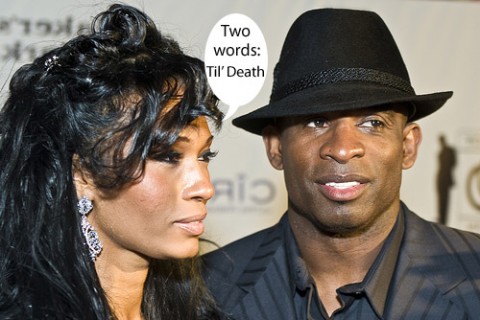
Dayum, Prime Time! According to TMZ , Deion’s list of transgressions only starts with telling the world he was chucking Pilar the deuces before telling her. But she still wants her man. Pilar Sanders’ lawyer, Larry Friedman, tells us she was “heartbroken and surprised when [she] read … that Deion announced his decision, on his own, to end their marriage.” Pilar’s lawyer adds, “Pilar’s sole focus and top priority for the last 12.5 years has been her marriage and children. Based on recent discoveries, [Pilar] now realizes that Deion did not view their family the same way.” Friedman would not reveal any details about the “recent discoveries” to which he referred. Friedman tells us Pilar has NOT negotiated a divorce settlement with Deion — but says she fully intends to protect herself and her children. Translation — this divorce ain’t gonna come cheap. Still, Pilar says she isn’t 100% convinced the marriage is dead … chalking up Deion’s recent behavior to a “temporary lapse of judgment” … and insisting she’s “confident that he will come to his senses and return to his family as he has in the past.” Oooh. Giiiiiirrrrl. Please keep your dignity and children in mind…
One of the most anticipated titles among circles who enjoy male strippers and movies is the upcoming Steven Soderbergh drama Magic Mike — a movie about male strippers that allegedly lured the filmmaker away from early retirement . At long last, a first image from the project has surfaced featuring Alex Pettyfer, Matthew McConaughey and Channing Tatum striking a pose onstage for what promises to be a very patriotic (and erotic) dance number. You know what this means, fellow Movieliners — grab the nearest captioning pen and stack of singles. Where to even begin? McConaughey appears in classic McConaughey fashion ( shirtless ). Tatum appears in classic G.I. Joe franchise-star fashion (in camouflage). For further captioning reference, the official premise of Magic Mike is as follows: “Veteran male stripper Magic Mike (Tatum) teaches a new male stripper (Pettyfer) about the occupation. They work at the club Xquisite, which is owned by the former male stripper Dallas (McConaughey).” The project is inspired by Tatum’s experiences as a teenage stripper in Florida. Joe Manganiello (also pictured above) co-stars as Big Dick Richie. Magic Mike is scheduled for a June 29, 2012, release. Let the captioning begin! Follow Julie Miller on Twitter . Follow Movieline on Twitter .
Writer/director Dee Rees has spent six years with Pariah , a film she wrote as a full-length script in 2005, then recalibrated as a short subject in ’07, and finally re-adapted as a feature film that premiered at this year’s Sundance Film Festival. Pariah concerns a teenager named Alike (Independent Spirit Award nominee Adepero Oduye), an expressive girl who only encounters more identity issues as she tries establishing herself as an out lesbian. Though Rees came out as a lesbian in her 20s, she feels a deep connection to Alike — especially in her resistance to “butch” and “femme” labels. Movieline caught up with Rees to discuss Pariah ‘s wonderful story, the visibility of the LGBT coming out experience in 2011, and Rees’s unexpected connection to Dallas . Since Pariah ’s genesis as a short film years ago, there’s been a lot more visibility about the coming-out experience. Did you find it necessary to tailor the movie to the burgeoning sense of awareness about the topic? When I first wrote the script in ’05, I had a sense of who Alike was and where she was going, so there was no pressure to change it because I wanted to stay true to her and what her experience was. I didn’t want to make Alike’s experience vary from anyone else’s experience or make it topical. I just let it be what it was and just trustd that if we’re honest about the character and honest about the world, that it would be relevant no matter when it came out. It’s funny because some people along the way have said, “Is this an issue anymore? Is being gay cool now?” And it’s like, no. It’s not OK now, and it’s not “cool.” Although people’s experiences of coming out are changing and it’s becoming much more visible, that’s not necessarily everyone’s experience. It was about remaining true to the character and what this story was. I’m glad to see that coming out is relevant and people are aware of it, but I definitely didn’t feel compelled to make it fit anything. You’ve said that you came out in your 20s, but you wrote about the coming-out experience of a teenage girl. How did you find the inspiration for her character? It was just my own coming-out experience sort of transposed onto a 17-year-old. I chose to make her 17 because it’s such a higher-stakes age; figuring stuff out that young, it’s going to be higher because you’re still dependent on your parents and so much is still uncertain about you. You don’t know what you’re going to be. For her to make that discovery at that age, it makes her more interesting. For me, it’s also inspired by being in New York and being among out teenagers, which is something I’d never seen in Nashville, Tennessee. I barely saw out adults. To see out teenagers who were not only out, but out in the streets was inspiring for me. It made me wonder, “Even if I had known at 17, would I have that courage to be the person in the film?” – this woman who was trying to live in two worlds. Do you have particular favorite teenager characters from movies? No, not really! I just like Alike because she’s imperfect. Initially she isn’t courageous. In teen movies, we see characters who get to say exactly what’s on their mind and say what they want and thumb their nose in the face of adult authority. For Alike, I wanted someone who didn’t feel quite comfortable – someone who’s not so self-possessed, not so self-assured, and is figuring things out. Pariah ’s lead actress Adepero Oduye just earned an Independent Spirit Award nomination. Can you describe watching her on set? What did she bring to the character? Watching her on set was an experience of watching her inner life. Adepero is so expressive and yet so subtle. It was great to watch changes going on in her eyes and going on in her body language and behavior – those unspoken things. I felt like I was watching her internalize the characters’ feelings. She was really in that moment. She was really feeling what Alike was feeling. The feeling like she wanted to cry, feeling like she wanted to laugh – the changes were literally visceral. They were changing her, moving through her body. Getting to watch somebody unfold on camera is like watching a flower open. Amazing. In recent years, we’ve seen more in the media about gay men’s coming out experiences than lesbians’. Do you think Pariah highlights the specificity of a woman’s coming-out? I think Pariah highlights that there’s this gray area within the gay or lesbian community. Sometimes there’s a pressure to check a box, to either be hard and be butch or be feminine and wear heels. Alike’s neither of those things, so there’s a gray area. And her coming-out experience is different because she’s coming into a different space. Alike’s not figuring out if she’s gay – she knows she loves women, that’s not her question. It’s more “How [do I] be in the world?” The first half hour isn’t “Am I gay?” It’s, “Laura’s telling me I should be butch. Mom’s telling me I should be femme.” Versus other coming out experiences, like… when she’s wearing the club clothes, that’s not really her. When she changes into this different thing for Mom, she’s not that either. We don’t see her changing from her true self into another self – she’s neither of things she’s taking on or off. We don’t know who she is. She doesn’t really want to be this butch lesbian. She just wants to be Alike. You’ve been talking about this project everywhere for years and years. You’re the Carmen Sandiego of the indie film circuit. Which was the best kids’ game show ever! Indeed! What have you gained from spending so much time introducing the film to festival audiences? Specifically from being on tour with the film, I’ve gained a huge connection with audiences – an affirmation that we told the story truthfully. To your point, we weren’t writing it based on what people were saying or what was going on in the world. We stayed in a cocoon and wrote this thing. When we finished, we didn’t know how people would respond. But people felt we told a story and were honest with the experience, so we gained a feeling of affirmation. And personally, having gone from a point where when I was coming out and I was not quite sure the world that the world would accept me for who I have, or not quite sure that I could be loved or find love, and going to this press tour and seeing audiences embrace the film and saying, “We love you,” Pariah basically gave me the courage to be who I am. I came out behind the shield of this film. This tour has been this amazing wash of affirmation and love. It makes me feel good about audiences. They’re smart and progressive and open. They’re willing to see stories beyond themselves, images that don’t exactly look like them. It restored my faith in cinemagoers. They are hungering for good stories and are willing to step outside their experience to get them. Lastly, what do you have coming up? I imagine your new projects differ from Pariah because this movie is so emotional. One project coming up is called Large Print , a spec script I did, which is about a 50-something insurance adjuster who is recently divorced and lately incontinent, and has to redefine happiness for herself. Though she’s 56, it’s still a coming-of-age story. It’s going to be an emotional film because she’s played life by the rules and nothing’s turned out the way she’s expected. The other film I’m writing is called Bolo , a thriller set in the south. It’s also about, “What is home?” What if where you grew up changes? How do you accept that? Though it has more of a genre element, it goes back to these human things. I’m working on a TV series with HBO and Viola Davis about corruption in education, which will be cool. I’m working on another TV series called Reveal set in Nashville. It’s Dallas meets The Wire , about a city going through an identity crisis. I continue to be drawn to characters, and characters that are flawed especially. I love exploring flawed people trying to make their way. Did you just say “ Dallas meets The Wire ?” Yeah! Do you know how exciting that is? Ha! We’ll see! Dallas was the soap growing up. All my aunts gathered around the TV. We should not have been the target audience for Dallas . Pariah debuts in limited U.S. release December 28. Follow Louis Virtel on Twitter . Follow Movieline on Twitter .
Marlene Dietrich is one of the most talented, intelligent, and iconic actors of all time, and not just because everyone from Madeline Kahn to Madonna and Suzanne Vega has invoked her image with staggering results. The ferocious screen icon and cabaret star is the very definition of a vision , a cutting and defiant actress with gusto and guts galore. On the occasion of her 110th birthday, let’s commemorate her finest work. Though she garnered an Oscar nod for her turn in 1930′s Morocco , there can be no mistaking Dietrich’s amazing, beguiling work in 1957′s Witness for the Prosecution . As the mysterious wife of an accused murderer (Tyrone Power, in his last role), Dietrich tears up the screen with dramatic testimonies, cryptic declarations, and the icy conviction of a Teutonic high priestess. Here’s the climactic scene, wherein she reveals her entire plans to the dumbfounded Wilfred Robards (Charles Laughton). What’s your favorite Marlene moment? Follow Louis Virtel on Twitter . Follow Movieline on Twitter .
Marlene Dietrich is one of the most talented, intelligent, and iconic actors of all time, and not just because everyone from Madeline Kahn to Madonna and Suzanne Vega has invoked her image with staggering results. The ferocious screen icon and cabaret star is the very definition of a vision , a cutting and defiant actress with gusto and guts galore. On the occasion of her 110th birthday, let’s commemorate her finest work. Though she garnered an Oscar nod for her turn in 1930′s Morocco , there can be no mistaking Dietrich’s amazing, beguiling work in 1957′s Witness for the Prosecution . As the mysterious wife of an accused murderer (Tyrone Power, in his last role), Dietrich tears up the screen with dramatic testimonies, cryptic declarations, and the icy conviction of a Teutonic high priestess. Here’s the climactic scene, wherein she reveals her entire plans to the dumbfounded Wilfred Robards (Charles Laughton). What’s your favorite Marlene moment? Follow Louis Virtel on Twitter . Follow Movieline on Twitter .