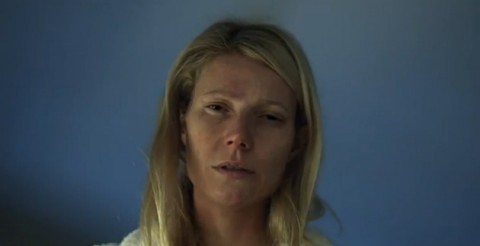
When it all boils down to it, Gwyneth Paltrow , Oscar-winning actress-megamillionaire celebrity-Gleek-blogger extraordinaire, is just like us: She is so getting wasted on New Year’s Eve. Sure, her morning-after hangover advice includes words like “quinoa” and “Turkish Hammam,” but still! Gwyneth’s advice is mostly medically sensible-sounding, though I can’t promise your pocketbooks will appreciate these fancy tricks. Get her five best tips (*as parsed by your helpful Movieline editors) after the jump so you can battle the blinding, alcohol-induced post-binge blahs in grand Paltrow fashion come Sunday morning. Below, the five most useful selections from a GOOP newsletter post entitled ” The Hangover! “, which is accompanied by this message: “We all know what happens on NYE so here is our best to help you prepare for the day after… – Love, gp.” Oh, but first: Gwyneth gives us the official definition of a hangover, courtesy of Dr. Frank Lipman : “The reason why one gets a hangover is that your body – your liver in particular – is not able to process and metabolize the break down products from the alcohol quickly enough. In addition to needing enough enzymes, the liver also needs water to process and get rid of the toxins. When supplies run low, it takes water from other organs, including the brain. This is why alcohol is so dehydrating, and why you can wake up with a throbbing headache (and a dry mouth) from drinking too much.” Now you know. On to Gwyneth’s advice! 1. Visit a Turkish Hammam. Or a Japanese spa. Or, fine — just take a bath. “If you have the time and the inclination, I’ve found that the best hangover remedy can be a hot and cold spa treatment. The original would be the traditional Turkish Hamman,[sic] but you can find this kind of treatment in spas all over the world, including my favorites, the low-key Japanese spas in New York, like Osaka.” 2. Hydrate with expensive European water. “Hydration. Keep hydrating yourself with alkaline forming Italian sparkling mineral water ie Pellegrino.” 3. Ingest ” bioavailable ” vitamin protein drink thingies. “Eat properly before and after your evening by including protein and low glycemic index foods (solid fruits, watermelon, etc ) to counteract the sugar depletion caused by alcohol…The perfect protein drink to ingest before bed would be Nutritious and Delicious – 15 grams of protein, 2 grams of fat, 19 grams of carbohydrate no gluten, no soy.” 4. Eat protein- and carb-packed foodstuffs before your drinking binge. Good foods to eat, cited by Paltrow and her host of medical experts, include: Quinoa, chicken, fish, vegetables, watermelon, coconut water, Gatorade, ginger ale, Probiotic mints, Manuka honey sweets. 5. Take “Mercy,” a fantastic product that — my stars! — Paltrow also co-owns. “Full disclosure, this stuff is so good that I went ahead and invested in the company. Mercy is a drink that is almost like a health elixir – packed with amino acids, vitamins, minerals and herbs that protect your system against the inevitable hangover and that flush you can get from drinking. You can drink it alone or mix it with alcohol to create a hangover preventing cocktail. I also drink one if I’m just feeling tired to give my system a boost.” Or, finally — and we could’ve told you this one — nurse that pounding headache with a little hair o’ the dog. Study up on even more Paltrow-endorsed bioflavono-whatsit-packed tips over at GOOP , and have a safe New Year’s Eve! You don’t want to end up looking like this on New Year’s Day, do you? [via GOOP ]
There’ve been updates about The Paperboy ‘s casting for awhile, but only now do I realize the gravity of what’s occurring. Um, wow: Nicole Kidman and Zac Efron are sharing a screen! And John Cusack! And Matthew McConaughey, for the hell of it! And — what now? — Lee Daniels is directing! They should call this quaint tale Extra Precious: Based on the Cutie ‘Zac’ by Efron . Synopsis and impressive poster after the jump. Downright old-fashioned and sharp. Reminds me of Young Adult ‘s evocative cover in coloring and detail. From a distance, Mr. Efron’s cheeks look a tad more pregnant than they usually do. I know what you’re thinking, and let me assure you: I’m the father. The Paperboy concerns a reporter who returns to his hometown to save a man on death row, though he’s derailed by the romance he strikes up with the inmate’s lady friend. I have the feeling we won’t get a juicy character study worthy of Nicole Kidman’s involvement in this movie, and that sucks because I’m still reeling from Rabbit Hole . Still, I’m in for Zac Efron’s sacred facial architecture. He’s like a cathedral of tawny hotness. Paperboy Poster [GossipCop]
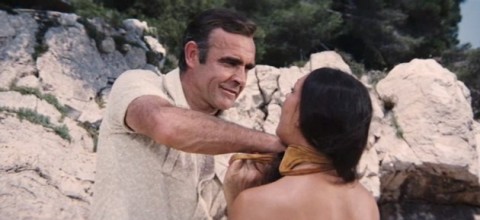
Forty years ago this Friday, United Artists released Diamonds Are Forever — the seventh entry in the James Bond series, and one that dragged founding franchise star Sean Connery out of 007 retirement in the hopes of rinsing the bad taste that his replacement, George Lazenby, left in moviegoers’ mouths in the 1969 film On Her Majesty’s Secret Service . Connery succeeded, but only by making what remains arguably the silliest Bond film to date. Enfolding globetrotting jewel smugglers, reclusive Las Vegas casino barons, effete hit men, bikinied enforcers named after cartoons, lunar-landing conspiracy bait, cosmetically enhanced villain-doppelgangers, and more one-liners than a decade’s worth of White House Correspondents Dinners, Diamonds Are Forever is campier than a dome tent and almost as vacant. I vividly remember watching it on TV as a kid, figuring its geopolitical space-race intrigues and bedhopping exploits were over my 8-year-old head. Today, after recently catching up with it for the first time in nearly 30 years, I realize that it’s basically Tinker Tailor Soldier Why? — that there is no making sense of the plot, the characters, the gays, the straights, the overlapping interests or why any of it is worth so much subterfuge and many people dying in so many gruesome ways. There is only the luxuriant enjoyment of a quintessential Bad Movie We Love. It all starts with the vengeful Bond — whose new bride was killed at the end of OHMSS — tormenting a diverse array of associates who can lead him to his murderous archnemesis Ernst Stavro Blofeld. That much is clear. Note to self: Bikini-top strangulation is a hugely tasteful way to extract information from lithe, defenseless sunbathers. Actual line: “Speak up darling, I can’t hear you!” And Bond catches him just in time, what with all the plastic surgery Blofeld’s arranging for numbers of hapless decoys. You just know this is where Saddam Hussein got the idea for lookalike bodyguards. I hesitate to include the video below, if only because the dude in the mud bath deserves every penny of royalties he earned for what looks like a hugely unpleasant bit part. Or at least his kin does, if they even deign to acknowledge, “Yup — that’s paw, awright, gettin’ all mud-shit on and hosed off and re-drowned. Hold yer nose, paw!” Or how about the guy who gets the scalpel in the heart? Whatever. Let’s just be thankful that modern cosmetic surgery has moved out of the dank, bubbling tar-pit lairs of Diamonds Are Forever . Duchess of Alba Cayetana Fitz-James Stuart knows exactly what I’m talking about. From there Commander Bond is back to Britain, where payback is brushed aside for the moment and the details of his latest mission are laid out. Sort of: There are diamond mines in South Africa! And workers are smuggling jewels out! In their mouths! To dentists! Who in turn wind up exchanging the rocks during desert rendezvous with… these guys: That would be Mr. Kidd and Mr. Wint, played with stone-like conviction by Putter Smith and Bruce “Father of Crispin” Glover, respectively. They identify themselves only by name at first, but creep back into the action wherever diamonds are found. Are they sophisticated high-class criminals proving the British Intelligence theory that someone’s hoarding diamonds to create a depression? Not so much: They’re dry, they’re wry, they’re cold-blooded… but mostly they are just creepy lovers whose homosexuality and psychopathology appear to be conflated in the film’s only truly irredeemable streak of bad taste. It’s not just that Mr. Wint can’t abide Mr. Kidd paying pretty woman a compliment, as happens later in the film (“I must say, Miss Case seems quite attractive — for a lady!”). I mean, holy Christ , check out how they celebrate a double homicide: After that, it’s anybody’s guess. Sort of, anyway: There is the selflessly, thanklessly composed Wikipedia summary for the film, which lays out a succession of convolutions that track Bond from Amsterdam — where he poses as diamond smuggler Peter Franks and encounters Franks’s clothes-allergic peer Tiffany Case (Jill St. John, always my favorite Bond Girl after Eva Green. Well, and Maryam D’Abo, of course ) — to Los Angeles to Las Vegas. But only after Bond kills the real Peter Franks in a three-minute elevator fight and fatal fire-extinguisher blow — but not the way you might think. The diamonds are hidden inside Franks’s body, leading to Kidd and Wint’s attempt to cremate Bond, who is then saved by the wizened Sin City comic Shady Tree, who is in cahoots with the CIA, who meets his own regrettable demise at the hands of our gay assassins. Following? With comebacks like this, does it matter? Originally scripted by Richard Maibaum, Diamonds Are Forever received a near-total rewrite by Tom Mankiewicz — the son of Oscar-winner Joseph L. Mankiewicz — who was brought on to soup up a screenplay that would entice Connery to return as Bond. The results were not only a six-month stay on the project and a nearly 10-year stint with the Bond franchise, but a film with its tongue embedded so deep in its cheek it left a bruise. While steering the 007 franchise to the outer limits of levity, it also resulted in such extraordinary interludes as this one with craps maiden Plenty O’Toole: Let’s hear it for Lana “Sister of Natalie” Wood! She only solidifies her finest screen performance moments later with a topless defenestration into a pool from Bond’s hotel suite (“I’ve got friends in this toowwwwnnnn…”), but still: This is Connery and St John’s film. And it still makes no sense: Something about a reclusive billionaire hotel owner (Bond producer Albert Broccoli was inspired to include Willard Whyte after a dream in which his close friend Howard Hughes had a deadly double) with a top secret lab out in the desert, where Bond and Case achieve basically zero plot mobility but initiate consecutive car chases featuring both a lunar-stage moon buggy… … and and a ’71 Mustang, which… I mean… You really must watch it once and then play it back just to hear those vintage sound FX harmonize. It’s not like director Guy Hamilton purposely left off the score — that is the score: And you know what? For all the fancy driving throughout, I’m ultimately much fonder of the Clark County Sheriff, whose extraordinary perception (“There goes that son of a bitch and saboteur!”) and fearsome law-enforcement prowess deserve a nice long still-frame appreciation: And while there remains an hour more to this movie , you find yourself envisioning a glorious world where this head-cramping gaudiness and camp endure forever — where Bond scales all of the towers in Vegas, and where, inside those towers, he meets all of the cosmetically altered carbon copies of the douche who killed his wife, and that all of those baddies may disguise their voices as Blofeld does, and that you, too, may someday match his acumen after miraculously escaping from a tube buried in the Nevada desert: And, of course, where all the watchdogs in the world have been replaced by comely, backhanded commentaries on the Equal Rights Movement. Ahem . I’m no more certain of what happens in the rest of Diamonds Are Forever than I was decades ago — something about Blofeld stockpiling diamonds to build a killer satellite, which apparently doubles as an excuse for Bond to blow the shit out of a SPECTRE base disguised as an oil well off the coast of Mexico. But there is no mistaking what’s going on in the climactic showdown between Bond and Messrs. Wint and Kidd, which is to say: Beating Airplane! at its own sight-gag-and-sound-effect game nearly 10 years ahead of time. Happy anniversary, Diamonds Are Forever ! Bombe surprise for everyone! Follow S.T. VanAirsdale on Twitter . Follow Movieline on Twitter .
Some of you may be tempted to BitTorrent the latest new releases this week (Were you one of those Fast Five pirates ? Admit it, rascal!), but let indie filmmaker Ti West bend your ear with a personal plea as his latest film, the spooky ghost tale The Innkeepers , hits VOD on Friday (December 30). “It’s not the money,” he writes , admitting that he still hasn’t made a dime from his excellent 2009 film House of the Devil . Pay to see indie films like West’s, he argues, “because if the movie makes money… that’s tangible evidence of a paying audience out there for movies like mine. For independent films. For something different. Not just bland remakes/sequels or live action versions of comic books/cartoons/boardgames.” Hear, hear. West pours a good deal of real talk into his open letter, and not just for potential illegal movie downloaders; he also sheds light on the realities of life as a filmmaker in the arrangement he’s struck – retaining creative vision while ceding profits to someone else. I do not own the films, and by the time any profits would trickle down to little old me (writer/director/editor/producer) they would all have been mysteriously soaked up into vague expenses, random fees and outrageous overages. This is the nature of the business and I have come to accept it. As long as I don’t own my films – something I give up in exchange for someone with much deeper pockets affording me the budgets to make them – this is how it goes. It’s a trade off and I’m fine with it. That concession alone is maddening, and yet makes sad, practical sense. House of the Devil was West’s biggest film to date and made just $101,215 theatrically via Magnolia upon release. As someone who loved it I’d argue that number was woefully, undeservedly low; it was a film that made me instantly hope to see more from its director, to see where he’d go with a little more money and a bigger profile. That chance came for me earlier this year when I caught the droll, spooky Innkeepers , and my fellow West watchers will get their chance to see it when it hits VOD this week a month ahead of its February 3 theatrical limited release. But if you need more convincing in favor of supporting films like this, whether you’re a potential pirate or an indie film lover on the fence about ticket prices, let’s go back to West: Every time you purchase something you are making a statement. You are creating physical evidence that something has value. If something has a high value, then it becomes in high demand. So if you make a concerted effort to support lesser-known, interesting and esoteric things (Art?) then you are helping make those lesser-known things more popular. I’m sure we can all agree that there are incredible movies made every year that never get the attention they deserve – That’s not the movies’ fault. That is our collective fault for not being proactive enough to GO OUT OF OUR WAY to support them. So yes, I want you to go out of your way and pay for my movie. Not because I’m greedy, but because if the movie makes money (whomever for) that’s tangible evidence of a paying audience out there for movies like mine. For independent films. For something different. Not just bland remakes/sequels or live action versions of comic books/cartoons/boardgames. This is a powerful time for the consumer. With a small platform release like ours (VOD/Theatrical) , it’s been made incredibly easy for you to support the film…You don’t even have to get out of bed. Think about what your dollars mean; they tell financiers to to keep funding outside-the-box movies so that you have more options than the latest fivequels/rom-coms/superhero movies/the dreck that folks like Katherine Heigl or Adam Sandler fart out year after year. And lastly: Where we choose to spend our money should reflect what matters to us and what we want to support. If independent film matters to you, then do me a solid and pay for the film instead of downloading it. It’s not a huge financial commitment, but it has a huge financial impact. I am not a corporation, I am not independently wealthy, I don’t come from a family of the industry…I’m just a regular dude who made a movie and wants to keep on making them. I can’t do that without your help, and it would be very much appreciated. Put it another way: More House of the Devil s/ Innkeepers and fewer Jack and Jill s or Green Lantern s is a future we would all appreciate and should aspire to. Make it so, people.
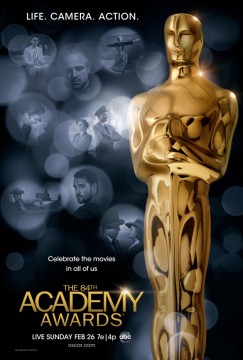
The Academy of Motion Picture Arts and Sciences has released the poster for the 84th Academy Awards, and it’s… nice? I mean, Oscar looks sexy as ever, and all those foggy images of awards-night glories past recall both the champagne-fueled afterparties and the preponderance of white folks who take this hardware home every year. But isn’t something missing? Like, the host? After all that hullabaloo about Brett Ratner and Eddie Murphy that the Academy worked to deflect, and after all the lengths that the Board of Governors went to just to replace Murphy with an ultrasafe, ultrastable emcee, and after years of advertising hosts from Chris Rock to Jon Stewart to Alec Baldwin and Steve Martin to Anne Hathaway and Anne Franco, where is Billy Crystal? If I’m a casual viewer, I’m far likelier to take positive notice of the host than of the centrally positioned reminder that Driving Miss Daisy actually won Best Picture once upon a sad, sad time. Also: Can’t we get some more color in here? Sidney Poitier? Denzel Washington? Mo’Nique? If it has to be Best Picture alums, maybe Poitier and Rod Steiger from In the Heat of the Night ? Even Anthony Mackie and Jeremy Renner from The Hurt Locker . I’m not sure what this says about the young demographic that the aging Academy claims to covet; I doubt they’re watching Giant and/or The Sound of Music . Or maybe they are! Are you “young” and obsessive-compulsively watching Gone With the Wind on a DVD loop in honor of white, uptight, vaunted Academy legacies? Tell us in the comments! [via Awards Daily ]
One of the most anticipated titles among circles who enjoy male strippers and movies is the upcoming Steven Soderbergh drama Magic Mike — a movie about male strippers that allegedly lured the filmmaker away from early retirement . At long last, a first image from the project has surfaced featuring Alex Pettyfer, Matthew McConaughey and Channing Tatum striking a pose onstage for what promises to be a very patriotic (and erotic) dance number. You know what this means, fellow Movieliners — grab the nearest captioning pen and stack of singles. Where to even begin? McConaughey appears in classic McConaughey fashion ( shirtless ). Tatum appears in classic G.I. Joe franchise-star fashion (in camouflage). For further captioning reference, the official premise of Magic Mike is as follows: “Veteran male stripper Magic Mike (Tatum) teaches a new male stripper (Pettyfer) about the occupation. They work at the club Xquisite, which is owned by the former male stripper Dallas (McConaughey).” The project is inspired by Tatum’s experiences as a teenage stripper in Florida. Joe Manganiello (also pictured above) co-stars as Big Dick Richie. Magic Mike is scheduled for a June 29, 2012, release. Let the captioning begin! Follow Julie Miller on Twitter . Follow Movieline on Twitter .
Writer/director Dee Rees has spent six years with Pariah , a film she wrote as a full-length script in 2005, then recalibrated as a short subject in ’07, and finally re-adapted as a feature film that premiered at this year’s Sundance Film Festival. Pariah concerns a teenager named Alike (Independent Spirit Award nominee Adepero Oduye), an expressive girl who only encounters more identity issues as she tries establishing herself as an out lesbian. Though Rees came out as a lesbian in her 20s, she feels a deep connection to Alike — especially in her resistance to “butch” and “femme” labels. Movieline caught up with Rees to discuss Pariah ‘s wonderful story, the visibility of the LGBT coming out experience in 2011, and Rees’s unexpected connection to Dallas . Since Pariah ’s genesis as a short film years ago, there’s been a lot more visibility about the coming-out experience. Did you find it necessary to tailor the movie to the burgeoning sense of awareness about the topic? When I first wrote the script in ’05, I had a sense of who Alike was and where she was going, so there was no pressure to change it because I wanted to stay true to her and what her experience was. I didn’t want to make Alike’s experience vary from anyone else’s experience or make it topical. I just let it be what it was and just trustd that if we’re honest about the character and honest about the world, that it would be relevant no matter when it came out. It’s funny because some people along the way have said, “Is this an issue anymore? Is being gay cool now?” And it’s like, no. It’s not OK now, and it’s not “cool.” Although people’s experiences of coming out are changing and it’s becoming much more visible, that’s not necessarily everyone’s experience. It was about remaining true to the character and what this story was. I’m glad to see that coming out is relevant and people are aware of it, but I definitely didn’t feel compelled to make it fit anything. You’ve said that you came out in your 20s, but you wrote about the coming-out experience of a teenage girl. How did you find the inspiration for her character? It was just my own coming-out experience sort of transposed onto a 17-year-old. I chose to make her 17 because it’s such a higher-stakes age; figuring stuff out that young, it’s going to be higher because you’re still dependent on your parents and so much is still uncertain about you. You don’t know what you’re going to be. For her to make that discovery at that age, it makes her more interesting. For me, it’s also inspired by being in New York and being among out teenagers, which is something I’d never seen in Nashville, Tennessee. I barely saw out adults. To see out teenagers who were not only out, but out in the streets was inspiring for me. It made me wonder, “Even if I had known at 17, would I have that courage to be the person in the film?” – this woman who was trying to live in two worlds. Do you have particular favorite teenager characters from movies? No, not really! I just like Alike because she’s imperfect. Initially she isn’t courageous. In teen movies, we see characters who get to say exactly what’s on their mind and say what they want and thumb their nose in the face of adult authority. For Alike, I wanted someone who didn’t feel quite comfortable – someone who’s not so self-possessed, not so self-assured, and is figuring things out. Pariah ’s lead actress Adepero Oduye just earned an Independent Spirit Award nomination. Can you describe watching her on set? What did she bring to the character? Watching her on set was an experience of watching her inner life. Adepero is so expressive and yet so subtle. It was great to watch changes going on in her eyes and going on in her body language and behavior – those unspoken things. I felt like I was watching her internalize the characters’ feelings. She was really in that moment. She was really feeling what Alike was feeling. The feeling like she wanted to cry, feeling like she wanted to laugh – the changes were literally visceral. They were changing her, moving through her body. Getting to watch somebody unfold on camera is like watching a flower open. Amazing. In recent years, we’ve seen more in the media about gay men’s coming out experiences than lesbians’. Do you think Pariah highlights the specificity of a woman’s coming-out? I think Pariah highlights that there’s this gray area within the gay or lesbian community. Sometimes there’s a pressure to check a box, to either be hard and be butch or be feminine and wear heels. Alike’s neither of those things, so there’s a gray area. And her coming-out experience is different because she’s coming into a different space. Alike’s not figuring out if she’s gay – she knows she loves women, that’s not her question. It’s more “How [do I] be in the world?” The first half hour isn’t “Am I gay?” It’s, “Laura’s telling me I should be butch. Mom’s telling me I should be femme.” Versus other coming out experiences, like… when she’s wearing the club clothes, that’s not really her. When she changes into this different thing for Mom, she’s not that either. We don’t see her changing from her true self into another self – she’s neither of things she’s taking on or off. We don’t know who she is. She doesn’t really want to be this butch lesbian. She just wants to be Alike. You’ve been talking about this project everywhere for years and years. You’re the Carmen Sandiego of the indie film circuit. Which was the best kids’ game show ever! Indeed! What have you gained from spending so much time introducing the film to festival audiences? Specifically from being on tour with the film, I’ve gained a huge connection with audiences – an affirmation that we told the story truthfully. To your point, we weren’t writing it based on what people were saying or what was going on in the world. We stayed in a cocoon and wrote this thing. When we finished, we didn’t know how people would respond. But people felt we told a story and were honest with the experience, so we gained a feeling of affirmation. And personally, having gone from a point where when I was coming out and I was not quite sure the world that the world would accept me for who I have, or not quite sure that I could be loved or find love, and going to this press tour and seeing audiences embrace the film and saying, “We love you,” Pariah basically gave me the courage to be who I am. I came out behind the shield of this film. This tour has been this amazing wash of affirmation and love. It makes me feel good about audiences. They’re smart and progressive and open. They’re willing to see stories beyond themselves, images that don’t exactly look like them. It restored my faith in cinemagoers. They are hungering for good stories and are willing to step outside their experience to get them. Lastly, what do you have coming up? I imagine your new projects differ from Pariah because this movie is so emotional. One project coming up is called Large Print , a spec script I did, which is about a 50-something insurance adjuster who is recently divorced and lately incontinent, and has to redefine happiness for herself. Though she’s 56, it’s still a coming-of-age story. It’s going to be an emotional film because she’s played life by the rules and nothing’s turned out the way she’s expected. The other film I’m writing is called Bolo , a thriller set in the south. It’s also about, “What is home?” What if where you grew up changes? How do you accept that? Though it has more of a genre element, it goes back to these human things. I’m working on a TV series with HBO and Viola Davis about corruption in education, which will be cool. I’m working on another TV series called Reveal set in Nashville. It’s Dallas meets The Wire , about a city going through an identity crisis. I continue to be drawn to characters, and characters that are flawed especially. I love exploring flawed people trying to make their way. Did you just say “ Dallas meets The Wire ?” Yeah! Do you know how exciting that is? Ha! We’ll see! Dallas was the soap growing up. All my aunts gathered around the TV. We should not have been the target audience for Dallas . Pariah debuts in limited U.S. release December 28. Follow Louis Virtel on Twitter . Follow Movieline on Twitter .
Writer/director Dee Rees has spent six years with Pariah , a film she wrote as a full-length script in 2005, then recalibrated as a short subject in ’07, and finally re-adapted as a feature film that premiered at this year’s Sundance Film Festival. Pariah concerns a teenager named Alike (Independent Spirit Award nominee Adepero Oduye), an expressive girl who only encounters more identity issues as she tries establishing herself as an out lesbian. Though Rees came out as a lesbian in her 20s, she feels a deep connection to Alike — especially in her resistance to “butch” and “femme” labels. Movieline caught up with Rees to discuss Pariah ‘s wonderful story, the visibility of the LGBT coming out experience in 2011, and Rees’s unexpected connection to Dallas . Since Pariah ’s genesis as a short film years ago, there’s been a lot more visibility about the coming-out experience. Did you find it necessary to tailor the movie to the burgeoning sense of awareness about the topic? When I first wrote the script in ’05, I had a sense of who Alike was and where she was going, so there was no pressure to change it because I wanted to stay true to her and what her experience was. I didn’t want to make Alike’s experience vary from anyone else’s experience or make it topical. I just let it be what it was and just trustd that if we’re honest about the character and honest about the world, that it would be relevant no matter when it came out. It’s funny because some people along the way have said, “Is this an issue anymore? Is being gay cool now?” And it’s like, no. It’s not OK now, and it’s not “cool.” Although people’s experiences of coming out are changing and it’s becoming much more visible, that’s not necessarily everyone’s experience. It was about remaining true to the character and what this story was. I’m glad to see that coming out is relevant and people are aware of it, but I definitely didn’t feel compelled to make it fit anything. You’ve said that you came out in your 20s, but you wrote about the coming-out experience of a teenage girl. How did you find the inspiration for her character? It was just my own coming-out experience sort of transposed onto a 17-year-old. I chose to make her 17 because it’s such a higher-stakes age; figuring stuff out that young, it’s going to be higher because you’re still dependent on your parents and so much is still uncertain about you. You don’t know what you’re going to be. For her to make that discovery at that age, it makes her more interesting. For me, it’s also inspired by being in New York and being among out teenagers, which is something I’d never seen in Nashville, Tennessee. I barely saw out adults. To see out teenagers who were not only out, but out in the streets was inspiring for me. It made me wonder, “Even if I had known at 17, would I have that courage to be the person in the film?” – this woman who was trying to live in two worlds. Do you have particular favorite teenager characters from movies? No, not really! I just like Alike because she’s imperfect. Initially she isn’t courageous. In teen movies, we see characters who get to say exactly what’s on their mind and say what they want and thumb their nose in the face of adult authority. For Alike, I wanted someone who didn’t feel quite comfortable – someone who’s not so self-possessed, not so self-assured, and is figuring things out. Pariah ’s lead actress Adepero Oduye just earned an Independent Spirit Award nomination. Can you describe watching her on set? What did she bring to the character? Watching her on set was an experience of watching her inner life. Adepero is so expressive and yet so subtle. It was great to watch changes going on in her eyes and going on in her body language and behavior – those unspoken things. I felt like I was watching her internalize the characters’ feelings. She was really in that moment. She was really feeling what Alike was feeling. The feeling like she wanted to cry, feeling like she wanted to laugh – the changes were literally visceral. They were changing her, moving through her body. Getting to watch somebody unfold on camera is like watching a flower open. Amazing. In recent years, we’ve seen more in the media about gay men’s coming out experiences than lesbians’. Do you think Pariah highlights the specificity of a woman’s coming-out? I think Pariah highlights that there’s this gray area within the gay or lesbian community. Sometimes there’s a pressure to check a box, to either be hard and be butch or be feminine and wear heels. Alike’s neither of those things, so there’s a gray area. And her coming-out experience is different because she’s coming into a different space. Alike’s not figuring out if she’s gay – she knows she loves women, that’s not her question. It’s more “How [do I] be in the world?” The first half hour isn’t “Am I gay?” It’s, “Laura’s telling me I should be butch. Mom’s telling me I should be femme.” Versus other coming out experiences, like… when she’s wearing the club clothes, that’s not really her. When she changes into this different thing for Mom, she’s not that either. We don’t see her changing from her true self into another self – she’s neither of things she’s taking on or off. We don’t know who she is. She doesn’t really want to be this butch lesbian. She just wants to be Alike. You’ve been talking about this project everywhere for years and years. You’re the Carmen Sandiego of the indie film circuit. Which was the best kids’ game show ever! Indeed! What have you gained from spending so much time introducing the film to festival audiences? Specifically from being on tour with the film, I’ve gained a huge connection with audiences – an affirmation that we told the story truthfully. To your point, we weren’t writing it based on what people were saying or what was going on in the world. We stayed in a cocoon and wrote this thing. When we finished, we didn’t know how people would respond. But people felt we told a story and were honest with the experience, so we gained a feeling of affirmation. And personally, having gone from a point where when I was coming out and I was not quite sure the world that the world would accept me for who I have, or not quite sure that I could be loved or find love, and going to this press tour and seeing audiences embrace the film and saying, “We love you,” Pariah basically gave me the courage to be who I am. I came out behind the shield of this film. This tour has been this amazing wash of affirmation and love. It makes me feel good about audiences. They’re smart and progressive and open. They’re willing to see stories beyond themselves, images that don’t exactly look like them. It restored my faith in cinemagoers. They are hungering for good stories and are willing to step outside their experience to get them. Lastly, what do you have coming up? I imagine your new projects differ from Pariah because this movie is so emotional. One project coming up is called Large Print , a spec script I did, which is about a 50-something insurance adjuster who is recently divorced and lately incontinent, and has to redefine happiness for herself. Though she’s 56, it’s still a coming-of-age story. It’s going to be an emotional film because she’s played life by the rules and nothing’s turned out the way she’s expected. The other film I’m writing is called Bolo , a thriller set in the south. It’s also about, “What is home?” What if where you grew up changes? How do you accept that? Though it has more of a genre element, it goes back to these human things. I’m working on a TV series with HBO and Viola Davis about corruption in education, which will be cool. I’m working on another TV series called Reveal set in Nashville. It’s Dallas meets The Wire , about a city going through an identity crisis. I continue to be drawn to characters, and characters that are flawed especially. I love exploring flawed people trying to make their way. Did you just say “ Dallas meets The Wire ?” Yeah! Do you know how exciting that is? Ha! We’ll see! Dallas was the soap growing up. All my aunts gathered around the TV. We should not have been the target audience for Dallas . Pariah debuts in limited U.S. release December 28. Follow Louis Virtel on Twitter . Follow Movieline on Twitter .
Surprises too are often tied to expectation, or lack of it. The first film I saw in 2011 surprised me in part because it was the first film I saw in 2011 — that is, a film shunted onto the whistling heath of the January release schedule. It was Shana Feste’s Country Strong , and it got a raw deal. Casting Gwyneth Paltrow as a country superstar is either a brave decision or an incredibly timid one — regardless, Paltrow stepped into an outsized role and very nearly filled it out. The supporting cast of Leighton Meester, Tim McGraw, and especially Garrett Hedlund give the celebrity melodrama human ballast, and Feste manages to pace a pretty slick story with moments of believable intimacy and alienation. When it comes to horror films and especially on-screen gore (I suppose off-screen gore as well), I am — as Justin Timberlake’s character pronounced it in the reasonably surprising Friends With Benefits — a huge pu-ssay. Seeing Final Destination 5 next to my name on the assignment slate was a definite short straw situation, but I fancy myself a professional, and so cleared my schedule and my appetite and headed to midtown. I had never seen a Final Destination , which accounted for the formula’s novelty for me — the villain here is death itself, manifested in the trickle down economics of excruciating coincidence — but the film, shot in 3-D, is also brilliantly choreographed and possessed of the kind of tension — outrageous but not totally gratuitous — that directors rarely bother with anymore, when splatters and shakey cams do just as well. Not that there aren’t — heaven knows — plenty of guts a-squishin’ in Final Destination 5 . But it was worth a few pounds of flesh to be reminded how pleasurable it is to be both really and truly scared and perfectly safe in a crowded movie theater. So a quick check-in on the Friends alumni: Most promising cast member Jennifer Aniston seems resigned to debasing herself in Adam Sandler shitshows like Just Go With It ; Matthew Perry, always rebounding in my heart, is as ever poised for a comeback; Lisa Kudrow keeps launching hothouse comic series that feel too cringey to last; Courtney Cox has a network show and yet seems to spend her days fastened to a mirror; Matt LeBlanc came up with something interesting in the meta-TV cable series Episodes ; and David Schwimmer pretty much killed it directing his second feature film, the internet predator drama Trust . Clive Owen gives a powerful and difficult performance as a father reckoning with his daughter’s role in her own victimization and Liana Liberato makes a frankly astonishing debut as a young girl drawn into the emotional confusions of abuse. In deploying real emotional toughness against easy accusations of after-school special-dom, it is Schwimmer who emerges as the mature and still-promising talent. I was surprised, anyway. Though it’s not strictly movie-centric, I feel compelled to note one of the most pleasant surprises of my favorite new television series — the venue, after all, to which so many of our movie stars have migrated. Luke Wilson hit an inexplicable rough patch in the late aughts, his endearing, chronically bedazzled comic presence and magma-deep melancholy wasted on minnow-ish indies like Middle Men and I Melt With You director Mark Pellington’s Henry Poole Was Here . And then his disheartening appearance in the ads that cannot be named. But in playing the innocuous waster Levi Callow in Mike White’s HBO series Enlightened , Wilson seems to have not only returned to form but raised his game. White cast the role perfectly, and dispenses the character of Levi in precise and exact-right doses: Initially seen through the warped lens of Laura Dern’s Amy — a recent inductee into the narcissistic cult of well being — he emerges as more than a pathetic fallback and projection screen for his ex. In the exquisite Robin Wright episode, by making Levi’s exasperation his own White brings Amy’s desperation into clearer view. In a later confrontation with Amy’s mother (Diane Ladd) Levi is finally unleashed as a whole, seething person. Wilson makes what might be an ordinary role feel risky, and in his fringy yet essential presence sets up the question of whether Levi is a poignant satellite in Amy’s orbit or she is a moon to his Melancholia. I’m really happy to be watching Luke Wilson again, is mostly what I’m saying — on any screen. Happy and a little bit relieved. Follow Michelle Orange on Twitter . Follow Movieline on Twitter .
A slumpy month at the box office showed little sign of abating on Friday, when the holdovers Mission: Impossible – Ghost Protocol , Sherlock Holmes: A Game of Shadows and Alvin and the Chipmunks: Chipwrecked fought off a trio of high-octane newcomers — including the abysmally performing We Bought a Zoo — to lead the early holiday-weekend competition. Your Friday Box Office is here. 1. MISSION: IMPOSSIBLE – GHOST PROTOCOL : $9,740,000 ($42,175,000) 2. SHERLOCK HOLMES: A GAME OF SHADOWS : $6,785,000 ($65,539,000) 3. ALVIN AND THE CHIPMUNKS: CHIPWRECKED : $5,400,000 ($42,340,000) 4. THE GIRL WITH THE DRAGON TATTOO : $4,600,000 ($12,976,000) 5. THE ADVENTURES OF TINTIN : $3,525,000 ($11,532,000) 6. WE BOUGHT A ZOO : $3,000,000 (new) [Figures via Box Office Mojo ]