Tag Archives: philosophy

‘Limitless’: Five Secrets Revealed

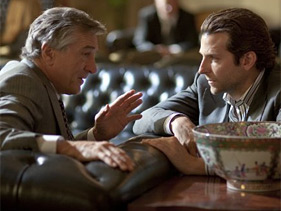
Director Neil Burger takes us behind the scenes of Bradley Cooper and Robert De Niro’s new thriller. By Eric Ditzian Robert DeNiro and Bradley Cooper in “Limitless” Photo: Universal Pictures There is a scene midway through “Limitless” in which Abbie Cornish’s character is running through a park, attempting to escape a guy intent on gutting her like a fish. Unsure how to get away, she swallows a black-market drug called NZT — a little pill allowing her to access 100 percent of her mind — and scans the park for possible weapons: a pair of gardening sheers or a baseball bat, perhaps? Then she sees a little girl on ice skates off in the distance. Bingo! She races toward the rink as the evil dude gives chase, then picks up the girl and uses her ice skates to slice her enemy’s face. It’s a wackily kinetic scene in a thriller filled with such moments. The only problem for director Neil Burger was casting the girl to take part in the madness. “Luckily, the stunt people were completely game to offer up their child to be thrown through the air!” Burger laughed in a recent conversation with MTV News. And that, it turns out, is how Piper Brown, daughter of Jill Brown (whose stunt credits include “The Green Hornet” and “I Am Legend”), made her big-screen debut. “It was our first day of shooting, which is an insane way to begin,” Burger said. We had to do it in one day with 200 extras on the ice, plus the crew, and we’re just powering through everyone with cameras and cranes.” That’s just one of the untold stories behind the production of “Limitless” we picked up during a recent conversation with Burger. Before checking out the film, which hit theaters Friday (March 18), check out four more “Limitless” secrets revealed: Why Is NZT a Clear Pill? In creating a fictional drug for the big screen, Burger and his team could have gone in any direction. NZT could have been something you swallow or smoke or, heck, even something used as a suppository reminiscent of a troubling scene in “Trainspotting.” But following the book on which the movie is based, they stuck with a pill. What, however, would the pill that Bradley Cooper’s character gets hooked on look like? “Right up to the end, we were thinking about what this pill would be,” Burger explained. “Sometimes we thought it’d have these beveled edges or a different colored center, but it started to look like a hundred other things you’ve seen, from a Lifesaver to Skittles. Then we stumbled onto one that was clear, and I knew it was just perfect. It sums up exactly what it does for him.” What Exactly Does NZT Do? Though the story is based on a novel by Alan Glynn, it was up to Burger to “invent the rules of the drug,” as he put it. How does it affect Cooper’s Eddie Morra? What would happen if Eddie suddenly couldn’t get his fix? “I worked on it on my own, because I had to become an authority on it with the actors and crew,” he added. “It became that you don’t get high or wired or stoned. You were just clear and knew what to do and how to get it done.” Along those lines, Burger didn’t refer to any existing drugs, because there’s nothing on Earth like NZT. “I didn’t do research. I just decided what I wanted the drug to be. I wanted Eddie to become the perfect version of himself. I wanted him to remember everything he’s ever seen. It’s not that it makes him into Superman. It makes him fearless, and he’s able to access information instantaneously.” How Did They Pull Off Those Ultra-Long Zooming Shots? Often when Eddie is on NZT, the camera pushes through the cityscape in a long, seemingly continuous shot, pushing forward for miles without stop. It’s a very cool visual effect, one unlike we’ve ever seen. How the heck did they pull off what Burger calls “infinity zooms”? “I started looking at fractals,” he told us. “I liked the idea that each part they’re made up of is a mirror of the whole. And I looked at fractal zooms, where you push into the fractal, going from shape to shape, an Escher-like movement. That was how Eddie’s mind worked: these microcosms that mirrored a larger sense of the world. I wanted to bring that idea into the city and have it be like a fractal zoom. It was a great way to show how he perceived space and time. “So I had a very clear idea of how I wanted to do it, and nobody could figure out how to do it,” he explained. “I found a visual-effects company that finally figured it out — and it’s a bit of a secret, because it’s a new thing. We were able to move the camera through the city and then visually stitch it all together, but you can’t see where the seams are.” Why Did They Change Eddie’s Job From Copywriter to Novelist? In Glynn’s book, Eddie is a struggling copywriter. In the book, he’s a struggling novelist. Why was it important to change his job? “It was important to make him an artist with aspirations toward greatness, and it just wasn’t happening. A copywriter just wasn’t going to communicate that,” Burger said. “He had to have the big dream. We all want to be a rock star or a pro basketball player or Warren Buffet, but then when push comes to shove, we aren’t those things — we can’t be those things. He was just one more guy who had this big dream, and he couldn’t achieve it, even though he wanted to. NZT could let him achieve that dream, and then a whole lot more.” Check out everything we’ve got on “Limitless.” For breaking news, celebrity columns, humor and more — updated around the clock — visit MTVMoviesBlog.com .

Follow this link:
‘Limitless’: Five Secrets Revealed

Matthew McConaughey Harnesses His Salesman Roots In ‘Lincoln Lawyer’

‘Always have a joker up your sleeve,’ actor tells MTV News of the trick to law and sales. By Kara Warner Matthew McConaughey Photo: MTV News In “The Lincoln Lawyer,” Matthew McConaughey plays unconventional defense attorney Mick Haller, a man who goes to great — and sometimes questionable — lengths to prove a client’s innocence. He also conducts most of his business from the backseat of his Lincoln, bringing new life to the phrase “wheelin’ and dealin’.” When MTV News caught up with McConaughey during the press day for the film, we learned some fun facts about the actor’s past. First, he loves lawyers and debate and wanted to be a lawyer until his junior year in college (when he switched his major to film production). Second, McConaughey revealed that he didn’t have to stretch too far to harness the wheelin’ and dealin’ aspects of his character. “I come from a long line of salesmen,” McConaughey said. “My father and my older brother are pipe salesmen. That’s wheelin’ and dealin’. I’ve always appreciated good salesmen. There’s an art to selling. You play a different part with different clients. You don’t talk to the head of the biker gang the same way you talk to the rich father in Beverly Hills or the rich mother in Beverly Hills who wants her son off and has a million dollars to put up for it; you talk to those people differently.” McConaughey went on to say that salesmen wear different hats as part of the hustle involved in the business. “You don’t show all your cards. Always have a joker up your sleeve,” he said, flashing that famous sly smile. We then asked if that bit of advice is part of his philosophy about life as well. “[It’s] pretty good to have a joker up your sleeve, it helps,” he said. “You might not need it, but there are times where you go, ‘Oh, there it is. Cool.’ ” Check out everything we’ve got on “The Lincoln Lawyer.” For breaking news, celebrity columns, humor and more — updated around the clock — visit MTVMoviesBlog.com .

Here is the original post:
Matthew McConaughey Harnesses His Salesman Roots In ‘Lincoln Lawyer’

Reuters Editor Shrieks: Tax ‘Lucky Sperm Club’ to Break ‘Landed Gentry’

For Chrystia Freeland, the thought of only taxing wealthy estates 35 percent is “destructive to the fabric of America.” The Reuters global editor-at-large went on a ear-piercing tear this afternoon on MSNBC's “Dylan Ratigan Show,” stoking the flames of class warfare. “[The wealthy] were just born–it's the lucky sperm club, right?” screeched Freeland. “I don't think American wealth should be determined by that.” Politics Daily contributor Matt Lewis, for his part, tried to maintain a civil discourse, but Freeland repeatedly interrupted him to interject her inflammatory rhetoric. “I thought the philosophy was against a landed gentry,” asserted an indignant Freeland. “I thought the philosophy was against an aristocracy. I thought the American way was you build it yourself and everyone was born equal.” [Video embedded after page break.] read more

Here is the original post:
Reuters Editor Shrieks: Tax ‘Lucky Sperm Club’ to Break ‘Landed Gentry’

Chris Pine Rode With His Idols For ‘Unstoppable’

The ‘Star Trek’ captain describes becoming a train operator for the Denzel Washington/ Tony Scott film. By Kara Warner Chris Pine in “Unstoppable” Photo: 20th Century Fox Any time Tony Scott and Denzel Washington team up on a film, moviegoers can count on blockbuster-scale action sequences, serious acting and a thrilling plot. Their latest effort, and fourth film together overall, is “Unstoppable,” and with “Star Trek” star Chris Pine thrown into the mix, the film has all the makings of a box-office hit when it opens on November 12. The story, which is loosely based on real events, revolves around seasoned train engineer Frank Barnes (Washington) and newly hired operator Will Colson (Pine). While out doing a training run, they hear a warning of an out-of-control train full of hazardous chemicals careening down the rails on a path toward massive destruction. Barnes and Colson set out on a suicide mission to stop the train before it’s too late. When MTV News caught up with Pine, we talked about the technicalities and dangers of train operation, his out-of-body experience during his first meeting with Scott and Washington, and the inevitable “Speed” comparisons. MTV : What kind of training did you get with regard to operating actual trains? Chris Pine : There’s a little railroad yard in L.A. that — essentially there are different classes of railroad, and this is, I think, maybe a third-level railroad. So we went to that yard and got a chance to hop on the trains, learn what it was like to be in the cab, and what all the various assorted technical jargon was all about. It was a lot of fun. It was like being a kid. MTV : What does it feel like to operate the trains? Can you feel the power behind the machines? Pine : Well, the one thing they keep telling you, and it’s so true, is that especially the trains in the yards, they’re very quiet, and obviously the trains are thousands and thousands and thousands of pounds, tons of weight. The guys would tell stories about guys who weren’t paying attention on the tracks, with their backs turned, and very silently a train would creep up, whether it was working on the yard, or whatever was happening at the time, and would crush someone. And there’s no way to stop a train once it’s going. If a train’s going, a train will not stop on a dime. And pretty much to a T, every single one of the conductors or engineers had stories about hitting someone or maiming someone, and each yard has a therapist in place to deal with that. And more often than not, it’s not their fault. People are committing suicide or people are screwed up and accidently left their cars on the tracks. But it can be a pretty grim business. MTV : Yikes. What was the stunt work like on the film? Pine : The stunt work was pretty hairy stuff. Again, you’re working with actual trains, obviously, so there’s no CG, there’s nothing fake about it. You know there’s trains going really fast, and you have to hang off trains or jump on the train, and thank god we had a wonderful stunt team behind us. And I had a great stunt double. You know, I would try to do everything I could within reason, but once it got really hairy, that’s when I stepped back and went to video village, got my seat, got my drink, and watched the action unfold with everybody else. MTV : What was your most impressive feat, stunt-wise? Pine : Well, if I were to tell you that, I think I’d give away some of the movie, [but] suffice it to say, most of it’s me. If it gets really scary, you can pretty much guarantee it was my wonderful stunt double. MTV : What was your experience like with Mr. Washington and Mr. Scott? Pine : Well, I grew up watching their movies. One of the first movies I ever fell in love with was “Top Gun,” and I’ve been watching Denzel since “Glory,” and on and on and on down the line. So, to work with two of my idols was just a dream come true, and I remember a point early on in the process when we all met in Tony’s office in L.A. It was me and Denzel and Tony and we’re kind of shooting the sh– and talking about life, and seeing if our schedules were going to work out to be able to do this movie. And then afterwards, I kind of had this out-of-body experience thing — “I just had a conversation with two of my idols, one of the best actors of all time, one of the best directors of all time. We were talking about maybe doing a film together if our schedules worked out!” [That was] one of those times when you really remember just how lucky you are and how grateful you are to be able to be in the position. MTV : And for audiences who know you from “Star Trek,” what are they going to get out of this film? Pine : It’s a lot of fun. Like “Star Trek,” it has the genetic code of the summer tentpole movie. It’s fun. It’s action-packed, and it’s got some really interesting, complex characters to kind of anchor the whole thing. And Tony always talked about how the movie was like a train. You know, once it gets going, it just does not stop, and Tony doesn’t give you much time to rest or settle in your seat before something happens. MTV : What do you think about the inevitable “Speed” comparisons? Pine : Well, it’s very much like “Speed” in the sense that … you have two vehicles that are moving, and they’re both capable of inflicting large-scale damage, and it’s up to two people to stop it who are initially at odds. Obviously, Denzel and I don’t fall in love in this one, but there’s a lot of love there for sure. From the saucy Jessica Alba in “Little Fockers” to James Franco’s grueling journey in “127 Hours,” the MTV Movies team is delving into the hottest flicks of fall 2010. Check back daily for exclusive clips, photos and interviews with the films’ biggest stars. Check out everything we’ve got on “Unstoppable.”

Link:
Chris Pine Rode With His Idols For ‘Unstoppable’

‘Going The Distance’ Co-Stars Think Romance And Bromance Can Coexist

Charlie Day and Jason Sudeikis share their philosophy on male friendships. By Kara Warner Jason Sudeikis Photo: MTV News As a rule, romantic comedies generally follow a pretty standard formula: Boy meets girl, boy and girl fall in love, boy and girl’s relationship is put to the test by brief bit of drama (overprotective potential in-laws, nosy friends, etc.), boy and girl live happily ever after. It’s typical and predictable, but also why we love rom-coms! The latest entrant into the beloved genre is this week’s “Going the Distance,” starring Drew Barrymore and Justin Long as a new couple who try to make their relationship work while living on opposite coasts. The film also features the comedic stylings of Charlie Day (“It’s Always Sunny in Philadelphia”) and Jason Sudeikis (“Saturday Night Live”), who play a pair of buddies doing their best to keep their close friendship alive, while Long’s character tries to distance himself from his pals and make more time for his new romance. When MTV News caught up with the two funnymen at the film’s press day, we asked them to compare and contrast the complicated aspects of real-life guy friendship, a.k.a. bromance, and romance — and whether the two can exist at the same time. “Well, there’s a lot less sex in the bromance,” Day offered. “We’re bromancing each other, but we’re not bromancing each other in bed, so that’s different.” Sudeikis admitted that sometimes you need to put the bromance on the back burner. “At some point, you have to let your friend go and your romance will trump the bromance,” he said. “You have to let the little bird fly out of the nest.” “A romance and a bromance can happen at the same time — they’re not mutually exclusive,” Day added. “They can, they absolutely can. Sometimes people think that when the romance starts, the bromance ends, but that’s not true.” This comment prompted Sudeikis to theorize that it’s a bad sign if the guy friends in question have a problem with their friend’s new love interest. “If the bromance really has a negative reaction to the romance, it’s probably not a healthy romance,” he said. “There’s no reason a good romance can’t be perfectly bromantical,” Day added. “Yeah,” Sudeikis agreed. “Not all squares are rectangles.” “And not all rectangles are shapes,” Day said. There you have it, philosophies on love and bromance, courtesy of Sudeikis and Day. Check out everything we’ve got on “Going the Distance.” For breaking news, celebrity columns, humor and more — updated around the clock — visit MTVMoviesBlog.com . Related Videos Drew Barrymore And Justin Long Are ‘Going The Distance’

Read more:
‘Going The Distance’ Co-Stars Think Romance And Bromance Can Coexist

Pro-War Conservatives Are A Walking Contradiction

It is a testament to the power of government propaganda that several generations of self-described conservatives have held as their core belief that war and militarism are consistent with limited, constitutional government. These conservatives think they are “defending freedom” by supporting every military adventure that the state concocts. They are not. Even just, defensive wars inevitably empower the state far beyond anything any strict constructionist would approve of. Prowar conservatives, in other words, are walking contradictions. They may pay lip service to limited constitutional government, but their prowar positions belie their rhetoric. “War is the health of the state,” as Randolph Bourne said in his famous essay of that title. Statism, moreover, means central planning, heavy taxation, fascist or socialist economics, attacks on free speech and other civil liberties, and the suffocation and destruction of private enterprise. Classical liberals have always understood this, but conservatives never have. (Neoconservatives either don't understand it or don't care.) Thus, you have the celebrated neoconservative writer Victor Davis Hanson writing in the December 2, 2009, issue of Imprimis that antiwar activism and other “factors” that make people “reluctant” to resort to war are “lethal combinations” that supposedly threaten the existence of society. Hanson was merely repeating the conservative party line first enunciated by the self-proclaimed founder of the modern conservative (really neoconservative) movement, William F. Buckley Jr. Murray Rothbard quoted Buckley as saying in the January 25, 1952 issue of Commonweal magazine that the Cold War required that we have got to accept Big Government for the duration — for neither an offensive nor a defensive war can be waged … except through the instrumentality of a totalitarian bureaucracy within our shores. … [We must support] large armies and air forces, atomic energy, central intelligence, war production boards and the attendant centralization of power in Washington. “We” must advocate the destruction of the free society in the name of defending the free society, said “Mr. Conservative,” a former CIA employee. In reality, antiwar “factors” are a threat only to the military/industrial/congressional complex, which profits from war; they are not a threat to society as a whole. In fact, quite the opposite is true. Seeing through the dense murk of such war propaganda is one of the purposes of my ten-week, online Mises Academy course on “The Political Economy of War,” which begins on September 21. Students will learn about the economics and politics of war from some of the giants of classical liberalism, such as Ludwig von Mises, Frederic Bastiat, Lionell Robbins, Murray Rothbard, Milton Friedman, Robert Higgs, and others. Among the topics to be discussed are * Why capitalism is the very opposite of war * The economic causes of war * Why nationalism is always a threat to peace and prosperity * Why Marx was wrong about war and imperialism, but the Austrian economists got it right * Why and how war is the health of the state, always ratcheting up governmental power at the expense of individual liberty and prosperity * The role of free trade in deterring war * The evils of military conscription * How war cripples a nation's economy, benefiting only a small group of war profiteers in the process * How the state employs the Fed to hide and disguise the costs of war * The role of statist intellectuals in promoting war precisely because they, too, understand that war is the health of the state * Why conservatives love war and the state * The dangerous myth that democracy promotes peace * Private alternatives to a massive “national-defense” establishment * What is a just war? Each class will consist of a 45–50 minute lecture followed by 45 minutes of Q&A with students. My lectures will cover the topics listed on the syllabus for the course, but will be more than rehashes of the readings that are listed — I will concentrate on both my understanding of the readings (and other literature) and my own research and writings. The importance of understanding the political economy of war is perhaps illustrated by this passage from Randolph Bourne's famous essay: War is a vast complex of life-destroying and life-crippling forces. If the State's chief function is war, then it is chiefly concerned with coordinating and developing the powers and techniques which make for destruction. And this means not only the actual and potential destruction of the enemy, but of the nation at home as well. For the very existence of a State in a system of States means that the nation lies always under a risk of war and invasion, and the calling away of energy into military pursuits means a crippling of the productive and life-enhancing processes of the national life. Ludwig von Mises expressed a similar sentiment in Human Action, when he wrote, Mises Academy: Tom DiLorenzo teaches The Political Economy of War What distinguishes man from animals is the insight into the advantages that can be derived from cooperation under the division of labor. Man curbs his innate instinct of aggression in order to cooperate with other human beings. The more he wants to improve his material well-being, the more he must expand the system of the division of labor. Concomitantly he must more and more restrict the sphere in which he resorts to military action. The emergence of the international division of labor requires the total abolition of war. … This philosophy is, of course, incompatible with statolatry.[1] These two quotes give one an indication of why those individuals who help the public to become reluctant to support war are more likely to be heroes of society as opposed to the “lethal combinations” of neoconservative folklore. http://mises.org/daily/4659 added by: shanklinmike

Matthews Attacks! McConnell and Limbaugh Trying to ‘De-Americanize Obama’

When Republican Senate Minority Leader Mitch McConnell, on Sunday’s Meet the Press, in response to a David Gregory question about whether Barack Obama was a Christian, told the NBC host that “I take him at his word” Chris Matthews thought that was McConnell using some sort of code language to play to the Birther crowd, as the MSNBC host, on Monday’s Hardball, claimed McConnell’s phrasing was a “Pitch perfect, dog whistle to the haters.” Matthews devoted much of his show to  “The right wing’s attempt to de-Americanize the President” as he invited on Newsweek’s Howard Fineman and the Huffington Post’s Sam Stein to dissect what they thought was some sort of nefarious strategy on the parts of McConnell, Reverend Franklin Graham, Rush Limbaugh and Glenn Beck to ride a “message of fear”  to victory in November. Matthews started the opening segment attacking McConnell for failing to denounce any sort of conspiracy theories as he claimed: “The Republican leader of the Senate played Birther politics with abandon.” He even brought on Fineman — who proudly claimed that since he used to work in McConnell’s home state of Kentucky and therefore “understands it” –to explain to viewers that the Republican senator was trying to get Rand Paul elected by playing to a “nativist appeal” that “really works big time” in that state. However McConnell wasn’t the only target of Matthews’ ire as the conversation soon turned towards Rush Limbaugh: MATTHEWS: Okay let’s go, we gotta get to, we gotta get to Rush Limbaugh, just to complete the hat trick here. Here’s, here’s Mitch McConnell, Reverend Franklin Graham and now Rush Limbaugh today on this topic. Is Barack Obama of the relig-, everybody watching right now, by the way, gets credit for being of the religion you say you are. You go to the church, you go to the synagogue, the mosque, whatever? That’s the one you’re a member of. That’s the one you are. We accept that in America. It’s called freedom of religion and respect for religion. Apparently the new rule is “Oh I take him at his word.” Which means “I really don’t, really have any reason to believe he’s telling the truth.” SAM STEIN, HUFFINGTON POST: There’s a debate, yes. MATTHEWS: Here he is. Here’s Rush Limbaugh on this topic. (Begin clip) RUSH LIMBAUGH: What is the only proof we have that Obama is a Christian? Well, okay. His, his word. His word. But Jeremiah Wright is the only proof that we have that he’s a Christian. Obama described Wright as his spiritual mentor. Well we, sorry, media. We’ve heard Jeremiah Wright. We know what Jeremiah Wright said. We know what he thinks of America. (End clip) MATTHEWS: Does everybody watching know what was going on right there? Smearing this guy? I mean, does everybody know what’s happening here? He didn’t answer the question. Rush Limbaugh has an IQ as high as anybody’s around. He’s a smart guy. He knows exactly what he’s doing here. He switched the topic from what a man says his religion is to “How much do we hate Jeremiah Wright?” FINEMAN: Yeah well, everybody who watches this show knows exactly what’s going on because we’re explaining it to them. And this has a deep history of fearing the other, of fearing the outsider. Look Barack Obama came in as a president representing something new, big change- MATTHEWS: Right. FINEMAN: He kind of came out of nowhere. This scares the heck out of these people. And they’ll use any element of fear they can. The following is the a full transcript of the entire first segment as it was aired on the August 23 edition of Hardball: CHRIS MATTHEWS: Good evening, I’m Chris Matthews back in Washington. Leading off, tonight “Who is Mitch McConnell and why is he saying those terrible things about me?” Yesterday the Republican leader of the Senate played Birther politics with abandon. What did he say when asked whether President Obama is of the religion he says he is, quote, “I take him at his word.” And there you have it. Why do 34 percent of Republicans say Obama is a Muslim? Why do only 27 percent of Republicans say he’s a Christian? Only 23 percent say he was born in America. One reason might be that people like Republican leader Mitch McConnell go on Meet the Press, as he did yesterday, and say things like, “I take him at his word,” when asked if the President is, as he says, a Christian. Pitch perfect, dog whistle to the haters. “Yeah sure, whatever he says, right.” This is not about belief. It’s an accusation that President Obama is not one of us. The right wing’s attempt to de-Americanize the President is our top story tonight. … MATTHEWS: We’ll start with the attempt to de-Americanize President Obama. Newsweek’s Howard Fineman is an MSNBC political analyst and Sam Stein is a political reporter for the Huffington Post. I want you gentlemen to watch what happened on Meet the Press yesterday. Here’s Republican Senate leader Mitch McConnell on Meet the Press. Let’s listen to the give and take between he and moderator, David Gregory. (Begin clip) MITCH MCCONNELL: The President’s faith in the government to stimulate the economy is what people are questioning. DAVID GREGORY: That, that, that certainly is a sidestep to this particular question. Again- MCCONNELL: Well no I…. GREGORY: As a leader of the country sir, as one of the most powerful Republicans in the country, do think you have an obligation to say to 34 percent of Republicans, in the country rather, 31 percent who believe the President of the United States is a Muslim. That’s misinformation! MCCONNELL: The President says, the President says he’s a Christian. I take him at his word. I don’t think that’s in dispute. GREGORY: And do you think, how do you think it comes to be that this kind of misinformation gets spread around and prevails? MCCONNELL: I have no idea. But I take the President at his word. (End clip) MATTHEWS: Well, there you have it, Howard. In politics I think we call that “trimming.” When it’s apparent, apparent to the person listening to you, you’re not really believing the person, but you’re just voicing something that undermines him. HOWARD FINEMAN, NEWSWEEK: Yeah, and that’s what Mitch McConnell was doing there. I’ve covered him ever since he was county judge in Louisville, Kentucky, over the years. He knows how to play the cultural fault lines and divides here. And he does it in a very low key, kind of syrupy, Kentucky way. But that’s, that’s what he’s doing, that’s clearly what he’s doing. MATTHEWS: Parsing his words in a way that says he is not lying but- FINEMAN: Okay now I e-mailed Karl Rove. I said, Karl Rove, what do you think? Do you think, do you have any doubt that, that Barack Obama is a Christian? Karl Rove e-mailed back, “None whatsoever.” On the other hand, I contacted the RNC’s office, the Republican National Committee’s office here in Washington. I said what is Michael Steele, the chairman, saying about this? Nothing. Here’s what Michael Steele, here’s what the answer was. “That’s not an issue the committee has discussed.” MATTHEWS: Ha! FINEMAN: “We’re focused on how the Obama-Pelosi-Reid agenda is blah, blah.” That’s the same approach here. MATTHEWS: By the way, you’re always great. This is one thing I like about you. The reporting is up to the minute. FINEMAN: I’m just trying to keep up with Sam. MATTHEWS: No but I mean, I mean, I want to get to Sam, but the fact of the matter is the Republican National Committee knows this is a hot issue, today. FINEMAN: Yes. MATTHEWS: They’re prepared to answer it, and their answer is “We’re not talking.” FINEMAN: The answer is “We’re not talking.” Which allows Mitch McConnell to be the spokesperson. MATTHEWS: Okay, look Sam, there’s no accident out there. The American people are all listening to this conversation. This conversation here is like it is at a bar room somewhere, in a car pool somewhere. And somehow this delves down to the following. That 27 percent of the American people who knows this guy says he’s a Christian, believe he is. SAM STEIN, HUFFINGTON POST: Yeah. MATTHEWS: I’m not talking about what the right religion is. Nobody actually knows what the right religions is. Everybody says what theirs is, obviously. But 27 percent of the people believe him. STEIN: Yeah. MATTHEWS: On the fact of what his religion is, only 23 percent believe, hard fact, he was born here – of the Republican party. This is a highly prejudicial issue. Republicans have a very different issue, position on this than most Americans do. STEIN: Sure. MATTHEWS: Why? STEIN: Well- MATTHEWS: Is Mitch McConnell to blame because of this pussyfooting or whatever the right word is, yesterday? STEIN: Well first off I want to up my reporting chops here. I reached out… MATTHEWS: What’s the latest? STEIN: I reached out to McConnell’s office after this happened. And they were insisting that he wasn’t trying to do anything of the sort. That he was being straight forward in saying he believes the President. Now to borrow their phrase, I guess I’ll take him at his word, the spokesman for Mitch McConnell. What I think’s going on here is you have a dichotomy. You have the Republican establishment that is perfectly willing and fine to let the commentariat, predominately, spread this stuff. MATTHEWS: Mitch McConnell says he’s a Republican. I take him at his word. STEIN: I take him at his word as well. But listen, you have Glenn Beck, you have the Rush Limbaughs. MATTHEWS: And what are they all saying? STEIN: You have Franklin Graham, who actually was out there, saying very, you know, authoritatively that… MATTHEWS: Let’s take a look at Franklin Graham. Let’s talk about Franklin Graham who is a man who has played this politics. Not the son of Billy Graham, he is the son of Billy Graham. He’s speaking here as Franklin Graham. A guy who’s engaged in this kind of anti-Muslim comments before. Here he is on CNN this past Thursday. Let’s listen. (Begin clip) FRANKLIN GRAHAM: The President’s problem is that he was born a Muslim. His father was a Muslim. The seed of Islam is passed through the father. Like the seed of Judaism is passed through the mother. He was born in a Muslim. His father gave him an Islamic name. Now it’s obvious that the President has renounced the prophet Muhammad and he has renounced Islam. And he has accepted Jesus Christ. That’s what he say he has done. I cannot say that he hasn’t. So I just have to believe the President is what he has said. (End clip) MATTHEWS: What is this precious bodily fluids crap we’re getting from this guy? The seed of Islam. If he’s a Christian, of course, Billy Graham’s son is a Christian. I take him at his word. STEIN: Yeah, yeah. MATTHEWS: But the fact is he’s out there saying that Islam believes the seed the seed comes from the father. What is this talk about? STEIN: Well this is my point here. And that is… FINEMAN: There’s a person in Iowa that… MATTHEWS: What is he talking about? STEIN: Yeah well this is my point, is that you have a commentary, you have a section of the Republican Party that’s talking like this. And now we’re seeing it start to filter into the actual Republican officials. We, we reported today that an RNC member in Iowa, a woman out there, actually firmly believes that Republican, that sorry, that Barack Obama is a Muslim. And she’s out there publicly saying… MATTHEWS: And who is she? FINEMAN: This is some RNC committee woman. MATTHEWS: So she’s official. FINEMAN: She’s a member, she’s a member of the Republican National Committee, in Iowa, in Iowa- STEIN: Yeah. FINEMAN: -the state that has the first caucuses. MATTHEWS: Okay let’s go, we gotta get to, we gotta get to Rush Limbaugh, just to complete the hat trick here. Here’s, here’s’ Mitch McConnell, Reverend Franklin Graham and now Rush Limbaugh today on this topic. Is Barack Obama of the relig-, everybody watching right now, by the way, gets credit for being of the religion you say you are. You go to the church, you go to the synagogue, the mosque, whatever? That’s the one you’re a member of. That’s the one you are. We accept that in America. It’s called freedom of religion and respect for religion. Apparently the new rule is “Oh I take him at his word.” Which means “I really don’t, really have any reason to believe he’s telling the truth.” STEIN: There’s a debate, yes. MATTHEWS: Here he is. Here’s Rush Limbaugh on this topic. (Begin clip) RUSH LIMBAUGH: What is the only proof we have that Obama is a Christian? Well, okay. His, his word. His word. But Jeremiah Wright is the only proof that we have that he’s a Christian. Obama described Wright as his spiritual mentor. Well we, sorry, media. We’ve heard Jeremiah Wright. We know what Jeremiah Wright said. We know what he thinks of America. (End clip) MATTHEWS: Does everybody watching know what was going on right there? Smearing this guy? I mean, does everybody know what’s happening here? He didn’t answer the question. Rush Limbaugh has an IQ as high as anybody’s around. He’s a smart guy. He knows exactly what he’s doing here. He switched the topic from what a man says his religion is to “How much do we hate Jeremiah Wright?” FINEMAN: Yeah well, everybody who watches this show knows exactly what’s going on because we’re explaining it to them. And this has a deep history of fearing the other, of fearing the outsider. Look Barack Obama came in as a president representing something new, big change- MATTHEWS: Right. FINEMAN: He kind of came out of nowhere. This scares the heck out of these people. And they’ll use any element of fear they can. Sometimes I think Rush Limbaugh is amusing. Sometimes I think he’s useful in the conversation. This is wrong, because ministers such as Joel Hunter, who’s a conservative Republican of Florida, is one of the people- MATTHEWS: Right. Approved putting- FINEMAN: -is one of the people that, whom Obama consults with- MATTHEWS: Making your point- FINEMAN: -who he talks to all the time. There, there are- MATTHEWS: We got the new Pew poll out says 34 percent say he’s a Christian. One in three, even though he says he is. You’d think most people would get credit for what they say. That’s down from 48 percent in March of 2009. Eighteen percent say he’s Muslim, 43 percent say they don’t know. This “don’t know” thing is getting out of hand. That’s the game that Mitch McConnell is playing – “I don’t know.” STEIN: Yeah see… MATTHEWS: “I don’t know” is a character assault. If somebody says, “I’m Jewish” and [somebody] says “No way, you’re not.” That’s a character assault. You are, who you say you are in this country. And if somebody says you’re not who you say you are, they’re calling you a liar. STEIN: Yeah. MATTHEWS: It’s basically what you’re saying. It’s worst than any religion, to call a guy a liar. STEIN: Well the whole, the whole idea is to seed doubt. I mean there’s so many conflicting, contradiction labels that they’re putting on this man. It went from a black liberation theologist, to a communis, to a Marxist to a Muslim sympathizer, to a Muslim himself. MATTHEWS: Okay here’s a question. Pure politics. They got the economy in bad shape, most people are hurt. Middle aged people are getting hurt. People are losing jobs. Companies are dropping people they’ve had for years. Right? It’s not the usual unemployed. All kinds of people are facing unemployment right now. They got high debt that doesn’t sell. They got taxes maybe about to be back raised again, back to Clinton levels, at least. They have all of the things going for them. Why are the Republicans playing the dirt ball game when they don’t need it? This is like Nixon when he could have won an election easily, he still reverted to this. I don’t know why people do this. Why are they using this? STEIN: We were talking about, we were talking about this and trying to put it in historical context, in looking back at the Great Depression when there were smears against Franklin Roosevelt for being a supposed Jew. And I think a lot of it has to- MATTHEWS: Well that was Coughlin. Pretty far out. STEIN: Yeah I mean driven by… MATTHEWS: Did actual, did actual Republicans say that stuff? FINEMAN: But millions and millions of people listened to Father Coughlin back in the day. MATTHEWS: Yeah. FINEMAN: But the answer to your question is right now there are two tracks. There’s the economic track and there’s this track involving immigration, race and religion. MATTHEWS: Right. FINEMAN: What I foresee happening is the two of them coming together at some point. MATTHEWS: November election then? FINEMAN: Sam was making the point earlier, when people are worried about the economic status that they have, they’re more open to- MATTHEWS: To a scapegoat. FINEMAN: -these kinds of appeals of fear. MATTHEWS: Hey we’ve seen this! FINEMAN: And we’ve seen it with immigration and you may see it with the Islam issue as well. MATTHEWS: Okay here’s the question. Sam, hard question and then back to Howard. STEIN: Sure. MATTHEWS: Could it be that Mitch McConnell as a politician? Just guessing? STEIN: Shocking, yes. MATTHEWS: I take him at his word. He’s a politician. Okay, he knows he’s got a very good chance of picking up four or five Senate seats, but still being at the short end of that thing. Still having to face whoever the Democrats have. Whether it’s Harry Reid or it’s Chuck [Schumer] or it’s Dick Durbin or somebody running the party. But he may well be on the short end, probably. I looked at the numbers. We all, it’s very hard for him to run 11 to 1 which he would have to do among the top 12 races to get the 10 point, 10 seat pick up. Could it be that he figures this is gonna be the winning cap? “We’ll win on the economy, win five or six seats on the economy and then we’ll take it away on culture and ethnicity and, and, and Americanism. That we can really knock the Democrats out of the batting box on this and grab the Senate.” STEIN: If that is- MATTHEWS: With this, with this stuff. STEIN: If that is his philosophy, the he is actually going against some people in the Republican Party who insist that’s the wrong way to go about it. They look back at the impeachment trial- MATTHEWS: How do they get hurt? STEIN: They go back to the impeachment trial of Clinton and say that, that, that detracted from the idea that it should have been all about the economy. MATTHEWS: Yeah but Clinton was popular. STEIN: True. FINEMAN: I think, I think and, most of the time, Karl Rove thinks that the economy is the way to do it. Okay? So he sort of agrees… MATTHEWS: That’s how Reagan got elected. FINEMAN: Okay and Karl goes back to George W. etcetera and don’t forget George W. was rather benign on some of these issues related to culture and so forth. MATTHEWS: Back in 2000 he was! FINEMAN: Okay, he was. But Mitch McConnell is looking at it through the lens of Kentucky. And since I used to work there, I understand it. MATTHEWS: He wants Rand to win. FINEMAN: And that’s a native, that’s a state where the nativist appeal outside of Louisville really works big time. He’s trying to defend this guy, Rand Paul. And they’re gonna use whatever fear message they can. MATTHEWS: So the nativism is aimed at the center of the country? FINEMAN: Well it’s aimed at Kentucky, for sure. MATTHEWS: Yeah okay, well that’s what we’re looking at. And I like doing this, on this show. Understand why people do what they do. These guys like Mitch McConnell know exactly what they’re doing. When he says “I take him at his word,” those words are crafted. Thank you. As always, you won on the reporting, by the way. FINEMAN: No I didn’t. MATTHEWS: Howard Fineman, Sam Stein. This guy working his reporter’s notebook to the last minute. He’s the best this the business. Later on this show I’m going to tell you what I really think about some of this sleazy and dangerous stuff, I’ve begun to. It’s smart, if you’re evil.

Link:
Matthews Attacks! McConnell and Limbaugh Trying to ‘De-Americanize Obama’

Arizona Writer Latest Journalist to Pass Through Media-Democrat Revolving Door

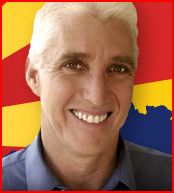
Investigative journalist John Dougherty of Arizona deserves a hand from everyone concerned with liberal media bias, because he has given it up. Dougherty, pictured right in a photo from his website, has, shall we say, crossed the border from being biassed to seeking the Democratic nomination for US Senate . In the late 80’s he was involved with uncovering Charles Keating’s use of campaign contributions to five senators-including John McCain, whom Dougherty would most likely face in an election-in exchange for putting pressure on banking regulators. He also investigated Governor Fife Symington, polygamist leader Warren Jeffs and Sherrif Joe Arpaio. Whatever else he has done in the past, Dougherty has already succesfully morphed into a politician, writing a blog for the Huffington Post on illegal immigration and its relationship to crime that directly contradicts the conclusions he reached in an article he wrote for the High County News. Dougherty told Jilted Journalists that, if elected, he would hire investigative reporters as his staff to investigate other politicians and that he “can’t wait to hold hearings at the US Senate.” He also said that he shares much of the Tea Party’s frustration with government, although “‘Government is not the problem, corrupt government is the problem,’ he said, blaming lobbyist spending for putting corporations and special interests ahead of people. Government needs to be ‘much more aggressive,’ ‘strong,’ and ‘tough,’ he said.” If elected, Dougherty would join a long line of journalists who sought public office: Senators Harry F. Byrd (both Senior and Junior), President Warren Harding, Clare Boothe Luce, Pat Buchanan, Steve Forbes, William Randolph Hearst and even McCain’s challenger in the Arizona Republican Primary, JD Hayworth. As one of the most famous journalists ever to run for public office, Dave Barry once wrote: “And of course the most agonizing question is: Why, really, do I WANT to be president? Is it just so that I can have a limousine and a helicopter and a big plane and a huge staff of boot-licking lackeys waiting on me hand and foot? Yes.” That just about sums up the attraction of journalists to politics.

Read more:
Arizona Writer Latest Journalist to Pass Through Media-Democrat Revolving Door

Georgetown Law-educated Bonnie Erbe Blusters Nonsense About Supreme Court Ruling on Gun Rights

Given that our tax dollars are subsidizing her salary, is it too much to expect PBS’s Bonnie Erbe to have at least some intelligent command of the issues of the day? On second thought, don’t answer that. In her latest blogging misadventure at USNews.com, the “To the Contrary” host portrayed yesterday’s 5-4 ruling in McDonald v. City of Chicago as a blow to “local rights” : The Supreme Court’s decision , taking away important local rights to control gun ownership, marks another sad day in America’s now seemingly endless political appetite for increasing the number of privately owned guns in this country. By 5-4 the justices overturned strict gun ownership rules set by Chicago and one of its suburbs. Perhaps the general lethargy that has caused many Americans to lose faith in government has crept into our philosophy on law and order, feeling hopelessly that even our local police and sheriffs can no longer protect us from harm. Vigilantism reigns supreme and with it a misinterpretation of the Second Amendment to the U.S. Constitution that the powerful gun ownership lobby has interpreted to mean anyone can essentially own any weapon or weapons of any caliber. Of course the Court’s rulings in both McDonald and Heller dealt simply with the most extreme of liberal gun control schemes: complete bans on gun ownership by the cities of Chicago and Washington, D.C. In both cases the local authorities grossly overstepped the boundaries of their authority by infringing on the right of the people to keep and bear arms. Far from taking away a legitimate power of government, the Supreme Court’s rulings were corrective actions to stop governmental abuse of individual liberties. What’s more, these rulings do not mean the Court has or intends to consider any and all gun control legislation to be illegitimate, just as the First Amendment doesn’t mean one has a right to yell “Fire!” in a crowded theater, to propagate libelous speech, or to burn a cross on someone’s lawn in an effort to intimidate him. Erbe, a Georgetown Law grad , most certainly knows that, yet she still elected to hack out hyperbolic drivel instead of at least attempt to present a cogent liberal case for why she believes the Court is off the mark.

View original post here:
Georgetown Law-educated Bonnie Erbe Blusters Nonsense About Supreme Court Ruling on Gun Rights

WaPo Applauds Obama for Not Choosing ‘Outspoken Liberals’ for Supreme Court

On the day confirmation hearings begin for Obama Supreme Court nominee Elena Kagan, The Washington Post stresses on the front page that Kagan has been an “elusive GOP target.” The Post website summarized: “Republicans have struggled to find a compelling line of attack to take against the Supreme Court nominee. But their efforts have largely failed.” When Republicans nominate a Supreme Court justice, it’s the liberal media that aids their favorite activists in creating “compelling lines of attack.” But when Democrats do it, the journalists not only skip over the attacks, they also praise the Democrats for their political skills. Post reporters Anne Kornblut and Paul Kane suggested that the oil spill and the McChrystal hubbub have pushed Kagan out of attention, but also lauded the “skilled operatives” of Team Obama:   But it is also a measure of how skilled operatives have become at managing the process — and choosing nominees who are notable in part for their political blandness….  In part, the attention has been muted because Obama has not chosen outspoken liberals in either of his first two opportunities to influence the makeup of the court. Kagan, who would replace Justice John Paul Stevens, would not tilt the court’s ideological balance. So the stakes are lower than if she had been picked to replace a conservative, participants on both sides said. She is also an especially elusive target: a politically savvy operator who has no record of judicial rulings and has spent much of her career carefully positioning herself for the next step. Who else is elusive to the Post? Conservative activists, who are nowhere to be found in the Kornblut-Kane story — unlike a liberal lobbyist for People for the American Way. (Sen. Jeff Sessions is the only opposition figure quoted.) This claim, that Kagan and Sonia Sotomayor are baronesses of “blandness,” too “elusive” to be identified as liberals, is simply bizarre. To say that Sotomayor’s lobbying at left-wing Latino organizations or Kagan’s clerking for ultraliberal Justice Thurgood Marshall isn’t identifiably liberal is counter-factual. For contrast, please see The Washington Post’s front page story on Bush Supreme Court nominee Samuel Alito on the first day of his confirmation hearings on January 9, 2006. He was a staunch Reaganite. The story relentlessly repeated how conservative he was. “Blandness” was not on the menu. Reporters Jo Becker and Dale Russakoff began:  The captains of the Reagan revolution at the Justice Department had two big concerns about a bookish new recruit named Samuel A. Alito Jr., who arrived in 1981: his blank slate as a conservative activist and his pedigree from a perceived bastion of legal liberalism. “I wouldn’t let most people from Yale Law School wash my car, let alone write my briefs,” said Michael A. Carvin, a political deputy at the department. Six years later, the revolutionaries saw Alito as one of them, tapping him to become U.S. attorney in New Jersey in 1987 and eventually, they hoped, a judge. Speaking on a New Jersey public affairs television program, the young prosecutor showcased the philosophy that had won the confidence of his Washington mentors. Asked his opinion of President Ronald Reagan’s nomination of Robert H. Bork to the Supreme Court, Alito gave a ringing defense of the conservative icon he said had been “unjustifiably rejected” by the Senate in one of the most ideologically polarizing nomination battles in decades. There weren’t any professional liberal activists in the piece — other than the Post reporters themselves.

More here:
WaPo Applauds Obama for Not Choosing ‘Outspoken Liberals’ for Supreme Court