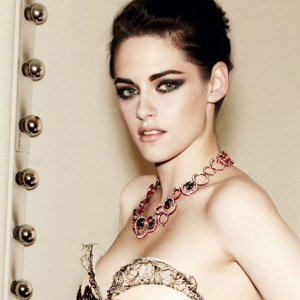
Twilight / Snow White and the Huntsman star Kristen Stewart comes off as admirably self-possessed (“I don’t care about the voracious, starving shit eaters who want to turn truth into shit”) in Vanity Fair, even when bemoaning the photograph that changed her life: “You can Google my name and one of the first things that comes up is images of me sitting on my front porch smoking a pipe with my ex-boyfriend and my dog. It was [taken] the day the movie came out. I was no one. I was a kid. I had just turned 18. In [the tabloids] the next day it was like I was a delinquent slimy idiot, whereas I’m kind of a weirdo, creative Valley Girl who smokes pot. Big deal. But that changed my daily life instantly. I didn’t go out in my underwear anymore.” [ Vanity Fair ]
People with a strong sartorial sense know the difference between what’s elegant and what’s merely elaborate. It’s not the same in the movie world, where big and overcomplicated is so often mistaken for better, when really it’s only…big and overcomplicated. Ridley Scott ’s Prometheus , designed as a sort-of prequel to the director’s 1979 terror-in-space aria Alien , is elaborate all right. But it’s imaginative only in a stiff, expensive way. Scott vests the movie with an admirable degree of integrity – it doesn’t feel like a cheap grab for our moviegoing dollars – but it doesn’t inspire anything so vital as wonder or fear, either. Prometheus has been one of the most anticipated pictures of the summer, but its lackluster payoff is summed up perfectly by one of its chief characters, a scientist who travels a long way from Earth in the hope of meeting the allegedly superior beings who created us humans: “This place isn’t what we thought it was.” [ Some spoilers follow. ] That character, Elizabeth Shaw ( Noomi Rapace ), is an archeologist who, in one of the movie’s early scenes, circa 2089, stands hand-in-hand with her partner and beau Charlie Holloway (the exquisitely, painfully dull Logan Marshall-Green ) as the two gaze in wonder upon an Earth cave drawing they’ve just discovered. The pictogram shows a couple of unearthly creatures standing tall and pointing at something-or-other. Are they gods who created us, or just random visitors? Shaw thinks they may be the former, and she’s eager for a meet-and-greet. “I think they want us to come and find them,” she says, voicing one of those really bad ideas that make the world of science fiction go ’round. Before long the two have joined a crew of 15 others, all headed to an undisclosed destination in space where they will freely and joyfully act upon yet more bad ideas, including packing a severed alien head into a space baggie and reaching out to touch a slimy tadpole-penis-head thing. But let’s not get ahead of ourselves. The others aboard the all-too-appropriately named Prometheus include a tall, icy businesswoman named Vickers ( Charlize Theron ), a representative of the corporate behemoth that’s funding the trip; the ship’s captain, Janek (played by the appealing, casual Idris Elba); David ( Michael Fassbender ), an android a la Ian Holm’s character in Alien , who has learned a healthy handful of ancient languages as a way of possibly communicating with whatever godlike forebears the crew may encounter; and a random Asian guy who wanders around idly in the background of a few shots until, inexplicably — mini-spoiler alert — he becomes one of the story’s heroes. (This disposable Asian is played by Benedict Wong, who also appeared in Duncan Jones’ 2011 Moon .) There are a bunch of others – including some dumb geologists/biologists (Rafe Spall and Sean Harris) and a doctory-scientist type (Kate Dickie) – but the cast of Prometheus suggests that 17 crew members on a movie space ship is about 10 too many. (The Nostromo , after all, carried 7, and Scott and writer Dan O’Bannon made it easy to distinguish one from another.) But Prometheus , both ship and movie, is overloaded in every way: Scott and screenwriters Jon Spaihts and Damon Lindelof have packed the picture full of noble themes, most of them having to do with the way our yearning to understand the unknown jostles uncomfortably against our desire to explain everything through science. “I just want answers, babe,” the logic-mongering Holloway tells the dreamier Shaw, though this is before – and here, take note of another mini-spoiler alert – a wriggly wormlike thing starts poking out of his eyeball. What do Shaw and the others discover on the mysterious planet to which they’ve trekked? They make their way into a cave where the air is actually breathable – they lift off their bubble helmets and take in deep gulps of the stuff, which seems inadvisable, but what the heck? Deep in the cave’s recesses they find a magnificent hallway replete with majestic murals and a large sculpture surrounded by a formation of conga drums covered with sweaty spores. Prometheus features a host of effects designed to make you say, “What the heck?” and yet none of it stirs real curiosity, awe or dread. The crew also encounters, of course, some variations on the magnificent spoodly pinky-gray creatures designed by H.R. Giger for the earlier Alien pictures. Perhaps these thingies are supposed to be bigger, more impressive and more realistic, whatever that might mean. Yet there’s a business-as-usual quality about them, and they herald their presence openly rather than lurk menacingly in the shadows, as if announcing cheerfully, “You expected to see us, and here we are!” That’s not to say there aren’t some lovely effects in Prometheus , including a sequence in which a group of hologram ghosts appear as shimmery dots and dashes of light – they rush toward and through our intrepid explorers, on their way to, or away from, something. But we never find out who they are or what they’re running toward or from. In fact, there are dozens of loose ends in Prometheus , hanging like so many squirmy, dangly tails. Fassbender’s android commits a significant, malicious act for reasons that are never made clear: We know he has no soul, and thus probably no conscience, but his actions seem like the result of some deeply human traits — Scott never bothers to explain. The geography of the ship is carelessly delineated: Creatures show up in one passageway or another – it’s never clear what room or area they’re coming from. One of these slimy, willfully malevolent wrigglers emerges at a significant climactic moment, and it’s unclear whether it’s a random critter or a larger version of a baby we’ve seen earlier – the lapse represents a missed opportunity, a possible means of fleshing out some of the movie’s ideas about the relationship between gods and the creatures they create (or destroy). Scott is trying to make sure Prometheus is about something, and his ideals may have distracted him from the more prosaic task of just getting on with the storytelling. When Brian De Palma presented, with Mission to Mars , a much more passionate, and more narratively sound, version of this sort of interplanetary spiritual idealism, it was treated as a “bad” science fiction movie. Prometheus , on the other hand, is tasteful even in the midst of all its squirm-inducing gross-outs, and that’s a liability: It’s impossible to have tasteful passion. The actors mostly seem lost here: Rapace comes off as a doll-like naïf, pretty but wholly lacking in charisma or even science-fueled ardor. Guy Pearce appears in heavy age makeup which, if you ask me, is a total waste of a perfectly good Guy Pearce. Theron and Fassbender have much more presence: Theron, at least, gets to suit up and fire a flamethrower – the vision of her big bubble-helmeted head perched upon a body that seems to consist mainly of two lily-stem legs is something to behold. And Scott gives Fassbender the quietest, most poetic sequence in the movie: Early in the picture, the robot David wanders the ship while the rest of the crew are still deep in their hypersleep dreams. He busies himself with assorted tasks, and then sits down before a massive wraparound screen, where he watches Lawrence of Arabia with rapturous admiration. David finds a physical, if not spiritual, twin in O’Toole’s T.E. Lawrence, a model for the man he’d like to be, if only he were a man at all. But Scott doesn’t, or can’t, sustain the eerie, resonant beauty of that sequence. Prometheus isn’t a piece of junk. It feels as if Scott has tried very hard to please us, his audience, in an honest if costly way. He surely knows how high the stakes are: With Alien , Scott gave us one of the great science-fiction films of all time, a picture that was at once glorious and austere; when I looked at it recently, I was struck by how wonderfully slow-moving it was, and yet every minute is taut. But Prometheus is a world apart, a far more unwieldy picture that tries hard to defy this new, noisier age of movies and doesn’t have the agility or the suppleness to do so. You can practically hear Prometheus groaning under the weight of its ambitions; it’s a far cry from the sound Scott was going for, the music of the celestial spheres. Follow Stephanie Zacharek on Twitter . Follow Movieline on Twitter .
People with a strong sartorial sense know the difference between what’s elegant and what’s merely elaborate. It’s not the same in the movie world, where big and overcomplicated is so often mistaken for better, when really it’s only…big and overcomplicated. Ridley Scott ’s Prometheus , designed as a sort-of prequel to the director’s 1979 terror-in-space aria Alien , is elaborate all right. But it’s imaginative only in a stiff, expensive way. Scott vests the movie with an admirable degree of integrity – it doesn’t feel like a cheap grab for our moviegoing dollars – but it doesn’t inspire anything so vital as wonder or fear, either. Prometheus has been one of the most anticipated pictures of the summer, but its lackluster payoff is summed up perfectly by one of its chief characters, a scientist who travels a long way from Earth in the hope of meeting the allegedly superior beings who created us humans: “This place isn’t what we thought it was.” [ Some spoilers follow. ] That character, Elizabeth Shaw ( Noomi Rapace ), is an archeologist who, in one of the movie’s early scenes, circa 2089, stands hand-in-hand with her partner and beau Charlie Holloway (the exquisitely, painfully dull Logan Marshall-Green ) as the two gaze in wonder upon an Earth cave drawing they’ve just discovered. The pictogram shows a couple of unearthly creatures standing tall and pointing at something-or-other. Are they gods who created us, or just random visitors? Shaw thinks they may be the former, and she’s eager for a meet-and-greet. “I think they want us to come and find them,” she says, voicing one of those really bad ideas that make the world of science fiction go ’round. Before long the two have joined a crew of 15 others, all headed to an undisclosed destination in space where they will freely and joyfully act upon yet more bad ideas, including packing a severed alien head into a space baggie and reaching out to touch a slimy tadpole-penis-head thing. But let’s not get ahead of ourselves. The others aboard the all-too-appropriately named Prometheus include a tall, icy businesswoman named Vickers ( Charlize Theron ), a representative of the corporate behemoth that’s funding the trip; the ship’s captain, Janek (played by the appealing, casual Idris Elba); David ( Michael Fassbender ), an android a la Ian Holm’s character in Alien , who has learned a healthy handful of ancient languages as a way of possibly communicating with whatever godlike forebears the crew may encounter; and a random Asian guy who wanders around idly in the background of a few shots until, inexplicably — mini-spoiler alert — he becomes one of the story’s heroes. (This disposable Asian is played by Benedict Wong, who also appeared in Duncan Jones’ 2011 Moon .) There are a bunch of others – including some dumb geologists/biologists (Rafe Spall and Sean Harris) and a doctory-scientist type (Kate Dickie) – but the cast of Prometheus suggests that 17 crew members on a movie space ship is about 10 too many. (The Nostromo , after all, carried 7, and Scott and writer Dan O’Bannon made it easy to distinguish one from another.) But Prometheus , both ship and movie, is overloaded in every way: Scott and screenwriters Jon Spaihts and Damon Lindelof have packed the picture full of noble themes, most of them having to do with the way our yearning to understand the unknown jostles uncomfortably against our desire to explain everything through science. “I just want answers, babe,” the logic-mongering Holloway tells the dreamier Shaw, though this is before – and here, take note of another mini-spoiler alert – a wriggly wormlike thing starts poking out of his eyeball. What do Shaw and the others discover on the mysterious planet to which they’ve trekked? They make their way into a cave where the air is actually breathable – they lift off their bubble helmets and take in deep gulps of the stuff, which seems inadvisable, but what the heck? Deep in the cave’s recesses they find a magnificent hallway replete with majestic murals and a large sculpture surrounded by a formation of conga drums covered with sweaty spores. Prometheus features a host of effects designed to make you say, “What the heck?” and yet none of it stirs real curiosity, awe or dread. The crew also encounters, of course, some variations on the magnificent spoodly pinky-gray creatures designed by H.R. Giger for the earlier Alien pictures. Perhaps these thingies are supposed to be bigger, more impressive and more realistic, whatever that might mean. Yet there’s a business-as-usual quality about them, and they herald their presence openly rather than lurk menacingly in the shadows, as if announcing cheerfully, “You expected to see us, and here we are!” That’s not to say there aren’t some lovely effects in Prometheus , including a sequence in which a group of hologram ghosts appear as shimmery dots and dashes of light – they rush toward and through our intrepid explorers, on their way to, or away from, something. But we never find out who they are or what they’re running toward or from. In fact, there are dozens of loose ends in Prometheus , hanging like so many squirmy, dangly tails. Fassbender’s android commits a significant, malicious act for reasons that are never made clear: We know he has no soul, and thus probably no conscience, but his actions seem like the result of some deeply human traits — Scott never bothers to explain. The geography of the ship is carelessly delineated: Creatures show up in one passageway or another – it’s never clear what room or area they’re coming from. One of these slimy, willfully malevolent wrigglers emerges at a significant climactic moment, and it’s unclear whether it’s a random critter or a larger version of a baby we’ve seen earlier – the lapse represents a missed opportunity, a possible means of fleshing out some of the movie’s ideas about the relationship between gods and the creatures they create (or destroy). Scott is trying to make sure Prometheus is about something, and his ideals may have distracted him from the more prosaic task of just getting on with the storytelling. When Brian De Palma presented, with Mission to Mars , a much more passionate, and more narratively sound, version of this sort of interplanetary spiritual idealism, it was treated as a “bad” science fiction movie. Prometheus , on the other hand, is tasteful even in the midst of all its squirm-inducing gross-outs, and that’s a liability: It’s impossible to have tasteful passion. The actors mostly seem lost here: Rapace comes off as a doll-like naïf, pretty but wholly lacking in charisma or even science-fueled ardor. Guy Pearce appears in heavy age makeup which, if you ask me, is a total waste of a perfectly good Guy Pearce. Theron and Fassbender have much more presence: Theron, at least, gets to suit up and fire a flamethrower – the vision of her big bubble-helmeted head perched upon a body that seems to consist mainly of two lily-stem legs is something to behold. And Scott gives Fassbender the quietest, most poetic sequence in the movie: Early in the picture, the robot David wanders the ship while the rest of the crew are still deep in their hypersleep dreams. He busies himself with assorted tasks, and then sits down before a massive wraparound screen, where he watches Lawrence of Arabia with rapturous admiration. David finds a physical, if not spiritual, twin in O’Toole’s T.E. Lawrence, a model for the man he’d like to be, if only he were a man at all. But Scott doesn’t, or can’t, sustain the eerie, resonant beauty of that sequence. Prometheus isn’t a piece of junk. It feels as if Scott has tried very hard to please us, his audience, in an honest if costly way. He surely knows how high the stakes are: With Alien , Scott gave us one of the great science-fiction films of all time, a picture that was at once glorious and austere; when I looked at it recently, I was struck by how wonderfully slow-moving it was, and yet every minute is taut. But Prometheus is a world apart, a far more unwieldy picture that tries hard to defy this new, noisier age of movies and doesn’t have the agility or the suppleness to do so. You can practically hear Prometheus groaning under the weight of its ambitions; it’s a far cry from the sound Scott was going for, the music of the celestial spheres. Follow Stephanie Zacharek on Twitter . Follow Movieline on Twitter .
Lindsay Lohan is officially back doing what she does best. The actress might have been getting into character as Elizabeth Taylor , but what would the Hollywood icon think of this display on the set of Lifetime’s Liz & Dick? The oft-troubled train wreck was anything but elegant as she struggled to keep her breasts inside a low-cut halter dress while shooting scenes with Grant Bowler: Trying to channel old Hollywood glamour on the set of the much-anticipated biopic, LiLo fell short, though she did show off two reasons why she landed the part. The film, which documents the rocky on-again off-again relationship between Taylor and two-time husband Richard Burton is off to a rocky start in its own right. Lindsay, 25, squeezed into a retro 1960s-style sundress, but as she and Bowler argued during this particular scene, the actress’ chest busted out for all to see. Check out more Lindsay Lohan pics after the jump for a closer angle: Wow. We really need to see this movie all of a sudden . [Photos: Pacific Coast News]
Vita Coco recently exposed their latest campaign with spokeswoman Rihanna . The singer rocks a pineapple printed midriff baring top and short shorts for the ad. Peep the full version below The ad was shot by famed photo Terry Richardson. What do you think? Hit the flip for photos of Rihanna partying at Greystone Manor this Sunday… and she wasn’t the only celeb in the building.
If you could distill essence de chat into a few well-chosen pen strokes, you’d end up with something like Jean-Loup Felicioli and Alain Gagnol’s superb animated adventure A Cat in Paris , a picture whose modest demeanor only underscores how expressive and imaginative it is. This isn’t the kind of big-budget animation we get from the major studios: It’s richness of another sort, a feat of hand-drawn animation that relies on spare but succinct character design and a dazzling sense of perspective — rather than a volley of cultural in-jokes — to tell its story. The picture sparkles, but in the nighttime way — its charms have a noirish gleam. Most of the picture does, in fact, take place at night, beginning and ending with the nocturnal Parisian perambulations of a wily striped cat named Dino. Dino “belongs” to a little girl named Zoe. He pledges his devotion by bringing her little gifts from his nighttime hunting jaunts. Actually, he keeps bringing her the same gift: One dangly, limp dead lizard after another, but Zoe is delighted by them and saves them all in a little box, much to the annoyance of her new nanny. What almost no one knows is that Dino doesn’t go out at night just for fun, or simply out of a feline sense of duty. He’s also a cat burglar, assisting a sneaky but noble local jewel thief, Nico, on his midnight rounds. The plot becomes more complicated — to the extent that it’s complicated at all — by the fact that Zoe’s mother, Jeanne, is a detective with the Paris police. She’s consumed with concern for Zoe, who hasn’t spoken since her father was killed by a square-shouldered, square-headed thug named Victor Costa. She’s also riven with grief, and she’s determined to avenge her husband’s death by catching Costa, who, it turns out, has a new scheme: He plans to steal a precious, valuable and huge antiquity, the Colossus of Nairobi, a hulking totem that’s being brought to the city for an exhibit. Meanwhile, though, Jeanne has peskier problems: Jewels keep disappearing from various households in the city, thanks to Nico and an accomplice with four silent, velvet paws. A Cat in Paris is being released in the states in two versions, an English-language one (in which Marcia Gay Harden, Anjelica Huston and Matthew Modine provide some of the key voices) and a subtitled French one (which features, in the role of the nanny, the voice of actress Bernadette Lafont, who, for those who keep track of such things, played Marie in The Mother and the Whore ). If you’re bringing children and are lucky enough to have bilingual ones, I recommend the French version, since it is simply more French; to hear the English language pouring forth from these characters’ mouths feels just a little wrong. But the visuals of A Cat in Paris resonate in any language, and it doesn’t hurt that the picture features a stunning, stealthy Bernard Hermann-style orchestral score by Serge Bessett. (The music in A Cat in Paris is finer and more resonant than that of any live-action picture I’ve seen this year.) This is Felicioli and Gagnol’s first full-length feature — it was a 2012 Academy Award nominee — and it clocks in at a very trim but visually rich 70 minutes. The filmmakers’ drawings are both meticulous and highly stylized: They render the rooftops of Paris (what is it about city rooftops in general, and Paris rooftops in particular?) as a dusky, velvety patchwork, an invitation to adventure — they take great delight in the city’s highs and lows, in the contrast between tall and short. Their palette features an array of oranges, from muted citrus tones to deep sienna, and lots of deep, nighttime turquoise. And they dot the picture with small but inventive visual touches: When a character dons night goggles, the figures around him are rendered as stark white lines on a flat black surface. And the gargoyles of Notre Dame feature in the climactic chase sequence, a bit of travelogue whimsy that’s nonetheless dramatically gripping, perhaps even a little dizzying for those who are hinky about heights — it doesn’t matter that you can’t really fall off a cartoon building. And then there’s Dino, an utterly bewitching arrangement of orange and chocolate triangles (with a pink one for a nose). Dino isn’t a cute cartoon cat — there’s an element of mystery and devilishness about him, suggesting that Felicioli and Gagnol understand true feline spirit. They also understand feline loyalty, which is a contradiction in terms only to those who don’t understand (to the extent that understanding is possible) these elusive, magnetic creatures. Dino comforts the distressed Zoe by visiting her in bed, sliding under her arms as if he could pretend she’d never notice. And in a way, she doesn’t notice — somehow, suddenly, Dino is simply there , a presence who changes, only ever so slightly, the nature of the room around him. That’s the quiet province of cats everywhere — not just those who are lucky enough to live in the animated city of Paris. Follow Stephanie Zacharek on Twitter . Follow Movieline on Twitter .
If you could distill essence de chat into a few well-chosen pen strokes, you’d end up with something like Jean-Loup Felicioli and Alain Gagnol’s superb animated adventure A Cat in Paris , a picture whose modest demeanor only underscores how expressive and imaginative it is. This isn’t the kind of big-budget animation we get from the major studios: It’s richness of another sort, a feat of hand-drawn animation that relies on spare but succinct character design and a dazzling sense of perspective — rather than a volley of cultural in-jokes — to tell its story. The picture sparkles, but in the nighttime way — its charms have a noirish gleam. Most of the picture does, in fact, take place at night, beginning and ending with the nocturnal Parisian perambulations of a wily striped cat named Dino. Dino “belongs” to a little girl named Zoe. He pledges his devotion by bringing her little gifts from his nighttime hunting jaunts. Actually, he keeps bringing her the same gift: One dangly, limp dead lizard after another, but Zoe is delighted by them and saves them all in a little box, much to the annoyance of her new nanny. What almost no one knows is that Dino doesn’t go out at night just for fun, or simply out of a feline sense of duty. He’s also a cat burglar, assisting a sneaky but noble local jewel thief, Nico, on his midnight rounds. The plot becomes more complicated — to the extent that it’s complicated at all — by the fact that Zoe’s mother, Jeanne, is a detective with the Paris police. She’s consumed with concern for Zoe, who hasn’t spoken since her father was killed by a square-shouldered, square-headed thug named Victor Costa. She’s also riven with grief, and she’s determined to avenge her husband’s death by catching Costa, who, it turns out, has a new scheme: He plans to steal a precious, valuable and huge antiquity, the Colossus of Nairobi, a hulking totem that’s being brought to the city for an exhibit. Meanwhile, though, Jeanne has peskier problems: Jewels keep disappearing from various households in the city, thanks to Nico and an accomplice with four silent, velvet paws. A Cat in Paris is being released in the states in two versions, an English-language one (in which Marcia Gay Harden, Anjelica Huston and Matthew Modine provide some of the key voices) and a subtitled French one (which features, in the role of the nanny, the voice of actress Bernadette Lafont, who, for those who keep track of such things, played Marie in The Mother and the Whore ). If you’re bringing children and are lucky enough to have bilingual ones, I recommend the French version, since it is simply more French; to hear the English language pouring forth from these characters’ mouths feels just a little wrong. But the visuals of A Cat in Paris resonate in any language, and it doesn’t hurt that the picture features a stunning, stealthy Bernard Hermann-style orchestral score by Serge Bessett. (The music in A Cat in Paris is finer and more resonant than that of any live-action picture I’ve seen this year.) This is Felicioli and Gagnol’s first full-length feature — it was a 2012 Academy Award nominee — and it clocks in at a very trim but visually rich 70 minutes. The filmmakers’ drawings are both meticulous and highly stylized: They render the rooftops of Paris (what is it about city rooftops in general, and Paris rooftops in particular?) as a dusky, velvety patchwork, an invitation to adventure — they take great delight in the city’s highs and lows, in the contrast between tall and short. Their palette features an array of oranges, from muted citrus tones to deep sienna, and lots of deep, nighttime turquoise. And they dot the picture with small but inventive visual touches: When a character dons night goggles, the figures around him are rendered as stark white lines on a flat black surface. And the gargoyles of Notre Dame feature in the climactic chase sequence, a bit of travelogue whimsy that’s nonetheless dramatically gripping, perhaps even a little dizzying for those who are hinky about heights — it doesn’t matter that you can’t really fall off a cartoon building. And then there’s Dino, an utterly bewitching arrangement of orange and chocolate triangles (with a pink one for a nose). Dino isn’t a cute cartoon cat — there’s an element of mystery and devilishness about him, suggesting that Felicioli and Gagnol understand true feline spirit. They also understand feline loyalty, which is a contradiction in terms only to those who don’t understand (to the extent that understanding is possible) these elusive, magnetic creatures. Dino comforts the distressed Zoe by visiting her in bed, sliding under her arms as if he could pretend she’d never notice. And in a way, she doesn’t notice — somehow, suddenly, Dino is simply there , a presence who changes, only ever so slightly, the nature of the room around him. That’s the quiet province of cats everywhere — not just those who are lucky enough to live in the animated city of Paris. Follow Stephanie Zacharek on Twitter . Follow Movieline on Twitter .
If you could distill essence de chat into a few well-chosen pen strokes, you’d end up with something like Jean-Loup Felicioli and Alain Gagnol’s superb animated adventure A Cat in Paris , a picture whose modest demeanor only underscores how expressive and imaginative it is. This isn’t the kind of big-budget animation we get from the major studios: It’s richness of another sort, a feat of hand-drawn animation that relies on spare but succinct character design and a dazzling sense of perspective — rather than a volley of cultural in-jokes — to tell its story. The picture sparkles, but in the nighttime way — its charms have a noirish gleam. Most of the picture does, in fact, take place at night, beginning and ending with the nocturnal Parisian perambulations of a wily striped cat named Dino. Dino “belongs” to a little girl named Zoe. He pledges his devotion by bringing her little gifts from his nighttime hunting jaunts. Actually, he keeps bringing her the same gift: One dangly, limp dead lizard after another, but Zoe is delighted by them and saves them all in a little box, much to the annoyance of her new nanny. What almost no one knows is that Dino doesn’t go out at night just for fun, or simply out of a feline sense of duty. He’s also a cat burglar, assisting a sneaky but noble local jewel thief, Nico, on his midnight rounds. The plot becomes more complicated — to the extent that it’s complicated at all — by the fact that Zoe’s mother, Jeanne, is a detective with the Paris police. She’s consumed with concern for Zoe, who hasn’t spoken since her father was killed by a square-shouldered, square-headed thug named Victor Costa. She’s also riven with grief, and she’s determined to avenge her husband’s death by catching Costa, who, it turns out, has a new scheme: He plans to steal a precious, valuable and huge antiquity, the Colossus of Nairobi, a hulking totem that’s being brought to the city for an exhibit. Meanwhile, though, Jeanne has peskier problems: Jewels keep disappearing from various households in the city, thanks to Nico and an accomplice with four silent, velvet paws. A Cat in Paris is being released in the states in two versions, an English-language one (in which Marcia Gay Harden, Anjelica Huston and Matthew Modine provide some of the key voices) and a subtitled French one (which features, in the role of the nanny, the voice of actress Bernadette Lafont, who, for those who keep track of such things, played Marie in The Mother and the Whore ). If you’re bringing children and are lucky enough to have bilingual ones, I recommend the French version, since it is simply more French; to hear the English language pouring forth from these characters’ mouths feels just a little wrong. But the visuals of A Cat in Paris resonate in any language, and it doesn’t hurt that the picture features a stunning, stealthy Bernard Hermann-style orchestral score by Serge Bessett. (The music in A Cat in Paris is finer and more resonant than that of any live-action picture I’ve seen this year.) This is Felicioli and Gagnol’s first full-length feature — it was a 2012 Academy Award nominee — and it clocks in at a very trim but visually rich 70 minutes. The filmmakers’ drawings are both meticulous and highly stylized: They render the rooftops of Paris (what is it about city rooftops in general, and Paris rooftops in particular?) as a dusky, velvety patchwork, an invitation to adventure — they take great delight in the city’s highs and lows, in the contrast between tall and short. Their palette features an array of oranges, from muted citrus tones to deep sienna, and lots of deep, nighttime turquoise. And they dot the picture with small but inventive visual touches: When a character dons night goggles, the figures around him are rendered as stark white lines on a flat black surface. And the gargoyles of Notre Dame feature in the climactic chase sequence, a bit of travelogue whimsy that’s nonetheless dramatically gripping, perhaps even a little dizzying for those who are hinky about heights — it doesn’t matter that you can’t really fall off a cartoon building. And then there’s Dino, an utterly bewitching arrangement of orange and chocolate triangles (with a pink one for a nose). Dino isn’t a cute cartoon cat — there’s an element of mystery and devilishness about him, suggesting that Felicioli and Gagnol understand true feline spirit. They also understand feline loyalty, which is a contradiction in terms only to those who don’t understand (to the extent that understanding is possible) these elusive, magnetic creatures. Dino comforts the distressed Zoe by visiting her in bed, sliding under her arms as if he could pretend she’d never notice. And in a way, she doesn’t notice — somehow, suddenly, Dino is simply there , a presence who changes, only ever so slightly, the nature of the room around him. That’s the quiet province of cats everywhere — not just those who are lucky enough to live in the animated city of Paris. Follow Stephanie Zacharek on Twitter . Follow Movieline on Twitter .
If you could distill essence de chat into a few well-chosen pen strokes, you’d end up with something like Jean-Loup Felicioli and Alain Gagnol’s superb animated adventure A Cat in Paris , a picture whose modest demeanor only underscores how expressive and imaginative it is. This isn’t the kind of big-budget animation we get from the major studios: It’s richness of another sort, a feat of hand-drawn animation that relies on spare but succinct character design and a dazzling sense of perspective — rather than a volley of cultural in-jokes — to tell its story. The picture sparkles, but in the nighttime way — its charms have a noirish gleam. Most of the picture does, in fact, take place at night, beginning and ending with the nocturnal Parisian perambulations of a wily striped cat named Dino. Dino “belongs” to a little girl named Zoe. He pledges his devotion by bringing her little gifts from his nighttime hunting jaunts. Actually, he keeps bringing her the same gift: One dangly, limp dead lizard after another, but Zoe is delighted by them and saves them all in a little box, much to the annoyance of her new nanny. What almost no one knows is that Dino doesn’t go out at night just for fun, or simply out of a feline sense of duty. He’s also a cat burglar, assisting a sneaky but noble local jewel thief, Nico, on his midnight rounds. The plot becomes more complicated — to the extent that it’s complicated at all — by the fact that Zoe’s mother, Jeanne, is a detective with the Paris police. She’s consumed with concern for Zoe, who hasn’t spoken since her father was killed by a square-shouldered, square-headed thug named Victor Costa. She’s also riven with grief, and she’s determined to avenge her husband’s death by catching Costa, who, it turns out, has a new scheme: He plans to steal a precious, valuable and huge antiquity, the Colossus of Nairobi, a hulking totem that’s being brought to the city for an exhibit. Meanwhile, though, Jeanne has peskier problems: Jewels keep disappearing from various households in the city, thanks to Nico and an accomplice with four silent, velvet paws. A Cat in Paris is being released in the states in two versions, an English-language one (in which Marcia Gay Harden, Anjelica Huston and Matthew Modine provide some of the key voices) and a subtitled French one (which features, in the role of the nanny, the voice of actress Bernadette Lafont, who, for those who keep track of such things, played Marie in The Mother and the Whore ). If you’re bringing children and are lucky enough to have bilingual ones, I recommend the French version, since it is simply more French; to hear the English language pouring forth from these characters’ mouths feels just a little wrong. But the visuals of A Cat in Paris resonate in any language, and it doesn’t hurt that the picture features a stunning, stealthy Bernard Hermann-style orchestral score by Serge Bessett. (The music in A Cat in Paris is finer and more resonant than that of any live-action picture I’ve seen this year.) This is Felicioli and Gagnol’s first full-length feature — it was a 2012 Academy Award nominee — and it clocks in at a very trim but visually rich 70 minutes. The filmmakers’ drawings are both meticulous and highly stylized: They render the rooftops of Paris (what is it about city rooftops in general, and Paris rooftops in particular?) as a dusky, velvety patchwork, an invitation to adventure — they take great delight in the city’s highs and lows, in the contrast between tall and short. Their palette features an array of oranges, from muted citrus tones to deep sienna, and lots of deep, nighttime turquoise. And they dot the picture with small but inventive visual touches: When a character dons night goggles, the figures around him are rendered as stark white lines on a flat black surface. And the gargoyles of Notre Dame feature in the climactic chase sequence, a bit of travelogue whimsy that’s nonetheless dramatically gripping, perhaps even a little dizzying for those who are hinky about heights — it doesn’t matter that you can’t really fall off a cartoon building. And then there’s Dino, an utterly bewitching arrangement of orange and chocolate triangles (with a pink one for a nose). Dino isn’t a cute cartoon cat — there’s an element of mystery and devilishness about him, suggesting that Felicioli and Gagnol understand true feline spirit. They also understand feline loyalty, which is a contradiction in terms only to those who don’t understand (to the extent that understanding is possible) these elusive, magnetic creatures. Dino comforts the distressed Zoe by visiting her in bed, sliding under her arms as if he could pretend she’d never notice. And in a way, she doesn’t notice — somehow, suddenly, Dino is simply there , a presence who changes, only ever so slightly, the nature of the room around him. That’s the quiet province of cats everywhere — not just those who are lucky enough to live in the animated city of Paris. Follow Stephanie Zacharek on Twitter . Follow Movieline on Twitter .