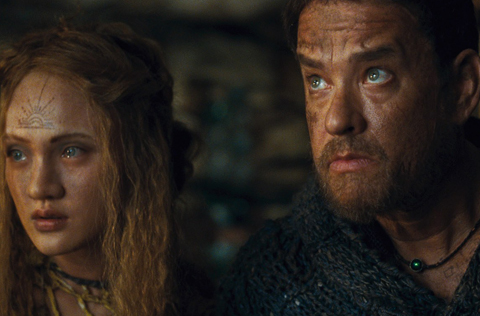
October’s Cloud Atlas is as dense and ambitious as it sounds from what I hear, and the newly unveiled five-minute trailer is almost as confounding as it is beautiful to look at. But regardless of how vaguely The Fountain -ish the nested story feels — jumping through time and various incarnations of cast mates (including Tom Hanks, Halle Berry, and Jim Sturgess) as they repeat life in six different eras from the 19th century Pacific to the post-apocalyptic future — the trio of directors at the helm, including Lana Wachowski in her first post-Larry feature credit, should make things very interesting. Fittingly, Cloud Atlas explores themes like rebirth and transformation, so in a way the adaptation of David Mitchell’s award-winning novel feels like a perfect project for Lana’s debut. (She directs alongside brother Andy and Tom Tykwer.) One of the storylines involves a seafarer, a futuristic clone, and another Tom Hanks in the wild; all of them, and all of us, are connected, according to the trailer. But Tykwer and the Wachowskis know theirs is a tough movie to sell, so they put together an adorable director’s commentary to introduce their trailer: “I think it started as a joke,” the trio begin, finishing each others’ sentences. “‘Why don’t we make a movie together?’ But it became this ongoing fantasy. It had to be something we’d never seen before, but it had to remind us of the kind of movies we watched over and over, the kind of movies that made us want to watch movies. Big screen movies! Massive in scope! But relevant to a normal life, to human beings. It would have drama and comedy. Romance! But it had to be political, philosophical. Lots of action, set in the past and the future, every genre.” Verdict: Iiiiinteresting . Still a tough sell for most audiences, but interesting … gorgeous imagery, a somewhat unwieldy trailer, but Lana and Tom and Andy won me over with their giggly enthusiasm. Meanwhile, new images from the film have debuted, showing more of the cast and their divergent (but connected, somehow) stories. Click on the image below for more and leave your impressions below.
The title character of Ruby Sparks is a 26-year-old painter from Dayton, Ohio played by Zoe Kazan, who also wrote the film’s screenplay, She has bangs and wears brightly colored tights. Her first crushes were on John Lennon and Humphrey Bogart. She loves to cook, can’t drive and doesn’t own a computer. Her problems, as someone points out, are all of the “endearing” variety. She’s also entirely the invention of Calvin Weir-Fields (Paul Dano), a blocked author who wrote a hit novel at age 19 and 10 years later, has yet to follow it up. Living a solitary life in Los Angeles, he’s advised by his shrink Dr. Rosenthal (Elliott Gould) to write about meeting someone while out walking his dog, Scotty. Ruby first appears to Calvin in his sleep, and soon he’s fleshing her character out on his typewriter. For the first time in ages, words come to him easily as he tells the story of how his literal dream girl meets and ends up with a guy who’s a lot like him. Directed by Little Miss Sunshine ‘s team of Jonathan Dayton and Valerie Faris, Ruby Sparks isn’t the exercise in stevia-dusted whimsy that it sounds like, especially once a flesh-and-blood Ruby suddenly materializes — exactly as Calvin wrote her — with no awareness that she began as a fictional literary character. This touch of movie magic is actually a way for the filmmakers to tartly examine the cinematic trope of the manic pixie dream girl and the larger problems inherent in searching for someone who’s perfect for you. Ruby is perfect for Calvin because he wrote her to be that way. She’s not your stereotypical pneumatic blond lust object because while sex is certainly part of the relationship Calvin is looking for, control and security are more important. She’s adorable but vulnerable because she’s been treated badly. She’s eager to please, and though Calvin is nothing like the other men she’s dated, she falls in love with him instantly and even promises him, “I will never get sick of you.” As Calvin’s older, married brother Harry (Chris Messina) points out when reading his sibling’s description of Ruby before she ever manages her transition into the physical world, “you haven’t written a person, you’ve written a girl.” And Kazan has written a portrait of a self-pitying, self-protective creative type that becomes so progressively biting that the film’s hopeful epilogue doesn’t quite fly. We learn more about Calvin as he initially freaks out about Ruby’s presence — he thinks he’s going nuts until he realizes other people can see her — but then gratefully comes to accept it. In ebullient montages, the pair goes to an arcade and out dancing. They settle into a life together. Calvin and his brother figure out early on that Ruby is a malleable creation. Calvin can dictate his dream girl’s behavior by continuing to write about her. At first, he vows not to play God and locks up his work in a drawer, but Ruby starts to chafe at being Calvin’s sole companion and at being expected to support his self-centered behavior. His treatment of Ruby grows crueler and as we meet his ex-girlfriend Lila ( True Blood ‘s Deborah Ann Woll) and realize that his account of their breakup is seriously slanted. Ruby starts building a life away from Calvin, and soon he’s pulling out paper and trying to fix her problems with him (instead of himself). Dayton and Faris have created a very grounded L.A. for this not-so-grounded story. They make notable use of the all-white bungalow in which Calvin spends most of his days sitting by the backyard pool . Dano is very good at morphing from the shaggy, appealing literary genius he appears to be at the film’s outset into a troubled, not-so-nice guy who comes sharply into focus at film’s end. After all, Ruby Sparks is really about Calvin. Ruby is simply a mirror — which is why the ending strikes the only real false note of the movie. Calvin gets a dose of much-needed self-awareness and what feels like the wrong sort of chance at redemption. As a whole, however, Ruby Sparks lands like a punch. It’s a smart counter-jab to the many movies out there that put forth the myth that the world is full of quirky angels in ballet flats who are just waiting for some morose protagonist to come along in need of their love. It’s as much of a fantasy as Kelly LeBrock emerging from a teenager’s PC. Real people have problems that can’t be dismissed with a sweeping sentence on a page — and real relationships involve compromise and dealing with those problems, not holding out for someone who indulges your every foible and asks nothing in return. Follow Alison Willmore on Twitter . Follow Movieline on Twitter .
Although the proliferation of talent shows on TV is proof of just how much audiences have come back around to watching dance on screen, Step Up Revolution suggests Hollywood is still conflicted about how to film it. On one hand, the fourth movie in the Step Up franchise was shot in eye-popping 3-D. In choreographed numbers that grow crazier and more extravagant as the film proceeds, breakdancers kick their legs out toward the camera and hold gravity-defying poses; tracking shots glide across the pavement between cars as kids stride out in time to music; performers on bungee cords leap down a ramp toward us only to snap back. As spectacle, it is resoundingly cool. On the other hand, these sequences tend to be edited to bits, as if the filmmakers were afraid their audience would get bored if either the camera or point of view weren’t constantly in motion. Directed by Scott Speer (of the web series “The LXD”) with cinematography by Karsten Gopinath, the film’s best shots, both in terms of dancing and the 3-D, are usually the ones in which the camera sits directly in front of the performers as their main audience, so that we can see their full bodies as they’re used in impossible, athletic feats of movement. But the film rarely maintains this perspective for more than a few seconds before cutting to a reaction shot, a close-up, then up and overhead, then off to the side. While the editing creates a sense of frantic momentum, it’s also dizzying and disorienting. Step Up Revolution is also not a movie you watch for its incredible story and dialogue. The film doesn’t even share much connective tissue with its predecessors save for an appearance from Adam Sevani as Moose. The plot features a boy, Sean (Ryan Guzman), and a girl, Emily (Kathryn McCormick) — who are both making their feature-film debuts. (McCormick was a finalist on the 2009 season of “So You Think You Can Dance.”) Sean is from the most adorably Epcot Center-worthy “gritty” Miami neighborhood ever, while she’s the daughter of a wealthy real estate developer Bill Anderon (Peter Gallagher) with plans to knock the place down and build skyscrapers on top of it. They meet cute at the beach club attached to the hotel that Emily’s father owns. Sean, who works at the hotel, and Emily form a mutual admiration society after facing off in a deliciously over-the-top dance duel that’s filmed like a fight scene. Emily flings sand at the camera and maneuvers Sean under the outdoor shower so that they can both have clingy wet outfits. As you might expect, both have dancing aspirations. When not waiting tables, Sean and his friends make up a flash-mob dance troupe called The Mob. Emily is auditioning for a place in the prestigious Wynwood Dance Company. Guzman, McCormick and the rest of the cast have generic good looks right out of an Abercrombie catalog and enough range to convincingly project the three sentiments for which the script (written by Jenny Mayer) calls — happy, sad and “dance face.” Guzman is particularly gifted at committing to howlers without a wince or trace of irony. “I can’t just do whatever I want,” Emily says. “There are rules.” Sean gets up close and breathes: “Break the rules.” At first, The Mob stages its elaborate pop-up routines as part of a YouTube competition — the first page to reach 10 million hits wins a cash prize. But when the neighborhood in which Sean and his best friend Eddy (Misha Gabriel) grew up is threatened, Emily suggests they use their growing internet fame to draw attention and build opposition to the development plan (without her father’s knowledge). It’s protest art! It’s the 99 percent! And it’s brutally phony, especially when picture pretends to be about the preservation of local culture. The Mob has essentially been formed out of a broad Google search for subcultures. There’s the DJ, the videographer from the SoCal skate scene, the hacker, the street artist, the parkour dudes. The only Miami-specific concession is that the group hangs out at a salsa bar called Ricky’s. Step Up Revolution is, at least, shot on location in Miami, which looks golden and gorgeous in 3D helicopter shots and ridiculously, stiflingly pretty as a backdrop in others. When Sean and Emily practice a duet on the beach, you expect an “Obsession by Calvin Klein” logo to appear next to their faces in their final pose. And it wouldn’t seem that out of place. The film is such a slick product that its vague anti-corporate ideas keep sliding right out of sight — it takes some effort to situate that Au Bon Pain logo so prominently in the middle background of a dance sequence. The movie ends with a never-explicated, and, frankly, insulting compromise. (Spoiler alert!) The Mob — who, three songs earlier, ended a performance with the declaration, ‘We’re not for sale!” — triumphantly sign with Nike as part of a marketing firm plan. Way to stick it to the man, y’all. Follow Alison Willmore on Twitter . Follow Movieline on Twitter .
Manhattan Montessori Principal Gets Up To 7 Years In Prison Relationship With Underage Student This lady looks like she could probably pull a decent man of age, but hey, she must like the young meat… She tried arguing that she “faints” and has anxiety, and even that her boy victim had enjoyed it. But there was no mercy yesterday for Lina Sinha, the beautiful former headmistress of an Upper East Side Montessori school, who was finally sent away to serve at least 2 1/3 years in prison for her twisted and damaging sex affair with a student who was just 13. “This is a woman of every advantage, and she preyed on her victim for years,” Manhattan Supreme Court Justice Carol Berkman said as the predatory ex-principal stared glumly down at the defense table. “She hijacked his life as a child,” the judge said of the victim, who grew up to be a New York City cop and had compellingly taken the witness stand, describing years of trysts on class furniture and in a field-trip van with the Montessori School of New York headmistress he called “Miss Sinha.” “She did try to destroy his life,” the judge said. “So time has passed, but the victim has not regained the childhood the defendant has stolen for him, and I presume he never will.” Sinha, 46, had remained free on bail, pending appeal, for the five years since a Manhattan jury convicted her of a depraved predation that might never have been exposed. The victim came forward only as a police officer in training, after he finally broke off their nine-year “relationship” in 2004 and Sinha embarked on a rampage of vengeance against her former boy toy, including making bogus accusations of assault and rape and repeated 911 calls and Civilian Complaint Review Board allegations. “This case came at great personal embarrassment to him,” Assistant District Attorney Robert Hettleman, chief of the Manhattan DA’s child-abuse unit, said of the victim, whose courage he praised. The victim, whose name is being withheld, was a Queens-based, 24-year-old rookie when he testified against Sinha in 2007, and remains a cop, Hettleman said. Sinha spoke briefly, and tearfully, at the proceeding, wasting not a word on apologies or regrets. Instead, she went on about how difficult the past eight years have been for her and her family, and the great sacrifices she had made to become an educator, given her family’s money and “the many doors open to me.” “Most people thought I did a very good job” in education, she told the judge. “If you deem it fit for me to go to prison, then that is what I will do,” she said. “I have gone through their life savings,” she complained, referring to her family. “I have gone through my life savings a long time ago.” Sinha tried through veteran defense lawyer Gerald Shargel to argue for a reduction in sentence. She suffers from glaucoma and diabetes, and has fainting spells and anxiety problems, Shargel told the judge. This lady sounds like a trip. Her perverted azz needs to be locked up for preying on young boys like that. Source
There’s a case to be made for the idea that Greece has more ghosts than the average country. This argument would involve space – having relatively little, especially for their dead, Greeks rent out cemetery plots for three years maximum before the body is exhumed to make room – but also the fact that Greece’s is one of the more fully recorded histories we have. And what ghosts exist that are not remembered? Alps , the latest from Athens-born director Yorgos Lanthimos, tells a certain kind of ghost story. Lanthimos is most famously the director of 2009’s Dogtooth , the creepy, Oscar-nominated fable of clannish perversion that made the film world sit up and wonder, “What the fuck is up with Greece?” Alps carries over several of that film’s themes and intensifies its aesthetic mood of earthly limbo: Several of its scenes are set in a hospital, the rest are infused with a similarly antiseptic starkness. The tone is one of deadpan discombobulation, a world turned 45 degrees to the left but presented with a clear, dry perspective. Whether you are willing or able to match that perspective will determine the better part of your response to Alps , which opens with a puzzling sequence and only gets weirder from there. A young woman (Ariane Labed) performs a rhythmic gymnastics routine to a swollen orchestral recording, protests to her coach (Johnny Vekris) that she wants to perform to pop music, and is promptly threatened with a grisly death. Next we meet a paramedic (Aris Servetalis) with an odd way of comforting accident victims: “You may be about to die,” he says to a critically injured teenage girl in the back of his ambulance. “Who’s your favorite actor?” As is revealed at the director’s mischievous leisure, that question is more purposeful than it first appears. As the nurse (Aggeliki Papoulia) who receives the ailing teen girl – an accomplished tennis player – tells the girl’s parents, “Death is not the end.” In fact, she offers, after reminding them of how important it is to remember the deceased, it could be the beginning a beautiful relationship, one that involves her stopping by a few times a week and “substituting” for their daughter, equipped with a costume and a few salient preferences, including the fact that her favorite actor is Jude Law. Papoulia (who played the elder sister in Dogtooth ) knows she is not the intuitive choice for this particular gig. That would be Labed (none of the characters are named), the other female in their four-person troupe (including Vekris and Servetalis) of substitutes. They meet in the gym to debrief, try out celebrity impressions, and agree on their group name, Alps, chosen because no other mountain could stand in for an Alp but the Alps could stand in for any other mountain. Resemblance and age-appropriateness are less important than you’d think, as is acting facility: The Alps know their lines (usually) and hit their marks, but that’s about it. The customers don’t require total fidelity — just bring them a body. The troubled, empathetic nurse emerges as the central character, and through her Lanthimos explores the lonely succor of standing in for what’s been lost. He keeps the focus on the substitutes, the customers are only seen in fragments, blurred, or from behind; only their need is felt. There is no talk of money, though we know the first three visits are free. Client requests are highly specific, and usually involve repeating the same lines over and over again; fights and confrontations are reenacted with mordantly wooden timing. The script (which Lanthimos co-wrote with Efthimis Filippou) feels at once tightly controlled and improvisational — each moment is deeply, almost mechanically constructed, and yet they play out in a sequence that is too lax for too long. The layering at work is so subtle as to seem incidental; Lanthimos resists easy signposts or even a clear demarcation of the lanes, never letting us settle on what to make of this misfit, distinctly patriarchal crew. When a ghost gets ghosted, Alps cracks open and one character’s desperation drives the final third of the film. The climax errs on the side of the overwrought and overdetermined, like an earnest adolescent’s first attempt at a short story. And yet Papoulia’s extraordinary performance lingers, as does the film’s provocative existential fog. Slowly but with terrible surety, Alps reveals the fracture lines within its subjects, their families and the group itself, so that by the end it’s no longer clear who is substituting for whom. Only that the dead are surely better loved than the living. Follow Michelle Orange on Twitter . Follow Movieline on Twitter .
Snoozy but sumptuous, Benoît Jacquot’s quasi-historical drama Farewell, My Queen isn’t going to set the world aflame: The experience of watching it is something like lounging on a satin divan, being fanned lazily with a bouquet of ostrich plumes. But maybe that’s part of what you want in a picture about the last days of Marie Antoinette’s rule: The languorousness of Farewell, My Queen recalls the last days of summer, though in this case the air is quivering not with the chirping of crickets but with a whisper of foreboding. The picture coasts along quite nicely on the strength of its contemplative sensuality, its macaron colors, and the exquisite beauty of its three chief actresses, Léa Seydoux, Virginie Ledoyen and Diane Kruger. Oh, and there’s nudity in it too, not to mention lesbian undertones – or are they overtones? I knew that would get your attention. Kruger plays Marie Antoinette, and in our first glimpse of her, she’s just awakened from what must have been a hell of a beauty sleep: Bedecked in a cream-colored nightie and sitting up in her bed at Versailles, she looks fresh and creamy and glowing, like a prized blond peach. One of her servants, the quiet but astute Sidonie Laborde (Seydoux), has come to read to her. Shall it be a novel or a fashion magazine today? It quickly becomes clear that Sidonie harbors a special fondness for her mistress and seeks to protect her from the gossip of the court — or worse. Meanwhile, the queen lavishes attention and worry on her own special favorite, the regal and somewhat icy Gabrielle de Polignac (Ledoyen). Sidonie hopes that someday the queen will single her out; but her hopes are dashed when she learns that her mistress has a special task in mind for her, one that could demand the ultimate sacrifice. There are men in Farewell, My Queen : Xavier Beauvois plays Louis XVI, and Michel Robin appears as his historiographer. But really, who cares about them? The picture also gives an appropriate sense of the court’s decadence while being only marginally tolerant of the queen’s taste for expensive finery: I suspect that Farewell, My Queen is the movie that many of the detractors of Sofia Coppola’s Marie Antoinette wanted that picture to be. Coppola didn’t want to punish her heroine, and her refusal to bow to that kind of moralism turned off plenty of people who thought the movie should have been more politically astute. But Farewell, My Queen — which was based on the novel by Chantal Thomas — is in its own way sympathetic to the ill-fated ruler. One servant claims to understand why Marie Antoinette spends hours staring at her accumulated luxury goods: “That’s how she forgets she’s queen.” She also longs for love, and her ardor for Gabrielle appears to skim lightly over any perceived impropriety of feelings or behavior. Her desire is only partly carnal; it seems that Gabrielle is a kind of sisterly twin to her. Seydoux’s Sidonie registers all of this not with pouty disappointment but with greater resolve, and, ultimately, a resignation that’s a kind of victory. Meanwhile, she’s the most overtly sensuous of the three: Kruger’s beauty is fine-grained and luminous, and Ledoyen’s is cool as pink marble, but Seydoux has both brains and a thumping pulse. The picture’s painterly production design and cinematography (by Katia Wyszkop and Romain Winding, respectively) ensure that everything is gorgeous to look at, but Jacquot never lets the picture slide into total sterility – even the sight of Seydoux scratching her mosquito bites is vaguely libidinous. Farewell, My Queen may move along at a stately pace, and it may not cut very deep. But even if it’s essentially little more than a pretty porcelain figurine, it’s one that at least nods to the glow and warmth of real flesh. Follow Stephanie Zacharek on Twitter . Follow Movieline on Twitter .
At first glance, Mira Sorvino’s character in Union Square , a claustrophobic but well-acted sibling chamber piece, bears a striking resemblance to Linda Ash, the tacky hooker with the heart of gold from Mighty Aphrodite . The latter role won Sorvino an Oscar in 1996, and though she has worked steadily since that time the actress has suffered from that vague but chronic condition of feeling under-seen. With its small cast and focus on performance, Union Square promises to be a welcome showcase for Sorvino, and the early rhymes with Miss Linda are intriguingly open-ended. Lucy (Sorvino) is a character, all right. After the opening 10 minutes, in which we watch the Bronx-dwelling, stack-heeled, short-skirted, generally disheveled blonde arrive in Union Square, fine-tune a text message, take a spin around Filene’s Basement, then have a colossal meltdown when the object of her visit – a shadowy lover – refuses to see her or take her next dozen calls, the idea of spending an entire movie with Lucy fills one with dread. If you saw her smeared face coming on the subway, you’d switch cars. Director Nancy Savoca (who co-wrote the script with Mary Tobler) leans heavily on Lucy’s repellent qualities right up front. She’s unstable, unseemly, un-self-aware, a guileless garbage-mouth; at the same time, she’s streetwise and an exposed nerve out in the world. As a fallback Lucy shows up at the door of an estranged friend who we soon learn is her sister. Jenny (Tammy Blanchard) is Lucy’s direct inverse: She runs a holistic product business with her fiancé Andy (Christopher Backus), and her sleek Manhattan apartment has pointed ground rules: No noise, no shoes, no dogs, and no smoking. No sooner is she introduced to share our Lucy-generated dismay than Jenny starts to seem like a piece of work herself. Savoca spends too much time inviting us to gawp at Lucy’s hot messiness, and the contrast between them is neat and condescending. Jenny and Andy (who looks, as Lucy observes, just like Superman) live meticulously, down to the ginseng and the running log, and Lucy’s arrival seems to paralyze her sister. They have passed three years without contact, and no trace of the Bronx can be detected in Jenny’s voice or bearing. This, it is later revealed, is quite deliberate. As far as the blithely incurious Andy is concerned, Jenny is a sweet girl from Maine with no family to speak of. Thus a dilemma is set up, and through its resolution we hope Lucy and Jenny will emerge as something more than counterpoint caricatures of hysteria and Stepford catatonia. Which is not to say the actresses aren’t involving: Sorvino in particular develops a depth and pathos to shore up her city-girl charisma. Lucy decides to protect her sister’s secret, for as long as it lasts, and keeps several of her own close at hand. One involves their wayward mother (played, in a brief vignette, by Patti Lupone), and once it is divulged Lucy and Jenny begin to emerge as human beings with a history. The script can’t bring their relationship into a more complex, convincing relief, but Union Square comes closer to that than you would first imagine. Its best moments find Sorvino and Blanchard out of the apartment, where the direction and the writing feel more stagebound. Wending through the Union Square market, losing each other in a light-pulsing nightclub, and falling apart at the pier, they feel most like what they are: Bewildered sisters living in two kinds of reaction to their roots. Follow Michelle Orange on Twitter . Follow Movieline on Twitter .
Michael Winterbottom, one of the most fascinating and idiosyncratic filmmakers of our age, makes so many movies that some of them creep into festivals very quietly and, just as quietly, creep out, never to be seen again. That wasn’t the case with The Trip , for my money one of the most intriguing pictures of 2011, a woolly exploration of middle-aged angst that featured Steve Coogan and Rob Brydon (as themselves) bickering and trading Sean Connery impersonations as they made their way through the English countryside. But two years before that, in 2008, Winterbottom brought a picture called Genova to the Toronto International Film Festival. The picture, a mildly engaging drama in which Colin Firth plays a father who moves his family to Italy after the death of their mother, never got a U.S. release, fading like the worn face of a stone saint on a medieval church. Fortunately, Winterbottom’s latest, Trishna , a retelling of Thomas Hardy’s Tess of the d’Urbervilles set in contemporary India, hasn’t met the same fate. And though it’s a bit of an oddity, it’s an affecting curio suitable for both Hardy enthusiasts and Winterbottom fans alike. Freida Pinto is Trishna, the Tess character, who comes from an impoverished family living in a small village. Jay (Riz Ahmed), is her Angel/Alec (Hardy purists should be warned that the two characters have been condensed into one, perhaps a bit clumsily), a man who sweeps her away from her life of poverty, only to end up resenting and degrading her. Even if Winterbottom has taken what some might consider unforgivable liberties with the story, Trishna works: Winterbottom has a feel for the story’s landscape, including the hardscrabble beauty of the countryside, all yellow dust and scrubby trees. It’s both a place Trishna needs to escape from and it’s home — there’s no safety or freedom there, but it’s the only place she’s truly herself. Pinto gives a lovely performance here. No other role she’s been given — as the hero’s dream woman in Slumdog Millionaire, or as a Palestinian orphan girl in Julian Schnabel’s deeply disappointing Miral — has asked as much of her, and she greets the challenge boldly. In the barest terms of the plot, Trishna is a victim, a tragic heroine, but Pinto always lets you see the character’s immovable self-assurance shimmering beneath the surface — that’s the very thing that threatens her lover and tormentor, and brings about her downfall. In Winterbottom’s scenario, Jay’s sudden turn against Trishna isn’t believable or readable in movie terms — his love for her appears to be operated by a switch that turns off abruptly without cause or reason — but it makes sense in the grander scheme of the impossibility of love. The dialogue here is mostly improvised — this is a casual, hip-pocket approach to a revered classic — but Winterbottom keeps the story moving deftly. We might appreciate Winterbottom more if he worked less, but he’s unlike any other filmmaker on the landscape, trying something new just about every year. Some of it sticks and some of it doesn’t. But almost always, he gives us something worth looking at. Editor’s note: Portions of this review appeared earlier in Stephanie Zacharek’s Toronto International Film Festival coverage.
It may seem like an unlikely pairing, the academic and author Douglas Brinkley teaming up with one of the world’s biggest movie stars to edit a little-known unpublished novel by the late folk singer/songwriter Woody Guthrie titled House of Earth . But that is in fact in the works. Johnny Depp is partnering with Brinkley whose writings eventually informed documentaries including Spike Lee’s Hurricane Katrina work When the Levees Broke: A Requiem in Four Acts as well as the 2004 doc Going Upriver: The Long War of John Kerry . Brinkley stumbled upon the work, which Guthrie finished in 1947, while researching an article about Bob Dylan for Rolling Stone. Brinkley happened upon the manuscript and told the New York Times he did not know of its existence. He cited two biographies about the late folk singer, who would have turned 100 this coming Saturday (July 14th), but neither mention Guthrie’s manuscript, which he completed in 1947. The story revolves around a West Texas couple are confronted by banks and lumber companies as they work to build adobe homes as protection against harsh weather. Brinkley and Depp wrote an essay for the New York Times Book Review about Guthrie’s work, describing it as a “portrait” of life in the Dust Bowl during the Great Depression. Pitched somewhere between rural realism and proletarian protest, somewhat static in terms of narrative drive, “House of Earth” nonetheless offers a searing portrait of the Panhandle and its marginalized Great Depression residents. Guthrie successfully mixes Steinbeck’s narrative verve with D. H. Lawrence’s openness to erotic exploration… Guthrie was born in Oklahoma and eventually traveled with migrant workers to California during during the era and was frequently linked to left-wing groups at the time. His guitar often had the slogan “This Machine Kills Fascists.” Exactly how the Douglas Brinkley/Johnny Depp tie-in has been left vague, though one can’t help but think there is a possible movie in the works longterm. The two have known each other since the mid ’90s through Hunter S. Thompson. The two partnered in writing the liner notes on a soundtrack for Alex Gibney’s recent doc Gonzo: The Life and Work of Dr. Hunter S. Thompson . Brinkley said House of Earth will be released in the Spring of 2013 by a “major New York publisher.” Check out the Gonzo trailer with a brief intro by Depp: [Source: NYT ]
“Katy tells us that it’s okay to stand out,” one of pneumatic pop star Katy Perry’s disciples intones at the beginning of Katy Perry: Part of Me 3D , a shiny, brightly colored piece of fan candy that follows the performer as she embarks on her 2011 world tour. Also the Word of Katy: “How could you ever be too cartoon-y?” The latter, exclaimed as Perry’s being fitted into one of her Jetsons concession girl costumes, is a baldly rhetorical question. Somewhere in between those two lines of pop scripture lies the explanation for the only female artist to eke five number-one hits from a single album, her 2010 record Teenage Dream . Do we still talk in terms of albums? The record-keepers do, anyway, still bound by the standards of the past. And Perry, the daughter of born-again evangelists (her father’s aging rock god outfit makes more sense upon learning that he used to cook up LSD; no trace of her mother’s romantic history with Jimi Hendrix remains), likes to play with a retro look. But she is an unmistakably modern creation, as the brand-conscious Part of Me confirms, beginning with the webcam testimonials from fans about the realness and relatability of their heroine that segue to an 18-year-old Katy earnestly confiding into her own laptop. Except the teenage Katy, as though guided by shivering foreknowledge of this exact moment, expresses her desire to be a leader, and her doubts about taking on “all those responsibilities.” Madonna was 25 when Dick Clark got her to blurt out her plan “to rule the world.” Perry has cited pop music’s great survivor as an influence, but I couldn’t watch Part of Me without thinking of how thinly it compares to Madonna: Truth or Dare , a backstage concert film that documents the singer at the peak of world domination. Madonna the road-mother, Madonna the hardass, Madonna the cut-up, Madonna the boyfriend emasculator, Madonna the “even when I feel like shit they love me” fan mocker, Madonna the incandescent performer who terrifies her followers as often as she transfixes them. I became a Madonna fan as a little girl; I could still dance the entire Blonde Ambition tour if I had to, like, save the world. Not that I’ve envisioned such a scenario. But then as now I would have chewed through my own wrist to avoid an encounter with the star, and the idea of relating to Madonna in some sisterly or otherwise pals-y way feels universe-invertingly wrong. Part of Me works hard to establish that Katy Perry is just like you and me. At the same time, her coterie (including an assistant as well as costume and make-up teams) assure us that Perry deserves her fame. She’s a good person from Santa Barbara who charmed even the Cobra Snake (a louche nightlife photographer) when she lit out for Los Angeles with a few bikinis, zero bibles, and a dream. Small doubts are seeded through the introductory interviews – can she handle a tour this big? – and even her manager expresses surprise at her success. There’s a glaze to the talking head segments familiar from any number of MTV or VH-1 artist infomercials. The concert footage (from shows staged around the world) is meant to showcase the 3-D presentation; there are dancers bouncing around and some fleet camerawork, but the laser light effects make the best use of it. Reality TV figureheads and first-time directors Dan Cutforth and Jane Lipsitz produced last year’s wildly successful Justin Bieber: Never Say Never . The same formula of gifting a fan-made star back to the people is followed, but Cutforth and Lipsitz never ascend to a moment of kitsch ecstasy on par with Bieber’s slow-mo signature lid shimmy. Perry is no dancer and not much of a mover; she’s a more mannequin-ish presence, but an energizer mannequin, expressive and ever connecting. Her cabaret rendition of “I Kissed a Girl” has unprocessed flair, and a witty quick-change number sparks an absolute shitfit in the stands. Her solid and unsurprising voice sounds solid and unsurprising, but with any production as slick as this one – where personality is prized over performance – it’s hard to know what you’re getting. Unlike Bieber, Perry had several close encounters with the big time. We learn of her various blighted record deals and studio makeovers (Perry tried everything from gospel to country to angry-girl rock) and get a small sense of her musicianship. Then, in a preposterous sequence, the story of her professional bottom (involving a botched partnership with pop gurus The Matrix) is crosscut with a bondage number in which Katy wails about being held hostage. After that, we are told, Perry decided to just be herself, and the rest is chart and bullet-bra-busting history. And who is that? What can you say about someone whose real self resembles a marzipan anime character? Well, she’s a goofball and a charmer, to start. She’s sweet with fans and an everygirl champ with her crew. She’s in every way devoted to the job of being Katy Perry, and the state of her marriage to comedian Russell Brand soon replaces the “can she hack it?” storyline. Or maybe it’s another stem of the same storyline. “A baby can’t have a baby,” she pronounces after Brand texts her possible names for their kids. “And I’m still a baby.” Background drama builds to a meltdown in Brazil, the show goes dramatically on, and the split is reframed as a feminist conundrum: The baby wants to work. Despite this careful (and successful) depiction of a warm and decent person, Perry the pop star remains stubbornly two-dimensional. She’s a sexless sex symbol, too girlish to be a girl, and her crack about being a cartoon feels critical to her anodyne appeal. Perry might sing about seeing your peacock and cover the front rows in whipped cream shot out of a two-foot canister, but it couldn’t be more congenial or less erotic. Only an extreme fetishist could actually get off on her shtick; for the rest of us, especially her adoring tween army of fans, she’s a human Pez dispenser barking out candy-covered platitudes. Even her much-feted boobs seem friendly. Beckoning from behind them is the strangely modern conception of pop stardom, one that derives its powerful hold on (largely young, female) fans from the promise that if you can’t live the cupcake dream, Katy Perry will gladly live it for you. Follow Michelle Orange on Twitter . Follow Movieline on Twitter .