Tag Archives: review

REVIEW: Crazy Eyes Traces the Travails of a Rich, Self-Absorbed, Self-Pitying Angeleno. Do We Care?

The rich, F. Scott Fitzgerald famously (and much overabusedly) wrote, “are different from you and me,” and  Crazy Eyes tests just how much an audience will be able to care about their problems despite this fact. Wealth isn’t the explicit topic of the film, but it colors everything about it, from the swank house in the hills in which Zach (Lukas Haas) lives to the women who trail after him with dollar signs in their eyes to the way that he seems to have nothing to fill his time with except alcohol. The privilege isn’t the problem so much as how it has shaped our protagonist — a self-absorbed, self-pitying Los Angeles asshole who happens to be in a self-destructive phase. The motivating factor of the film is Zach’s pursuit of something, for once, he isn’t easily able to have — Rebecca (Madeline Zima), to whom he’s given the nickname “Crazy Eyes,” a girl who’ll drink herself into oblivion at his side but who won’t sleep with him. Crazy Eyes is the third directorial effort from Adam Sherman, and is, like his 2010  Happiness Runs , based on his own personal experiences, suggesting he either has a staggering sense of self-laceration or a just as noteworthy lack of awareness about audience empathy. The close of the film would seem to indicate the latter, as it finds Zach murmuring in his periodic noir-style voiceover that “I could tell you pleasing details, like maybe I quit drinking or ended up with a beautiful girl, but I don’t feel like telling you stuff like that, because if I told, and it was true, then I’d probably mess it up like everything else.” Until that point, the film has done so little to make you hope for or invest in any way in Zach’s redemption that the moment is eyebrow-raising — were we supposed to be rooting for this jerk the entire time? Zach’s malaise is due in part to his recent divorce and in part to some lingering parental resentment. Between bouts with booze we see him neglect his adorable, lisping urchin of a son and deal with his folks as his father (Ray Wise) tries to recover from a stroke. His days bleed into his nights in a slurry series of drunk scenes blending into bleary daylight — one thing Crazy Eyes  does do well is to offer a feel for the elasticity of time when you’re in the middle of a bender, the messy burnt ends of disastrous evenings followed by the characters groaningly waking up in the late afternoon with little sense of mooring (“Oh, man, is it the weekend?” Zach asks, dismayed, when he pulls up to an art exhibit on a date and sees the length of the line outside). We never see where Zach met Rebecca, but at first she’s not even at the top of his list of girls to call when he wants company for the evening. She gets Zach’s attention by refusing it — by letting him take her back to his home and then pushing him away when he tries to make a move on her, saying that she has a boyfriend. This pattern comes to define their relationship, as do attempts at what Zach fondly refers to as a “struggle-fuck.” She comes over and often ends up in Zach’s bed, but his attempts at anything physical generally end, unpleasantly, with her fighting him off, sometimes violently. Despite Zach’s name for her, how crazy Rebecca actually is is something of an open question. The film is a measure of Zach’s subjective experience, from his narration to the way it visually echoes his less-than-sober outlook with jittery editing and close camerawork, and so presumably she’s being seen through his biased personal filter, as is his snippy ex-wife (Moran Atias), “lingerie designer” Autumn (Tania Raymonde) and the girl in New York (Regine Nehy) who keeps calling him to profess her love and insist “I just want your dick so bad it hurts.” All the women in Zach’s world are beautiful and want his money, and Rebecca is something of an anomaly because she resists, though we start to feel this may be part of a calculated game for her to keep him in the chase. Sherman co-wrote  Crazy Eyes with Rachel Hardisty, the real-life inspiration for Rebecca, along with Dave Reeves, who’s presumably the rough equivalent to Zach’s bartending/coke-dealing best friend Dan (Jake Busey) — another relationship based, at least in part, on an underlying monetary enticement. The film seems to aim for a gritty and real depiction of a drug- and drink-fueled not-quite romance, but it’s in fact just your worst fears about the kinds of people who populate L.A. brought to ugly, misogynistic and sometimes maudlin life. “You’re a rich asshole with no feelings — you don’t even know what it’s like to struggle!” Rebecca yells at Zach right after we’ve seen him get, and not share with her, terrible news about his family. But it doesn’t feel like she’s wrong — it’s all just fodder for his eventual movie. Follow Alison Willmore on Twitter . Follow Movieline on Twitter .

Read more here:
REVIEW: Crazy Eyes Traces the Travails of a Rich, Self-Absorbed, Self-Pitying Angeleno. Do We Care?

Demi Lovato Gets Personal With ‘Rowdy’ New Jersey Crowd

‘X Factor’ judge talks breakups and goes ‘old school’ on the latest stop of her summer tour. By Jocelyn Vena Demi Lovato performs at the PNC Bank Arts Center in Holmdel, NJ on Friday Photo: HOLMDEL, NEW JERSEY — Not even rain showers could scare away the Lovatics who crowded the PNC Bank Arts Center to catch the latest stop on Demi Lovato ‘s summer tour Friday night. The star, who’s fitting in the trek between her judging duties on the “X Factor,” brought out some of New Jersey’s most devoted Demi fans. The star swaggered out to a killer guitar riff before busting out the night’s first song, “All Night Long.” She shimmied all night in red shorts, a black-and-white blazer and a sheer top, never once stumbling in her sky-high platforms. She displayed her rock-star bravado when she teased and flirted with her band during tracks that were hardly audible over all the screams. “Thank you so much for coming,” she told the crowd, “You guys are amazing. Let me just tell you guys, I love being in Jersey. It is one of my favorite places. You guys are the rowdiest fans.” Several tracks in, Demi displayed her musicianship by strapping on an acoustic guitar for “Catch Me,” only to switch over to a yellow electric one mid-song, proving that a ’70s rock goddess lurks inside the 19-year-old. Soon though, it was time to slow it down and she showed off her R&B princess side for the Unbroken ballad, “My Love Is a Star,” her vocal pyrotechnics mirrored by the lightning and thunder taking place just feet away from where the singer was performing. “This next song is a pretty personal song for me,” she told the room. “How many of you guys have been through a breakup? As you all know I’ve been through a few. I’ve been there and I made it through. I love you and I’m always there for you.” She then launched into an emotional version of her track, “Fix a Heart.” The intense moment, in which Lovato looked as though she was struggling to hold back her emotions, was met with cheers. She followed it with her now famous cover of Lil Wayne’s “How To Love.” But, things didn’t stay slow for long. “Who’s That Boy” picked up the pace followed by “You’re My Only Shorty,” “Here We Go Again,” and “La La Land.” And then came the perfect time for her big (albeit fleeting) plug of the night when she reminded room, “Recently I’ve been working on a show ‘X Factor’ [and I get to sit] next to Britney Spears … I’m gonna slow it down a little bit. Basically I just want to see you guys,” she added, requesting that the room hold up a cell phone or glow-stick or lighter if “you’re old school.” The firefly effect only made the impact of her slow jam, “Lightweight,” more grand. Next she sat at the piano and said, “Before my concerts I get to do a meet-and-greet with some of my fans, and some are brave enough to share some of their stories,” however as she got personal a guitar fell and she joked, “Well there goes that moment. … You don’t realize I got through my issues and my problems [because of you guys].” That was the perfect set-up for her defining power ballad, “Skyscraper.” Then, in an interesting twist, she went into the cover of Chris Brown’s “Turn Up the Music.” And to wrap up the first act of the show she did her own tracks “Together” and her rock-tinged “Remember December.” She came back out for her encore to deafening screams where she kept the energy turned up to a big 10 thanks to her disco anthem “Unbroken” and her current single, “Give Your Heart a Break.” Lovato will be on the road through September 1, with her special guests Hot Chelle Rae. The tour wraps up just in time for the premiere of “X Factor” September 12. Related Videos ‘Demi Lovato: Stay Strong’ Demi Lovato’s Year In Review Related Artists Demi Lovato

Link:
Demi Lovato Gets Personal With ‘Rowdy’ New Jersey Crowd

REVIEW: Abraham Lincoln: Vampire Hunter Tells the Real Story Behind the Civil War — Not!

It’s not every day you see a movie and ask yourself, “Why does this thing even exist?” But I’m truly puzzled by the existence of Abraham Lincoln: Vampire Hunter . I get that it’s based on a novel by Seth Grahame-Smith, part of a pop literary genre — launched by Grahame-Smith himself — that takes famous figures, fictional or otherwise, and pits them against vampires and zombies. I get that it’s directed by Timur Bekmambetov, the zany Russian-Kazakh mastermind behind cult apocalyptic favorites Night Watch and Day Watch (2004 and 2006, respectively), not to mention the stupidly entertaining 2008 action thriller Wanted. I even grant you that it’s probably OK to make up wholly imaginary motives for why Abraham Lincoln might have wanted to end slavery, motives having to do not with the preservation of human dignity, equality between all people and all that rot, but because it was kind of a handy sideline to the task of ridding the world of vampires. I know and accept all of this. And still I ask — Why? I do understand, sort of, the appeal of Benjamin Walker, a young actor who made a splash on the New York stage a few years back in another semi-historical (actually, pretty damn historical) work of fiction, Bloody, Bloody Andrew Jackson . In Abraham Lincoln: Vampire Hunter , he plays first the young and then, with a strip of fun fur attached to his chin, the older Abe Lincoln, radiating a suitable degree of Mount Rushmorelike intensity. But again I ask — Why? Abraham Lincoln: Vampire Hunter provides an alternative history of the Civil War, one that begins during Abe’s childhood: He realizes an evil neighbor has caused the death of his mother, but he doesn’t know exactly how. Later, he meets a fellow who explains it all: Henry Sturgess (Dominic Cooper) gives Abe the lowdown on vampires who restlessly walk the earth — the man who murdered Abe’s mother was one of these nasty dudes — and then trains him in the art of vampire destruction (it’s a little more complicated than you might imagine), necessitating a training sequence in which Abe learns to twirl an ax like a majorette at Ole Miss. Mid-movie, Abe retires from the vampire hunting game and turns his attention to politics. By this time, he’s married (to a serene Mary Todd, played by Mary Elizabeth Winstead), and before long, the Civil War breaks out and things get really hairy, including his chin. It’s then that Abe learns the bloodsuckers, led by vampires extraordinaire Adam (Rufus Sewell) and Vedoma (leggy model-turned-actress Erin Wasson), play an even more sinister role in American politics than he’d previously thought. Meanwhile, the always-terrific Anthony Mackie wanders through the film listlessly as Abe’s Black Friend. It doesn’t take long for Bekmambetov to wear out his welcome with a laundry list of generic-looking action sequences: When you’ve seen one vampire get stabbed in the eyeball, you’ve seen ’em all. Actually, the script, written by Grahame-Smith, explains the whole North vs. South, Abolitionist vs. pro-slavery interests, vampire vs. human thing pretty well, considering how inane it is. And the picture is surprisingly handsome-looking, especially for a 3D vehicle. (The DP is Caleb Deschanel.) But none of those attributes are enough to convince me that Abe Lincoln: Vampire Hunter isn’t the sort of story that’s best left as an unfilmed concept. The moment Winstead’s Mary Todd Lincoln taps her foot impatiently and calls to her husband, “Hurry, Abraham — we’ll be late for the theater!” can’t come soon enough. At least Grahame-Smith had the good sense to realize he couldn’t make up a better ending. Follow Stephanie Zacharek on Twitter . Follow Movieline on Twitter .

Original post:
REVIEW: Abraham Lincoln: Vampire Hunter Tells the Real Story Behind the Civil War — Not!

REVIEW: A Surprise Twist Steals the Show from the Heroine in Bold, Unusual Brave

Pixar is at its best when it’s making movies about rats working in restaurants and families of superheroes with not-so-super powers; not so much when it’s spinning cautionary environmental tales with robots-in-love subplots and sentimental weepers about grumpy codgers “learning to love again.” Somewhere at the more golden end of that yardstick is Brave , in which a peppery redheaded Scottish princess from days of yore named Merida – her voice is provided by the wonderful Glasgow-born actress Kelly Macdonald – decides she doesn’t want to marry from the selection of gents her parents have chosen for her and would much prefer traipsing through the forest with her trusty bow-and-arrow. Note: This review includes spoilers. Except Brave doesn’t go where you’re probably expecting it to. (And if you’re sensitive to spoilers, you may not wish to read further.) There isn’t an ultimate prince, a swain of Merida’s choice who steps in to offer her everlasting happiness, while letting her be herself, of course. This is a story about mothers and daughters and the ways they clash over basic, seemingly simple things, only to find their ultimate connection in the very things they can’t change about each other. Even that oversimplifies Brave a little too much, but you get the idea. Brave has a marvelous secret weapon in Emma Thompson, who provides the voice for Merida’s mother, Elinor, a queen with a sense of propriety and a desire to keep her daughter from making bad decisions. But this is a queen who turns into a bear, a big growly girl with a pear-shaped body and a most unladylike manner when it comes to eating fish. The quivering, multi-hued strands of Merida’s curly mane notwithstanding — and they are a sight to behold – the character design of Bear Elinor, coupled with the personality Thompson gives her, steals the show. You might be wondering how a queen turns into a bear. Why, via a witch’s spell, of course. Merida is at the age where she hates her parents, Thompson’s Elinor and the scruffy, burly, affectionate Fergus (Billy Connolly), chiefly because they’re intent on marrying her off, and she wants none of it. She hurls hurtful words at her mother — if you’ve ever been either a teenage girl or the mother of one, the sting will be familiar — and stalks off into the forest on her trusty horse, only to stumble upon the cottage of a witch (Julie Walters), who sells Black Forest-style carved-wood gewgaws as a front for her real trade. Merida, frustrated by her mother’s directives to always behave like a proper lady, and by her insistence that she knows what’s best for her daughter, gives the witch vague, exasperated instructions to “change” her mother. The witch gives her a little magic cake to bring back to the kingdom, and Merida is off and gone before she receives instructions for its proper use. Merida gives the cake to her mother as a wily peace offering, only to watch in dismay as Elinor first falls ill and then awakens as a half-clumsy, half-dainty she bear: Elinor Bear, horrified when she discovers her changed form, reaches instinctively for the delicate crown she wore as a human — it perches on her enlarged, furry head like a lady’s cocktail hat, giving her an aura of ridiculous elegance. But aside from the fact that Elinor simply does not like her new shape, bears are simply not welcome in her kingdom: Years earlier, when Merida was just a sprout, Fergus lost his leg to a great warrior bear and has always hoped to avenge this wrong. What would he do if he found a girl-bear in his own castle, not realizing it was his own wife? Both Elinor and Merida know the scene wouldn’t be pretty. The best part of Brave is the section in which Merida and Bear Elinor head out into the wilderness, hoping to find the witch and learn how to break the spell. The grudging camaraderie that forms between them is more like what might happen on your stereotypical father-son camping trip: Elinor Bear scavenges for berries that she believes are edible, only to be told by her more knowledgeable daughter that they’re poisonous. Unable to speak, she points to Merida’s bow, suggesting her daughter will have to be the one to feed them. Later, Bear Elinor learns to catch her own fish in her paws, gulping the shiny wriggling things with unbridled glee. But Bear Elinor will also do anything to protect her child, and she has the physical strength to do so. The newfound symbiosis between Elinor and her daughter could be a metaphor for lots of things, among them the way we switch from child to caretaker when our parents get older. But Brave doesn’t get too hung up on deep meanings. The story is a simple one, told with agility and grace — a little surprising, considering the movie is credited to three directors (Mark Andrews, Brenda Chapman and, as co-director, Steve Purcell) and four writers (Andrews, Purcell, Chapman and Irene Mecchi, from a story by Chapman). Perhaps it’s a wonder that Brave hangs together at all, but the picture’s charms just keep mounting in its favor: Merida has three mischievous redheaded triplet brothers, who of course love cake, especially magic cake – their transformation into miniature Three Stooge-style cubs is one of the movie’s silliest delights. And Macdonald makes Merida a likable but not overbearing heroine: At one point she utters the line “It’s just my bow,” and it comes out “It’s just m’ boe,” an adorable and hilarious niblet of Scotspeak. But my heart belongs to Bear Elinor, whose movements and mannerisms are a tender echo of Human Elinor’s – her character is designed and drawn just that carefully. Bear Elinor becomes more and more bearlike as the spell wears on, and if she and Merida can’t reverse the witch’s handiwork, she will be a bear forever. You can see why she doesn’t want that fate: Bear Elinor is embarrassed by her furry clumsiness, by the way she devours whole fish – live ones, no less! – instead of nibbling away at them with a knife and fork, as her human self would do. Yet she’s a marvel of bearlike grace, almost ballerina-like even in her rotund ursine form. It’s inevitable that Elinor will have to return to human form at some point, but her bear form is so much more memorable. It’s the beast in her that’s really the beauty. Follow Stephanie Zacharek on Twitter . Follow Movieline on Twitter .

See more here:
REVIEW: A Surprise Twist Steals the Show from the Heroine in Bold, Unusual Brave

R.I.P. Andrew Sarris: Revisit the Influential Film Critic’s Breakthrough Review

Decades after championing auteur theory and tangling with Pauline Kael, New York-based film critic Andrew Sarris has died at the age of 83, survived by his wife, the film critic Molly Haskell. In honor of one of the most influential careers in American film criticism, revisit one of Sarris’s first notable reviews — his celebration of Alfred Hitchcock’s seminal 1960 film Psycho , which the then-32-year-old insisted “should be seen at least three times by any discerning film-goer.” Sarris, whose career spanned stints at the New York Bulletin, the Village Voice, and The New York Observer, popularized and championed the auteur theory after spending time with New Wave filmmakers in Paris. Subbing in for the absent Village Voice critic Jonas Mekas, he infused his review of Psycho with this approach to viewing film as a expression of a director’s personal vision, later solidifying his stance (and coining the phrase “auteur theory”) in his 1962 essay “Notes on the Auteur Theory.” But back to bold beginnings: Read Sarris’s full Psycho review here (re-published in J. Hoberman’s 2010 remembrance), portions of which are excerpted below. “A close inspection of Psycho indicates not only that the French have been right all along, but that Hitchcock is the most-daring avant-garde film-maker in America today. Besides making previous horror films look like variations of Pollyanna , Psycho is overlaid with a richly symbolic commentary on the modern world as a public swamp in which human feelings and passions are flushed down the drain. What once seemed like impurities in his patented cut-and-chase technique now give Psycho and the rest of Hollywood Hitchcock a personal flavor and intellectual penetration which his British classics lack.” “…Hitchcock no longer cheats his endings. Where the mystery of Diabolique , for example, is explained in the most popular after-all-this-is-just-a-movie-and-we’ve-been-taken manner, the solution of Psycho is more ghoulish than the antecedent horror which includes the grisliest murder scenes ever filmed. Although Hitchcock continually teases his conglomerate audience, he never fails to deliver on his most ominous portents. Such divergent American institutions as motherhood and motels, will never seem quite the same again, and only Hitchcock could give a soft-spoken State Trooper the visually sinister overtones of a dehumanized machine patrolling a conformist society.” ” Psycho should be seen at least three times by any discerning film-goer, the first time for the sheer terror of the experience, and on this occasion I fully agree with Hitchcock that only a congenital spoilsport would reveal the plot; the second time for the macabre comedy inherent in the conception of the film; and the third for all the hidden meanings and symbols lurking beneath the surface of the first American movie since Touch of Evil to stand in the same creative rank as the great European films.” [ NYT ] [Photo: Sarris last month at the 25th anniversary of Columbia University’s Film Festival, via Getty Images]

Original post:
R.I.P. Andrew Sarris: Revisit the Influential Film Critic’s Breakthrough Review

REVIEW: Seeking a Friend for the End of the World Falters With Forced Romance

If the world were ending imminently — say, in three weeks — would you throw off the shackles of social confines and indulge in every crazy impulse the moment inspired? Would you seek out your loved ones in order to spend your last days in their company? Would you just stay put and continue on as normal right up until the final moment?  Seeking a Friend for the End of the World , the directorial debut of  Nick and Norah’s Infinite Playlist writer Lorene Scafaria, combines a deviously tragicomic take on the approaching annihilation of mankind with a irritatingly unconvincing and unnecessary love story. Until romance reluctantly but unavoidably creaks into the story (seeking a friend, my ass), the film starts off so well, exploring the most prosaic of upcoming apocalypses as seen through the eyes of Dodge ( Steve Carell ), a man whose life has been largely unexceptional and is now about to come to an end, along with most everyone else’s. (One of the film’s nice touches is an overheard radio broadcast about how the planet’s best and brightest are being gathered into some kind of ark — a standard issue global cataclysm plot point never touched on again, because the characters in this film aren’t exceptional enough to be plucked up.) At the outset beginning, he and his wife listen to a news announcement about how a last effort to stop a giant asteroid headed toward us has failed, and that impact was in an estimated 21 days. She looks at him, and then runs for the hills, never to be seen again. For a while, Dodge keeps going into work at his insurance company, where his boss notes that the few remaining employees are allowed to dress like it’s casual Friday every day, and wonders if anyone would like to take over as CFO. On the TV, there’s news that air travel has ended and cell phones are no longer working. At a dinner party being thrown by Dodge’s friends Warren (Rob Corddry) and Diane (Connie Britton), polite talk about what attendees plan to do with the rest of their time (one member suggests she’s going to finally take that pottery class she’s been meaning to) devolves into wild debauchery, getting the children drunk and someone arriving with hard drugs like you would a nice bottle of wine for the table. “I regret my entire life,” Dodge says, and seems ready to let that be the sentiment with which he waits out Armageddon, until he has a chance encounter with his neighbor Penny ( Keira Knightley ), a flaky, teary Brit who has just broken up with her boyfriend Owen (Adam Brody) and now mourns the fact that she has no way to make it back to England to see her family one last time. She also has a pile of his letters that were accidentally put in her box — three years worth — including one from his high school girlfriend saying he’s the love of her life. Penny has a car and Dodge knows someone who has a plane, and the two make a deal to help each other get where they need to go. Seeking a Friend for the End of the World is primarily a meander through random encounters on the road toward Dodge’s old sweetheart, most of them wild-eyed but sweet — aside from a riot that springs up in Los-Angeles-barely-pretending-to-be-New-York, where the pair live, the film’s world is good-hearted even when faced with impending doom. Whether encountering survivalists or the dedicated, giddy employees of a chain restaurant, everyone quivers with a delirious what-the-hell vibe that’s melancholy and amusing. Our obsession with the apocalypse is stronger than ever — it practically merits its own movie subsection, if its too scattered to be a genre. There’s no reason why the end of the world shouldn’t get the romantic comedy treatment, but the connection that springs up between Dodge and Penny feels awkward and forced. It’s not just that Carell is 22 years older than Knightley, or that the process in which he falls in love with her consists of him staring puppy-dog like while she weeps on the phone to her family — it’s that the idea of two people finding an unexpected connection to one another and offering up kindness in desperate times is actually much more touching than the insistence that they’re last-minute soulmates. Carell and Knightley have no spark of romantic chemistry between them — in fact, they actually clash in more interesting ways, with Dodge being a morose wet blanket and Penny coming across as a disaster who tends to allow major mistake to happen and then cry about them. The things they stumble onto — dinner in an abandoned house, a line of people headed to the beach — have a warm, wistful tangibility to them, in the way that you’d think the conscious gathering of last experiences would. Seeking a Friend for the End of the World ‘s effusive declarations of love just seem like the stagey stuff of movies — they’ve got nothing on the moment in which Dodge lies on the carpet and listens the Walker Brothers’ “The Sun Ain’t Gonna Shine (Anymore)” on vinyl while he waits for the earth to be destroyed. Follow Alison Willmore on Twitter . Follow Movieline on Twitter .

Here is the original post:
REVIEW: Seeking a Friend for the End of the World Falters With Forced Romance

REVIEW: Marina Abramovic: The Artist Is Present Casts Light on the Shadowy Secrets of an Enigmatic Performer

“After the show I have to really put some more attention to sex in my life,” Marina Abramovic vows near the beginning of Marina Abramovic: The Artist Is Present , an elegantly observed, sleekly packaged look at an artist whose career-long balance of enigma and self-exposure culminated in a 2010 retrospective at New York City’s Museum of Modern Art. “Semi-intellectual artist at the top of her career,” goes Abramovic’s self-drafted personal ad, “looking for single male.” My head completed a few full rotations taking in what all’s going on in that sentence, but let’s begin with the part about being on top. That Abramovic seems to have willed her own peak into being — the German artist Frank Uwe Laysiepen (AKA “Ulay”) teases his former partner about whether she now prefers to be addressed as “the grandmother of performance art” or “the diva of performance art” — is deftly interlayered with director and cinematographer Matthew Akers’s presentation of a life and career united by the stubborn pursuit of meaning. The picture gives a sense of life’s fragments aligning, finally, to form a coherent story. What that story is depends on who’s doing the telling, of course. At the outset of her three-month MoMA performance — where the artist sat like a Buddha in a red (or blue, or white) dress, receiving an intrigued, then entranced, then near-hysterical public, one at a time, for a bout of eye contact across a wooden table — Abramovic outlines the three different versions of herself, her favorite being the pure, unshackled sensibility watching over the two other, more mortal selves. Hers is a very physical feat, as is made clear; there’s a bedpan built into her chair, and Ulay describes being wrecked by a similar performance during their partnership. As she did then, Marina carries on, outlasting her lover and smiting her doubters, a martyr to an indeterminate and therefore capacious cause — to “create a charismatic space” that will slow down time, return us to the present, absorb our ills, reflect us to ourselves, and/or furnish an insatiable attention-seeker with patiently queued reams of admirers. There is a careful reverence to these kinds of commissioned artist studies, and the earnest styling of the subject as a kind of time-bending sensei — a destination and a journey — might feel more poncy if it hadn’t played out pretty much exactly that way over three months in midtown Manhattan. Walking into the atrium the first day of the exhibition, Abramovic jokes about feeling like Marie Antoinette being led to her fate. But if the crossover success of “The Artist Is Present” came as a surprise, The Artist Is Present suggests a woman very consciously stepping forward to collect her due. “Excuse me,” Abramovic says in her smoky Balkan accent, “I’m 63 — I don’t want to be alternative anymore.” But the HBO treatment (it will air on that channel after a brief theatrical run) makes a strange and occasionally unsatisfying match for its subject. Entire corollary documentaries are glimpsed in a scene or a comment: Ambramovic’s ambition is alluded to in somewhat dark tones; the footage of striking and often disturbing previous performances barely outlines a complex and sometimes confounding sensibility; gallerist Sean Kelly speaks of his team’s invention of a market for her work, a model that has become a standard in the performance-art world; Ulay’s reappearance and the couple’s awkward, poignant reunion suggests untold romantic galaxies. And then there is curator Klaus Biesenbach, who in word and manner reveals a critical, under-investigated side of Abramovic. “Klaus, I love you,” Abramovic murmurs to him in the moments before her performance begins. “Is this okay?” Biesenbach acquires a curiously steely look when he describes the way “Marina seduces everyone she ever meets.” They are great friends now, he says, repeating it twice, “but we’re divorced .” Groupies and pranksters abound, as do would-be artists who see themselves as part of the show; all shenanigans are quickly shut down as Abramovic lowers her head like a mournful deity. In fact, Biesenbach says, the exhibition is ultimately a self-portrait, and just as he mistakenly believed Abramovic to be in love with him, so the same misunderstanding is repeated “with every single person in the atrium.” The better part of Abramovic’s personality slips out in asides and interactions, rather than in the rehearsed bits about her trinity of selves. Eerily untouched by age, her imposing physicality is softened by girlish accents. A shadow storyline trails Akers’s art show procedural, and it involves, of all plainly human things, Marina Abramovic getting laid. And yet the sideways frequency with which the issue comes up feels telling. As so often seems to be the case with successful women, for Abramovic being at the top of her career means forever looking past that next big project for her “other” life to begin, the one where she falls in love and has heaps of sex and looks up the hot Asian guy from day X and hour Y of her MoMA residency. At the outset Abramovic says she wanted to show the world, one time, the unglamorous underside of art’s creation; in fact the result has a slickness some might find disconcerting. Seeing her pinned down and packaged as an art star or even just a documentary “personality” might feel antithetical to a body of work committed to its own transience. And yet The Artist Is Present is ultimately an Abramovic production, whether the purists care to acknowledge her love of designer clothes and way with a one-liner or not. Why shouldn’t this be the woman who made an entire city confront the tyranny of time’s passage? Because I wasn’t seeking anything so grand from this clean-lined documentary, I came away moved most of all by the perseverance of an artist who, having put the time in, was rewarded with a moment that set a life lived largely through performance into meaningful relief. There’s also something to be said for having your ex come and pay homage to you, on your turf, at a MoMA restrospective of your career. As Ulay himself demurs: Only respect. Follow Michelle Orange on Twitter . Follow Movieline on Twitter .

Go here to read the rest:
REVIEW: Marina Abramovic: The Artist Is Present Casts Light on the Shadowy Secrets of an Enigmatic Performer

REVIEW: Marina Abramovic: The Artist Is Present Casts Light on the Shadowy Secrets of an Enigmatic Performer

“After the show I have to really put some more attention to sex in my life,” Marina Abramovic vows near the beginning of Marina Abramovic: The Artist Is Present , an elegantly observed, sleekly packaged look at an artist whose career-long balance of enigma and self-exposure culminated in a 2010 retrospective at New York City’s Museum of Modern Art. “Semi-intellectual artist at the top of her career,” goes Abramovic’s self-drafted personal ad, “looking for single male.” My head completed a few full rotations taking in what all’s going on in that sentence, but let’s begin with the part about being on top. That Abramovic seems to have willed her own peak into being — the German artist Frank Uwe Laysiepen (AKA “Ulay”) teases his former partner about whether she now prefers to be addressed as “the grandmother of performance art” or “the diva of performance art” — is deftly interlayered with director and cinematographer Matthew Akers’s presentation of a life and career united by the stubborn pursuit of meaning. The picture gives a sense of life’s fragments aligning, finally, to form a coherent story. What that story is depends on who’s doing the telling, of course. At the outset of her three-month MoMA performance — where the artist sat like a Buddha in a red (or blue, or white) dress, receiving an intrigued, then entranced, then near-hysterical public, one at a time, for a bout of eye contact across a wooden table — Abramovic outlines the three different versions of herself, her favorite being the pure, unshackled sensibility watching over the two other, more mortal selves. Hers is a very physical feat, as is made clear; there’s a bedpan built into her chair, and Ulay describes being wrecked by a similar performance during their partnership. As she did then, Marina carries on, outlasting her lover and smiting her doubters, a martyr to an indeterminate and therefore capacious cause — to “create a charismatic space” that will slow down time, return us to the present, absorb our ills, reflect us to ourselves, and/or furnish an insatiable attention-seeker with patiently queued reams of admirers. There is a careful reverence to these kinds of commissioned artist studies, and the earnest styling of the subject as a kind of time-bending sensei — a destination and a journey — might feel more poncy if it hadn’t played out pretty much exactly that way over three months in midtown Manhattan. Walking into the atrium the first day of the exhibition, Abramovic jokes about feeling like Marie Antoinette being led to her fate. But if the crossover success of “The Artist Is Present” came as a surprise, The Artist Is Present suggests a woman very consciously stepping forward to collect her due. “Excuse me,” Abramovic says in her smoky Balkan accent, “I’m 63 — I don’t want to be alternative anymore.” But the HBO treatment (it will air on that channel after a brief theatrical run) makes a strange and occasionally unsatisfying match for its subject. Entire corollary documentaries are glimpsed in a scene or a comment: Ambramovic’s ambition is alluded to in somewhat dark tones; the footage of striking and often disturbing previous performances barely outlines a complex and sometimes confounding sensibility; gallerist Sean Kelly speaks of his team’s invention of a market for her work, a model that has become a standard in the performance-art world; Ulay’s reappearance and the couple’s awkward, poignant reunion suggests untold romantic galaxies. And then there is curator Klaus Biesenbach, who in word and manner reveals a critical, under-investigated side of Abramovic. “Klaus, I love you,” Abramovic murmurs to him in the moments before her performance begins. “Is this okay?” Biesenbach acquires a curiously steely look when he describes the way “Marina seduces everyone she ever meets.” They are great friends now, he says, repeating it twice, “but we’re divorced .” Groupies and pranksters abound, as do would-be artists who see themselves as part of the show; all shenanigans are quickly shut down as Abramovic lowers her head like a mournful deity. In fact, Biesenbach says, the exhibition is ultimately a self-portrait, and just as he mistakenly believed Abramovic to be in love with him, so the same misunderstanding is repeated “with every single person in the atrium.” The better part of Abramovic’s personality slips out in asides and interactions, rather than in the rehearsed bits about her trinity of selves. Eerily untouched by age, her imposing physicality is softened by girlish accents. A shadow storyline trails Akers’s art show procedural, and it involves, of all plainly human things, Marina Abramovic getting laid. And yet the sideways frequency with which the issue comes up feels telling. As so often seems to be the case with successful women, for Abramovic being at the top of her career means forever looking past that next big project for her “other” life to begin, the one where she falls in love and has heaps of sex and looks up the hot Asian guy from day X and hour Y of her MoMA residency. At the outset Abramovic says she wanted to show the world, one time, the unglamorous underside of art’s creation; in fact the result has a slickness some might find disconcerting. Seeing her pinned down and packaged as an art star or even just a documentary “personality” might feel antithetical to a body of work committed to its own transience. And yet The Artist Is Present is ultimately an Abramovic production, whether the purists care to acknowledge her love of designer clothes and way with a one-liner or not. Why shouldn’t this be the woman who made an entire city confront the tyranny of time’s passage? Because I wasn’t seeking anything so grand from this clean-lined documentary, I came away moved most of all by the perseverance of an artist who, having put the time in, was rewarded with a moment that set a life lived largely through performance into meaningful relief. There’s also something to be said for having your ex come and pay homage to you, on your turf, at a MoMA restrospective of your career. As Ulay himself demurs: Only respect. Follow Michelle Orange on Twitter . Follow Movieline on Twitter .

Go here to read the rest:
REVIEW: Marina Abramovic: The Artist Is Present Casts Light on the Shadowy Secrets of an Enigmatic Performer

D’Angelo Joins Questlove For Historic Superjam At Bonnaroo

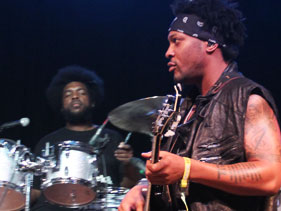
R&B singer hits the stage during early morning hours his first U.S. performance in 12 years. By Nadeska Alexis Questlove and D’Angelo Photo: Rya Backer/ MTV News MANCHESTER, Tennessee — Questlove always has a few tricks up his sleeve, and the Roots drummer saved his one of his biggest stunts in recent history for Saturday night’s “Superjam” session at the Bonnaroo Music and Arts Festival. Just a couple hours after the Roots finished their own set on the festival’s main stage, D’Angelo joined Questlove for his first U.S. performance in over a decade. The Superjam session (billed as “?uestlove with very special guests”) didn’t kick off until well after midnight at “This Tent,” and Quest wasn’t on the stage for long before he proudly introduced the legendary R&B singer to the crowd, telling them, “I’ve been waiting 12 years to say this: Ladies and gentleman, D’Angelo!” After warming up with a few recent shows in Europe , D’Angelo finally made his way to a stage in the states. With the support of a nine-piece band and musical veterans like Roots collaborator James Poyser, D’Angelo joined Quest for over an hour, opening with Jimi Hendrix’s “Have You Ever Been (to Electric Ladyland)” and hitting songs like the Beatles’ ‘She Came in Through the Bathroom Window” and Led Zeppelin’s “What is and What Should Never Be.” Rumors of an appearance from D’Angelo had been circulating through the music tents in Manchester, Tennessee all day, and when MTV News caught up with Questlove a few hours before the surprise set, he explained, without naming names, what his vision for the night was. ‘What I wanted to do was recreate the magic of the songwriting process at the time when I was taking residency in Electric Lady Studios,” he explained, referencing Jimi Hendrix’s studio facility built in New York’s West Village in 1970. “I made that my central location from 1996 ’til about 2004, and during that time that’s where D’Angelo’s Voodoo album as created, Mos Def’s Black on Both Sides was created, and even some of Phrenology and The Tipping Point was created,” he said. “That was really the central location for our soul querying catalog, so what I’ve done [for the Superjam] is gathered a cast of characters to show what a night in that period was like.” And what exactly what a typical night in Electric Lady Studios like? “Around 3 a.m., we would sit around bored and decide what album to re-do,” he reminisced. “So let’s say Prince’s Under the Cherry Moon album — we would get in the studio and karaoke-style do the album from start to finish. But if at any point we started playing something that sounded good, we kept playing the groove over it, then all the music would go away, the drums would still go … and it slowly morphed into another song. That was our songwriting process. So tonight, eight musicians of historical significance will be on stage and when we’re in that circle, it’s just gonna be the eight of us. I’m not even gonna look at the thousands of people watching.” The thousands of people who were watching had a hard time believing that D’Angelo was really jamming at the late-night set, and it’s safe to say that not one of them was “bored” as Questlove joked they might be. The next time fans will be able to catch D’Angelo live is at the upcoming Essence Music Festival in New Orleans, where he’ll likely treat crowds to his own classics. Are you at Bonnaroo? Share your review in the comments below! Related Videos Bonnaroo 2012 Gets The Party Started Related Photos 2012 Bonnaroo Music And Arts Festival Related Artists D’Angelo The Roots

More here:
D’Angelo Joins Questlove For Historic Superjam At Bonnaroo

THG Week in Review: Miley Gets Engaged, Amber Goes to Jail, Kate Baby Bump Buzz & More!

Welcome to THG’s Week in Review! Below, our staffers look back at the stories, stars and scandals that made the last seven days some of the craziest all year. If you don’t already, FOLLOW THG on Twitter , Google+ and Facebook for 24/7/365 news. Every day, week and year, let us be your celebrity gossip source! Now, a rundown of the week that was at The Hollywood Gossip : At age 19, finally, Miley Cyrus is engaged to Liam Hemsworth! Congrats! Teen Mom star Amber Portwood was sentenced to five years in prison . Doug Gotterba claims he was the secret lover of John Travolta for years. Married actor Brian Presley hit on Melissa Stetten … who live Tweeted it. Queen Elizabeth’s Diamond Jubilee marked her 60th year on the throne. Kate Middleton’s baby bump , or lack thereof, also had Brits buzzing! Another week, and another Lindsay Lohan wardrobe malfunction . It was as Elizabeth Taylor at least. Classy wardrobe malfunction! Olivia Culpo was named Miss USA 2012 on Sunday night! Miss PA Sheena Monnin said the whole thing was rigged. Myla Sinanaj is dating Kris Humphries for some reason! Rihanna posed and got pissed in Esquire. Kristen Stewart Wins Best Kiss Kristen Stewart won Best Kiss at the 2012 MTV Movie Awards . Poor Lil Wayne feels unwelcome at Oklahoma City NBA games. Jenelle Evans and Gary Head ‘s engagement was off, briefly. Gwyneth Paltrow’s n-word controversy was surprising. Kim and Kanye supposedly might elope. Not. Gisele Bundchen is pregnant again. Timothy Poe America’s Got Talent Audition America’s Got Talent hopeful Timothy Poe is in major hot water. Faking your back story like he did will get you death threats . Dee Jay Daniels got popped for murder, gang activity. The controversial Chris Brown performed on Today … … but not before Chris Rock owned him . Scout Willis was arrested. Barack Obama Singing ‘Call Me Maybe’ by Carly Rae Jepsen The President got into the “Call Me Maybe” meme (albeit unwittingly). Amanda Bynes was charged with DUI … and asked Obama for help. The Bachelorette spoilers continue to paint a murky picture. Erin Moran of Happy Days now lives in a trailer park. Robert Pattinson and Kristen Stewart are hot. Finally, here’s Octomom as a porn star … What was the highlight of the week for you? Did we leave anything out?

Read this article:
THG Week in Review: Miley Gets Engaged, Amber Goes to Jail, Kate Baby Bump Buzz & More!