If you need further evidence that Marvel is winning the battle against DC on the comic-book movie front, consider the latest Internet chatter about the Guardians of the Galaxy movie. Latino Review , which knows how to work that fan boy beat, reports that Marvel has inquired about the availability of both Jim Carrey and Adam Sandler for the movie, which is slated to hit theaters on Aug. 1, 2014. It’s unclear what roles Marvel envisions these actors playing, but Latino Review and other blogs have been guessing Rocket Raccoon (whose creation was inspired by the Beatles’s White Album song “Rocky Raccoon”) and the tree-like Groot are the most plausible, since both are reportedly in the Guardians of the Galaxy script. Given these two superheroes’ non-human appearances, they’ll probably exist as computer-generated characters , and if I’m doing the casting, I’d want the shape-shifting Carrey to play Groot because the character bears a resemblance to the Grinch, which the actor already played (in Ron Howard’s obnoxious adaptation of the Dr. Seuss book), and Sandler as Rocket. Sandler’s biggest hit in a long time was as the voice of the CGI Count Dracula in Hotel Transylvania last year, so I suspect he’ll be up for the gig. Even if Marvel casts just one of these guys, or some equally funny dude, it’s an astute move because, while the costumes and action sequences in these comic-book movies are fun, it’s the humor that gives them soul and makes them — so far — superior to the DC equivalent. Yes, Christopher Nolan’s The Dark Knight trilogy was exceptional, but, given the choice, I’ll take Robert Downey Jr.’s satisfyingly smart-ass portrayal of Tony Stark and Iron Man every time. [ Latino Review , io9 ] Follow Frank DiGiacomo on Twitter. Follow Movieline on Twitter.
Last night’s Golden Globes cemented Argo as the People’s Film from an awards season stand-point, setting the scrappy underdog to stand toe-to-toe with the monolithic Lincoln . Theoretically, the “People’s Film” would be The Hunger Games , which won Favorite Movie at the People’s Choice Awards, but in the context of the Oscars, the populism is relative to the awards — and none of the elite awards are more populist than the Golden Globes. The Hollywood Foreign Press Association established the annual Golden Globes as an opportunity to gather Hollywood’s elite, and the awards create the appearance of a competitive event instead of simply another gala. The goal is TV revenue, ostensibly to fund the HFPA’s philanthropic endeavors. The voting is dubious, with a body of less than 100 journalists with a penchant for press junkets that hinge on the interviewee’s charisma and charm. This is why the Globes live up to their reputation of grinning, drunken swagger: they can be loose and fun, because at the end of the day, it’s not about the awards, it’s about the audience. So the HFPA awarded Argo the title of Best Motion Picture – Drama, as well as giving Ben Affleck the award for Best Director — something he cannot replicate at the Oscars, where he’s not nominated for Best Director. But the narrative is shifting in Argo ’s direction. The film has always been a contender. With just three directed films and a severe image challenge as a personality, actor-turned-director Affleck has reconfigured himself as a filmmaker who demands respect. The fictionalized true story behind Argo , tying a Middle Eastern thriller to Hollywood in-jokes, was always the sort of smart film audiences could embrace. The box office reflected this, earning more than $111 million in the United States (ignoring a probable post-Globe, pre-Oscar rerelease), which is less than Lincoln to date but still nothing to scoff at for an R-rated political thriller. Along the way, Argo has quietly been picking up awards from various critics groups. It was one of the AFI Films of the Year and made the National Board of Review’s Top Films list. It won ensemble awards from the Hollywood Film Festival and Palm Springs International Film Festial, took the top prize from the San Diego critics and took 2nd place from the New York critics. This past week, it scored a major win at the Critics’ Choice Awards, taking Best Picture and Best Director on the same day the AMPAS directing wing blocked Affleck out. Like the Globes, the Critics’ Choice flexed the populism muscle, despite the assumed prestige from an umbrella group of critics. The Critics’ Choice tried something new this year by being broadcast on the CW, awkwardly combining the general intelligence of film critics with the popcorn atmosphere of the network. The organization received flack for poor decisions such as cutting away from the screenplay award (which went to Lincoln ‘s Tony Kushner) and for focusing on less prestigious nominees in favor of name recognition. What all of this amounts to, however, is a critics award that was aiming for Golden Globe-style populism. Argo winning both Critics’ Choice and the Golden Globe for Best Drama has set its tone and changed the popular conversation, commanding awards-watchers to take the film seriously again after losing momentum earlier in the season thanks to the thunder-stealing Zero Dark Thirty . What remains to be seen are the results of the Screen Actors Guild and the BAFTAs . Argo has received ensemble attention, so SAG’s big award isn’t out of the realm of possibility, but Argo has not received the individual acting attention that Les Miserables , Silver Linings Playbook , or even Lincoln have. This makes SAG the biggest landmark on Argo ’s horizon, because a win there would solidify the film’s narrative as the People’s Film, and the one that people want to win it all. Chime in below with your Oscar musings: With all this populist momentum, does Argo have a shot at Best Picture? MORE ON THE GOLDEN GLOBES: WATCH: Jodie Foster Wins The Golden Globes With Her ‘Coming Out’ Speech ‘Argo’ & ‘Les Misérables’ Take Top Movie Prizes At Golden Globes – WINNERS LIST High Five! The Best GIFs Of The 2013 Golden Globes John Hendel is a playwright from Los Angeles. Follow him on Twitter @hendyhendel . Follow Movieline on Twitter .
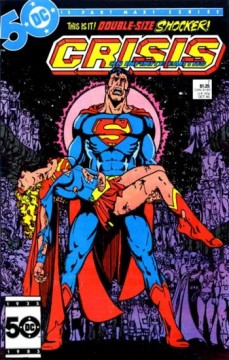
Latino Review is citing a source who says Warner Bros. has settled on storyline its 2015 Justice League movie. According to the tipster, the film will look to issues 183-185 of the Justice League comic, which was released back in 1980. That plot has Darkseid — confirmed as the movie’s villain — attempting to use a magical laser beam to blast planet Earth to bits and move his home world, Apokolips, into its place. Yikes! Latino Review ‘s stories are quite usually accurate, but until the news receives official confirmation, I’m taking this with a big-ass grain of Kryptonite. Besides, as cool as this sounds, there’s a hell of a lot more from DC’s storied history worth mining for the first cinematic team-up between Superman and Batman (and the rest, cough.) I think DC and WB need to consider all options available to them before committing, so to help them out, here are three other superpowered super stories worth exploiting: 1. Crisis on Infinite Earths (1985) By the 1980s, the DC universe had stopped making sense thanks to 40-plus years of superhero funnybooks that had been reactively and haphazardly modified to suit the aesthetic tastes of the times. Batman was both the grumpy avenger of the 1970s AND the campy 1950s version whose relationship with Robin unfairly inspired the moral panic book Seduction of the Innocent . Superman was both a stiff-necked last son of Krypton and the guy who had Krypto the Super Dog. No superhero’s official backstory made any sense at all, basically, and DC’s official explanation, the Multiverse (all these various contradictory versions of characters existed in numerous parallel dimensions) now made less sense than Mulholland Drive. To fix this mess, DC writer Marv Wolfman came up with Crisis , in which two godlike beings — The Monitor and his evil counterpart the Anti-Monitor — used DC’s various character incarnations in a battle over control of the Multiverse. Total destruction was narrowly avoided when even stalwart villains like Darkseid joined the fight to stop the Anti-Monitor — the result being that DC became a single universe once more and some inconvenient characters were erased seemingly forever from Continuity. (RIP: Supergirl and Barry Allen.) Subsequently, that universe was rebooted, and the next two years saw Superman restarted at issue 1 and the publication of both Batman: Year One and Batman: The Dark Knight Returns . Since Christopher Nolan’s Dark Knight series and Zack Snyder’s upcoming Man of Steel both take their cues from the post- Crisis DC universe, they don’t need a reboot, but not so the rest of the DC movie and television continuity. We know Darkseid is the villain of the Justice League movie, but that doesn’t mean his evil plan couldn’t have the happy result of willing the recent Green Lantern movie, and the old Wonder Woman and The Flash tv shows out of existence forever. A Crisis -inspired plot could give us new versions of those characters without the tedious need for any sort of origin-story movies. Just so long as Mark Hamill’s Trickster stays in the picture. 2. War of the Gods (1991) You know which character is unfairly ignored, despite frequent, abortive attempts to revive her onscreen? Wonder Woman . By far the DC superhero with the most potential for epic plots full of crazy mythology this side of Superman, Wonder Woman is an immortal demigod and the second most powerful active superhero in the DC universe. Too bad though, because instead of the terrifyingly powerful Amazonian princess we need, every attempt to bring Wonder Woman back ends up being some silly faux-feminist nonsense that manages more than anything else to infantilize the character. This is why of all the trepidations I have about Justice League , the most troubling is how she’ll be portrayed. Warner Bros. can fix this by basing the plot of Justice League on the War of the Gods crossover, which was created to celebrate Wonder Woman’s 50 th anniversary. That story had the ancient Roman gods go to war against the ancient Greek gods (which is kind of like the original cast of Beverly Hills 90210 starting a gang war with the cast of the CW’s 90210 ), while pantheons of other ancient cultures rose up and tried grabbing a piece of whatever was left. Wonder Woman and her fellow Amazonians of Paradise Island end up having to save Earth, with some help from DC’s other heroes (including a Brainwashed Captain Marvel). Darksied, being the antagonist of DC’s New Gods, is the perfect behind-the-scenes manipulator to rile the old gods. And best of all, it gives Wonder Woman, criminally neglected in filmed-entertainment for almost 40 years, a chance to be front and center of Justice League without it coming off as painful tokenism. 3. Hostess Snack Cake Wars Finally, we come to the greatest and the timeliest crisis for Warner Bros.’ Justice League to overcome: The horrifying shortage of Twinkies. From 1975 through the early ’80s, Hostess advertised heavily in the pages of Marvel and DC comics via a series of hilariously irresponsible short comics featuring each company’s superheroes and villains battling over control of — no, seriously — Hostess snack cakes. You can see the whole series of them here . Each adventure involved either some nefarious villain’s plot to steal or disrupt the supply of these delicious, obesity-causing confections — believe me, I know. #formerfatkid — or superheroes using Hostess cakes to foil criminal activity. No matter who lost, we won, however, because Vanilla Pudding Pies were the shit. Of course, now we know that if the average super villain was serious about destroying the supply of Hostess Ding Dongs and Twinkies, they should have gotten their MBA. So why not make this current event the basis of Justice League ? Have the ruler of Apokolips form an asset management company, buy Hostess, and loot it from the inside via perfectly legal tricks like destroying the employee fund. Thrill to the helplessness of the Justice League as they fail to convince a bankruptcy court that not only should Hostess employees get to keep their pensions, but that Darkseid is planning to destroy the universe. Darkseid could even run for president, citing his business acumen as proof of competence and rendering Superman painfully impotent as cable news channels constantly demand to see his Kryptonian birth certificate. Far-fetched? Hell yes, but no more so than the idea that unions are a force more evil than the Legion of Doom. So what would you like to see in the Justice League movie? Sound off in comments. Ross Lincoln is a LA-based freelance writer from Oklahoma with an unhealthy obsession with comics, movies, video games, ancient history, Gore Vidal, and wine. READ MORE: DC’s Competitive Darkseid? Reported ‘Justice League’ Villain Inspired ‘Avengers 2’ Bad Guy Follow Ross A. Lincoln on Twitter. Follow Movieline on Twitter.
In another major awards win for Kathryn Bigelow ‘s latest, Zero Dark Thirty took major nods from the National Board of Review, receiving kudos for Best Film, Best Director and Best Actress for Jessica Chastain . [ Related: NY Film Critics Circle Spices Up Oscar Race With ‘Zero Dark Thirty’ Best Picture Pick ] Also taking major wins by the group were Bradley Cooper for Best Actor for Silver Linings Playbook , Leonardo DiCaprio (Best Supporting Actor) for Django Unchained , while Michael Haneke’s Cannes Palme d’Or winner Amour took Best Foreign Language Film. Sundance ’12 winner Beasts of the Southern Wild won both Best Directorial Debut for Benh Zeitlin and the Breakthrough Actress prize for Quevenzhané Wallis. Ben Affleck’s Argo received a Special Achievement in Filmmaking mention. Meredith Vieira will host the National Board of Review Gala on January 8th in New York. 2012 National Board of Review Prizes : Best Film: Zero Dark Thirty Best Director: Kathryn Bigelow, Zero Dark Thirty Best Actor: Bradley Cooper, Silver Linings Playbook Best Actress: Jessica Chastain , Zero Dark Thirty Best Supporting Actor: Leonardo DiCaprio , Django Unchained Best Supporting Actress: Ann Dowd , Compliance Best Original Screenplay: Rian Johnson , Looper Best Adapted Screenplay: David O. Russell , Silver Linings Playbook Best Animated Feature: Wreck-It Ralph Special Achievement in Filmmaking: Ben Affleck , Argo Breakthrough Actor: Tom Holland , The Impossible Breakthrough Actress: Quvenzhané Wallis , Beasts of the Southern Wild Best Directorial Debut: Benh Zeitlin , Beasts of the Southern Wild Best Foreign Language Film: Amour Best Documentary: Searching for Sugarman William K. Everson Film History Award: 50 Years of Bond Films Best Ensemble: Les Misérables Spotlight Award: John Goodman (Argo, Flight, Paranorman, Trouble with the Curve) NBR Freedom of Expression Award: Central Park Five NBR Freedom of Expression Award: Promised Land Top Films (in alphabetical order) ARGO BEASTS OF THE SOUTHERN WILD DJANGO UNCHAINED LES MISÉRABLES LINCOLN LOOPER THE PERKS OF BEING A WALLFLOWER PROMISED LAND SILVER LININGS PLAYBOOK Top 5 Foreign Language Films (In Alphabetical Order) BARBARA THE INTOUCHABLES THE KID WITH A BIKE NO WAR WITCH Top 5 Documentaries (In Alphabetical Order) AI WEIWEI: NEVER SORRY DETROPIA THE GATEKEEPERS THE INVISIBLE WAR ONLY THE YOUNG Top 10 Independent Films (In Alphabetical Order) ARBITRAGE BERNIE COMPLIANCE END OF WATCH HELLO I MUST BE GOING LITTLE BIRDS MOONRISE KINGDOM ON THE ROAD QUARTET SLEEPWALK WITH ME
As beloved and popular as J.R.R. Tolkien’s The Hobbit has been in the seventy plus years since its publication, the simple adventure story has never been much more than prologue, a light and sunny rain compared to the epic hurricane force of Tolkien’s Lord of the Rings , the transformative high fantasy quest narrative which C.S. Lewis once said contained “beauties which pierce like swords or burn like cold iron.” The worst thing that could be said about Peter Jackson ‘s fourth cinematic foray into Middle Earth, The Hobbit: An Unexpected Journey , is that it follows suit, being merely good when greatness was anticipated or expected. As with Lord of the Rings , but perhaps never more so than in The Hobbit , Jackson brings a plain earnestness to the material which matches Tolkien’s direct and straightforward narrative voice. There’s awe and wonder to be found beyond The Shire as the eponymous hobbit, Bilbo, (Martin Freeman) and a band of fierce but merry dwarves led by Thorin Oakenshield (Richard Armitage), embark on their adventure towards the dragon Smaug’s stronghold deep within The Lonely Mountain, but never any slyness or irony, no winks at the audience behind cynical detachment. (One earnest sequence in particular, in which Bilbo takes his leave of Gollum and then talks of what home means to the dwarves, recalls Sam’s speech at the end of Two Towers and will leave viewers’ hearts aching.) Jackson’s unwillingness to embrace anything other than earnestness in his original Lord of the Rings trilogy is in part what made those films resonate so strongly with early 21st century audiences. They contain silliness and laughter, but a silliness and laughter always carefully calibrated to service a delicate tonal balance. In those films, as in Tolkien’s original works, the story begins in Fellowship with the comical idea of an old hobbit’s birthday party, gradually elevating its register until, by the end of Return of the King , it becomes one of the greatest quest narratives ever filmed (or written). The problem with The Hobbit: An Unexpected Journey as quest narrative, however, is that, for Tolkien, who wrote the story long before he ever put pen to paper on Lord of the Rings , that register never changes or elevates. Although in later years he would go back and make minor corrections to the original text to reflect updated plot points or characters, what starts with “In a hole in the ground there lived a hobbit” ends quite matter-of-factly in the same style, never going much beyond a simple and unpretentious adventure story for children. Jackson, taking on the task in reverse (creating his Hobbit after his Lord of the Rings ) occasionally missteps in his desire to combine the two stories into a tonally consistent whole, bringing silliness to moments that should be of great portent, and vice versa. For example: Many will point to Radagast the Brown (Sylvester McCoy), with his jackrabbit sled and bird poop-bespotted hair, as an example of comic relief that goes too far. It doesn’t, but the general dottiness of the character comes at a moment in the film of great peril, when it is revealed for the first time that the villainous Necromancer who is troubling the borders of Mirkwood might, in fact, be the villain — the evil Sauron. Tolkien could avoid the confluence, but not Jackson, who in his fierce desire to make The Hobbit as tonally consistent with Lord of the Rings as possible mixes the two and finally pushes his finely-tuned and hard-earned cart over, unbalancing the film in this and other parts as he tries too hard to align it with his earlier work. Where Jackson might occasionally misstep tonally, he takes the reigns from the episodic original and runs with generally fantastic results through several narrative additions, all of which give the characters more agency in their own affairs. After the film’s somewhat meandering first half (which includes two separate dwarf musical numbers), Bilbo and Thorin succeed in, for instance, escaping the trolls and wargs with actual actions and choices, instead of a Deus Ex Gandalf . Though hardcore fans might scoff at the blasphemy of adding anything to the source material, even those things written by Tolkien himself in the appendixes, Jackson succeeds cinematically in pulling off the Orc/Dwarf Battle of Nanduhirion and the fleshing out of Azog as a dominant and recurring adversary. Less successful are scene additions consisting of actors reprising their roles from Lord of the Rings . While the stuff with Galadriel (Cate Blanchett) and Sarumon (Christopher Lee) at the White Council works like gangbusters, an early scene where Frodo (Elijah Wood) stands around and does nothing smacks of prequel-itis. Even with all these additions, or perhaps because of them (the film clocks in at a staggering 166 minutes, or about a minute for every two pages of text in the original — and there are two films left) An Unexpected Journey feels less like a self-contained narrative and more like a partial installment, in ways the Lord of the Rings films never did. Like Bilbo reflecting on his long path from The Shire and what it means to fight for a place to call your own, however, returning to Middle Earth feels right . And if it doesn’t quite soar as high in transformative joy or ecstasy as we thought it might… it’s still home. Note : I saw the film in 3-D at 24 fps. The 3-D adds nothing to the film, and is a surcharge to be avoided. READ MORE ON THE HOBBIT (In theaters December 14): ‘Hobbit’ First Review: 48 FPS Is ‘Eye-Popping,’ But Watch Out For The Jar Jar Binks Of ‘LOTR’ WATCH: Peter Jackson’s Hobbit Video Reveals Over Ten Minutes of Behind the Scenes Footage Shawn Adler is a film writer and interviewer based out of NYC. For his in-depth writing on genre films, Shawn was once called “The Harold Bloom of superhero trailers” by the “Hollywood Reporter.” It would be a mistake to simply think that nobody cares about that now. Nobody cared about it then either. You can follow him on Twitter @Lethrup . Follow Shawn Adler on Twitter . Follow Movieline on Twitter .
Killing Them Softly is set in Boston, maybe. Someone mentions living in Somerville, a scattering of the characters have the accent, and they talk about going down to Florida. But the film was shot in New Orleans, often in the industrial edges still ragged from Hurricane Katrina, and the only people who seem to inhabit its universe are gangsters — high level ones with pretentions of civility and hardscrabble losers struggling to get a few dollars together by way of hazardous schemes. What ties this abstract, violent place to the real world is the 2008 presidential election, which provides a backdrop for its tale of an ill-advised robbery and the guy brought in to clean up after it. There’s George W. Bush talking about the bailout on a TV in the corner as two guys knock over a card game; there’s Barack Obama promising change on a billboard over a neighborhood filled with empty lots and abandoned houses. It’s a neat idea, matching the brisk kill-or-be-killed business of unforgiving criminal life to an America staggering from the economic crisis. But as in his last feature, the gorgeous and stiltedly self-conscious The Assassination of Jesse James by the Coward Robert Ford , Australian filmmaker Andrew Dominik shows a tendency to lean too hard on his symbolism rather than letting it exist as part of the whole. In Jesse James it was the tying in of the last days of the outlaw to a meditation on celebrity. Here, it’s the capitalism-as-a-disease parallels on a national and narrative scale that start to feel on the nose long before a character barks “America’s not a country, it’s a business — now fucking pay me!” and Barrett Strong’s “Money (That’s What I Want)” plays over the closing credits. But when Dominik , working off his own screenplay adaptation of a novel by George V. Higgins, is less focused on trying to make an important movie, he turns out an indisputably fun one, a stylish and flamboyantly macho affair that cribs pleasantly from Mamet, Blue Velvet , Tarantino and Scorsese . The film starts with Frankie (Scoot McNairy), a ferrety guy recently out of prison and eager to convince his Australian pal Russell ( Ben Mendelsohn , memorably scary in Animal Kingdom ) to get in with him on a job. Russell’s working his own scheme involving kidnapping purebred dogs and using the money to buy an ounce of heroin and become a dealer, but Frankie’s pal Johnny (Vincent Curatola) has what he claims is a foolproof gig. They’ll rob a poker game run by a guy named Markie ( Ray Liotta ), who arranged to hold up his own game once in the past and got away with it. The games are protected, but if his gets robbed again everyone will assume he’s the one behind it. Killing Them Softly starts off with its main heist, if it can be called that, and then turns to the fallout, letting things rattle along for a considerable amount of time before introducing Jackie ( Brad Pitt ), a guy who can’t really be described as a hero or antihero. Jackie’s a fixer and a hitman who’s filling in for the last go-to guy, Dillon (Sam Shepard, glimpsed only in flashbacks), and he’s a competent, no nonsense figure in a world full of fuck-ups. Dominik’s film is interesting in that the crimes themselves, whether stick-ups or killings, are rarely difficult — it’s the aftermath that gets people in trouble, when they can’t keep their mouths shut about what they just pulled off or don’t know when to cut their losses and get out of town. Dominik shows an open appreciation for his actors and for the way tough guys, aspiring and genuine, talk to each other — and Killing Them Softly is as much centered around talking as it is action. Pitt, playing a practical know-it-all who falls somewhere between Rusty Ryan and Tyler Durden, is terribly entertaining shooting the shit with Driver (Richard Jenkins), the representative of the unspecified group who hired him, the two complaining about the new “total corporate mentality” like disgruntled office workers on a smoke break. Later, he brings in Mickey (James Gandolfini) from New York to help out, and watches him with worried calculation as he turns out to be in rough shape. If gangsterism is just capitalism in a more raw form, then Jackie is the creature best suited for this world. He knows the rules and enforces them without prejudice, because it’s just business and this is just a job. Killing Them Softly doesn’t give that idea its intended sting. The film wants to be angry and scathing, but, to its credit, enjoys its characters and its mechanics too much to have a sharp edge. Whether it’s showing someone’s death in a luxurious slow motion spray of bullets and glass or lingering as someone drunkenly reminisces about a girl he sometimes sleeps with but has no hold on, the film is too fond of its rich details to allow them to become damning symbols of the system in which they can be found. Follow Alison Willmore on Twitter. Follow Movieline on Twitter.
James Cameron will return to Pandora next year. The Avatar director, who attended the premiere of Peter Jackson’s The Hobbit: An Unexpected Journey in Wellington, New Zealand on Wednesday, told the West Australian (via Total Film ) that he hoped to have the scripts to Avatar 2 and 3 completed by February, and to begin shooting by the end of 2013. Cameron, who owns a farm in New Zealand, said he was working on the scripts there, but complained that the beauty of his surroundings was “too damn distracting.” Nonetheless, the filmmaker said, “I want to get these scripts nailed down, I don’t want to be writing the movie in post-production.” He added: “We kind of did that on the first picture, I ended up cutting out a lot of scenes and so on and I don’t want to do that again.” The blockbuster director behind Titanic, Terminator and Aliens has said that he’s writing Avatar 2 and 3 together and plans to shoot them back-to-back to complete one long story arc. (He’s also suggested that an Avatar 4 could happen and the sequels could conceivably be populated with Chinese Na’vi . Cameron also predicted that Jackson’s decision to shoot The Hobbit at 48 frames per second — 24 is the standard — would do for high-definition filmmaking what Avatar did for 3D movies. “We charged out ahead on 3D with Avatar , now Peter’s doing it with The Hobbit . It takes that kind of bold move to make change.” [ West Australian , Total Film ] Follow Frank DiGiacomo on Twitter. Follow Movieline on Twitter.
Peter Jackson ‘s The Hobbit: An Unexpected Journey had its New Zealand premiere Wednesday, and although local press are still under embargo, the New York Daily News has burst out of the gate with the first published review of the anticipated Lord of the Rings follow-up. What’s the early verdict on Jackson’s groundbreaking 48 fps presentation, which was so publicly panned in previews ? Ethan Sacks’ review is enthusiastic if not terrifically detailed, but let’s cut to the elephant in the room: Will audiences reject the super-resolution 48 fps look of The Hobbit ? “Critics who saw a trailer earlier this year were unimpressed, but after a minute or two of adjusting, the higher resolution is eye-popping, similar to discovering HD television for the first time,” Sacks writes. Phew. Well, grain of salt: This is the first and only review out there now, so we’ll see if other critics agree as The Hobbit begins screening stateside tomorrow. As for the film itself, expect a cameo-filled romp that should satisfy Tolkien fans: “Lighter and funnier than its Lord of the Rings predecessors, The Hobbit: An Unexpected Journey remains faithful to the fantasy world last seen in the 2003 Academy Award-winning The Lord of the Rings: The Return of the King .” There is just one little glaring notation; Sacks warns of one potentially grating character by dropping three of the most fearsome words in popular geekdom: Jar Jar Binks. “Like all unexpected journeys, there are a few pitfalls along the way, most notably the tangential subplot surrounding bumbling wizard Radagast the Brown (Sylvester McCoy), whose buffoonery at times descends into Jar Jar Binks territory.” [ New York Daily News ] The Hobbit: An Unexpected Journey hits theaters December 14. Read more: Wranglers Say ‘Hobbit’ Animals Suffered Gruesome Deaths On ‘Death Trap’-Ridden Farm The Hobbit, The Silmarillion, and 48 FPS: More Tolkien In Store for Peter Jackson? The Hobbit 48 FPS Preview Divides Audiences at CinemaCon Follow Jen Yamato on Twitter . Follow Movieline on Twitter .
It’s that time, folks! Kick off the end-of-year deluge of Top 10 lists with the best films of the year, as selected by Cahiers du Cinema . Because why bother waiting for the rest of 2012’s Oscar hopefuls to screen when you’ve already had your mind blown by Leos Carax’s wondrously WTF Holy Motors ? Cahiers du Cinema ‘s Top 10 of 2012 (via MUBI / TOFilmReview ): 1. Holy Motors (Leos Carax) 2. Cosmopolis (David Cronenberg) 3. Twixt (Francis Ford Coppola) 4. 4:44 Last Day On Earth (Abel Ferrara) 4. In Another Country (Hong Sang-Soo) 4. Take Shelter (Jeff Nichols) 7. Go Go Tales (Abel Ferrara) 8. Tabu (Miguel Gomes) 8. Faust (Alexadre Sokourov) 10. Keep The Lights On (Ira Sachs) Of the honorees on the arthouse-centric list, Carax’s Holy Motors , a transfixing ode to cinema and performance anchored by Denis Lavant’s lead performance, should be the one to pop up elsewhere most frequently this season on critics’ lists. Abel Ferrara makes the list twice — not too shabby considering that both 4:44 Last Day On Earth and Go Go Tales earned mixed acclaim from critics. And who would’ve thought, four years ago when the first Twilight movie launched him into the teen idol stratosphere, that Robert Pattinson would not only make the Cahiers du Cinema Top 10 but come in with a film in the #2 slot? Looks like teaming up with Cronenberg was RPattz’s best career move , after all. The Google translation of the Cahiers du Cinema December 2012 issue is rough, to say the least, but Stéphane Delorme’s editorial (located online here ) states, among other agendas of the issue (translated from French: “Rather than commenting on Tops, we prefer to dwell on the failings of contemporary cinema copyright”) that the publication’s Top 10 selection “shows that we expect from cinema audacity and heart.” And who can argue with that? Sound off with your thoughts below. [ Cahiers du Cinema / MUBI / TO Film Review via The Playlist ] Follow Jen Yamato on Twitter . Follow Movieline on Twitter .
There’s a five-minute tracking shot in the middle of Joe Wright’s 2007 film Atonement that is impossible to forget once you’ve seen it. A wounded Robbie ( James McAvoy ) is on the beach at Dunkirk, waiting to be evacuated, and in a nightmarish, beautiful single Steadicam take he wanders past crowds of soldiers, burning cars, horses being shot, a beached ship, a choir singing, the ferris wheel still spinning in the ruined background. It’s a mind-boggling piece of work, requiring immaculate timing and choreography, and it takes you right out of the movie because it’s there to show off. As impressive as it is from a production standpoint, the shot takes your focus away from the story and puts it on the mechanics of what’s happening on screen. Wright’s new adaptation of Tolstoy’s Anna Karenina lives in the hollow clockwork world of that shot. From a filmmaking perspective, it’s a gorgeous shadowbox of a production, filmed largely in a single location: a set resembling a run-down theater that was built on a Shepperton Studios sound stage. It starts with the sounds of an unseen audience settling down — there are no visible viewers of this story other than ourselves — and closes in on a proscenium arch as a curtain goes up. The scrim behind it reads “Imperial Russia, 1874.” Oblonsky (Matthew Macfadyen) is on stage, receiving a shave. When a door opens off the side, it is to a snowy street exterior in Moscow. He pays a visit to the family governess he’s having a fling with, and when he heads home, through a backstage area, he opens a door to see his wife Dolly (Kelly Macdonald) weeping over evidence of his infidelity. The scene sets the story into motion as his sister Anna ( Keira Knightley ) comes to visit in an attempt to save their marriage. Anna Karenina isn’t a filmed stage production in any way — it lives within this theoretical theater while not being confined to it. Characters stride up wooden stairs into bustling rafters that stand in for a city street, or walk through a bureaucratic office that, as the camera rotates, is pulled away and restaged as an upscale restaurant. Musicians wander through the space providing a soundtrack to the transition as it happens in front of our eyes. It’s an incredible thing to behold, at least at the start. Wright is clearly a fan of Aleksandr Sokurov ‘s Russian Ark , and the intense cleverness of his direction and the way Anna Karenina revels in artifice set the film apart visually from typically glossy film adaptations of classics that gleam with assured self-importance. But the gorgeous look and stage work and the way the movie connects impossible spaces — backdrops lift to reveal the Russian countryside, a grassy field running down the stage into the orchestra — is only a temporary salve. The unfortunate truth is that beneath the initial brilliance of its stylized setting, the film is just as dramatically inert as a more stuffy, traditional take on the material might have been. Scripted by playwright Tom Stoppard , the film labors to fit Tolstoy’s sprawling story into its two hour and ten minute runtime by drawing its characters with minimal lines. The film may be experimental, but the adaptation is actually fairly traditional, if briskly efficient. Anna, a Saint Petersburg aristocrat married to the stiff but good and moral Alexei Karenin (Jude Law), meets the handsome cavalry officer Count Vronsky (Aaron Taylor-Johnson) when departing the train for Moscow. Everyone expects Vronsky to propose to Dolly’s sister Kitty (Alicia Vikander), but he falls for Anna, following her home to Saint Petersberg and around to the parties, operas and other frilly gatherings until he wins her. As Anna struggles with wanting to leave Karenin for Vronsky, a scandal that would result in her being shunned by society, Kitty comes back around to Levin (Domhnall Gleeson), the earnest, shy childhood friend of Oblonsky whose proposal she at first turned down. The performances in Anna Karenina are strong, albeit built around a story told in shorthand, and the actors sometimes feel like they’re staging recreations of famous paintings rather than embodying characters. Knightley, lit sumptuously and dressed in luxurious gowns, stands out among the performers-as-props, but she can’t portray the complicated journey of a character who gives up everything for love, only to doubt and regret it. In this condensed version of the story, she seems more like someone who dithers for a few hours before throwing herself in front of a train. Wright has said that his inspiration for this adaptation was that the aristocrats at the time of Tolstoy’s novel were constantly on display and observed in society, living their lives as if they were always on stage. But this Anna Karenina feels like a diminishment of the story, not the essence of it. Rather than a tale of an affair that would have been fine had it not turned into a more serious love that broke societal rules, Anna Karenina feels like a group of people play-acting at passion. They hit all the famous elements in the story — the train station, the ball, the races, the running off together, the suicide — without a sense of them as a coherent whole or as anything other than opportunities for innovatively staged sequences. It’s a beautiful creation, but a remote and empty one. Follow Alison Willmore on Twitter. Follow Movieline on Twitter.