Tag Archives: scientists

NASA Discovers New Form of Life

Hours before their special news conference today, the cat is out of the bag: NASA has discovered a completely new life form that doesn't share the biological building blocks of anything currently living in planet Earth. This changes everything. At their conference today, NASA scientist Felisa Wolfe Simon will announce that they have found a bacteria whose DNA is completely alien to what we know today. Instead of using phosphorus, the bacteria uses arsenic. All life on Earth is made of six components: carbon, hydrogen, nitrogen, oxygen, phosphorus and sulfur. Every being, from the smallest amoeba to the largest whale, share the same life stream. Our DNA blocks are all the same. But not this one. This one is completely different. Discovered in the poisonous Mono Lake, California, this bacteria is made of arsenic, something that was thought to be completely impossible. While she and other scientists theorized that this could be possible, this is the first discovery. The implications of this discovery are enormous to our understanding of life itself and the possibility of finding beings in other planets that don't have to be like planet Earth. No details have been disclosed about the origin or nature of this new life form. We will know more today at 2pm EST but, while this life hasn't been found in another planet, this discovery does indeed change everything we know about biology, and in the astrobiology of the Milky Way and beyond: The universe suddenly becomes alive with potential life forms in the trillions of possible planets in galaxies known and unknown. And that's without counting yesterday's announcement on the discovery of a massive number of red dwarf stars, which may harbor trillion of Earths. http://gizmodo.com/5704158/nasa-finds-new-life added by: pjacobs51

The Cosmos + Sacred Geometry

We could be living in a small Universe where space is curved in on itself, rather like a football, say researchers in this week's Nature journal. Leonardo da Vinci had the right idea More precisely, we may inhabit a dodecahedral cosmos. It is, according to the scientists, the best way to account for the latest satellite observations. Dodecahedrons, and similar shapes, have long fascinated mankind. Plato believed that the Universe was made up of them. Leonardo da Vinci also studied them, as did the great astronomer Kepler, who thought the structure of the Solar System was based on geometrical shapes. Further observations, especially from space probes yet to be launched, may settle the matter, and may at last reveal the hidden geometry of the Universe. Ripples in the sky The Cosmic Microwave Background (CMB) radiation, the “echo” of the Big Bang, contains a wealth of data about the early history of the Universe, as well as its large-scale structure. If only we had precise enough observations of it to discriminate between competing ideas of what the Universe is like. The scientists were writing in Nature magazine Will it expand forever? Is space infinite? Such profound questions may have their answers in the CMB. Specifically, the answers may be found in the ripples in the CMB – miniscule, regular, fluctuations in its strength over the sky. Data from the US space agency's Wilkinson Microwave Anisotropy Probe (WMAP), which maps the CMB, suggests that at the very largest scales its temperature fluctuations seen across the sky are smaller than would be produced by an infinite Universe. It seems the WMAP data shows the Universe is too small for large fluctuations to be seen in the microwave background radiation. Positively curved space sections Astronomers from the US and France suggest that space itself is not big enough to support such waves. A small, cosmologically speaking, finite Universe, however, made of curved pentagons joined together into a sphere, would fit the observations. The answer could be in the CMB Writing a commentary in Nature, George Ellis of the University of Cape Town, says we live in a Universe “with positively curved space sections and a non-standard topology”. Indeed, a dodecahedral Universe, were you able to traverse it, would have some interesting properties. If you went out to the edge of the dodecahedron, you would come back in through the opposite face. More precise observations made by WMAP and by its successor, the Planck satellite, to be launched in 2007, will tell scientists if the cosmos does have such a shape, or if it is even stranger. http://news.bbc.co.uk/2/hi/science/nature/3175352.stm http://www.youtube.com/watch?v=NbHHr90psIs added by: mattovermatter

Papal Science Advisors Say World’s Poor Need GM Crops & Scientists Have Moral Duty to Develop Them

photo: Luigi Guarino / Creative Commons The Vatican’s science advisors have come out in support of genetically modified crops , saying that they scientists have both the right and moral duty to produce them to help the world’s poor, Ne… Read the full story on TreeHugger

Read the original here:
Papal Science Advisors Say World’s Poor Need GM Crops & Scientists Have Moral Duty to Develop Them

Proof of extra dimensions possible next year: CERN

GENEVA (Reuters) – Scientists at the CERN research center say their “Big Bang” project is going beyond all expectations and the first proof of the existence of dimensions beyond the known four could emerge next year. In surveys of results of nearly 8 months of experiments in their Large Hadron Collider (LHC), they also say they may be able to determine by the end of 2011 whether the mystery Higgs particle, or boson, exists. Guido Tonelli, spokesman for one of the CERN specialist teams monitoring operations in the vast, subterranean LHC, said probing for extra dimensions — besides length, breadth, height and time — would become easier as the energy of the proton collisions in it is increased in 2011. Other CERN physicists say the success so far of the world's largest scientific project suggests that some great enigmas of the universe they have in their sights could be at least partly resolved much sooner than they thought. “One year ago, it would have been impossible for us to guess that the machine and the experiments could achieve so much so quickly,” said Fabiola Gionotti, spokeswoman for another research team in the surveys, issued on CERN's website ( www.cern.org ). RESULTS ALL THE TIME “We are producing new results all the time,” she added. The existence or otherwise of the Higgs, never yet spotted but believed to provide the glue giving mass to matter, should be settled one way or another by the end of next year. The $10 billion LHC, whose operation and monitoring involves scientists and research centers in 34 countries, went into full operation on March 31, smashing protons together at near the speed of light with increasing energy. These collisions have been creating millions of simulations of the Big Bang which 13.7 billion years ago brought into existence the primordial universe from which stars, planets and life on earth — and perhaps elsewhere — eventually emerged. The LHC operations have been so trouble-free that at the start of this month CERN scientists were able to switch to colliding lead ions, creating temperatures a million times hotter than at the heart of the Sun. The ion collisions, creating an amalgam dubbed a quark-gluon plasma, give the research teams another way of looking at what happened within a nano-second of the Big Bang and at the first matter produced by that mighty explosion. CERN scientists say they have already taken research with ions further than those with gold at the long-established Relativistic Heavy Ion Collider at the U.S. Brookhaven National Laboratory on Long Island. These experiments have shown the power of the link-up of 140 computing centers around the world known as the Grid which processes the vast amounts of information that ion collisions produce. On December 6, the LHC will be shut down for servicing and to avoid draining electricity in the depths of winter from the energy networks of France and Switzerland along whose border CERN lies. It will start up again in February, then run at full blast, with protons, until the end of the year, when it will close down again until 2013 while engineers prepare it for running at double the energy to the end of the decade and beyond. added by: Vierotchka

Three Boys Found After 50 days Lost at Sea

;_ylt=AvmMk3gyBWE9Zn2knTmaldWs0NUE;_ylu=X3oDMTNyaDZ1MG4xBGFzc2V0A2FwLzIwMTAxMTI1L2FzX3NvdXRoX3BhY2lmaWNfcmVzY3VlBGNjb2RlA21vc3Rwb3B1bGFyBGNwb3MDNQRwb3MDMgRwdANob21lX2Nva2UEc2VjA3luX2hlYWRsaW5lX2xpc3QEc2xrA2FmdGVyNTBkYXlzYQ– added by: 02

Experts find shocking plagiarism in 2006 climate report requested by Joe Barton(R-Tx)

An influential 2006 congressional report that raised questions about the validity of global warming research was partly based on material copied from textbooks, Wikipedia and the writings of one of the scientists criticized in the report, plagiarism experts say. Review of the 91-page report by three experts contacted by USA TODAY found repeated instances of passages lifted word for word and what appear to be thinly disguised paraphrases. The evidence has become overwhelming that recent global warming is unprecedented in magnitude and speed and cause (see “Two more independent studies back the Hockey Stick and below). Indeed, as WAG notes, within a few decades, nobody is going to be talking about hockey sticks, they will be talking about right angles or hockey skates (see chart above). The disinformers (and the confusionists who Curry favor with them), however, are not merely oblivious to the multiple, independent lines of scientific investigation that lead to that conclusion. They have for over a decade tried to discredit one small piece of that underlying analysis, the Hockey Stick graph developed by Michael Mann, Raymond S. Bradley & Malcolm K. Hughes — continuing their obsession even after that analysis was largely reaffirmed by a 2006 report from the National Academy of Sciences, the “Supreme Court of science.” A cornerstone of the disinformer’s ultimately self-destructive attack on climate science is a 2006 report, commissioned by Rep. Joe Barton (R-TX) and Rep. Ed Whitfield (R-KY), and led by George Mason University statistician Edward Wegman, who is now himself under investigation by GMU. You can find all the details you could want about the shoddy analysis of the report at Deep Climate — including his “methodical demolishing of any hint of statistics” in the report, as John Mashey puts it in the comments. Here’s more from the stunning USA Today piece: “It kind of undermines the credibility of your work criticizing others’ integrity when you don’t conform to the basic rules of scholarship,” Virginia Tech plagiarism expert Skip Garner says. Led by George Mason University statistician Edward Wegman, the 2006 report criticized the statistics and scholarship of scientists who found the last century the warmest in 1,000 years. “The report was integral to congressional hearings about climate scientists,” says Aaron Huertas of the Union of Concerned Scientists in Washington, D.C. “And it preceded a lot of conspiratorial thinking polluting the public debate today about climate scientists.” But in March, climate scientist Raymond Bradley of the University of Massachusetts asked GMU, based in Fairfax, Va., to investigate “clear plagiarism” of one of his textbooks. Bradley says he learned of the copying from a year-long analysis of the Wegman report made by retired computer scientist John Mashey of Portola Valley, Calif. Mashey’s analysis concludes that 35 of the report’s 91 pages “are mostly plagiarized text, but often injected with errors, bias and changes of meaning.” Copying others’ text or ideas without crediting them violates universities’ standards, according to Liz Wager of the London-based Committee on Publication Ethics. “The matter is under investigation,” says GMU spokesman Dan Walsch by e-mail. In a phone interview, Wegman said he could not comment at the university’s request. In an earlier e-mail Wegman sent to Joseph Kunc of the University of Southern California, however, he called the plagiarism charges “wild conclusions that have nothing to do with reality.” The plagiarism experts queried by USA TODAY disagree after viewing the Wegman report: • “Actually fairly shocking,” says Cornell physicist Paul Ginsparg by e-mail. “My own preliminary appraisal would be ‘guilty as charged.’ “ •”If I was a peer reviewer of this report and I was to observe the paragraphs they have taken, then I would be obligated to report them,” says Garner of Virginia Tech, who heads a copying detection effort. “There are a lot of things in the report that rise to the level of inappropriate.” •”The plagiarism is fairly obvious when you compare things side-by-side,” says Ohio State’s Robert Coleman, who chairs OSU’s misconduct committee. The report was requested in 2005 by Rep. Joe Barton, R-Texas, then the head of the House energy committee. Barton cited the report in an October letter to The Washington Post when he wrote that Penn State climate scientist Michael Mann’s work was “rooted in fundamental errors of methodology that had been cemented in place as ‘consensus’ by a closed network of friends.” The Wegman report criticized 1998 and 1999 reports led by Mann (Bradley was a co-author) that calculated global temperatures over the last dozen centuries. It also contained an analysis of Mann’s co-authors that appears partly cribbed from Wikipedia, Garner says…. A 2006 report by the National Research Council (NRC), which examines scientific disputes under a congressional charter, largely validated Mann, Bradley and the other climate scientists, according to Texas A&M’s Gerald North, the panel’s head. The NRC report found the Wegman report’s criticism of the type of statistics used in 1998 and 1999 papers reasonable but beside the point, as many subsequent studies had reproduced their finding that the 20th century was likely the warmest one in centuries. Indeed, the Nature article on the report was headlined, “Academy affirms hockey-stick graph.” The Wegman report called for improved “sharing of research materials, data and results” from scientists. But in response to a request for materials related to the report, GMU said it “does not have access to the information.” Separately in that response, Wegman said his “email was downloaded to my notebook computer and was erased from the GMU mail server,” and he would not disclose any report communications or materials because the “work was done offsite,” aside from one meeting with Spencer…. cont added by: JanforGore


China Admits It’s the World’s Largest Greenhouse Gas Emitter

Photo: Haldini , Flickr, CC So it’s not exactly news: Scientists have known for years that China’s greenhouse gas emissions have surpassed that of the United States . But it’s telling that China, typically very guarded about pollution issues and climate impacts, has openly admitted as much. Here’s what China’s chief climate negotiator, Xie Zhenhua, told a news conference in Beijing, just days before he’s set to travel to the next round of international talks on glo… Read the full story on TreeHugger

Excerpt from:
China Admits It’s the World’s Largest Greenhouse Gas Emitter

Green Gift Guide: The Pop Culture Fan (Slideshow)

Image: TreeHugger Our 10 holiday gift guides are packed with green gifts, and this one is for the giftees who know exactly what’s on TV, in the theaters, or hot on the streets: Pop culture may seem flightly, but few things are more luxurious than losing yourself in a good book, taking the time to appreciate great art, or spending your afternoon lounging in front of an engrossing movie . You also can’t deny the influence that

Original post:
Green Gift Guide: The Pop Culture Fan (Slideshow)

Are Disposable eReaders In Our Future?

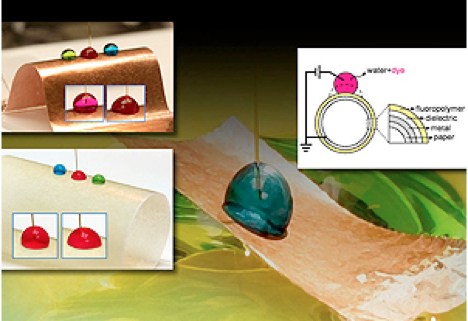
Image via University of Cincinnati Scientists at University of Cincinnati have figured out how to use a plain old sheet of paper as a surface for electrowetting, the technology behind e-paper such as used in e-readers and similar devices. It sounds like a dream come true because, as the researchers point out, it reduces device complexity and cost. However, it could be a huge concern since it may very well result in “disposable” one-time-use electronics. … Read the full story on TreeHugger

More here:
Are Disposable eReaders In Our Future?

Psychic Powers Proved Real

Psychology Today recently published an article called “Have Scientists Finally Discovered Evidence for Psychic Phenomena?!” an unfortunately minor exegesis regarding the large amount of “psychic” data that has appeared recently in peer-reviewed publications. The article highlights Dr. Daryl Bem's research into “seeing into the future” and “retrograde priming study” which appropriately echoes Dr. Rupert Sheldrake’s work for the last few decades (morphogenetic field theory). Regarding telepathy, Sheldrake has said, “I think all social animals have such fields…I think it’s a normal means of communication…I don’t think it’s paranormal, I think it’s normal. I don’t think it’s supernatural, I think it’s natural. I think it’s essentially a form of animal communication within groups.” We all know the feeling of falling in love with an individual or being close with a friend or family member or group; and when separated from each other we find each other thinking or feeling the exact same thing. How many times have you answered the phone and exclaimed, “I was just thinking of you—hard!” This “entangled minds” phenomena is the basis of one of Dr. Dean Radin’s book of the same title. Rumors of psychic abilities have steadily been bleeding in from the fringes and into the mainstream culture for the past century. From Princeton’s Engineering Anomalies Research laboratories, to government funded remote viewing projects at Stamford Research Institute, to the models of Campbell, Sheldrake, Wolf, and Radin to name a few, science (“the religion of the west”) is under pressure, now more than ever, to address the problem of consciousness—the measurer of all measurements. more at link… Through the rigorous program of Remote Viewing, it is possible for an individual to tap into the extra-sensory powers of the brain. Obviously, throughout history, individuals have had more natural proclivity for these abilities just as some are more athletic, smarter, etc., that we call psychic. I know the potential for telepathy and Star Wars force-like ability is inherent in our brains. We're just too busy building computers and robots supplanting our minds, instead of striving for the limits of our potential and making that quantum leap of faith towards a new Renaissance for humanity. added by: rodstradamus