Tag Archives: environment

CNN’s Gupta: Womb is a ‘Sacred Space’ and a ‘Safe Refuge’ for ‘Babies’?

CNN anchor Dr. Sanjay Gupta refreshingly made an implicitly pro-life argument during a report about how toxic chemicals possibly affect the unborn children: “Here in the womb, enveloped in darkness and warmth, a baby’s life begins in earnest. It is a sacred space: pristine, insulated, more than nine months of safe refuge from the world outside ” . Dr. Gupta made that statement as he gave a voice-over for the first segment of his “Toxic Childhood” special, which first aired on Thursday evening at 8 pm Eastern. CGI of a baby in the womb played as he described the “sacred space.” The anchor continued on this note in his first question to Dr. Frederica Perera of Columbia University: ” We imagine a baby sort of nice and safe and tucked away in the womb , impervious to all the assaults that occur on the body. You say, not so fast?” So Gupta twice referred to the unborn human as a “baby.” Despite this pro-life language, the CNN anchor failed to mention the liberal affiliation of the Environmental Working Group, an organization whose study he cited during the report, and how they are a project of the Tides Foundation . On two earlier occasions as well, Gupta leaned towards the pro-abortion side. During a December 19, 2008 segment , he included only one pro-life voice among several statements and clips from pro-abortion groups opposed to the expansion of health care workers’ right not to participate in controversial procedures such as abortion and in-vitro fertilization. The doctor also failed to correct former President Clinton after he repeatedly referred to human embryos as not being fertilized during a March 11, 2009 interview. Over the past year, CNN has slanted several times towards the pro-abortion position. Correspondent Carol Costello’s June 2, 2009 report highlighted a prediction by former Washington Post reporter Cynthia Gorney that there would be a “huge backlash” against pro-lifers after the murder of late-term abortionist George Tiller. CNN senior legal analyst Jeffrey Toobin fretted in a November 23, 2009 column that “abortion, as the academics like to say, is being marginalized.” Earlier in 2010, CNN.com attacked black pro-lifers and anchor Kyra Phillips conducted a softball interview of a woman who Tweeted her abortion as it took place. On the other hand, CNN’s Anderson Cooper spotlighted a woman who decided not to abort her infant daughter despite her severe genetic defects during a June 2, 2009 interview .

View post:
CNN’s Gupta: Womb is a ‘Sacred Space’ and a ‘Safe Refuge’ for ‘Babies’?

Gucci’s Luxury Packaging Gets a Green(er) Makeover

Gucci’s newly designed packaging is FSC-certified and recyclable. Image courtesy of Gucci. We have been following Rainforest Action Network’s ( RAN ) ” Don’t Bag Indonesia’s Rainforests ” campaign since its inception and it continues to reach new heights in the fight against the pulp and paper industry; Over 20 leading fashion brands including

Originally posted here:
Gucci’s Luxury Packaging Gets a Green(er) Makeover

Ask Pablo: Which Is Less Bad For The Environment: Wine Or Beer?

Image Source: Riebschlager Dear Pablo: When asked if I prefer beer or wine I am neutral. To help me get off the fence I am wondering: Is beer or wine better for the environment? Like car commercials claiming that 2000 pounds of metal and plastic are “good for the environment” because it has a trunk full of batteries, the choice between beer and wine for environmental reasons is a false one. Hardly anything that we humans do on this planet can be considered good for it. T… Read the full story on TreeHugger

More:
Ask Pablo: Which Is Less Bad For The Environment: Wine Or Beer?

UN urges global move to meat and dairy-free diet

Lesser consumption of animal products is necessary to save the world from the worst impacts of climate change, UN report says A global shift towards a vegan diet is vital to save the world from hunger, fuel poverty and the worst impacts of climate change, a UN report said today. As the global population surges towards a predicted 9.1 billion people by 2050, western tastes for diets rich in meat and dairy products are unsustainable, says the report from United Nations Environment Programme's (UNEP) international panel of sustainable resource management. It says: “Impacts from agriculture are expected to increase substantially due to population growth increasing consumption of animal products. Unlike fossil fuels, it is difficult to look for alternatives: people have to eat. A substantial reduction of impacts would only be possible with a substantial worldwide diet change, away from animal products.” Professor Edgar Hertwich, the lead author of the report, said: “Animal products cause more damage than [producing] construction minerals such as sand or cement, plastics or metals. Biomass and crops for animals are as damaging as [burning] fossil fuels.” The recommendation follows advice last year that a vegetarian diet was better for the planet from Lord Nicholas Stern, former adviser to the Labour government on the economics of climate change. Dr Rajendra Pachauri, chair of the UN's Intergovernmental Panel on Climate Change (IPCC), has also urged people to observe one meat-free day a week to curb carbon emissions. The panel of experts ranked products, resources, economic activities and transport according to their environmental impacts. Agriculture was on a par with fossil fuel consumption because both rise rapidly with increased economic growth, they said. Ernst von Weizsaecker, an environmental scientist who co-chaired the panel, said: “Rising affluence is triggering a shift in diets towards meat and dairy products – livestock now consumes much of the world's crops and by inference a great deal of freshwater, fertilisers and pesticides.” Both energy and agriculture need to be “decoupled” from economic growth because environmental impacts rise roughly 80% with a doubling of income, the report found. Achim Steiner, the UN under-secretary general and executive director of the UNEP, said: “Decoupling growth from environmental degradation is the number one challenge facing governments in a world of rising numbers of people, rising incomes, rising consumption demands and the persistent challenge of poverty alleviation.” The panel, which drew on numerous studies including the Millennium ecosystem assessment, cites the following pressures on the environment as priorities for governments around the world: climate change, habitat change, wasteful use of nitrogen and phosphorus in fertilisers, over-exploitation of fisheries, forests and other resources, invasive species, unsafe drinking water and sanitation, lead exposure, urban air pollution and occupational exposure to particulate matter. Agriculture, particularly meat and dairy products, accounts for 70% of global freshwater consumption, 38% of the total land use and 19% of the world's greenhouse gas emissions, says the report, which has been launched to coincide with UN World Environment day on Saturday. Last year the UN's Food and Agriculture Organisation said that food production would have to increase globally by 70% by 2050 to feed the world's surging population. The panel says that efficiency gains in agriculture will be overwhelmed by the expected population growth. Prof Hertwich, who is also the director of the industrial ecology programme at the Norwegian University of Science and Technology, said that developing countries – where much of this population growth will take place – must not follow the western world's pattern of increasing consumption: “Developing countries should not follow our model. But it's up to us to develop the technologies in, say, renewable energy or irrigation methods.” added by: animalia_libero

U.S. Begins Criminal Investigation into BP/Transocean/Halliburton Oil Spill

PART ONE… http://www.cnn.com/2010/US/06/01/gulf.oil.spill/index.html?hpt=T1&iref=BN1 U.S. begins criminal investigation into oil spill By the CNN Wire Staff June 1, 2010 4:24 p.m. EDT (CNN) — U.S. Attorney General Eric Holder said Tuesday that the Justice Department has launched a criminal investigation into the massive oil spill spreading through the Gulf of Mexico. Holder said the investigation would be comprehensive and aggressive. He promised that the federal officials will prosecute anyone who broke the law. Holder, who made the announcement during a visit to the Gulf, called early signs of the spill heartbreaking and tragic. The attorney general was in the Gulf to survey the BP oil spill and meet with state attorneys general and federal prosecutors from Louisiana, Alabama and Mississippi, according to the Justice Department. In May, a group of senators — including Environment and Public Works Committee Chair Sen. Barbara Boxer, D-California — sent Holder a letter expressing concerns “about the truthfulness and accuracy of statements submitted by BP to the government in its initial exploration plan for the site,” and asking Holder to investigate possible criminal and civil wrongdoing. In a reply to that letter last week, a Justice Department official did not say whether a criminal investigation had begun. “The Department of Justice will take all necessary and appropriate steps to ensure that those responsible for this tragic series of events are held fully accountable,” Assistant Attorney General Ronald Welch wrote. Holder said in May that the Justice Department would “ensure that BP is held liable.” BP began its latest attempt to curtail the flow of oil from an underwater well in the Gulf of Mexico on Tuesday, using robot submarines to cut into a damaged pipe a mile down. The operation carries the risk that the flow of crude from the ruptured well, already the largest oil spill in U.S. history, will increase. But if successful, the company says it will be able to catch most of that oil with a cap it plans to place over the severed lower marine riser pipe. “Even with an increased flow rate, this cap will be able to handle this,” BP Managing Director Bob Dudley told CNN's “American Morning.” While the engineering has never been attempted at a depth of 5,000 feet, Dudley said Tuesday the latest attempt is “more straightforward” than previous, unsuccessful efforts. A mechanical claw began squeezing the heavy riser pipe late Tuesday morning, the first step in a series of planned cuts. After that, a diamond-cut saw will be used to make a “clean cut,” preparing the way for the custom-made cap to be fitted over the package. Tar balls and puddles of oil from the oil spill reached the shores of Alabama's Dauphin Island on Tuesday, residents and researchers involved in cleanup efforts reported. Coast Guard Adm. Thad Allen said authorities were investigating reports that the outer sheen of oil was reaching coastal waters off Mississippi and Alabama earlier Tuesday, but those reports had not been confirmed when he spoke to reporters in New Orleans, Louisiana. The National Oceanographic and Atmospheric Administration had warned earlier this week that the spreading slick was heading toward the Alabama and Mississippi coasts. Tar balls associated with the Gulf spill had hit Dauphin Island, about 35 miles south of Mobile, in early May. Oil has been gushing from the undersea well since April 20 when the Deepwater Horizon oil rig exploded and later sank. Government estimates are that up to 19,000 barrels (798,000 gallons) of oil a day are flowing into the Gulf of Mexico. Dudley said that could increase by up to 20 percent — nearly 160,000 gallons — when the pipe is cut, but he said the company has learned lessons from its earlier attempts that it is applying to the new process. Warm water and methanol will be pumped into the cap to limit the growth of gas hydrate crystals that thwarted an earlier attempt to cap the spill, he said. And a second line is planned to draw more oil off the well's blowout preventer, a critical piece of safety equipment that has so far failed to shut down the well, using equipment involved in last week's failed “top kill” operation. BP's handling of the spill and its statements regarding the status of operations have been sharply criticized by some in recent weeks. The Obama administration announced Tuesday that it would no longer hold joint news briefings with the company and that Allen, its point man on the spill, will now become the face of the government's response effort. Allen told reporters in New Orleans, Louisiana, that his job is to speak “very frankly with the American public.” “I think we need to be communicating with the American people through my voice as the national incident commander,” he said. Rear Adm. Mary Landry, who has been the Coast Guard's on-scene coordinator for five weeks, will be returning to her duties as chief of the service's New Orleans district office. Coast Guard Commandant Robert Papp said the plan always has been for Landry to resume that role in preparation for the Atlantic hurricane season, which began Tuesday. Allen praised Landry's work leading “an anomalous and unprecedented response” to the spill, but said Landry now needs to focus “on the larger array of threats” to her district, which includes the U.S. Southeast and Midwest. CONTINUED… added by: EthicalVegan

T.I. Says Critical Georgia Parents Ignored His ‘Message’

‘I think the message is more important than who’s giving it,’ Tip says of his middle school visit, on ‘The Wendy Williams Show.’ By Jayson Rodriguez T.I. Photo: Moses Robinson/ Getty Images T.I. won over fans and court officials alike last year when he starred in the MTV show “Road to Redemption.” In the series, viewers followed the Atlanta MC as he counseled troubled kids about avoiding the mistakes he’d made. Filmed before he went to prison on weapons charges in June 2009, “Redemption” also helped satisfy the requirements of Tip’s reduced sentencing deal , which included 1,000 hours of community service. But not everyone was moved by the rapper’s progression. In April, some parents of students at a Georgia middle school were upset after learning that T.I. visited as a featured speaker. Parents were not notified before the rapper’s appearance. T.I. responded to the criticism in an interview with talk show host Wendy Williams. He told Williams that before lashing out against him — parents should ask their kids what they’d learned. “Well, to be perfectly honest, speaking freely if I may, I honestly believe that they should more concerned with the message than the guy giving the message,” the rapper said during Friday’s episode. “I think they should have asked their children, ‘What did you hear? What did he say?’ The complaints came after the fact. I think they should have asked, ‘What did this guy tell you?’ I think the message is more important than who’s giving it. Because if it had been an accountant, a dentist, someone else coming in giving the same message, the message wouldn’t have been received.” Last year, in an interview with MTV News, Tip opened up about the heart-to-heart conversations he was having with children, and said he would continue to give the talks ever after his release from prison. He addressed specifically the kids he had mentored on “Road to Redemption.” “[I know] they desire to,” Tip said of his impression that the at-risk youth wanted to do good. “Of course, they don’t ride around with T.I. every moment of every day of their life — when they’re not with me, they’re back in their environment that they were in before they met me,” he explained. “The people they spend most of their time around can have a negative influence on their decision-making sometimes. A lot of times they can overcome that negative influence, sometimes it’s half and half. They still go to school, get good grades, do the right thing. When they come home, sometimes they’re kicking it here and kicking it there, doing things — they might not do it as much as they used to.” What do you think about T.I.’s comments? Share your thoughts comments. Related Videos MTV News Extended Play: T.I. Related Artists T.I.

View post:
T.I. Says Critical Georgia Parents Ignored His ‘Message’

Mom wants 2-year old son to cut down on smoking (link to video).

Jakarta, Indonesia (CNN) — Two-year-old Aldi yanked on his mother's hair and squirmed in her arms. Tears formed a small pool in the folds of his double chin. “He's crying because he wants a cigarette,” said Diana, his mother, who like many Indonesians goes by only one name. We caught up with Aldi, who is nearly twice the weight of other babies his age (20 kilograms or 44 pounds), and his mother at Jakarta's airport. Video of him plopped on a brightly-colored toy truck inhaling deeply and happily blowing smoke rings had circulated on the Internet last week, turning him into a local celebrity. As we spoke to his mother, a crowd gathered and a man taunted Aldi with a cigarette, blowing smoke in his direction. “Smoking has been a part of our culture for so long it isn't perceived as being hazardous, as causing illness, as poisonous,” said Seto Mulyadi, chairman of Indonesia's National Commission for Child Protection. “A lot of adults who are around children will smoke. They will carry a baby in one hand and a cigarette in another. Even mothers don't understand that they are poisoning their children.” Mulyadi met with Aldi in Jakarta, where his mother brought him for help. He said Aldi was a bright boy, quicker than most children his age. He also said Aldi was a victim of his environment. Mulyadi told Diana that she needed to find other things to occupy the boy's time. But he told us what was disturbing was that the parents motivation to get Aldi to quit wasn't stemming primarily from an understanding of the risk to his health, but more from the cost of spending four dollars a day — Aldi smokes an average of 40 cigarettes daily. “Well, I don't want to give him cigarettes, but what I am I supposed to do? I am confused,” his mother said. “I didn't let him smoke, I even forbade him from smoking, but I was trying to stop him from getting sick.” She showed us a scar on Aldi's head, where she said he smashed his head into a wall during one of his tantrums. She said he also vomits when he can't satisfy his addiction. “I was smoking when I was pregnant, but after I gave birth I quit,” she said. “I don't remember when, but we went to the market and then suddenly he had a cigarette in his hand. Even when he was a baby and he would smell smoke he would be happy.” Both she and her husband have quit smoking. She said that Aldi had cut down his habit in Jakarta and hopefully he will soon quit. “For us, it's not shocking at all, but it's very, very sad,” Mulyadi said. “What we know about this phenomenon is only the tip of the iceberg.” He said ignorance about the dangers of smoking is compounded by aggressive advertising by tobacco companies. Nearly 170 nations have signed a treaty calling for health warnings and other anti-smoking measures. Indonesia, however, is the only country in the Asia-Pacific region not to have ratified the World Health Organization's framework on tobacco control. Legislation has been stuck in parliament for years. The spokesman for the Ministry of Health, Tritarayati, said: “We're still discussing it.” A study by the child protection commission shows that between 2001 and 2007, the number of children smoking between the ages of five and nine jumped 400 percent. That is tens of thousands of cases and does not take into account children like Aldi, who are under the age of five. Mulyadi believes the number is significantly higher and child smokers are getting younger. A few months ago, video of a four-year-old Indonesian boy smoking also appeared online. An adult male voice prompts him off camera and laughs as the child blows smoke rings calling himself a “bad boy.” That child was also helped by the National Commission for Child Protection and is now smoke free, Mulyadi said. “We are fighting to remind the country that we really need to protect our children,” Mulyadi said. Aldi's mother asked to end to the interview after she had spoken with us for a few minutes. She said she was tired. “I learned that I can't use force to stop him, but I need to be gentle and try to distract him.” We asked her what she had learned about her child and smoking: “I learned that my kid is smart and he doesn't have any illnesses,” she said. Diana seemed uncomfortable with the attention and the questions. Cheeks wet, Aldi waved a chubby arm goodbye to the watching crowd. http://www.cnn.com/2010/WORLD/asiapcf/05/31/indonesia.smoking.baby/index.html?er… added by: thedirtman

Getting Developing Nations on a Greener Path Without Creating a New Renewable Energy ‘Colonialism’

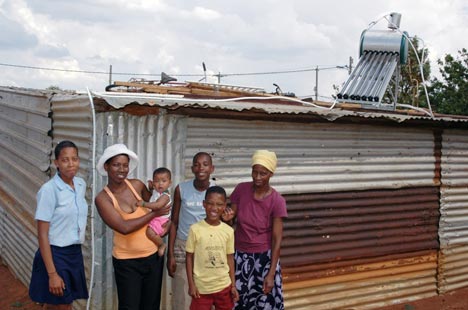
Family and friends pose in front of a house in South Africa with a new solar heating system. Photo by Abri_Beluga via Flickr No matter how much it might help the environment for fewer nations to produce and consume at U.S.-style levels, slowing global development would clearly be an unworkable — and profoundly unfair — way to address the climate crisis. As environmental scientist Ernst Ulrich von Weizsäcker put it this morning at a conference in Berlin: “Poor and cle… Read the full story on TreeHugger

Read more:
Getting Developing Nations on a Greener Path Without Creating a New Renewable Energy ‘Colonialism’

Prominent Princeton Scientist Dr. Happer Testifies to Congress: ‘Warming and increased CO2 will be good for mankind’

Climate Depot’s Selected Highlights of Dr. Happer’s May 20, 2010 Congressional Testimony: (Dr. Happer’s Full Testimony here: (To read the warmists’ testimony of Ralph Cicerone, Stephen Schneider, and Ben Santer, see here. ) Dr. Will Happer’s Testimony Before the House Select Committee on Energy Independence and Global Warming – May 20, 2010 My name is William Happer, and I am the Cyrus Fogg Bracket Professor of Physics at Princeton University. I have spent my professional life studying the interactions of visible and infrared radiation with gases – one of the main physical phenomena behind the greenhouse effect. I have published over 200 papers in peer reviewed scientific journals. I am a member of a number of professional organizations, including the American Physical Society and the National Academy of Sciences. I have done extensive consulting work for the US Government and Industry. I also served as the Director of Energy Research at the Department of Energy (DOE) from 1990 to 1993, where I supervised all of DOE’s work on climate change. Key Excerpts: The CO2 absorption band is nearly “saturated” at current CO2 levels. Adding more CO2 is like putting an additional ski hat on your head when you already have a nice warm one below it, but you are only wearing a windbreaker. The extra hat makes you a little bit warmer but to really get warm, you need to add a jacket. The IPCC thinks that this jacket is water vapor and clouds. The climate-change establishment has tried to eliminate any who dare question the science establishment climate scientists and by like-thinking policy-makers – you are either with us or you are a traitor. Orwellian: I keep hearing about the “pollutant CO2,” or about “poisoning the atmosphere” with CO2, or about minimizing our “carbon footprint.” This brings to mind a comment by George Orwell: “But if thought corrupts language, language can also corrupt thought.” CO2 is not a pollutant and it is not a poison and we should not corrupt the English language by depriving “pollutant” and “poison” of their original meaning. Our exhaled breath contains about 4% CO2. That is 40,000 parts per million, or about 100 times the current atmospheric concentration. CO2 is absolutely essential for life on earth. Commercial greenhouse operators often use CO2 as a fertilizer to improve the health and growth rate of their plants. Plants, and our own primate ancestors evolved when the levels of atmospheric CO2 were at least 1000 ppm, a level that we will probably not reach by burning fossil fuels, and far above our current level of about 380 ppm. We try to keep CO2 levels in our US Navy submarines no higher than 8,000 parts per million, about 20 time current atmospheric levels. Few adverse effects are observed at even higher levels. That we are (or were) living at the best of all CO2 concentrations seems to be an article of faith for the climate-change establishment. Enormous effort and imagination have gone into showing that increasing concentrations of CO2 will be catastrophic: cities will be flooded by sea-level rises that are ten or more times bigger than even IPCC predicts, there will be mass extinctions of species, billions of people will die, tipping points will render the planet a desert. Any flimsy claim of harm from global warming brings instant fame and many rewards. Sea Level: The sea level is indeed rising, just as it has for the past 20,000 years since the end of the last ice age. Fairly accurate measurements of sea level have been available since about 1800. These measurements show no sign of any acceleration. The rising sea level can be a serious local problem for heavily-populated, low-lying areas like New Orleans, where land subsidence compounds the problem. But to think that limiting CO2 emissions will stop sea level rise is a dangerous illusion. It is also possible that the warming seas around Antarctica will cause more snowfall over the continent and will counteract the sea-level rise. Hockey Stick: I was very surprised when I first saw the celebrated “hockey stick curve,” in the Third Assessment Report of the IPCC. Both the little ice age and the medieval warm period were gone, and the newly revised temperature of the world since the year 1000 had suddenly become absolutely flat until the last hundred years when it shot up like the blade on a hockey stick. This was far from an obscure detail, and the hockey stick was trumpeted around the world as evidence that the end was near. We now know that the hockey stick has nothing to do with reality but was the result of incorrect handling of proxy temperature records and incorrect statistical analysis. There really was a little ice age and there really was a medieval warm period that was as warm or warmer than today. I bring up the hockey stick as a particularly clear example that the IPCC summaries for policy makers are not dispassionate statements of the facts of climate change. Conclusion: I regret that the climate-change issue has become confused with serious problems like secure energy supplies, protecting our environment, and figuring out where future generations will get energy supplies after we have burned all the fossil fuel we can find. We should not confuse these laudable goals with hysterics about carbon footprints. For example, when weighing pluses and minuses of the continued or increased use of coal, the negative issue should not be increased atmospheric CO2, which is probably good for mankind. We should focus on real issues like damage to the land and waterways by strip mining, inadequate remediation, hazards to miners, the release of real pollutants and poisons like mercury, other heavy metals, organic carcinogens, etc. Life is about making decisions and decisions are about trade-offs. The Congress can choose to promote investment in technology that addresses real problems and scientific research that will let us cope with real problems more efficiently. Or they can act on unreasonable fears and suppress energy use, economic growth and the benefits that come from the creation of national wealth. added by: Dagum

BP is sticking with its dispersant choice | NOLA.com

BP has told the Environmental Protection Agency that it cannot find a safe, effective and available dispersant to use instead of Corexit, and will continue to use that chemical application to help break up the growing spill in the Gulf of Mexico. BP was responding to an EPA directive Thursday that gave BP 24 hours to identify a less toxic alternative to Corexit — and 72 hours to start using it — or provide the Coast Guard and EPA with a “detailed description of the alternative dispersants investigated, and the reason they believe those products did not meet the required standards.” BP spokesman Scott Dean said Friday that BP had replied with a letter “that outlines our findings that none of the alternative products on the EPA's National Contingency Plan Product Schedule list meets all three criteria specified in yesterday's directive for availability, toxicity and effectiveness.” Dean noted that “Corexit is an EPA pre-approved, effective, low-toxicity dispersant that is readily available, and we continue to use it.” He did not directly address widely broadcast news reports that more than 100,000 gallons of an alternative dispersant chemical call Sea-Brat 4 was stockpiled near Houston and available for application. EPA issued its directive amid complaints from some environmentalists and members of Congress that, as Rep. Edward Markey, D-Mass., put it, “BP had chosen one of the most toxic and least effective chemicals that were approved for use.” On Friday, Markey, who chairs the Energy Committee's Subcommittee on the Energy and the Environment, held a briefing of the effect on the ocean of the Deepwater Horizon oil spill, now in its second month and still gushing, at which experts questioned the wisdom of using any dispersant at all. To date, BP has used a little more than 670,000 gallons of Corexit, an unprecedented application and for a duration and at depths also without precedent. “We don't know what the effect of dispersants applied a mile underwater is; there's been no laboratory testing of that at all, or the effect of what it does when it combines with oil a mile underwater,” said Sylvia Earle, the explorer-in-residence for the National Geographic Society and former chief scientist at the National Oceanic and Atmospheric Administration. “I would say, until we know more about the fate of the dispersants, I'd tell BP or anybody else who's involved with this, whether it's EPA or whatever, 'Stop, just stop, don't do it.' ” A second panelist at Markey's briefing, Carl Safina, president and co-founder of Blue Ocean Institute, a New York-based conservation organization, was even more unsparing in his criticism of the use of a dispersant strategy, which he said had more to do with PR than good science. “It's not at all clear to me why we are dispersing the oil at all,” Safina said. “It's an out-of-sight, out-of-mind strategy. It's just to get it away from the cameras on the shoreline. “It takes something that we can see that we could at least partly deal with and dissolves it so we can't see it and can't deal with it.” The scientists said that we have quite literally a surface understanding of what a spill of this magnitude may have on ocean life, with most attention and understanding devoted to what is visible atop the ocean, when it soils birds or marine life that we can see, or when it fouls a wetland or beach. But its most profound and long-lasting effects, they said, may be on ocean life in the deep waters of the Gulf, which, Earle said, at its lower depths remain, to a remarkable degree, a “mystery.” “With a huge oil spill this involves difficult trade-off decisions on what species to protect at the expense of others,” said Carys Mitchelmore, an associate professor with the Chesapeake Biological Laboratory at the University of Maryland Center for Environmental Science, who said that one problem with breaking down the oil is that it makes it easier for many organisms to ingest. “What is frightening about this spill isn't just what we know but what we don't know,” Markey said. Markey said that he was sending a letter Friday to BP, Transocean and Halliburton asking that they fund independent, scientific research into the spill. Transocean is the contractor that owned and ran the drilling rig that burned and sank after the well blew on April 20, killing 11 workers. Halliburton is the company that did the cementing job that was supposed to close off the well, “We need independent scientists to step in where BP has stepped away from telling the truth,” Markey said. “When will BP allow our best and brightest minds to work with them to stop this disaster?” “BP's been lying to us,” said Markey, beginning with the size of the spill, which they have estimated at some 5,000 barrels a day but which Markey said independent scientists indicate must be “at least 50,000 to 60,000 barrels a day.” http://www.nola.com/news/gulf-oil-spill/index.ssf/2010/05/bp_is_sticking_with_it… SAVE THE GULF! Facebook – http://www.facebook.com/SaveTheGulfOfMexico?v=wall added by: julesrs007