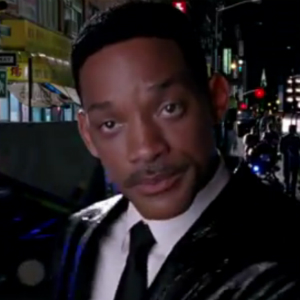
Sony’s got quite the job ahead of them selling the mega-budgeted sequel Men in Black III , due in May, if the new trailer is any indication: See Will Smith drop lines like “I don’t have no problem pimp-slapping the shiznit outta Andy Warhol” and be transported to a futuristic time-traveling retro ’60s that looks and sounds a lot like the one Austin Powers came from. I guess the ’90s are the new ’80s, but this is just lazy. The new sequel follows alien-hunting Agent J (Smith) into the past to save Agent K ( Tommy Lee Jones ) by teaming up with a younger version of K ( Josh Brolin doing his best Tommy Lee Jones impression). Look forward to the usual broad aliens-among-us gags and that mind eraser schtick that audiences loved in 1997! Smith bemoans that he’s “getting too old for this,” and I’m inclined to agree. Aren’t we all? Verdict: Looks tired. Insert mind eraser joke here.
What do you get when you fold two decades’ worth of young stars — and one very confused-looking Tom Sizemore — into a cautionary tale about the perils of meth use? Try Meth Head , a swear-y, scream-y, violent and thoroughly destabilizing journey to the depths of the worst known addiction this side of Words With Friends. Your venerable guides: Lukas Haas, Wilson Cruz, Scott Patterson and a laconic Sizemore among others. It’s the feel-bad movie of 2012, coming soon to a festival near you! To wit, from a press release: Kyle Peoples never wanted to be the man he has become in his 30s, an accountant stuck in a dead end job, with a lover who is more successful than he and a family that doesn’t get him at all. So when a night of partying leads to a new family of friends and fun, Kyle sees an opportunity for escape from reality. But Kyle’s new friendship with Maia and Dusty and the trio’s love of crystal meth eventually cost Kyle his job, his companion, his home and his family. Kyle’s escape becomes his trap, the party is an illusion and the crystal is slowly killing him, physically and psychologically. When he finally bottoms out and is no longer the young man his father once boasted about with pride, Kyle must choose: life or meth. Yikes. This thing has me wanting to go to rehab. Festival premieres are forthcoming, according to the release; stay tuned to Movieline for more details as events warrant. Follow S.T. VanAirsdale on Twitter . Follow Movieline on Twitter .
Screw the bread : From the innovative bakery that brought you edible Uggies — and just in time for one of the more passionately anticipated opening days of the year — comes this remarkable contribution to the annals of sweets: Hunger Games cookies. Leave it to the masterminds at Eleni’s to whip up Katniss, Peeta, Gale, tracker jackers and the rest of the “Down with the Capitol” cookie set — an assortment of call-outs to the best-selling, soon-to-be-a-major-motion-picture book series. I’ve never read a page of Suzanne Collins’s novels and personally continue to find Woody Harrelson’s wig a staggeringly tall barrier to film-franchise entry, but even a disinterested party can’t help but want to nibble on Jennifer Lawrence. Or Liam Hemsworth. I can’t believe I just wrote that. It’s Friday! I’m high of cold meds and self-loathing. Just stand back. Find out more at Eleni’s Web site . Read more of Movieline’s Hunger Games coverage here .
Film narration carries the dubious reputation of being a fallback trick for lesser directors, a device to trot out when other more classically visual narrative devices fail. In the same way that long, unbroken takes supposedly signify expertise, the use of narration often serves lazy critics with an easy indication that the director has lost the plot. Still, even the most anti-narration snob would have to concede that the larger film canon contains some pretty notable exceptions to this rule. The Naked City, A Clockwork Orange, Sunset Boulevard, GoodFellas, Ferris Bueller’s Day Off, The Big Lebowski, The Shawshank Redemption — all use narration, and far from stalling story or characterization, with them it pushes everything forward. Rather than quibbling over the merits of the device itself, acknowledging those notable examples of its effective use would at least seem to necessitate deeper analysis. If some filmmakers have successfully used it, serious students of film should probably take a closer look, if only to better understand the exceptions that prove the rule. To that end, we could loosely categorize film narration into four different groups according to two distinctions: the distance of the narrator’s involvement with the film’s conflict and themes, and the directness with which the narrator addresses the viewer. The first distinction is represented on one end of the spectrum by films like Taxi Driver , where the narration directly clues the viewer in to the motivations of a certain character or elaborates on the conflict that drives the film forward. Taxi Driver is an especially good example of the so-called involved voiceover, because it gives a first-hand view to the inner workings of the main character Travis Bickle’s demented psychology, fleshing out his odd behavior with an equally discomfiting internal monologue. Watching Bickle talk to his own reflection while parading an arsenal of homemade weapons is certainly harrowing, but to hear him detail the skewed reasoning behind his plotting with talk about “a real rain that will wash the scum off the streets” only adds another level to his menace. On the other end of this “involvement spectrum,” we see films like The Royal Tenenbaums , which feature a totally detached third person narrator who nonetheless comments meaningfully on the film’s action from afar. Played with a perfect mixture of somber knowingness and monotone disinterest by a heard-and-not-seen Alec Baldwin, the voiceover for Tenenbaums still adds layers of thematic meaning to much of what goes on. Whether by adding back-story, as when the narrator informs the audience of the divorce of Royal and Ethel Tenenbaum in the first scene, or character insight, as when he explains in one scene that Royal “didn’t realize what he had said was true until after he had said it,” the voiceover’s apartness actually serves as a useful perspective from which to view the action along with the audience and insert helpful cues along the way. The second distinction, having to do with the directness of address, or the level of audience engagement of the narration, involves how forcefully the narration is meant to appeal to the viewer. With films like High Fidelity or Annie Hall , for instance, the narrator grabs the viewer by the lapels and demands attention, speaking directly into the camera with vocal inflections suggesting conversation rather than monologue. This is probably the trickiest sort of voiceover to pull off, and the one that grates the worst when done wrong. The other end is represented by narrators who speak with an authoritative, almost historical tone, rattling off characters’ back-stories with seemingly little consideration of who may be watching or why. I found the tone of the initial voiceover by Cate Blanchett as Galadriel in The Lord of the Rings: The Fellowship of the Ring especially removed in this sense. Galadriel is involved in the goings on of the film’s story, interceding at several key moments throughout the saga, and yet she could not be more tonally remote from the audience. In fact, that is half the pleasure of Galadriel’s narration: She sounds like she’s speaking to the viewer from another world. The importance of this relative level of audience engagement reveals itself most in unreliable narration. For instance, the main character from Memento narrates intimately, always invoking the viewer’s sympathies, and yet because of Leonard’s particular character quirks, this closeness proves false by film’s end. If a diversity of type speaks anything to the value of a particular storytelling device, then film narrators definitely don’t deserve their bad reputation. Then again, if the domination of last weekend’s Oscar ceremony by The Artist shows anything, those purely visual filmmaking elements still very much strike the critical fancy, as they should. The simplest and best criterion for judging the effectiveness of narration will always be its facility to complement the moving pictures themselves. Nathan Pensky is an associate editor at PopMatters and a contributor at Forbes , among various other outlets. He can be found on Tumblr and Twitter as well.
He is the Lorax, he speaks for the trees – or at least he would, if he could get a word in edgewise. Because Dr. Seuss’ The Lorax , as directed by Chris Renaud and Kyle Balda, is so cluttered — with extra narrative, extra characters, extra everything — that its famously mossy and bossy central figure barely figures into the plot. More a bowdlerization than an adaptation of the great Theodor Geisel’s somber plea for environmental preservation, The Lorax is so big, flashy and redundant that it courts precisely the kind of blind consumerism it’s supposed to be condemning. It doesn’t trust kids to sit still and pay attention for even a minute. In the book, a young boy approaches the dark lair of the Once-ler, situated in the middle of a bare wasteland. The Once-ler spins a tale about what this godforsaken patch of land used to be like: It was dotted lavishly with Truffula Trees, their tufty heads looking like psychedelic dandelions and smelling of “butterfly milk.” This was a land populated by humming fish and bearlike creatures known as Bar-ba-Loots (“frisking about in their Bar-ba-Loot suits”), and guarded over by the stern, if noodgy, Lorax, who is especially protective of the area’s chief natural resource, those Truffula Trees. The Once-ler begins cutting down the trees for his own gain, initiating a destructive spiral that the book resolves only tentatively – with a single Truffula seed held out as a symbol of hope for the future. Those simple but potent ingredients aren’t enough for this Lorax, which was adapted – maybe “mauled” is the better word – by Ken Daurio and Cinco Paul. The boy who sets the whole story in motion is a pre-teener named Ted (voiced by Zac Efron), who lives in Thneedville, a town that’s completely made of plastic – air is pumped in by an evil and very short entrepreneur named Mr. O’Hare (Rob Riggle). Ted takes an interest in trees because the girl on whom he has a crush, Audrey (Taylor Swift), thinks they’re neat and wishes they weren’t all gone. So he approaches the lair of the reclusive Once-ler (Ed Helms), who spins the sad and sorry tale of the long-lost Truffula Trees, and of his encounter with the Lorax (Danny DeVito), who tried to stop their destruction before it was too late. But wait, there’s more – much, much more. Ted has a mother who tries to convince him that the artificial trees of Thneedville are perfectly adequate, as well as a grandmother who secretly advises him otherwise. The Once-ler has a family of social-climbing boobs who persuade him to ax the Truffula forest, a touch that’s designed, maybe, to make the Once-ler more sympathetic, but what’s the point? The Once-ler wriggles his way into the good graces of the Bar-ba-Loots (who aren’t referred to by their right and proper name but who are treated as if they were simply garden-variety bears) by showering them with marshmallows. And so forth. The great marvel of Dr. Seuss’ work – in addition to his noodly characters, silly-brilliant drawings and captivating rhyme schemes — was its economy: Dr. Seuss’ books tell fairly complex and imaginative stories in a remarkably simple way. (Even One Fish Two Fish Red Fish Blue Fish has a narrative, albeit one with a streak of Dada madness.) These books are never overpopulated – Seuss never, for example, threw in extra parental characters just to give his characters something to rebel against. Adolescent boys trying to impress girls? Please. But the story Seuss tells in The Lorax is almost completely obscured here, buried beneath needless extra details. The look of the film nods adequately to certain Seussisms – the tops of those Truffula Trees do look pretty luxurious, like Troll-doll hair in unbelievable shades of magenta and citrus orange. Yet there’s so much to look at that almost nothing registers. The town of Thneedville is elaborate and plasticky-looking, populated largely by fat, lazy people. The Truffula wonderland is much prettier to look at, but it’s almost too much of a good thing. The creatures who populate it – like those humming fish, who spend a great deal of time bouncing around dry land on their flexible tails – may be cute, but they also seem like afterthoughts; there’s just too much business happening all around them. Even the Lorax himself – despite DeVito’s singular vocal charms – comes through as a blur in the midst of a hyperactive muddle. When it comes to this mess, who’s left holding the Truffula-stuffed bag? Renaud was one of the directors (with Pierre Coffin) of what was, for my money, the best and most gleefully disreputable animated film of 2010, Despicable Me . That picture was relaxed and loopy; The Lorax is stiff and junked-up. The casual details that Seuss would drop so effortlessly are belabored here. For example, when the butterfly-milk scent of those Truffula tufts comes up in conversation, Ted and Audrey can’t let this magical true-fact pass without comment: “What does that even mean?” “I know, right?” they counter, compelled to show how hip they are to the idea that, you know, butterflies can’t actually produce milk. Thanks for that, masterminds behind Dr. Seuss’ The Lorax . It saves me a lot of time feeling around for those really tiny butterfly nipples. I should have known Theodor Geisel made it all up. Follow Stephanie Zacharek on Twitter . Follow Movieline on Twitter .
“In the movie Wall Street I play Gordon Gekko , a greedy corporate executive who cheated to profit while innocent investors lost their savings. The movie was fiction, but the problem is real.” And with that, Michael Douglas stumps for the FBI in a new public service announcement warning investors against financial misdeeds. If Gordon Gekko himself says greed is no longer good, it must be true. Fraudsters, beware! [ FBI via Deadline ]
It’s Oscar Sunday! Keep track of your Oscar pool ballots with Movieline’s list of Academy Award winners, updated throughout the telecast — and chime in below with your thoughts on which of Hollywood’s brightest most deserved their statuettes, who gave the best acceptance speeches (and runners-up-caught-on-camera faces), and which were the biggest surprises of the night. Aaaaand The Artist performed as expected (read Movieline’s review here ), taking Best Picture, Best Director, Best Actor, Best Costume Design and Best Score, with Martin Scorsese’s Hugo running a close second on the night with five awards of its own. And Uggie made an appearance! What were your favorite wins and speeches of the night? Winners highlighted in bold below. BEST CINEMATOGRAPHY Guillaume Schiffman, The Artist Jeff Cronenweth, The Girl with the Dragon Tattoo Robert Richardson, Hugo Emmanuel Lubezki, The Tree of Life Janusz Kaminski, War Horse BEST ART DIRECTION Laurence Bennett, Robert Gould, The Artist Stuart Craig, Stephanie McMillan, Harry Potter and the Deathly Hallows: Part 2 Dante Ferretti, Francesca Lo Schiavo, Hugo Rick Carter, Lee Sandales, War Horse BEST COSTUME DESIGN Mark Bridges, The Artist Michael O’Connor, Jane Eyre Sandy Powell, Hugo Lisy Christl, Anonymous Arianne Phillips, W.E. BEST MAKEUP Albert Nobbs Harry Potter and the Deathly Hallows: Part 2 The Iron Lady BEST FOREIGN-LANGUAGE FEATURE Bullhead , Belgium Footnote , Israel In Darkness , Poland Monsieur Lazhar , Canada A Separation , Iran BEST SUPPORTING ACTRESS Berenice Bejo, The Artist Jessica Chastain, The Help Melissa McCarthy, Bridesmaids Janet McTeer, Albert Nobbs Octavia Spencer, The Help BEST FILM EDITING Michel Hazanavicius and Anne-Sophie Bion, The Artist Kevin Tent, The Descendants Thelma Schoonmaker, Hugo Kirk Baxter and Angus Wall, The Girl with the Dragon Tattoo Christopher Tellefsen, Moneyball BEST SOUND EDITING Drive The Girl with the Dragon Tattoo Hugo Transformers: Dark of the Moon War Horse BEST SOUND MIXING The Girl with the Dragon Tattoo Hugo Moneyball Transformers: Dark of the Moon War Horse BEST DOCUMENTARY FEATURE Hell and Back Again If a Tree Falls: A Story of the Earth Liberation Front Paradise Lost 3: Purgatory Pina Undefeated BEST ANIMATED FILM FEATURE A Cat in Paris Chico and Rita Kung Fu Panda 2 Puss in Boots Rango BEST VISUAL EFFECTS Harry Potter and the Deathly Hallows: Part 2 Hugo Real Steel Rise of the Planet of the Apes Transformers: Dark of the Moon BEST SUPPORTING ACTOR Christopher Plummer, Beginners Max Von Sydow, Extremely Loud & Incredibly Close Jonah Hill, Moneyball Kenneth Branagh, My Week with Marilyn Nick Nolte, Warrior BEST ORIGINAL SCORE John Williams, The Adventures of Tintin Ludovic Bource, The Artist Howard Shore, Hugo Alberto Iglesias, Tinker Tailor Soldier Spy John Williams, War Horse BEST ORIGINAL SONG “Man or Muppet,” The Muppets “Real in Rio,” Rio BEST ADAPTED SCREENPLAY Stan Chervin, Aaron Sorkin and Steven Zaillian, Moneyball George Clooney, Grant Heslov and Beau Willimon, The Ides of March John Logan, Hugo Bridget O’Connor and Peter Straughan, Tinker Tailor Soldier Spy Alexander Payne, Nat Faxon and Jim Rash, The Descendants BEST ORIGINAL SCREENPLAY Woody Allen, Midnight in Paris J.C. Chandor, Margin Call Asghar Farhadi, A Separation Michel Hazanavicius, The Artist Annie Mumolo and Kristen Wiig, Bridesmaids BEST LIVE-ACTION SHORT Pentecost Raju The Shore Time Freak Tuba Atlantic BEST DOCUMENTARY SHORT The Barber of Birmingham: Foot Soldier of the Civil Rights Movement God is the Bigger Elvis Incident in New Baghdad Saving Face The Tsunami and the Cherry Blossom BEST ANIMATED SHORT Dimanche/Sunday The Fantastic Flying Books of Mr. Morris Lessmore La Luna A Morning Stroll Wild Life BEST DIRECTOR Woody Allen Midnight in Paris Michel Hazanavicius, The Artist Terrence Malick, The Tree of Life Alexander Payne, The Descendants Martin Scorsese, Hugo BEST ACTOR Demián Bechir, A Better Life George Clooney, The Descendants Jean Dujardin, The Artist Gary Oldman, Tinker Tailor Soldier Spy Brad Pitt, Moneyball BEST ACTRESS Glenn Close, Albert Nobbs Viola Davis, The Help Rooney Mara, The Girl With the Dragon Tattoo Meryl Streep, The Iron Lady Michelle Williams, My Week With Marilyn BEST PICTURE The Artist The Descendants Extremely Loud & Incredibly Close The Help Hugo Midnight in Paris The Tree Of Life Moneyball War Horse Follow S.T. VanAirsdale on Twitter . Follow Movieline on Twitt
The champagne’s been tippled, the winners are all celebrating, and somewhere Uggie ‘s getting a LOT of sausages. So let’s relive the highlights of the 2012 Academy Awards show! Click through for Movieline’s gallery and name your favorite moment from the big night. Was it Best Supporting Actress Octavia Spencer ‘s emotional acceptance speech? Or Descendants co-scripter Jim Rash’s impromptu Angelina Jolie impersonation? Those bits and more in vivid photographic detail after the jump! Click to launch the Oscars 2012 gallery . Miss the show? Relive the best (and worst) of the 2012 Academy Awards in Movieline’s liveblog .
Congrats aren’t just in order for the winners of tonight’s Film Independent Spirit Awards ; major props go to Adam Sandler for an outstanding showing in today’s Razzie nominations announcement, which found the Jack & Jill / Just Go With It star breaking the previous record for most personal Razzie nominations earned in a year. (Sandler won 11 nominations, while Jack & Jill itself earned 12.) Eddie Murphy , guess you’re off the hook for the Year of Norbit . See the full list of fairly obvious nominees vying for Golden Raspberry (dis)honors after the the jump and leave your predictions below. WORST PICTURE Bucky Larson: Born to Be a Star Jack & Jill New Year’s Eve Transformers: Dark of the Moon Twilight: Breaking Dawn Part 1 WORST ACTOR Russell Brand, Arthur Nicolas Cage, Drive Angry 3-D / Season of the Witch / Trespass Taylor Lautner, Abduction / The Twilight Saga: Breaking Dawn Pt. 1 Adam Sandler, Jack & Jill / Just Go With It Nick Swardson, Bucky Larson: Born to Be a Star WORST ACTRESS Martin Lawrence, Big Mommas: Like Father Like Son Sarah Palin, Undefeated Sarah Jessica Parker, I Don’t Know How She Does It / New Year’s Eve Adam Sandler, Jack & Jill Kristen Stewart, The Twilight Saga: Breaking Dawn Pt. 1 WORST SUPPORTING ACTOR Patrick Dempsey, Transformers: Dark of the Moon James Franco, Your Highness Ken Jeong, Big Mommas 3 , Hangover Part 2 , Transformers: Dark of the Moon , Zookeeper Al Pacino, Jack & Jill Nick Swardson, Jack & Jill / Just Go With It WORST SUPPORTING ACTRESS Katie Holmes, Jack & Jill Brandon T. Jackson, Big Mommas 3 Nicole Kidman, Just Go With It David Spade, Jack & Jill Rosie Huntington-Whiteley, Transformers: Dark of the Moon WORST ENSEMBLE Bucky Larson: Born to Be a Star Jack & Jill New Year’s Eve Transformers: Dark of the Moon Breaking DawnThe Twilight Saga: Breaking Dawn Pt. 1 WORST DIRECTOR Michael Bay, Transformers: Dark of the Moon Tom Brady, Bucky Larson: Born to Be a Star Bill Condon, The Twilight Saga: Breaking Dawn Pt. 1 Dennis Dugan, Jack & Jill / Just Go With It Garry Marshall, New Year’s Eve WORST PREQUEL, REMAKE, RIP-OFF or SEQUEL Arthur Bucky Larson: Born to Be a Star The Hangover 2 Jack & Jill The Twilight Saga: Breaking Dawn Pt. 1 WORST SCREEN COUPLE Nicolas Cage and anyone Shia LaBeouf and Rosie Huntington-Whiteley, Transformers: Dark of the Moon Adam Sandler and Jennifer Aniston/Brooklyn Decker, Just Go With It Adam Sandler and Holmes, Pacino, or himself in Jack & Jill Kristen Stewart and RPattz or Taylor Lautner, The Twilight Saga: Breaking Dawn Pt. 1 WORST SCREENPLAY Bucky Larson: Born to Be a Star Jack & Jill New Year’s Eve Transformers: Dark of the Moon The Twilight Saga: Breaking Dawn Pt. 1 The Razzies will be announced on April 1. More info here .
Forty-eight hours to Oscar. Gut-check time — or maybe make that “gut-instinct check” time, a moment to break away from the meticulous zeitgeist-combing science of Movieline’s Institute For the Advanced Study of Kudos Forensics and make a few choices for myself. Not that they’ll be so different, but if you can’t go with a hunch where 5,765 fickle, insular industry minds are concerned, then what can you go with? We can’t all be be Otis the Oscar Cat , you know. Anyway, let’s make this quick: BEST PICTURE A certain voluble sliver of the Oscar punditocracy likes to whine about The Artist ‘s awards-season supremacy — as if it signaled some searing compromise of the Academy’s historic tradition of recognizing only the finest, most artistically challenging and rigidly contemporary work. These people sound like some bitter old man bitching about how the Super Bowl halftime show never features anyone good anymore, or some mouth-breathing fanboy complaining about the vanquished integrity of Star Wars . You guys, they were never good to begin with . In their own way — as meritocratic tastemakers — neither were the Academy Awards. This year’s foregone Artist win has less to do with regressive, reductive cultural tastes than it does with Harvey Weinstein being a good marketer, no different than 15 years ago. If these whinging bozos won’t learn, then can’t they at least shut up? Will win : The Artist Should win : Melancholia . Wait, what? Oh. Fuck it. That’s the best picture of 2011. Period. BEST DIRECTOR Have you seen Midnight in Paris recently? Man, that one does not hold up. The Descendants never did in the first place. Hugo is fine, but I think the groundswell of voters who got Terrence Malick into the competition in the first place could be formidable enough to actually sweep him right past Martin Scorsese into very close competition with Michel Hazanavicius. In fact, you know what? I’ll call it for Malick, why the hell not. Will win : Terrence Malick, The Tree of Life Should win : Lars von Trier, Melancholia . Yes, I heard you the first time. Make your own predictions. BEST ACTOR Here’s where I’m a lot more confident in the upset factor: Demi