From the people who brought you 16 & Pregnant , Date My Mom , A Shot at Love With Tila Tequila and Jersey Shore where once you found proud, pioneering music videos roaming free on the TV plains: Five new categories for this year’s MTV Movie Awards! Including “Best Music”! This should turn out great . And there’s more . From the official MTV press release just over the transom, which doesn’t even read like English after a while: “The Movie Awards will be a re-imagined celebration of the most popular films and performances from the past year,” said Stephen Friedman, President of MTV. “This year, we’ve overhauled categories and added a Breakthrough Performance award that will be chosen by some of the best directors in the world. We’re also making music a more central experience to the overall show creative, and are thrilled to announce fun. – a band that has already imprinted a new anthem on a generation – as our first musical moment.” Once again, MTV fans will hold the “Power of the Popcorn” awards in their hands. This year’s brand new “Best Music” category will allow fans to vote for a specific movie moment when the perfect song played during the perfect scene. In returning category favorites like “Movie of the Year,” will the final installment of Harry Potter bring home the crown or will the record-shattering The Hunger Games shake things up? Last year, Emma Stone took home the prize for “Best Comedic Performance” but could she receive a nomination for “Best Female Performance” for her role in The Help ? One thing is for certain, it’s Hollywood’s wildest awards ceremony and anything can happen. Categories for the “2012 MTV Movie Awards” include: “Movie of the Year” “Best Female Performance” “Best Male Performance” “Breakthrough Performance” “Best Comedic Performance” “Best Music”* “Best On-Screen Transformation”* “Best Gut-Wrenching Performance”* “Best Kiss” “Best Fight” “Best Cast”* “Best On-Screen Dirt Bag”* * New category The “2012 MTV Movie Awards” nominees will be elected by a special voting Academy, including members of the MTV audience. In addition, the winner of “Breakthrough Performance” will be decided on solely by a special Academy of Directors who will lend their expertise for spotting and developing new talent. What could go wrong, etc. etc. Find out June 3! [ MTV ]
Actor George Clooney once confessed to Oscar-winner Michael Moore that he used the filmmaker’s debut Roger & Me as a dating litmus test. Or so Moore told an audience at the Walter Reade Theater in New York, where the hit 1989 documentary had a special screening Tuesday night. Moore laughed when recalling the story at an event hosted by the Film Society of Lincoln Center, which screened the documentary as part of its lead-up to the 50th anniversary edition of the New York Film Festival in September. The director explained how Clooney shared with him years back that, “I use Roger & Me for dating. By the first or second date, they have to watch [your film]. If they get it, they get a [follow-up] date. If they don’t… they don’t.” Then Moore added rhetorically: “This story will only stay in this room, right?” Moore gave insight and, not surprisingly, his opinion about Roger & Me and how it figures in the present economic times Tuesday night, and didn’t hold back. “We’re in some deep shit,” Moore said about the condition of the country today compared to when he made Roger & Me for $150K back in ’89. “I had hoped that what we have now wouldn’t have happened.” Moore, who sat through the screening with his wife, said that he hadn’t seen the film in years because doing so is personally difficult. He noted today there are only 4,000 GM workers left in Flint, Michigan where Roger is mostly set, compared to 50,000 at the time he made the film. “Five minutes into the film, my wife started crying,” he said. FSLC program director Richard Peña praised Moore — dressed in a brown hoodie and Tribeca Film Festival baseball cap — for ushering in a “golden age” of documentary beginning with Roger & Me which screened at the New York Film Festival in 1989. “I was nobody in the business then,” Moore responded. “I was unemployed at the time. We screened it around the same time as Sex, Lies and Videotape was showing. The Warner Bros. people were in the audience that night and saw it receive a standing ovation and they bought it.” Roger & Me was the first documentary to hit multiplexes, eventually grossing nearly $8 million worldwide. “I never liked documentaries growing up, they felt like medicine,” Moore said. “I wanted this film to be structured in a way that can be enjoyed with popcorn in a theater, but at the same time, making sure all the facts are in fact — true.” Moore added that he takes pride in helping to “kick the door open” for doc filmmakers that have also had success with theatrical releases. But when it comes to making his movies including his blockbuster Fahrenheit 9/11 and Oscar-winner Bowling for Columbine , he said that he finds the root-cause of his films depressing. “I dread making these movies,” he said. “When we solicited stories from people for Sicko , it was very emotional. We couldn’t help crying.” Now, more than two decades after making his debut, Moore gave himself a pat on the back for Roger & Me , noting the film stood above the rest for him personally. “I wouldn’t change a frame of this film,” Moore said. “It’s probably the favorite of all my films. I was learning how to make a film as I was doing it.” Follow Brian Brooks on Twitter . Follow Movieline on Twitter . [Photo: Julie Cunnah/Film Society of Lincoln Center]
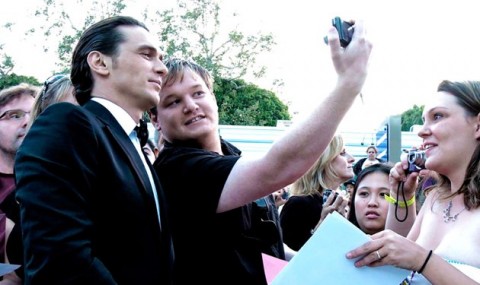
Just when you think you might have had enough of James Franco , along comes Francophrenia to either whet your appetite for more of the actor-director’s avant-garde pursuits — or officially turn you off to them forever. I might be overdramatizing a bit, but not by much, judging by the walkouts sporadically punctuating the experimental doc/pseudo-soap opera’s recent North American premiere at Tribeca. And with the skies pissing cold rain on Manhattan that evening, you really had to want to leave Franco’s tongue-in-cheek exploration of identity as cast through the prism of his infamous guest stint on General Hospital , reshaped into a sort of leering emo-psychodrama by co-director and editor Ian Olds. Not that Franco didn’t anticipate this. “I’m sure there’ll be different kinds of reactions to it,” he said before the screening, introducing the film with Olds. “But I’m just very glad it’s here at Tribeca. It’s my third film here (after Good Time Max [2007] and Saturday Night [2010]); we love the Tribeca Film Festival. We kind of knew that this film would be not…” Franco paused. “We’ve had mixed reactions. We sort of enjoy that now. I’m sure some of you will be very into it and some won’t. It does take a little bit of… engagement , that’s all. Otherwise, it’s very, very fun.” That’s fair. Francophrenia doesn’t take much of anything seriously, least of all the spectacle around the June 2010 GH episode that brought Franco’s eponymous, homicidal artist to a massive outdoor installation filmed at L.A.’s Museum of Contemporary Art. There, the killer continued his torment of Port Charles’s finest before — spoiler alert? — a protracted gun battle and, finally, his fatal, tuxedoed tumble from the roof. (The sequence provides the film’s subtitle, Don’t Kill Me, I Know Where the Baby Is .) Fans and casual observers alike had both privately and publicly reckoned with the performance-art nature of Franco’s character to that point; “Who is this guy playing, if anybody?” we asked ourselves, to the extent we cared at all. And in 2010, with the then-32-year-old actor at the seeming height of his creative (and, uh, academic) powers — and well before co-hosting the 2011 Oscars in another performance-art torpedo to his A-list celebrity goodwill — we did care a bit. Which, as Francophrenia asserts in its long, deconstructing takes of hair sessions, set-roaming and other behind-the-scenes banality, was really kind of foolish of us. But in daring to sniff at the inviolable absurdity of fame, the spirit of actor/director Franco’s enterprise equivocates. Is his grinning mask while signing autographs and taking photos with fans just garden-variety, all-in-a-day’s-work magnanimity? Or is it a vulgar showcase for Franco’s cynicism, his “art” shielding him from the plebes? Who’s taking the piss here? It’s not as open a question as it seems, especially as drops of whispery voice-over (written by Olds and Paul Felten) trickle into the sound design before flooding it with equal parts self-aggrandizement and self-effacement. On the one hand, Franco can’t trust the GH director, has to find his way “back to the world,” and asks, “What am I doing here?” as he glowers over the scene, reassuring himself with Marxist polymath Guy Debord’s observation that “Separation is the alpha and omega of the spectacle.” But Olds and Felten leaven all the high-minded paranoia with riffs on Franco’s mythology: “I went to graduate school for a reason, people,” he reminds the viewer at one point — when he’s not, say, craving a cookie or calling his producer Vince Jolivette a “prophet of lies and false consciousness.” Mostly, though, Franco — the character hovering somewhere between the real man and the GH hyperparody — is constantly undermined by the camera itself and even a torrent of gossip promulgated by the icons on the sign outside the men’s bathroom. They chirp about how high and/or pretentious Franco is, deflating his airier platitudes with such brusque dismissals as, “Transcendent my ass!” Conceptually, anyhow, Francophrenia is nothing if not inspired — half-Malick, half- Mystery Science Theater 3000 , a postmodern meltdown superimposed on one of TV’s longest-running melodramas. “It’s easy to see the film as a kind of a gimmick if it’s just riffing on all this culture surrounding James’s celebrity,” Olds said following Sunday’s Tribeca premiere. “It’s a lot of fun to do, but there’s something that interested…” He paused. “The idea is: How can you sort of bend the documentary footage so it serves this artificial narrative, but at the same time, how can you reframe the documentary footage so you can see it with new life? So you can say, ‘What they hell are they doing here? What is all this energy going into? What are they building?’ In a sense, the clearest thing I could think about is that in some ways, it’s maybe like a deranged portrait of the labor behind the spectacle.” But here’s the thing: Franco and Olds have been here before. Francophrenia perhaps works most interestingly as a companion piece to their previous collaboration Saturday Night , another backstage opus also framing what Olds on Sunday called “this sort of mundane human labor.” In that case, it was an all-access glimpse at what goes into producing one episode of Saturday Night Live : the pitch meetings, the grueling all-nighters, the set designs and musical arrangements, the ruthless slashing of material and the general stresses that accompany creating in Studio 8H. Yet where Saturday Night glimpsed those phenomena with a kind of meandering introspection, Francophrenia sends them up with abandon. It’s as though one show is good enough for Franco’s guileless intellect, while the other can only withstand a lengthy frisk before the actor sends it on its way. A viewer Sunday asked Franco about his intentions here, hinting at the double standard that you could just as easily apply to his recent work as Very Serious Artists like Allen Ginsberg ( Howl ) and Hart Crane ( The Broken Tower ). “I really enjoyed working with those people,” he said of the GH crew. “Some of the people I worked with have sadly been fired from General Hospital ; daytime is having a hard time right now. But they’ve gone on to other shows, and I’m going to work with them. Part of my initial impulse to go on General Hospital before this project was even conceived of was to try and examine and break down this kind of hierarchy people have in their minds about levels of entertainment — that movies are better than soaps, or that kind of thing. So I just wanted to insert myself there and experience it and see what it was all about, and I found that there are many things you can do in daytime that movies can’t do, and I really loved it. “I think maybe what you’re reading is because the soap opera is our subject,” Franco continued. “We’re using it as material to examine certain things. But I don’t think the project was ever to make fun of soap operas. It’s just using it like they use me and my image as material to examine certain ideas.” He later elaborated on the ultimate spirit of the project, citing the evaluation of James Franco’s identity by those other than James Franco as his reason for handing the 40-plus hours of GH footage off to Olds. “All along the way, it’s been about turning myself over to these different entities and letting them do what they will with my image,” Franco said. “I look at the film and I see the slicked-back hair and you’ve got all the shots where I’m looking crazy. And that’s exactly how it needs to be! It’s slightly embarrassing. It can’t ever be something where I’m trying to look cool or make you like James Franco or something. It needed to have somebody else manipulating the material and not me, since that’s one of the subjects of the movie.” Again, though: Do we care? I mean, Joaquin Phoenix has demonstrated how much more cynical this could all be, so Franco has at least a little further to go before his whims fall in a forest with nobody around to hear. But to paraphrase Paul Sunday’s admonition in There Will Be Blood , I would like it better if Franco didn’t think I was stupid — or at least if the variation of Franco that appears in Francophrenia didn’t think I was stupid, or that the protean puppeteer above it all didn’t think we can’t spot the hypocrisy calling out from earlier acts of this same show. It’s certainly a show worth watching, an adventure too funny, too playful, too thought-provoking to write off for its cheap shots and rectitude. Still, I hope the curtain comes down soon — and that its mastermind has better ideas ahead. Francophrenia screens again at Tribeca this Saturday, April 28, at noon. Read all of Movieline’s Tribeca 2012 coverage here . Follow S.T. VanAirsdale on Twitter . Follow Movieline on Twitter . [Photo credits: Doug Chamberlain / Tribeca Film Festival ]
Sundance ’11 darling Brit Marling is now a year and change removed from the stunning festival debut that made her one to watch thanks to two films she co-wrote, produced, and starred in: The moody sci-fi drama Another Earth , released last summer, and the mesmerizing Sound of My Voice . The latter film finally hits theaters this week, giving audiences a chance to see a different side of Marling: Earthy, enigmatic, dangerously charismatic, and — as the leader of a cult amassing members in a basement in the Valley — possibly from the future. Movieline spoke with Marling last year about Sound of My Voice , in which a would-be documentarian and his girlfriend (Christopher Denham and Nicole Vicius) find themselves falling deeper under the spell of Marling’s Maggie as she prepares her followers for an unknown event. As with Another Earth , which was co-written and directed by Mike Cahill , Marling penned the script for Sound of My Voice with director Zal Batmanglij (who is currently at work on his SOMV follow-up The East , a drama centered around an anarchist group starring Ellen Page , Alexander Skarsgard , Julia Ormond , Patricia Clarkson , and Marling). Marling herself has since filmed the dramatic thriller Arbitrage with Richard Gere and Susan Sarandon and will be seen in Robert Redford ‘s The Company You Keep . In Movieline’s chat she discusses the borderline illegal guerrilla filmmaking tricks that made Sound of My Voice possible, her thoughts on taking professional risks, her dream director list, and how to avoid the “morally-corrupt swamp” that is Hollywood. (A longer version of this interview was previously published here .) Sundance was a huge coming out event for you. How did you process the sudden attention of being named a Sundance darling in your first major festival appearance? To be perfectly honest, it’s a little weird. It’s weird because, I guess, you’re working for so long in a vacuum — writing this work, making this work — and you’re doing it really on your own. It hasn’t met up with the world, and you’re totally sustained by just making the work. So it’s a completely different experience for it to enter the world and to get responses and reactions. And of course, the Sundance experience was amazing. I’m incredibly moved by the programmers of that festival — that they would search out these films that are so small, handmade, truly outside of the system of filmmaking, and that they would bring these movies that were made in little caves in Silverlake and take them and bring them into the light. It’s pretty amazing. Not only that, you also got to bring two films to Sundance with two of your close collaborators, Mike Cahill and Zal Batmanglij. You were all three roommates once upon a time, right? For a long time in L.A. the three of us lived together and we were kind of each others’ family in L.A., in a way. We’d all left family on the East Coast and come out to the West Coast, and L.A. can be a very isolating city. Doing this kind of work is really extreme work. I think we were really lucky that we had each other and could encourage each other, because there was quite a bit of time before we were able to make these movies. And of course you’re filled with doubt; can you really do this? So it’s nice to have each other for encouragement, to keep going. Otherwise I’m not sure. Maybe I would have ended up doing something else. What would you be doing instead? When I think about what I would be doing if I wasn’t an actor… maybe an environmental activist? An eco-terrorist of some kind? I don’t know. [Laughs] Take us back to your days at Georgetown. How did you meet Zal and Mike in the first place? I was a freshman and they were seniors and there was a film festival at Georgetown, which is really odd because everyone there is going to work on Capitol Hill or at an investment bank. But they had a festival, and it was the first year they’d had one, and the films were all horrible. I mean, the worst student filmmaking ever. And then there was this film that came on at the end, and it was colorful and poetic and it was digital filmmaking like you’d never seen before. It had all this breadth to it, really beautiful imagery, the rhythm of it, an interesting story. I remember it won first place and I just popped up and led the standing ovation for the film. The filmmakers came onstage to get the award and it was Mike and Zal, and I saw them and I was like, “Okay. I have to be friends with these people.” And the three of us started making movies together. That was an amazing time; I don’t think we thought we would ever end up making movies that way later. We came out to L.A. and assumed we’d learn to make films properly, whatever that means, but because of the recession, because of the way filmmaking and technology has changed, we pretty much ended up making movies in the same sort of completely illegal guerrilla fashion that we’d been using to do stuff at Georgetown. You folks still talk, and openly so, about the semi-legit hustle of getting Sound of My Voice made… Like returning our Mac every 14 days! It was actually really hard; we would pull up, I would put on the emergency lights and Zal would run in with this heavy computer. Tamara Meem, the editor, had to reinstall the Final Cut software every time. It was an intense way to go about it but it was also the only way we could afford to do it. [Laughs] Yeah, we were pulling a lot of tricks like that. You have to think that somewhere out there, aspiring filmmakers are hearing these stories and thinking to themselves, “Brilliant idea!” Yeah, I think one of the things we realized is that sometimes in life when you’re doing your craft, you’re often waiting for permission — for someone to give you money, for someone to read a script and say yes, you can go do it. And I think at some point I was like, “I don’t want to wait for permission anymore.” Let’s just do this, let’s make these movies for whatever money we can raise, we’ll figure it out. And it’s kind of cool because there ends up being as much creativity in the execution of figuring out how to make a movie with limited resources as there is in the screenwriting or in the acting. You multi-task with your films, acting, producing, writing — but you studied a very different field. At what point did you decide to go full-force into filmmaking? I had done plays and studied acting a bit in high school, and I think when I was graduating a lot of my friends were going to theater school. I really wanted to act, but I felt like I knew a lot about plays, about Shakespeare and Chekhov and plays, but not enough about being a human being in the world. I didn’t understand how you could be an actor if you didn’t also study philosophy and study political science, astronomy. And also just go out and live life and have experiences. These are all somehow part of being able to bring something to Chekhov, or bring something to any play or any story. Or just merely having something to say. Yes! And at the time I decided that I was going to get a broader liberal arts education and also just go live some life, because the drama world felt small and a bit self-referential. Not a lot from the outside was coming in. I ended up studying economics — I don’t know exactly how all of that happened — and I ended up working in an investment bank for a while, then I think at some point I just decided that I didn’t want to be afraid. I think when you decide you’re going to go act in L.A. it’s just an overwhelming wave of fears: I’ll never make any money, I won’t survive, I’ll waste all this time in my life that I could have used pursuing another direction, I’ll fall behind… the feelings of illegitimacy, of struggling for so long and not getting to do the work you want to do. Everybody’s writing you off as another young girl who’s gone off to L.A. It’s a huge risk. And I guess I finally came to a point when I was working at this bank and studying econ when it didn’t feel like a risk anymore because I was so not living the life I wanted to live. And that felt like its own kind of death. So at some point you realize that your life is not just going to start one day in the future, that you’re living it. You are nothing more than the sum of the small choices you make on a daily basis, so if you choose to study economics or you choose to be a banker, this is going to be who you are. It gave me more courage to go be an actor, because the more time I spent acting the more I liked who I was. I feel like I’m a much better person when I’m developing my imagination and my innocence and my vulnerability. I like that version of me better than the version where I’m just working on my analytical mind. Since moving to L.A. have you been doing the regular aspiring actor thing, sending out head shots and resumes and hitting auditions? It’s funny, right when I got out to L.A. I realized pretty quickly that one, it’s just difficult to go on auditions as a young unknown. And then even if you can get an audition, what you’re auditioning for is probably garbage. I mean, it’s just horror films, the torture porn genre, or it’s just bad comedies, girlfriend characters, girl in bikini running from man with chainsaw. I thought to myself, “Oh my gosh, I don’t know how I can do this stuff.” People said to me you just have to start somewhere, everybody’s got this kind of work, the skeletons in their closet, and eventually you’ll get to the other side and you’ll get to do substantive work. I remember thinking to myself, nobody says to an aspiring heart surgeon, “One day you’ll get to operate on patients at Cedars-Sinai — but for now, come over to this back alley and remove kidneys illegally and sell them on the black market.” Nobody asks that of any other profession, that you wade through this morally-corrupt swamp. Also what I felt really strongly about was that I didn’t want to play these roles where women are constantly in these submissive positions or being sexually abused or harassed or just sexual objects. I did not want to do that. I didn’t want to be responsible for putting storytelling into the world that other young girls would watch and think, that’s what it means to be a woman. Hell no. So writing became a way to get to act in things that I thought were meaningful, and hopefully write stronger roles for other women. The Lorna character, to write [ SOMV character] Carol Briggs, to create work for other women that wasn’t like the stuff I was reading. Speaking of strong female characters, Maggie in Sound of My Voice is mesmerizing, manipulative, transfixing. There is an amazing power to her that’s almost inhuman. Where did that magnetism and power come from in your performance, and where did you draw her characteristics from when you were writing her? In the beginning when we wrote this, Maggie for a while was a bit of a blank placeholder. She was there, but we had a hard time determining her character. For a while she read pretty one-dimensionally, and then she started to flesh out the moment that we came up with the scene between her and Peter [Christopher Denham], where she kind of pressures Peter about his past and gets him to throw up, physically and emotionally. I think that scene gave us as writers insight into her character, in that she’s deeply intuitive, really compassionate on one hand, but on the other hand there’s a scorpion- or viper-like quality to her. If she feels dismissed or threatened, or if she feels someone accusing her of being a fraud, she will attack and it will be fearless and aggressive and very dangerous. I think that seed from that scene gave birth to this girl who’s at once potentially magical — is she a time traveler, is there something ethereal, or is she ordinary? And look, even if she is a time traveler, which I’m not going to answer, but if she is a time traveler, a time traveler is just a person from the future who comes back in time. She can be sort of an ordinary girl who, like, smokes menthol cigarettes and is kind of crass in the future and travels back in time. That ordinariness doesn’t leave her. I think we liked the idea of that juxtaposition, that she’s telling people the future and smoking softpack menthol cigarettes and has really badly chipped nail polish on her fingernails. [MILD SPOILERS] About that ending; you don’t have to tell us the answer, but is there an answer? Yeah. And that’s what’s amazing about this; this was actually conceived as the first part of a larger story. Oh my gosh, there are hours of storytelling that could be had. Whether or not that’s a trilogy of films or a TV show or a miniseries, it doesn’t matter — there is an ending that you come to between Peter and Maggie that is so, I think, beautiful and complicated. A really great love story. And I hope that we get a chance to tell that, because right now only Zal and I and another person know that ending. [END SPOILERS] It might just drive people crazy to know that more story is out there, even if it only exists in your minds. [Laughs] We’d love a chance to share it. Maggie’s a character that I think there’s still a lot to mine, in who she is. After Sundance, you signed with an agency. Did Sundance completely change things for you in terms of career opportunities, and what kind of roles have you been approached with since? It’s a very cool thing to begin to have the opportunity to read really great scripts, to actually go in and meet the people who are making those stories and really be in a position to be a part of them. That is awesome. But so far I haven’t been approached with anything similar. You do have to be careful of that, but because these films haven’t fully entered the world yet people still don’t really know. Absolutely, I don’t want to do another role that’s similar to Maggie or similar to Rhoda; I think as an actor once you’ve explored that territory it becomes safe and you begin seeking out the dangerous territory, something new that you feel you maybe cannot do. So I’m looking for that, and it obviously becomes much easier when you have an agent and managers and people supporting you that believe in your work and your ability to do it. As far as studio vs. independent films, I’m interested in any story that’s good and a lot of the great stories that I watch are huge studio films. I love 12 Monkeys , it’s one of my favorite movies of all time. I love The Princess Bride , I love The Fugitive . I also love Dogville and Edge of Heaven and I Am Love . So it doesn’t really matter to me, the budget or how it’s being made. It’s really a question of the story and the people behind it. The common thread in many of those films seems to be that they’re made by iconoclastic directors with very strong visions . Yeah, and I think that’s what interests me the most about being an actor. You have to surrender. You have to really trust the director and the way that they see things, and how can you surrender to anyone who doesn’t move you deeply and whom you don’t trust? I’m excited to meet those other directors and writers that will move me so much that I’m like, “Take me on the journey with you.” I will do my homework and know this human being that I’m playing inside and out and I’ll trust you to keep me safe. You have to be willing to make yourself really vulnerable. Who are some directors you can name who have inspired you that you’d like to work with as an actor? Oh, gosh. Ryan Fleck and Anna Boden; I love their work and Half Nelson is, I think, the most stunning film that’s come out of our generation. Fatih Akin blows my mind. Luca Guadagnino. So many people. In terms of directors working closely with their actors as you have in your films, Guadagnino developed I Am Love over a long period of time with Tilda Swinton. And her performance in it is transcendental! She’s speaking Italian with a Russian accent and then Russian? It blows my mind. Also Elegy , directed by Isabel Coixet. Beautiful film based on the Philip Roth novel. For whatever reason it came out at the same time as Vicky Cristina Barcelona and it got sort of got buried, but it is an amazing movie and she is a stunning director. A female director who also camera operates, which I think is so cool. Oh my gosh, there are so many directors I look forward to getting to know. Sound of My Voice opens in limited release Friday. Follow Jen Yamato on Twitter . Follow Movieline on Twitter .
The film : Strange Fruit: The Beatles’ Apple Records (2012), available on DVD via Chrome Dreams Why It’s an Inessential Essential : Clocking in at a mammoth 162 minutes, Strange Fruit: The Beatles’ Apple Records is an exhaustive new documentary about the short-lived record and film label that the Beatles used to release such artists as Badfinger and James Taylor. And while the absence of Ringo Starr and Paul McCartney and the lack of archival interview footage of the Beatles is striking (John Lennon only chimes in around the 135-minute mark), that’s also sort of liberating: The film takes a semi-critical look at why Apple, a label that was meant to have established artists promote new artists, never really took off. One could easily accuse talking heads like The Iveys’ bassist Ron Griffiths of having an axe to grind. Griffiths bad-mouthed Apple and said he was disappointed in their non-existent promotion of the band. But others, like Mojo Magazine’s Park Paytress, Apple biographer Stefan Granados and Beatles biographer Chris Ingham, all clearly know their stuff and hold no grudges. They also all have their own unique takes on the artists and history of the Beatles (Paytress is especially fond of Yoko Ono’s debut album Yoko Ono/Plastic Ono Band). Ultimately, Strange Fruit works because the filmmakers don’t have to be beholden to the Beatles’ sides of the story. That approach is almost immediately rewarding, too: The film quickly establishes that part of the reason why Apple was created was to help the Beatles pay less tax money than they otherwise would have had to. Apple Records’ financial failure is, after all, mostly due to creative mismanagement. It’s great to see Badfinger guitarist Joey Molland defuse tension by saying that he’s not mad at the Beatles but rather at the music industry in general. But it’s also more directly the Fab Four’s fault for not following through on their ideas and leaving almost all of their new artists in the lurch by not properly promoting them. How the DVD Makes the Case for the Film : There’s an interesting supplementary feature on the DVD where Stephen Friedland (aka: Brute Force) provides an emblematic example of why Apple artists like himself never really had a chance. Friedland was mystifyingly approached by George Harrison in 1968 to release “King of Fuh,” a bratty and deliberately button-pushing song that Friedland thought, at the time, was a sign of his “genius.” Along with McCartney, Harrison at the time was the only Beatle to take Apple’s mandate to discover and develop new talent seriously. But, after basically stumbling upon Friedland’s album thanks to a friend of a friend of a friend, Harrison casually called up Friedland, saying, “‘Hello, this is George Harrison. Just want you to know that you have a record on Apple Records.’” Because of the song’s risqué nature (Geddit? “Fuh King?”), both the BBC and FCC refused to play it. So as the documentary filmmakers relate through intertitles, even though Harrison “add[ed] string arrangements from the London Philharmonic,” EMI, the Beatles’ own record label, “refused to press or distribute [the single],” and, “it remained unreleased for years except for a small pressing by Apple of 3,000 copies.” Other Interesting Trivia : Of Strange Fruit ’s many interesting anecdotes, some of the most interesting are the ones about the artists that crossed paths but didn’t make establish any kind of working relationship with Apple or the Beatles. For example, apparently David Bowie and Crosby, Stills, Nash and Young were both considered to be Apple acts but didn’t quite make it that far. In the long run, that may not be such a bad thing… PREVIOUS INESSENTIAL ESSENTIALS The Last Temptation of Christ The Sitter Citizen Ruth The Broken Tower Dogville Night Call Nurses Simon Abrams is a NY-based freelance film critic whose work has been featured in outlets like The Village Voice, Time Out New York, Vulture and Esquire. Additionally, some people like his writing, which he collects at Extended Cut .
While most everyone else on the planet has forgotten the name Mariah Yeater by now, Justin Bieber is once again making it clear that this blackmailing 20-year old remains very much on his mind. A couple days after the singer taunted Yeater over Twitter , he told reporters in London that he actually wrote a single about the young woman who tried to sue him for paternity of her child last year. “There’s a song about that girl that said she was gonna have my baby, Mariah Yeater,” Justin said at a press event. “There are songs about things I’m going through. I wrote songs about different situations.” Bieber added that he penned 40 tracks for the album – titled “Believe” and set to own the music charts starting on June 19 – and isn’t sure if the Yeater single will be included. “Every song has a piece of me,” the Biebs told BBC News. “It’s so cool to do different styles and step out of my comfort zone.”
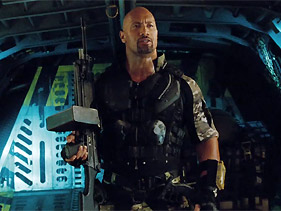
Duke goes early and so does London in the brand-new trailer for ‘G.I. Joe: Retaliation,’ from ‘Never Say Never’ director Jon Chu. By Josh Wigler Dwayne Johnson in “G.I. Joe: Retaliation” Photo: Paramount Crashing through the sky comes the fearful cry of Cobra, but I feel no fear at the laser-blasting terrorist organization’s coming arrival. For one, we all know the Joes have this battle in the bag. For another, there’s a second “G.I. Joe” movie heading our way in just two short months, and by the looks of it, it’s the movie that fans have always wanted. Bring on Zartan, Firefly and the rest of them, I say! Cobra Commander and his minions are out in full force in the brand-new “G.I. Joe: Retaliation” trailer that arrived Tuesday (April 24) courtesy of Machinima . Featuring an introduction from leading man Dwayne “The Rock” Johnson, the two-and-a-half minute trailer embraces everything we loved about that first “Retaliation” spot and ups the ante considerably. Keep reading for the five scenes from the trailer we were most excited to see. The Duke Of Hazard “Just don’t kill Duke. That’s really my only request,” MTV.com reader Adam wrote in response to the arrival of the first “Retaliation” trailer some months ago. Unfortunately, Adam, I don’t think your wish will be granted: Rumors have long been swirling about the early exit of Channing Tatum’s “Rise of Cobra” hero, and his limited appearance in the “Retaliation” trailer only fuels that fire further. If there’s a silver lining, it’s that Duke appears to have grown among the Joe crowd quite a bit since last we saw him. He’s got a strong relationship with Roadblock, so much so that he happily volunteers to babysit his fellow Joe’s little girls for a weekend. Duke might not last long in “Retaliation,” but expect his departure — however it comes — to weigh heavily on Roadblock as the film unfolds. The Country Is At War There’s only one man who could destroy G.I. Joe in one crushing move, and The Rock voted for him. Viewers well know that the president of the United States is Zartan in disguise, using his influence to push Cobra into the public eye and assert its dominance over the globe. If you thought the rise of Cobra meant the death of the former president, however, you’d be mistaken: The trailer reveals that the real president (played by “Pirates of the Caribbean” veteran Jonathan Pryce) is still alive, if not exactly well. Two Cases of Thin Mints With few allies left to turn to, Roadblock takes his surviving Joes — Flint and Lady Jaye — and teams up with the reclusive General Joe Colton, the man who started it all. The hero, played by action legend Bruce Willis, has gone from complaining about his high cholesterol to demanding Girl Scout cookies in this newest trailer. And he wonders why his blood pressure is all out of whack! London Bridge Is Falling Down “Rise of Cobra” saw the destruction of the Eiffel Tower. It looks like London’s going to undergo a similar “everything must go” sale when “Retaliation” rolls around. What, you really thought that President Zartan wanted world peace? He and the Cobra gang are behind the massive terrorist assault on the United Kingdom, and it’s going to be up to Roadblock and his pals to prevent further destruction from happening. Ninja Wrap So. Many. Ninjas. But never enough ninjas. There is no such thing, as Snake Eyes and Jinx battling an army of sword-wielding Cobra loyalists on the side of a mountain will surely tell you. Recently, Chu revealed that a nine- to ten-minute, dialogue-free ninja battle would occur in “Retaliation,” and going by the previous trailer and this latest one, it looks like this snow-covered mountain is where it’s all going down. Awesome. What do you think of the new “G.I. Joe” trailer? Sound off in the comments below! Check out everything we’ve got on ” G.I. Joe: Retaliation .” For breaking news, celebrity columns, humor and more — updated around the clock — visit MTVMoviesBlog.com . Related Photos “G.I. Joe: Retaliation” Character Photos Cast of G.I. Joe: Retaliation | Toy Fair 2012
Actor’s cameo in Tim Burton’s big-screen adaption of soap opera will be his last onscreen appearance. By John Mitchell Jonathan Frid in 1988 Photo: Getty Images Actor Jonathan Frid, best known as the man who brought vivid life to one of the most iconic undead characters in TV history, vampire Barnabas Collins in the soap opera “Dark Shadows,” died on Friday at the age of 87. He died of natural causes after a fall at his home in Ancaster, Ontario, though his family chose not to release the news until now. Frid was a classically trained stage actor, who began his stage career after a tour with the Royal Canadian Navy during World War II. He studied at the Royal Academy of Dramatic Arts in London before going to receive a Master of Fine Arts degree in directing from Yale in 1957. His talents were a strange match for “Shadows,” but Frid’s training brought an unexpected subtly to his performance, capturing the imaginations of viewers, including Tim Burton and Johnny Depp, both of whom were rabid fans of “Shadows” when they were young and labored for years to turn the soap into a feature film . Playing a 200-year-old vampire who is unearthed in the late-1960s, Frid’s Barnabas was not a villain but a complex and often sympathetic antihero, who through the soap’s 1966-71 run continued to mourn the loss of his true love while trying to crave his bloodlust and protect his descendents from the evil witches and monsters that plagued their beloved family mansion, Collinwood. The big-screen version of “Shadows” is set to open on May 11 and is easily one of the most anticipated films of the summer. Frid shot a cameo for the film, marking his first film role since 1974’s “Seizure” (Olive Stone’s feature-directing debut). While on set in London, he got to spend time with Depp, who plays Barnabas, and as Frid’s “Shadows” co-star Kathryn Leigh Scott told The Wrap , both Depp and Burton were effusive with their praise for the actor and his most famous character. “Both Johnny Depp and Tim Burton looked at Jonathan and said, ‘We wouldn’t be here without you,’ ” Scott said. After being based in New York City for more than 40 years and working to great acclaim both on and off Broadway, Frid retired to Canada in 1994, though he continued to act, performing one-man shows for charities in both Canada and the U.S., and appearing at “Dark Shadows” conventions, which have only grown in popularity over the years. He reportedly always felt a close connection to “Shadows” fans and maintained a website so they could follow what he was up to. Frid’s cameo in Burton’s “Shadows” will be his last onscreen performance.
Nicki Minaj’s “Leather Fit” [Video] Understandably Nicki Minaj looked a little wide-eyed as photographers started snapping away around her as she left her London hotel… But wait a second, what is she wearing!? Turn it to peep…
After spotting Perry at his Coachella set, M83’s Anthony Gonzalez offers to write singer’s next album. By James Montgomery Katy Perry and M83’s Anthony Gonzalez Photo: Getty Images M83’s Anthony Gonzalez has taken his widescreen electronic on the road with the likes of Kings of Leon and the Killers. He’s recorded a double-disc answer to the Smashing Pumpkins’ Mellon Collie and the Infinite Sadness and has even seen his work show up in the occasional Miley Cyrus song. But after his set at the Coachella festival this past weekend (yes, there were artists besides Holo-Tupac that performed), he’s really dreaming big: He wants to make Katy Perry’s next album. “I think I saw Katy Perry dancing [to] ‘Midnight City’ yesterday night,” Gonzalez wrote on his Facebook page following his performance. “Katy, let me write your next album!” For the uninitiated, “Midnight City” is the fantastic single off M83’s dynamic 2011 double album, Hurry Up, We’re Dreaming, and yes, Perry was right in front when Gonzalez played it (here’s photographic proof ). And following the performance, Perry tweeted , “M83 ONLY.” But does any of that mean a collaboration between the two might be in the works? We’re not sure, but when MTV News sat down with Perry last month in London — for the premiere of her “Part of Me” video — we asked her to name her current favorite artists, and she definitely let it be known that M83 was at the top of her playlist. “I’ve been listening to, well, I guess it would have to be M83’s last record, this past record,” she said, before singing a few bars of “City.” “I think I’m going to see him at Coachella. Oh man, I’m so there. I love it so much.” Of course, she didn’t stop there — turns out, Perry’s also fallen under the spell of Bj