Tag Archives: mexico

Ed Burtynsky on the Gulf Oil Spill

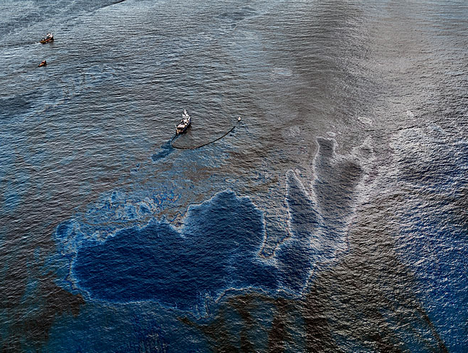
Images from metiviergallery : Oil Spill #4, Oil Skimming Boat near Ground Zero, May 12, 2010, chromogenic print The Canadian photographer, Ed Burtynsky, has been photographing the impact of industrialization on the environment for the last 30 years. His huge colour photographs depict the toll that environmental disasters are taking on human beings and the landscape. In May 2010 Burtynsky travelled to the Gulf of Mexico to photograph the oil spill. The series of 9 photos on display at a

More here:
Ed Burtynsky on the Gulf Oil Spill

Brad Pitt: Let’s Execute Some BP Executives

On July 27th and 28th, the  New York Times  published the  following headline:  “The oil slick in the Gulf of Mexico appears to be dissolving far more rapidly than anyone expected.” In the story that followed the headline, readers were informed: “The immense patches of surface oil that [once] covered thousands of square miles of the gulf after the…oil rig explosion are largely gone.” Ironically, the man who predicted this would be case was the much-maligned Tony Hayward, former Chief Executive of British Petroleum (BP). While being grilled on Capital Hill about the oil spill earlier this year, Hayward described it as a ” relatively tiny ” one in comparison to the “very big ocean” in which it had occurred.  Although the backlash Hayward faced by Democrats was nasty, Rush Limbaugh concurred with the BP boss, and stories like the one I cited from the  New York Times  seem to demonstrate that Hayward and Limbaugh were both correct. Yet, not only does BP continue to be the target of heavy criticism by Democrats and environmental groups, it has even found itself in the crosshairs of Brad Pitt, who recently “said he would  consider the death penalty  for those to blame for the Gulf oil spill crisis.” According to the UK’s  Daily Mail , Pitt’s exact words were: “I was never for the death penalty before – I am willing to look at it again.” With all respect to Pitt, a seemingly reasonable guy who has made some great movies, it may be a bit over the top to support (or even consider supporting) the death penalty for a human being simply because that person was involved in an environmental disaster. How out of whack has our world become when someone of Pitt’s stature can spend his whole life opposing the death penalty for men who commit crimes like rape and murder, then suddenly find a way to condone that punishment for men who accidentally spill oil in the waters of the Gulf? Talk about turning teleology on its head. Making matters worse, Pitt said these things almost a month after the  New York Times  and other media outlets informed readers that the spill will not be as bad as first thought. And while Pitt is talking up the death penalty,  Jeffrey Short , a former government scientist who now works with Oceana, is telling reporters that “40 percent of the oil in the gulf might have simply evaporated once it reached the surface” while another “unknown percentage of the oil would have been eaten by bacteria.”  (This doesn’t even take into account the percentage of oil that was dissolved by the dispersants BP put into the Gulf.) Simply put, the extent of the disaster predicted by many talking heads has been greatly reduced, if not done away, in many parts of the Gulf. And while this isn’t to condone any degree of environmental recklessness, it is to say that we shouldn’t be talking about “the death penalty” for men who may (or may not) have played a part in an oil spill that is “dissolving far more rapidly than anyone expected.” Crossposted at Big Hollywood

See more here:
Brad Pitt: Let’s Execute Some BP Executives

Gulf Oil Plume Gone, Eaten By Newly Discovered Microbes

Analysis by Berkeley Lab revealed the dominant microbe in the dispersed Gulf of Mexico oil plume was a new species, closely related to members of Oceanospirillales family. Image: Terry Hazen via Science Daily . In what seems a deus ex machina or perhaps deus ex gaia moment, scientists from Lawrence Berkeley National Laboratory report that the miles-long deep sea oil plume which resulted from the BP oil spill has essentially vanished, apparently eaten by micro… Read the full story on TreeHugger

Continue reading here:
Gulf Oil Plume Gone, Eaten By Newly Discovered Microbes

Drug War Sends Bullets Over Border Into El Paso City Hall

;_ylt=Ami0C1nq6Jgkv1JsabOnCWW9IxIF;_ylu=X3oDMTNlcDNodDVnBGFzc2V0A2FwLzIwMTAwODI1L3VzX2RydWdfd2FyX3N0cmF5X2J1bGxldHMEY2NvZGUDbW9zdHBvcHVsYXIEY3BvcwM1BHBvcwM1BHNlYwN5bl90b3Bfc3RvcmllcwRzbGsDZHJ1Z3dhcnNlbmRz The first bullets struck El Paso's city hall at the end of a work day. The next ones hit a university building and closed a major highway. Shootouts in the drug war along the U.S.-Mexico border are sending bullets whizzing across the Rio Grande into one of the nation's safest cities, where authorities worry it's only a matter of time before someone gets hurt or killed. At least eight bullets have been fired into El Paso in the last few weeks from the rising violence in Ciudad Juarez, Mexico, one of the world's most dangerous places. And all American police can do is shrug because they cannot legally intervene in a war in another country. The best they can do is warn people to stay inside. “There's really not a lot you can do right now,” El Paso County Sheriff Richard Wiles said. “Those gun battles are breaking out everywhere, and some are breaking out right along the border.” Police say the rounds were not intentionally fired into the U.S. But wildly aimed gunfire has become common in Juarez, a sprawling city of shanty neighborhoods that once boomed with manufacturing plants. It's ground zero in Mexico's relentless drug war. More than 6,000 people have been killed there since 2008, when the Sinaloa and Juarez cartels started battling each other and Mexican authorities for control of the city and smuggling routes into the U.S. Nationwide, more than 28,000 people have been killed since President Felipe Calderon launched his offensive against the cartels shortly after taking office in December 2006. Until now, communities on the U.S. side of the border have been largely shielded from the violence raging just across the river. But the recent incidents are the first time that live ammunition has landed in American territory. On Saturday, as gunmen and Mexican authorities exchanged gunfire in Juarez, police in El Paso shut down several miles of border highway. Border Patrol spokesman Doug Mosier said his agency asked for the closure — a first since the drug war erupted — “in the interest of public safety.” No one was injured on the U.S. side, but one bullet came across the Rio Grande, crashed through a window and lodged in an office door frame at the University of Texas at El Paso. Police are also investigating reports that another errant round shattered a window in a passing car. Witnesses at a nearby charity said at least one bullet hit their building, too. El Paso police spokesman Darrel Petry said authorities have only confirmed the single bullet found at the university, but it is possible that several other shots flew across the border. “As a local municipality, we are doing everything we can,” Petry said. “Looking where we're at, the community we live in, that's all we've got. It's the reality of life here in El Paso for right now.” Officers say the types of bullets used in the drug war can travel more than a mile before falling to the ground. In Saturday's shooting, the bullet that hit the campus building may have flown just under a mile before lodging in a door jam. Back in June, at least seven shots fired from Juarez flew more than half a mile before hitting City Hall. In some places, El Paso is separated from Juarez by little more than a few yards of riverbed. Andrew Kunert was napping Saturday when police started banging on his door at an apartment building just feet from the border. He said officers with high-powered rifles slung across their chests warned him to stay inside and away from windows until the shooting stopped. The rat-a-tat-tat of gunfire to the south is nothing new, but bullets coming north is a worrisome new development, Kunert said. “About once a week, you can hear gunfire,” he said. He worries about the children who live at the Old Fort Bliss apartment building and routinely play outside when gunmen are trading shots across the river. At the Rescue Mission of El Paso, kitchen manager Bill Cox said several bullets hit a pair of old silos on the charity's property, which is down a hillside from the university campus. Volunteers and homeless people coming to the mission for food or other help could easily be in the line of fire, he said. “Someone can be walking down the street out here and be hit,” Cox said. added by: Omnomynous

Marines Find 72 Bodies In Northern Mexico

;_ylt=Amd0ZcvVQDBWMAalHVREySZH2ocA;_ylu=X3oDMTM3Z2d0OGZxBGFzc2V0A2FwLzIwMTAwODI1L2x0X2RydWdfd2FyX21leGljbwRjY29kZQNtb3N0cG9wdWxhcgRjcG9zAzMEcG9zAzMEc2VjA3luX3RvcF9zdG9yaWVzBHNsawNtYXJpbmVzZmluZDc- Mexican marines have found the bodies of 72 people at a rural location in northern Mexico, following a shootout with suspected drug cartel gunmen that left one marine and three suspects dead. The find appears to be the largest drug-cartel body dumping ground found in Mexico since President Felipe Calderon launched an offensive against drug trafficking in 2006. Mexican drug cartels often use vacant lots or mine shafts to dump the bodies of executed rivals or kidnap victims. The Navy announced the discovery Wednesday, but did not give details on the victim's identities, who had killed them, or whether the bodies had been buried. It was also unclear whether the 58 men and 14 women had been killed at the same time, or separately. added by: Omnomynous

It’s as if a nuclear apocalypse has gone off in the Gulf

There are a few new, developing BP-related stories that should greatly disturb any American who values openness and transparency in their democracy. First, a chemist named Bob Naman claims samples he received from Orange Beach Alabama waters tested positive for the dangerous neurotoxin pesticide 2-butoxyethanol, the main ingredient of Corexit 9527A. The government has been claiming they discontinued the use of that version of Corexit in the Gulf. Now, Naman says he’s worried because BP called him and “threatened him.” Next, Dr. Nyman of Louisiana State University, who began comparative tests early May to determine the impact of oil and the impact of Corexit laced oil on maritime life, says, while marine life may recover quickly from oil exposure, the same cannot be said about exposure to Corexit. Large mammals were the least affected by the presence of oil, while the small bottom creatures, worms that are the food source for bottom feeders, were affected the most. The conclusion was that an oil spill is disruptive to maritime life but does not negatively impact the seafood population on a permanent basis. The impact is temporary and can reverse and restore itself over a period of time. The same cannot be said when natural waters contain a Corexit-oil mixture. Dr. Nyman’s studies show that the recovery period is twice or three times as long when maritime life is exposed to the toxic mixture of Corexit and oil. While the large mammals ultimately recover, the smaller fish population is reduced dramatically by 25% or more, depending on the concentration. The bottom of the natural food chain however, does not recover and is killed in its entirety which affects all the bottom feeders in the Gulf of Mexico, including shrimp, crawfish, crabs and lobster. Over at Counterpunch, Anne McClintock has a very good summary of the three vanishing acts playing out in the Gulf: the “disappearing” of oil courtesy of Corexit, the disappearing story in the media, and the disappearing of private contractors who are making a pretty penny helping BP and the Coast Guard keep a lid on the cover-up. Previously, I have written about the absolutely absurd claim that the oil has magically disappeared thanks to the Corexit fairy. Corexit simply hid the problem by sinking the oil, and there is no good way to clean up oil that is sitting deep in the ocean. Marine scientists have reported finding enormous oil plumes that could still exist in the Gulf due to the cold temperatures of the water. I recommend reading McClintock’s article in full, but I wanted to highlight this interaction with her source, a veteran named Steve who was hired to help in the clean-up effort. “It’s as if a nuclear apocalypse has gone off in the Gulf,” he said. “The media is not telling the truth. No one is telling the truth. Let me tell you something. Yesterday on the beach where we work, my crew cleaned up seven hundred bags of oil. Today we went back and the beach was completely covered in oil, as if we had never been there. Today we carried away another seven hundred and fifty bags. Every day we clean up, then the tide brings it in again. The oil is everywhere, deep under the sand. Today I wanted to measure the oil, so I stuck my shovel into the sand and the oil was down there eight inches deep.” Steve leaned in close, “Do you want to know how long my contract is to work down here?” he asked. “Three years.” His jaw muscles tightened as if he wanted to suck his words back into his mouth, but could not. “They are telling everyone it is not so bad, but clean-up will take many years. I am going to be here a long time.” Steve wiped a hand heavily over his eyes as if they were burning. “Let me tell you something. Today we saw three sharks washed up dead on the beach. The insides of their noses were black with oil. The membranes of their mouths were black with oil. Their eyes were black with oil.” As I have repeatedly stressed, the full ramifications of this disaster won’t be understood for years. That’s why it’s so essential the media doesn’t buy the narrative that the crisis is over. Ever since they refused to allow workers to wear respirators during the clean-up, BP has been doing everything in its power to skirt liability for not only the oil volcano, but also the consequences of dumping two million gallons of experimental toxins into the ocean. They have bullied, intimidated, and used private contractors to suppress free and open media coverage of the unfolding events. BP is now desperately trying to get the victims of the Gulf disaster to quickly sign away their legal rights in order to secure swift payment as opposed to dragging things out in a lengthy, expensive court war like the one Exxon victims had to (and continue to) endure. All the right rich people want the Gulf squared in their rearview mirrors. The oil companies want to drill, and many politicians want the oil companies to stay happy so they can secure their donations come election time. The media is fatigued by the story, and eager to believe BP and state officials when they brushed off their hands and delivered the clarion call, “The End!” Focusing on the unknown consequences of Corexit is bad PR. It’s bad for deep-sea oil drilling. It’s bad for the politicians that need oil corporation donations. In all honesty, it’s bad for the local fishing industry, too. And I feel for those poor men and women, who will suffer years of financial devastation because of the irresponsible actions by BP (another reason not to let BP off the legal hook.) Of course, it’s also necessary to ask these questions. No one really understands the long-term consequences of Corexit. In fact, every day it becomes clearer and clearer that no one has any idea what this stuff is going to do to the food chain. ~ Visit the original article for embedded links ~ Related: The recent news that a new oil-eating microbe is eating BP's oil plumes comes from UC Berkeley, which received the largest BP grant ever ($500 million) http://www.youtube.com/watch?v=2hnA8IqTr8c&feature=player_embedded added by: samantha420

Halliburton Employee Warned BP That Oil Well Plan Was Risky | Testifies at Today’s Oil Spill Hearings

Halliburton employee warned BP that oil well plan was risky, he testifies at oil spill hearings Published: Tuesday, August 24, 2010, 4:19 PM Updated: Tuesday, August 24, 2010, 5:49 PM David Hammer, The Times-Picayune PART ONE… This is an update from the joint hearings by the Coast Guard and the Bureau of Ocean Energy Management, Regulation and Enforcement investigating the causes of the Deepwater Horizon oil rig explosion on April 20. A Halliburton employee who worked on cementing BP's wild Gulf oil well testified Tuesday that he verbally warned BP officials that their well plan increased the risk of gas leaks and questioned them about their plans by e-mail, but wasn't able to get them to change the process before the well kicked gas and started the largest oil spill in U.S. history. On April 15, five days before the explosions, Jesse Gagliano ran a computer model for BP's engineers, principally Brian Morel, that assumed BP would use 21 devices called centralizers to prevent the cement Halliburton was providing from channeling in the hole, thus weakening its effectiveness in sealing the well. Using modeling for 21 centralizers, Gagliano's report showed a low risk of gas flow. But that same day, Morel sent an e-mail message to Gagliano saying BP was going to use only six centralizers, adding that it was “too late” to send any more of the safety devices. Morel was scheduled to testify in Houston before Gagliano, but Morel's lawyer came instead and said Morel was pleading the Fifth. Three days after the e-mail exchange with Morel, or two days before the accident, Gagliano sent BP officials a new report that included modeling for seven centralizers, Gagliano testified. That report showed a severe risk of gas flowing in the well. Gagliano said he noted the risk on page 18 of the report. In addition, while working in the same office with the BP decision-makers, he said he personally addressed the issue with top BP engineers. “I notified BP of the potential issue we were facing,” Gagliano said before a federal investigative panel. “I printed it out and got up to go show them. I ran into (BP engineering team members) Brett Cocales and Mark Hafle and I said, 'Hey, I think we have a problem here.'” But when asked why he didn't exercise his power to stop the drilling project, which is supposedly given to everyone working on the job, Gagliano said he didn't because “channeling doesn't equal a blowout. It just means increased risk.” Channeling refers to when cement flows unevenly around metal tubes that line the well. When that happens, one side of the cylindrical liners is thicker than the other, leaving a weakness on the thinner side. Later, Gagliano said he sent an e-mail message asking Cocales, Hafle, Morel and another BP official, Greg Walz, if they were going to use the additional centralizers. Gagliano said he never got a response. The issue of centralizers is just one of several in which BP apparently chose less safe designs or processes in the final days before the blowout. The company also decided to use a single, long string of pipe to line the center of the hole, rather than a shorter final liner that could tie back to ones above it and place an additional barrier against gas flowing to the surface. There are BP e-mails in which company officials note that the long string would save time and money. BP also eschewed a cement bond log, a test known as the gold standard for measuring the integrity of a cement job. BP decided to send home a stand-by crew from oil-field services company Schlumberger without having them run the test, another decision that saved time and money. Gagliano testified that in his opinion, BP should have run the cement bond log, but he wasn't asked to weigh in on that. The cement bond log is the best test to detect channeling. If channeling is discovered, there are remedial cement jobs that can be done to sturdy the barriers against any oil or gas that's trying to enter the hole from the side or below. BP also went without a bottoms-up test, in which drilling fluid is circulated through the well to check if gas has entered at the bottom. Gagliano testified that it was Halliburton's best practice to perform a bottoms-up test on each well, but that the contractor played no role in BP's decision not to do it. Except he said Halliburton officially recommended using a bottoms-up test. BP lawyer Richard Godfrey cross-examined Gagliano, noting that Gagliano prepared a design report on April 18 that assumed the use of seven centralizers and that document never explicitly says BP shouldn't use the design. Gagliano responded that he clearly indicated a high risk of gas flow and channeling of the cement in that report. That same day, Gagliano signed a 12-page report that never mentioned the centralizers. In that document, called a job recommendation report, Gagliano asserted that the cementing plan was Halliburton's recommendation. He backpedaled from that under questioning, saying the statement he signed was automatically generated. Again, Godfrey sought to use the document to show that Gagliano and Halliburton weren't really that concerned with BP's well design and were just emphasizing a few pre-accident references after the fact. Godfrey noted that Halliburton markets its ability to control severe gas flow and channeling problems. He also pointed out that Halliburton had poured cement for 21 wells in the Gulf of Mexico that it scored as a severe risk for gas flow, and only two of those were for BP. Gagliano responded that a ratio used to score the risk more precisely was particularly high in this case. After all was said and done, though, Nathaniel Chaisson, a Halliburton engineer on the rig, sent an e-mail to Gagliano stating, “We have completed the job and it went well.” That was 17 hours before the rig blew. Three days later, Gagliano sent a post-job report that said the cement job was good and also never mentions having given any warnings about centralizers, cement channeling or any other deficiency. CONTINUED… added by: EthicalVegan

Miss Universe Jimena Navarrete

I know you’ve all been on the edge of your seats waiting to finally find out who the new Miss Universe was going to be. Well wait no longer, last night Miss Mexico Jimena Navarrete was named the hottest woman in the universe according to Donald Trump. I’m not really seeing it, she’s hot and all, but she looks a little like a Mexican Tina Fey . But what do I know, I just deal with hotties all day every day. Anyhow, now you can order your commemorative plates or TV tables or whatever other Miss Universe memorabilia it that you collect…. Pageant people are weird. more pictures of Jimena Navarrete here

Jimena Navarrete Height Biography

Biography for Jimena Navarrete Birthdate February 22, 1988 (1988-02-22) Birthplace Guadalajara, Jalisco, Mexico Height 1.74 m (5 ft 8 1⁄2 in) Eye color Brown Hair color Brown Title(s) Nuestra Belleza México 2009 Miss Universe 2010 Jimena Navarrete (born February 22, 1988) is a Mexican beauty pageant titleholder and Miss Universe 2010. She was previously crowned Nuestra Belleza Jalisco in Guadalajara, Jalisco, on July 16, 2009, and Nuestra Belleza México on September 20, 2009, in Mérida,

Follow this link:
Jimena Navarrete Height Biography

The Marijuana Lawyer of Orange County, California

Chris Glew in the best marijuana lawyer in the OC. added by: RubyVideo






