Lady Gaga came, she saw, she conquered Super Bowl LI. While the Internet has responded with mixed opinions to the Patriots stunning comeback victory over the Falcons, nearly everyone is in universal agreement over Gaga: She was terrific. At halftime of the big game, Lady Gaga honored America … jumped from a stadium roof… danced all around… celebrated diversity… and played her greatest hits. You can grade her performance HERE . And you can relive it below, GIF style! 1. Lady Gaga in the Air There goes Lady Gaga! The singer is suspended from mid-air in this GIF from her terrific Super Bowl halftime show. 2. Going… Going.. Gaga! Look out below! Lady Gaga takes a dive off the roof in this Super Bowl halftime photo. 3. Flipping All the Way Out Lady Gaga is literally flipping out in this GIF from her well-reviewed halftime show. 4. Angry Gaga Gaga looks a little angry here, doesn’t she? Her actual halftime performance was pretty hopeful, though. 5. Let’s Do This! Lady Gaga has arrived on stage. She is ready to do her thing!!!!!! 6. It’s Important to Stretch Gotta work those leg muscles, right, Lady Gaga? You don’t want to pull anything. View Slideshow
Selena Gomez and Zedd’s new single, “I Want You To Know,” debuts tomorrow and nearly everyone is curious to hear the results after weeks and weeks of teases.
Very well played, Karl Stefanovic. The relatively unknown Australian news anchor has made waves around the Internet after growing irritated by the unsolicited fashion advice and appearance-based criticisms viewers have continually offered his female colleague, Lisa Wilkinson. In response, Stefanovic conducted his very own social experiment: he wore the same suit on air every single day for one year’s worth of broadcasts… and no one paid him any attention for it. Karl Stefanovic, Australian News Anchor, Makes Point About Sexism “No one has noticed; no one gives a sh-t,” Stefanovic tells The Sydney Morning Herald. “But women, they wear the wrong color and they get pulled up. They say the wrong thing and there’s thousands of tweets written about them. Women are judged much more harshly and keenly for what they do, what they say and what they wear.” This isn’t exactly earth-shattering news, but props must be paid to Stefanovic for pointing out the double standard in such an interesting manner. And heads must be shaken that this double standard exists so prominently around the globe. “I’m judged on my interviews, my appalling sense of humor – on how I do my job, basically,” Stefanovic added. “Whereas women are quite often judged on what they’re wearing* or how their hair is … that’s [what I wanted to test].” (*Or, in the case of Kim Kardashian , on what they’re not wearing.) Stefanovic is receiving praise from nearly everyone familiar with this story, but he has good news for co-workers who may have their own reasons for hoping he ends the experiment soon. “I’m hoping to get [the suit] into the dry cleaners at the end of the year,” he says. “It’s getting a bit stinky.” 29 Hilariously Awesome Moments in News 1. Jim Cantore Knees College Kid on Camera The Weather Channel’s Jim Cantore, reporting live from the site of crazy weather as he always does, beats back a college kid’s attempt to video bomb him.
A 20-year-old man was arrested in Bolivar, Missouri after admitting he bought firearms and 400 rounds of ammunition with the intent of shooting patrons this weekend at a screening of The Twilight Saga: Breaking Dawn — Part 2 — an attack that, had it been carried out, would have echoed the Aurora, Colorado tragedy . Blaec Lammers, who was charged on Friday with first-degree assault, making a terroristic threat and armed criminal action, told police that he bought a ticket to Breaking Dawn — Part 2 for Sunday with the intention of shooting people at the theater. According to the police report, however, he changed his mind and instead plotted to make his attack at a local Walmart so that he’d have access to additional ammunition if he ran out. The report also indicated that Lammers had never before shot a gun and that he was off his medication, although it did not offer specifics in terms of the latter. Lammers’ mother contacted police when she became concerned that he might be planning an attack similar to the Aurora, Colorado shooting at a screening of The Dark Knight Rises in July. Per the Springfield News-Leader (via Deadline ): An officer approached Lammers at the Bolivar Sonic and he agreed to come to the police station to be interviewed. During the interivew, Lammers said he had purchased two assault rifles for hunting, the statement said. As the conversation progressed, police asked Lammers about recent shootings that had been in the news. “Blaec Lammers stated that he had a lot in common with the people that have been involved in those shootings. Blaec Lammers state that he was quiet, kind of a loner, had recently purchased firearms and didn’t tell anybody about it, and had homicidal thoughts,” the statement said. Read more at the Springfield News-Leader . Related Story: You Will Never Feel Safe In A Movie Theater Again Revisit Movieline’s Coverage of the Aurora Tragedy Here. Follow Jen Yamato on Twitter. Follow Movieline on Twitter.
Oscar-nominated actor Jude Law plays a pious aristocrat in director Joe Wright’s sumptuous big screen adaptation of Anna Karenina . Almost unrecognizable behind a steely exterior, Law’s Karenin is Anna’s spurned husband in the film, which begins its roll out Friday and is a possible awards season heavyweight. Law seamlessly pulls off playing the high-ranking nobleman whose position at the heights of Imperial Russian society is rocked when his wife embarks on an affair with a dashing young soldier. Speaking about his role, Law, who turns 40 next month, said that he doesn’t think he could have played the character when he was younger — but he certainly would have given it a go. “When I was 25 I would probably say I could have played Karenin,” said Law. “When I was 29 and I put together a production of Doctor Faustus in London, it was successful but it took me the length of the production to realize that I was too young to play it. And I think the same would apply to this situation. I would have given it a good shot, but I think it would not have been as successful.” [ Related: Oscars and Obsession: Keira Knightley Talks About ‘Jumping Off A Cliff’ For Joe Wright In Anna Karenina ] Law said that youth would have been a handicap portraying the staid Karenin, who exudes stability and rationality to a fault. He is the archetypal patriarch that is a complete contrast from the youthful soldier who seduces his wife. “I think you need to have a certain amount of experience to play certain roles,” noted Law. “You want the audience to see a certain amount of wounds and battle scars that are obviously flickering in the mind and the soul.” Set in the lavish upper crust societies of St. Petersburg and Moscow in 1874, Anna Karenina follows the vibrant and beautiful Anna (Keira Knightley) who is the envy of nearly everyone in her gilded circle. She is the beautiful, stylish and rich wife of Karenin who holds a high position in the government and is blindly devoted to his spouse. Their enviable partnership is dealt a blow when she travels to Moscow to help save the marriage of her philandering brother Oblonsky (Matthew Macfadyen) after a plea for help from his wife, Dolly (Kelly Macdonald). En route, she meets the dashing cavalry officer Vronsky (Aaron Taylor-Johnson), which ignites passion; she returns to St. Petersburg, but she is followed by Vronsky and becomes consumed by him, and they go full-throttle into a ravenous love affair that stuns the establishment. Law said he believes some Anna Karenina readers have misunderstood his character. Though he is sullen compared to the dynamic Vronsky, there is complexity in his personality that many readers of the novel have failed to appreciate. “A lot of people I spoke to before I embarked on it said he was dull and cold, but I disagreed with them,” said Law. “I hadn’t read the novel before, but after reading it I was glad Joe [Wright] agreed with me, because I think it sort of belittles Tolstoy’s study of human complexity. People are complex and there’s a misunderstanding. But you do feel for him because he’s dragged into this arena of gossip and scandal. But ultimately for him, he has to question his belief in God because he believes his marriage is sanctioned by God.” Karenin’s position at the pinnacle of a narrow class of people who delighted in rarified privilege contrasted with the bleak existence that huge swaths of Russians were forced to live in during czarist times. Though Law said he was disturbed to see how extraordinarily the aristocracy lived while most people were barely living a life one notch above serfdom in Russia, he did see some parallels to today. “It’s shocking that they were that indulged and were able to follow their whims and fancies to such extraordinary lengths — and we look at that with jealousy and at times and with fascination. What intrigues me is that the heart of the piece is about love. But there are other aspects in the book that have also been highlighted in the film and that is the role of gossip and judgement. Today there is much of the same thing and we see that online and in papers all the time. We still do that — we call out people for ‘breaking the rules.'” Read more on Anna Karenina . Follow Brian Brooks on Twitter . Follow Movieline on Twitter .
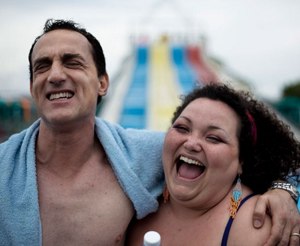
Reality TV is getting the Cannes treatment at the world’s premiere film festival. Italian director Matteo Garrone (pictured above right with actor Nando Paone) brought Reality to the fest’s competition, following up his critically acclaimed gangster pic Gomorrah several years ago. The film centers on a village fisherman who sacrifices everything for the perceived chance to become a reality-television celebrity. After being persuaded to apply for the Italian version of Big Brother , Luciano gets a follow up interview in Rome. He is initially reluctant to pursue the role, but after an interview he thinks went well, Luciano begins to believe he’s in the running for the series. After returning to Naples, he begins to believe he’s still “being cast” as he goes about his daily life. Soon, he lives as if he’s already on the show. A chance meeting with people from Rome turns into an “incognito casting session,” and soon it gets worse as he loses sense of actual reality. “After Gomorrah , I was waiting for a theme that would be as powerful,” Garrone said in Cannes on Friday morning. “I wanted a surprising film, but after Gomorrah , I didn’t realize I’d be hitting a brick wall.” The film is chock full of thematic takeaways, including the religious metaphor that through good works, one can achieve paradise: In the film, Luciano begins to give up his worldly possessions, believing the people secretly watching him will be charmed by his selflessness — much to the horror of his family. Reality could also be an indictment of the meteoric rise of reality television itself over the past decade, though Garrone said the film takes a neutral stance — at least officially. “We shot the film without trying to be critical in any way,” he said. “The main character is like a modern day Pinocchio. One can always re-invent this story. We were thinking of Pinocchio as we were making this film… People can read into this story what they like.” Still, Garrone alludes to some vague overriding associations. “In Rome he finds some kind of redemption,” he noted. The cult of fame topic is not new to modern Italian cinema. Back in 2009, Erik Gandini brought his documentary Videocracy to the Toronto International Film Festival. The film explores how celebrity worship and the quest for television stardom has threatened Italian democracy itself, turning the country into a culture of banality. Garrone’s Reality does not overtly condemn society on that level, but there is enough wiggle room to formulate conclusions. “We wanted to simply tell a tale that’s close to the people,” Garrone said. “We weren’t trying to critique politics or society. We follow this character and then he loses his inner identity and goes mad.” Read more of Movieline’s Cannes 2012 coverage here .
Ain’t no party like a Bill Murray dance party? Vulture had a front row seat at Cannes : “At the request of [ Moonrise Kingdom co-star Jared] Gilman, who just had his bar mitzvah and has a taste for dub-step, Bill Murray led the troop onto the dance floor, where the four kids and their accompanying man-child wiggled and jumped around with abandon. It was a scene of such next-level adorability that nearly everyone in the immediate vicinity pulled out a camera phone. ‘We’re just chilling! We’re just chilling!’ Murray shouted out as he put the kibosh on each video in turn. Then he’d go back to more happy wriggling to songs like ‘I’m So Excited.'” [ Vulture ]
The Los Angeles Lakers were completely and thoroughly embarrassed the Oklahoma City Thunder on Monday night. Nearly everyone had picked the Thunder to win this series, but most figured things would at least be mildly competitive throughout. As you can probably tell by the 119-90 final score – there was nothing competitive about what transpired last night. After the game, Kobe Bryant was understandably… Broadcasting platform : YouTube Source : Opposing Views Discovery Date : 15/05/2012 07:06 Number of articles : 3
There were many happy faces among critics on Saturday, the third day of the Berlinale. Because despite what I wrote yesterday about the criticism the festival has faced in recent years, particularly in terms of the films chosen for competition, nearly everyone I’ve spoken to thinks this year’s festival is off to a promising start. Of the six competition films that have been screened so far, not one has set any of my random sampling of critic friends howling with derision, or walking around wearing a perpetual scowly-frowny face. When the festival lineup was announced, friends who had to write pregame assessments had a hard time finding even one or two movies that, sight unseen, had the potential to stand out. But on the strength of what we’ve seen so far, it appears that the best of this festival, whatever that might be, will again come from left field, as it did last year with Asghar Farhadi’s A Separation . Not every edition of every festival starts out that way, with a sense of adventure and anticipation. Don’t quote me yet, but we may be onto something special here. We can attribute part of the buoyant mood to the reception of the screening of Paolo and Vittorio Taviani’s Caesar Must Die on Saturday morning. In the late 1970s and early 1980s the Taviani Brothers rode high, on an internationally cresting wave, with pictures like Padre Padrone and The Night of the Shooting Stars . But in recent years, mentioning their name would be likely to elicit a blank stare or a “Taviani Who?” Even though the brothers have been steadily making films in Italy since then, they’ve dropped off the map in the United States, and even at home their profile hasn’t exactly been blazing. But Caesar Must Die may reignite the fortunes of this octogenarian directing team. The picture is stark and alive in its simplicity; rendered mostly in black-and-white, it’s gorgeous to look at — you could practically use it as an illustrated textbook on framing and composition. Caesar Must Die is a sort-of documentary that tells the story of a group of prison inmates — incarcerated at Rome’s maximum security Rebibbia — who mount a production of Shakespeare’s Julius Caesar. Footage from the actual performance frames the picture: In the opening scene, we see a bunch of stubbly, rough-looking guys, wearing simple, stylized costumes that give the whole affair the aura of a children’s holiday pageant, doing some pretty interesting things with Shakespeare’s language. Not all of those things are, in the strict sense, good. But even the “bad” actors among this bunch — and remember, they’re not just nonprofessionals but convicted criminals, for Christ’s sake — contribute to the intense, quiet power of the final work. Most of Caesar Must Die is devoted to watching these men work their way through the material during rehearsal, learning its ins and outs, its dips and dives, and teasing out nuances and details that mean something to them. Sometimes the Tavianis draw the parallels between art and life a little too starkly. We don’t really need to hear the inmates reflecting on how Julius Caesar speaks to them when we can see how, in their proto-method-acting way, they bring every scrap of their experience to rehearsal: They touch each other warily but tenderly; when it’s time for a character to draw a knife, you can tell the actors respect it as both a weapon and a symbol, even though it’s presumably made out of plastic. You can bet these guys know a lot about duplicity and betrayal and power struggles, and they bring all of that to bear as they tangle with this challenging material, and with each other. The most wonderful sequence in this overall very fine picture may be the montage of the actors’ auditions, as they meet with the play’s director – a professional brought in from the outside – and try to impress him with their swagger and capacity for pathos. Many of them have both in spades. Some are awkwardly touching; others come off like they’ve spent too much time channeling Robert De Niro; and some are simply naturals, able to summon that deep-rooted whatever-it-is that makes magic happen in live performance. The picture also features a lovely, haunting Bernard Herrmann-inflected score — in places I could hear shadows of Taxi Driver . When Caesar Must Die eventually shows up in American theaters — and it will — it’s going to be easy as pie for marketing people to sell: An uplifting story about prison dudes finding meaning in art can pretty much sell itself. But even though that line essentially describes what happens in Caesar Must Die , it doesn’t come close to capturing the simultaneously joyous and mournful resonance of the picture. Caesar Must Die is really just about the way art lives on through people, sometimes in unlikely ways. There’s no way to keep it behind bars. Saturday’s press screening of Barbara, from German director Christian Petzold, didn’t draw the same kind of rapturous audience affection that Caesar Must Die did. But then, it’s a very different type of movie. In Barbara , a beautiful but rather blank-faced young doctor – played by the superb German actress Nina Hoss — arrives in a small East German town to take a new job at a tiny hospital. She doesn’t seem too happy to be there, though clearly the doc in charge – Ronald Zehrfeld, who somewhat resembles Brendan Fraser and is equally charming — takes an immediate shine to her. It’s 1980, as the movie’s press notes tell us, though if you go in cold, you probably won’t be able to immediately discern when and where the action is taking place. That’s probably intentional, and the approach works. This isn’t The Lives of Others, where the East-West divide is practically a major character; instead, it’s just a story about people living in constrained (and at times dangerous) circumstances and yearning for something more. Barbara is a drama and a romance, and it’s also laced with dry, delicate humor. There were times when the German members of the audience would laugh at a joke that I couldn’t quite get, and yet Petzold — the director behind the 2007 drama Yella, also featuring Hoss — is such a master of tone and mood that I could feel the vibrations of the movie’s subtle humor, even if I’d be hard-pressed to articulate it. Barbara starts out slow and then moves even slower — but by the end, somehow, it got me in its gentle clutches. Follow Stephanie Zacharek on Twitter . Follow Movieline on Twitter .