Tag Archives: Actors

Berlinale Dispatch: Billy Bob Thornton Directs Himself, Beautifully, in Otherwise Messy Jayne Mansfield’s Car
Billy Bob Thornton ’s Jayne Mansfield’s Car , screening in competition here at the Berlinale , is a sprawl of a movie, wonderful in some small, intimate ways but confounding when you step back to look at the bigger picture. This is a multi-generational family story set in late-1960s Alabama: A curmudgeonly patriarch, played by Robert Duvall, learns that his ex-wife, who’d long ago decamped to England to marry another man, has died; he’s forced to open his home to the second husband (John Hurt) and his two children when they arrive in the United States for the funeral. Duvall’s three sons, all veterans of the second World War, include Robert Patrick, who served but never saw action; Kevin Bacon, who worked as a medic and now, at the height of the Vietnam War protest, has become a pot-smoking peacenik; and Thornton, a former pilot whose mind has been addled by his wartime experience. Duvall also has a daughter, played by the gifted actress Katharine LaNasa (who may be best known for her work on TV shows like Big Love ), a flirtatious blonde who feels she sometimes gets lost in this family of strong and/or confused and/or ineffectual men. In fact, there’s a lot of “and/or” in Jayne Mansfield’s Car . (The title refers to the wrecked vehicle in which the Hollywood bombshell died in 1967, which makes its way to Duvall’s town as a morbid curio.) Thornton and cowriter Tom Epperson try to cram in so many relationship dynamics that the ensuing conflicts begin to lose significance. Duvall resents Hurt; Duvall’s sons all resent their father. Characters have crushes that amount to nothing, to the point where you wonder what these developments are even doing in the story. And while these disparate family members have been brought together by a death, no one, not even her own children, has much to say about the woman who has just died – she’s a screenwriter’s device in a handy casket. It doesn’t help that the three brothers, particularly Bacon’s character, are weirdly anachronistic for World War II vets. In 1969, most of those guys weren’t smoking pot or otherwise acting like petulant teenagers; at around age 50, they would have been, or would have been expected to be, certified grown-up men. This is the first picture Thornton has directed in 11 years – the last was the 2001 comedy Daddy and Them – and he isn’t fully in control of this messy, unfocused material. But he does have some terrific actors in his corner: Hurt and Duvall, in particular, are great fun to watch. But what struck me most about Jayne Mansfield’s Car – and it’s the single biggest reason to see the movie – is Thornton’s performance. This is the part that actors who work as directors usually mess up: They can’t direct themselves. (There are notable exceptions, of course, like Orson Welles or Laurence Olivier, but who wants to try to measure up to them ?) Yet Thornton is so relaxed here, and so believably befuddled, that your heart reaches out to him. There’s something extremely vulnerable-looking about Billy Bob: That too-big head on that too-skinny body (which now, at middle age, also features a slight, real-live-person paunch, as opposed to chiseled movie-star abs). He’s superb in an awkwardly tender seduction scene with Frances O’Connor (who plays his late mother’s English stepdaughter) – he stands before her literally and figuratively stripped down, his emotions distilled into something so intense and beautiful that it’s almost painful to watch. I suppose, after playing a scene like that, an actor-director could easily enough watch the playback and say, “Yep, that works.” But can Thornton himself really see how wonderful it is? Particularly in the midst of a movie that, scene for scene, doesn’t really work? Maybe the performance comes from a place where objective assessment recedes and instinct takes over. However it happened, it’s a small, sturdy miracle. Read more of Movieline’s Berlinale coverage here . Follow Stephanie Zacharek on Twitter . Follow Movieline on Twitter .

See original here:
Berlinale Dispatch: Billy Bob Thornton Directs Himself, Beautifully, in Otherwise Messy Jayne Mansfield’s Car
Berlinale Dispatch: The Return of Gillian Anderson — Hooray!

No one, as far as I know, has come to the Berlinale in search of Gillian Anderson, the strawberry-blonde vixen who set millions of hearts aflutter — and not just male ones — with her role in the supernaturally beloved ’90s show The X-Files . But Anderson has surprised those of us who love her by showing up — in small roles, but still — in two films here, James Marsh’s Shadow Dancer and Ursula Meier’s Sister . In Shadow Dancer , a thriller set in early-‘90s Belfast, she’s a British secret-service officer who squares off against a colleague (played by Clive Owen). In Sister , she’s the well-heeled patron of a tony Swiss ski resort — and a mom — who befriends a young thief and rapscallion who barely knows what it means to be a child. Anderson hasn’t really been in hiding. She was one of the best things — perhaps the only good thing — in last year’s Johnny English Reborn , and she recently played Miss Havisham in the British TV adaptation of Great Expectations . She chooses her roles carefully and doesn’t seem particularly attracted to big Hollywood vehicles — though it’s more likely that Hollywood isn’t particularly interested in her, which is certainly its loss. There are plenty of movies to parse and examine here at the Berlinale, but at dinner last night with some colleagues (who happened to be guys), Anderson came up in the conversation, and we just looked at one another: “Gosh! Isn’t she something?” is the gist of what we said. Perhaps we love her more because she shows up so infrequently and so fleetingly, like a ginger comet. Her role in Shadow Dancer is small and tokenlike, but it’s interesting for its metallic coldness, not a quality we usually associate with Anderson. Then again, maybe it’s really just a mirror angle of the clinical skepticism she brought to the role of Dana Scully in The X-Files : She’s good at playing characters who can turn the warmth off when it gets in the way of the goal at hand, and in Shadow Dancer , she plays a character who’s all about goals. In Sister , Anderson isn’t strawberry blonde but truly blonde, and the first glimpse we get of her is a mane of glorious, rich-girl hair. At first I could see only the oblique planes of her face and, not knowing she was in the movie, I thought to myself, “Could it be…?” Her role is small but potent: Her character, skiing at the resort with her own kids, meets the young thief Simon (played, beautifully, by a kid actor named Kacey Mottet Klein), and the two are immediately charmed by each other. He pretends to be a the son of the resort’s owner, when really he’s a mighty mite of a hustler who scrambles to make a living for himself and his sister (Léa Seydoux). Anderson scrutinizes his face as he advertises this fanciful false background — you can see, in this tiny but potent scene, that she’s amused by him and yet somehow, instinctively, she also feels protective. It’s not that she doesn’t believe his tale (she seems to buy it all); it’s that her better judgment tells her that this kid is in need of something, and though she can’t be the one to provide it, she grants him the kindest gift she can: She takes him seriously, reacting to him as if he were the miniature adult he’s trying so desperately to be, meeting him on his own scrappy turf. That’s a lot to pack into a few small scenes, and it’s a bit frustrating that her character’s role in the drama isn’t better worked out — her final encounter with Simon doesn’t feel true to the woman we met earlier. On the whole, the picture is unevenly worked out, but it’s ultimately touching, thanks to the bittersweet grace notes scattered throughout. Anderson is one of those grace notes; her presence is as subtle as a sigh, but it’s the kind that sticks with you long after the credits roll. Read more of Movieline’s Berlinale coverage here . Follow Stephanie Zacharek on Twitter . Follow Movieline on Twitter .

Go here to read the rest:
Berlinale Dispatch: The Return of Gillian Anderson — Hooray!

Exclusive: Celebrate Valentine’s Day with Mondo’s 25th Anniversary Princess Bride Poster

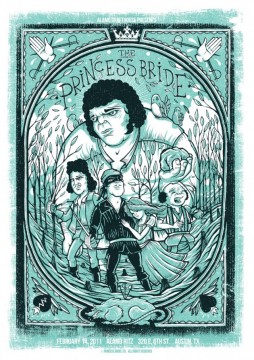
A collectible poster debut from the boutique art purveyors over at Mondo is always an event, but this Valentine’s Day Mondo and the Alamo Drafthouse have something in store so special it’s almost… inconceivable ! In celebration of the 25th anniversary of Rob Reiner’s 1987 fantasy classic The Princess Bride , the good folks at the Drafthouse have created a line of Princess Bride -themed wines (“The Bottle of Wits”) to coincide with a series of V-Day Princess Bride Quote-Along Feast events and a new illustrated commemorative poster by artist Drew Millward , which goes on sale today. Get the exclusive first look at Millward’s poster design after the jump! [Ed.: According to Mondo the Princess Bride posters have indeed been printed with the incorrect year and will be sold as planned, warts and all. ] Even 25 years after its debut, The Princess Bride , adapted from William Goldman’s book of the same name, has sustained its place among the best-loved American romances and comedies; you’d be hard pressed to find a self-respecting film lover these days who can’t conjure one of countless iconic lines from Reiner’s film. (See Movieline’s account of LACMA and Film Independent’s magical Princess Bride live-read for further evidence.) So it’s kind of perfect that the Drafthouse will host the Princess Bride Quote-Along Feast events this week at its six theaters in Austin and Houston on Feb. 14, in San Antonio on Feb. 15, and in Winchester, Va. on Feb. 16. What better way is there to spend Valentine’s Day than feasting on seared R.O.U.S. (“NY strip rubbed with telecherry peppercorn, mustard seed and espresso roasted medium rare in a pool of port demi, roast enoki mushrooms with mushroom risotto and grilled rapini”) and MLTs (for which “the mutton is shaved paper thin”) and toasting to “Twue Wuv” along with Westley, Buttercup and little Fred Savage? Millward’s whimsical Mondo poster (on sale at the Austin Quote-Along locations, printed in a limited run of 145) brings together the film’s most iconic elements (the six-fingered man! The R.O.U.Ses!) and its central heroes, from Cary Elwes’ The Man in Black to Robin Wright’s Princess Buttercup, the bouffant-coiffed Spaniard Inigo Montoya, Andre the Giant’s gentle Fezzik and Wallace Shawn’s evil Vizzini, who was last seen laughing maniacally while sloshing a goblet of wine. Speaking of wine… Inconceivable Cab and As You Wish White are the two varietals of Princess Bride wine available for order online ($28) at http://princessbridewine.com and at the Drafthouse locations starting today. The pairing of The Princess Bride with its own wine is an inspired concept that came from a brainstorming session by Drafthouse CEO Tim League and Co.: “At the end of last year, we were thinking about ideas to do something really fun with our wine list at the Alamo Drafthouse Cinema. To solve that challenge, a group of us got together after work, opened a bottle (a time-honored Alamo tradition) and started to brainstorm our favorite movie scenes involving wine. Quickly The Princess Bride rose to the top. The Princess Bride is one of our all-time favorite films. It stands beside The Big Lebowski as a movie that I will ALWAYS watch and thoroughly enjoy revisiting when it comes on TV. The ‘Battle of Wits’ sequence between Cary Elwes and Wallace Shawn easily stands toe-to-toe with ‘the Sideways Spit Bucket’ and ‘The Silence of the Lambs Chianti slurp’ as wine’s shining moment in film. We contacted the rights-holders and proposed a partnership to launch the product at the Alamo, and they were just as excited as we were. We are thrilled with the collectible bottle that Helms Workshop produced for us and think that fans of the movie will love it too. Although we can’t print it on the label because of legal reasons, we also promise each bottle to most likely be iocane free.” Get more info at the Alamo Drafthouse website .

Read more:
Exclusive: Celebrate Valentine’s Day with Mondo’s 25th Anniversary Princess Bride Poster

Oscar Season Distilled to 14 Words

“I hated this so much. It also has a very good shot of winning.” [ The Awl ]

View post:
Oscar Season Distilled to 14 Words

Abraham Lincoln: Vampire Hunter Trailer: History Lessen

Here’s a trailer for Abraham Lincoln: Vampire Hunter , the forthcoming Timur Bekmambetov film featuring our 16th president as an axe-wielding killer of the undead. There’s not much more to say that you can’t derive from the super slo-mo, mega-loud hyperviolence promised herein. America’s youth has got to get its history from somewhere, I guess. The film opens June 22.

Originally posted here:
Abraham Lincoln: Vampire Hunter Trailer: History Lessen

Berlinale Dispatch: Do Monks and Nuns Have More Fun? Metéora Ponders the Question

Nothing says “international film festival” like a 9 a.m. goat flaying, as I was reminded at Sunday morning’s screening of Spiros Stathoulopoulos’s Metéora , which is being shown here in competition. Though I wasn’t too happy about the onscreen animal suffering — the actual slaughter of the poor beast may have been simulated, but I’m not sure — I did find the picture bewitching in other ways. I seem to be in the minority on that: Metéora has met with a lot of derisive snorting from many of my colleagues. But I think Stathoulopoulos — a young Greek filmmaker who has made only one previous feature, a real-time picture called PVC-1 — is on to something in this tale of a Russian Orthodox nun and a Greek monk who fall in love and endure the pangs of intertwined passion and guilt. If it’s true that human beings most want what they cannot have, a pretty good-looking nun and a not-so-shabby monk, housed in side-by-side towers of asceticism, have the cards stacked against them. What could be sexier, in a Brother Sun, Sister Moon kind of way? The movie takes its title from the medieval monastery complex Metéora, in Thessaly, a series of structures built on natural sandstone pillars that stretch practically into the clouds. Stathoulopoulos takes some liberties with these structures as they exist in real life: In the movie’s opening moments, he shows them to us as part of a sepia-toned triptych – in his vision, they’re mile-high his-and-hers towers, with a much stubbier stone mountain, topped by a leafy tree, nestled between. The Monk (Theo Alexander), and the Nun (Tamila Koulieva-Karantinaki), have come down from their respective retreats for a meeting in the countryside below: We see them in wide shot — they’re gifting each other with necklaces, or strings of flowers, or something — and hear them exchange austere blessings amid the grass and wildflowers. Then they part: Monk begins climbing the 652 — or something like that — stone steps to the top of the monastery, while Nun must huddle into a little net, which is then raised via a pulley to the treehouse-style convent above. (Later, we see a few hardy sisters working the crank on the contraption — nothing comes easy in the hardscrabble world of religious devotion.) Nun and Monk alternately avoid each other and rush into each other’s company. Like resourceful teenagers, they send signals to each other from their respective cells by bouncing sunlight off the surface of framed devotional pictures. They take delight in a picnic of goat meat (at least we know that poor goat didn’t die in vain), which Monk has prepared with care for his inamorata. Unable to resist her during this lunchtime idyll, he makes his move: She struggles when he first kisses her and then nudges his hand between her thighs, but resistance, as you can imagine, is futile. Hot monk-on-nun action is inevitable, but Stathoulopoulos approaches it delicately, as if it were an ascent to grace instead of a fall from it. Maybe Metéora is, all in all, a little too tasteful. The filmmaking is restrained and austere — a colleague of mine called it “too artisanal,” and I know what he means. But the film doesn’t seem arid — it’s as if Stathoulopoulos is trying to work a kind of divine sublimation, perhaps only semi-successfully, but at times his picture does achieve a kind of burnished gold glow, like the halo on one of the stiffly painted medieval saints. In fact, Stathoulopoulos shows a strong attraction to all that strange, flat religious art. Even though Metéora is set in the present day, we don’t know it until we see the nuns hauling their foodstuffs in plastic milk crates. Stathoulopoulos is going for the full-on medieval vibe here, but he modernizes it with a charming touch: Here and there he illustrates the story of our Nun and Monk with animated Byzantine icons — they move stiffly, like paper cutouts, but the effect only underscores the characters’ all-too-human frailty and uncertainty. In one of these animated segments, Monk, with Nun’s assistance, approaches Christ on the crucifix and drives nails into his palms; the sea of blood that flows from the wounds spreads into a sea of stylized curlicues that overwhelms our two already overwhelmed protagonists. The symbolism is obvious, but its over-the-top quality is what’s glorious about it. Stathoulopoulos doesn’t always go for broke in Metéora : He’s feeling his way toward the sweet spot between secular and sacred passion, and maybe, in the end, he doesn’t quite find it. But if you’ve ever felt a vaguely naughty thrill while looking at religious art – if, say, you’ve ever had an “I’ll have what she’s having” moment while looking at Bernini’s Ecstasy of St. Teresa — you don’t have a dirty mind. You’re simply seeing what’s clearly there. Religious fervor plus guilt can be a pretty hot equation. And if your Monk can cook, you’re golden. Follow Stephanie Zacharek on Twitter . Follow Movieline on Twitter .

Read the original post:
Berlinale Dispatch: Do Monks and Nuns Have More Fun? Metéora Ponders the Question

Artist, Meryl Streep Win Big at BAFTA Awards

Stop me if you’ve heard this one before: The Artist made off with Best Picture, Best Director, Best Actor, and and fistful of other hardware at tonight BAFTA Awards ceremony in London, its final stop before the silent film’s Oscar express pulls into the Kodak Theater terminus on Feb. 26. Meryl Streep also won a key awards-race victory as the institute’s Best Actress, while Octavia Spencer and Christopher Plummer continued their own hot streaks in the supporting categories. Read on for all of 2012’s winners, and drop back by Movieline on Wednesday to find out how the latest developments affect our Oscar Index . BEST FILM THE ARTIST OUTSTANDING BRITISH FILM TINKER TAILOR SOLDIER SPY OUTSTANDING DEBUT BY A BRITISH WRITER, DIRECTOR OR PRODUCER TYRANNOSAUR — Paddy Considine (Director), Diarmid Scrimshaw (Producer) DIRECTOR Michel Hazanavicius, THE ARTIST LEADING ACTOR Jean Dujardin, THE ARTIST LEADING ACTRESS Meryl Streep, THE IRON LADY SUPPORTING ACTOR Christopher Plummer, BEGINNERS SUPPORTING ACTRESS Octavia Spencer, THE HELP FILM NOT IN THE ENGLISH LANGUAGE THE SKIN I LIVE IN DOCUMENTARY SENNA ANIMATED FILM RANGO ORIGINAL SCREENPLAY Michel Hazanavicius, THE ARTIST ADAPTED SCREENPLAY Bridget O’Connor and Peter Straughan, TINKER TAILOR SOLDIER SPY ORIGINAL MUSIC Ludovic Bource, THE ARTIST CINEMATOGRAPHY Guillaume Schiffman, THE ARTIST EDITING Gregers Sall and Chris King, SENNA PRODUCTION DESIGN Dante Ferretti and Francesca Lo Schiavo, HUGO COSTUME DESIGN Mark Bridges, THE ARTIST MAKE UP & HAIR Marese Langan, Mark Coulier and J. Roy Helland, THE IRON LADY SOUND Philip Stockton, Eugene Gearty, Tom Fleischman, John Midgley, HUGO SPECIAL VISUAL EFFECTS Tim Burke, John Richardson, Greg Butler and David Vickery, HARRY POTTER AND THE DEATHLY HALLOWS – PART 2 SHORT ANIMATION A MORNING STROLL SHORT FILM PITCH BLACK HEIST THE ORANGE WEDNESDAYS RISING STAR AWARD (voted for by the public) ADAM DEACON ### [Top photo of (L-R) Artist star Jean Dujardin, producer Thomas Langmann and director Michel Hazanavicius via AFP/Getty Images]

See original here:
Artist, Meryl Streep Win Big at BAFTA Awards

Berlinale Dispatch: The Taviani Brothers — Who? — Return with a Great Shakespeare-in-Prison Movie

There were many happy faces among critics on Saturday, the third day of the Berlinale. Because despite what I wrote yesterday about the criticism the festival has faced in recent years, particularly in terms of the films chosen for competition, nearly everyone I’ve spoken to thinks this year’s festival is off to a promising start. Of the six competition films that have been screened so far, not one has set any of my random sampling of critic friends howling with derision, or walking around wearing a perpetual scowly-frowny face. When the festival lineup was announced, friends who had to write pregame assessments had a hard time finding even one or two movies that, sight unseen, had the potential to stand out. But on the strength of what we’ve seen so far, it appears that the best of this festival, whatever that might be, will again come from left field, as it did last year with Asghar Farhadi’s A Separation . Not every edition of every festival starts out that way, with a sense of adventure and anticipation. Don’t quote me yet, but we may be onto something special here. We can attribute part of the buoyant mood to the reception of the screening of Paolo and Vittorio Taviani’s Caesar Must Die on Saturday morning. In the late 1970s and early 1980s the Taviani Brothers rode high, on an internationally cresting wave, with pictures like Padre Padrone and The Night of the Shooting Stars . But in recent years, mentioning their name would be likely to elicit a blank stare or a “Taviani Who?” Even though the brothers have been steadily making films in Italy since then, they’ve dropped off the map in the United States, and even at home their profile hasn’t exactly been blazing. But Caesar Must Die may reignite the fortunes of this octogenarian directing team. The picture is stark and alive in its simplicity; rendered mostly in black-and-white, it’s gorgeous to look at — you could practically use it as an illustrated textbook on framing and composition. Caesar Must Die is a sort-of documentary that tells the story of a group of prison inmates — incarcerated at Rome’s maximum security Rebibbia — who mount a production of Shakespeare’s Julius Caesar. Footage from the actual performance frames the picture: In the opening scene, we see a bunch of stubbly, rough-looking guys, wearing simple, stylized costumes that give the whole affair the aura of a children’s holiday pageant, doing some pretty interesting things with Shakespeare’s language. Not all of those things are, in the strict sense, good. But even the “bad” actors among this bunch — and remember, they’re not just nonprofessionals but convicted criminals, for Christ’s sake — contribute to the intense, quiet power of the final work. Most of Caesar Must Die is devoted to watching these men work their way through the material during rehearsal, learning its ins and outs, its dips and dives, and teasing out nuances and details that mean something to them. Sometimes the Tavianis draw the parallels between art and life a little too starkly. We don’t really need to hear the inmates reflecting on how Julius Caesar speaks to them when we can see how, in their proto-method-acting way, they bring every scrap of their experience to rehearsal: They touch each other warily but tenderly; when it’s time for a character to draw a knife, you can tell the actors respect it as both a weapon and a symbol, even though it’s presumably made out of plastic. You can bet these guys know a lot about duplicity and betrayal and power struggles, and they bring all of that to bear as they tangle with this challenging material, and with each other. The most wonderful sequence in this overall very fine picture may be the montage of the actors’ auditions, as they meet with the play’s director – a professional brought in from the outside – and try to impress him with their swagger and capacity for pathos. Many of them have both in spades. Some are awkwardly touching; others come off like they’ve spent too much time channeling Robert De Niro; and some are simply naturals, able to summon that deep-rooted whatever-it-is that makes magic happen in live performance. The picture also features a lovely, haunting Bernard Herrmann-inflected score — in places I could hear shadows of Taxi Driver . When Caesar Must Die eventually shows up in American theaters — and it will — it’s going to be easy as pie for marketing people to sell: An uplifting story about prison dudes finding meaning in art can pretty much sell itself. But even though that line essentially describes what happens in Caesar Must Die , it doesn’t come close to capturing the simultaneously joyous and mournful resonance of the picture. Caesar Must Die is really just about the way art lives on through people, sometimes in unlikely ways. There’s no way to keep it behind bars. Saturday’s press screening of Barbara, from German director Christian Petzold, didn’t draw the same kind of rapturous audience affection that Caesar Must Die did. But then, it’s a very different type of movie. In Barbara , a beautiful but rather blank-faced young doctor – played by the superb German actress Nina Hoss — arrives in a small East German town to take a new job at a tiny hospital. She doesn’t seem too happy to be there, though clearly the doc in charge – Ronald Zehrfeld, who somewhat resembles Brendan Fraser and is equally charming — takes an immediate shine to her. It’s 1980, as the movie’s press notes tell us, though if you go in cold, you probably won’t be able to immediately discern when and where the action is taking place. That’s probably intentional, and the approach works. This isn’t The Lives of Others, where the East-West divide is practically a major character; instead, it’s just a story about people living in constrained (and at times dangerous) circumstances and yearning for something more. Barbara is a drama and a romance, and it’s also laced with dry, delicate humor. There were times when the German members of the audience would laugh at a joke that I couldn’t quite get, and yet Petzold — the director behind the 2007 drama Yella, also featuring Hoss — is such a master of tone and mood that I could feel the vibrations of the movie’s subtle humor, even if I’d be hard-pressed to articulate it. Barbara starts out slow and then moves even slower — but by the end, somehow, it got me in its gentle clutches. Follow Stephanie Zacharek on Twitter . Follow Movieline on Twitter .

Read this article:
Berlinale Dispatch: The Taviani Brothers — Who? — Return with a Great Shakespeare-in-Prison Movie

Whitney Houston: A Film Fan’s Appreciation

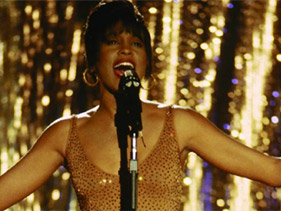
Late singer showed dignity and vulnerability in films like ‘The Bodyguard’ and ‘Waiting to Exhale.’ By Ryan J. Downey Whitney Houston in “Bodyguard” Photo: Warner Bros. Whitney Houston will be remembered for her voice, her hit songs, her charismatic presence. As someone who has spent my life sharing equal passion for music and movies, it’s particularly noteworthy to me that the biggest hit I associate Houston with is intrinsically tied to a film. Judging by the number of “Whitney, I will always love you” tweets from celebrities and fans on Saturday, I’d say I’m not alone in thinking of her big voice mostly in “I Will Always Love You,” which is inseparable from “The Bodyguard.” My late mother was a huge fan of Dolly Parton, who originally wrote and recorded the song that would become a huge hit for Houston on the soundtrack to “The Bodyguard,” in which she starred (years before people ran around saying “meta”!) as a pop singer. The stepmother who came into my life when I was a teenager passed away herself a couple of years ago. The first Christmas present I ever bought for her growing up was a copy of one of Whitney’s albums on cassette, so I experienced a variety of emotions and memories about important women in my life as my Twitter feed blew up with reports of the troubled star’s untimely passing. Nobody knew Houston could act (a bit part on an episode of the corny sitcom “Gimme a Break!” was certainly no barometer) when director Mick Jackson cast her to play Rachel Marron, a singer in need of protection from a stalker, in “The Bodyguard.” Big marquee name Kevin Costner played the title role of an ex-Secret Service agent turned private protector. The two characters, against the odds and against the rule, become more than co-workers as the story unfolds. The movie is cornball, sure, but Houston was quite fun. Lawrence Kasdan, who put his stamp all over my childhood as a writer on “The Empire Strikes Back,” “Raiders of the Lost Ark” and “Return of the Jedi,” reportedly conceived the script in the ’70s as a vehicle for the legendary Steve McQueen and Diana Ross. I was actually at the Grammy Special Merit Awards watching Ross accept a Lifetime Achievement Award when I saw the guy in front of me show his girlfriend a tweet about Whitney Houston’s death, which is how I first learned the news. Perhaps in some roundabout way you could call that my Six Degrees of Kevin Costner with this story. It’s not unusual to look for “signs” and coincidences when we try to process death around us, whether it’s a loved one, acquaintance or a public personality we never knew. “The Bodyguard” had action, romance and behind-the-scenes drama involving the entertainment industry, all of which are some touchtone topics that have followed me in life. I worked part-time in a record store when the movie came out and I vividly remember handling copies of the soundtrack on CD and cassette (remember those?) as patron after patron brought up a copy for me to ring up. The movie, the songs (“I Have Nothing” was no slouch!) and the CD were all intertwined, intermingled, wrapped up together to me. Houston’s performance displayed a certain tenderness combined with an elegant toughness that recalled screen sirens from mid-century. True, she was drawing from some life experience by playing someone so close to her comfort zone. But in 1995, she did it all over again in “Waiting to Exhale” and this time opposite acting heavyweight Angela Bassett (and directed by Forrest Whitaker!). “Exhale” shot straight to #1 at the box office, while Houston’s single from the movie did the same thing on Billboard. Last spring, Bassett did an interview in which she talked about a sequel reuniting the director and stars. Of course, that couldn’t happen now. Too many pop stars, rock idols and rappers trying their hand at acting have made the whole concept a joke to some people. And granted, not every musician who switches gears turns out to have chops (and vice versa in the actors-turned-musician department). But Penny Marshall certainly wouldn’t have put Houston next to Denzel Washington and Gregory Hines in “The Preacher’s Wife” if she’d watched “The Bodyguard” and “Waiting to Exhale” and thought the singer hadn’t pulled off the jobs. The remake of the 1947 film “The Bishop’s Wife” may have included some hokey fantasy elements, but it still became the best-reviewed movie Houston made. Sure, both “Bodyguard” and “Exhale” are “rotten” according to Rotten Tomatoes, which aggregates reviews from major film critics. I’m not going to try to pass either of them off as particularly great films. But “The Bodyguard,” my favorite of the two, is an inoffensive confection that rises above the phrase “guilty pleasure” ever so slightly even after repeated viewings and even after all of this time. There’s no denying Houston’s likability and watchability in all three of her major film roles. She was dignified, strong and yet vulnerable in the sort of way that made you want to sweep her up like Kevin Costner on the movie poster. Houston’s final film, “Sparkle,” is set to be released in August, and indeed, there is nothing the specter of addiction can do to erase her sparkle on the silver screen. We’ll miss you, Whitney. MTV News’ Sway and James Montgomery will be live from the Grammys red carpet this Sunday, February 12 starting at 5 p.m. ET to get reactions from music’s biggest stars on the death of Whitney Houston. Watch Reactions and Remembrances at MTV.com. Share your condolences with Whitney’s family and friends on our Facebook page. Related Videos Whitney Houston: Life And Music Of An Icon Related Photos Whitney Houston: A Life In Photos Related Artists Whitney Houston

Continued here:
Whitney Houston: A Film Fan’s Appreciation

Whitney Houston: A Film Fan’s Appreciation

Late singer showed dignity and vulnerability in films like ‘The Bodyguard’ and ‘Waiting to Exhale.’ By Ryan J. Downey Whitney Houston in “Bodyguard” Photo: Warner Bros. Whitney Houston will be remembered for her voice, her hit songs, her charismatic presence. As someone who has spent my life sharing equal passion for music and movies, it’s particularly noteworthy to me that the biggest hit I associate Houston with is intrinsically tied to a film. Judging by the number of “Whitney, I will always love you” tweets from celebrities and fans on Saturday, I’d say I’m not alone in thinking of her big voice mostly in “I Will Always Love You,” which is inseparable from “The Bodyguard.” My late mother was a huge fan of Dolly Parton, who originally wrote and recorded the song that would become a huge hit for Houston on the soundtrack to “The Bodyguard,” in which she starred (years before people ran around saying “meta”!) as a pop singer. The stepmother who came into my life when I was a teenager passed away herself a couple of years ago. The first Christmas present I ever bought for her growing up was a copy of one of Whitney’s albums on cassette, so I experienced a variety of emotions and memories about important women in my life as my Twitter feed blew up with reports of the troubled star’s untimely passing. Nobody knew Houston could act (a bit part on an episode of the corny sitcom “Gimme a Break!” was certainly no barometer) when director Mick Jackson cast her to play Rachel Marron, a singer in need of protection from a stalker, in “The Bodyguard.” Big marquee name Kevin Costner played the title role of an ex-Secret Service agent turned private protector. The two characters, against the odds and against the rule, become more than co-workers as the story unfolds. The movie is cornball, sure, but Houston was quite fun. Lawrence Kasdan, who put his stamp all over my childhood as a writer on “The Empire Strikes Back,” “Raiders of the Lost Ark” and “Return of the Jedi,” reportedly conceived the script in the ’70s as a vehicle for the legendary Steve McQueen and Diana Ross. I was actually at the Grammy Special Merit Awards watching Ross accept a Lifetime Achievement Award when I saw the guy in front of me show his girlfriend a tweet about Whitney Houston’s death, which is how I first learned the news. Perhaps in some roundabout way you could call that my Six Degrees of Kevin Costner with this story. It’s not unusual to look for “signs” and coincidences when we try to process death around us, whether it’s a loved one, acquaintance or a public personality we never knew. “The Bodyguard” had action, romance and behind-the-scenes drama involving the entertainment industry, all of which are some touchtone topics that have followed me in life. I worked part-time in a record store when the movie came out and I vividly remember handling copies of the soundtrack on CD and cassette (remember those?) as patron after patron brought up a copy for me to ring up. The movie, the songs (“I Have Nothing” was no slouch!) and the CD were all intertwined, intermingled, wrapped up together to me. Houston’s performance displayed a certain tenderness combined with an elegant toughness that recalled screen sirens from mid-century. True, she was drawing from some life experience by playing someone so close to her comfort zone. But in 1995, she did it all over again in “Waiting to Exhale” and this time opposite acting heavyweight Angela Bassett (and directed by Forrest Whitaker!). “Exhale” shot straight to #1 at the box office, while Houston’s single from the movie did the same thing on Billboard. Last spring, Bassett did an interview in which she talked about a sequel reuniting the director and stars. Of course, that couldn’t happen now. Too many pop stars, rock idols and rappers trying their hand at acting have made the whole concept a joke to some people. And granted, not every musician who switches gears turns out to have chops (and vice versa in the actors-turned-musician department). But Penny Marshall certainly wouldn’t have put Houston next to Denzel Washington and Gregory Hines in “The Preacher’s Wife” if she’d watched “The Bodyguard” and “Waiting to Exhale” and thought the singer hadn’t pulled off the jobs. The remake of the 1947 film “The Bishop’s Wife” may have included some hokey fantasy elements, but it still became the best-reviewed movie Houston made. Sure, both “Bodyguard” and “Exhale” are “rotten” according to Rotten Tomatoes, which aggregates reviews from major film critics. I’m not going to try to pass either of them off as particularly great films. But “The Bodyguard,” my favorite of the two, is an inoffensive confection that rises above the phrase “guilty pleasure” ever so slightly even after repeated viewings and even after all of this time. There’s no denying Houston’s likability and watchability in all three of her major film roles. She was dignified, strong and yet vulnerable in the sort of way that made you want to sweep her up like Kevin Costner on the movie poster. Houston’s final film, “Sparkle,” is set to be released in August, and indeed, there is nothing the specter of addiction can do to erase her sparkle on the silver screen. We’ll miss you, Whitney. MTV News’ Sway and James Montgomery will be live from the Grammys red carpet this Sunday, February 12 starting at 5 p.m. ET to get reactions from music’s biggest stars on the death of Whitney Houston. Watch Reactions and Remembrances at MTV.com. Share your condolences with Whitney’s family and friends on our Facebook page. Related Videos Whitney Houston: Life And Music Of An Icon Related Photos Whitney Houston: A Life In Photos Related Artists Whitney Houston

Read the rest here:
Whitney Houston: A Film Fan’s Appreciation