Tag Archives: german

Caesar Must Die Leads Berlinale Winners

Congrats to the Taviani Bros. ( who? ), the inveterate sibling filmmakers whose Shakespeare-in-prison semi-doc Caesar Must Die has claimed the top prize at this year’s Berlinale. Stephanie Zacharek has more about the Golden Bear winner in her review from Berlin — along with more about Barbara , whose own helmer, Christian Petzold, won the festival’s Best Director award. ( Tabu and Sister nabbed hardware as well.) As Stephanie predicted, Caesar Must Die secured U.S. distribution in this week in Berlin and will be Stateside later this year; stay tuned to Movieline for details about how and when you can see it, and read on for the complete list of winners. Congrats to all! GOLDEN BEAR FOR THE BEST FILM Cesare deve morire (Caesar Must Die) by Paolo & Vittorio Taviani JURY GRAND PRIX-SILVER BEAR Csak a szél (Just The Wind) by Bence Fliegauf SILVER BEAR FOR BEST DIRECTOR Christian Petzold for Barbara (Barbara) SILVER BEAR FOR BEST ACTRESS Rachel Mwanza in Rebelle (War Witch) by Kim Nguyen SILVER BEAR FOR BEST ACTOR Mikkel Boe Følsgaard in En Kongelig Affære (A Royal Affair) by Nikolaj Arcel SILVER BEAR FOR AN OUTSTANDING ARTISTIC CONTRIBUTION Lutz Reitemeier for the photography in Bai lu yuan (White Deer Plain) by Wang Quan’an SILVER BEAR FOR THE BEST SCRIPT Nikolaj Arcel, Rasmus Heisterberg for En Kongelig Affære (A Royal Affair) by Nikolaj Arcel ALFRED BAUER PRIZE, awarded in memory of the Festival founder, for a work of particular innovation: Tabu by Miguel Gomes SPECIAL PRIZE-SILVER BEAR L’enfant d’en haut (Sister) by Ursula Meier BEST FIRST FEATURE AWARD, endowed with 50,000 Euros, funded by GWFF Kauwboy Kauwboy by Boudewijn Koole (Generation Kplus) SPECIAL MENTION Tepenin Ardı Beyond the Hill by Emin Alper (Forum) PRIZES OF THE INTERNATIONAL SHORT FILM JURY GOLDEN BEAR Rafa by João Salaviza THE JURY PRIZE – SILVER BEAR Gurehto Rabitto The Great Rabbit by Atsushi Wada SPECIAL MENTION Licuri Surf Licuri Surf by Guile Martins EFA SHORT FILM NOMINEE BERLIN Vilaine Fille Mauvais Garçon Two Ships by Justine Triet DAAD SHORT FILM PRIZE: The Man that Got Away The Man that Got Away by Trevor Anderson PRIZES OF THE JURIES GENERATION Children’s Jury Generation Kplus CRYSTAL BEAR FOR THE BEST FILM: Arcadia by Olivia Silver SPECIAL MENTION: Just Pretended To Hear by Kaori Imaizumi CRYSTAL BEAR FOR THE BEST SHORT FILM: Julian by Matthew Moore SPECIAL MENTION: BINO by Billie Pleffer Youth Jury Generation 14 plus, CRYSTAL BEAR FOR THE BEST FILM: Night of Silence by Reis Çelik SPECIAL MENTION Kronjuvelerna The Crown Jewels by Ella Lemhagen CRYSTAL BEAR FOR THE BEST SHORT FILM: Meathead Meathead by Sam Holst SPECIAL MENTION 663114 by Isamu Hirabayashi International Jury Generation Kplus THE GRAND PRIX OF THE DEUTSCHES KINDERHILFSWERK FOR THE BEST FILM: Kauwboy Kauwboy by Boudewijn Koole SPECIAL MENTION: GATTU by Rajan Khosa THE SPECIAL PRIZE OF THE DEUTSCHES KINDERHILFSWERK FOR THE BEST SHORT FILM: BINO by Billie Pleffer SPECIAL MENTION: L by Thais Fujinaga Competition Panorama Forum Cesare deve morire (Caesar Must Die), by Paolo & Vittorio Taviani Rebelle (War Witch), by Kim Nguyen Die Wand (The Wall), by Julian Roman Pölsler Parada (The Parade), by Srdjan Dragojevic La demora (The Delay), by Rodrigo Plá Tabu (Tabu), by Miguel Gomes L’âge atomique (Atomic Age), by Héléna Klotz Hemel (Hemel), by Sacha Polak PRIZE OF THE GUILD OF GERMAN ART HOUSE CINEMAS: À moi seule (Coming Home), by Frédéric Videau C.I.C.A.E. PRIZE: Death For Sale (Death for Sale), by Faouzi Bensaïdi Forum Kazoku no kuni (Our Homeland), by Yang Yonghi LABEL EUROPA CINEMAS: My Brother The Devil (My Brother The Devil), by Sally El Hosaini Special Mention: Dollhouse (Dollhouse), by Kirsten Sheridan TEDDY AWARDS Keep The Lights On (Keep The Lights On), by Ira Sachs Call Me Kuchu (Call Me Kuchu), by Malika Zouhali-Worrall, Katherine Fairfax Wright Loxoro (Loxoro), by Claudia Llosa Jaurés (Jaurés), by Vincent Dieutre INDEPENDENT JURIES PRIZES OF THE ECUMENICAL JURY MADE IN GERMANY – PERSPEKTIVE FELLOWSHIP, endowed with 15,000 Euros, funded by Glashütte Original Annekatrin Hendel for Disko (Disco) DIALOGUE EN PERSPECTIVE, funded by the German-French Youth Office This Ain’t California (This Ain’t California), by Marten Persiel CALIGARI FILM PRIZE Tepenin Ardı (Beyond the Hill), by Emin Alper Special Mentions Bagrut Lochamim (Soldier / Citizen), by Silvina Landsmann Escuela normal (Normal School), by Celina Murga Jaurès (Jaurès), by Vincent Dieutre NETPAC PRIZE Paziraie Sadeh (Modest Reception), by Mani Haghighi PEACE FILM AWARD Csak a szél (Just The Wind), by Bence Fliegauf AMNESTY INTERNATIONAL FILM PRIZE Csak a szél (Just The Wind), by Bence Fliegauf CINEMA FAIRBINDET PRIZE Call Me Kuchu (Call Me Kuchu), by Malika Zouhali-Worrall, Katherine Fairfax Wright READERS’ JURIES AND AUDIENCE AWARDS Panorama Audience Award PPP – fiction film: Parada (The Parade), by Srdjan Dragojevic Panorama Audience Award PPP – documentary film: Marina Abramovic The Artist is Present (Marina Abramovic The Artist is Present), by Matthew Akers BERLINER MORGENPOST READERS’ PRIZE Barbara (Barbara), by Christian Petzold TAGESSPIEGEL READERS’ PRIZE La demora (The Delay), by Rodrigo Plá SIEGESSÄULE READERS’ AWARD Parada (The Parade), by Srdjan Dragojevic Special Mention Call Me Kuchu (Call Me Kuchu), by Malika Zouhali-Worrall, Katherine Fairfax Wright PRIZE OF THE BERLINALE TALENT CAMPUS SCORE COMPETITION Christoph Fleischmann (Germany) BERLIN TODAY AWARD Rafael Balulu (Israel) for Batman At The Checkpoint (Batman At The Checkpoint) Special Mention David Lalé (United Kingdom) for White Lobster (White Lobster) [via Deadline ]

See the rest here:
Caesar Must Die Leads Berlinale Winners

Berlinale Dispatch: The Taviani Brothers — Who? — Return with a Great Shakespeare-in-Prison Movie

There were many happy faces among critics on Saturday, the third day of the Berlinale. Because despite what I wrote yesterday about the criticism the festival has faced in recent years, particularly in terms of the films chosen for competition, nearly everyone I’ve spoken to thinks this year’s festival is off to a promising start. Of the six competition films that have been screened so far, not one has set any of my random sampling of critic friends howling with derision, or walking around wearing a perpetual scowly-frowny face. When the festival lineup was announced, friends who had to write pregame assessments had a hard time finding even one or two movies that, sight unseen, had the potential to stand out. But on the strength of what we’ve seen so far, it appears that the best of this festival, whatever that might be, will again come from left field, as it did last year with Asghar Farhadi’s A Separation . Not every edition of every festival starts out that way, with a sense of adventure and anticipation. Don’t quote me yet, but we may be onto something special here. We can attribute part of the buoyant mood to the reception of the screening of Paolo and Vittorio Taviani’s Caesar Must Die on Saturday morning. In the late 1970s and early 1980s the Taviani Brothers rode high, on an internationally cresting wave, with pictures like Padre Padrone and The Night of the Shooting Stars . But in recent years, mentioning their name would be likely to elicit a blank stare or a “Taviani Who?” Even though the brothers have been steadily making films in Italy since then, they’ve dropped off the map in the United States, and even at home their profile hasn’t exactly been blazing. But Caesar Must Die may reignite the fortunes of this octogenarian directing team. The picture is stark and alive in its simplicity; rendered mostly in black-and-white, it’s gorgeous to look at — you could practically use it as an illustrated textbook on framing and composition. Caesar Must Die is a sort-of documentary that tells the story of a group of prison inmates — incarcerated at Rome’s maximum security Rebibbia — who mount a production of Shakespeare’s Julius Caesar. Footage from the actual performance frames the picture: In the opening scene, we see a bunch of stubbly, rough-looking guys, wearing simple, stylized costumes that give the whole affair the aura of a children’s holiday pageant, doing some pretty interesting things with Shakespeare’s language. Not all of those things are, in the strict sense, good. But even the “bad” actors among this bunch — and remember, they’re not just nonprofessionals but convicted criminals, for Christ’s sake — contribute to the intense, quiet power of the final work. Most of Caesar Must Die is devoted to watching these men work their way through the material during rehearsal, learning its ins and outs, its dips and dives, and teasing out nuances and details that mean something to them. Sometimes the Tavianis draw the parallels between art and life a little too starkly. We don’t really need to hear the inmates reflecting on how Julius Caesar speaks to them when we can see how, in their proto-method-acting way, they bring every scrap of their experience to rehearsal: They touch each other warily but tenderly; when it’s time for a character to draw a knife, you can tell the actors respect it as both a weapon and a symbol, even though it’s presumably made out of plastic. You can bet these guys know a lot about duplicity and betrayal and power struggles, and they bring all of that to bear as they tangle with this challenging material, and with each other. The most wonderful sequence in this overall very fine picture may be the montage of the actors’ auditions, as they meet with the play’s director – a professional brought in from the outside – and try to impress him with their swagger and capacity for pathos. Many of them have both in spades. Some are awkwardly touching; others come off like they’ve spent too much time channeling Robert De Niro; and some are simply naturals, able to summon that deep-rooted whatever-it-is that makes magic happen in live performance. The picture also features a lovely, haunting Bernard Herrmann-inflected score — in places I could hear shadows of Taxi Driver . When Caesar Must Die eventually shows up in American theaters — and it will — it’s going to be easy as pie for marketing people to sell: An uplifting story about prison dudes finding meaning in art can pretty much sell itself. But even though that line essentially describes what happens in Caesar Must Die , it doesn’t come close to capturing the simultaneously joyous and mournful resonance of the picture. Caesar Must Die is really just about the way art lives on through people, sometimes in unlikely ways. There’s no way to keep it behind bars. Saturday’s press screening of Barbara, from German director Christian Petzold, didn’t draw the same kind of rapturous audience affection that Caesar Must Die did. But then, it’s a very different type of movie. In Barbara , a beautiful but rather blank-faced young doctor – played by the superb German actress Nina Hoss — arrives in a small East German town to take a new job at a tiny hospital. She doesn’t seem too happy to be there, though clearly the doc in charge – Ronald Zehrfeld, who somewhat resembles Brendan Fraser and is equally charming — takes an immediate shine to her. It’s 1980, as the movie’s press notes tell us, though if you go in cold, you probably won’t be able to immediately discern when and where the action is taking place. That’s probably intentional, and the approach works. This isn’t The Lives of Others, where the East-West divide is practically a major character; instead, it’s just a story about people living in constrained (and at times dangerous) circumstances and yearning for something more. Barbara is a drama and a romance, and it’s also laced with dry, delicate humor. There were times when the German members of the audience would laugh at a joke that I couldn’t quite get, and yet Petzold — the director behind the 2007 drama Yella, also featuring Hoss — is such a master of tone and mood that I could feel the vibrations of the movie’s subtle humor, even if I’d be hard-pressed to articulate it. Barbara starts out slow and then moves even slower — but by the end, somehow, it got me in its gentle clutches. Follow Stephanie Zacharek on Twitter . Follow Movieline on Twitter .

Read this article:
Berlinale Dispatch: The Taviani Brothers — Who? — Return with a Great Shakespeare-in-Prison Movie

Berlinale Dispatch: The Taviani Brothers — Who? — Return with a Great Shakespeare-in-Prison Movie

There were many happy faces among critics on Saturday, the third day of the Berlinale. Because despite what I wrote yesterday about the criticism the festival has faced in recent years, particularly in terms of the films chosen for competition, nearly everyone I’ve spoken to thinks this year’s festival is off to a promising start. Of the six competition films that have been screened so far, not one has set any of my random sampling of critic friends howling with derision, or walking around wearing a perpetual scowly-frowny face. When the festival lineup was announced, friends who had to write pregame assessments had a hard time finding even one or two movies that, sight unseen, had the potential to stand out. But on the strength of what we’ve seen so far, it appears that the best of this festival, whatever that might be, will again come from left field, as it did last year with Asghar Farhadi’s A Separation . Not every edition of every festival starts out that way, with a sense of adventure and anticipation. Don’t quote me yet, but we may be onto something special here. We can attribute part of the buoyant mood to the reception of the screening of Paolo and Vittorio Taviani’s Caesar Must Die on Saturday morning. In the late 1970s and early 1980s the Taviani Brothers rode high, on an internationally cresting wave, with pictures like Padre Padrone and The Night of the Shooting Stars . But in recent years, mentioning their name would be likely to elicit a blank stare or a “Taviani Who?” Even though the brothers have been steadily making films in Italy since then, they’ve dropped off the map in the United States, and even at home their profile hasn’t exactly been blazing. But Caesar Must Die may reignite the fortunes of this octogenarian directing team. The picture is stark and alive in its simplicity; rendered mostly in black-and-white, it’s gorgeous to look at — you could practically use it as an illustrated textbook on framing and composition. Caesar Must Die is a sort-of documentary that tells the story of a group of prison inmates — incarcerated at Rome’s maximum security Rebibbia — who mount a production of Shakespeare’s Julius Caesar. Footage from the actual performance frames the picture: In the opening scene, we see a bunch of stubbly, rough-looking guys, wearing simple, stylized costumes that give the whole affair the aura of a children’s holiday pageant, doing some pretty interesting things with Shakespeare’s language. Not all of those things are, in the strict sense, good. But even the “bad” actors among this bunch — and remember, they’re not just nonprofessionals but convicted criminals, for Christ’s sake — contribute to the intense, quiet power of the final work. Most of Caesar Must Die is devoted to watching these men work their way through the material during rehearsal, learning its ins and outs, its dips and dives, and teasing out nuances and details that mean something to them. Sometimes the Tavianis draw the parallels between art and life a little too starkly. We don’t really need to hear the inmates reflecting on how Julius Caesar speaks to them when we can see how, in their proto-method-acting way, they bring every scrap of their experience to rehearsal: They touch each other warily but tenderly; when it’s time for a character to draw a knife, you can tell the actors respect it as both a weapon and a symbol, even though it’s presumably made out of plastic. You can bet these guys know a lot about duplicity and betrayal and power struggles, and they bring all of that to bear as they tangle with this challenging material, and with each other. The most wonderful sequence in this overall very fine picture may be the montage of the actors’ auditions, as they meet with the play’s director – a professional brought in from the outside – and try to impress him with their swagger and capacity for pathos. Many of them have both in spades. Some are awkwardly touching; others come off like they’ve spent too much time channeling Robert De Niro; and some are simply naturals, able to summon that deep-rooted whatever-it-is that makes magic happen in live performance. The picture also features a lovely, haunting Bernard Herrmann-inflected score — in places I could hear shadows of Taxi Driver . When Caesar Must Die eventually shows up in American theaters — and it will — it’s going to be easy as pie for marketing people to sell: An uplifting story about prison dudes finding meaning in art can pretty much sell itself. But even though that line essentially describes what happens in Caesar Must Die , it doesn’t come close to capturing the simultaneously joyous and mournful resonance of the picture. Caesar Must Die is really just about the way art lives on through people, sometimes in unlikely ways. There’s no way to keep it behind bars. Saturday’s press screening of Barbara, from German director Christian Petzold, didn’t draw the same kind of rapturous audience affection that Caesar Must Die did. But then, it’s a very different type of movie. In Barbara , a beautiful but rather blank-faced young doctor – played by the superb German actress Nina Hoss — arrives in a small East German town to take a new job at a tiny hospital. She doesn’t seem too happy to be there, though clearly the doc in charge – Ronald Zehrfeld, who somewhat resembles Brendan Fraser and is equally charming — takes an immediate shine to her. It’s 1980, as the movie’s press notes tell us, though if you go in cold, you probably won’t be able to immediately discern when and where the action is taking place. That’s probably intentional, and the approach works. This isn’t The Lives of Others, where the East-West divide is practically a major character; instead, it’s just a story about people living in constrained (and at times dangerous) circumstances and yearning for something more. Barbara is a drama and a romance, and it’s also laced with dry, delicate humor. There were times when the German members of the audience would laugh at a joke that I couldn’t quite get, and yet Petzold — the director behind the 2007 drama Yella, also featuring Hoss — is such a master of tone and mood that I could feel the vibrations of the movie’s subtle humor, even if I’d be hard-pressed to articulate it. Barbara starts out slow and then moves even slower — but by the end, somehow, it got me in its gentle clutches. Follow Stephanie Zacharek on Twitter . Follow Movieline on Twitter .

See the article here:
Berlinale Dispatch: The Taviani Brothers — Who? — Return with a Great Shakespeare-in-Prison Movie

Our History Makers: Langston Hughes

Read more from the original source:

James Langston Hughes was born February 1, 1902, in Joplin, Missouri. His parents divorced when he was a small child, and his father moved to Mexico. His grandmother raised him until he was thirteen, when he moved to Lincoln, Illinois, to live with his mother and her husband, before the family eventually settled in Cleveland, Ohio. It was in Lincoln, Illinois, that Hughes began writing poetry. Following graduation, he spent a year in Mexico and a year at Columbia University. During these years, he held odd jobs as an assistant cook, launderer, and a busboy, and traveled to Africa and Europe working as a seaman. In November 1924, he moved to Washington, D.C. Hughes’s first book of poetry, The Weary Blues, was published by Alfred A. Knopf in 1926. He finished his college education at Lincoln University in Pennsylvania three years later. In 1930 his first novel, Not Without Laughter, won the Harmon gold medal for literature. Hughes, who claimed Paul Lawrence Dunbar, Carl Sandburg, and Walt Whitman as his primary influences, is particularly known for his insightful, colorful portrayals of black life in America from the twenties through the sixties. He wrote novels, short stories and plays, as well as poetry, and is also known for his engagement with the world of jazz and the influence it had on his writing, as in Montage of a Dream Deferred. His life and work were enormously important in shaping the artistic contributions of the Harlem Renaissance of the 1920s. Unlike other notable black poets of the period—Claude McKay, Jean Toomer, and Countee Cullen, Hughes refused to differentiate between his personal experience and the common experience of black America. He wanted to tell the stories of his people in ways that reflected their actual culture, including both their suffering and their love of music, laughter, and language itself. Langston Hughes died of complications from prostate cancer in May 22, 1967, in New York. In his memory, his residence at 20 East 127th Street in Harlem, New York City, has been given landmark status by the New York City Preservation Commission, and East 127th Street has been renamed “Langston Hughes Place.” In addition to leaving us a large body of poetic work, Hughes wrote eleven plays and countless works of prose, including the well-known “Simple” books: Simple Speaks His Mind, Simple Stakes a Claim, Simple Takes a Wife, and Simple’s Uncle Sam. He edited the anthologies The Poetry of the Negro and The Book of Negro Folklore, wrote an acclaimed autobiography, The Big Sea and co-wrote the play Mule Bone with Zora Neale Hurston. A Selected Bibliography Poetry Ask Your Mama: 12 Moods for Jazz (1961) Collected Poems of Langston Hughes (1994) Dear Lovely Death (1931) Fields of Wonder (1947) Fine Clothes to the Jew (1927) Freedom’s Plow (1943) Montage of a Dream Deferred (1951) One-Way Ticket (1949) Scottsboro Limited (1932) Selected Poems (1959) Shakespeare in Harlem (1942) The Dream Keeper and Other Poems (1932) The Panther and the Lash: Poems of Our Times (1967) The Weary Blues (1926) Prose Good Morning, Revolution: Uncollected Social Protest Writings by Langston Hughes (1973) I Wonder as I Wander (1956) Laughing to Keep From Crying (1952) Not Without Laughter (1930) Remember Me to Harlem: The Letters of Langston Hughes and Carl Van Vechten, 1925-1964 (2001) Simple Speaks His Mind (1950) Simple Stakes a Claim (1957) Simple Takes a Wife (1953) Simple’s Uncle Sam (1965) Something in Common and Other Stories (1963) Tambourines to Glory (1958) The Arna Bontemps-Langston Hughes Letters (1980) The Big Sea (1940) The Langston Hughes Reader (1958) The Ways of White Folks (1934) Drama Black Nativity (1961) Collected Works of Langston Hughes, vol. 5: The Plays to 1942: Mulatto to The Sun Do Move (2000) Don’t You Want to Be Free? (1938) Five Plays by Langston Hughes (1963) Little Ham (1935) Mulatto (1935) Mule Bone (1930) Simply Heavenly (1957) Soul Gone Home (1937) The Political Plays of Langston Hughes (2000) Poetry in Translation Cuba Libre (1948) Gypsy Ballads (1951) Selected Poems of Gabriela Mistral (1957) Translation Masters of the Dew (1947)

Our History Makers: Langston Hughes

J. Cole: 10 Interesting Facts

Read this article:

J. Cole blew up last year, but there’s still a lot the public doesn’t know about him, so here are some interesting facts about him. The good people over at Roc4Life.com generated a list of 10 J. Cole facts: 1.) He was born in Frankfurt, Germany’s fifth largest city. 2.) His mother, Kay Cole is German and is an actress. 3.) J. Cole has worked as a file clerk when in college, a bill collector when he graduated college and also worked at a skate rink in Fayetteville, where he had to dress up as a kangaroo at times, the rinks mascot. 4) When J. Cole got his signing bonus he took care of his New York landlord, a man called Muhammad who allowed him to fall back on his rent while he was waiting to get a deal. Being the true gent he is, J then added a bit extra to the amount he owed. See the rest of the list of J. Cole facts  right here . RELATED POSTS: J. Cole Shoots Video For “Nobody’s Perfect” J. Cole’s “Work Out” Mines Platinum

J. Cole: 10 Interesting Facts

Michelle Obama ‘Is Really Funny,’ Miranda Cosgrove Says

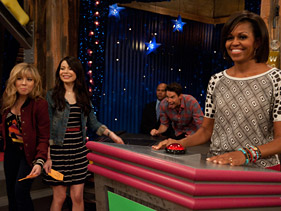
‘iCarly’ star tells MTV News about first lady’s cameo, airing Monday on Nickelodeon. By Jocelyn Vena Jennette McCurdy, Miranda Cosgrove, Jerry Trainor and Michelle Obama in “iCarly: iMeet the First Lady” Photo: Lisa Rose/Nickelodeon Miranda Cosgrove is welcoming her biggest and most political guest star to date on Monday’s episode of “iCarly.” The teen star will be joined by first lady Michelle Obama in a very special episode of the series aptly called “iMeet the First Lady.” The episode, which airs at 7:30 p.m. ET on Nickelodeon, will follow Carly as she prepares to welcome her military dad home for his birthday. When he’s unable to come back from his deployment, the First Lady meets with Carly to thank her for her family’s sacrifice and service. Cosgrove said the idea for the episode came courtesy of Mrs. O herself after watching the show with her daughters. “It was one of the most exciting days in the entire time we’ve been filming the series in the last five years,” she said. “Because there was Secret Service everywhere and there’s just so much preparation for her coming and everybody was so excited to meet her. And then she came to the set and she was really down to earth and fun.” Given that Mrs. Obama is such a rookie when it comes to acting, the young Hollywood heavyweight weighed in on the first lady’s skills, giving her two thumbs up. “In real life she’s really funny, so I think that helped a lot because she just has a really good sense of humor,” she said. “So, she has good comic timing.” While the episode is about Carly’s experience in a military family, the episode really pays homage to all the military families out there. “This is really the best thing we could have done because it’s all about celebrating military families, just really letting all these kids know how important their parents are and how great they are for supporting them,” Cosgrove said. In fact, just to show how much support the show has for these families, the cast has been hosting special screenings of the episode at military bases throughout the country. The last will be held Friday (January 13) near Washington, D.C., at Hayfield Secondary School in Alexandria, Virginia. “It’s been really fun going to all the different military bases and meeting all the families and kids,” Cosgrove said. “They’re the first ones who get to see it … The response has been really good.” And at this last screening, Cosgrave will be joined by her super special co-star. “Mrs. Obama is going to be there and we’re going to get to see her again,” she teased. “And maybe we’ll randomly dance.” Are you excited for the presidential episode of “iCarly”? Let us know below!

Read more here:
Michelle Obama ‘Is Really Funny,’ Miranda Cosgrove Says

Deniz Koyu Talks Quick Rise Into EDM’s Elite

‘I actually got into dance music quite late,’ German producer tells MTV News. By Adam Stewart Deniz Koyu Photo: MTV News One of dance music’s hottest underground names of 2011 is geared up to be one of dance music’s biggest draws of 2012. For those of you who have not been to a show or listened to a proper comp mix in the past six months, here’s your chance to get acquainted with one of the most talented people in the game, Deniz Koyu . MTV News recently sat down with the German producer while he was on tour with Fedde Le Grand, and even he admits that his ascension to the big league is something he never quite expected. “I actually got into dance music and house music quite late, like 18 or 19,” said Koyu, who recently made MTV News’ list of EDM Rookies to Watch . “Before, I was just into anything, pop music and indie pop also. I was also a huge fan of Daft Punk — maybe this is one of my big influences. Then there was this era with all this disco house stuff, which influenced me as well. Then electro house was big for a short period of time, then it went into progressive house. So yeah, I kind of got influenced by all of this over the past five years.” In that short time, Koyu has turned his personal tastes into thump-tastic tunes with some of the most unique and well-produced tracks you’re likely to find. In fact, less than a month ago, Swedish House Mafia showcased three of his tracks at their highly anticipated Madison Square Garden show , more than any other non-SHM artist in their set. If anything, Koyu’s calling card is his ability to avoid being recognized for any one signature thumbprint or production technique, but rather his uncanny ability to produce

REVIEW: Gorgeous War Horse Hits Sweet Spot Between Cornball and Classic

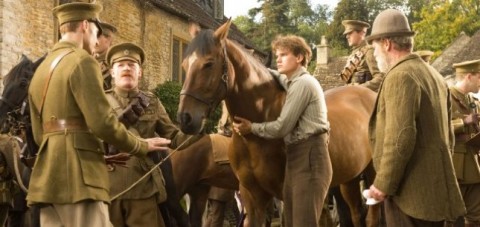
Steven Spielberg’s War Horse is masterly, accomplished, stirring, a real bang-up, show-off job — and watching it, I kept wishing it had been made by someone else, someone younger who hasn’t already proved dozens of times, beyond the point of redundancy, how much he cares about what he puts on the screen. Because Spielberg does care, and not just about the movies he makes himself. His forebears are with him every step of the way: With War Horse he tries on many masks, including those of David Lean, John Ford, Stanley Kubrick and David O. Selznick, just because he’s Steven Spielberg and he can. He wants to be everyone and everything at once: At times it’s way too much, but at others it’s a relief. In an Oscar-grabby end-of-year movie landscape littered with itsy-bitsy fuzzy-wuzzy literary adaptations and colorless apologias for lady monsters (I’m looking at you, Extremely Loud and Incredibly Close and Iron Lady ), why shouldn’t there be room for an old-school road-show picture with crazy-ass classical-filmmaking values? There’s something to be said for just sitting back and delivering yourself into the hands of a guy who creates a dissolve in which a piece of bumpy knitting transforms itself into a rock-strewn, hardscrabble landscape. Who else today would dare? Maybe it’s that unapologetic cornpone aesthetic, even more than all that virtuoso filmmaking, that makes War Horse so engaging. From the moment you see the foal Joey, having only recently squeezed forth from his mother’s womb, finding his matchstick legs on sturdy English soil, you’re either in the game or you’re not. Later, when Joey’s a bit older, he’s bought by an impoverished farmer, Ted Narracott (Peter Mullan), to spite his arrogant landlord (David Thewlis), who also had been eyeing the horse at auction. The purchase is immediately problematic: Joey isn’t a workhorse, which is what Ted and his family, including wife Rose (a half-winsome, half-grave Emily Watson) and teenage son Albert (Jeremy Irvine), need in order to save their failing farm. But Albert has already fallen in love with Joey, who was born and raised on a neighboring property — Albert had long been wooing the horse, discerning in him not just beauty but sterling character. Albert is right, of course: Joey not only helps save the farm, but when war — the Great one — breaks out, he’s sold out from under poor Albert and goes on to endure numerous hardships and touch the lives of everyone who’s lucky enough to stroke his noble, glossy, star-splashed head. Those include a noble but ill-fated English cavalry officer, Captain Nicholls (Tom Hiddleston), a French farmer and his fragile but feisty granddaughter (Niels Arestrup and Celine Buckens), and two nameless soldiers, one English and one German, who momentarily — I kid you not — forget their nation’s differences and reach across the bleak stretches of No Man’s Land to perform the ultimate act of kindness. Will Joey ever make it back to Albert, with whom he clearly longs to be? You can probably guess. But it’s important not to judge the bones of the story until you see what Spielberg does with it. (The script was adapted, by Lee Hall and Richard Curtis, from Michael Morpurgo’s slim, direct 1982 young adult novel. That material has also, of course, been turned into an acclaimed play, with puppets substituting for real horses; Spielberg was inspired to make the film after seeing the play.) This is the kind of excess you can get away with only when you’re Steven Spielberg, and maybe not even then. The filmmaker has surrounded himself with his usual posse, an all-star lineup of crackerjack craftspeople: Janusz Kaminski shoots the craggily gorgeous Devon countryside as if he were looking at it through God’s eyes. At one point he lights Joey in his stable — the character is played by 14 different horses — as if he were the Blessed Virgin on a holy card, a nimbus of gold emanating from his visage. John Williams, who has written some of the most superb scores in modern film but who, like every other superstar composer, is also sometimes guilty of phoning them in, is on top of his game here: The combat footage is heralded by lots of meaty brass and strings, but the most beautiful sections are the more pastoral ones, where the composer channels another Williams (or, rather a Vaughan Williams), Ralph: You can hear traces of the trilling sweetness and delicacy of “The Lark Ascending,” one of the most beautiful and most quintessentially English pieces of music ever composed. For the actors, War Horse is something of a round robin, the action passing from one character to another and only sometimes weaving back again. Spielberg is often too sentimental a director, and there are moments in War Horse that come close to being spongey-soft. But somehow the actors here save Spielberg from his worst impulses: Hiddleston plays that cavalry officer with the kind of slow-burning dignity that’s more archetypal than stereotypical; with his scrubbed-clean skin and carefully pomaded hair, he seems to know what England he’s fighting for, and he dresses the part until the end. Irvine, making his film debut, shows a suitable naïvete tempered by good instincts — he avoids mawkishness, perhaps only narrowly, but it’s a performance that always has mud on its shoes. And Arestrup packs a great deal of unfiltered feeling into the small role of the French grandfather. The bags beneath his eyes are packed with sorrow and happiness and everything in between. In War Horse Spielberg indulges his most melodramatic impulses, and sometimes they lead him astray: He’s a little cheap, for example, in the way he uses animal endangerment and suffering as a pulse point — a sequence in which the camera fixates on Joey’s stumbling leg as he painstakingly pulls an artillery cart that’s far too heavy for him is typical Spielbergian overkill. But melodrama isn’t a dirty word, and Lord knows there are few contemporary directors who know how to do it well, if at all. This movie is also, of course, an extended wartime metaphor, one that’s aware of the costs to both sides: Spielberg shows young, callow German and English soldiers alike, all unaware of what’s about to befall them. And when Spielberg goes big — as he does in the picture’s integral cavalry charge sequence — he does it right, capturing the essence of wartime chaos with clear images and clean cutting. (It’s almost as tense and meticulous a battle sequence as the one the young Branagh gave us in Henry V .) I saw War Horse at a critics’ screening and noted plenty of snickering around me, at the picture’s sometimes too-naked emotion, at its “Look at me, I’m Steven Spielberg!” panoramic landscapes, at the beatific lighting of the equine central character. The downer, of course, is that we already know Spielberg knows how to pull off all of these things well, perhaps better than anyone — now that Lean and Ford and everyone else is dead, it’s as if he feels he has no one to top but himself, and that’s a sad place for a filmmaker to be. But for all its borrowing from old Hollywood, I don’t think War Horse is particularly nostalgic. The word I’d use is wistful . It’s the largest, most lavish handful of wistfulness money can buy, and sometimes it’s too much. Yet it’s nice to know that even Steven Spielberg can still wish for something. Follow Stephanie Zacharek on Twitter . Follow Movieline on Twitter .

More here:
REVIEW: Gorgeous War Horse Hits Sweet Spot Between Cornball and Classic

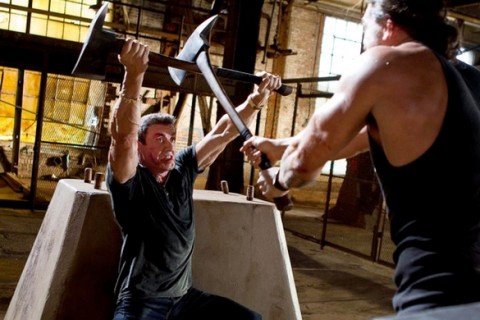
Help Movieline Caption The First Photo of Sylvester Stallone in Bullet to the Head

Sylvester Stallone may be the busiest aging action icon today (sorry Chuck Norris). In between adapting Rocky into German musical format and posing for photos on the set of Expendables 2 , Sylvester Stallone just finished filming Bullet to the Head . The New Orleans-set action movie stars Sly as a musclebound hitman who teams up with a young NYPD detective (Sung Kang) to investigate a pair of murders and naturally, exact revenge on anyone who stands in their way. Fortunately for us, the first caption-worthy photo from Bullet to the Head has arrived.

Read this article:
Help Movieline Caption The First Photo of Sylvester Stallone in Bullet to the Head

Ian Christe: The Mr. Skin Skinterview

Ian Christe is king of the metalheads. We know it’s hard to hear, headbangers, and we’re sure your record collection is appropriately trv, but this guy wrote the book. Literally. His book Sound of the Beast: The Complete Headbanging History of Heavy Metal , first published in 2003, contains over 400 pages of hard-rocking history and has been translated into German, Czech, Finnish, French, Japanese, and Spanish, among others (more on that later). Ian has since translated his incredible knowledge of all things heavy into the popular Sirius Satellite Radio show Bloody Roots , where every week he ” preaches a lesson in heavy metal heritage, with inside stories and tons of rare music from all of metal’s many subspecies,” and Bazillion Points Books , which published Swedish Sensationsfilms earlier this year (read our interview with author Daniel Ekeroth here ) and next year will bring Heavy Metal Movies to life with our own Mike McBeardo . Throw the horns with Ian Christe after the jump!

Go here to read the rest:
Ian Christe: The Mr. Skin Skinterview