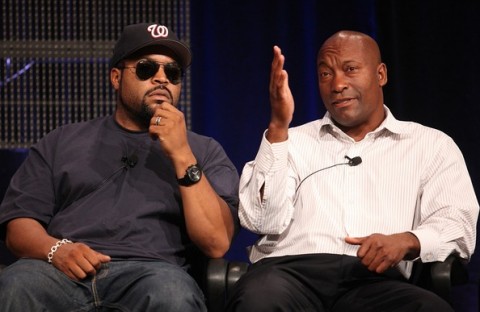
Kudos to John Singleton for speaking up on the growing trend of black films being made in Hollyweird without any input from blacks! Singleton penned a moving essay about the current state of affairs in black film, applauding 2013 as a banner year where great films made by black are being recognized ( Fruitvale Station, The Butler, 12 Years A Slave ), he also gives props to 42 which had a black director at the helm but help from Jackie Robinson’s widow Rachel and a black producer but he points out a problematic trend since the success of The Help — black films being made by whites with zero white input. Here are some excerpts via The Hollywood Reporter : What if the commercial success of “black films” like 42 and The Help, which also had a white director, are now making it harder rather than easier for African-American writers and directors to find work? That is exactly what people in certain Hollywood circles are debating. When I brought up the issue with a screenwriter friend, he replied, “It’s simple. Hollywood feels like it doesn’t need us anymore to tell African-American stories.” The thinking goes, “We voted for and gave money to Obama, so [we don’t need to] hire any black people.” I could go on and on about the white directors who got it right and others who missed the mark. But my larger point is that there was a time, albeit very brief, when heroic black figures were the domain of black directors, and when a black director wasn’t hired, the people behind the film at least brought on a black producer for his or her creative input and perspective. Spielberg did that on The Color Purple (Quincy Jones) and Amistad (Debbie Allen). Tarantino had Reggie Hudlin on Django Unchained . But now, that’s changing; several black-themed movies are in development with only white filmmakers attached, including a James Brown biopic. That’s right, the story of “Soul Brother No. 1, Mr. Say It Loud, I’m Black and I’m Proud” is being penned by two Brits for Tate Taylor, director of The Help. A compelling argument can be made that Brian Grazer, the project’s primary producer, has had multiple successes with black talent such as Eddie Murphy and Denzel. And Mick Jagger also is involved, and the Brits tend to have a greater appreciation for African-American creative culture than most white Americans. Still, it gives one pause that someone is making a movie about the icon who laid down the foundation of funk, hip-hop and black economic self-reliance with no African-American involvement behind the scenes. One of Brown’s most famous lines was, “I don’t want nobody to give me nothing; open up the door and I’ll get it myself.” How is that possible when the gatekeepers of this business keep the doors mostly locked shut in Hollywood? In the black film community, the consensus is that we’re entering a new era of “Al Jolson movies.” Jolson, for the uninitiated, was the star of the first “talkie,” The Jazz Singer in 1927, and is best known for donning blackface and singing “Mammy.” He is an apt symbol for what slowly is becoming the norm in Hollywood. Even when there are black directors or writers involved, some of the films made today seem like they’re sifted of soul. It’s as if the studios are saying, “We want it black, just not that black.” Audiences, though, can smell what’s real and what isn’t. And there is a noticeable difference between pictures that have significant contributions from African-Americans behind the scenes and those that don’t. That’s why I can fully relate to the disappointment some friends feel upon hearing about producers holding meetings on black-themed movies without even noticing that no one in the room speaks the language or intimately understands that world. There are cultural nuances and unspoken, but deep-seated emotions that help define the black American experience. The rhythm and cadence in which we carry ourselves among one another is totally alien to most non-blacks, even if it is a constant fascination to them. In many ways, The Help’s $170 million domestic box office set a new paradigm for how Hollywood wants its black pictures: uplifting, sentimental and inoffensive. It’s no one individual filmmaker’s fault. It reflects the latent racism that influences what gets made and what doesn’t in the studio system. What Hollywood execs need to realize is that black-themed stories appeal to the mainstream because they are uniquely American. Our story reminds audiences of struggles and triumphs, dreams and aspirations we all share. And it is only by conveying the particulars of African-American life that our narrative become universal. But making black movies without real participation by black filmmakers is tantamount to cooking a pot of gumbo without the “roux.” And if you don’t know offhand what “roux” is, you shouldn’t be making a black film. Very well done — the whole piece is worth being read in it’s entirety HERE . What do you think? Is it racist for white filmmakers to make black films without black input?