
Tag Archives: thousand-suns

Linkin Park’s A Thousand Suns: Kid A, All Grown Up?

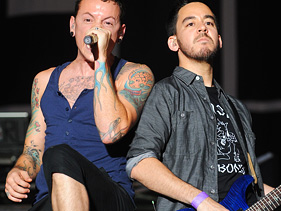
Bigger Than the Sound sees parallels between LP’s ambitious new effort and Radiohead’s seminal album, also a departure when released 10 years ago. By James Montgomery Linkin Park’s Chester Bennington and Mike Shinoda Photo: Flanigan/ FilmMagic According to legend, in August of 2000, a group of clearly terrified Capitol Records executives were outfitted with headphones, loaded into a series of unmarked vans and driven down the Pacific Coast Highway, where they listened to Radiohead’s Kid A for the first time. It was an inspired — not to mention particularly apt — premiere for the album, and though the whole thing is rather apocryphal, it certainly made for nice copy at the time. I only mention that because in August of 2010, a clearly relaxed Warner Bros. publicist sat me down in her office and allowed me one of the first listens to Linkin Park’s A Thousand Suns. There were no headphones or unmarked vans or winding, windswept vistas — budgetary cuts, one can only assume — just an iced coffee and a notepad, which was sort of a shame, because if ever there was an album that deserves the Radiohead treatment, it’s this one. Since, as you’ll probably discover in the coming weeks, A Thousand Suns is most definitely Linkin Park’s Kid A. Well, maybe not technically, but, at the very least, spiritually. Like Kid A, Suns is an album of great ambition and equally great scope, a fearless effort that takes the band to places they’ve never been: darker and doomier places, louder and (in sections) heavier places too. Like Kid A, it is so completely different from the band’s previous efforts that it will almost certainly stand as the line of demarcation between everything that came before and everything that will come after. And, much like Kid A, there just aren’t a whole lot of guitars on it. Instead, A Thousand Suns is washed in ominous electronics, jarring percussion and an unshakeable, unyielding post-millennial tension. The latter is nothing new for the band — their 2007 Minutes to Midnight dealt, in parts, with the politics of George W. Bush and the tragedy of Katrina — but here, they’ve steeped the entire album in a thick coat of dread. It’s a transition underscored in the repeated refrain of “God bless us every one/ We’re a broken people living under loaded gun,” first heard in opening number “The Requiem” and then later on in lead single “The Catalyst.” And in moments like the beginning of “When They Come for Me,” when chirping crickets are gradually drowned out by the sound of artillery, or, most notably, in the use of recorded, world-weary speeches by scientist Robert Oppenheimer, political activist Mario Savio and Martin Luther King Jr. Each of the speeches are appropriately monolithic — Oppenheimer’s famous quoting of the Bhagavad Gita after the first testing of the atomic bomb in 1945, Savio’s terrifyingly prescient “bodies upon the gears” screed in 1964, King’s 1967 lament that the horrors of modern life “cannot be reconciled with wisdom, justice and love” — and it’s telling that they all come from the last millennium. Because, really what A Thousand Suns (which takes its name from Oppenheimer’s speech) is trying to say is that none of these problems, these terrors or these specters that haunt us in 2010 are particularly new. Quite the opposite, in fact. We’ve just chosen to ignore the warnings. And now it might be too late. And that’s another reason it reminds me so much of Kid A. But that’s where the similarities between the albums end. Because rather than hide their fears in a claustrophobic din (as Radiohead did), Linkin Park make the conscious decision to rage against them. They’re not willing to go down without a fight, and it’s in those moments — the massive roar of “Waiting for the End,” the thunderous, squealing “Blackout” (Chester Bennington’s best moment on the album) and the muscle-bound might of “Wretches and Kings” — that the album truly soars. And it bears mentioning that for all its mechanized morose, there are some decidedly uplifting moments too. Most notable among them is “Iridescent,” which starts with just a piano line, then slowly heads skyward on interlocking guitars (they do in fact exist on the album) and explodes in a rousing chorus of “Remember all the sadness and frustration/ And let go.” It all ends with an acoustic-based number, “The Messenger,” which features Bennington going full-bore and culminates in this lyric: “When life leaves us blind/ Loves keeps us kind.” And perhaps that’s the real message of the album, that no matter how far gone things may be, humanity isn’t beyond saving. What separates man from machine is our capacity to love, and despite all evidence to the contrary, there are still things worth believing in. All of that may seem crazy, but Linkin Park seem just insane enough to buy into it. And they want you to as well. After all, at this point, it’s about all we have left. So while A Thousand Suns may be dark, sprawling, discordant, ambitious and an all-out game changer, Kid A it’s not. This one’s optimistic. Linkin Park are performing at the 27th annual MTV Video Music Awards, which will be broadcast live from the Nokia Theatre in Los Angeles on September 12 at 9 p.m. ET. Go to VMA.MTV.com (or text VMA to 97979 if they are Verizon subscribers) to vote for the Best New Artist video through September 12. Related Videos Linkin Park’s ‘The Catalyst’ Premieres Related Artists Linkin Park
Continue reading here:
Linkin Park’s A Thousand Suns: Kid A, All Grown Up?


Linkin Park’s ‘The Catalyst’ Video: Kiss The Past Goodbye

New clip sees LP pushing the envelope even further. By James Montgomery Photo: Warner Bros. Records Linkin Park are probably one of the 10 biggest rock acts on the planet. I mention this mostly because: A) It’s true, and B) It makes everything they’ve done post- Hybrid Theory (their big breakout album) all the more admirable. They have never been afraid to push the envelope and try new things. This is easy to do if you are a band that has nothing to lose, but in LP’s case, it borders on insanity. Their albums are the kinds of things labels schedule their financial quarters around. They’re tent poles (or life preservers) meant to keep things from sagging too low or sinking too deep. The danger of alienating their fanbase is very real, and the results could be catastrophic. Still, with each successive album, Linkin Park push even further into the void, and, in the process, they leave their n

Linkin Park’s ‘The Catalyst’ Video All About Contradiction

The clip conveys ‘something can be beautiful or it can be destructive,’ Mike Shinoda tells MTV News. By James Montgomery Mike Shinoda on the set of “The Catalyst” Photo: MTV News Linkin Park’s much-discussed A Thousand Suns will finally see the, uh, light of day on September 14, bringing to close a nearly two-year process that saw the band push themselves in ways they never thought possible. And, as is the case with most grand projects, things were still being worked out up until the very last minute. Case in point: The video for the album’s first single, “The Catalyst,” which the band shot back in June. In keeping with tradition, the clip was directed by the band’s DJ, Joseph Hahn, but aside from who would be sitting in the director’s chair, there were still plenty of details to sort out including just what they were going to call the song itself. “We are deciding the title as we speak,” LP’s Mike Shinoda told MTV News on the set of the video back in June. “We came in with a title in mind, and changed our minds, and probably by the end of the day, we’ll have a new name for the song.” And while they were still unsure of the song’s title a few months ago, the boys knew exactly the kind of emotions they wanted to convey in its video. Much like the album itself, they were gunning for big, often-contradictory themes: power and grace, destruction and salvation, ugliness and beauty. “The concept to the video: It kind of comes from the idea of, like, if you could imagine when nuclear fission was invented, or a moment in time when something can be used for positive or negative,” Shinoda said. “Something can be beautiful or it can be destructive. Or even, you know, if you’ve ever seen a dangerous fire from far away, it’s devastating up close, but from far away, it can be beautiful. Those are the kind of themes that run throughout the album, and they’re also themes that you see in the video.” “The Catalyst” video premieres at midnight August 25 (technically, the 26th) on MTV.com and VH1.com, and then on MTV, VH1, MTV2, mtvU, MTV Hits, MTV Tr3s and all MTV international territories at 8 p.m. ET/PT on August 26. Are you looking forward to seeing what kind of video Linkin Park created? Tell us in the comments! Related Artists Linkin Park

More here:
Linkin Park’s ‘The Catalyst’ Video All About Contradiction

Linkin Park’s ‘Catalyst’ Video All About Contradiction

The clip conveys ‘something can be beautiful or it can be destructive,’ Mike Shinoda tells MTV News. By James Montgomery Mike Shinoda on the set of “The Catalyst” Photo: MTV News Linkin Park’s much-discussed A Thousand Suns will finally see the, uh, light of day on September 14, bringing to close a nearly two-year process that saw the band push themselves in ways they never thought possible. And, as is the case with most grand projects, things were still being worked out up until the very last minute. Case in point: The video for the album’s first single, “The Catalyst,” which the band shot back in June. In keeping with tradition, the clip was directed by the band’s DJ, Joseph Hahn, but aside from who would be sitting in the director’s chair, there were still plenty of details to sort out including just what they were going to call the song itself. “We are deciding the title as we speak,” LP’s Mike Shinoda told MTV News on the set of the video back in June. “We came in with a title in mind, and changed our minds, and probably by the end of the day, we’ll have a new name for the song.” And while they were still unsure of the song’s title a few months ago, the boys knew exactly the kind of emotions they wanted to convey in its video. Much like the album itself, they were gunning for big, often-contradictory themes: power and grace, destruction and salvation, ugliness and beauty. “The concept to the video: It kind of comes from the idea of, like, if you could imagine when nuclear fission was invented, or a moment in time when something can be used for positive or negative,” Shinoda said. “Something can be beautiful or it can be destructive. Or even, you know, if you’ve ever seen a dangerous fire from far away, it’s devastating up close, but from far away, it can be beautiful. Those are the kind of themes that run throughout the album, and they’re also themes that you see in the video.” “The Catalyst” video premieres at midnight August 25 (technically, the 26th) on MTV.com and VH1.com, and then on MTV, VH1, MTV2, mtvU, MTV Hits, MTV Tr3s and all MTV international territories at 8 p.m. ET/PT on August 26. Are you looking forward to seeing what kind of video Linkin Park created? Tell us in the comments!

View original post here:
Linkin Park’s ‘Catalyst’ Video All About Contradiction





