Tag Archives: ken burns

ARRIVALS: Martin McDonagh Takes On Tarantino With ‘Seven Psychopaths’

If there’s a case to be made that turning one’s dark, twisted fantasies into plays and movies is good for the soul, Martin McDonagh is Exhibit A.  The platinum-haired Irishman has given the world some breathtakingly black comedy, such as his 2003 play about a child serial killer The Pillowman and, as of Friday, the slightly lighter Seven Psychopaths . But if he’s nursing a tortured soul, there was very little evidence of it when I interviewed him at the Toronto International Film Festival in September.  McDonagh, who looks like a character actor from a Bond film, laughs easily when he talks, often at his own wit. He’s also cheekily confident about his writing, which he should be. His 2008 directorial debut, the hitman buddy flick In Bruges  was cinematic poetry, and his bloody but surprisingly deep follow up,  Seven Psychopaths,  easily propels him into Tarantino territory. I smell a Bond film in his future. There’s been plenty written about the plot of the movie, so I’ll get right to the interview in which McDonagh talked about the unwritten film-industry rule that it’s okay to kill women but not pets in movies, his plans to take a break from psychopaths in the near future and why the next project we see from him will likely be another play. Movieline: What a cast you have.  Were they hard to line up?   McDonagh: No, strangely I knew four of the boys from before. Obviously, I know Colin [Farrell], and Sam [Rockwell] and Chris [Walken] and I did a play two, three years ago in New York, A Behanding in Spokane .  Actually, I knew Sam for about five years before we did that. Woody, strangely, I’ve known for about nine or 10 years because he’s a big theater fan. We hooked up in Dublin about 10 years ago and have stayed in touch since. I’d known a couple of the other actors socially. I met Abbie [Cornish] a year or two before and Olga Kurylenko a year or two before. And they were all first choices. With Woody, there was a situation with someone else. He almost did us a favor really because he came in at the last minute and knocked it out of the park. And Tom Waits I knew a little bit before, too.  Chris and Tom have been heroes of mine since I was eight or nine. I got Swordfish Trombones when it came out. I was 11 or so. He’s more than a musician or an actor. He’s an idol and a icon of American letters. I agree. So, to make an offer and have Tom say, “yes” made me go ‘Fuck!  I’m going to have to direct these people!  What am I going to say? I know nothing! [Laughs]    RELATED: McDonagh talks about  revisiting the “creepy fucked-up musical” he was working on with Tom Waits called A Very Dark Matter. The role seem tailor made for each of the characters. Is that a function of  how good a writer you are? Yes, let’s go with that. [Laughs]  None of these parts were written for those boys because the script was written about seven or eight years ago.  It was written just after the script of In Bruges but before I made Bruge . I knew at the time that I didn’t have the wherewithal to make this as my first film because there’s so much going on in it and so many cinematic aspects to it.  I thought it was best to go with something small-scale like Bruges where you have three characters in one town.  It’s almost like a play really. I think it’s a credit to how good they are as actors. They just take it and make it feel like it’s completely natural, as if they’re making this stuff up on the spot. No one talks like Chris. No one breaks up a script like he does. Even with the play we did,  I can’t hear anyone else’s voice in that character ever again.  Unless the next actor broke it up exactly like he did, it would feel wrong,  But, you know, none of that is on the page. Seven Psychopaths is framed by two suicides:  You’ve said this movie is about the deranged and the spiritual, and one of the suicides is deranged. The other is spiritual — a sacrificial statement made in an effort to end violence. But isn’t suicide an act of violence?   No, I don’t. I mean, it’s horrible, but I could never — I guess lots of my heroes went that way: Kurt Cobain, Richard Brautigan, the Beat writer. But yeah, I could never criticize it. It’s terribly sad, obviously, but I guess there’s some aspect of me that finds something honorable about it. For a movie in which a woman gets shot in the stomach and a head explodes, the final scenes are quite surprising.  After all of this outrageous violence and black comedy, it’s quite spiritual and moving. That was the hope: to have all these crazy comic elements but still totally go to that place. I’m glad you felt that way. I kind of feel like we did get there, and I’m happy about that.  It’s a much crazier movie than In Bruges was. Bruges was more simple and funny but melancholic and it’s own thing. But this is a crazy bag of lizards — on fire — that had to be spiritual. [Laughs] I loved Sam Rockwell’s riff on Gandhi’s “eye for an eye” line. [See the trailer below.] Is that something you’ve been thinking about for a long time? No, That just came out on the day when I was writing the script.  I don’t think there’s anything I could have done about it, but the next line — the punch line almost — always gets missed because there’s a big laugh. Sam says, ‘Gandhi was wrong’ but then what gets missed is “but no one’s got the balls to come right out and say it.” I think that would be good to go on a poster. Violence is a big theme in your work.  Where does Gandhi’s pacifism fall into your worldview? I’m a big believer. I just saw Alex Gibney’s   Mea Maxima: Culpa Silence in the House of God, and I was thinking you’d be great to direct a dramatic movie or a black comedy about that subject. Can you make a black comedy about sexual abuse these days?  I think it’s almost impossible, although what’s that one with Phil Hoffman that Todd Solondz did?   Happiness .  It’s black and it’s funny, but fuck. That kind of stuff is just too horrific for me to ever want to fool with.  Stuff like that is just too depressing to even get into. In the movie, Christopher Walken’s character Hans tells Colin Farrell that psychopaths “get tiresome after a while.” Since your work has dealt with quite a few psychopaths, is that you sending a hint that you’re thinking of moving in a different direction? Probably not!  Psychopaths are so much fun to write about.  Like Sam’s character in the film: if he doesn’t know what the fuck he’s going to say or do next, then you don’t.  That’s a joy as a writer.  Although I do want to get away from it a little bit. Gunfights and shootouts are exciting, but I think the next film is going to be much more of a quieter character piece and quite female based. There’s going to be a strong female lead — an older female lead, too. The script is already written. Do you have an actress in mind? Yeah, but I should talk to her first. [Laughs] What else can you tell me about it? I think that all I can say is that there’s a very strong female lead and two other male characters. Do you have a title? It’s convoluted deliberately:  Three Billboards Outside of Ebbing, Missouri You really seemed to be having fun with thriller movie conventions in Seven Psychopaths . Christopher Walken tells Colin Farrell that the his dialogue for women is so terrible. [Laughs] Yes.  I admire that.  My own plays have very strong women characters, so, thankfully, I know that the next movie is going back to strong female leads. I wasn’t accusing you of doing that. Well, you should. It’s true. [Laughs]  The female characters are terrible in this. The actresses are fantastic, but they all die.  They all have only a scene and a half. Rockwell’s character also a cites a rule that “you can’t let the animals die in a movie. Just the women.”  Is that an unwritten rule of movie-making? It is. There were [studio] notes about a gun to a dog’s head and killing or not killing the dog. Not a word about shooting a woman in the stomach.  That’s the way it works. How many dead animals have you seen in the last year in movies?  And how many dead women have you seen?  I know what I’m putting my money on. Did you put that line in before or after the notes?  After. You’ve worked with Colin Farrell twice now. Why do you like him so much as an actor? We have a shorthand — we don’t really have to speak. We hardly saw each other for the three years or so in between films, and when we got together to read the script for Seven Psychopaths at his house, it was like not a day had passed since the last day of shooting. He’s very honest and very open to going anywhere and being truthful. And he’s very supportive. With the last film, I came in not having made a feature before. And he was the star. But every day, he’d help me through it. He’s just a lovely guy as well. Not starry at all. Did you have as much fun off the set as you did on it? It was lovely. Colin drove Sam and I out to Joshua Tree about four or five weeks before shooting because you can sense it if people are playing friends or lovers and there isn’t any kind of chemistry.  So, I wanted to make sure. They didn’t know each other terribly well before the film, so I wanted to make sure that they were both safe with each other. So we went off for a little weekend. And Sam and I drank too much, but we worked through the script in these little cabins in the desert. It was quiet and real and proper work.  But it was also the drive out there. Colin went into a service station and he got Sam that hat he wears in the movie. Right, and the cheese puffs and chocolate milk.  Eating cheese puffs and drinking chocolate milk was Colin’s idea.  Even when we were doing the play, Sam loves acting and eating at the same time.  And there are like ten scenes of him doing that. At the Toronto premiere they had their arms around each other. It sure looked like they had bonded. Yeah, I think they’ve stayed in touch. I’d like to do something with them again, too. And Chris and Sam are the same way. They are really good friends.  I guess the play helped, too.   So, for me, it was just capturing that love and chemistry, and I hope it’s one of the main things that comes through. What’s your relationship to theater right now?  I remember you saying not so long ago that you “respect film and disrespect theater.” I used to say that because it was true. I grew fond of a type of theater that I or Tracy Letts or Mamet or Shepard do.  I was disrespectful of that snooty, shitty English type of theater — or shitty American theater. It’s so expensive and sometimes it exudes that snottiness from the stage. So, that was what I was always fighting against. But I won the fight. [Laughs]  And I’ll keep coming back to it because it’s fun.  It’s also  easier to write a play. Or it was.  I’m going to go off after this and not do anything for a bit and let whatever story comes to me come.  If it’s a play, fine.  The play I did with Sam and Colin was done after making In Bruges . It was very easy to do. The good thing about a play is you can get in and out and do one in the course of six months. A film is two straight years. But I kind of like the fact that, having finished a film, it will be there for good.  Some of the plays I’ve done in the past — as happy as I’ve been with them, or as well as they’ve been received, they’re gone forever. I could never show you Sam and Chris’s performance. It’s just gone. So, there’s that aspect of it. When you say “after this,” do you mean after the next movie you’re making? No, I’m going to be really lazy. [Terrence] Malick was always one of my heroes and not just for the movies themselves. He could just stop for ages.  And now he’s doing the opposite. So we could see a play from you next instead of a movie? Possibly. I think it will probably be the next thing I will write. I’ve probably got two films that are sort of ready to go. And at the same time, I’d like to write something again for all the guys in this film.  Whether it’s a pairing or three of them. When you’ve got a relationship like that, you want to keep  working with them. I’m dying to know. Have you and Quentin Tarantino ever met? No.  Never. That’s interesting.  Given that you share a lot of influences, like Sam Peckinpah, for instance, I’m guessing that you guys would either love each other or hate each other . Yeah. I wonder, too. [Smiles] Follow Frank DiGiacomo on Twitter. Follow Movieline on Twitter.

Visit link:
ARRIVALS: Martin McDonagh Takes On Tarantino With ‘Seven Psychopaths’

ARRIVALS: Martin McDonagh Takes On Tarantino With ‘Seven Psychopaths’

If there’s a case to be made that turning one’s dark, twisted fantasies into plays and movies is good for the soul, Martin McDonagh is Exhibit A.  The platinum-haired Irishman has given the world some breathtakingly black comedy, such as his 2003 play about a child serial killer The Pillowman and, as of Friday, the slightly lighter Seven Psychopaths . But if he’s nursing a tortured soul, there was very little evidence of it when I interviewed him at the Toronto International Film Festival in September.  McDonagh, who looks like a character actor from a Bond film, laughs easily when he talks, often at his own wit. He’s also cheekily confident about his writing, which he should be. His 2008 directorial debut, the hitman buddy flick In Bruges  was cinematic poetry, and his bloody but surprisingly deep follow up,  Seven Psychopaths,  easily propels him into Tarantino territory. I smell a Bond film in his future. There’s been plenty written about the plot of the movie, so I’ll get right to the interview in which McDonagh talked about the unwritten film-industry rule that it’s okay to kill women but not pets in movies, his plans to take a break from psychopaths in the near future and why the next project we see from him will likely be another play. Movieline: What a cast you have.  Were they hard to line up?   McDonagh: No, strangely I knew four of the boys from before. Obviously, I know Colin [Farrell], and Sam [Rockwell] and Chris [Walken] and I did a play two, three years ago in New York, A Behanding in Spokane .  Actually, I knew Sam for about five years before we did that. Woody, strangely, I’ve known for about nine or 10 years because he’s a big theater fan. We hooked up in Dublin about 10 years ago and have stayed in touch since. I’d known a couple of the other actors socially. I met Abbie [Cornish] a year or two before and Olga Kurylenko a year or two before. And they were all first choices. With Woody, there was a situation with someone else. He almost did us a favor really because he came in at the last minute and knocked it out of the park. And Tom Waits I knew a little bit before, too.  Chris and Tom have been heroes of mine since I was eight or nine. I got Swordfish Trombones when it came out. I was 11 or so. He’s more than a musician or an actor. He’s an idol and a icon of American letters. I agree. So, to make an offer and have Tom say, “yes” made me go ‘Fuck!  I’m going to have to direct these people!  What am I going to say? I know nothing! [Laughs]    RELATED: McDonagh talks about  revisiting the “creepy fucked-up musical” he was working on with Tom Waits called A Very Dark Matter. The role seem tailor made for each of the characters. Is that a function of  how good a writer you are? Yes, let’s go with that. [Laughs]  None of these parts were written for those boys because the script was written about seven or eight years ago.  It was written just after the script of In Bruges but before I made Bruge . I knew at the time that I didn’t have the wherewithal to make this as my first film because there’s so much going on in it and so many cinematic aspects to it.  I thought it was best to go with something small-scale like Bruges where you have three characters in one town.  It’s almost like a play really. I think it’s a credit to how good they are as actors. They just take it and make it feel like it’s completely natural, as if they’re making this stuff up on the spot. No one talks like Chris. No one breaks up a script like he does. Even with the play we did,  I can’t hear anyone else’s voice in that character ever again.  Unless the next actor broke it up exactly like he did, it would feel wrong,  But, you know, none of that is on the page. Seven Psychopaths is framed by two suicides:  You’ve said this movie is about the deranged and the spiritual, and one of the suicides is deranged. The other is spiritual — a sacrificial statement made in an effort to end violence. But isn’t suicide an act of violence?   No, I don’t. I mean, it’s horrible, but I could never — I guess lots of my heroes went that way: Kurt Cobain, Richard Brautigan, the Beat writer. But yeah, I could never criticize it. It’s terribly sad, obviously, but I guess there’s some aspect of me that finds something honorable about it. For a movie in which a woman gets shot in the stomach and a head explodes, the final scenes are quite surprising.  After all of this outrageous violence and black comedy, it’s quite spiritual and moving. That was the hope: to have all these crazy comic elements but still totally go to that place. I’m glad you felt that way. I kind of feel like we did get there, and I’m happy about that.  It’s a much crazier movie than In Bruges was. Bruges was more simple and funny but melancholic and it’s own thing. But this is a crazy bag of lizards — on fire — that had to be spiritual. [Laughs] I loved Sam Rockwell’s riff on Gandhi’s “eye for an eye” line. [See the trailer below.] Is that something you’ve been thinking about for a long time? No, That just came out on the day when I was writing the script.  I don’t think there’s anything I could have done about it, but the next line — the punch line almost — always gets missed because there’s a big laugh. Sam says, ‘Gandhi was wrong’ but then what gets missed is “but no one’s got the balls to come right out and say it.” I think that would be good to go on a poster. Violence is a big theme in your work.  Where does Gandhi’s pacifism fall into your worldview? I’m a big believer. I just saw Alex Gibney’s   Mea Maxima: Culpa Silence in the House of God, and I was thinking you’d be great to direct a dramatic movie or a black comedy about that subject. Can you make a black comedy about sexual abuse these days?  I think it’s almost impossible, although what’s that one with Phil Hoffman that Todd Solondz did?   Happiness .  It’s black and it’s funny, but fuck. That kind of stuff is just too horrific for me to ever want to fool with.  Stuff like that is just too depressing to even get into. In the movie, Christopher Walken’s character Hans tells Colin Farrell that psychopaths “get tiresome after a while.” Since your work has dealt with quite a few psychopaths, is that you sending a hint that you’re thinking of moving in a different direction? Probably not!  Psychopaths are so much fun to write about.  Like Sam’s character in the film: if he doesn’t know what the fuck he’s going to say or do next, then you don’t.  That’s a joy as a writer.  Although I do want to get away from it a little bit. Gunfights and shootouts are exciting, but I think the next film is going to be much more of a quieter character piece and quite female based. There’s going to be a strong female lead — an older female lead, too. The script is already written. Do you have an actress in mind? Yeah, but I should talk to her first. [Laughs] What else can you tell me about it? I think that all I can say is that there’s a very strong female lead and two other male characters. Do you have a title? It’s convoluted deliberately:  Three Billboards Outside of Ebbing, Missouri You really seemed to be having fun with thriller movie conventions in Seven Psychopaths . Christopher Walken tells Colin Farrell that the his dialogue for women is so terrible. [Laughs] Yes.  I admire that.  My own plays have very strong women characters, so, thankfully, I know that the next movie is going back to strong female leads. I wasn’t accusing you of doing that. Well, you should. It’s true. [Laughs]  The female characters are terrible in this. The actresses are fantastic, but they all die.  They all have only a scene and a half. Rockwell’s character also a cites a rule that “you can’t let the animals die in a movie. Just the women.”  Is that an unwritten rule of movie-making? It is. There were [studio] notes about a gun to a dog’s head and killing or not killing the dog. Not a word about shooting a woman in the stomach.  That’s the way it works. How many dead animals have you seen in the last year in movies?  And how many dead women have you seen?  I know what I’m putting my money on. Did you put that line in before or after the notes?  After. You’ve worked with Colin Farrell twice now. Why do you like him so much as an actor? We have a shorthand — we don’t really have to speak. We hardly saw each other for the three years or so in between films, and when we got together to read the script for Seven Psychopaths at his house, it was like not a day had passed since the last day of shooting. He’s very honest and very open to going anywhere and being truthful. And he’s very supportive. With the last film, I came in not having made a feature before. And he was the star. But every day, he’d help me through it. He’s just a lovely guy as well. Not starry at all. Did you have as much fun off the set as you did on it? It was lovely. Colin drove Sam and I out to Joshua Tree about four or five weeks before shooting because you can sense it if people are playing friends or lovers and there isn’t any kind of chemistry.  So, I wanted to make sure. They didn’t know each other terribly well before the film, so I wanted to make sure that they were both safe with each other. So we went off for a little weekend. And Sam and I drank too much, but we worked through the script in these little cabins in the desert. It was quiet and real and proper work.  But it was also the drive out there. Colin went into a service station and he got Sam that hat he wears in the movie. Right, and the cheese puffs and chocolate milk.  Eating cheese puffs and drinking chocolate milk was Colin’s idea.  Even when we were doing the play, Sam loves acting and eating at the same time.  And there are like ten scenes of him doing that. At the Toronto premiere they had their arms around each other. It sure looked like they had bonded. Yeah, I think they’ve stayed in touch. I’d like to do something with them again, too. And Chris and Sam are the same way. They are really good friends.  I guess the play helped, too.   So, for me, it was just capturing that love and chemistry, and I hope it’s one of the main things that comes through. What’s your relationship to theater right now?  I remember you saying not so long ago that you “respect film and disrespect theater.” I used to say that because it was true. I grew fond of a type of theater that I or Tracy Letts or Mamet or Shepard do.  I was disrespectful of that snooty, shitty English type of theater — or shitty American theater. It’s so expensive and sometimes it exudes that snottiness from the stage. So, that was what I was always fighting against. But I won the fight. [Laughs]  And I’ll keep coming back to it because it’s fun.  It’s also  easier to write a play. Or it was.  I’m going to go off after this and not do anything for a bit and let whatever story comes to me come.  If it’s a play, fine.  The play I did with Sam and Colin was done after making In Bruges . It was very easy to do. The good thing about a play is you can get in and out and do one in the course of six months. A film is two straight years. But I kind of like the fact that, having finished a film, it will be there for good.  Some of the plays I’ve done in the past — as happy as I’ve been with them, or as well as they’ve been received, they’re gone forever. I could never show you Sam and Chris’s performance. It’s just gone. So, there’s that aspect of it. When you say “after this,” do you mean after the next movie you’re making? No, I’m going to be really lazy. [Terrence] Malick was always one of my heroes and not just for the movies themselves. He could just stop for ages.  And now he’s doing the opposite. So we could see a play from you next instead of a movie? Possibly. I think it will probably be the next thing I will write. I’ve probably got two films that are sort of ready to go. And at the same time, I’d like to write something again for all the guys in this film.  Whether it’s a pairing or three of them. When you’ve got a relationship like that, you want to keep  working with them. I’m dying to know. Have you and Quentin Tarantino ever met? No.  Never. That’s interesting.  Given that you share a lot of influences, like Sam Peckinpah, for instance, I’m guessing that you guys would either love each other or hate each other . Yeah. I wonder, too. [Smiles] Follow Frank DiGiacomo on Twitter. Follow Movieline on Twitter.

Visit link:
ARRIVALS: Martin McDonagh Takes On Tarantino With ‘Seven Psychopaths’

Producer Jason Blum Talks ‘Sinister’ & The ‘Paranormal Activity’ Recipe For Success

Jason Blum had produced a dozen projects before he hit upon 2007’s sleeper phenomenon Paranormal Activity , a micro-indie horror pic with no stars that in turn became the model for Blumhouse Productions, his own genre-leaning multimedia label. Fast forward just five years and Paranormal Activity 4 is set to continue the series’ low-budget thrills (with webcam technology!) next week, while the Blum-produced Sinister , about a writer (Ethan Hawke) contending with a house haunted by insidious forces, opens today. (For a third new venture, The Blumhouse of Horrors, Blum & Co. take over a historic theater in downtown Los Angeles. More info here .) Movieline caught up with the man behind many of the most profitable — and cost-effective — horror hits in recent memory for a peek behind the curtain: What’s the Blum secret to success? What was it that first interested you in Sinister , these filmmakers, and this story – and given your past horror projects, how do you think it fits into your portfolio? I’m super happy with the movie. I think it works because very simply [writer C. Robert] Cargill and [director Scott Derrickson] did a terrific job on it. They first pitched it to me a year and a half ago and the movie they first described to me in my office and the movie you’ll see are very close, they’re virtually the same thing. All I did was give these guys the creative freedom to make what they wanted to make. Your name has been so closely associated with the Paranormal Activity franchise and its success – how do you feel about being known for these particular films? I love genre movies. I’ve made a handful of other ones in addition to the Paranormal movies, and my favorite thing about what Paranormal allowed our company to do is that the company is based on this idea of betting on yourself. That’s what Oren Peli did on Paranormal Activity , that’s what James Wan did on Insidious , and that’s what Scott and Cargill did on Sinister . It’s given birth to all these movies and I’m really pleased that our company is associated with them. I’m really interested in genre, but I’m also doing TV shows and a haunted house in L.A. Having Paranormal and it allowing my company to expand in all things genre, I feel really lucky. Has the Paranormal franchise gotten a bad rap, a reputation it doesn’t deserve? It’s been so successful and the more these sequels charge on the more complaints you hear about found footage, or sequel fever, and all that. I’m sort of proud of the way the franchise has evolved. We’ve taken directors with very specific visions – Kip Williams was a real art house director and Henry and Rel who did 3 and 4 did Catfish . All the directors of the sequels of Paranormal , none of them had ever done genre movies before. And not that we would do that or not do that specifically going forward, but I feel that’s kept it fresh. The way each sequel has built on what’s come before and evolved the mythology has been fresh, but how much can you keep innovating? How much more difficult does it then become to find a new angle for the next one? The cool thing about Paranormal is now we have a real built-in mythology, of the demon and the family that the demon has upset, so it allows for a lot of places to go. And obviously technology changes so fast, so found footage can shift. Paranormal Activity 4 uses Skype webchat technology, which is new to movies – but it was also used recently in V/H/S . I did see that in V/H/S . It’s an interesting coincidence, that both of these films picked up on that same emerging technology at the same time. Sure. And I think I’ve seen it in some other movies too. I think because Skype is becoming so much more prevalent and you’re looking at someone else on a screen it’s going to work its way into movies and TV shows in all different ways, which I think is really cool. Where do you go from there? In this franchise alone you’ve gone through film, video, home movies, now Skype – are cell phone cameras and iPads and the rearview camera on my Prius next? I hope so! I think surveillance, and cameras are so prevalent everywhere that it allows for different possibilities for found footage. I wish I could see the future but I can’t, but I do think that cameras are everywhere now, and they’re so inexpensive. That’s a great thing. I read an interview where someone said “It’s a shame that anyone can make a movie now” and I feel the exact opposite. It’s much less cost-prohibitive… and to answer your question, that will allow Paranormal hopefully to grow and be different each time out. You came across Paranormal Activity early on, and that was a case in which the film was almost curated and then brought into the mainstream consciousness. The idea of discovering a micro-budget independent film and having that platform to bring it to audiences, is that a formula that’s easy to replicate — and is that even your plan at this stage? A hundred percent. I saw Paranormal as a rough cut, but I felt my job on Paranormal and my job on Sinister weren’t wildly different. I’m proud of Sinister because Scott and Cargill did a great job on the movie and I set up a framework for them to make what they wanted to make. They gave me the idea and I figured out how to get it out into the world. Oren did the same thing. I don’t have any aspirations to be a writer or director; I really like identifying a story or a pitch, whether it’s a script or a rough cut of a movie that resonates with me, and trying to get it out into the world. That’s what our company does and that’s what, personally, I’m passionate about. That’s kind of our mission. This is a big question, but: What is the state of horror cinema now, in your eyes? The realm of independent horror and studio-released mainstream horror are divided, with independent original stories balancing against studio-released sequels and remakes. Where do you feel you stand in the grand scheme of it all? I feel the state of horror cinema is the same as it’s been for the last ten or 20 years. When there’s a great horror movie, people are like, “Horror’s back!” And when there’s a series of not so good ones, “Horror’s dead.” I think it’s all about the quality. When there are one or two good horror movies in a row, people come out interested again. I think our company’s specific role is that we straddle both of those worlds. We make all of our movies independently – with the exception of the sequels of Paranormal – but Sinister , Insidious , and the first Paranormal Activity were made completely outside of the studio system but then distribution is through the studio system. Paranormal Activity was the model for what my company does, from that experience. For me, and I can’t speak to other people, it’s the best of both worlds. We get to make these movies with the director’s vision and a singular vision, and to me that’s the definition of an independently made film – it’s one person’s vision. The movies that our company is involved with have the director’s vision, and then we get the great benefit of studio distribution – which no one has figured out a way to compete with. Maybe in five years someone will but at the moment it’s virtually impossible to compete with the studios in terms of distribution. You’ve used the word “independent” to describe your films, but when I think of indie horror I think of the You’re Next and V/H/S filmmakers. They seem to be in a separate camp within the world of indie horror, while you tend to bring in directors from outside the genre community and work with studios. Do you see that as a distinct separation? From a consumer’s point of view I don’t think there’s a separation. You’re Next is going to come out wide from Lionsgate. I loved the movie, I think it’s a terrific movie. I think it’s a very commercial movie. It’s going to be released by a studio and was made independently, so I don’t think from a consumer’s perspective it’s radically different from the movies we’re doing. You have identified something; we tend to work with directors who have a few movies under their belt. You’re opening a haunted house attraction in L.A. – The Blumhouse of Horrors. Where did that concept come from? It’s a great extension of what we’re doing in movies and TV – almost all of our movies shoot in L.A. and we work with the same crews, so we approached the haunted house as if it was a movie production. We got a big crew of people who’ve been prepping for about as long as it takes to prep a movie and we took over a building in downtown L.A. It’s going to be a really cool live experience that’s scary, and hopefully great. That sounds like a clever extension of horror culture, taking it off the screen. But horror cinema has been going increasingly meta in recent years – look at Cabin in the Woods , for example – and it already feels like the serpent is eating its tail. What happens after horror comes all the way full circle ? Boy, I wish I had the answer to that. I just love that people are into it and I’m just really passionate about exploring all different media to scare people, whether it’s a haunted house or a reality show or a scripted show or a movie, it’s a really fun, creative place to be playing in. But what eventually happens… your guess is as good as mine. Follow Jen Yamato on Twitter . Follow Movieline on Twitter .

Read more:
Producer Jason Blum Talks ‘Sinister’ & The ‘Paranormal Activity’ Recipe For Success

Producer Jason Blum Talks ‘Sinister’ & The ‘Paranormal Activity’ Recipe For Success

Jason Blum had produced a dozen projects before he hit upon 2007’s sleeper phenomenon Paranormal Activity , a micro-indie horror pic with no stars that in turn became the model for Blumhouse Productions, his own genre-leaning multimedia label. Fast forward just five years and Paranormal Activity 4 is set to continue the series’ low-budget thrills (with webcam technology!) next week, while the Blum-produced Sinister , about a writer (Ethan Hawke) contending with a house haunted by insidious forces, opens today. (For a third new venture, The Blumhouse of Horrors, Blum & Co. take over a historic theater in downtown Los Angeles. More info here .) Movieline caught up with the man behind many of the most profitable — and cost-effective — horror hits in recent memory for a peek behind the curtain: What’s the Blum secret to success? What was it that first interested you in Sinister , these filmmakers, and this story – and given your past horror projects, how do you think it fits into your portfolio? I’m super happy with the movie. I think it works because very simply [writer C. Robert] Cargill and [director Scott Derrickson] did a terrific job on it. They first pitched it to me a year and a half ago and the movie they first described to me in my office and the movie you’ll see are very close, they’re virtually the same thing. All I did was give these guys the creative freedom to make what they wanted to make. Your name has been so closely associated with the Paranormal Activity franchise and its success – how do you feel about being known for these particular films? I love genre movies. I’ve made a handful of other ones in addition to the Paranormal movies, and my favorite thing about what Paranormal allowed our company to do is that the company is based on this idea of betting on yourself. That’s what Oren Peli did on Paranormal Activity , that’s what James Wan did on Insidious , and that’s what Scott and Cargill did on Sinister . It’s given birth to all these movies and I’m really pleased that our company is associated with them. I’m really interested in genre, but I’m also doing TV shows and a haunted house in L.A. Having Paranormal and it allowing my company to expand in all things genre, I feel really lucky. Has the Paranormal franchise gotten a bad rap, a reputation it doesn’t deserve? It’s been so successful and the more these sequels charge on the more complaints you hear about found footage, or sequel fever, and all that. I’m sort of proud of the way the franchise has evolved. We’ve taken directors with very specific visions – Kip Williams was a real art house director and Henry and Rel who did 3 and 4 did Catfish . All the directors of the sequels of Paranormal , none of them had ever done genre movies before. And not that we would do that or not do that specifically going forward, but I feel that’s kept it fresh. The way each sequel has built on what’s come before and evolved the mythology has been fresh, but how much can you keep innovating? How much more difficult does it then become to find a new angle for the next one? The cool thing about Paranormal is now we have a real built-in mythology, of the demon and the family that the demon has upset, so it allows for a lot of places to go. And obviously technology changes so fast, so found footage can shift. Paranormal Activity 4 uses Skype webchat technology, which is new to movies – but it was also used recently in V/H/S . I did see that in V/H/S . It’s an interesting coincidence, that both of these films picked up on that same emerging technology at the same time. Sure. And I think I’ve seen it in some other movies too. I think because Skype is becoming so much more prevalent and you’re looking at someone else on a screen it’s going to work its way into movies and TV shows in all different ways, which I think is really cool. Where do you go from there? In this franchise alone you’ve gone through film, video, home movies, now Skype – are cell phone cameras and iPads and the rearview camera on my Prius next? I hope so! I think surveillance, and cameras are so prevalent everywhere that it allows for different possibilities for found footage. I wish I could see the future but I can’t, but I do think that cameras are everywhere now, and they’re so inexpensive. That’s a great thing. I read an interview where someone said “It’s a shame that anyone can make a movie now” and I feel the exact opposite. It’s much less cost-prohibitive… and to answer your question, that will allow Paranormal hopefully to grow and be different each time out. You came across Paranormal Activity early on, and that was a case in which the film was almost curated and then brought into the mainstream consciousness. The idea of discovering a micro-budget independent film and having that platform to bring it to audiences, is that a formula that’s easy to replicate — and is that even your plan at this stage? A hundred percent. I saw Paranormal as a rough cut, but I felt my job on Paranormal and my job on Sinister weren’t wildly different. I’m proud of Sinister because Scott and Cargill did a great job on the movie and I set up a framework for them to make what they wanted to make. They gave me the idea and I figured out how to get it out into the world. Oren did the same thing. I don’t have any aspirations to be a writer or director; I really like identifying a story or a pitch, whether it’s a script or a rough cut of a movie that resonates with me, and trying to get it out into the world. That’s what our company does and that’s what, personally, I’m passionate about. That’s kind of our mission. This is a big question, but: What is the state of horror cinema now, in your eyes? The realm of independent horror and studio-released mainstream horror are divided, with independent original stories balancing against studio-released sequels and remakes. Where do you feel you stand in the grand scheme of it all? I feel the state of horror cinema is the same as it’s been for the last ten or 20 years. When there’s a great horror movie, people are like, “Horror’s back!” And when there’s a series of not so good ones, “Horror’s dead.” I think it’s all about the quality. When there are one or two good horror movies in a row, people come out interested again. I think our company’s specific role is that we straddle both of those worlds. We make all of our movies independently – with the exception of the sequels of Paranormal – but Sinister , Insidious , and the first Paranormal Activity were made completely outside of the studio system but then distribution is through the studio system. Paranormal Activity was the model for what my company does, from that experience. For me, and I can’t speak to other people, it’s the best of both worlds. We get to make these movies with the director’s vision and a singular vision, and to me that’s the definition of an independently made film – it’s one person’s vision. The movies that our company is involved with have the director’s vision, and then we get the great benefit of studio distribution – which no one has figured out a way to compete with. Maybe in five years someone will but at the moment it’s virtually impossible to compete with the studios in terms of distribution. You’ve used the word “independent” to describe your films, but when I think of indie horror I think of the You’re Next and V/H/S filmmakers. They seem to be in a separate camp within the world of indie horror, while you tend to bring in directors from outside the genre community and work with studios. Do you see that as a distinct separation? From a consumer’s point of view I don’t think there’s a separation. You’re Next is going to come out wide from Lionsgate. I loved the movie, I think it’s a terrific movie. I think it’s a very commercial movie. It’s going to be released by a studio and was made independently, so I don’t think from a consumer’s perspective it’s radically different from the movies we’re doing. You have identified something; we tend to work with directors who have a few movies under their belt. You’re opening a haunted house attraction in L.A. – The Blumhouse of Horrors. Where did that concept come from? It’s a great extension of what we’re doing in movies and TV – almost all of our movies shoot in L.A. and we work with the same crews, so we approached the haunted house as if it was a movie production. We got a big crew of people who’ve been prepping for about as long as it takes to prep a movie and we took over a building in downtown L.A. It’s going to be a really cool live experience that’s scary, and hopefully great. That sounds like a clever extension of horror culture, taking it off the screen. But horror cinema has been going increasingly meta in recent years – look at Cabin in the Woods , for example – and it already feels like the serpent is eating its tail. What happens after horror comes all the way full circle ? Boy, I wish I had the answer to that. I just love that people are into it and I’m just really passionate about exploring all different media to scare people, whether it’s a haunted house or a reality show or a scripted show or a movie, it’s a really fun, creative place to be playing in. But what eventually happens… your guess is as good as mine. Follow Jen Yamato on Twitter . Follow Movieline on Twitter .

Read more:
Producer Jason Blum Talks ‘Sinister’ & The ‘Paranormal Activity’ Recipe For Success

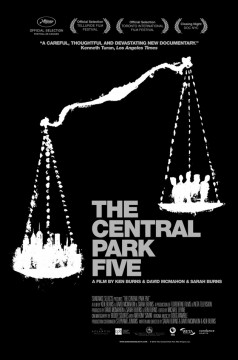
EXCLUSIVE: First Look At Poster For Controversial Ken Burns Documentary, ‘The Central Park Five’

New York City officials are already teed off over Ken and Sarah Burns documentary The Central Park Five — but just wait until they see the poster for the headlines-generating film. The stark, black-and-white image simply, effectively — and immediately — communicates the idea that the scales of justice did not work for the five men  who were convicted and later cleared in the racially charged 1989 Central Park jogger case that rocked the city.  As I reported in early October,   lawyers for the city of New York have subpoenaed notes and outtakes from the documentary, which Burns directed with his daughter Sarah Burns and her husband David McMahon, in order to determine whether the material can help them fight a federal civil rights lawsuit that five men filed nine years ago as a result of their experience. (Each of the five men is seeking $50 million.) The documentary, which was shown at the Cannes, Telluride and Toronto film festivals,  scrutinizes the initial convictions of the Central Park Five — Yusef Salaam, Antron McCray, Kevin Richardson, Raymond Santana, and Kharey Wise — noting, for instance that the five men did not appear to be in the area of the park where the rape occurred, that their DNA was not found on the victim and that their confessions did not jibe with one another’s. As I also reported, the filmmakers are fighting the subpoena .  Sarah Burns told me, “We’re not sure the city can subpoena us because we believe we’re protected by the shield laws” that allow journalists to protect their sources and research. In 2009, on the 20th anniversary of the incident, the lawyer for the five men, Jonathan Moore called their experience “the most racist prosecution that occurred in the City of New York. The city maintains that that cops and prosecutors acted appropriately. “We believe that based on the information that the police and prosecutors had at the time, they had probable cause to proceed, and the confessions were sound,”  a city spokeswoman told the New York Times. Follow Frank DiGiacomo on Twitter. Follow Movieline on Twitter.

More:
EXCLUSIVE: First Look At Poster For Controversial Ken Burns Documentary, ‘The Central Park Five’