Tag Archives: investors business daily

Treasury Draft Docs Vindicate IBD’s 2009 ‘Individual Private Medical Insurance Is Illegal’ Claim

In mid-July of last year, the good folks on the editorial board at Investors Business Daily made the following observations about the version of ObamaCare then under consideration by the House: … Right there on Page 16 is a provision making individual private medical insurance illegal. … the “Limitation On New Enrollment” section of the bill clearly states: “Except as provided in this paragraph, the individual health insurance issuer offering such coverage does not enroll any individual in such coverage if the first effective date of coverage is on or after the first day” of the year the legislation becomes law. So … Those who currently have private individual coverage won’t be able to change it. Nor will those who leave a company to work for themselves be free to buy individual plans from private carriers. The leaked Treasury draft documents ( 83-page PDF ) referred to in an earlier post this morning about employer coverage (at NewsBusters ; at BizzyBlog ) go beyond vindicating IBD by applying the same prohibitions to group coverage, as the following graphic from Page 14 of the document shows: Therefore, effective March 23: Individuals seeking new or alternative coverage can only buy policies that “comply with Affordable Care Act provisions from which grandfathered health plans are exempted.” Groups seeking new or alternative coverage (obviously including new groups) are in the same boat. As shown earlier this morning, any changes beyond trivial to existing group or individual policies will cause those policies to lose their grandfathered status, forcing those plans to “comply with Affordable Care Act provisions.” Thus, those looking to purchase new policies or who make even minor changes to existing policies that lead to de-grandfathering will have three choices: ObamaCare’s specified minimum coverage levels, which are far higher and far more expensive than typical private plans. Coverage that is more generous and therefore even more expensive than ObamaCare’s specified minimum — but not too generous. As commenter Gary Hall at the previous NewsBusters post noted, if one has coverage that is considered overly generous, it will run the risk of being considered a “Cadillac” plan subject to a 60% excise tax. By 2018, when that tax takes effect, the distance between ObamaCare’s high-threshold minimum coverage and where the “Cadillac tax” kicks in may not be very great. A majority of large-employer plans and plans at many small professional enterprises may end up being subject to the tax. Paying the individual penalty for either not buying insurance (for individuals) or not covering employees (for employers). In other words, individuals can’t freely engage in commercial transactions with insurance providers to buy new policies with provisions tailored to their or their employees’ particular needs and circumstances. Entering into a contract that would do so is now illegal, as IBD observed last July. In an editorial five days after its original, IBD stuck to its guns in the face of withering attacks from the establishment media outlets, “backed up” by the likes of FactCheck.org. Their common complaint was, “Well, they will still be able to buy individual insurance through the state-run ‘exchanges.'” But it was clear then and true now that they will only be able to buy coverage there that is at or above ObamaCare’s specified minimums, and in one so-called “marketplace.” In reality, the “exchanges” are the roach motels of health insurance; once you’re forced in, you can never get out. It turns out that IBD was absolutely correct last year. For affected individuals and even groups, there is no real “market” for health insurance. There is only ObamaCare, or something even more expensive. Absent repeal, anything else is outlawed. Cross-posted at BizzyBlog.com .
Read the original here:
Treasury Draft Docs Vindicate IBD’s 2009 ‘Individual Private Medical Insurance Is Illegal’ Claim

Leaked Draft Treasury Docs: Majority of Employer Health Plans Won’t Be ‘Grandfathered’

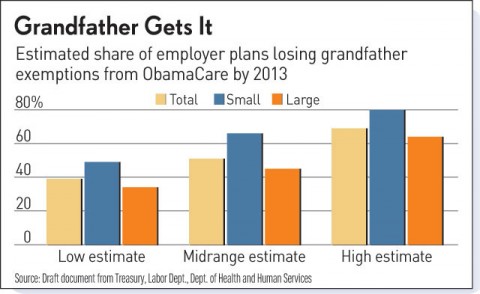
Earlier this year, in his “Can we lose health coverage? Yes we can” column, syndicated columnist Deroy Murdock made a point asserted in dozens if not hundreds of columns and reports during the hide-and-seek legistlative process that ultimately led to the passage of what is commonly known as ObamaCare: The President’s core promise relating to the statist health care legislation that ultimately became law in March — namely that “If you like your health care plan, you will be able to keep your health care plan. Period. No one will take it away. No matter what” — could not and would not be kept. In that column, Murdock quoted Cato Institute analyst Michael Cannon as follows: “Obama’s definition of ‘meaningful’ coverage could eliminate the health plans that now cover as many as half of the 159 million Americans with employer-sponsored insurance, plus more than half of the roughly 18 million Americans in the individual market. … This could compel close to 90 million Americans to switch to more comprehensive health plans with higher premiums, whether they value the added coverage or not.” In a late Friday afternoon blog post followed by a fuller early evening report , David Hogberg and Sean Higgins at Investors Business Daily confirmed that Obama’s never-credible core promise is on the brink of being shattered, and that the employer-related calculations by Cato’s Cannon were essentially correct (graphically illustrated by IBD at the top right): Internal administration documents reveal that up to 51% of employers may have to relinquish their current health care coverage because of ObamaCare. Small firms will be even likelier to lose existing plans. The “midrange estimate is that 66% of small employer plans and 45% of large employer plans will relinquish their grandfathered status by the end of 2013,” according to the document. In the worst-case scenario, 69% of employers — 80% of smaller firms — would lose that status, exposing them to far more provisions under the new health law. …. The 83-page document, a joint project of the departments of Health and Human Services, Labor and the IRS, examines the effects that ObamaCare’s regulations would have on existing, or “grandfathered,” employer-based health care plans. Draft copies of the document were reportedly leaked to House Republicans during the week and began circulating Friday morning. Rep. Bill Posey, R-Fla., posted it on his Web site Friday afternoon. … In a statement, Posey said the document showed that the arguments in favor of ObamaCare were a “bait and switch.” … (A White House) source conceded: “It is difficult to predict how plans and employers will behave in the coming years, but if plans make changes that negatively impact consumers, then they will lose their grandfather status.” … In total, 66% of small businesses and 47% of large businesses made a change in their health care plans last year that would have forfeited their grandfathered status. When one looks at the list of what would cause a plan to get de-grandfathered compiled by Hogberg and Higgins, it’s easy to see why the percentages are so large. The referenced Treasury document (an 83-page PDF ) lays out how employers might react to the new law on Page 36: Page Plan sponsors and issuers can decide to: 1. Continue offering the plan or coverage in effect on March 23, 2010 with limited changes, and thereby retain grandfathered status; 2. Significantly change the terms of the plan or coverage and comply with Affordable Care Act provisions from which grandfathered health plans are excepted; or 3. In the case of a plan sponsor, cease to offer any plan. Option 1 would be nice, but as the IBD reporters noted in the bolded paragraph in the excerpt above, most employers would have run afoul of it during the past year. This means that they would have been forced into Options 2 or 3. Employers choosing Option 2 would have to buy pre-designed and very expensive coverage through the bill’s health insurance exchanges. Employers choosing Option 3 would force their employees to buy pre-designed and very expensive coverage through those same exchanges. If the legislation stands, the end result over a not very long time will be that the large majority of employers and employees will be stuck in the exchanges, the roach motels of health care — Once you go in, you can’t come out. Statist mission accomplished. The Associated Press has noticed the story too, but with the weakest of headlines: “Health overhaul to force changes in employer plans.” The content isn’t much better. Earth to AP reporter Ricardo Alonso-Zaldivar: ObamaCare, as predicted by so many during the previous year by experts most of the establishment press willfully ignored, will cause many employers to drop their insurance entirely. Cross-posted at BizzyBlog.com .

More:
Leaked Draft Treasury Docs: Majority of Employer Health Plans Won’t Be ‘Grandfathered’