If you think his screenplay is implausible , check out Pablo Fenjves’s earlier work: “Fenjves, who lived in Brentwood in the early ’90s, was the person who heard a dog wailing at the time of the murders of Nicole Simpson and Ron Goldman. Even odder, Fenjves found himself years later ghost-writing Simpson’s If I Did It pseudo-memoir.” [ THR ]
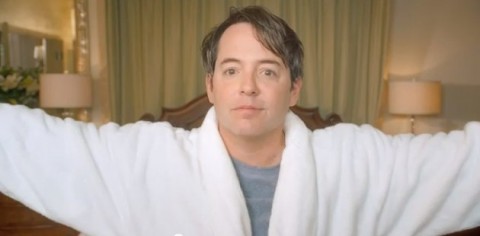
It would be too easy to seethe and writhe with dismay about Matthew Broderick — who’ll turn the big five-O(MG I’m old ) in March — reprising his role as everyone’s favorite truant teen from the ’80s, Ferris Bueller, for Honda. But factor in a 10-second teaser and a few other implications reported this morning, and the spasms of outrage might just ensue involuntarily. Indeed, there is something more than a little destabilizing about a doughy, gray-haired Bueller ripping open his curtains, uttering a midlife-crisis variation on his indelible dictum from the 1986 John Hughes classic Ferris Bueller’s Day Off : “How can I possibly be expected to handle school on a day like this?” The new video’s most optimistic observers wondered, “Sequel?”, while a new dispatch from Jalopnik may prompt a more piercing cry of, “Heresy?” A source familiar with Honda’s operations hinted to us earlier this year that the company was going to do a Ferris Bueller -style ad for the Super Bowl starring none other than Matthew Broderick. The source also added that the spot was going to mimic much of the original film, except this time prominently featuring Hondas. The big jump the two valets do in Cameron’s dad’s Ferrari? We hear this time it’s going to be a Honda CR-V. Honda is pouring a lot of money into this ad and, according to our source, hired The Hangover writer/director Todd Phillips to put it all together. Ah… ha . [Cue prolonged silence] I reached out earlier to both Phillips and Hughes’s family for insights and reactions to the news; neither has yet responded, but as far as I can tell, licensing the Bueller likeness is a two-party process involving Honda and Paramount, so you probably don’t have any legal drama or the like to anticipate. Coaxing Broderick, meanwhile, probably wasn’t too hard but couldn’t have been cheap at all . It’s strange, too — I always thought of Sarah Jessica Parker as the paycheck-part pants wearer in the family. According to the teaser’s YouTube page, viewers can “[s]tick it out until the Super Bowl, or take a ‘day off’ on Monday and catch the big reveal.” Your call. Developing… Follow S.T. VanAirsdale on Twitter . Follow Movieline on Twitter .
Well would you looky who is JET Beauty of the Week this time around??? Spike Lee is JET’s cover star for their upcoming (February 6) issue and inside he gets pretty revealing. Here’s what he had to say about how he found his calling: “I was just standing in the corner, looking out my window and seeing the richness and variety of African-American experience. What I was seeing on television and the diversity of African-American experience was lacking in television and film. And my parents were very progressive. I remember getting a lecture from my mother. ‘Don’t let them tell you that Cleopatra looked like Elizabeth Taylor.’ She really was about re-education.” We’ve been using this guy for great headlines for a minute now, so it was no surprise to hear him admit his work and his opinions have caused him some trouble in his time, check the next page for more excerpts from the story.
Critics give mostly positive reviews to the Liam Neeson’s wolf-punching thriller. By Kevin P. Sullivan Liam Neeson in “The Grey” Photo: Open Road Films For the third January in a row, Liam Neeson returns to kick ass more than any other 59-year-old we know. This time he isn’t taking down sex traffickers like in “Taken” or whatever he was fighting in “Unknown.” No, this time, it’s wolves. For a movie that was sold on the notion of wolf punching, “The Grey” has received primarily positive reviews for its deeper-than-you’d-think story and characters. Check out what the critics are saying about “The Grey.” The Story “We meet Neeson’s character, a heartbroken loner named John Ottway, on the verge of suicide and thinking back, obsessively, to the woman who got away. His demons temporarily quelled, Ottway boards a small plane with his fellow refinery workers and in one of the most nerve-racking flights ever put on film, the aircraft runs afoul of bad weather and crashes. (For a turbulence wimp like me, this scene was not easy.)” — Michael Phillips, Chicago Tribune The Star “Having paid his quality biopic dues as Oskar Schindler, Michael Collins and Alfred Kinsey, Mr. Neeson has, at least for now, turned to the rougher and perhaps more lucrative work of action heroism. It takes nothing away from his earlier achievements to note that he’s really good at it. He conveys a ferocious and absolute seriousness even when the going gets silly, and he finds the soul in each new angry-everyman cipher he is asked to play.” — A.O. Scott, New York Times The Wolves ” ‘The Grey’ is an unrelenting demonstration that wolves have no opinion. When they attack, it’s not personal. They’ve spent untold millennia learning how to survive, naked and without weapons, in fearsome places like the Arctic Circle in the dead of winter. They aren’t precisely unarmed; they have their teeth and claws, but how far would that get us, even if we had rifles?” — Roger Ebert, Chicago Sun-Times The Director “We’ve come, in vain, to see [Neeson] danse-macabre with wolves, and the film’s director, Joe Carnahan, provides the occasional horror-film sneak attack. He also manages to create one of the movies’ more nightmarish plane crashes and conclude with just the sort of ludicrous finale that paying customers who’ve seen the ads might assume they would be getting a whole film of.” — Wesley Morris, Boston Globe The Final Word “For all its macho standoffs and action set pieces and menacing off-screen howling, ‘The Grey’ is at heart a simple moral fable about how true heroism consists in helping other human beings to live as long and die as well as they can, which is, after all, the task all of us face each day, even when we’re not fending off wolves with broken glass duct-taped to our knuckles.” — Dana Stevens, Slate
Joran van der Sloot was sentenced to 28 years for the murder of Stephany Flores, but the killer is hoping to win an appeal and shorten that time dramatically. “He is appealing his sentence and hopes he gets parole in less than five years,” an insider revealed , meaning he could walk out a free man as soon as 2017. He hasn’t won anything yet, but that would be a fraction of the sentence that was handed to him on January 13 after he confessed to the May 2010 killing. The 24-year-old Dutchman’s lawyer, Jose Luis Jimenez, filed an appeal last week claiming that the three judges did not take into account his plea of guilty. After being transferred from a more lenient Castro Castro prison to the maximum security Piedras Gordas, Joran has experienced several health problems: “His health has suffered and he is not doing well there. Joran blames the food and the water, he says that he is depressed and feeling weak all the time.” Hearts are weeping around the world, no doubt. Joran’s home is considered one of the harshest places in the Peru, but many observers likely feel that even a full sentence at Piedras Gordas is not long enough. He is, after all, the prime suspect in the disappearance of Natalee Holloway, who went missing in 2005. She was declared legally dead earlier this month.
‘I’m not Bow; I’m daddy,’ MC tells ‘RapFix Live’ about spending time with his daughter, Shai. By Rob Markman, with reporting by Sway Calloway Bow Wow Photo: Natasha Chandel/ MTV News Becoming a dad changes things. After a lot of rumors and speculation, Bow Wow admitted last year on his website that he had fathered his first child, a baby girl named Shai. At first, the 24-year-old rapper hid the truth because he was “nervous” about how his fans, who have been following him since he first debuted at 13 years old, would look at him. On Wednesday’s “RapFix Live,” Bow (real name: Shad Gregory Moss) had no reservations about opening up about fatherhood. “For me, it’s just the quality time I get. I’m Bow Wow all the time. To the world, I’m Bow Wow. When I leave here and I go to L.A. and I go to my daughter’s house and I sit with her, I feel like Shad. I’m not Bow; I’m daddy,” he told MTV News correspondent Sway. “It’s, like, the illest feeling in the world. I feel like I’m away from everything.” The feeling has even spilled over into the studio. On his upcoming album, Underrated, Bow said he will include “Boy or Girl,” a previously released mixtape track on which he rhymes about being a dad. “The record just hit home, because it was just honest. Right then, I was like, ‘Yo, I have to make honest records. I gotta be more personal, I gotta be more honest,’ ” Bow said. “That’s what music is about.” On January 8, Jay-Z joined the ranks of famous rapper dads when he and wife Beyonc
Some adaptations of great literature become so beloved and important in their own right that it can be hard to separate where the book ends and the movie begins. To Kill a Mockingbird is one of those cases. Released in 1962, two years after Harper Lee’s novel was published, the movie propelled the nationwide discussion on racial inequality and introduced characters that went against the norm yet were easy to relate and aspire to. Scout and Atticus Finch are finding their footing in a challenging environment, not an alien concept for generations of junior high and high school kids who are assigned to read the book. These days, those students might also be shown director Robert Mulligan’s classic film — featuring Gregory Peck in an indelible, Oscar-winning turn as Atticus Finch, a Southern attorney who defends an African-American man unjustly accused of rape — as a complement to Lee’s book. The movie has left an impression on generations of Americans, but two women with a close relationship to it — Peck’s onscreen daughter, Mary Badham, and his actual daughter, the filmmaker Cecilia Peck — found that it steered them into adulthood in a more direct way. (The Atticus role is so inseparable from Peck and his legacy that Badham, herself an Oscar nominee for her performance as Scout Finch, still refers to the actor as Atticus half a century later.) Indeed, an adult revisiting To Kill a Mockingbird will discover a new perspective on the story and its lessons, going beyond the adventures of Scout, Jem and Dill. For Badham and Peck, taking a look back also reveals how Atticus, and the man who played him so perfectly on film, shaped them as adults and as parents. Mockingbird is celebrating its 50th anniversary with a new collector’s edition DVD, due Jan. 31. Movieline caught up with Mary Badham and Cecilia Peck to talk about their memories of Gregory Peck, their affinity for Scout and the influence the film had on them and the nation. What was your relationship with each other at the time, and in the years since? Peck: It’s a family. I was 3, but Mary was like part of the family and has been ever since. Right, Mary? Badham: Yes, she’s the little sister I never had. And, yeah, Atticus was my other daddy. I lost my parents very early in my life. My mom died three weeks after I graduated from high school, and my dad died two years after I got married. So it was nothing for me to pick up the phone, and he [Peck] would be calling to check and make sure I was doing OK. If he was going to be somewhere doing his one-man show, he’d find out if I could come to him, and sometimes he’d come visit me. It was great, and whenever I’m out in California I go visit the family. Atticus and [Peck’s wife, Veronique] were great role models for me as parents, and I just can’t say enough things about what a great role model Atticus was especially. That’s so important for children when they’re growing up, to have a strong male role model. Did you realize at the time of the film’s release how important and beloved the story of To Kill a Mockingbird was? Badham: I had no idea, being all of 9 or 10 years old at the time, anything about the importance of the film at all. Now that I’m an adult, I am so pleased and honored to be a part of something that was so important to so many thousands and millions of people, and that has done so much good in this world. Peck: I had always known that my father was in a great film, and one of the favorite films of all time, and he won the Oscar for it. But for me, when my father was doing that one-man show that Mary mentioned that I filmed for a documentary called A Conversation With Gregory Peck in ’99 and 2000 — and Mary was often there — I heard how many people in the audiences had gone to law school because of Atticus or named their child Gregory or Atticus or named their daughters Scout. It wasn’t until then that I realized how lasting the influence of the film was on our whole nation, or fully became aware of how many generations of people it affected, and still does. Badham: The book is taught in all the high schools. It’s mandatory reading. A lot of my time is spent on the road visiting high schools, colleges, universities, libraries, talking about the importance of the book and the film and doing historical studies of then and when I was growing up, and to now and how it’s pertinent today. Peck: [My son] Harper’s reading it this year, in seventh grade. Badham: There you go! Peck: They’re just starting it. Badham: It’s so great that they teach it. I’ve been to England and Russia with this, and it’s just amazing. It has touched people all over the world. Has Harper seen the film? Peck: Yes, he’s seen the film. He’s seen it ever since he was little, and we all got together and watched it this spring when Mary was in Los Angeles at Grauman’s Chinese Theater as part of the TCM Classic Film Festival. So he was there — which we all were, onstage — and we were all talking about it. I think he does have a sense of what the film means. His school is doing a program on Martin Luther King right now, so reading the book and seeing the film is connected to their studies of the Civil Rights Movement. I think the film, which did come out before the civil rights legislation in our country, and before Martin Luther King’s “I Have a Dream” speech, was one of the ways that allowed people to start the dialogue about racism, which was so important at the time. It was ahead of its time, don’t you think, Mary? It was one of the first films that dealt with that subject. Badham: Exactly. And it gave the nation a way to talk about a subject that desperately needed to be discussed, and people were past ready to talk about it, but they didn’t know how to begin. But this gave them a stepping stone to work through it. That’s the way I understand it. To have a film such as The Help coming out this year, and up for nominations as well — it’s got some nominations for Academy Awards — I really feel it’s interesting that here, 50 years later, we have another film that’s still discussing this. It speaks to so much that’s going on today. To me, the root of all evil is ignorance, and this book speaks directly to the importance of getting an education because ignorance breeds things like bigotry and racism, and all that hatred. We’re still dealing with that, right here in the United States, if we’re talking about Muslims or Mexicans or immigrants, you know, it’s a major deal right now. So we’re still grappling with these issues. It’s just that people have changed their clothes, that’s all. This is not a 1930s black-and-white issue, this is here and now, today. (L-R) Mary Badham, Cecilia Peck and Veronique Peck at a screening of To Kill a Mockingbird in 2011 Do you think the 50th anniversary will shed more light on the film and introduce it to a new generation? Badham: I hope so. Peck: I know the collector’s edition that Universal has put together is such a beautiful gift and keepsake. I don’t know if you’ve seen it yet, Mary … Badham: Not yet. Peck: It’s got great script notes, some of the pages of the script with [Peck’s] notes of shooting, notes in the margin, and there are two documentaries … what else is in there? Harper [Lee] wrote something. My mother wrote something. It’s absolutely beautiful, and just full of treasures. The book, as Mary talked about, is read every year, and the movie is seen every year, but they have a really beautiful new edition coming out. What are each of your relationships with the character Scout Finch, and how would you say it’s changed over the years? Badham: Well, for me, I really feel like Scout was me as a child. I was very much a tomboy. I’ve always been rather outspoken [laughs], headstrong, and I’m pretty much that way to this day. I think that’s why they picked me for the role, and picked each of the actors for their role, because they were, in real life, so much like the character that they would be portraying. Gregory Peck was totally Atticus. I mean, there couldn’t have been anybody else picked for that role. Peck: For me, I think of all the little girls in the world who must have wished that they had Atticus as their dad, being Scout, and I did. And I think my father was so much an Atticus and became even more of an Atticus after playing this role. He parented us exactly like Atticus parented his children, except for the constant presence of his true love, my mother, Veronique. I think I wanted to be Scout, and tried to be like Scout, and look like Scout, too — right Mary? We did look alike … Badham: [Laughing] Yeah! Peck: … and maybe I took on a little bit of that dynamic with him of being a little bit of an outspoken, rebellious daughter, and then getting to have him as a real-life dad. Badham: He was such a proud but gentle daddy. He was the perfect balance, but the best thing about him was he had his sense of humor. Wouldn’t you agree, Cecilia? He loved to laugh and make other people laugh. Peck: Yes, people don’t really know that about him, but he was so witty and so charming, and so much fun to be with. I tried to show that side of him in A Conversation With Gregory Peck, which I did think gave people an insight into how funny he was. Badham: Yeah. Right. I thought you did a brilliant job with that. Peck: He was half Irish, and he had a real Irish wit. Did your view of the Atticus character change as you reached adulthood and became parents yourselves? Badham: I think it made us more mindful of what it is to be a parent. It’s one thing to have children. It’s something else to be a true parent, and the character of Atticus helped lead the way. And we had it in living, breathing reality with him because he embodied that whole sensibility of needing the respect of his children and demanding of himself to be the best role model for us that he could be. Wouldn’t you agree, Cecilia? Peck: Yes. I can’t even separate my dad and Atticus as far as parenting. My dad was extremely strict with us, but also fair and decent, but very strict. I rebelled against it, and we clashed a lot in my teenage years and I felt misunderstood, but now I’m exactly like he was. Badham: [Laughs] Peck: [Laughing] You have to set boundaries when you’re a parent, and you don’t always understand it as a teenager, but it’s so important for the parent to draw the line. How else does your child know where the boundaries are? Badham: And that’s where they find their safety. I’ve heard the saying that to say “no” is the most loving thing that you can say to your children. To Kill a Mockingbird doesn’t shy away from difficult subjects. How did your parents guide you during the making of the film, and what impression did that have on you? Peck: I think it’s a film that exists on so many different levels that you’re able to understand what you’re able to at the time of seeing it. I know that when I was little I was drawn toward the father-daughter story and the Boo Radley story, but I didn’t understand everything about the trial. So it is a movie about parenting as well, about Atticus being a single parent, as well as the issue of racism and the issue of abuse, or rape. I don’t think that my dad addressed that, or my mom, before we were ready to understand it. That’s something I came to later, and now I’m actually doing a documentary on the subject of rape, so it’s definitely something that’s been part of my awareness, and I think as a parent it’s one of the most important subjects to address. I think you get from the book and the film what you’re ready for at the time. Badham: I would agree with that. I don’t think there was any discussion on that subject. It was sort of a larger question of good against evil. And what I found with this book and this film is I have a lot of parents come to me and they say, “I just don’t know if my child is ready for that.” And I say, well, you as the parent are the only one who can judge that, and a lot of times you don’t need to worry about that. Children are going to take away from it what they want to. Most of the time, children concentrate on what the kids are doing in the film, and the trial stuff just goes by the way. So, you know, and then adults focus on the trial because that’s more the adult thing. I think that’s the way our parents approached it. If we didn’t ask, they didn’t talk about it because there was no need to. We weren’t concerned about it. Even as you were making a movie that dealt with issues so straightforwardly? Peck: Scout doesn’t know, sitting on that balcony, exactly what Tom is accused of, right? Badham: Right. I mean, Atticus said it so simply, you know, it was the carnal knowledge of a woman. OK, well, fine. A child back then was so innocent. They had no clue about any of that. What they knew was that this person accusing Tom Robinson was a very bad person. He was a very ignorant, mean person. And what the children were more concerned about was that Atticus was going to try and help Tom, who was innocent, and make everything all right. And then they’re just totally devastated when he doesn’t win. But Atticus knew he was going to lose — and that’s part of the lesson of life. You don’t always win, but you have to try. The 50th anniversary edition of To Kill a Mockingbird arrives Tuesday, Jan. 31, on DVD and Blu-ray. [Photos: Getty Images]
Joe Carnahan ’s thriller The Grey , currently receiving kudos for its blend of red-blooded action and considered existentialism, tells the fictional tale of a group of oilrig workers who survive a plane crash only to be hunted by wolves in the wild. Among the ragtag band of comrades facing off against nature under Liam Neeson ’s steady leadership is Dermot Mulroney’s Talget, who, like the others, learns to shed his protective layers and confront his own fears when forced to face off directly with Mother Nature. For Mulroney, The Grey represents a kind of muscular, male-driven pic that no longer gets made often enough. In a conversation ranging from the film’s throwback sense of masculinity to his reasons for joining Carnahan & Co. on the unusually brutal shoot (the cast and crew filmed in snowy, sub-zero conditions for months in Canada), Mulroney spoke candidly about how much the landscape has changed for him as an actor since he burst on the scene in the ‘80s, why he was happy to be in a film with no women, and how his first time on the other side of the camera (directing last year’s Love, Wedding, Marriage , which he describes as “a badly made movie”) turned him away from directing, at least for the time being. Liam Neeson aside, you’re probably the most recognizable cast member in The Grey even though you’ve been hidden under layers of clothing and those glasses. How much consideration went into the conception of how your character looks ? I can’t say that wasn’t deliberate but that wasn’t necessarily my idea. It was in conjunction discussing it with the director, Joe [Carnahan], who saw my character as someone who has kind of receded under his protective layers whether it’s the hat and the glasses and the beard and the scarf and all this, and then slowly as the movie progresses some of those layers come off. I hope that we pulled that off. That was his goal; he was so specific with character. What appealed to you about joining this ensemble pic and working with Joe Carnahan? But even from his screenplay, really, is what hooked me, and obviously the opportunity to work with him and Liam. You know, I love to work – I still love to work – and I’d go anywhere for something good like this. It turns out I was going to northern British Colombia in sub-zero temperatures and blizzard conditions… It seems like it was an unusually extreme scenario for a film shoot! But your cast mates have described Joe as having picked a disparate group of actors who somehow shared a specific quality, a like-mindedness about the project, that made it all worthwhile . Very much so. I don’t know what it is that Joe has to be able to do that, but my understanding is that he’s done that with all of his films – he’s handpicked people that have something, as you say, other than the fact that they were right for the part. They’re also the right man that he wants to have on the experience. He wants to experience . What Joe Carnahan loves to do more than anything at all is shoot a movie, so he wants to do it with people that are also going to enjoy it and make it more enjoyable for him. So he’s not just picking actors, he’s kind of picking future friends. Were you acquainted before the film? I’d never met him before! I walk in to audition and I can tell he’s a helluva guy and that I would enjoy his company – but I think he’s actually casting for that as well. He’s casting not only for the film, but for the steak dinners after work, you know? In a way, he was. And really what I’m describing is his ability to intuitively “get” what people would have to offer, and the thing that he was determined to achieve was to get guys who were willing and able. You know, as actors we’re of course all willing, but I don’t think all of them would’ve been able to take on those extreme conditions. I couldn’t believe that you all went into those freezing climes to shoot; word is Joe got frostbite out there at one point. I know Dallas [Roberts] got frostbit on the nose, and I think Joe Anderson got some fingertips… this is, like, angry cold. This is all-the-way cold! But as an actor, your body – your fingertips, your nose – is your livelihood! That seems like a risk to take for a film. Oh, I hadn’t even thought of that! I didn’t suffer any ill effects from the cold. [Laughs] I have good circulation, so… and everybody else handled it great, too. It certainly was never life-threatening, but it never occurred to me that it might somehow affect my ability to make a living. So when you signed on to The Grey , you were signing on not only to a film but to having an extraordinary experience . We were signing on not only to an extraordinary experience but to risk, but a lot of guys would have. These were parts that a lot of people wanted, for the quality, for the personnel, for the content, but also the same as Joe – for the experience of getting to do something like this. I’ve done a lot of movies on stages, and sets, in a house, around a dining room table, sitting in a thing, going to the dance, all that – wonderful. But how often does somebody say, ‘Hey – do you want to go up further than you’ve ever been and stand around in the cold with me for a couple of months?’ For me, I had just come from a movie called Big Miracle which comes out next month where there, too, we were shooting in Anchorage, Alaska and it was cold and dark. I’m guessing Drew Barrymore did not get frostbite on her nose. She did not get frostbite, but she did get in freezing cold water! In a wetsuit, for real – she did it all. Nobody complained and nobody got hurt, and even Kristen Bell, who’s as big as this, pulled off standing around all day in zero degree temperatures. Looking at the themes in The Grey , we’re in an era where metrosexuality has become a thing and more masculine stories and themes are something of another generation. The characters, not just Liam’s but all of them, are different shades of… Grey? Yes, in many respects. But moreso these guys seem to represent a spectrum of what it means to be a man, or to come to terms with your own masculinity and mortality, when faced with this kind of life or death situation. I think that’s a wonderful diagram of the film. I hadn’t quite tapped into that myself. If I were to try to get to the bottom of what character I was playing, my idea for Talget was that he’s the mother of the group. He’s the little old lady with the babushka and the thing and ‘Come on,’ because they already have a natural leader or father type, they already have a hotheaded adolescent with Diaz, and they have a knowledgeable wise grandparent type with Henrik. Where’s the mother? So I kind of filled that slot. That doesn’t answer your masculinity question because I’d much rather be accused of being testosterone-fueled than being a little old lady, but by the same token if you’re looking at each of these characters as a facet of what manhood is, then part of what manhood is, is your mother. But that’s okay! It’s only when these guys strip away their machismo that they are able to be emotionally honest with each other. Right. [Pause] There a couple of scenes in Jaws when the shark goes out of the movie, and you don’t really get a great look at that shark anyhow, much like this movie. But then they’re sitting in that boat and they’re just talking, and Shaw goes into this whole thing about the Indianapolis and it’s this incredible moment, an historical moment in the history of our cinema. So you say this movie has some throwback qualities, or some old school manly-man qualities; that’s intentional. That’s the kind of movie Joe wants to make. Joe is one of those guys. So, guilty as charged on that; if that’s something that needs to be brought back, then let’s bring it back. It seems like people are responding to that about this movie and to my mind there haven’t been enough of them. The pendulum swung the other way since I started in this business and there were men’s movies like whatever those Tom Cruise movies… The meaty ‘80s, yes. Yeah. And then all of a sudden Sigourney Weaver comes in the Alien and we have strong women, we have Working Girl , we have all this, we have Best Friend’s Wedding , and before you know it, all the fucking movies are about the girls! Do you really think so? I do! I do. The ones that I was asked to be in, for certain. All of them. So that’s kind of what I did for a while, and every once in a while I’d get this sweet relief of being in a movie like [ The Grey ], where there are no girls in it, there are no women in it – Nobody vying for your affections… Nobody’s vying for anybody’s affections in this movie, that’s right. [Laughs] That’s one relief right there. Aren’t we kind of tired of the vying for affection in the American cinema? Well, let me ask you this — [Laughs] I know, it’s tough because “wry” doesn’t really come across in print, but you put that on the website and we’ll see how that flies. “Too many ladies in the movies for a while there.” No! I think it’s interesting you say this, given your directorial debut, Love, Wedding, Marriage . Yeah, and it couldn’t be a more womanly movie, right? Let’s skip it. Change the topic. I am interested in your directing impulses… I’m not, so much. Did you get it all out in that one film? No, it just didn’t go very well. If I ever tried again I’d do it alarmingly differently. Why so? I don’t even want to talk about that movie, to be honest with you. I don’t think it’s a very clean segue, either, from masculine guy in The Grey to director of a badly made movie. It’s only that the types of movies that they are, are interesting in juxtaposition. I like movies like The Grey to view and to act in a lot more than I like movies like that. The Grey is in theaters Friday. Follow Jen Yamato on Twitter . Follow Movieline on Twitter .
Drake and Spike Lee among MTV News’ favorite sit-downs at this year’s Sundance Film Festival. By Josh Wigler, with additional reporting by Josh Horowitz and Sam Hendrick Rashida Jones and Andy Samberg Photo: MTV News The Sundance Film Festival is still raging on in Park City, Utah, but the MTV Movies team is back home safe and sound after a weeklong journey filled with movie screenings and high-profile interviews. If you’re interested in hearing about the films that caught the most buzz at Sundance this year, never fear: We’ve got you covered. But there’s more to enjoy at Sundance than just the movies themselves; there are also interviews with countless actors, filmmakers, musicians and other stars for you to chew on. From the absurdly hilarious to the cool and informative, here are our favorite interviews conducted by MTV News at Sundance this year: 5. AnnaLynne McCord It was the nip slip heard ’round the cyber-world. Weeks ago, “90210” actress AnnaLynne McCord inadvertently posted a photo of herself on Twitter that revealed more than she bargained for. But lest you think she’s embarrassed about the overexposure, think again. “The moral of the story is not to stop taking pictures of yourself naked,” she told MTV News. “We all like being naked. Just make sure that the little bit of your areola isn’t in the picture before you send it to a hundred billion people.” 4. Andy Samberg and Rashida Jones The stars of “Celeste and Jesse Forever” tackle uncomfortable but often funny subject matter in their Sundance indie. In real life, the situation isn’t so different. Samberg and Jones are both hilarious in their regular “SNL” and “Parks & Rec” gigs, and in person, the laughs are there as well — even when it comes to a topic as uncomfortable as Lana Del Ray’s “SNL” collapse . “People gave her a lot of crap. I saw it online. BriWi,” he said when we asked about the incident; BriWi, of course, refers to “NBC Nightly News” anchor Brian Williams’ critique of the performance. Try watching the veteran newsman without thinking of him as “BriWi” again. It’s just not possible. 3. Spike Lee The New York filmmaker brought Brooklyn to Park City with his new film “Red Hook Summer,” a spiritually charged drama that takes a dark and unexpected turn before the credits roll. The movie hasn’t been kindly received by all critics, but regardless of reception, Lee’s thought process behind the film was a revelation to hear. “We wanted to make a film about young black kids like ‘Stand by Me,’ ” he said. “I love that film. Where’s the people-of-color version of that film? I’m not saying this is it, but that’s the type of film. … I want to see that. [Writer] James [McBride] and I wanted to see this film in a theater. We wanted the world to see these characters in this isolated part of Brooklyn, Red Hook.” 2. Drake Battling tigers is not always easy. But when you’re Drake, it’s always awesome. The Toronto MC performed at Sundance and spoke with MTV News ahead of the gig, recounting his recent trip to Africa, during which he did battle with a true-blue tiger. We kid you not. “I went on a safari. I got tackled by a tiger. It was crazy,” Drake recounted for MTV’s Sam Hendrick, who mustered the only response humanly possible to such wild and crazy news: “That’s dope!” Co-signed, Sam. 1. Paul Giamatti MTV Movie Brawl 2012 came to a close during our time at Sundance. With hours to go before the polls closed, David Cronenberg’s “Cosmopolis” clinched the win with an absolutely insurmountable lead. One of the film’s many stars, Paul Giamatti, was on the ground in Park City and was happy to accept the top honor on the “Cosmopolis” cast’s behalf. “Holy cow, that’s astounding!” he said upon hearing the news. “The fact of that is amazing. … That’s a really cool thing that it brings that visibility to that movie.” Bonus: Tim Heidecker and Eric Wareheim Perhaps the greatest of all the interviews we enjoyed at Sundance is one we have yet to unveil: our conversation with the absurd duo behind “Tim and Eric’s Billion Dollar Movie.” We cannot verify the film’s actual budget, but our interview with Mr. Heidecker and Mr. Wareheim is worth at least a billion bucks. You’ll see it soon, but for now, some out-of-context teasers: Will Forte. “Filet of fish, no bun.” “Back to you.” If it doesn’t make sense yet, just wait — it’ll be even less clear when the insanity-fueled interview hits the Web. Stay tuned … Stick with the MTV Movies team as we roll out more coverage from the Sundance Film Festival ! Related Videos Sundance 2012: Interviews From Park City Related Photos Celebrities Hit The Ground At Sundance 2012 Film Fest Sundance 2012: Behind The Scenes Photos