Tag Archives: storytelling

REVIEW: Jeff, Who Lives at Home Finds Moments of Grace Amid Forced Cosmic Coincidences

You have to admire the chutzpah, if not necessarily the filmmaking skills, of Jay and Mark Duplass, the duo behind the stay-at-home-son comedy-drama Jeff, Who Lives at Home . With their 2005 debut, The Puffy Chair , the Duplass brothers took an uninteresting story fleshed out with lackadaisical dialogue and, using barely rudimentary camera skills, fashioned a noodly tale about love, life and relationships. It’s easier, maybe, to admire the Duplasses’ boldness more than the actual product, but you have to say this much for them: They sure do keep moving. Jeff, Who Lives at Home is the duo’s fourth feature, and if their sense of craftsmanship hasn’t grown by leaps and bounds in the past seven years, it has surely improved. Which raises the question: At what point do we stop applauding the Duplass brothers for their gumption and stick-to-itiveness and admit that, maybe, their storytelling just isn’t so hot? Or that their characters sometimes seem more like groovy-cute constructs than believable people? For example, the protagonist of Jeff, Who Lives at Home , played by Jason Segal, believes that everything and everyone in the universe is interconnected. Why? Because he keeps watching M. Night Shyamalan’s Signs over and over again. In the movie’s prologue, we hear him in voiceover as he writes in his diary, “It keeps getting better every time I see it.” Even if the movie’s title didn’t give it all away, you could probably guess that’s a setup for a story about a schleppy 30-ish guy who still lives at home with his mother (in this case, Susan Sarandon) but who will somehow find his purpose in life – his own sense of interconnectedness – during the course of the movie. And you’d be right. The whole conceit feels a little too manicured, too neat, even though the filmmaking around it is still pretty Duplassy – in other words, its earmarks are lots of (somewhat) shaky handheld camera moves and a decidedly uncinematic sense of composition. But there is, at least, a story here, and Jeff, Who Lives at Home suggests that the Duplass brothers really do want their movies to be better and better. Like the duo’s last movie, the 2010 Cyrus , Jeff deals with an adult son who isn’t, for vague yet understandable reasons, quite equipped to live in the real world. Sarandon’s Sharon, hoping to give him at least some purpose in life, just wants him to help out a little around the house – she sends him on a mission to buy some wood glue to repair a cupboard door’s broken slat. Jeff heads out to the store via bus, gazing out the window in a state of semi-wonder as it makes its way past some of the nondescript gas stations and fast-food eateries of Baton Rouge. He never makes it to the store: A mishap surrounding his certainty that the name “Kevin” is somehow of cosmic significance leads him into contact with his estranged brother, Pat (Ed Helms), whose wife, Linda (Judy Greer), has just given him the gate for being a fiscally irresponsible loser. (She seems to be right.) Jeff and Pat forge a tentative reconnection, reminiscing about their dead father and gradually – perhaps too gradually – wending their way toward a climax that gives real meaning to their lives. There’s some genuine sweetness in this story: Jeff may be a clueless galoot who overthinks everything, but he’s really searching for something here, and as Segel plays him, he does have a degree of lumpy charm. But even though much of the dialogue in Jeff is improvised, there’s still something deeply calculated about the picture: It has the distinction of feeling unshaped and sloppy and at the same time meticulously planned out in terms of what it’s asking us to feel. The picture demands that we feel protective of Jeff, and so we do. But we’re also supposed to find it gratifying when Jeff learns that the signs he’s learned to read by watching Signs really are signs. How you feel about the ending of Jeff, Who Lives at Home will depend on your capacity for cosmic delight, but I will say that one man’s date with destiny is just another man’s handy plot device. still, there’s one area in which the Duplasses’ instincts serve them well: The movie features a subplot in which Sharon learns she has a secret admirer at work. She’s pleased and flattered, but she has no clue who it is, and she shares her flutter of confusion with her co-worker and friend, Carol (played, with marvelous suppleness and grace, by Rae Dawn Chong). Everything Sarandon does here feels believable and natural — that’s in addition to the fact that she looks lovely, like a woman who’s happy to be living in her own skin instead of trying to shape it into a mask. She’s the kind of actress who can do a lot with a little, and it’s a pleasure to watch the way small gradations of feeling play across her face like the shifting sunlight on a half-cloudy, half-bright day. Her scenes with Chong (whom the Duplass brothers, God love them, also cast in Cyrus ) are superb, and they suggest that the Duplasses’ improvisational MO can work beautifully with the right kind of actors. Like the Duplass brother’s other movies, Jeff, Who Lives at Home worships at the altar of the small moment, without recognizing that some moments are just, well, small. But occasionally, the Duplasses hold their cracked magnifying glass up to something very real. And oddly enough, it’s the crack that makes all the difference. Follow Stephanie Zacharek on Twitter . Follow Movieline on Twitter .

Read the original post:
REVIEW: Jeff, Who Lives at Home Finds Moments of Grace Amid Forced Cosmic Coincidences
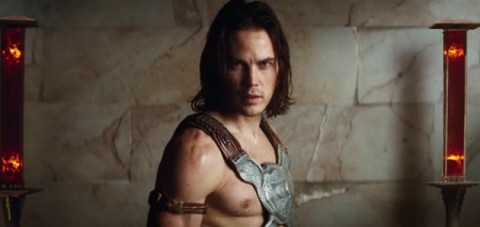
9 Pro Tips for Landing That Action Star Gig from John Carter’s Taylor Kitsch

Taylor Kitsch is about to have a very big 2012. In addition to carrying Disney’s ambitious sci-fi adaptation John Carter as the titular Edgar Rice Burroughs hero, a Civil War veteran transported to Mars, he’s also fronting Peter Berg’s alien invasion actioner Battleship and starring in Oliver Stone ’s Savages later this year. But as Kitsch revealed to Movieline, the John Carter job wasn’t easy to get — and the toll it took on him during production was a challenge in itself. So who better to offer pro tips on nabbing the spotlight and handling the pressure of becoming an action hero than Kitsch, on the eve of a new chapter in his career? It should be noted that Kitsch is no stranger to action, having appeared in films like Snakes on a Plane , The Covenant , and X-Men Origins: Wolverine already in his six-year career, and no stranger to the spotlight thanks to his beloved turn as Tim Riggins on Friday Night Lights . But John Carter marks his first starring role and by far his biggest film to date, a sprawling epic set on a vast alien world envisioned in great detail by director Andrew Stanton ( Finding Nemo , WALL-E ). So how did Kitsch land the coveted role? What does his John Carter role share in common with his last one, as the late South African photojournalist Kevin Carter, in The Bang Bang Club ? All this and more as Taylor Kitsch shares his pro tips on landing (and keeping) that action hero gig. 1. Don’t think of yourself as an action star . “That’s you guys labeling me, so me saying yes to that – I can’t say yes to that because I refuse to put myself in that bubble. You saw Bang Bang Club , that’s no action movie. We hope to keep throwing you curveballs so you can’t put me in a spot like that.” 2. Ignore the hype and the naysayers – worry about putting pressure on yourself to do the work so you can sleep at night . “The pressure is what I put myself on in the sense of getting and doing the best I can, and having no regrets with what I put into it. That’s the pressure. The pressure now is that you can overthink everything, from how it’s going to do and how people are going to perceive it, you, this and that. If you want to drive yourself crazy over that you can, but I think that’s why you put so much into it. So you can lay down at night and be okay with what you did and be like, you know what? I still wouldn’t change it. If you say I’m fucking shit, I still wouldn’t change it.” 3. Be picky. Taking on a blockbuster gig is a huge commitment, so make sure you’re doing it for the right reasons. “Hopefully you feel that, you see it. You see the emotion and the energy that it takes to really do what it deserves, potentially. I think that’s what it’s about, and that’s why I’m so picky with the jobs. I’m all in. I’m never going to do a job for the sake of working. So we’re at a point now of looking at the next job, or whatever that is, and my people, my team, have been with me from Day One. If I don’t work for a year, I’m OK with it. We’re not going to do it unless we have to do it. “I was and still am okay with doing indies for the rest of my life. I don’t need to be in the spotlight; if anything, I’ll push it away even more. I live in Austin. I love the work. I love the storytelling, and that’s what the first meeting represented. I could play so many parts in this one character, from the Western, from the guy that doesn’t give a shit, to the guy who’s finally come full circle and become the leader that he’s pushed away for so long. I love that, and I love working with an Andrew Stanton, a Willem Dafoe, a Mark Strong, a Sam Morton, a Thomas Haden Church, a Lynn Collins.” 4. Make sure there is a “there” there. “Man, I will be shit if you give me nothing to play. Any actor will tell you, the more you can give me, the more depth I can escape into, the better it’s going to be on every level.” 5. Flawed characters are more interesting to play, and are worth diving into headfirst — even if it takes a lot out of you. “It’s not the war thing, but the more interesting guys I grew up watching — I like watching the more flawed guys than the perfect guys, and that’s more interesting for me to play. That’s more real to me. I love that and I love bringing people into a performance and it takes so fucking much out of you to do it honestly, but it’s worth it. Kev Carter – you won’t meet a guy more flawed. That crushed me.” 6. Remember to maintain balance with the emotional and physical demands of carrying a tentpole… especially when they require regular, long-term maintenance of action-hero muscles. “I was beyond exhausted in this film. Yeah, six day weeks is what killed me. I think I just pushed myself — I don’t regret it because you see it, but at times I could have had a better balance, maybe, just because waking up that early so often and the lack of sleep and pushing yourself that much, to have that much energy onscreen… for seven months, to be at that aesthetic! It’d be a lot easier if I had one shirtless scene and I could just get toned for that then be OK and balance it out, but it was 11 months that I was on that diet and training regimen. It’s very unreal to do that and to look that way, obviously, but it’s what I guess I demanded out of myself. This goes back to Kev [Carter, of the Bang Bang Club ], too. No one asked me to lose a pound, I wanted to. 7. That said, don’t worry too much about how you look, stud . “Fuck, man. You never want to be that conscious in a scene. That’d mean I’d be so totally out of John Carter mode, if I’m really that conscious of how I look and the lighting. That’s really bad. [But] you definitely have to do what you have to do to put yourself in the moment so it’s connecting to whatever it is. I think you’ve just got to get to a point where you’re okay with how you look and what you’re doing and you leave it and let it lay. Whatever it is, I look at that scene and it is what it is” 8. Go out for a role knowing it’s yours to lose. The audition process for John Carter was particularly grueling, with five actors and five actresses vying for the same roles over the course of two intense days. “Man, I was just so focused, I was so myopic with it. I prepped so much for that audition. I’ve always been an underdog and I came in on this gig that way, but it was like I felt it was mine to lose. I went in with that thinking really, if I can go in all out on this, I’m going to go in and kill it as much as I can. But it was a tough process, for sure. Two 14-hour days… and you’ve got to remember, what’s bizarre about getting roles and auditioning for the most part is you do your prep and everything for the most part after you get the role. It’s like OK, now I’ve got to sit down and really sketch this guy out. It’s a trip. “ 9. Whatever you do, do not go out partying the night before a big audition. “I won’t call the guy out, but I know and it gave me more oomph, put it that way, knowing that this one guy that was up for it was out partying quite hard the night before or two nights before. No matter what, I hear about that and I know I got ya, man. It’s like, good on ya for making it a little bit easier on me.” John Carter is in theaters this week. Read more on the film here . Follow Jen Yamato on Twitter . Follow Movieline on Twitter .

The rest is here:
9 Pro Tips for Landing That Action Star Gig from John Carter’s Taylor Kitsch

‘The River’: The Reviews Are In!

Critics say the found-footage TV series, while scary, suffers from poor writing and one really annoying character. By Eric Ditzian Eloise Mumford and Joe Anderson in “The River” Photo: American Broadcasting Companies, Inc. “The River” carries a sense of pop culture inevitably in its shaky, grainy found-footage escapades. After “Paranormal Activity” resuscitated the horror subgenre with its wide release in 2009 — grossing $193 million worldwide and spawning two sequels and a slew of variously successful imitators — it was only a matter of time until found-footage scares arrived on network TV. Thankfully, that arrival comes courtesy of “Paranormal” mastermind Oren Peli . “The River,” premiering on ABC on Tuesday at 9 p.m. ET, borrows liberally from Peli’s hit film franchise (as well as from past network hits like “Lost”) in a midseason replacement that sees a crew venture into the Amazon to locate a missing explorer named Emmet Cole. The question, of course, is whether “The River” can replicate the successes of its wildly popular forbearers (or, perhaps, the been-there-found-that disappointments of other genre copycats). Critics, at this point, are split. Some have found the series satisfyingly scary. Others have faulted the show’s weak character development. For those critiques and more, read on for a deep dive into reviews of “The River.” The Storyline “[‘The River’] is a nifty supernatural adventure tale set in mysterious river-riven regions of the uncharted Amazon. Topographically speaking, it is ‘Lost’ inside-out. The story is this: Emmet Cole (Bruce Greenwood), a world-beloved, globe-trotting ‘Crocodile Hunter’ sort, has gone missing. Six months after his disappearance, an emergency beacon begins suddenly transmitting and his former crew and co-stars, including his wife and son and the daughter of his also-missing cameraman, head into the jungle to find him, with TV cameras rolling. Emmet’s television catch phrase, ‘There’s magic out there,’ will prove to be presciently literal.” — Robert Lloyd, Los Angeles Times The Comparisons “There are so many moments in ABC’s ‘The River’ when you want to congratulate its creators for trying a little more blatantly to be ‘Lost’ than others will admit, and there are other times when you think, ‘Wow, ‘Paranormal Activity’ on a weekly basis, with a touch of ‘Heart of Darkness,’ might be interesting, too.’ Quick camera cuts, people in peril, freaky and scary happenings — what’s not to like? Put them together, and you have a series that cobbles together a pretty strong rooting interest. We all need a show like this on the small screen again. But is there really a weekly series here?” — Tom Goodman, The Hollywood Reporter The Writing “[W]hen the characters start to talk to each other? ‘The River’ just feels like one poorly written TV show. ‘The River’ is swimming in bad dialogue and clich

‘The River’ Is ‘Paranormal Activity’ Meets ‘X-Files,’ Eloise Mumford Says

‘It’s groundbreaking TV,’ actress tells MTV News of the found-footage series, which premieres tonight. By Josh Wigler Eloise Mumford in “The River” Photo: American Broadcasting Companies, Inc. There’s magic out there … you just need to ford “The River” to find it. “Paranormal Activity” mastermind Oren Peli is back with another found-footage fright-fest, but this time, it’s playing out on the small screen in the form of “The River,” a new supernatural series debuting on ABC on Tuesday (February 7). “The River” stars “Star Trek” actor Bruce Greenwood as Dr. Emmet Cole, a television personality and famed explorer who vanishes without a trace while seeking magic in the depths of the Amazon. Six months later, new evidence regarding Emmet’s whereabouts comes to light, leading his wife, Tess (Leslie Hope), and son, Lincoln (Joe Anderson), to the Amazon with a television crew in tow. What they find there is darker and more inexplicable than anything they expected — and as promised by the missing Dr. Cole, there is indeed magic out there, deadlier than the rabbits-from-hats variety. Actress Eloise Mumford, who stars on the show as adventurer Lena Landry, dropped by MTV News this week to talk about the premiere of “The River,” and why it’s a television event that fans of found-footage absolutely can’t miss. “It’s ‘Paranormal Activity’ meets ‘X-Files,’ ” she told MTV about the premise of the show. “The conceit is that it’s all shot as a TV show — you’re aware that it’s not just a TV show on TV, but that the whole thing is being shot as a TV show within a TV show. It’s really fun, because it’s all shot as a documentary. You see the camera guys; they’re characters. Sometimes we had up to 13 cameras rolling at once. It’s groundbreaking TV in that sense. It’s taking this age of technology right now and taking full advantage of that.” Indeed, though found-footage is a prominent part of pop culture today, it’s a device that’s rarely explored in scripted genre television. Mumford said that the unique perspective will help set “The River” apart from other shows currently on TV. “If you’re flipping through the channels, you’re going to go, ‘Whoa!’ It’s such a different look,” she said. “And the storytelling of it is so much faster. There’s really unique points of view in all of it.” “It’s in line with the youth of today,” she added of what makes “The River” relevant. “We’re used to shooting our own stuff on our cellphones. We’re used to capturing everything. To be able to have that as a TV show is going to be really fun for people to watch.” “The River” flows on ABC tonight (February 7) at at 9 ET/PT (8 Central). Are you excited for the premiere of “The River”? Leave your comment below.

Follow this link:
‘The River’ Is ‘Paranormal Activity’ Meets ‘X-Files,’ Eloise Mumford Says

REVIEW: Meticulous Murakami Adaptation Norwegian Wood Does Everything Right, and Still, We Snooze

Tran Anh Hung’s Norwegian Wood is meticulously faithful to the book it’s based on, Haruki Murakami’s 1987 novel of the same name: It takes no significant liberties with the plot, and it captures the novel’s delicate, half-hopeful, half-mournful tone. So why, unlike its source material, does it feel only half-alive? It’s so easy, too easy, to get lost in the book-vs.-movie debate. But a movie like Norwegian Wood is a peculiar case – its intentions are sterling, and it’s hard to pinpoint any technical flaws. The problem, maybe, is that it’s trying  too hard; Tran has such firm control over the storytelling that the resulting picture has no room to breathe. Watanabe (Kenichi Matsuyama) is an aimless young university student in late-1960s Tokyo. His closest friend, Kizuki, committed suicide at age 17, leaving behind his childhood love, the fragile Naoko (Rinko Kikuchi, the Japanese actress who made a splash in the 2006  Babel ). Watanabe “inherits” the friendship of Naoko, and it seems that the two might fall in love. But Naoko disappears – the intensity of the blossoming relationship is too much for her, sexually and emotionally, and she enters a retreat-like sanitorium in the country. Though Watanabe continues, sweetly, to pine for her, he also starts tagging along with his more sexually adventurous roommate, Nagasawa (Tetsuji Tamayama). He also embarks on a fledgling friendship with another student, Midori (Kiko Mizuhara) ,who, unlike Naoko, seems boldly certain about what she wants out of life. She is, perhaps, a little too bold for Watanabe: She outlines her idea of the ideal lover (essentially, a man who will be at her beck and call, so she can then turn him away). And she informs him that she already has a boyfriend, anyway. Watanabe continues to visit Naoko in her forest retreat, though his time with her is nearly always supervised by Noako’s half-protective, half-possessive roommate, Reiko (Reika Kirishima). The rest of Norwegian Wood outlines the rather delicate dance between the things Watanabe might think he wants and the things he may actually be able to have. Tran adapted the screenplay himself, with obvious care and precision (though the resulting movie doesn’t do much to address, as Murakami’s novel did, the social unrest among young people in late-‘60s Tokyo). His actors have plenty of moments of grace and subtlety, particularly Kikuchi – somehow, she makes us see a deeply troubled soul in Naoko, not just a wan, self-absorbed victim of circumstance. And there isn’t a single frame in  Norwegian Wood that isn’t gorgeous to look at: The cinematographer is Mark Lee Ping Bin, who also shot  In the Mood for Love (sharing credit with Kwan Pung-Leung  and Christopher Doyle), and every inch of the movie’s surface fairly glows. Or, rather, every millimeter glows — the picture creeps along at a very leisurely pace, which shouldn’t by itself be a problem. Norwegian Wood is Tran’s fifth feature. (The director, who was born in Vietnam and who lives in Paris, is perhaps best known for the 1993  The Scent of Green Papaya .) I kept watching  Norwegian Wood waiting for that pleasant, wide-awake state of hypnosis to kick in, the slipstream effect that a well-constructed, slow-moving picture sets into gear. But for reasons that are hard to pinpoint, Norwegian Wood seems to be hampered by its own integrity; it’s like a ghost wearing a trailing nightie that’s just too long. Would the movie be more effective if every lingering shot were cut by just a second or two, or if the dialogue between characters had just a little more energy and crackle? Maybe. But whatever it is that’s wrong with  Norwegian Wood couldn’t possibly be remedied by any quick fix. That’s both its tragedy and its virtue. Follow Stephanie Zacharek on Twitter . Follow Movieline on Twitter .

Read the rest here:
REVIEW: Meticulous Murakami Adaptation Norwegian Wood Does Everything Right, and Still, We Snooze

The Foreign Exchange: "Authenticity" (Video)

http://www.youtube.com/v/R4ywe4g12I4

Read more here:

Nicolay and Phonte are still pushing Authenticity, their third album as the Foreign Exchange that I reviewed (and loved) last year when it dropped in October. And like their previous videos, the one for “Authenticity” is heavy on the storytelling and mostly follows the lyrics sung by Phonte throughout. The big difference here, though, is that only Phonte makes a brief guest appearance in the video… Broadcasting platform : YouTube Source : prefixmag Discovery Date : 21/02/2011 19:15 Number of articles : 2

The Foreign Exchange: "Authenticity" (Video)