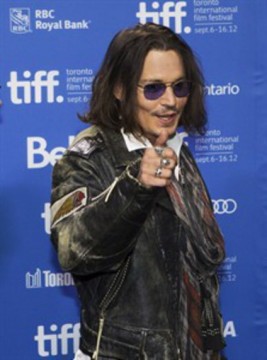
Even as he anticipated the sunset of his filmmaking career recently, Quentin Tarantino is looking ahead to who he’d like to work with, and Johnny Depp tops the list. The Django Unchained director said he’d like Depp to star in a future pic, but will only cement plans once he’s written the perfect part for the Pirates of the Caribbean actor. [ Related: Quentin Tarantino Hints At Retirement And Getting High On ‘Django Unchained’ and Quentin Tarantino Wants You To Feel The Inhumanity Of Slavery In ‘Django Unchained’ ] Tarantino told talk show host Charlie Rose that it would be “magical” to work with the 49 year-old actor, adding: “We would love to work together. We’ve talked about it for years. Not that we get together and talk about it for years, but from time to time.” The two appear to have mutually high esteem for the other, according to Tarantino. But the key is finding the right moment. “We’re obviously fans of each other,” he said according to Contactmusic.com. “I just need to write the right character that I think Johnny would be the right guy to do it with. And if he agrees, then we’ll do it, and then it’ll be magical.” Continuing, Tarantino shared that he hasn’t as of yet, “written the perfect character for Johnny Depp as of yet. Maybe someday I will, maybe someday I won’t. We’ll see.” Tarantino also said he’d like to work with Meryl Streep and Michael Caine. The filmmaker recently unveiled plans for a new movie, tentatively titled Killer Crow , which would again center on people rising up against their overlords, forming a trilogy with the current Django Unchained and 2009’s Inglorious Basterds . [ Sources: Contactmusic.com , Mid-Day.com ]
In a recent interview about the controversial Quentin Tarantino film, Django: Unchained, Samuel L. Jackson is asked about the constant use of the N-word in…
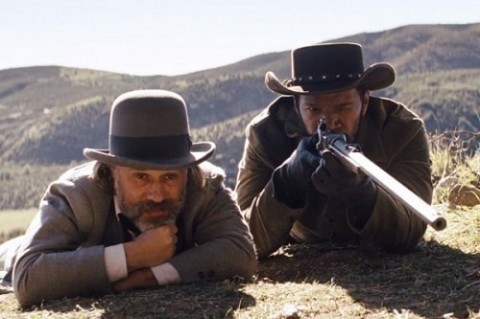
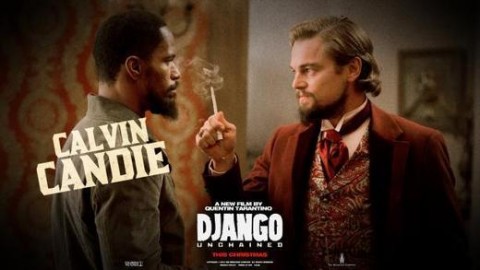
Django Unchained may be receiving attention for its excessive use of the N-Word , and the body count in this Quentin Tarantino thriller may be as high as anything the director has ever helmed, but neither of those issues gets to the heart of the film: Two men, one friendship and the way Christoph Waltz was pretty much born to recite words written by Tarantino. Waltz portrays Dr. King Shulz, essentially the same character that earned him an Oscar in Inglourious Basterds . He’s a loquacious, laid back killer who smiles through the most tense situations. Tarantino penned the part for Waltz, and the best parts of the 166-minute movie feature Shulz simply talking: to residents of a town after he kills their sheriff; to Foxx’s slave-turned-bounty-hunter, Django; to Leonardo DiCaprio’s evil plantation owner. Waltz brings Tarantino terrific dialogue to entertaining life. And Foxx is also strong, evolving from a quiet slave to “the fastest draw in the South,” obliterating foes along the way and tracking down his wife (Kerry Washington), who has been purchased by DiCaprio’s Calvin Candle. The movie is Tarantino through and through, from the unusual combination of history and absurdity… to the drawn out scenes (one involving a group of white men complaining about the holes in their KKK-like hoods)… to his need to violently murder almost everyone on screen. Due to the latter point, the film is about 30 minutes too long. Without giving anything away, it easily could have ended around the time of a certain handshake, but Tarantino just can’t resist. He had to up the body count, he had to use up all his red dye budget. Indeed, the closing handful of scenes are cartoon-like in their violence. They’re just examples of Tarantino having fun with fake bullets and slow motion and shredded corpses. But these aren’t the difficult ones to watch. There’s one moment where a man is torn apart by dogs that even Michael Vick from a few years ago would have trouble watching. Overall? Django Unchained is exactly what anyone familiar with Tarantino’s work would expect. It may push the boundaries of good taste at times, and it definitely runs longer than necessary, but it’s a fun two-plus hours. You’re in for impressive visuals, unique characters and a series of fantastic exchanges between great actors. Sound off now with your take and visit Movie Fanatic for another Django Unchained review .
If you and the fam headed to the multiplex to watch one of the season’s big new releases this week , chances are you caught Tom Hooper ‘s epic weepie Les Miserables or Quentin Tarantino ‘s Django Unchained . (Or maybe the in-laws dragged you to Parental Guidance , in which case, my condolences.) We’ll get spoilery all over Django later, but for now let’s get to hashing out the answer to the question that’s been on every showtune-lover’s mind for months: Which Les Miz cast member totally nailed the live-sung suffering for the big screen (and whose warblings made us les miserables )? I’ll start: Anne Hathaway ? NAILED IT. I’ll admit I was tres apprehensive at first listen when the trailers featuring her tremulous Fantine cry-singing hit the web. Watching the whole film, however, it’s clear Hathaway and Hugh Jackman are leading a masterclass in sing-acting for the entire Les Miserables cast, and in context the breathy imperfect perfection of Hathaway’s “I Dreamed A Dream” is downright heart-wrenching. It’s been said before, but the Oscar already belongs to that hitch in her voice that hits as she’s choking on tears while wailing about her miserable prostitute life with Hooper’s camera all up in her face — one of the only performances in the film riveting and emotional enough to sustain those damned extended close-ups . Runner-up for best performance in Les Miserables goes to Jackman, who wows in Jean Valjean’s pre-bath scenes with a filthy, feral energy that I honestly didn’t think he had in him. Pacing back and forth in the bishop’s chapel during “What Have I Done?” Jackman is riveting; you can see Valjean’s confused, broken mind reeling as Jackman spits and cries out in song, and Hooper’s camera work actually fits the number. It’s a shame, then, that the nearly three-hour running time of Les Miserables suffers from Jackman fatigue by the time Valjean’s singing his umpteenth song. On second thought, I’ll give Jackman a tie for runner-up with the little kid who plays Gavroche. (His name’s Daniel Huttlestone. He’s 12. He started his career on the West End. What have you done with your life lately?) Talk about making the most out of a handful of screen minutes; I’d trade a dozen of Jackman’s blah Valjean scenes for more of the impish street urchin who fights on the front lines with the students. I’d watch Gavroche picking pockets, or scamming rich folk, or stealing hearts up and down the dirty streets of Paris. In fact, can we just make him the Han of Les Miz and give him his own Fast & Furious -style prequel where he goes on a Moonrise Kingdom -esque adventure that never ends? (Also great: Samantha Barks as Eponine , the patron saint of girls harboring unrequited life-and-death crushes on boys who are too dumb to see what’s in front of them, and Aaron Tveit AKA Tripp from Gossip Girl as Enjolras.) Now for the not-so-great performances. Let’s just say that Amanda Seyfried ‘s birdlike soprano trill is totes fine, but I daresay she was wasted in the role of Cosette, AKA The Most Boring Girl In All Of France. I can take or leave Sacha Baron Cohen and Helena Bonham Carter as the Thenardiers, whose slapsticky numbers took some folks out of the abject misery of Les Mis but didn’t move the needle for me in either direction. Russell Crowe did himself no favors in my book with his mismatched 30 Odd Foot Of Grunts belting , but Hooper made it worse with those CG crane shots of Javert, wailing existential above the sewers in a dead-armed stance. I love me some Russell Crowe, but by the time he finally jumped to his death with a sigh of despair, I was rooting for it. Sweet, sweet relief. So, Movieliners: Did you hear the Les Miserables cast sing? Who made your heartstrings ache the hardest? Who sung the sweetest through the tears? Which cast members would you let warble their most miserable miseries in your castle on a cloud? READ MORE ABOUT LES MISERABLES : ‘Les Misérables’ Hits High Notes, But Also Skitters Great Moments In ‘Les Miserables’ Mania: Katie Holmes Sings ‘On My Own’ On ‘Dawson’s Creek’ Early Reaction: Oscar Race Heats Up As NYC Screening Of ‘Les Miserables’ Prompts Cheers & Tears Follow Jen Yamato on Twitter . Follow Movieline on Twitter .
John Ford may be one of American cinema’s great directors, but Quentin Tarantino has some choice words for the maker of such film classics as The Searchers , Stagecoach , and The Grapes of Wrath : “To say the least, I hate him,” Tarantino told The Root in a recent conversation about Django Unchained . What’s more, he says Ford inspired him to write a scene in Django Unchained in which comically inept proto-Klansmen get their just desserts. Earlier this month, Django producer Stacey Sher alluded to Tarantino’s animosity toward Ford at the film’s PGA screening. “He’s not a John Ford fan,” she said. “Do you know why? John Ford was a Klansman in Birth of a Nation , so Quentin can’t really get past that — and I can’t blame him.” That’s terrifically provocative and explanatory a statement in itself, but in a fantastically in-depth interview at The Root , Tarantino explains the Ford beef further : Oddly enough, where I got the idea for the Klan guys [in Django Unchained ] — they’re not Klan yet, the Regulators arguing about the bags [on their heads] — as you may well know, director John Ford was one of the Klansmen in The Birth of a Nation , so I even speculate in the piece: Well, John Ford put on a Klan uniform for D.W. Griffith. What was that about? What did that take? He can’t say he didn’t know the material. Everybody knew The Clansman [on which Birth of a Nation was based] at that time as a piece of material. …he put on the Klan uniform. He got on the horse. He rode hard to black subjugation. As I’m writing this — and he rode hard, and I’m sure the Klan hood was moving all over his head as he was riding and he was riding blind — I’m thinking, wow. That probably was the case. How come no one’s ever thought of that before? Five years later, I’m writing the scene and all of a sudden it comes out. One of my American Western heroes is not John Ford, obviously. To say the least, I hate him. Forget about faceless Indians he killed like zombies. It really is people like that that kept alive this idea of Anglo-Saxon humanity compared to everybody else’s humanity — and the idea that that’s hogwash is a very new idea in relative terms. And you can see it in the cinema in the ’30s and ’40s — it’s still there. And even in the ’50s. A true cinephile controversy! (Read/listen to the whole interview here .) Pot, consider yourself stirred. Discuss! [ The Root h/t @GlennWhipp ]
Sarah Silverman is standing up for the concept of art. And the pervasive use of a certain racial slur. Allow us to explain… With Spike Lee criticizing director Quentin Tarantino for the abundance of N-Word utterances in Django Unchained (over 110, according to unofficial counts), the female comedian is coming out in defense of the film and wondering: “Doesn’t it take place like during slavery? Wouldn’t it be odd if they didn’t have that horrific word in it?” Silverman tells TMZ that she likes Lee, but… “[Spike’s] got a lot of mishegas with a lot of art. I think you can’t really tell art what to do.” Movie goers didn’t seem to have any misgivings about the film, as Django Unchained broke box office records for an R-rated movie on Christmas day. Have you seen it? What do you think of its N-Word use? It is… Totally inappropriate! Totally accurate for the era! I don’t care View Poll »
So much for our terrible Les Miserables review . The big screen version of this world famous musical banked $18.2 million yesterday, according to The Hollywood Reporter, setting a new benchmark for weekday Christmas Day openings. Sherlock Holmes owns the overall Christmas record when it opened on a Friday and earned $24.6 million. Les Miserables Movie Trailer Django Unchained Trailer Django Unchained , meanwhile, didn’t exactly disappoint, either. Despite Spike Lee’s protest. The Jamie Foxx, Christoph Waltz and Leonardo DiCaprio-driven drama shot past Ali to become the highest-grossing R-rated movie to open on December 25. It brought in a cool $15 million. The Hobbit: An Unexpected Journey raked in $11.3 million, with Parental Guidance and Jack Reacher rounding out the top five.
Now that Les Misérables is expected to surpass its opening-day box-office expectations by $5 million-10 million, director Tom Hooper could pretend that adapting the beloved musical for the big screen was a walk in the park, but he’d be lying. On Thursday, Hooper spoke to Movieline from his Sydney, Australia hotel room and likened the challenge of directing the film to the massive tanker he was watching navigate Sydney Harbor. “It was an extraordinary dance between musical structure and filmic structure,” Hooper explained in a revealing interview about the making of Les Miz . The Oscar-winning filmmaker, who’s expected to snare his second Best Director nomination on Jan. 10, talked at length about his reasons for making the movie and the challenges of pacing and editing a film that is essentially sung through from beginning to end. He also addressed criticism that he relied too heavily on close-ups in the film, divulged Eddie Redmayne’s technique for attaining such exquisite sadness in his performance of “Empty Chairs at Empty Tables” and answered the burning question of the day: whether Anne Hathaway or Hugh Jackman is a bigger musical geek. Movieline: When I saw Les Misérables in New York, I was surprised by the audience’s passionate reaction to the movie. After certain scenes and songs, they were applauding and cheering as if they were actually seeing a live performance. Tom Hooper: It’s quite extraordinary. I’ve never sat in any cinema or any premiere, or any screening of one of my films and seen a response like this. It’s like you’re at some kind of happening, some kind of out-of-body experience rather than a movie. I was at the Tokyo premiere with the Crown Prince of Japan on Monday. It was quite a formal screening and the audience went kind of crazy. The Japanese broke into a standing ovation at the end, and I was told that for people to stand in the presence of the Crown Prince without him having gotten to his feet first was a total break of protocol. Since you had the foresight to make this movie, what do you think is causing audiences to react so effusively? Actually, I want to ask you: What about the movie connected with you? I’m very interested. Oddly enough, I’m not a big fan of movie musicals, but I liked that Les Misérables wasn’t afraid to wear its heart on its sleeve, especially in a year when Lincoln and Zero Dark Thirty, which I also admire, are these relatively cool procedurals. I also thought that your decision to have the actors sing on camera paid off. There are some honest, raw performances in Les Miz and, as a result, the movie ends up being quite a cathartic experience. Yes, I think that’s the word. I always get asked, “Why did you do this film?” The very first time I saw the musical, the ending was what made me want to do the movie. There’s that moment where the hero of the story, Jean Valjean ( Jackman ), has just passed away and you hear the distant sound of “Do you hear the people singing?” — like an angelic chorus. I had a bodily physical reaction and was crying. I remember thinking what, why am I reacting this way? I was crying about my dad. My dad is alive and well and — but I couldn’t help thinking about the fact that this moment is going to come with my father. A few years ago, he went through cancer. He recovered, but when he was facing it, he told me, “Tom, I want to master the art of dying well.” And I said, “Dad, what on earth do you mean by that?” He said, “When I pass away, I want to do it in a way that’s as compassionate to my family as possible and that limits the pain they suffer. These words came to me when I was thinking about the end of this film. I thought, what’s extraordinary about Les Misérables is that it looks death square in the eye and says that if you navigate that moment with love, it’s possible to achieve a kind of peace. Valjean finds peace through his love of Cosette. He has loved this girl furiously since he met her and been a parent to her. Not only that, he’s rescued the man who’s going to marry her. He’s passed the duty of loving her on to someone else so he can leave this world knowing that she’s cared for and protected. And in the moment of his death, he’s able to tell his story. He’s able to say that this is the story of a man who turned from hating to love through Cosette. It’s like the line from “Finale”: “To love another person is to see the face of God.” It basically says that the only way to navigate our mortality, which we all face, is through love. And I think there’s something incredibly true about that message. But I think the thing that makes Les Misérables special is that it offers so many different ways in emotionally for people. It holds up a mirror to either your own suffering or the suffering of someone close to you, and it manages to process that suffering, leaving you feeling better about it by the end of the film. I’ll agree with you there. Over the past year and a half, I’ve lost a couple of friends and some people who played crucial roles in my life. So, “Empty Chairs at Empty Tables” was pretty devastating to me, but I didn’t come out of the theater feeling depressed. I felt like I’d let something go. So much of filmmaking today is avoidance basically. It’s distraction, avoidance, irresponsible fantasy. Les Misérables is somehow not that. It manages to go to the tough places. It’s escapism with a moral compass, and I’m not quite sure people are aware how difficult it was to actually get the film to do what it does. There are some scenes in Les Misérables that aren’t in the stage musical. Can you tell me about what went into your decision to make these changes? There are actually a lot of changes to the screenplay that have gone largely unnoticed. I was working with Claude-Michel Schönberg, Alain Boublil, and Herbert Kretzmer, who were the original creative team on the musical and when the changes are done in a voice that’s so identical to the way it was originally written, they’re hard to detect unless you know Les Misérables really well. Basically, we disassembled and reassembled the musical in order to improve the storytelling. One small example takes place in the factory when the fight breaks out with Fantine (Hathaway). In the musical, there is no reason why Valjean is distracted from dealing with the disruption. He simply says to the foreman, “You sort it out.” The first time I saw the musical, I had the idea: what if the thing that distracted Valjean from focusing on Fantine was the arrival of Javert as the town’s new police inspector? In that moment, he sees this specter from his past and the world falls away. He sees nothing else but that. That led to the scene in the movie where Valjean sees Javert in the factor window. By adding this moment, it better establishes the guilt that Valjean has over the death of Fantine. You upped the emotional impact of Valjean’s relationship to Fantine. Yes, and it sets up this theme about how the ghosts of the past keep coming back to haunt you. You can never be free of them. And it sets up the whole dilemma where Valjean says, “Shall I finally free myself from this past by just admitting who I really am and facing the music?” But that modification required a new piece of music to be composed that went in the middle of the factory scene that, famously, never had had anything in the middle of it. So then, we had the challenge of creating a new melody that marked the drama of that encounter between Valjean and Javert and, yet, didn’t completely fuck up the unity of the factory music. How do you accomplish that? You’ve got to pre-decide on the length of the melody that you need to express this thought, and melodic construction is not that flexible. So Claude-Michel says we can use this bit of melody and Alain works its out and gives you, say, 16 lines. But then you realize that 16 lines is too long and that we’re being repetitive. So, you go back to Claude-Michel and say, “Can you make the melody a bit shorter?” He says it either has to be 16 lines or, say, four lines to work melodically in that context. I don’t have the freedom to make it, say, 10 lines. So, we would say okay, Claude-Michel would play the piano onto his iPhone and email the recording to us so that we had a guide. And then Alain and Herbie would say what we needed to say in four lines. It was unlike anything I’ve ever done or will do because there’s this constant dance between how quickly melody exhausts itself and the amount of words you need to make the point. And I imagine that’s just the beginning of the process. That’s before you get to the edit process. Again, I’ve never done anything like it. The film is now under two-and-a-half hours, but in September it was running around two hours and 42 minutes. So, you spend a few days in the cutting room and let’s say you take five minutes out of the running time. You can’t just press play and watch your film because it doesn’t play. And the reason it doesn’t play is, wherever you changed the length, the music and the orchestration don’t work anymore. So, in order to see how you feel about the edits you’ve made, the composers have got to recompose all the bits where the lengths changed, and then the orchestrators have got to orchestrate it. We had programmers who basically programmed the music using sample sounds so that we didn’t have to spend money on orchestras. They rebuilt the programmed orchestra and then the music editors fit it to the picture. And then maybe about a week later, I could watch it and see the impact of my changes. It was an extraordinary dance between musical structure and filmic structure. Imagine what it does to pacing. With The King’s Speech , I could vary the pace of almost any scene by taking a second out here or a few frames there. In a musical, once the songs start, you can’t change the pace at all. So it was fascinating to learn how to control pace when you don’t have control of the timeline. You learn that there are points where you can actually take a little chunk out of the music, but in order to do that, I literally had to get to the point where I could read music again and read the score in order to work out what secret cuts I could take. So, you’re leaving me with the impression that making Les Misérables was like solving a Rubik’s Cube because the music and the story were so interwoven that you couldn’t just change one aspect of the movie without affecting a large swath of it. Exactly. You’re navigating whole blocks in the movie where the pace is what the music is. And, therefore, you have to use shot selection and editing to create any variations in that pace. The work involved in getting the movie to run under two-and-a-half hours was incredibly complicated. Not only does the stage musical run longer, we added material. So this movie was like an oil tanker. You’ve come in for some criticism in terms of the number of close-ups you use in the movie. What’s your response to that? I find that discussion interesting. I always give myself options. I didn’t assume that the tight close-up was the best way to do a song. So in “I Dreamed A Dream”, there was a close-up of Anne that we used but there were two other cameras shooting from other perspectives. The tight close-ups won out in the cutting room because, over and over again, the emotional intimacy was far more intense than when you go loose. In fact, in the case of “I Dreamed A Dream,” for a long time we were using a mid-shot of her at the beginning of the scene followed by a very slow track and maybe in the last quarter of the scene it was a medium close-up. And then Eddie Redmayne , who’s been a friend of mine since I worked with him on Elizabeth I , said to me: “Why aren’t you using that close-up that you’re using in that teaser trailer?” He was talking about the way you see all the muscles in Anne’s neck work as she sings and the raw power of that, and I thought, God, that’s interesting . So, it was actually Eddie’s suggestion to re-examine that scene, and the moment we put that close-up in, the film played in a completely different way. The level of emotion went up about a hundred percent. So the process of moving toward these close-ups was a process of discovery. Given the challenges that you faced, is there a scene that you’re particularly proud of? If I’m honest, it’s the final scene in the movie, because, on paper, the idea of the barricade covered in the ghosts of the fallen could be really corny and awful beyond relief. Instead, it creates this incredible emotion in people who see it. It’s something that I’m definitely proud of because, like The King’s Speech , I always knew that it was all about the end. And with Les Miz , I always knew it was about the way we go from the grief of Valjean’s death to the hope of the fallen. But it could have felt ridiculous, and the fact that we avoid the many pitfalls that existed in that scene is definitely one thing I’m at peace about. I’m also incredibly proud of what Eddie does with “Empty Chairs at Empty Tables.’ Anne is evidently miraculous during “I Dreamed A Dream,” but I do think that there’s a balance in the movie that’s corrected by how brilliant Eddie is at that point. It’s a powerful performance. Do you know how he connected to his grief in that scene? It’s palpable. He wouldn’t tell me. It’s funny with actors sometimes. One feels that it’s wrong to pry. But he did have a rather unusual idea: Because the song deals with the devastation of the loss of his friends, he suggested that he sing it three times in a row without the camera cutting. That way, the devastation he’d reached at the end of the first singing would become the beginning of the second and so on. He kept pushing himself further and further into the pit of despair. Okay, so you’ve done the Oscar jockeying, and you won. As we get into the thick of awards season, are you approaching your second time any differently? As I sit here right now with the film – it’s opening in Japan today, it’s previewing in Korea and Australia, it’s opening in America on Christmas day — I’m incredibly occupied. It’s about getting through the next few days. But ask me again when I get through this bit. Given what you went through for Les Miz , would you do another movie musical and if so, what would it be? God, I would be open to it. It’s just that this is a very special case. This is arguably the world’s most popular musical and that musical version had never been made into a film until now. There aren’t that many really great musicals that haven’t been made into films. Have you decided what’s next for you? I literally have no idea. I did such crazy hours on this film for the last year and a half. I literally worked every hour I could stay awake and, therefore, I haven’t been able to read any material or any scripts. So, it’s a completely open thing at the moment. Okay, last question: who’s the bigger musical geek, Anne Hathaway or Hugh Jackman? Well, without a doubt, Anne is the bigger Les Misérables geek. It wasn’t just that her mother was in the American tour of Les Miz , she was the understudy for Fantine. So these high points of drama marked Anne’s early life. I remember her saying that, for instance, there would be a phone call telling her that her mother was going to go on as Fantine in Washington and could Anne get there from New York in time to see her mother play the role? So there was this idea that Fantine wasn’t her Mom’s right. It was this scarce gift that occasionally she was given to play, and, for Anne the role defined a certain electricity and audacity. Hugh is different because he’s actually starred in musicals on Broadway and on London’s West End. He’s a bona-fide musical star in his own right, where a lot of Anne’s singing has been in the privacy of her own home or at the Oscars, but not something like [ Les Misérables ]. It’s not something I can say, but Hugh feels that in a way he’s been a force in revolutionizing the way you do a movie musical. And that’s something I know he finds very exciting because I think he’s a real student of the genre and has seen it from so many different sides. [ Deadline ] Follow Frank DiGiacomo on Twitter. Follow Movieline on Twitter. Read More on Les Miz: Early Reaction: Oscar Race Heats Up As NYC Screening Of ‘ Les … INTERVIEW: Samantha Barks On ‘ Les Miserables ,’ Eponine….
“I witnessed the genesis,” Christoph Waltz says of this season’s hot awards contender, Django Unchained . ” Quentin [Tarantino] l et me have twenty-thirty pages as he finished them !” Looks like Waltz and Tarantino have become true creative partners. But the actor, whose performance is one of the highlights of Django Unchained , would love to get even more involved. He lamented that he wasn’t able to be around for post-production when the film takes shape and “it really becomes interesting,” he said. In a one-on-one interview, I also asked him about foreign actors being stereotyped in Hollywood as villains, and he agreed that — as a good guy in Django Unchained — it always “feels good to break the cliche”. Plus he spills a secret about working with Uggie , Tinseltown’s top pooch, on Water for Elephants . Check out the full interview below: Get more on Django Unchained , in theaters Christmas Day. Follow Grace Randolph on Twitter . Follow Movieline on Twitter .
Quentin Tarantino’s slave western has been drawing criticism from the day the trailer was released and comments from the controversial director have not helped. RELATED: Samuel…