Tag Archives: time

Libertarians say Republicans owe apology, not pledge, to America

In response to the recent Republican “Pledge to America,” Libertarian Party executive director Wes Benedict released the following statement: Instead of a “Pledge to America,” the Republicans should have written an “Apology to America.” It should have gone something like this: “We're sorry, America. Sorry we grew the federal government budget from $1.7 trillion to over $3 trillion. Sorry we added $5 trillion to the federal debt. Sorry we doubled the size of the Department of Education. Sorry we started two incredibly costly foreign wars. Sorry we supported the absurd and costly TARP bailouts. Sorry we created a huge and costly new Medicare entitlement. Sorry we did nothing to end the costly and destructive War on Drugs. Sorry we did nothing to reform the federal government's near-prohibition on immigration. But hey, at least we helped you by shifting a lot of your tax burden onto your children and grandchildren.” There are so many lies, distortions, hypocrisies, and idiocy in this document that it's hard to know where to start. It is deeply insulting to see the Republicans refer to “America's founding values” on their cover. The Republican Party has no understanding whatsoever of America's founding values. They have proven and re-proven that for decades. The document talks a lot about “tax cuts.” Unfortunately, the Republican “tax cut” proposals would really do nothing to cut taxes. All their proposals achieve is to defer taxes, pushing the burden onto our children and grandchildren. The only real way to cut taxes is to cut government spending, and the Republican document does almost nothing in that regard. The Republicans say they want to “roll back government spending to pre-stimulus, pre-bailout levels.” In other words, to re-create the situation near the end of the Bush administration, after Republicans had massively increased federal spending on almost everything. Republicans must love it when Democrats expand government, because it gives them the opportunity to propose small “cuts,” while still ending up with huge government. One shocking aspect of the document is that it actually includes subtle Republican proposals to increase government spending. The Republicans offer no plan whatsoever to reduce military spending, America's foreign wars and nation building, or our military defense of rich foriegn nations. On the contrary, the Republicans apparently want to increase military spending, promising to “provide the resources, authority, and support our deployed military requires, fully fund missile defense, and enforce sanctions against Iran.” The Republicans also appear to want to increase government spending on border control. They say “We will ensure that the Border Patrol has the tools and authorities to establish operational control at the border,” a costly proposition. Furthermore, as expected, the document complains about “massive Medicare cuts,” implying that Republicans want to make sure Medicare is kept gigantic. The bulk of federal spending is in three places: Social Security, Medicare, and the military. The Republicans propose absolutely nothing to reduce spending on these three things, or even to slow down their growth. There must be a typo in the document where it says “Undeterred by dismal results, Washington Democrats continue to double-down on their job-killing policies.” That probably should read “Washington Democrats continue to double-down on *Republican* job-killing policies.” The best way to restore American prosperity would be to implement the straightforward 28 planks of the Libertarian Party platform, or even just follow the Constitution. I mean the actual Constitution, not the Republican re-write that allows for every federal government program imaginable. I suppose the one positive aspect of the document is that it finally dispels any illusion that Republicans want to shrink government in any meaningful way. Apparently the Republicans are hoping they can “fool some of the people all of the time.” The Libertarian Party is ready to point out Republican lies and hypocrisy to American voters, and we hope that Americans who actually want small and constitutional government, not just hypocrisy and worthless rhetoric, will vote Libertarian this November. The Libertarian Party has 21 candidates for U.S. Senate and 170 candidates for U.S. House in the upcoming November 2010 elections. For more information, or to arrange an interview, call LP Executive Director Wes Benedict at 202-333-0008 ext. 222. The LP is America's third-largest political party, founded in 1971. The Libertarian Party stands for free markets and civil liberties. You can find more information on the Libertarian Party at our website. http://www.lp.org/news/press-releases/libertarians-say-republicans-owe-apology-n… added by: shanklinmike
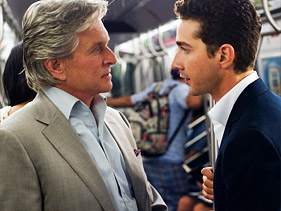
‘Wall Street 2’: The Reviews Are In!

Critics are divided, but one praises Oliver Stone sequel as ‘urgent and strangely necessary.’ By Eric Ditzian Michael Douglas and Shia LaBeouf in “Wall Street: Money Never Sleeps” Photo: 20th Century Fox Twenty-three years ago, Oliver Stone’s “Wall Street” finished third at the weekend box office, losing out to “Throw Momma From the Train” and “Three Men and a Baby.” Times, and tastes, have changed. Stone’s sequel, “Wall Street: Money Never Sleeps,” is likely to nab this weekend’s top box office slot. No matter that critics have not exactly been kind to the film since its Cannes opening in May, after which Stone was said to have headed back into the edit room in search of a new cut. What he found there should be enough to dispatch the animated owls of “Legend of the Guardians” and secure Stone his first #1 opener since 1999’s “Any Given Sunday.” Here’s what the critics are saying: The Story “Gordon Gekko (Michael Douglas, sly and purry as ever) walks away from jail in the movie’s 2001 opening scene, brick-like cellphone in hand. Seven years pass and he’s back on top, with a new book (‘Is Greed Good?’) and untold millions. But the money can’t buy what he wants: a relationship with his estranged daughter Winnie (Carey Mulligan). She lives with her boyfriend Jake (Shia LaBeouf), an up-and-coming young trader who hears Gekko speak and is enamored by his message. Drawn into Gekko’s orbit — the older man hopes to use the younger as a conduit to Winnie — Jake gets caught up in the world of deal making, not necessarily to his benefit.” — Moira Macdonald, The Seattle Times The Performances “Douglas is terrific, and he’s joined by fellow heavyweights Josh Brolin, Eli Wallach and Frank Langella as rival financial titans. But the movie belongs to LaBeouf. Stone loves to show us the convoluted world through the lens of a young striver still clinging to antiquated ideals. LaBeouf’s shark-in-training manages to keep all of the balls in the air with a winning performance that balances moral wranglings with love and ambition.” — Clint O’Connor, The Cleveland Plain Dealer The Director “Using an ingeniously layered visual design, split screens and sinuous mobile cameras that move through scenes like the human sharks who inhabit them, Stone here proves that he’s still a director of bold muscularity. If some of his references hit too squarely on the nose — the shot of a child’s soap bubble standing in for the metaphoric financial version, for example, or the vaguely fascist corporate insignia of a malign CEO played by Josh Brolin — Stone has a knack for pacing, detail and atmosphere that manages to feel authentic and fancifully allegorical at the same time.” — Ann Hornaday, The Washington Post The Dissenters “This time around, the team does show occasional flourishes of the original’s snap and urgency. However, it’s nearly impossible to stay invested in a narrative stuffed with pliable characters whose actions fail to stay true to their natures. That’s particularly glaring in a climax that ties everything up with a hunky-doryness that should have been liquidated faster than a risky hedge fund.” — Randy Myers, San Jose Mercury News The Final Word “The movie’s punch-drunk energy can’t quite make up for what, without giving away any plot points, I can only describe as a third-act lapse into maudlin sentimentality. By the film’s last frame, Gordon Gekko has gone from evil to sympathetic to ambiguous so many times that we no longer trust any twist involving him. But thanks in no small part to Michael Douglas’ evident joy in playing the role, Gekko has now become one of those characters, like ‘The Big Lebowski’ ‘s Dude, who no longer needs a movie to sustain him. Oliver Stone’s account of the events of 2008 is as unsubtle in its charms as Gordon Gekko himself. But like Gekko, the film also feels urgent and strangely necessary.” — Dana Stevens, Slate Check out everything we’ve got on “Wall Street: Money Never Sleeps.” For breaking news, celebrity columns, humor and more — updated around the clock — visit MTVMoviesBlog.com .

See original here:
‘Wall Street 2’: The Reviews Are In!

Movie Review: ‘Wall Street’ Sequel Attacks Debt, ‘Cancer’ of the Financial System

“Greed, for lack of a better word, is good.” That was the defining line of Oliver Stone’s 1987 film “Wall Street,” and his attack on the financial system that the news media would use for decades to portray businessmen as villains. The theme Stone wants viewers to take away from his sequel, “Wall Street: Money Never Sleeps,” was tucked away in the credits of his film on a greenback. “In Greed We Trust,” the bill proclaimed where the words “In God We Trust” should have been. “Money Never Sleeps,” which opens in theaters Sept. 24, uses the financial crisis of 2008 as a backdrop for the comeback of Gordon Gekko, the iconic villain of the original. This time Gekko reinvents himself as a changed man, coming back bearish on housing and speculation. In a business school lecture Gekko warns, “The mother of all evils is speculation — leveraged debt.” He claims the economy is merely moving money around in circles and the business model itself is like a “cancer.” The 1987 Gekko is a shark, a killer, the viewer senses it from the outset and can anticipate the time when Gekko’s blade will rip into protégée Bud Fox’s back. This Gekko comes across as a different animal entirely, a snake that can charm you into believing he won’t sell you out to make a buck. But in the end Gekko’s still the shark, he’s just gotten better at hiding his sharp teeth. Stone’s movie weakly attempts to convince the audience that everyone is in the “game” now, and that the corruption (caused by greed and envy) has become “systemic.” From people taking out second mortgages to go shopping, to greedy real estate investors; the new evil is leverage itself. As proof it offers many characters including Josh Brolin’s Bretton James. In the film, James secretly creates a panic by spreading rumors about a competitor in order to tank its stock and acquire it. The fictional investment bank that collapses and is acquired is meant to resemble Bear Stearns that had two of its hedge funds collapse in July 2007. Liberal themes such as green energy is good and materialism is bad abound, but the story is less political than one might expect. There were no mentions of political parties or specific administrations (Bush or Obama). Stone’s movie criticizes the types of financial products that were in use and slams toxic subprime debt, but without delving into the government policies that helped create the devastating housing bubble and the financial crisis. It says nothing about the accounting rules that many economists and financial experts say helped cause the liquidity crisis. Economist and Business & Media Institute advisor Dr. Walter E. Williams explained in a Sept. 17, 2008, column that the “credit crunch and foreclosure problems are failures of government policy.” What “foolhardy government policy” was Williams referring to? The Community Reinvestment Act, which “intimidated lenders” into offering credit to more people and specifically “discourages them from restricting their credit services to low-risk markets, a practice sometimes called redlining.” A couple of scenes show closed door meetings with bankers, the Federal Reserve and the Treasury Department, where bankers were asking for a bailout because they were “too big to fail.” But according to BB&T’s former CEO John Allison, that’s not the whole story. Allison and others have said “most of the banks didn’t need to be saved,” and that his bank (BB&T) and others were strong-armed by the Treasury into taking bailout (TARP) funds. Allison said in a 2009 speech, “I think the news media unfortunately has been quite willing to jump on the criticism of capitalism and not the [government].” Overall, Stone’s latest film does the same thing: attacking the capitalist system and its players, rather than examining the government’s culpability. But at least viewers know his movie is fiction. Like this article? Then sign up for our newsletter, The Balance Sheet .

Go here to read the rest:
Movie Review: ‘Wall Street’ Sequel Attacks Debt, ‘Cancer’ of the Financial System

Sofia Vergara’s Sweet Latina Curves

Sofia Vergara took her sweet latina curves to the Late Show the other day and decided to give us look at her MILF booty. Not a great look, but it’s something I guess. I love this girl, I have no idea what the hell she’s talking about most of the time, but I can look past the language barrier. Wait, she’s speaks english? Really? That’s english? I just assumed she was always speaking in spanish. Huh. Live and learn.

What do you think the world will look like in 100 years?

Once upon a time — in 1909 to be exact — the New York Times predicted that by 2009, we'd no longer use automobiles. We know that prediction was way off, but based on pulp history scholar Jess Nevins' transcription of the original piece, there are other interesting glimpses of what people back then thought our lives would be like now:

Jersey Shore: The Ho Double Standard [Video]

In the world of Jersey Shore , the most important sociological experiment of our time, the men are praised for sleeping around but the women are demonized for it. The creature known as Trash Bags feels this sting the worst. More

Drake Says He’s Debating ‘Fancy’ Video Re-shoot

Drizzy tells MTV News he has a ‘way better idea’ for the clip, but may start fresh with ‘Show Me a Good Time.’ By Jayson Rodriguez Drake Photo: MTV News The last time Drake changed his mind about a music video at the last minute, his original idea for a sensitive clip for the ladies turned into the over-the-top “Best I Ever Had” visual directed by Kanye West . This time, however, the Toronto lyricist insists his next video will be great, regardless of his temporary indecisiveness. He’s debating whether to reshoot “Fancy” or commission a clip for his next single, “Show Me a Good Time.” “We shot ‘Fancy,’ and to be honest with you, it was done and I watched it and I just had a way better idea,” Drake told MTV News earlier this week. “And that’s why the video hasn’t come out yet. And to follow up ‘Find Your Love’ and ‘Miss Me,’ I really wanted to do something different, conceptually, and so I had this amazing idea and now I’m debating whether I should reshoot it or go straight to ‘Show Me a Good Time.’ But there should be a new Drake visual in the next little bit.” The Thank Me Later star said the “Fancy” clip was directed by Anthony Mandler (Jay-Z, Mary J. Blige, Rihanna), who also helmed “Over,” “Find Your Love” and “Miss Me” for Drake. According to Drake, the two are deciding what to do next, and the rapper is enthusiastic about the forthcoming production, regardless of which song they decide to shoot. “It’s something to look forward to,” he said. “I’m excited by it.” Next up, Drake will appear in Rick Ross’ “Aston Martin Music” video. Ross talked to MTV News about the clip earlier this month, saying the visual was “dope.” “We were just going over treatments for ‘Aston Martin Music,’ ” Ross said. “We’re going to shoot the dope version: Drake’s going to be rapping his verse and Chrisette [Michele will be there] and most definitely me. We’re just finalizing all the details. We should be shooting that hopefully next week, so look for that real soon.” Related Videos MTV News Extended Play: Drake Related Artists Drake

Read more here:
Drake Says He’s Debating ‘Fancy’ Video Re-shoot

NewsBusters Sparks PolitiFact Examination of Bill Clinton Remark

A NewsBusters article about misstatements made by former President Bill Clinton on “Meet the Press” sparked a fact-checking examination by the St. Petersburg Times’ PolitiFact. As reported Sunday, Clinton bragged to host David Gregory that his administration had “paid down the debt for four years, paid down $600 billion on the national debt.” This of course was quite incorrect as the debt didn’t decline one year while Clinton was in the White House and actually increased by $394 billion in the four years in question. PolitiFact staff writer Lou Jacobson contacted a number folks on this issue including me to reach what I consider a “politically correct” conclusion : It depends on what the definition of “national debt” is. There are actually a few ways of tabulating the debt. One is public debt, which includes all debt borrowed by the federal government and held by investors through Treasury notes and other securities. Another is gross federal debt, which includes public debt plus debt held by the government. The most notable forms of debt held by the government are the trust funds for Social Security and Medicare, money which is owed to beneficiaries in the future. The Office of Management and Budget estimates that the public debt will reach $9.3 trillion by the end of fiscal year 2010. Add in the $4.5 trillion in debt held by the government, and you come up with a gross federal debt of $13.8 trillion. Now let’s look at Clinton’s tenure. Using the public debt figures, we see that the debt rose year by year during the first four fiscal years of Clinton’s stewardship, then fell during each of the following four fiscal years, from a 1997 peak to a 2001 trough. So using this measurement, Clinton is correct that “we paid down the debt for four years,” though he did overestimate the amount that was paid down when he said it was $600 billion. The actual amount was $452 billion — which was equal to about 12 percent of the existing public debt in 1997. But what about gross federal debt? On this score, NewsBusters is correct: In each fiscal year from 1993 to 2001, the gross federal debt increased, because the increase in money in government trust funds exceeded the annual decreases in the federal budget deficit. So by one of these measures, Clinton is correct, and by another, he’s wrong. After citing a number of economists on either side of the aisle, PF quoted one of my e-mail messages concerning the subject: “If the public debt during those years was bought with other debt — meaning by the Social Security trust and the Federal Reserve — we didn’t actually pay down any debt, did we? If you take out an equity line of credit on your home to pay off your car loan, your debt didn’t decrease. Furthermore, if you take out an equity line of credit to pay off your car loan and buy a boat, it would be deceitful on your part to say you reduced your debt, right? This is what happened those four years: We did retire some debt held by the public, but we did so by increasing debt held by the government and the (Federal Reserve). That’s not retiring debt. That’s just shifting it from one lender to another.” Despite this seemingly incontravertible logic, PF concluded: We see merit in using both public debt and gross debt, so we are reluctant to declare that Clinton is definitively right or definitively wrong in citing statistics supported by the public debt figure. Clinton’s phrasing — talking about “the debt” and “the national debt” — strikes us as vague enough to refer to either the public debt or the gross federal debt. So we are left with a statement that’s correct using one measurement and incorrect using another measurement. In addition, Clinton overestimated by about 25 percent the dollar amount by which the public debt declined from its peak during his term, though he also correctly characterized the changes in the debt under Republican presidents. So on balance, we rule Clinton’s statement Half True. As readers likely predict, I feel Clinton’s statement should have gotten either a “False” or a “Pants on Fire.” Looking at exclusively public debt would be like a lender only considering your mortgage balance in determining your credit-worthiness while completely ignoring your car loans and your credit cards.  Don’t you wish that were the case? The reality is the Treasury includes moneys owed to Social Security and Medicare in its gross debt figures because they are part of our nation’s total debt. Even the National Debt Clock tabulates gross federal debt and not just what is held by the public. In this instance as it pertains to Clinton’s claim, here are the pertinent facts. Debt held by the public did decline by $452 billion from the end of FY 97 to the end of FY 01. However, the amount held by government accounts – which mostly means Social Security and Medicare trusts – increased by $853 billion. Yet the surpluses in Social Security and Medicare only totalled $534 billion. This means these trust accounts purchased $319 billion more Treasury paper those four years than their actual surplus. That represents most of the $394 billion increase in gross federal debt during this period. Remember, we were told at the time that this debt buyback was as a result of the surpluses. Quite the contrary, what happened was debt held by the public was largely converted into debt owned by the Social Security and Medicare trusts as well as the Federal Reserve.  As our budgets are “unified,” it is therefore ludicrous to only look at public debt when referring to what the nation owes. Let me explain. Since 1969, we calculate what’s called “unified” budgets meaning they include receipts and expenditures associated with Social Security and Medicare. When the Clinton administration was reporting budget surpluses from 1998 on, and the CBO was projecting “surpluses as far as the eye can see,” they were including projected surpluses in Social Security and Medicare. Without these “trust fund” surpluses, we actually showed what’s called “on-budget” deficits in FY 98 and FY 01. In fact, in the four years that we showed unified budget surpluses of a combined $559 billion, fully $534 billion of that came from surpluses in Social Security and Medicare. Our actual “on-budget” surplus those four years was only $25 billion, a far cry from what was advertised and celebrated. With this in mind, if we’re going to report budget figures that include Social Security and Medicare surpluses – and even brag about our performance – we should certainly include what we owe these programs when we talk about national debt. Failing this is allowing political figures to have their cake and eat it too.  Something else to consider is media outlets look at the gross debt and not just what’s held by the public. When the gross debt past the $13 trillion mark earlier this year, these were some of the headlines: ABCNews.com reported on May 26, “National Debt Soars Past $13 Trillion”     Bloomberg.com reported on May 26, “U.S.’s $13 Trillion Debt Poised to Overtake GDP”  CBSNews.com reported on June 2, “National Debt Tops $13 Trillion for First Time” Once again, please recall that Clinton said “national debt.” As such, it appears our friends at PolitiFact were being generous in their ruling, at least in my opinion. That said, Jacobson was tremendously cordial in his e-mail discussion with me, and appears to have done a nice job of soliticiting varied opinions for this piece. Also of note, and in case your assumption was that this group always defends anyone named Clinton, this is not the case. Mr. Clinton has had twelve of his previous comments examined by PF resulting in four “Trues,” three “Half Trues,” one “Barely True,” two “Falses” and two “Pants on Fires.” Maybe this means that the next time the gang at PF is led to examine someone’s statements as a result of something I wrote, I’m going to need to plead my case a little better. To quote the late Ed Hart, we will know in the fullness of time.

Read the original here:
NewsBusters Sparks PolitiFact Examination of Bill Clinton Remark

New MRC Report Documents Massive CBS Tilt Toward Obama: ‘Syrupy Minutes’

On Sunday, the season premiere of 60 Minutes will include an anticipated Scott Pelley report on the Ground Zero mosque. Will the story be pro-mosque, just like President Obama? The first clips displayed softballs of sympathy , that it should be seen as “a hub of culture, a hub of coexistence, a hub of bringing people together.” To underline the overwhelming sympathetic tilt of this program in the Obama era — especially all the Steve Kroft hope-and-change goo before the 2008 election — the MRC has a new special report called “Syrupy Minutes.” Here’s my executive summary:  In the last five years, CBS’s 60 Minutes has become infamous for letting its left-wing ardor get way ahead of its journalistic mission. Dan Rather destroyed his own reputation in 2004 with a 60 Minutes II “expose” of President Bush’s incomplete Vietnam-era service in the Texas Air National Guard which relied on falsified documents. A CBS-appointed panel found “myopic zeal” in Rather’s professional demise, but no one would admit a political bias. For more than 40 years, CBS has boasted of 60 Minutes as a hard-hitting news show, a weekly story of investigative gumshoes digging up dirt and accusing major business and government leaders of committing dastardly deeds against the public interest. But the history of 60 Minutes isn’t filled to the brim with brutal investigations. It has a much softer, syrupy side, and it isn’t just reserved for movie stars or rock musicians. When it comes to champions of liberalism and even the radical left, the CBS News program has rolled out a red carpet, asking softball questions and lionizing their policy stands and programs – whether they were actually “achievements” or disasters. On September 19, a week before the new season officially began, CBS’s Lesley Stahl promoted the latest book of Jimmy Carter, and insisted that Carter was a bigger success than most presidents, including Ronald Reagan: “But when all is said and done, and many will be surprised to hear this: Jimmy Carter got more of his programs passed than Reagan and Nixon, Ford, Bush 1, Clinton or Bush 2.” Carter’s utter failure to end the Iranian hostage standoff and crushing inflation and unemployment rates were somehow irrelevant to history. Stahl also gushed to Carter: “A lot of critics of yours, when you were President, say that you’ve been a fantastic ex-President. You hear that all the time.” She said this even as she reminded viewers that Carter wrote a letter to the U.N. Security Council telling them they should oppose the first President Bush on the need for the Gulf War. In studying 60 Minutes broadcasts from January 1, 2006 through the September 2010 season premiere, Media Research Center analysts have found a very biased pattern of soft interviews and promotional language for the American left: — Liberals were featured more than twice as often than conservatives, and were four times more likely to be awarded easygoing interviews. Since 2006, 60 Minutes has aired 35 interviews with liberal leaders and celebrities versus 17 with conservatives. Twenty-four of the 35 interviews with liberals (69 percent) were friendly and unchallenging. Only five of the 17 conservative segments (29 percent) were soft – and one unchallenged conservative was hammering Sarah Palin as utterly unqualified for national office.. — Barack Obama was a major beneficiary of 60 Minutes admiration. CBS has devoted hours of air time to the promotion of Barack Obama – five interviews before the election, and six after it, all reported by Steve Kroft. Of the 49 Kroft questions in the first four CBS interviews (before the financial crisis hit), 42 were personal or horse-race questions. Only seven focused on issues – five on foreign policy, and two on trade – with no real focus on any domestic issues. Kroft never focused a question on Obama scandals, or his record in the Illinois legislature. Even issue questions were soft and open-ended. Kroft’s interviews were even made into a DVD for nostalgic Obama supporters, Obama All Access . — Other candidates for president were not granted the same red carpet as Obama. The contrast was striking to Scott Pelley’s 2008 bailout interview with John McCain: “But why would you let the Wall Street executives sail away on their yachts and leave this on the American taxpayer?” Mike Wallace’s interview with Mitt Romney in 2007 was sharply personal, demanding to know if the Republican candidate had premarital sex with his wife and asking his five sons why none of them had ever joined the military. — Liberal journalists and celebrities were also celebrated, and conservative celebrities were hounded. Morley Safer championed Stephen Colbert for satirizing conservative talk show hosts and their “wildly inaccurate, but patriotic and combative noise…With all of their excesses, it was only a matter of time before someone came along to skewer them. Well, the eagle has landed.” Safer also felt the pain of actor Alec Baldwin having to deal with “conservative junkyard dogs like Sean Hannity.” But Mike Wallace confronted Bill O’Reilly: “You are addicted to the power, you are addicted to the money, you are addicted to the fact that ‘I am Bill O’Reilly, and everybody knows it.'” A review of the recent output of 60 Minutes should cause media historians to restrain themselves before declaring that this program is a hallmark of hard-hitting journalism, without a political axe to grind. They either carry an axe or a shoe-shine kit.

Originally posted here:
New MRC Report Documents Massive CBS Tilt Toward Obama: ‘Syrupy Minutes’

New Jersey Patients Unhappy about Medical Marijuana Law Delays

Marta Portuguez of Roselle Park is one of the law's potential beneficiaries. The 49-year-old woman suffers from 10 different illnesses, including gastroparesis, fibromyalgia, and chronic fatigue syndrome. Her symptoms include muscle spasms, attacks of nausea, and severe pain. “The diseases are my constant companions,” she said. “I'm on pain medications, and the doctors don't allow me to work. Not that I could — I find it impossible to sit for more than half an hour.” Portuguez turned to medical marijuana on the advice of a family member who knew someone very ill whose doctor had recommending trying it. “I didn't really know anything about it, but the more research I did, the more clear it became that it would be a great help. My stomach is dead, and I needed medication I don't have to take orally,” she explained. “They brought some to me and it was like a miracle,” Portuguez exclaimed. “I went from horrific pain 24-7 even with morphine, to almost no pain, almost immediately. I could be rolled up in a ball shaking and puking my guts out, and when I use it, that immediately starts dissipating. It's quite remarkable. I can sit down with my husband and children and enjoy a movie. I have a little bit better quality of life; I'm not always so sick.” But because marijuana is illegal, Portuguez is unable to get regular access to it. “I don't have it all the time,” she said. “It's sporadic. I'm not comfortable with the fact that it's illegal, that's why it's so important for it to be legalized. It's about compassion and helping your fellow human beings.” http://stopthedrugwar.org/chronicle/2010/sep/22/new_jersey_patients_fume_over_me added by: JackHerer